

|
시장보고서
상품코드
2118156
고리성형술용 링 시장 : 시장 점유율 분석, 업계 동향 및 통계, 성장 예측(2026-2031년)Annuloplasty Rings - Market Share Analysis, Industry Trends & Statistics, Growth Forecasts (2026 - 2031) |
||||||
 Mordor Intelligence
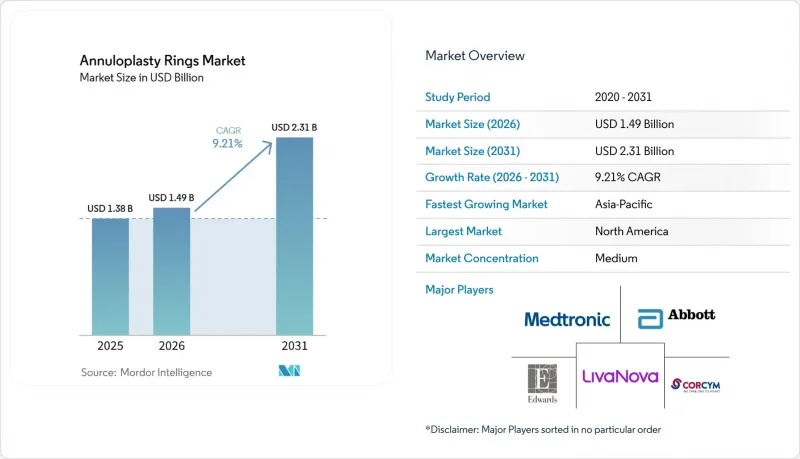
Mordor Intelligence에 의하면, 고리성형술용 링 시장은 2025년 13억 8,000만 달러로 평가되었고, 2026년에는 14억 9,000만 달러로 추정되고, 2026-2031년 CAGR 9.21%로 성장을 지속할 전망이며, 2031년까지 23억 1,000만 달러에 이를 것으로 예측됩니다.
본 보고서는 제품 유형별(안장형 판막 성형 링, 플랫형 판막 성형 링), 소재별(폴리에스터 원단으로 덮인 링, 기타), 용도별(승모판막 수복술, 삼첨판막 수복술, 기타), 최종 사용자별(병원, 심장외과 센터, 기타), 지역별(북미, 유럽, 아시아태평양, 기타)별로 분류되어 있습니다. 시장 예측은 금액(달러) 기준으로 제시되어 있습니다.
세계의 고리성형술용 링 시장 동향 및 인사이트
전 세계 심장 판막 질환 부담 증가
심장 판막 질환은 전 세계 심혈관 질환 부담에서 더 큰 비중을 차지하게 되었으며, 이러한 변화가 고리성형술용 링 시장을 직접적으로 뒷받침하고 있습니다. 전 세계 비류마티스성 심장판막 질환의 유병 수와 연령 조정 유병률은 2035년까지 인구 10만 명당 20.28에 달할 것으로 예측됩니다. 이러한 부담은 균등하게 분포되어 있지 않습니다. 사회인구통계지수(SDI)가 높은 지역에서는 10만 명당 56.45의 발생률이 기록되고 있으며, 이는 세계 평균을 크게 상회합니다. 또한, 이러한 지역은 이미 고리성형술용 링 시장의 대부분을 차지하고 있는 지역과 일치합니다. 외과적 교정 수술에 대한 수요도 이러한 추세를 밀접하게 따르고 있습니다. 이는 판막 고리 확대를 동반한 승모판 역류와 삼첨판 역류가 여전히 링 이식의 주요 적응증이기 때문입니다. 이러한 역학적 상황과 조기 진단이 결합됨에 따라, 고리성형술용 링 시장은 단순한 인구 고령화만으로는 예측할 수 없을 정도로 광범위한 수술 기반을 갖추고 있습니다.
판막 수복이 필요한 고령 심혈관 질환 환자층
고령화되는 환자층은 고리성형술용 링 시장에 있어 여전히 중장기적인 주요 버팀목이 되고 있습니다. 55세 이상 환자의 경우, 연령 조정 유병률은 10만 명당 1,876.01에 달하며, 이는 세계 평균의 약 5배에 해당하여 퇴행성 판막 질환과 연령 간의 강한 상관관계를 반영하고 있습니다. 이러한 경향은 65세 이상 인구가 계속 증가하고 있으며, 확립된 수술 체계를 통해 진단에서 수술 건수로의 전환이 보다 효율적으로 이루어지는 북미와 유럽에서 특히 두드러집니다. 주목할 만한 추세로 60대 환자 수가 증가하고 있다는 점을 들 수 있습니다. 이 환자군은 여전히 판막 수복술의 적응증이 될 수 있는 양호한 상태이며, 항응고 요법이나 구조적 판막 기능 악화에 따른 장기적인 문제를 피할 수 있기 때문에 링을 이용한 수복술이 권장되는 사례가 늘고 있습니다. 아시아태평양에서는 고령 인구의 규모가 큰 잠재적 환자층을 형성하고 있으며, 3차 의료 수준의 심장 의료 인프라가 확대됨에 따라 수술 건수가 증가할 것으로 예측됩니다. 의료 접근성이 개선됨에 따라, 고리성형술용 링 시장은 고령 환자 증가뿐만 아니라, 근치적 수복술을 견딜 수 있는 환자를 선별하는 정확도가 향상되는 점에서도 혜택을 볼 것으로 예측됩니다.
선택적 판막 수복술에 따른 높은 수술 및 의료기기 비용
높은 비용은 특히 제한된 의료 예산 속에서 선택적 심장 수술이 이루어지는 지역에서 고리성형술용 링 시장 수요 증가를 현저히 억제하는 요인이 되고 있습니다. 2025년 아크라 선언에서는 충족되지 않은 임상적 수요가 현저함에도 불구하고, 수입된 외과용 소모품이 아프리카에서 지속 가능한 심장 수술의 주요 과제로 남아 있다고 언급하고 있습니다. 링 자체는 총 치료 비용의 일부에 불과하며, 심폐 우회술용 소모품, 관류 지원,마취, 중환자실 치료 등을 통한 회복 관리 등이 모두 최종 의료비에 가산되기 때문입니다. 이로 인해 중저소득 국가에서는 선택적 심장 판막 수복술의 보급이 어려우며, 선진국의 의료 시스템에서도 병원이나 보험사가 비용 압박에 직면할 경우 수술이 연기될 가능성이 있습니다. 각 제조업체들은 가격 책정의 유연성이나 서비스 지원을 통해 이러한 장벽을 해소하고자 노력하고 있지만, 수술의 경제성과 보험사의 결제 능력 사이에는 여전히 격차가 존재하여, 비용에 민감한 지역에서의 고리성형술용 링 시장 확대를 제한하고 있습니다. 이 격차가 좁혀지지 않는 한, 시장 성장은 계속해서 더 풍부한 의료 시스템이나 고급 민간 의료 네트워크에 크게 의존하게 될 것으로 보입니다.
부문 분석
2025년 현재, 안장형 링은 고리성형술용 링 시장 점유율의 53.26%를 차지했으며, 가장 큰 제품 카테고리가 되고 있습니다. 그 우위는 오랜 기간에 걸친 임상 사용 실적과 승모판막 고리의 본래의 비평면적인 형태를 유지할 수 있다는 점에 기인합니다. 이러한 형태는 수축기 동안 판막 끝부분에 가해지는 스트레스를 완화하고, 적절하게 선택된 수복술에서 잔류 역류의 위험을 줄일 수 있습니다. 메모 : 4D 반강성 안장형 링에 관한 MANTRA 하위 연구에서는 17개 국제 의료 기관에서 치료를 받은 165명 이상의 환자에서 양호한 초기 혈역학적 결과가 나타났습니다. 30일 시점에서 환자의 91.7%가 승모판 역류를 ‘없음’,‘미량’, 또는 ‘경증’으로 보고했습니다. 이러한 임상 실적을 바탕으로, 안장형 링은 고리성형술용 링 시장, 특히 내구성이 뛰어난 기하학적 형태 회복을 우선시하는 승모판막 치료 프로그램에서 확고한 입지를 계속해서 다져가고 있습니다.
플랫형 링은 2026-2031년 연평균 성장률(CAGR) 9.74%를 기록할 전망이며, 고리성형술용 링 시장에서 가장 빠르게 성장하는 제품 유형이 될 것으로 예측됩니다. 이 링의 얇은 설계는 더 작은 접근 포트가 필요하고, 더 정밀한 기기 조작이 요구되는 흉강경 및 로봇 보조 수술 워크플로우에 최적입니다. 로봇 수술 프로그램의 확대에 따라, 판막륜 형성 링 시장의 제품 설계는 영상 유도 워크플로우와의 연동이 용이한, 더 평평하고 적응성이 높은 링 구조가 주류를 이룰 전망입니다.
2025년에는 폴리에스테르 직물로 피복된 링이 매출의 42.34%를 차지했으며, 승모판 링 시장 전체에서 1위를 유지했습니다. 이러한 위상은 오랜 기간에 걸친 임상 실적, 익숙한 봉합 특성, 경질 및 반경질 설계에 관계없이 일관되게 사용되어 온 점을 반영합니다. 2026년에 실시된, 연속된 153건의 승모판 수복술 환자를 대상으로 한 후향적 연구에 따르면, 일반적으로 폴리에스터 재질의 봉합 플랫폼이 사용되는 반경질 링의 사망률은 2.0%였으며,추적 심초음파 검사에서 ‘양호’ 또는 ‘중등도’의 수복 결과가 95.9%에서 확인되었습니다. 또한, 폴리에스터는 조직의 제어된 내생장을 촉진하며, 임플란트 시험을 통해 이미 충분히 이해되고 있기 때문에 여전히 선호되는 외층 봉합 기재로 자리 잡고 있습니다.
티타늄 코어 링은 2031년까지 연평균 성장률(CAGR) 10.13%로 확대될 것으로 예상되며, 이에 따라 고리성형술용 링 시장에서 가장 빠르게 성장하는 소재 부문이 될 것입니다. 외과의사들은 금속 코어 설계의 강도 대 중량 비율은 물론, MRI 호환성 및 경과 관찰과 복잡한 수술 중 영상 가시성 향상에 점점 더 주목하고 있습니다. 니티놀 기반 제품은 형상 기억 특성 덕분에 정적인 폴리머나 강성 금속 제품보다 동적인 판막 고리 리모델링을 가능하게 하여 더욱 주목받고 있습니다. 영상 진단, 로봇을 이용한 삽입, 삼첨판 수복술이 모두 보편화됨에 따라, 고리성형술용 링 시장에서는 수술 중 취급성과 장기적인 구조적 거동 모두를 향상시키는 소재 시스템에 더욱 큰 관심이 쏠리고 있습니다.
지역별 분석
2025년, 북미는 고리성형술용 링 시장의 45.47%를 차지하며 지역별 최대 점유율을 기록했습니다. 그 대부분은 미국이 차지하고 있는데, 이는 1인당 심장 수술 건수가 많고, 확립된 보험 환급 제도에 더해 수술 건수가 많은 판막 치료 센터들이 밀집된 네트워크를 형성하고 있기 때문입니다. 캐나다에서는 공적 의료 제도를 통해 안정적인 수요가 나타나고 있지만, 구매 주기는 비교적 느린 경향을 보입니다. 또한, 크기 결정 워크플로우의 개선으로 인해 고급 기기의 도입도 촉진되고 있습니다. 2026년 프라이부르크 대학의 연구에 따르면, 3D 평가는 기존의 2D 측정과 비교하여 고리성형술용 링의 크기 예측 정확도를 향상시키는 것으로 밝혀졌습니다.
2025년, 유럽은 독일, 영국, 프랑스의 지원에 힘입어 고리성형술용 링 시장에서 여전히 2위 지역 블록으로서의 지위를 유지했습니다. CE 마크를 획득한 기기의 일원화된 조달과 꾸준히 높은 수술 건수가 지역 전체 수요를 지속적으로 안정화시키고 있습니다. EU의 MDR(의료기기 규정)에 따른 일정으로 인해 새로운 플랫폼 시장 출시가 지연되지만, 일단 승인을 받으면 여러 국가에서의 전개는 여전히 효율적으로 진행할 수 있습니다. LivaNova는 AATS Week 2025에서 Memo 3D ReChord의 데이터를 발표하며, 수술 정확도 향상과 학습 곡선의 단축을 강조했습니다. 이는 새로운 링 설계 검증의 장으로서 유럽이 수행하는 역할을 뒷받침하는 것입니다.
아시아태평양은 2031년까지 연평균 성장률(CAGR) 11.72%로 확대될 것으로 예측되며, 고리성형술용 링 시장에서 가장 빠르게 성장하는 지역이 될 전망입니다. 이 지역의 성장은 고령화 진행에 더해 중국, 인도, 일본, 한국의 첨단 심장외과 인프라가 지속적으로 확충되고 있는 데 힘입고 있습니다. 일본은 하이브리드 수술실의 구축 현황과 로봇 심장외과 수술 역량이 이미 충분히 확립되어 있어, 계속해서 프리미엄 시장으로서의 위상을 유지하고 있습니다. 또한, 한국의 3차 의료기관에서는 승모판 수리 계획용 AI 지원형 크기 측정 도구의 시범 도입이 진행 중이며, 향후 수술 워크플로우에서 디지털 지원이 더욱 적극적으로 활용될 것임을 시사하고 있습니다. 중동 및 아프리카는 절대 규모 면에서는 여전히 작지만, 2025년 ‘아크라 선언’에서는 심장외과 수술의 지속가능성을 높이기 위해 일괄 조달 및 현지 소모품 제조 확대가 필요하다는 점이 명확히 제시되었습니다. 남미는 여전히 신흥 시장이며, 브라질과 아르헨티나가 민간 의료기관에서 구조적 심장 질환 치료의 대부분을 담당하고 있어, 해당 지역의 판막륜 성형술 수요의 주요 기반이 되고 있습니다.
기타 혜택
- 엑셀 형식 시장 예측(ME) 시트
- 3개월간의 애널리스트 지원
자주 묻는 질문
목차
제1장 서론
제2장 조사 방법
제3장 주요 요약
제4장 시장 구도
제5장 시장 규모 및 성장 예측
제6장 경쟁 구도
제7장 시장 기회 및 향후 전망
AJY 26.09.03According to Mordor Intelligence, the annuloplasty rings market is expected to grow from USD 1.38 billion in 2025 to USD 1.49 billion in 2026 and is forecasted to reach USD 2.31 billion by 2031 at 9.21% CAGR over 2026-2031.
This report is Segmented by Product Type (Saddle Shaped Annuloplasty Rings, Flat Shaped Annuloplasty Rings), Material (Polyester Fabric-Covered Rings, and More), Application (Mitral Valve Repair, Tricuspid Valve Repair, and More), End-User (Hospitals, Cardiac Surgery Centers, and More), and Geography (North America, Europe, Asia-Pacific, and More). The Market Forecasts are Provided in Terms of Value (USD).
Global Annuloplasty Rings Market Trends and Insights
Rising Global Burden of Valvular Heart Disease
Valvular heart disease is becoming a larger part of the global cardiovascular burden, and that shift is directly supporting the annuloplasty rings market. Global non-rheumatic valvular heart disease incidence and the age-standardized incidence rate is projected to reach 20.28 per 100,000 people by 2035. The burden is not evenly distributed, because high Socio-demographic Index regions recorded incidence of 56.45 per 100,000, which is far above the global average and aligns with the regions that already account for much of the annuloplasty rings market. Surgical repair demand follows this pattern closely because mitral and tricuspid regurgitation with annular dilation remain the main settings for ring implantation. That combination of epidemiology and earlier diagnosis gives the annuloplasty rings market a broader procedure base than demographic aging alone would suggest.
Aging Cardiovascular Patient Pool Requiring Valve Repair
The aging patient pool remains a core long-range support for the annuloplasty rings market. In patients aged 55 years and older, the age-standardized prevalence rate reached 1,876.01 per 100,000, which was close to 5x the global average and reflects the strong age link in degenerative valve disease. This matters most in North America and Europe, where the over-65 population continues to grow and where established surgical systems can convert diagnosis into procedure volume more efficiently. A notable pattern is the increase in patients in their 60s who remain good repair candidates and who are often steered toward ring-based repair because it avoids the long-term issues tied to anticoagulation and structural valve deterioration. In Asia-Pacific, the size of the older population creates a large latent pool that will translate into higher procedure volumes as tertiary cardiac infrastructure expands. As that access improves, the annuloplasty rings market should benefit not only from more elderly patients, but also from better identification of patients who can still tolerate definitive repair.
High Procedure and Device Cost in Elective Valve Repair
High cost remains a meaningful volume restraint for the annuloplasty rings market, especially where elective cardiac surgery competes with limited health budgets. The 2025 Accra Declaration stated that imported surgical consumables remain a major challenge for sustainable cardiac surgery in Africa, despite significant unmet clinical need. The ring itself is only one part of total treatment cost, because cardiopulmonary bypass consumables, perfusion support, anesthesia, and intensive care recovery all add to the final bill. That makes elective valve repair difficult to scale in lower-middle-income settings and can also lead to deferrals when hospitals or payers face cost pressure in developed systems. Manufacturers are trying to reduce some of this friction through pricing flexibility and service support, but the gap between procedure economics and payer capacity is still limiting how far the annuloplasty rings market can reach in cost-sensitive regions. Unless that gap narrows, growth will continue to depend heavily on wealthier systems and premium private networks.
Other drivers and restraints analyzed in the detailed report include:
- Preference for Valve Repair Over Replacement in Clinical Guidelines
- Expanding Adoption of Minimally Invasive and Robotic Cardiac Surgery
- Limited Specialist Access in Low-Resource Cardiac Centers
For complete list of drivers and restraints, kindly check the Table Of Contents.
Segment Analysis
Saddle-shaped rings held 53.26% of the annuloplasty rings market share in 2025, making them the largest product category. Their lead comes from long-standing clinical use and from their ability to preserve the native non-planar geometry of the mitral annulus. This geometry helps lower leaflet stress during systole and can reduce the risk of residual regurgitation in appropriately selected repairs. The MANTRA sub-study around the Memo 4D semi-rigid saddle ring showed favorable early hemodynamic outcomes across more than 165 patients treated in 17 international centers, with 91.7% of patients reporting none, trace, or mild mitral regurgitation at 30 days. That clinical base keeps saddle configurations firmly established in the annuloplasty rings market, especially in mitral programs that prioritize durable geometry restoration.
Flat-shaped rings are projected to be the fastest-growing product type in the annuloplasty rings market at a 9.74% CAGR from 2026 to 2031. Their lower profile fits well with thoracoscopic and robotic workflows that depend on smaller access ports and more controlled device handling. As robotic programs expand, product design in the annuloplasty rings industry is likely to favor flatter and more adaptable ring architectures that work more easily with image-guided workflows.
Polyester fabric-covered rings accounted for 42.34% of revenue in 2025, which kept them in the lead across the annuloplasty rings market. Their position reflects a long clinical track record, familiar suturing behavior, and consistent use across rigid and semi-rigid designs. A 2026 retrospective study that reviewed 153 consecutive mitral valve repair patients found that semi-rigid rings, which commonly use polyester sewing platforms, were associated with 2.0% mortality and 95.9% good or moderate repair on follow-up echocardiography. Polyester also remains the preferred outer sewing substrate because it supports controlled tissue ingrowth and is already well understood in implant testing.
Titanium core rings are projected to expand at a 10.13% CAGR through 2031, which makes them the fastest-growing material segment in the annuloplasty rings market. Surgeons are increasingly drawn to the strength-to-weight ratio of metallic core designs, along with MRI compatibility and stronger imaging visibility during follow-up or complex procedures. Nitinol-based concepts are receiving added attention because their shape-memory behavior can allow more dynamic annular remodeling than static polymer or rigid metal formats. As imaging, robotic delivery, and tricuspid repair all gain traction, the annuloplasty rings industry is giving more attention to material systems that improve both procedural handling and long-term structural behavior.
Complete Report Scope:
- By Product Type
- Saddle Shaped Annuloplasty Rings
- Flat Shaped Annuloplasty Rings
- By Material
- Polyester Fabric-Covered Rings
- Titanium Core Rings
- Nitinol-Based Rings
- Other Materials
- By Application
- Mitral Valve Repair
- Tricuspid Valve Repair
- Aortic Valve Repair
- Pulmonary Valve Repair
- Combined Valve Repair
- By End-User
- Hospitals
- Cardiac Surgery Centers
- Ambulatory Surgical Centers
- Other End-Users
- By Geography
- North America
- United States
- Canada
- Mexico
- Europe
- Germany
- United Kingdom
- France
- Italy
- Spain
- Rest of Europe
- Asia-Pacific
- China
- Japan
- India
- Australia
- South Korea
- Rest of Asia-Pacific
- Middle East and Africa
- GCC
- South Africa
- Rest of Middle East and Africa
- South America
- Brazil
- Argentina
- Rest of South America
- North America
Geography Analysis
North America held 45.47% of the annuloplasty rings market share in 2025, which made it the largest regional contributor. The United States accounts for most of that base because it combines high per-capita cardiac surgery activity with established reimbursement and a dense network of high-volume valve centers. Canada adds stable demand through its public system, although purchasing cycles can move more slowly. Premium device adoption is also supported by better sizing workflows, and a 2026 University of Freiburg study found that 3D assessment improved annuloplasty ring size prediction compared with conventional 2D measurements.
Europe remained the second-largest regional block in the annuloplasty rings market in 2025, supported by Germany, the United Kingdom, and France. Centralized procurement of CE-marked devices and consistently high procedure volumes help keep demand stable across the region. EU MDR timelines extend commercialization for newer platforms, but once approval is secured, rollout across multiple countries can still move efficiently. LivaNova presented Memo 3D ReChord data at AATS Week 2025 that highlighted improved surgical accuracy and a short learning curve, which reinforces Europe's role as a validation ground for newer ring designs.
Asia-Pacific is projected to expand at an 11.72% CAGR through 2031, making it the fastest-growing geography in the annuloplasty rings market. Growth in this region is being driven by aging populations and by continued expansion of advanced cardiac surgery infrastructure across China, India, Japan, and South Korea. Japan remains a premium market because hybrid operating room availability and robotic cardiac surgery capabilities are already well developed. South Korean tertiary centers are also piloting AI-assisted sizing tools for mitral repair planning, which points to stronger use of digital support in future procedural workflows. Middle East and Africa remain smaller in absolute size, but the 2025 Accra Declaration made clear that bulk procurement and more local consumable manufacturing are needed to improve the sustainability of cardiac surgery. South America is still emerging, with Brazil and Argentina anchoring most private-center structural heart activity and providing the main base for regional annuloplasty demand.
- Abbott Laboratories
- Affluent Medical
- Artivion, Inc.
- B. Braun
- Beijing Balance Medical Technology Co., Ltd.
- Boston Scientific
- Braile Biomedica
- Cardinal Health
- Cook Group
- Corcym S.r.l.
- Edward Lifesciences
- Genesee BioMedical, Inc.
- Getinge
- Jenavalve Technology
- LivaNova
- Medtronic
- Meril Life Science
- Micro Interventional Devices, Inc.
- NeoChord, Inc.
- Terumo
- Valcare Medical Ltd.
Additional Benefits:
- The market estimate (ME) sheet in Excel format
- 3 months of analyst support
TABLE OF CONTENTS
1 Introduction
- 1.1 Study Assumptions and Market Definition
- 1.2 Scope of the Study
2 Research Methodology
3 Executive Summary
4 Market Landscape
- 4.1 Market Overview
- 4.2 Market Drivers
- 4.2.1 Rising Global Burden of Valvular Heart Disease
- 4.2.2 Aging Cardiovascular Patient Pool Requiring Valve Repair
- 4.2.3 Preference for Valve Repair Over Replacement in Clinical Guidelines
- 4.2.4 Expanding Adoption of Minimally Invasive and Robotic Cardiac Surgery
- 4.2.5 Premiumization Through Next-Generation Biocompatible Ring Designs
- 4.2.6 Increased Use of Ring Sizing and Imaging Guidance to Improve Surgical Outcomes
- 4.3 Market Restraints
- 4.3.1 High Procedure and Device Cost in Elective Valve Repair
- 4.3.2 Limited Specialist Access in Low-Resource Cardiac Centers
- 4.3.3 Stringent Regulatory and Clinical Evidence Requirements
- 4.3.4 Long Procurement Cycles for Hospital Capital Committees
- 4.4 Supply/Value Chain Analysis
- 4.5 Regulatory Landscape
- 4.6 Technological Outlook
- 4.7 Porter's Five Forces Analysis
- 4.7.1 Threat of New Entrants
- 4.7.2 Bargaining Power of Suppliers
- 4.7.3 Bargaining Power of Buyers
- 4.7.4 Threat of Substitutes
- 4.7.5 Competitive Rivalry
5 Market Size & Growth Forecasts (Value, USD)
- 5.1 By Product Type
- 5.1.1 Saddle Shaped Annuloplasty Rings
- 5.1.2 Flat Shaped Annuloplasty Rings
- 5.2 By Material
- 5.2.1 Polyester Fabric-Covered Rings
- 5.2.2 Titanium Core Rings
- 5.2.3 Nitinol-Based Rings
- 5.2.4 Other Materials
- 5.3 By Application
- 5.3.1 Mitral Valve Repair
- 5.3.2 Tricuspid Valve Repair
- 5.3.3 Aortic Valve Repair
- 5.3.4 Pulmonary Valve Repair
- 5.3.5 Combined Valve Repair
- 5.4 By End-User
- 5.4.1 Hospitals
- 5.4.2 Cardiac Surgery Centers
- 5.4.3 Ambulatory Surgical Centers
- 5.4.4 Other End-Users
- 5.5 By Geography
- 5.5.1 North America
- 5.5.1.1 United States
- 5.5.1.2 Canada
- 5.5.1.3 Mexico
- 5.5.2 Europe
- 5.5.2.1 Germany
- 5.5.2.2 United Kingdom
- 5.5.2.3 France
- 5.5.2.4 Italy
- 5.5.2.5 Spain
- 5.5.2.6 Rest of Europe
- 5.5.3 Asia-Pacific
- 5.5.3.1 China
- 5.5.3.2 Japan
- 5.5.3.3 India
- 5.5.3.4 Australia
- 5.5.3.5 South Korea
- 5.5.3.6 Rest of Asia-Pacific
- 5.5.4 Middle East and Africa
- 5.5.4.1 GCC
- 5.5.4.2 South Africa
- 5.5.4.3 Rest of Middle East and Africa
- 5.5.5 South America
- 5.5.5.1 Brazil
- 5.5.5.2 Argentina
- 5.5.5.3 Rest of South America
- 5.5.1 North America
6 Competitive Landscape
- 6.1 Market Concentration
- 6.2 Market Share Analysis
- 6.3 Company Profiles (includes Global level Overview, Market level overview, Core Segments, Financials as available, Strategic Information, Market Rank/Share for key companies, Products & Services, Recent Developments)
- 6.3.1 Abbott Laboratories
- 6.3.2 Affluent Medical
- 6.3.3 Artivion, Inc.
- 6.3.4 B. Braun Melsungen AG
- 6.3.5 Beijing Balance Medical Technology Co., Ltd.
- 6.3.6 Boston Scientific Corporation
- 6.3.7 Braile Biomedica
- 6.3.8 Cardinal Health, Inc.
- 6.3.9 Cook Medical
- 6.3.10 Corcym S.r.l.
- 6.3.11 Edwards Lifesciences Corporation
- 6.3.12 Genesee BioMedical, Inc.
- 6.3.13 Getinge AB
- 6.3.14 JenaValve Technology, Inc.
- 6.3.15 LivaNova PLC
- 6.3.16 Medtronic plc
- 6.3.17 Meril Life Sciences Pvt. Ltd.
- 6.3.18 Micro Interventional Devices, Inc.
- 6.3.19 NeoChord, Inc.
- 6.3.20 Terumo Corporation
- 6.3.21 Valcare Medical Ltd.
7 Market Opportunities & Future Outlook
- 7.1 White-space & Unmet-need Assessment


