

|
시장보고서
상품코드
2118161
심근경색 치료제 시장 : 시장 점유율 분석, 업계 동향 및 통계, 성장 예측(2026-2031년)Myocardial Infarction Therapeutics - Market Share Analysis, Industry Trends & Statistics, Growth Forecasts (2026 - 2031) |
||||||
 Mordor Intelligence
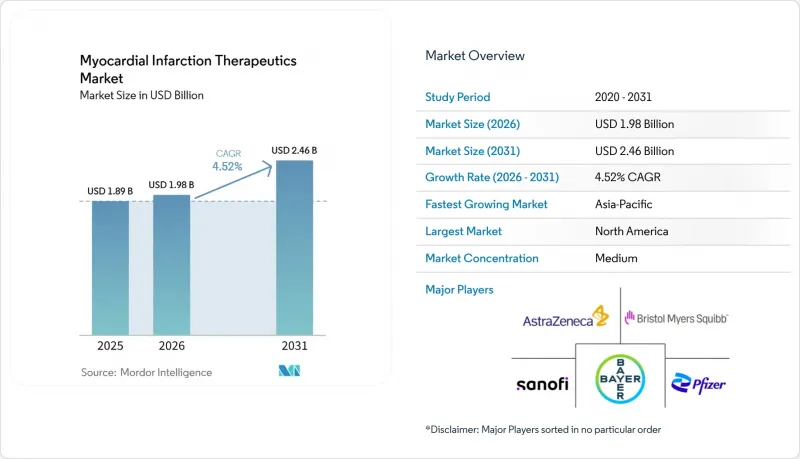
Mordor Intelligence에 의하면, 심근경색 치료제 시장 규모는 2025년에 18억 9,000만 달러로 평가되었고, 2026년 19억 8,000만 달러에서 2031년까지 24억 6,000만 달러에 이를 것으로 추정되며, 예측 기간(2026-2031년) CAGR은 4.52%를 나타낼 전망입니다.
본 보고서는 치료 분류별(항혈소판제, 항응고제, β-차단제 등), 치료 환경별(응급·급성기 치료, 재관류 요법 등), 투여 경로별(경구, 주사제 등), 유통 경로별(병원 약국, 온라인 약국 등), 지역별(북미, 유럽, 아시아태평양 등)로 분류되어 있습니다. 예측치는 금액(달러)으로 표시되어 있습니다.
세계의 심근경색 치료제 시장 동향 및 인사이트
급성 관상동맥 증후군 증가와 2차 예방 치료에 대한 수요 증가
미국에서는 매년 80만 명 이상이 심근경색을 발병하고 있으며, 이는 급성기 치료 및 지속적 관리에 대한 수요를 뒷받침하고 있습니다. 미국심장협회(AHA) 보고서에 따르면, 2021년 전 세계 심혈관 질환으로 인한 사망자 수는 1,941만 명에 달했으며, 한편 저·중소득 국가에서는 대사성 위험 요인이 계속해서 확대되고 있습니다. 급성 심근경색의 경우, 일반적으로 12개월 이상 지속될 수도 있는 다제 병용 요법이 시행됩니다. 이러한 치료법에는 대개 항혈소판제, 스타틴, 베타 차단제, RAAS 억제제가 포함됩니다. ‘2025년 허혈성 심장질환 부담에 관한 연구’에 따르면, 연령 조정 사망률은 감소하고 있으나 2021년 유병자 수는 2억 5,430만 명, 사망자 수는 899만 명에 달했습니다. 증례 수 증가와 생존율 향상 사이에 발생하는 이러한 격차가 심근경색 치료제 시장의 지속적인 치료 수요를 뒷받침하고 있습니다.
항혈전 요법 및 지질 저하 요법 강화에 관한 지침
2025년 2월에 발표된 ACC, AHA, ACEP, NAEMSP, SCAI의 통합 지침에서는 10년 만에 처음으로 급성 관상동맥 증후군 관리 지침이 갱신되었습니다. 이 지침에서는 스타틴 요법을 최대 내약량까지 투여해도 LDL-C가 70 mg/dL 이상으로 유지되는 적격 급성 관상동맥 증후군 환자에 대해, 비스타틴계 지질강하제를 추가하는 것에 대해 클래스 I, 레벨 A의 권고가 제시되었습니다. 이러한 접근법에는 에제티미브, 에볼로쿠맙, 알릴로쿠맙, 인크리실란 및 벤페드산이 포함됩니다. 또한, 본 지침에서는 다발성 병변에 대해 원인 병변만 치료하는 것이 아니라 완전한 혈관 재건술을 권장하고 있습니다. 아울러, 치료 시작 후 4-8주 후에 공복 시 지질 프로파일 검사를 실시할 것을 요구하고 있습니다. 이러한 조치로 인해 북미 및 유럽의 병원 처방집에서 지질강하제의 조기 도입이 촉진될 것으로 기대됩니다.
출혈 위험과 복약 순응도 사이의 상충 관계가 가이드라인의 완전한 도입을 방해하고 있다.
2025년 급성 관상동맥 증후군 가이드라인에서는 항혈전 치료를 선택할 때의 출혈 위험에 대해 언급했습니다. 이 지침은 글리코프로테인 IIb/IIIa 억제제의 일상적인 사용을 응급 처치 경우로 제한하고 있으며, PCI 시 대퇴동맥 접근보다 요골동맥 접근을 권장하고 있습니다. 이러한 권고 사항은 이중 항혈소판 요법에 수반되는 출혈 위험을 반영한 것입니다. 허혈 위험이 높고 항응고 요법의 적응증이 있는 환자의 경우, 이 문제는 더욱 복잡해집니다. 임상의는 이러한 사례에서 P2Y12 억제제 치료를 단계적으로 축소하는 경우가 많으며, 그 결과 브랜드 의약품의 사용이 감소할 가능성이 있습니다. 또한, 퇴원 후 첫 6-12개월 동안은 다제 병용 요법의 복약 순응도가 떨어지는 경향이 있으므로, 치료의 지속성을 확보하기 위해서는 약사 주도형 지원 및 환자의 참여를 유도하는 도구가 중요합니다.
부문 분석
2025년, 항혈소판제는 심근경색 치료제 시장 점유율의 34.31%를 차지했습니다. 이러한 위상은 급성 관상동맥 증후군 후 12개월 이상 지속되는 경우가 많은 이중 항혈소판 요법의 필요성을 반영합니다. 2025년 지침에서는 PCI(경피적 관상동맥 성형술)를 받은 환자에게 클로피도그렐보다 티카그렐롤 또는 프라그렐의 사용을 권장하고 있습니다. 이러한 권고로 인해, 클로피도그렐 제네릭이 이용 가능함에도 불구하고 브랜드 P2Y12 억제제에 대한 수요가 유지되고 있습니다. 항응고제는 급성기 치료에서 여전히 중요한 수익원으로 자리 잡고 있습니다. 반면, 당단백질 IIb/IIIa 억제제의 경우, 현재 가이드라인에서 주로 응급 상황에서의 사용으로 제한되어 있어 그 역할은 제한적입니다.
지질 저하 요법은 2031년까지 연평균 성장률(CAGR) 5.38%를 나타낼 것으로 예측되며, 심근경색 치료제 시장에서 가장 빠르게 성장하는 치료제 범주가 될 것입니다. 고위험 환자에서 PCSK9 억제제에 대한 지침의 지지가 이러한 전망의 배후에 있는 중요한 요인입니다. 혈전 용해제는 남미 일부 지역, 남아시아의 농촌 지역, 아프리카 등 1차 PCI를 이용할 수 없는 지역에서 여전히 중요한 역할을 하고 있습니다. 베타 차단제 및 RAAS 요법은 제네릭 의약품 처방이 안정적인 대규모 부문으로 남아 있습니다. 이러한 광범위한 사용이 지리적 시장에 관계없이 일관된 수요를 뒷받침하고 있습니다. 상업적 균형은 급성기 이후 심혈관 및 신장 보호 효과를 제공하는 치료법으로 점차 이동하고 있습니다.
2025년에는 퇴원 후 2차 예방 요법이 치료 환경별 매출의 38.44%를 차지했습니다. 이 부문은 환자가 퇴원 후에도 처방이 지속된다는 점에서 혜택을 받고 있습니다. 또한, 여러 약물의 병용 처방이나 정기적인 처방전 갱신으로부터도 혜택을 받고 있습니다. 재발성 심근경색의 대부분은 첫 발병 후 12개월 이내에 발생하기 때문에 치료를 지속해야 할 임상적 필요성이 입증되고 있습니다. 응급·급성기 치료는 1회 진료당 가치는 높지만, 이와 유사한 정기적인 처방 패턴은 형성되지 않습니다. 또한, 입원 치료는 병원의 처방약 목록 결정에 크게 좌우됩니다.
장기 관리 요법은 2031년까지 연평균 성장률(CAGR) 6.52%로 확대될 것으로 예측됩니다. 이러한 성장은 PCSK9 억제제, SGLT2 억제제 및 장기 항혈소판 요법의 지속적인 사용을 반영한 것입니다. 2026년 실세계 연구에 따르면, 대상 급성 심근경색 환자의 40.6%가 퇴원 시 병원에서 SGLT2 억제제 투여를 시작한 것으로 나타났습니다. 이 결과는 심대사 관리가 심근경색 후 장기 관리의 일부가 되어가고 있음을 보여줍니다. 도어-투-벌룬(door-to-balloon) 시간이 가이드라인 기준을 충족하지 못하는 급성기에는 재관류 요법이 여전히 중요합니다. 입원 치료는 표준화된 약물 목록으로 인해 가격 책정의 유연성이 제한되는 가운데, 항혈전제 및 항허혈제를 중심으로 이루어지고 있습니다.
지역별 분석
2025년, 북미는 심근경색 치료제 시장 규모의 40.61%를 차지했습니다. 이 지역은 확립된 STEMI 네트워크, 브랜드 의약품의 높은 보급률, 그리고 가이드라인에 따른 처방 변경이 빈번하게 이루어지고 있다는 이점을 가지고 있습니다. 2025년 2월 발표된 급성 관상동맥 증후군 관련 지침에서는 비스타틴계 지질강하제의 역할이 확대되었으며, 완전한 혈류 재건에도 언급되었습니다. 이러한 변경으로 인해 급성기 및 그 이후의 약물 사용이 증가할 가능성이 있습니다. 미국은 가치 기반 심장 치료 프로그램이 다제 병용을 통한 2차 예방의 복약 순응도를 촉진하고 있기 때문에 해당 지역의 매출에서 큰 비중을 차지하고 있습니다.
캐나다는 지질 저하 작용을 가진 생물학적 제제의 높은 채택률을 통해 기여하고 있는 반면, 멕시코는 제네릭 의약품을 우선시하는 보험 급여 조건에 직면해 있습니다. 2025년 연구에 따르면, 미국 병원 간 STEMI에 대한 PCI(경피적 관상동맥 중재술) 사용에 현저한 편차가 있는 것으로 밝혀졌습니다. 이러한 치료상의 차이는 지속적인 품질 평가와 보다 표준화된 항혈전 요법의 필요성을 뒷받침하고 있습니다. 유럽은 공적 의료 제도, 심혈관 질환에 대한 높은 인식, 그리고 임상 연구 활동 덕분에 여전히 두 번째로 큰 규모를 자랑하는 지역입니다. 독일, 영국, 프랑스는 근거 기반 의료 및 치료제 시장에서 중요한 위치를 차지하고 있습니다. 2025년 프랑스에서 실시된 클로피도그렐 재평가는 남유럽 국가들에서 가격 책정에 대한 감시가 계속되고 있음을 보여줍니다.
아시아태평양은 2031년까지 연평균 성장률(CAGR) 6.65%를 나타낼 것으로 예측되며, 심근경색 치료제 시장에서 지역별 가장 높은 성장률을 보이고 있습니다. 중국의 ‘건강 중국 2030’ 전략, 인도의 암·당뇨병·심혈관 질환·뇌졸중 대응 국가 프로그램, 그리고 일본의 고령화가 수요를 뒷받침하고 있습니다. 일본에서 2026년에 발표된 급성 관상동맥 증후군에 대한 1차 PCI에 관한 전문가 합의는 병원 현장에서 약물 요법의 추가적인 확산을 촉진하고 있습니다. 중국의 규제 정책은 수입 제품에 대해 현지화 요건을 부과하는 한편, 국내 의약품 개발을 장려하고 있습니다. 중동 및 아프리카 및 남미는 여전히 시장 규모가 작지만, 인프라 확충으로 인해 혈전 용해제 및 제네릭 항혈소판제에 대한 수요가 뒷받침되고 있습니다.
기타 혜택 :
- 엑셀 형식 시장 전망(ME) 시트
- 3개월간의 애널리스트 지원
자주 묻는 질문
목차
제1장 서론
제2장 조사 방법
제3장 개요
제4장 시장 구도
제5장 시장 규모 및 성장 예측
제6장 경쟁 구도
제7장 시장 기회 및 향후 전망
AJY 26.09.01According to Mordor Intelligence, the myocardial infarction therapeutics market size was valued at USD 1.89 billion in 2025 and is estimated to grow from USD 1.98 billion in 2026 to reach USD 2.46 billion by 2031, at a CAGR of 4.52% during the forecast period (2026-2031).
This report is Segmented by Therapeutic Class (Antiplatelet, Anticoagulants, Beta-Blockers, and More), Therapy Setting (Emergency and Acute Care Therapy, Reperfusion Therapy, and More), Route of Administration (Oral, Injectable, and More), Distribution (Hospital Pharmacies, Online Pharmacies, and More), Geography (North America, Europe, Asia-Pacific, and More). Forecasts in Value (USD).
Global Myocardial Infarction Therapeutics Market Trends and Insights
Rising Acute Coronary Syndrome and Secondary-Prevention Treatment Demand
More than 800,000 people in the United States experience a heart attack each year, which sustains demand for acute treatment and continuing care. The American Heart Association reported 19.41 million cardiovascular deaths worldwide in 2021, while metabolic risk factors continue to spread in low- and middle-income countries. An acute myocardial infarction commonly leads to a multi-drug regimen that can continue for 12 months or longer. These regimens often include antiplatelets, statins, beta-blockers, and RAAS inhibitors. The 2025 ischemic heart disease burden study reported 254.3 million prevalent cases and 8.99 million deaths in 2021, even as age-standardized mortality rates declined. This gap between a growing case burden and improving survival supports recurring treatment demand in the myocardial infarction therapeutics market.
Guideline Intensification of Antithrombotic and Lipid-Lowering Therapy
The unified ACC, AHA, ACEP, NAEMSP, and SCAI guideline released in February 2025 updated the management of acute coronary syndromes for the first time in more than a decade. The guidance gave Class I, Level A support for adding nonstatin lipid-lowering drugs for eligible acute coronary syndrome patients whose LDL-C remains at or above 70 mg/dL despite maximally tolerated statin therapy. Ezetimibe, evolocumab, alirocumab, inclisiran, and bempedoic acid are included in that approach. The guidance also favors complete revascularization in multivessel disease rather than treatment of only the culprit lesion. It requires a fasting lipid panel 4-8 weeks after treatment begins. These steps can support earlier use of lipid-lowering medicines in hospital formularies across North America and Europe.
Bleeding and Adherence Trade-Offs Limit Full Guideline Uptake
The 2025 acute coronary syndrome guideline addresses bleeding risk when selecting antithrombotic treatment. It limits routine glycoprotein IIb/IIIa inhibitor use to bailout situations and favors radial over femoral access for PCI. These recommendations reflect the bleeding burden associated with dual antiplatelet regimens. The issue is more difficult for patients who have both high ischemic risk and an indication for anticoagulation. Clinicians often de-escalate P2Y12 inhibitor treatment in such cases, which can reduce use of branded agents. Adherence to multi-drug regimens can also fall during the first 6-12 months after discharge, making pharmacist-led support and patient engagement tools important to treatment continuity.
Other drivers and restraints analyzed in the detailed report include:
- Aging, Diabetes, Obesity and Hypertension Expanding the Treatable Population
- Post-MI Heart-Failure Prevention Broadening Cardiometabolic Therapy Use
- Affordability and Reimbursement Gaps Restrict Newer Agents
For complete list of drivers and restraints, kindly check the Table Of Contents.
Segment Analysis
Antiplatelet agents held 34.31% of the myocardial infarction therapeutics market share in 2025. Their position reflects dual antiplatelet therapy requirements that often last 12 months or longer after acute coronary syndrome. The 2025 guideline recommends ticagrelor or prasugrel over clopidogrel for patients managed with PCI. This recommendation supports demand for branded P2Y12 inhibitors despite generic clopidogrel availability. Anticoagulants continue to provide meaningful revenue during acute treatment. Glycoprotein IIb/IIIa inhibitors have a narrower role because current guidance limits them mainly to bailout use.
Lipid-lowering therapies are projected to record a 5.38% CAGR through 2031, making them the fastest-growing therapeutic class in the myocardial infarction therapeutics market. Guideline support for PCSK9 inhibitors in high-risk patients is a key factor behind this outlook. Thrombolytics remain relevant where primary PCI is unavailable, including parts of South America, rural South Asia, and Africa. Beta-blockers and RAAS therapies remain high-volume segments with stable generic prescribing. Their broad use supports consistent demand across geographic markets. The commercial balance is shifting toward treatments that add cardiovascular and kidney protection after the acute event.
Post-discharge secondary prevention therapy captured 38.44% of therapy-setting revenue in 2025. The segment benefits from prescriptions that continue after the patient leaves the hospital. It also benefits from co-prescribing of several medicines and regular refills. Most recurrent MI events occur within 12 months of the index event, supporting the clinical need to maintain treatment. Emergency and acute care therapy has high value per encounter but does not create the same recurring prescription pattern. Inpatient treatment also depends heavily on hospital formulary decisions.
Long-term management therapy is forecast to expand at a 6.52% CAGR through 2031. The growth reflects continued use of PCSK9 inhibitors, SGLT2 inhibitors, and extended antiplatelet therapy. The 2026 real-world study found that 40.6% of eligible acute MI patients began an SGLT2 inhibitor in hospital at discharge. This finding indicates that cardiometabolic management is becoming part of longer-term post-MI care. Reperfusion therapy remains important in the acute setting where door-to-balloon times cannot meet guideline thresholds. Inpatient hospital-based therapy remains centered on antithrombotic and anti-ischemic medicines, where standardized formularies restrict pricing flexibility.
Complete Report Scope:
- By Therapeutic Class
- Antiplatelet Agents
- Anticoagulants
- Glycoprotein IIb/IIIa Inhibitors
- Beta-Blockers
- Lipid-Lowering Therapies
- RAAS and Neurohormonal Therapies
- Vasodilators and Anti-Ischemic Agents
- Thrombolytics
- Other Therapeutic Classes
- By Therapy Setting
- Emergency and Acute Care Therapy
- Reperfusion Therapy
- Inpatient Hospital-Based Therapy
- Post-Discharge Secondary Prevention Therapy
- Long-Term Management Therapy
- By Route of Administration
- Oral
- Injectable
- Sublingual
- Transdermal
- By Distribution Channel
- Hospital Pharmacies
- Retail Pharmacies
- Online Pharmacies
- Other Distribution Channels
- By Geography
- North America
- United States
- Canada
- Mexico
- Europe
- Germany
- United Kingdom
- France
- Italy
- Spain
- Rest of Europe
- Asia-Pacific
- China
- Japan
- India
- Australia
- South Korea
- Rest of Asia-Pacific
- Middle East and Africa
- GCC
- South Africa
- Rest of Middle East and Africa
- South America
- Brazil
- Argentina
- Rest of South America
- North America
Geography Analysis
North America accounted for 40.61% of the myocardial infarction therapeutics market size in 2025. The region benefits from established STEMI networks, high uptake of branded medicines, and frequent guideline-led changes to prescribing. The February 2025 acute coronary syndrome guidance expanded the role of nonstatin lipid-lowering agents and addressed complete revascularization. These changes can increase medication use during and after an acute event. The United States generates most regional revenue because value-based cardiac care programs support adherence to multi-drug secondary prevention.
Canada contributes through higher adoption of lipid-lowering biologics, while Mexico faces reimbursement conditions that favor generics. A 2025 study found substantial variation in PCI use for STEMI across U.S. hospitals. These care differences support continued quality measurement and more standardized antithrombotic treatment. Europe remains the second-largest region because of public health systems, cardiovascular disease awareness, and clinical research activity. Germany, the United Kingdom, and France are important evidence and treatment markets. France's 2025 clopidogrel reassessment indicates continued pricing scrutiny in Southern Europe.
Asia-Pacific is forecast to grow at a 6.65% CAGR through 2031, the fastest regional rate in the myocardial infarction therapeutics market. China's Healthy China 2030 strategy, India's national program for cancer, diabetes, cardiovascular diseases, and stroke, and Japan's aging population support demand. Japan's 2026 expert consensus on primary PCI for acute coronary syndromes supports broader pharmacological management in hospital settings. China's regulatory approach creates a localization requirement for imported products while encouraging local drug development. Middle East and Africa and South America remain smaller contributors, but expanding infrastructure supports demand for thrombolytics and generic antiplatelet medicines.
- Amgen
- AstraZeneca
- Bayer
- BioCardia, Inc.
- Boehringer Ingelheim
- Bristol-Myers Squibb
- CeleCor Therapeutics
- CellProthera
- CHIESI Farmaceutici S.p.A.
- Daiichi Sankyo
- Eli Lilly and Company
- Faraday Pharmaceuticals
- Idorsia Pharmaceuticals Ltd.
- Johnson & Johnson Innovative Medicine
- Merck
- Mesoblast Limited
- Novartis
- Pfizer
- Recardio
- Regeneron Pharmaceuticals
- Sanofi
- Viatris
Additional Benefits:
- The market estimate (ME) sheet in Excel format
- 3 months of analyst support
TABLE OF CONTENTS
1 Introduction
- 1.1 Study Assumptions and Market Definition
- 1.2 Scope of the Study
2 Research Methodology
3 Executive Summary
4 Market Landscape
- 4.1 Market Overview
- 4.2 Market Drivers
- 4.2.1 Rising Acute Coronary Syndrome and Secondary-Prevention Treatment Demand
- 4.2.2 Guideline Intensification of Antithrombotic and Lipid-Lowering Therapy
- 4.2.3 Aging, Diabetes, Obesity and Hypertension Expanding the Treatable Population
- 4.2.4 Faster Diagnosis and Regional STEMI Systems Expanding Treatment Windows
- 4.2.5 Post-MI Heart-Failure Prevention Broadening Cardiometabolic Therapy Use
- 4.2.6 Cell- and Tissue-Targeted Delivery for Reperfusion Injury and Remodeling
- 4.3 Market Restraints
- 4.3.1 Bleeding and Adherence Trade-Offs Limit Full Guideline Uptake
- 4.3.2 Affordability and Reimbursement Gaps Restrict Newer Agents
- 4.3.3 Diagnostic and Reperfusion Inequity Delays Treatment
- 4.3.4 Heterogeneous Post-MI Evidence Slows Label Expansion for Cardiometabolic Drugs
- 4.4 Supply-Chain Analysis
- 4.5 Regulatory Landscape
- 4.6 Technological Outlook
- 4.7 Porter's Five Forces Analysis
- 4.7.1 Threat of New Entrants
- 4.7.2 Bargaining Power of Suppliers
- 4.7.3 Bargaining Power of Buyers
- 4.7.4 Threat of Substitutes
- 4.7.5 Competitive Rivalry
5 Market Size & Growth Forecasts (Value, USD)
- 5.1 By Therapeutic Class
- 5.1.1 Antiplatelet Agents
- 5.1.2 Anticoagulants
- 5.1.3 Glycoprotein IIb/IIIa Inhibitors
- 5.1.4 Beta-Blockers
- 5.1.5 Lipid-Lowering Therapies
- 5.1.6 RAAS and Neurohormonal Therapies
- 5.1.7 Vasodilators and Anti-Ischemic Agents
- 5.1.8 Thrombolytics
- 5.1.9 Other Therapeutic Classes
- 5.2 By Therapy Setting
- 5.2.1 Emergency and Acute Care Therapy
- 5.2.2 Reperfusion Therapy
- 5.2.3 Inpatient Hospital-Based Therapy
- 5.2.4 Post-Discharge Secondary Prevention Therapy
- 5.2.5 Long-Term Management Therapy
- 5.3 By Route of Administration
- 5.3.1 Oral
- 5.3.2 Injectable
- 5.3.3 Sublingual
- 5.3.4 Transdermal
- 5.4 By Distribution Channel
- 5.4.1 Hospital Pharmacies
- 5.4.2 Retail Pharmacies
- 5.4.3 Online Pharmacies
- 5.4.4 Other Distribution Channels
- 5.5 By Geography
- 5.5.1 North America
- 5.5.1.1 United States
- 5.5.1.2 Canada
- 5.5.1.3 Mexico
- 5.5.2 Europe
- 5.5.2.1 Germany
- 5.5.2.2 United Kingdom
- 5.5.2.3 France
- 5.5.2.4 Italy
- 5.5.2.5 Spain
- 5.5.2.6 Rest of Europe
- 5.5.3 Asia-Pacific
- 5.5.3.1 China
- 5.5.3.2 Japan
- 5.5.3.3 India
- 5.5.3.4 Australia
- 5.5.3.5 South Korea
- 5.5.3.6 Rest of Asia-Pacific
- 5.5.4 Middle East and Africa
- 5.5.4.1 GCC
- 5.5.4.2 South Africa
- 5.5.4.3 Rest of Middle East and Africa
- 5.5.5 South America
- 5.5.5.1 Brazil
- 5.5.5.2 Argentina
- 5.5.5.3 Rest of South America
- 5.5.1 North America
6 Competitive Landscape
- 6.1 Market Concentration
- 6.2 Market Share Analysis
- 6.3 Company Profiles (includes Global Level Overview, Market Level Overview, Core Segments, Financials as available, Strategic Information, Market Rank/Share, Products and Services, Recent Developments)
- 6.3.1 Amgen Inc.
- 6.3.2 AstraZeneca plc
- 6.3.3 Bayer AG
- 6.3.4 BioCardia, Inc.
- 6.3.5 Boehringer Ingelheim International GmbH
- 6.3.6 Bristol Myers Squibb Company
- 6.3.7 CeleCor Therapeutics
- 6.3.8 CellProthera
- 6.3.9 CHIESI Farmaceutici S.p.A.
- 6.3.10 Daiichi Sankyo Company, Limited
- 6.3.11 Eli Lilly and Company
- 6.3.12 Faraday Pharmaceuticals
- 6.3.13 Idorsia Pharmaceuticals Ltd.
- 6.3.14 Johnson & Johnson Innovative Medicine
- 6.3.15 Merck & Co., Inc.
- 6.3.16 Mesoblast Limited
- 6.3.17 Novartis AG
- 6.3.18 Pfizer Inc.
- 6.3.19 Recardio
- 6.3.20 Regeneron Pharmaceuticals, Inc.
- 6.3.21 Sanofi
- 6.3.22 Viatris Inc.
7 Market Opportunities and Future Outlook
- 7.1 White-Space and Unmet-Need Assessment


