|
시장보고서
상품코드
2118171
이온 커플링 시약 시장 : 시장 점유율 분석, 업계 동향 및 통계, 성장 예측(2026-2031년)Ionic Coupling Reagents - Market Share Analysis, Industry Trends & Statistics, Growth Forecasts (2026 - 2031) |
||||||
 Mordor Intelligence
Mordor Intelligence에 의하면, 이온 커플링 시약 시장 규모는 2025년에 1억 7,842만 달러로 평가되었고, 2026년 1억 8,591만 달러에서 2031년까지 2억 2,273만 달러에 이를 것으로 추정되며, 예측 기간(2026-2031년) CAGR은 3.68%를 나타낼 전망입니다.
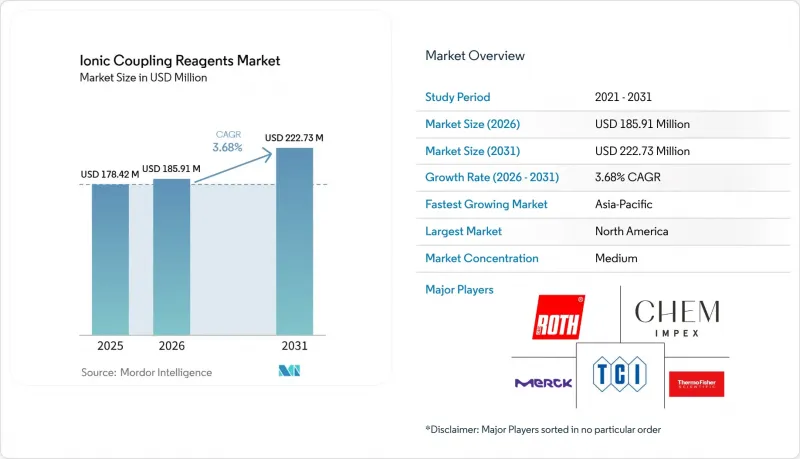
본 보고서는 제품 유형별(우로늄 및 구아니디늄계 시약, 포스포늄계 시약), 형태별(분말 및 용액), 용도별(펩타이드 합성, 의약품 원료(API) 합성 등) 및 지역별(아시아태평양, 북미, 유럽, 남미, 중동 및 아프리카)로 분류되어 있습니다. 시장 예측은 금액(달러) 기준으로 제시되어 있습니다.
세계의 이온 커플링 시약 시장 동향 및 인사이트
펩타이드계 치료제에 대한 수요 증가
이온 커플링 시약 시장은 글루카곤 유사 펩타이드-1(GLP-1) 수용체 작용제의 상업적 성공으로부터 직접적인 추진력을 얻고 있습니다. 이러한 약제로 인해 펩타이드 합성이 프로젝트 규모에서 산업 규모 생산으로 전환되었기 때문입니다. 30-40개의 아미노산 사슬을 합성하는 고상 펩타이드 합성(SPPS)에서는 커플링 공정이 반복적으로 수행되지만, 반응 효율이 저하되면 사이클이 1회 늘어날 때마다 최종 수율이 떨어질 가능성이 있습니다. 따라서 각 커플링 공정에서 미미한 개선만 보여도 불순물 부하를 줄이고 대규모 생산 공정 전체에 걸친 다운스트림 공정인 정제 작업을 경감할 수 있기 때문에 반응성이 높은 이온계가 중요시되고 있습니다. 바켐(Bakem)사는 2025년, GLP-1 수요가 펩타이드 제조를 산업화된 플랫폼 모델로 추진하고 있다고 밝혔습니다. 이는 시약 선택이 개별 개발 단계뿐만 아니라 합성 공정 전체에서 중요해지고 있음을 의미합니다. 또한, 새로운 CDMO(위탁 개발·제조 기관)의 펩타이드 생산 라인이 가동을 시작할 때도 이온 커플링 시약 시장에 긍정적인 영향을 미칩니다. 이는 새로운 설비의 시운전에 따라 시약의 재인증이나 공급업체 변경이 이루어질 기회가 생기기 때문입니다. 머크(Merck)사도 2025년에 복잡한 원료의약품(API)의 합성 과정에서 생체 촉매를 이용한 펩타이드 단편의 커플링이 주목받고 있음을 강조했습니다. 이는 제조업체들이 서로 다른 합성 경로를 조합하면서도, 표준적인 커플링 단계에서는 여전히 이온성 시약에 의존하고 있음을 시사합니다.
올리고뉴클레오티드 계열 의약품 개발 확대
이온 커플링 시약 시장은 기존의 펩타이드 중심 기반을 넘어, 핵산 치료제 분야에서 새로운 수요층을 확보해 나가고 있습니다. 올리고뉴클레오티드 워크플로우에서 이온성 커플링 화학은 GalNAc 링커 결합, 고상 지지체 상에서의 유도체화, 그리고 펩타이드·올리고뉴클레오티드 복합체의 합성에 이용되고 있으며, 이러한 공정에서는 정확한 아미드 결합 형성이 여전히 중요시되고 있습니다. 전 세계 올리고뉴클레오티드 합성 시장은 2026년에 43억 1,000만 달러에 달할 것으로 예상되며, 이는 관련 합성 수요가 시약 공급업체에게 중요한 요소가 되고 있음을 뒷받침합니다. 이러한 변화는 승인된 및 후기 임상 단계의 핵산 의약품이 고순도 워크플로우에서 사용되는 커플링 시약을 포함하여 GMP 요건을 업스트림 화학의 더 깊은 단계까지 확대하고 있다는 점에서 매우 중요합니다. 따라서 이온 커플링 시약 시장은 올리고뉴클레오티드 개발 프로그램 수요 증가뿐만 아니라, 규제 대상인 펩타이드 제조 분야에서 이미 확고한 입지를 구축한 우량 공급업체에 유리하게 작용하는 더욱 엄격한 품질 기준에도 직면하게 될 것입니다. 이러한 추세는 GalNAc 표지 siRNA 및 관련 치료법에 사용되는 제품에서 특히 중요하며, 고순도가 요구됨에 따라 적격 공급업체의 선택 폭이 좁아지고 있습니다.
고급 이온 커플링 시약의 높은 비용
이온 커플링 시약 시장은 명백한 비용 장벽에 직면해 있습니다. 이는 고순도의 HATU 및 COMU가 범용 대체품보다 더 엄격한 제조 관리와 품질 관리가 필요하기 때문입니다. GLP-1 및 기타 펩타이드 프로그램에서 수 Kg 또는 톤 단위로 제조할 경우, 시약비는 배치 생산 모델에서 가장 높은 경상 소모품 비용 중 하나가 됩니다. 따라서 조달 팀은 고품질의 이온성 시스템이 더 뛰어난 커플링 효율과 낮은 불순물 부하를 제공하더라도, 더 저렴한 대안과 비교할 수밖에 없습니다. 학술 기관이나 소규모 생명공학 기업들은 이러한 압박을 더욱 절실히 느끼고 있습니다. 예산이 제한적이기 때문에 까다로운 서열에서 성능이 떨어지더라도 카르보디이미드계 대체품을 선택할 수밖에 없는 상황에 몰리기 때문입니다. 중국의 제네릭 등급 공급업체와 GMP 인증을 획득한 유럽 및 미국 공급업체 간의 가격 차이는 동일한 공칭 사양이라도 5배를 초과할 수 있으며, 이로 인해 규제 대상 고객사공급업체 적격성 심사가 엄격해지고 있습니다. 그 결과, 이온 커플링 시약 시장에서는 제약 업계에서 품질 프리미엄이 유지되고 있지만, 비용에 대한 민감성으로 인해 요구 사항이 가장 까다로운 합성 환경을 제외한 광범위한 채택은 여전히 제한되고 있습니다.
부문 분석
2025년 시점에서 우로늄 및 구아니디늄 계열 시약은 이온 커플링 시약 시장 점유율의 58.21%를 차지했으며, 이 등급은 제약 및 연구 분야의 전체 수요에서 1위 자리를 확고히 하고 있습니다. 이러한 우위는 고체상 펩타이드 합성(SPPS) 워크플로우에서 오랜 기간 사용되어 온 실적에서 비롯된 것이며, HATU 및 HBTU는 카탈로그 및 제조 채널을 통해 여전히 검증되었으며 널리 구할 수 있습니다. 이러한 시약은 표준 펩타이드 서열부터 까다로운 펩타이드 서열에 이르기까지 더 높은 수율을 실현하는 고반응성 중간체를 형성하기 때문에 까다로운 커플링에 사용됩니다. 이온 커플링 시약 시장은 규제 대상인 펩타이드 합성, 특히 반응 속도와 마찬가지로 공정의 재현성이 중요시되는 상황에서 계속해서 이 계열을 기본 선택지로 의존하고 있습니다. 현재 이 범주 내에서 뚜렷한 변화가 나타나고 있습니다. 새로운 우수 제조 기준(GMP) 시설에서는 적합성 평가 과정에서 HOBt를 포함한 재료의 안전성에 대한 상충 관계를 점점 더 면밀히 검토하고 있기 때문입니다. Luxembourg Bio Technologies사는 COMU를 라세미화 경향이 낮고, 마이크로파 지원 합성과 호환되는 옥시마 계열 대체재로 입증하고 있으며, 이것이 안전성을 중시하는 워크플로우에서 그 수용이 확대되고 있는 이유입니다.
또한, 이 부문은 2031년까지 연평균 성장률(CAGR) 4.28%를 나타낼 것으로 예측되며, 이미 매출의 상당 부분을 차지하고 있는 부문으로서 주목할 만한 수치입니다. 이러한 추세는 주요 제품군이, 특히 고사양 의약품 펩타이드 제조와 같은 가장 빠르게 성장하는 상업적 수요층과 얼마나 밀접하게 연동되어 있는지를 반영합니다. TBTU 및 TOTU는 서열의 복잡성이 낮고, 반드시 최고 수준의 성능이 요구되지 않는 비용 중심의 연구 및 위탁 합성 분야에서 여전히 중요한 역할을 하고 있습니다. 따라서 제품 선호도가 기존의 HOBt 계열에서 보다 안전한 3세대 염으로 서서히 이동하고 있음에도 불구하고, 이온 커플링 시약 시장은 여전히 우로늄 계열 및 구아니디늄 계열에 의해 지탱되고 있습니다. 포스포늄 시약은 단편 축합 및 용액상 작업에서 여전히 중요한 역할을 하고 있지만, 보다 특수한 요구를 충족시키는 제품이기 때문에 안전성을 중시하는 고객들로부터 더 엄격한 시선을 받고 있습니다. 시그마-올드리치(Sigma-Aldrich)의 펩타이드 커플링 선정 가이드는 이러한 양극화를 반영하고 있으며, PyBOP 및 PyAOP는 까다로운 커플링 용도로 분류되는 반면, 우로늄 계열이 지배하는 광범위한 판매량 기반에서는 제외되어 있습니다.
지역별 분석
2025년, 북미는 이온 커플링 시약 시장의 37.11%를 차지했으며, 전 세계 매출에서 가장 큰 비중을 차지하는 지역이 되었습니다. 이 점유율의 대부분은 미국이 주도하고 있으며, 미국은 밀집된 제약 거점 외에도 규제 준수 등급의 시약을 필요로 하는 대규모 계약 연구 기관(CRO) 및 계약 개발·제조 기관(CDMO) 네트워크를 보유하고 있습니다. FDA의 GMP 요건, 국제조화회의(ICH) Q11 요건 및 미국의 유해 물질 취급 규제로 인해 고품질 제품 사양이 지지받았으며, 문서화가 불충분한 대체품의 사용이 제한되었습니다. 서모피셔 사이언티피크(Thermo Fisher Scientific)가 2025년 4월, 미국 내 제조 및 연구 개발(R&D)에 20억 달러를 투자하겠다고 발표한 것은 공급업체들이 국내 의약품 생산 능력 및 관련 시약 수요를 우선시하고 있음을 반영합니다. 캐나다에서는 학술 분야 및 중규모 의약품 합성에서 안정적인 수요가 나타난 반면, 멕시코는 고사양 원료에 대해서는 여전히 수입에 의존하고 있지만, 지속적으로 성장하는 제네릭 의약품 제조 거점을 통해 시장에 기여했습니다.
유럽은 독일, 영국, 프랑스, 이탈리아에 힘입어 이온 커플링 시약 시장에서 지역별 2위 자리를 유지했습니다. 이 지역은 견조한 제약 연구 개발, 확립된 특수 화학물질 제조 능력, 그리고 표준 커플링 시약과 첨단 커플링 시약을 모두 소비하는 연구 생태계의 혜택을 받았습니다. 또한, 유럽은 제품 혁신 면에서도 중요한 역할을 계속해 왔으며, 아이리스 바이오테크(Iris Biotech)와 룩셈부르크 바이오 테크놀로지스(Luxembourg Bio Technologies)가 특수 시약 개발 및 보다 안전한 대체재 제공에 기여했습니다. EU의 화학물질 등록, 평가, 허가 및 제한에 관한 규정(REACH)과 벤조트리아졸과 관련된 환경 문제 및 취급에 대한 우려가 커짐에 따라, 특히 더 안전한 대체 물질을 찾는 대규모 합성 거점에서는 조달 결정에 영향을 미쳤습니다. 이러한 압박으로 인해 유럽의 규제 대상 시설 전반에서 옥시마 계열 시스템에 대한 관심이 높아졌지만, 기존의 도입 프로세스로 인해 전환 속도는 여전히 더딘 상태였습니다.
아시아태평양은 중국, 인도, 일본, 한국이 펩타이드 및 의약품 화학 역량을 강화하고 있어 2031년까지 연평균 성장률(CAGR) 4.93%를 나타낼 것으로 예측되며, 이는 이온 커플링 시약 시장 전체에서 가장 높은 성장률입니다. 중국은 수요가 확대되는 중심지일 뿐만 아니라 새로운 공급 거점으로도 두각을 나타내고 있으며, GL Biochem사는 3만 5,000제곱미터 규모의 펩타이드 시약 시설을 운영하며 연간 100메트르톤의 시약 생산 능력을 보유하고 있습니다. 일본은 고사양 분야에서 여전히 중요한 위치를 차지하고 있으며, 후지필름 와코의 2024년 오사카 확장 계획은 GMP 준수 원료 분야에서 해당 기업의 입지를 강화할 것입니다. 인도는 ‘생산 연계 인센티브(PLI)’ 지원과 CDMO 시장의 광범위한 성장을 배경으로 확대되고 있으며, 이에 따라 연구개발 및 상업적 조달 전반에 걸친 수요 증가가 예상됩니다. 한국은 바이오 의약품보다 펩타이드 API의 규모 확대에 더 앞서 있으며, 공정 화학 역량의 향상에 따라 향후 지역 전체 수요가 확대될 것으로 예측됩니다. 남미, 중동 및 아프리카는 여전히 소규모 시장이지만, 브라질, 아르헨티나, 사우디아라비아가 향후 주목해야 할 주요 수요 거점으로 부상하고 있습니다.
기타 혜택 :
- 엑셀 형식 시장 예측(ME) 시트
- 3개월간의 애널리스트 지원
자주 묻는 질문
목차
제1장 서론
제2장 조사 방법
제3장 주요 요약
제4장 시장 구도
제5장 시장 규모 및 성장 예측
제6장 경쟁 구도
제7장 시장 기회 및 향후 전망
AJY 26.09.03According to Mordor Intelligence, the ionic coupling reagents market size was valued at USD 178.42 million in 2025 and is estimated to grow from USD 185.91 million in 2026 to reach USD 222.73 million by 2031, at a CAGR of 3.68% during the forecast period (2026-2031).
This report is Segmented by Product Type (Uronium and Guanidinium-Based Reagent and Phosphonium-Based Reagents), Form (Powder and Solution), Application (Peptide Synthesis, Pharmaceutical API Synthesis, and More), and Geography (Asia-Pacific, North America, Europe, South America, and Middle-East and Africa). The Market Forecasts are Provided in Terms of Value (USD).
Global Ionic Coupling Reagents Market Trends and Insights
Growing Demand for Peptide-Based Therapeutics
The ionic coupling reagents market is receiving direct support from the commercial success of Glucagon-Like Peptide-1 (GLP-1) receptor agonists, as these drugs have shifted peptide synthesis from project-scale to industrial-scale production. Solid-phase peptide synthesis (SPPS) for 30- to 40-amino-acid chains involves repeated coupling steps, and each additional cycle can reduce the final yield when reaction efficiency declines. This makes high-reactivity ionic systems valuable, as even small gains in each coupling step can lower impurity loads and reduce downstream purification work across large production runs. Bachem stated in 2025 that GLP-1 demand is pushing peptide manufacturing toward industrialized platform models, meaning reagent choice now matters across the full synthesis train rather than only in isolated development steps. The ionic coupling reagents market also benefits when new Contract Development and Manufacturing Organization (CDMO) peptide lines come online, as fresh equipment commissioning often creates a window for reagent requalification and possible vendor changes. Merck also highlighted in 2025 that biocatalytic peptide fragment coupling is gaining attention for complex Active Pharmaceutical Ingredient (API) synthesis, suggesting manufacturers are combining different synthesis routes while still relying on ionic reagents for standard coupling stages.
Rising Development of Oligonucleotide-Based Drugs
The ionic coupling reagents market is gaining a new layer of demand from nucleic acid therapeutics, extending beyond its traditional peptide-focused base. In oligonucleotide workflows, ionic coupling chemistry is used in GalNAc linker conjugation, solid-support derivatization, and peptide-oligonucleotide conjugate synthesis, where precise amide bond formation remains important. The global oligonucleotide synthesis market reached USD 4.31 billion in 2026, supporting the view that adjacent synthesis demand is becoming material for reagent suppliers. This shift is significant because approved and late-stage nucleic acid drugs have already pushed GMP expectations deeper into upstream chemistry, including the coupling reagents used in high-purity workflows. The ionic coupling reagents market therefore gains not only more demand from oligonucleotide programs but also tighter quality standards that favor premium suppliers already established in regulated peptide manufacturing. This dynamic is especially relevant for products used in GalNAc-conjugated siRNA and related modalities, where high purity expectations narrow the field of acceptable vendors.
High Cost of Advanced Ionic Coupling Reagents
The ionic coupling reagents market faces a clear cost barrier, as high-purity HATU and COMU require more controlled production and tighter quality management than commodity alternatives. For GLP-1 and other peptide programs running at multi-kilogram or ton scale, reagent spend is one of the highest recurring consumable costs in a batch economics model. This leads procurement teams to compare premium ionic systems against less expensive options, even when premium products offer better coupling efficiency or lower impurity burden. Academic users and smaller biotech companies face this pressure more acutely, as limited budgets can push them toward carbodiimide-based substitutes despite lower performance in difficult sequences. The price gap between Chinese generic-grade suppliers and GMP-certified European or US sources can exceed 5-fold for the same nominal specification, which intensifies supplier qualification reviews in regulated accounts. As a result, the ionic coupling reagents market retains a quality premium in pharma, but cost sensitivity continues to limit broader adoption outside the most demanding synthesis settings.
Other drivers and restraints analyzed in the detailed report include:
- Increasing Adoption of Automated SPPS Platforms
- Expansion of Pharmaceutical API Manufacturing Infrastructure
- Safety and Stability Challenges with HOBt-Derived Reagents
For complete list of drivers and restraints, kindly check the Table Of Contents.
Segment Analysis
Uronium and guanidinium reagents held 58.21% of the ionic coupling reagents market share in 2025, making this class the product leader across pharmaceutical and research demand. Their lead stems from long-standing use in solid-phase peptide synthesis (SPPS) workflows, where HATU and HBTU remain validated and widely available across catalog and manufacturing channels. These reagents are used for difficult couplings because they form highly reactive intermediates that support better yields across both standard and challenging peptide sequences. The ionic coupling reagents market continues to rely on this class as the default choice in regulated peptide synthesis, particularly where process reproducibility is as important as reaction speed. A notable shift is now visible within the category, as newer Good Manufacturing Practice (GMP) sites increasingly review the safety trade-offs of HOBt-containing materials during qualification. Luxembourg Bio Technologies has documented COMU as an Oxyma-based alternative with low racemization tendency and compatibility with microwave-assisted synthesis, which explains its growing acceptance in safety-conscious workflows.
This class is also forecast to grow at a 4.28% CAGR through 2031, which is notable for a segment that already holds the majority of revenue. This pattern reflects how closely the leading product class aligns with the fastest-growing commercial demand pools, especially high-specification pharmaceutical peptide manufacturing. TBTU and TOTU still retain a role in cost-sensitive research and custom synthesis, where sequence complexity is lower and premium performance is not always required. The ionic coupling reagents market therefore remains anchored by uronium and guanidinium systems, even as product preference gradually shifts from legacy HOBt-based options toward safer third-generation salts. Phosphonium reagents remain relevant for fragment condensation and solution-phase work, but they serve more specialized needs and face greater scrutiny in safety-sensitive accounts. Sigma-Aldrich's peptide coupling selection guide reflects this split, with PyBOP and PyAOP positioned for demanding couplings while remaining outside the broader volume base controlled by uronium systems.
Complete Report Scope:
- By Product Type
- Uronium and Guanidinium-Based Reagents
- Phosphonium-Based Reagents
- By Form
- Powder
- Solution
- By Application
- Peptide Synthesis
- Pharmaceutical API Synthesis
- Oligonucleotide Synthesis
- Medicinal Chemistry
- Specialty and Fine Chemical Synthesis
- Academic Research
- Other Applications
- By Geography
- Asia-Pacific
- China
- India
- Japan
- South Korea
- Rest of Asia-Pacific
- North America
- United States
- Canada
- Mexico
- Europe
- Germany
- United Kingdom
- France
- Italy
- Russia
- Rest of Europe
- South America
- Brazil
- Argentina
- Rest of South America
- Middle-East and Africa
- Saudi Arabia
- South Africa
- Rest of Middle-East and Africa
- Asia-Pacific
Geography Analysis
North America accounted for 37.11% of the ionic coupling reagents market in 2025, making it the largest regional contributor to global revenue. The United States drove most of this share, combining a dense pharmaceutical base with a large Contract Research Organization (CRO) and Contract Development and Manufacturing Organization (CDMO) network that required regulated-grade reagents. FDA GMP requirements, International Council for Harmonisation (ICH) Q11 expectations, and US hazardous-handling regulations supported premium product specifications and limited the use of low-documentation alternatives. Thermo Fisher Scientific's April 2025 commitment of USD 2 billion to US manufacturing and R&D reflected the priority suppliers placed on domestic pharmaceutical production capacity and related reagent demand. Canada added steady demand from academic and mid-scale pharmaceutical synthesis, while Mexico contributed through a growing generic manufacturing base that remained dependent on imports for high-specification inputs.
Europe held the second-largest regional position in the ionic coupling reagents market, supported by Germany, the United Kingdom, France, and Italy. The region benefited from strong pharmaceutical R&D, established specialty chemical capabilities, and a research ecosystem that consumed both standard and advanced coupling reagents. Europe also remained relevant in product innovation, with Iris Biotech and Luxembourg Bio Technologies contributing to specialized reagent development and safer alternatives. EU Registration, Evaluation, Authorisation and Restriction of Chemicals (REACH) regulations and growing concerns around benzotriazole-linked environmental and handling issues influenced procurement decisions, particularly at larger synthesis sites seeking safer alternatives. This pressure drove greater attention toward Oxyma-based systems across European regulated facilities, although existing installed processes continued to slow the pace of transition.
Asia-Pacific is projected to grow at a 4.93% CAGR through 2031, the fastest rate across the ionic coupling reagents market, as China, India, Japan, and South Korea strengthen peptide and pharmaceutical chemistry capabilities. China stands out as both a growing demand center and an emerging supply base, with GL Biochem operating a 35,000-square-meter peptide reagent facility with an annual reagent output capacity of 100 metric tons. Japan remains relevant on the high-specification side, and FUJIFILM Wako's 2024 Osaka expansion supports its position in GMP-compliant raw materials. India is expanding under Production Linked Incentive (PLI) support and broader CDMO growth, which is expected to increase demand across research, development, and commercial procurement. South Korea is more advanced in peptide API scaling than in biologics, but its growing process chemistry capabilities are expected to expand regional demand over time. South America, the Middle East, and Africa remain smaller markets, with Brazil, Argentina, and Saudi Arabia representing the main forward-looking demand points.
- AAPPTec
- Biosolve Chimie
- BLD Pharmatech Ltd.
- Carl Roth GmbH + Co. KG
- Chem-Impex
- Enamine Ltd.
- Fluorochem Ltd.
- FUJIFILM Wako Pure Chemical Corporation
- GL Biochem (Shanghai) Ltd.
- Iris Biotech GmbH
- Luxembourg Bio Technologies Ltd.
- Merck KGaA
- Santa Cruz Biotechnology, Inc.
- Suzhou Highfine Biotech Co., Ltd.
- Thermo Fisher Scientific Inc.
- Tokyo Chemical Industry Co., Ltd.
Additional Benefits:
- The market estimate (ME) sheet in Excel format
- 3 months of analyst support
TABLE OF CONTENTS
1 Introduction
- 1.1 Study Assumptions and Market Definition
- 1.2 Scope of the Study
2 Research Methodology
3 Executive Summary
4 Market Landscape
- 4.1 Market Overview
- 4.2 Market Drivers
- 4.2.1 Growing Demand for High-Efficiency Peptide Coupling Reagents
- 4.2.2 Rising Development of Peptide Therapeutics and Oligonucleotide Drugs
- 4.2.3 Increasing Adoption of Solid-Phase Peptide Synthesis
- 4.2.4 Expansion of Pharmaceutical CDMO and CRO Services
- 4.2.5 Growing Preference for Low-Racemization and High-Yield Coupling Chemistries
- 4.3 Market Restraints
- 4.3.1 High Cost of Advanced Ionic Coupling Reagents
- 4.3.2 Safety and Stability Concerns Associated With Certain Benzotriazole-Based Reagents
- 4.3.3 Availability of Lower-Cost Carbodiimide Alternatives
- 4.4 Value Chain Analysis
- 4.5 Porter's Five Forces Analysis
- 4.5.1 Threat of New Entrants
- 4.5.2 Bargaining Power of Suppliers
- 4.5.3 Bargaining Power of Buyers
- 4.5.4 Threat of Substitutes
- 4.5.5 Competitive Rivalry
5 Market Size and Growth Forecasts (Value)
- 5.1 By Product Type
- 5.1.1 Uronium and Guanidinium-Based Reagents
- 5.1.2 Phosphonium-Based Reagents
- 5.2 By Form
- 5.2.1 Powder
- 5.2.2 Solution
- 5.3 By Application
- 5.3.1 Peptide Synthesis
- 5.3.2 Pharmaceutical API Synthesis
- 5.3.3 Oligonucleotide Synthesis
- 5.3.4 Medicinal Chemistry
- 5.3.5 Specialty and Fine Chemical Synthesis
- 5.3.6 Academic Research
- 5.3.7 Other Applications
- 5.4 By Geography
- 5.4.1 Asia-Pacific
- 5.4.1.1 China
- 5.4.1.2 India
- 5.4.1.3 Japan
- 5.4.1.4 South Korea
- 5.4.1.5 Rest of Asia-Pacific
- 5.4.2 North America
- 5.4.2.1 United States
- 5.4.2.2 Canada
- 5.4.2.3 Mexico
- 5.4.3 Europe
- 5.4.3.1 Germany
- 5.4.3.2 United Kingdom
- 5.4.3.3 France
- 5.4.3.4 Italy
- 5.4.3.5 Russia
- 5.4.3.6 Rest of Europe
- 5.4.4 South America
- 5.4.4.1 Brazil
- 5.4.4.2 Argentina
- 5.4.4.3 Rest of South America
- 5.4.5 Middle-East and Africa
- 5.4.5.1 Saudi Arabia
- 5.4.5.2 South Africa
- 5.4.5.3 Rest of Middle-East and Africa
- 5.4.1 Asia-Pacific
6 Competitive Landscape
- 6.1 Market Concentration
- 6.2 Strategic Moves
- 6.3 Market Share (%)/Ranking Analysis
- 6.4 Company Profiles (includes Global Overview, Market Overview, Core Segments, Financials as available, Strategic Information, Products and Services, and Recent Developments)
- 6.4.1 AAPPTec
- 6.4.2 Biosolve Chimie
- 6.4.3 BLD Pharmatech Ltd.
- 6.4.4 Carl Roth GmbH + Co. KG
- 6.4.5 Chem-Impex
- 6.4.6 Enamine Ltd.
- 6.4.7 Fluorochem Ltd.
- 6.4.8 FUJIFILM Wako Pure Chemical Corporation
- 6.4.9 GL Biochem (Shanghai) Ltd.
- 6.4.10 Iris Biotech GmbH
- 6.4.11 Luxembourg Bio Technologies Ltd.
- 6.4.12 Merck KGaA
- 6.4.13 Santa Cruz Biotechnology, Inc.
- 6.4.14 Suzhou Highfine Biotech Co., Ltd.
- 6.4.15 Thermo Fisher Scientific Inc.
- 6.4.16 Tokyo Chemical Industry Co., Ltd.
7 Market Opportunities and Future Outlook
- 7.1 White-Space and Unmet-Need Assessment