

|
시장보고서
상품코드
2118179
임상용 의료 소프트웨어 시장 : 시장 점유율 분석, 업계 동향 및 통계, 성장 예측(2026-2031년)Clinical-grade Medical Software - Market Share Analysis, Industry Trends & Statistics, Growth Forecasts (2026 - 2031) |
||||||
 Mordor Intelligence
Mordor Intelligence에 의하면, 임상용 의료 소프트웨어 시장 규모는 2025년에 35억 6,000만 달러로 평가되었고, 2026년 42억 4,000만 달러에서 2031년까지 102억 달러에 이를 것으로 예측되며, 예측 기간(2026-2031년) CAGR은 19.18%를 나타낼 전망입니다.
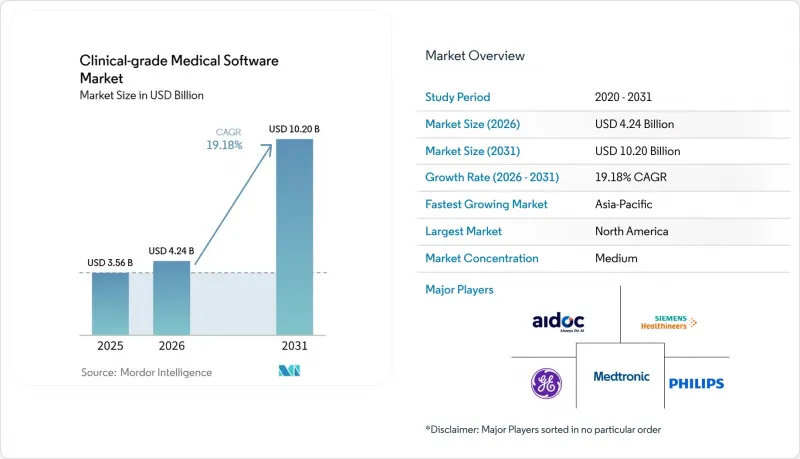
본 보고서는 임상 기능별(진단, 모니터링, 치료, CDS, 기타), 도입 형태별(클라우드 기반, 온프레미스형, 하이브리드형), 구성 요소별(소프트웨어, 서비스), 치료 분야별(종양학, 순환기학, 신경학, 방사선학, 기타), 최종 사용자별(병원, 당일 수술센터, 진단센터, 기타), 지역별(북미, 유럽, 아시아태평양, 중동 및 아프리카, 남미)로 분류되어 있습니다. 예측치는 금액(달러)으로 표시되어 있습니다.
세계의 임상용 의료 소프트웨어 시장 동향 및 인사이트
AI를 활용한 임상 워크플로우 자동화가 임상 생산성의 격차를 확대되고 있습니다.
AI를 활용한 워크플로 도구는 임상용 소프트웨어 구매 결정 과정에서 주목받고 있습니다. 앰비언트 문서화 도구는 수작업에 의한 문서 작성 부담을 줄여주며, 임상의가 환자 치료에 할애하는 시간을 늘릴 수 있습니다. 의료 기관에서는 기존에 수작업에 의한 문서화 및 조정에 의존하던 업무를 지원하기 위해 이러한 시스템의 시범 도입이 진행되고 있습니다. 에이전트 기반 시스템은 소프트웨어의 가치를 전자의무기록(EHR)의 범위를 넘어 임상 업무 조정으로 전환시켜 전문 워크플로우 제공업체에 새로운 기회를 제공하는 한편, 기존 EHR 공급업체에 대한 압박을 가중시킬 가능성이 있습니다. 시뮬레이션 환경에서 실시된 조사에 따르면, 에이전트형 EHR 시스템은 특정 진단 업무에서 경험이 풍부한 의사의 성과에 근접한 결과를 보여주었으며, 이는 지속적인 임상 평가의 근거가 되고 있습니다.
EHR, PACS, LIS 통합 요구가 플랫폼의 가치를 재정의
의료 기관은 EHR, PACS, LIS 및 분석 시스템을 아우르는 소프트웨어를 점점 더 많이 요구하고 있습니다. 분산된 영상 진단 시스템 및 검사 시스템, HL7 FHIR 도입 현황의 불균일성, 그리고 분산된 IoT 데이터는 여전히 엔터프라이즈 AI 활용의 장벽으로 남아 있습니다. 벤더가 임상의가 환자 기록에서 벗어나지 않고도 정보를 연동할 수 있게 한다면, 임상용 의료 소프트웨어 시장은 그 혜택을 누리게 될 것입니다. 활성 EHR 기록 내의 영상에 대한 맥락에 기반한 접근은 기업 구매 담당자에게 실질적인 요구 사항이 되고 있는 반면, 신뢰할 수 있는 상호 운용성을 통해 공급업체는 단일 기능이 아닌 운영상의 적합성을 놓고 경쟁할 수 있게 됩니다.
사이버 보안 취약점은 임상용 소프트웨어의 성능 위험을 초래하고 있습니다.
사이버 보안은 단순한 IT상의 우려 사항이 아니라 진료의 연속성과 관련된 문제가 되고 있습니다. 2025년, 의료 분야에서의 랜섬웨어 피해 건수는 전년 대비 58% 증가했습니다. 2026년 4월 ChipSoft에 대한 공격은 공급업체 측의 사고가 여러 의료 기관의 EHR 접근을 방해할 가능성이 있음을 보여주었습니다. 현재 의료 서비스 제공업체들은 임상용 소프트웨어를 평가할 때 보안, 개인정보 보호, 복구 능력 및 고가용성 인프라를 우선시하고 있으며, 이는 임상용 의료 소프트웨어 시장에 대한 신뢰에 영향을 미치고, 공급업체의 엔지니어링 비용을 증가시키며, 조달 주기를 장기화시킬 가능성이 있습니다.
부문 분석
2025년, 진단용 소프트웨어는 임상용 의료 소프트웨어 시장 규모의 33.22%를 차지했습니다. AI를 활용한 분류(triage)가 방대한 영상 데이터 관리와 제한된 전문의 인력을 보완하는 데 기여함에 따라, 방사선과 및 병리학 분야의 워크플로가 이러한 위치를 뒷받침했습니다. 2026년 3월 기준, FDA 승인을 받은 1,524건의 AI 알고리즘 중 1,163건이 방사선과 분야였으며, 이는 진단 용도에서의 제품 환경이 성숙해졌음을 반영합니다. 『Nature Biomedical Engineering』지의 기사에 따르면, 미국에서는 진단 영상의 오류로 인해 연간 4만-8만 건의 예방 가능한 사망이 발생하며, 의료 과실로 인한 비용은 40억 달러 이상에 달할 것으로 추정됩니다.
치료용 소프트웨어는 2031년까지 연평균 성장률(CAGR) 20.93%를 나타낼 것으로 예측됩니다. 이 범주에는 심혈관 질환, 호흡기 질환, 대사성 질환 관리에 사용되는 용도이 포함되며, 처방전이 필요한 디지털 치료제에 대한 보험사의 급여 범위 확대가 시장 확대에 여전히 중요할 것입니다. 모니터링 소프트웨어, 질환 관리 소프트웨어, 임상 의사결정 지원 소프트웨어, 임상 워크플로우 및 커뮤니케이션 소프트웨어, 원격의료 및 가상 진료 소프트웨어, 그리고 의료 영상 및 시각화 소프트웨어가 나머지 임상 기능 카테고리를 구성합니다. 임상용 의료 소프트웨어 업계는 보상 범위 확대와 임상적 근거를 바탕으로 파일럿 프로그램의 범위를 넘어 도입이 촉진됨에 따라 혜택을 볼 가능성이 있습니다.
2025년 기준, 클라우드 기반 소프트웨어는 임상용 의료 소프트웨어 시장 규모의 56.23%를 차지했습니다. 이러한 위상은 의료 시스템이 호스팅형 용도, 엔터프라이즈 이미징 및 분석 서비스로 전환되고 있음을 반영합니다. 클라우드 도구는 병원 및 외래 진료 시설 간의 정보 공유를 지원하여, 의료 제공업체가 로컬 인프라에만 의존하지 않고 대응 능력을 확대할 수 있게 했습니다. 클라우드 도입에는 여전히 보안, 개인정보 보호 및 임상적 연속성에 대한 요구 사항이 부과되고 있습니다.
하이브리드형 소프트웨어는 2031년까지 연평균 성장률(CAGR) 22.86%를 나타낼 것으로 예측됩니다. 의료 시스템에서는 지연에 민감한 워크로드, 긴밀하게 통합된 워크로드, 규제상의 제약이 있는 워크로드를 온프레미스로 유지하면서, 분석, AI 추론, 2차 영상 진단 이용 사례를 퍼블릭 클라우드 환경에 배치하기 위해 하이브리드 설계를 채택하고 있습니다. 2026년 조사 보고서에서는 기밀성이 높은 임상 기록을 보호하면서 상호 운용성을 지원하기 위해 병원의 프라이빗 클라우드, 커뮤니티 클라우드 및 정부 클라우드의 각 계층을 결합한 하이브리드 모델이 소개되었습니다. 온프레미스형 소프트웨어는 엄격한 데이터 거주지 규정이 마련된 관할 구역, 업데이트 예산이 제한된 시설에서 여전히 중요한 역할을 수행하고 있습니다.
지역별 분석
2025년, 북미는 임상용 의료 소프트웨어 시장에서 42.76%의 점유율을 차지했습니다. 이는 기업 내 EHR의 광범위한 도입, FDA 승인을 받은 여러 AI 도구, 그리고 디지털 케어를 위한 성숙한 보험사 프레임워크에 힘입은 결과입니다. 의료 서비스 제공업체들은 사이버 위험에 대비해 인프라를 강화하는 동시에 임상 기능을 확충했습니다. 멕시코에서는 민간 병원 그룹이 디지털 인프라에 투자함에 따라 수요가 증가했으며, 캐나다에서는 의료 서비스 제공업체들이 기존 플랫폼 공급업체를 대체할 대안을 검토함에 따라 계속해서 활발한 구매가 이루어졌습니다.
유럽에서는 MDR 요건과 GDPR(EU 개인정보보호규정)의 데이터 주권 관련 규정에 의해 형성된 규정 준수 중심의 환경이 유지되었습니다. 인터시스템즈(InterSystems)는 2026년 5월, IntelliCare가 AI 네이티브 EHR로서 최초로 EU의 MDR 클래스 IIa 인증을 획득했다고 발표했습니다. 이러한 인증은 규제 대상 입찰에서 중요한 요건이 될 가능성이 있습니다. 독일, 영국, 북유럽 국가들은 계속해서 임상 AI 도구의 적극적인 사용자이며, 한편 GCC 국가들에서는 AI 네이티브 EHR 도입이 부각되어 Medcare가 EMEA 지역 공급자로서 최초로 인터시스템즈의 IntelliCare를 도입했습니다.
아시아태평양은 중국, 인도, 일본, 한국, 호주의 국가 차원의 디지털화 프로그램, 병원 IT 현대화, 현지 벤더의 발전에 힘입어 2031년까지 연평균 성장률(CAGR) 19.56%를 나타낼 것으로 전망됩니다. 중국 병원의 장비 교체 주기는 기업용 영상 진단 소프트웨어 조달 기회를 창출한 반면, 인도의 국내 헬스 IT 개발은 접근성이 높은 도입 모델을 뒷받침했습니다. 또한 한국의 ‘K-Digital’ 이니셔티브와 호주의 ‘My Health Record’ 확대도 수요를 견인했습니다. 브라질과 아르헨티나를 필두로 한 남미는 공립 병원의 디지털화가 확장성이 높은 조달 기회를 창출함에 따라, 계속해서 신흥 지역으로서의 위상을 유지했습니다.
기타 혜택 :
- 엑셀 형식 시장 예측(ME) 시트
- 3개월간의 애널리스트 지원
자주 묻는 질문
목차
제1장 서론
제2장 조사 방법
제3장 개요
제4장 시장 구도
제5장 시장 규모 및 성장 예측
제6장 경쟁 구도
제7장 시장 기회 및 향후 전망
AJY 26.09.01According to Mordor Intelligence, the clinical-grade medical software market size was valued at USD 3.56 billion in 2025 and is estimated to grow from USD 4.24 billion in 2026 to reach USD 10.20 billion by 2031, at a CAGR of 19.18% during the forecast period (2026-2031).
This report is Segmented by Clinical Function (Diagnostic, Monitoring, Therapeutic, CDS, Others), Deployment (Cloud-Based, On-Premise, Hybrid), Component (Software, Services), Therapeutics Area (Oncology, Cardiology, Neurology, Radiology, Others), End User (Hospitals, Ascs, Diagnostic Centers, Others), Geography (North America, Europe, Asia-Pacific, MEA, South America). Forecasts in Value (USD).
Global Clinical-grade Medical Software Market Trends and Insights
AI-Enabled Clinical Workflow Automation Widens Clinical Productivity Gaps
AI workflow tools are gaining visibility in clinical software purchasing decisions. Ambient documentation tools can reduce manual documentation workloads and give clinicians more time for patient care. Health systems are testing these systems to support tasks that previously depended on manual documentation and coordination. Agent-based systems may shift software value beyond the electronic health record (EHR) toward clinical task coordination, creating opportunities for specialized workflow providers and increasing pressure on established EHR suppliers. Research in a simulated setting found that agentic EHR systems approached experienced physician performance in selected diagnostic tasks, supporting continued clinical evaluation.
EHR, PACS and LIS Integration Demand Redefines Platform Value
Health systems increasingly seek software that works across EHR, PACS, LIS, and analytics systems. Fragmented imaging and laboratory systems, uneven HL7 FHIR adoption, and disconnected IoT data remain barriers to enterprise AI use. The clinical-grade medical software market benefits when vendors connect information without requiring clinicians to leave the patient record. In-context access to images within an active EHR record is becoming a practical requirement for enterprise buyers, while reliable interoperability allows suppliers to compete on operational fit rather than a single feature.
Cybersecurity Exposure Creates a Performance Risk for Clinical Software
Cybersecurity has become a clinical continuity issue, not just an IT concern. Healthcare ransomware incidents rose 58% year over year in 2025. The April 2026 ChipSoft attack showed how a vendor incident can disrupt EHR access across several institutions. Providers now prioritize security, privacy, recovery capabilities, and resilient infrastructure when evaluating clinical software, which can affect confidence in the clinical-grade medical software market, increase vendor engineering costs, and lengthen procurement cycles.
Other drivers and restraints analyzed in the detailed report include:
- Regulatory and Reimbursement Support for Digital Care Opens Market Access
- Cloud-Native Clinical Software Adoption Moves From Strategy to Execution
- Clinical Validation Requirements Extend Deployment Timelines for AI-Driven Tools
For complete list of drivers and restraints, kindly check the Table Of Contents.
Segment Analysis
Diagnostic Software held 33.22% of the Clinical-grade Medical Software market size in 2025. Radiology and pathology workflows supported this position, as AI triage helped manage high imaging volumes and limited specialist capacity. Radiology represented 1,163 of 1,524 FDA-cleared AI algorithms by March 2026, reflecting a mature product environment for diagnostic applications. A Nature Biomedical Engineering article stated that diagnostic imaging errors caused 40,000-80,000 preventable deaths annually in the United States and more than USD 4 billion in malpractice costs.
Therapeutic Software is forecast to grow at a 20.93% CAGR through 2031. The category includes applications used in cardiovascular, respiratory, and metabolic disease management, with payer coverage for prescription digital therapeutics remaining important to expansion. Monitoring Software, Disease Management Software, Clinical Decision Support Software, Clinical Workflow and Communication Software, Telehealth and Virtual Care Software, and Medical Imaging and Visualization Software make up the remaining clinical function categories. The Clinical-grade Medical Software industry can benefit when reimbursement coverage and clinical evidence support adoption beyond pilot programs.
Cloud-Based Software held 56.23% of the Clinical-grade Medical Software market size in 2025. Its position reflected health systems' shift toward hosted applications, enterprise imaging, and analytics services. Cloud tools supported shared access to information across hospitals and outpatient settings and allowed providers to expand capacity without relying only on local infrastructure. Cloud deployment remained subject to security, privacy, and clinical continuity requirements.
Hybrid Software is forecast to grow at a 22.86% CAGR through 2031. Health systems use hybrid designs to retain latency-sensitive, tightly integrated, or regulation-constrained workloads on site while placing analytics, AI inference, and secondary imaging use cases in public cloud environments. A 2026 review described hybrid models that combined private hospital clouds, community clouds, and government cloud layers to support interoperability while protecting sensitive clinical records. On-Premise Software remains relevant in jurisdictions with strict data residency rules and in facilities with limited replacement budgets.
Complete Report Scope:
- By Clinical Function
- Diagnostic Software
- Monitoring Software
- Therapeutic Software
- Disease Management Software
- Clinical Decision Support Software
- Clinical Information and Documentation Software
- Clinical Workflow and Communication Software
- Telehealth and Virtual Care Software
- Medical Imaging and Visualization Software
- Others
- By Deployment
- Cloud-Based Software
- On-Premise Software
- Hybrid Software
- By Component
- Software
- Services
- By Therapeutics Area
- Oncology
- Cardiology
- Neurology
- Radiology
- Respiratory Diseases
- Metabolic Disorders
- Infectious Diseases
- Immunology
- Women's Health
- Other Therapeutic Areas
- By End User
- Hospitals and Health Systems
- Ambulatory Surgical Centers
- Diagnostic and Imaging Centers
- Home Healthcare Providers
- Others
- By Geography
- North America
- United States
- Canada
- Mexico
- Europe
- Germany
- United Kingdom
- France
- Italy
- Spain
- Rest of Europe
- Asia-Pacific
- China
- India
- Japan
- Australia
- South Korea
- Rest of Asia-Pacific
- Middle East and Africa
- GCC
- South Africa
- Rest of Middle East and Africa
- South America
- Brazil
- Argentina
- Rest of South America
- North America
Geography Analysis
North America held a 42.76% share of the clinical-grade medical software market in 2025, supported by broad enterprise EHR adoption, multiple FDA-cleared AI tools, and mature payer frameworks for digital care. Providers added clinical capabilities while strengthening infrastructure against cyber risk. Mexico added demand as private hospital groups invested in digital infrastructure, while Canada remained an active buyer as providers evaluated alternatives to established platform suppliers.
Europe maintained a compliance-focused environment shaped by MDR requirements and GDPR data sovereignty rules. InterSystems announced in May 2026 that IntelliCare became the first AI-native EHR to receive EU MDR Class IIa certification. Such certifications can become important requirements in regulated tenders. Germany, the United Kingdom, and Northern Europe remained active users of clinical AI tools, while the GCC emerged for AI-native EHR adoption, with Medcare becoming the first EMEA provider to deploy InterSystems IntelliCare.
Asia-Pacific is forecast to grow at a 19.56% CAGR through 2031, supported by national digitization programs, hospital IT modernization, and local vendor development across China, India, Japan, South Korea, and Australia. China's hospital upgrade cycles created procurement opportunities for enterprise imaging software, while India's domestic health IT development supported accessible deployment models. South Korea's K-Digital initiative and Australia's My Health Record expansion also supported demand. South America, led by Brazil and Argentina, remained an emerging area as public hospital digitization created scalable procurement opportunities.
- Aidoc Medical Ltd.
- Athenahealth
- Elsevier B.V.
- Epic Systems
- GE HealthCare Technologies Inc.
- HeartFlow, Inc.
- Intersystems
- IQVIA
- Koninklijke Philips
- Lunit
- Mckesson
- Medical Information Technology
- Medtronic
- Merative, Inc.
- NextGen Healthcare
- NVIDIA
- Optum
- Oracle
- Qure.ai Technologies Private Limited
- SAS Institute
- Siemens Healthineers
Additional Benefits:
- The market estimate (ME) sheet in Excel format
- 3 months of analyst support
TABLE OF CONTENTS
1 INTRODUCTION
- 1.1 Study Assumptions and Market Definition
- 1.2 Scope of the Study
2 RESEARCH METHODOLOGY
3 EXECUTIVE SUMMARY
4 MARKET LANDSCAPE
- 4.1 Market Overview
- 4.2 Market Drivers
- 4.2.1 AI-Enabled Clinical Workflow Automation
- 4.2.2 EHR, PACS and LIS Integration Demand
- 4.2.3 Regulatory and Reimbursement Support for Digital Care
- 4.2.4 Cloud-Native Clinical Software Adoption
- 4.2.5 Alert Personalization to Reduce Clinician Cognitive Load
- 4.2.6 Clinical Software Localization for Underserved Specialist Markets
- 4.3 Market Restraints
- 4.3.1 Cybersecurity, Privacy and Ransomware Exposure
- 4.3.2 Clinical Validation and Evidence Requirements
- 4.3.3 Alert Fatigue from Layered Algorithmic Prompts
- 4.3.4 Fragmented Clinical Ownership of Software Procurement
- 4.4 Value/Supply-Chain Analysis
- 4.5 Regulatory Landscape
- 4.6 Technological Outlook
- 4.7 Porter's Five Forces Analysis
- 4.7.1 Bargaining Power of Suppliers Analysis
- 4.7.2 Bargaining Power of Buyers Analysis
- 4.7.3 Threat of New Entrants Analysis
- 4.7.4 Threat of Substitutes Analysis
- 4.7.5 Competitive Rivalry Analysis
5 MARKET SIZE AND GROWTH FORECASTS (VALUE, USD)
- 5.1 By Clinical Function
- 5.1.1 Diagnostic Software
- 5.1.2 Monitoring Software
- 5.1.3 Therapeutic Software
- 5.1.4 Disease Management Software
- 5.1.5 Clinical Decision Support Software
- 5.1.6 Clinical Information and Documentation Software
- 5.1.7 Clinical Workflow and Communication Software
- 5.1.8 Telehealth and Virtual Care Software
- 5.1.9 Medical Imaging and Visualization Software
- 5.1.10 Others
- 5.2 By Deployment
- 5.2.1 Cloud-Based Software
- 5.2.2 On-Premise Software
- 5.2.3 Hybrid Software
- 5.3 By Component
- 5.3.1 Software
- 5.3.2 Services
- 5.4 By Therapeutics Area
- 5.4.1 Oncology
- 5.4.2 Cardiology
- 5.4.3 Neurology
- 5.4.4 Radiology
- 5.4.5 Respiratory Diseases
- 5.4.6 Metabolic Disorders
- 5.4.7 Infectious Diseases
- 5.4.8 Immunology
- 5.4.9 Women's Health
- 5.4.10 Other Therapeutic Areas
- 5.5 By End User
- 5.5.1 Hospitals and Health Systems
- 5.5.2 Ambulatory Surgical Centers
- 5.5.3 Diagnostic and Imaging Centers
- 5.5.4 Home Healthcare Providers
- 5.5.5 Others
- 5.6 By Geography
- 5.6.1 North America
- 5.6.1.1 United States
- 5.6.1.2 Canada
- 5.6.1.3 Mexico
- 5.6.2 Europe
- 5.6.2.1 Germany
- 5.6.2.2 United Kingdom
- 5.6.2.3 France
- 5.6.2.4 Italy
- 5.6.2.5 Spain
- 5.6.2.6 Rest of Europe
- 5.6.3 Asia-Pacific
- 5.6.3.1 China
- 5.6.3.2 India
- 5.6.3.3 Japan
- 5.6.3.4 Australia
- 5.6.3.5 South Korea
- 5.6.3.6 Rest of Asia-Pacific
- 5.6.4 Middle East and Africa
- 5.6.4.1 GCC
- 5.6.4.2 South Africa
- 5.6.4.3 Rest of Middle East and Africa
- 5.6.5 South America
- 5.6.5.1 Brazil
- 5.6.5.2 Argentina
- 5.6.5.3 Rest of South America
- 5.6.1 North America
6 COMPETITIVE LANDSCAPE
- 6.1 Market Concentration
- 6.2 Market Share Analysis
- 6.3 Company Profiles (includes Global Level Overview, Market Level Overview, Core Segments, Financials as available, Strategic Information, Market Rank/Share, Products and Services, Recent Developments)
- 6.3.1 Aidoc Medical Ltd.
- 6.3.2 athenahealth, Inc.
- 6.3.3 Elsevier B.V.
- 6.3.4 Epic Systems Corporation
- 6.3.5 GE HealthCare Technologies Inc.
- 6.3.6 HeartFlow, Inc.
- 6.3.7 InterSystems Corporation
- 6.3.8 IQVIA Holdings Inc.
- 6.3.9 Koninklijke Philips N.V.
- 6.3.10 Lunit Inc.
- 6.3.11 McKesson Corporation
- 6.3.12 Medical Information Technology, Inc.
- 6.3.13 Medtronic plc
- 6.3.14 Merative, Inc.
- 6.3.15 NextGen Healthcare, Inc.
- 6.3.16 NVIDIA Corporation
- 6.3.17 Optum, Inc.
- 6.3.18 Oracle Corporation
- 6.3.19 Qure.ai Technologies Private Limited
- 6.3.20 SAS Institute Inc.
- 6.3.21 Siemens Healthineers AG
7 MARKET OPPORTUNITIES AND FUTURE OUTLOOK
- 7.1 White-Space and Unmet-Need Assessment


