

|
시장보고서
상품코드
2118187
소버린 고객 관리형 암호화 소프트웨어 시장 : 시장 점유율 분석, 업계 동향 및 통계, 성장 예측(2026-2031년)Sovereign Customer Managed Encryption Software - Market Share Analysis, Industry Trends & Statistics, Growth Forecasts (2026 - 2031) |
||||||
 Mordor Intelligence
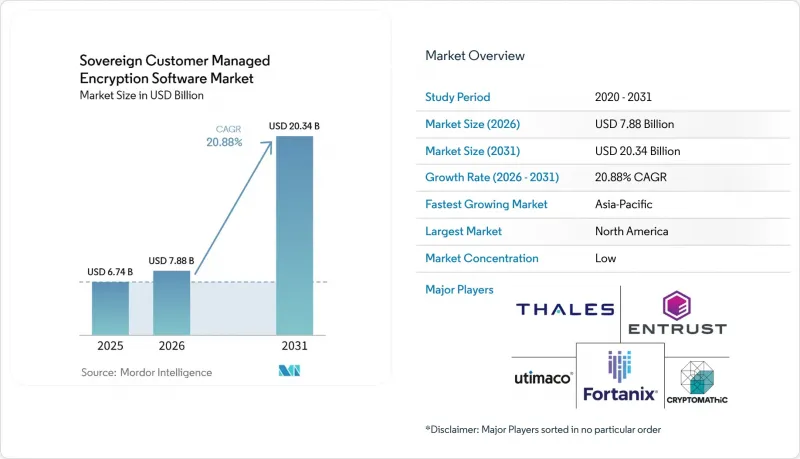
Mordor Intelligence에 의하면, 소버린 고객 관리형 암호화 소프트웨어 시장 규모는 2025년 67억 4,000만 달러로 평가되었고, 2031년까지 203억 4,000만 달러로 확대될 전망이며, 2026-2031년 CAGR 20.88%를 나타낼 것으로 예측됩니다.
본 보고서는 구성 요소별(소프트웨어 및 서비스), 배포 모델별(클라우드, 하이브리드, 온프레미스), 용도별(클라우드 스토리지 및 오브젝트 스토리지 암호화, 데이터베이스 암호화 등), 최종 사용자별(IT 및 통신, 은행, 금융서비스 및 보험(BFSI), 자동차 및 운송 등) 및 지역별로 분류되어 있습니다. 시장 전망은 금액(달러) 기준으로 제시되어 있습니다.
세계의 소버린 고객 관리형 암호화 소프트웨어 시장 동향 및 인사이트력
데이터 주권 및 개인정보 보호 규제 강화
개인정보 보호 규제는 데이터가 어디에 저장되어 있는지뿐만 아니라 누가 암호화 키를 관리하는지에 점점 더 초점을 맞추었습니다. ‘CLOUD법’은 미국에 본사를 둔 제공업체에게 미국 외부에 보관된 데이터의 공개를 의무화할 가능성이 있습니다. 고객이 키를 보유함으로써, 제공업체가 보호된 정보를 복호화하는 능력을 제한할 수 있습니다. 2026년, 프랑스의 공공 조달 정책에서는 기술 구매 시 디지털 주권에 더 높은 우선순위를 부여했습니다. 이 정책에서는 특히 독립적인 암호화 키 관리가 평가 기준의 상위에 위치했습니다. 이러한 동향으로 인해 기밀 데이터에 대한 입증 가능한 관리를 필요로 하는 공공기관 및 규제 대상 기업에게 있어, 소버린 고객 관리형 암호화 소프트웨어 시장의 중요성은 더욱 높아지고 있습니다. 이와 유사한 규정은 공급업체 선정, 계약 설계, 그리고 외부 위탁 처리의 감독에도 영향을 미칠 가능성이 있습니다.
심화되는 클라우드 데이터 유출 및 랜섬웨어 노출
랜섬웨어의 성공률은 2025년 50%에서 2026년에는 56%에 달할 전망입니다. 건당 평균 복구 비용은 170만 달러에 달하고, 전년 대비 11% 증가했습니다. 소포스(Sophos) 보고서에 따르면, 2026년에는 66%의 조직이 암호화된 데이터를 복구하기 위해 백업을 활용했습니다. 공격자가 백업 저장소를 표적으로 삼는 사례가 늘어나면서, 복구 계획에서 키 보호의 중요성이 부각되고 있습니다. 조직이 암호화된 백업 데이터를 고객 관리형 암호화 소프트웨어 하에 둘 경우, 소버린(Sovereign) 고객 관리형 암호화 소프트웨어 시장이 혜택을 볼 것입니다. 이를 통해 데이터를 공개할 권한과 백업 사본을 저장하는 시스템을 분리할 수 있습니다. 이러한 접근 방식을 통해 제공업체 계정이 침해되었을 때, 운영 데이터와 복구용 사본이 모두 유출될 위험을 줄일 수 있습니다.
소버린 키 인프라의 높은 총 소유 비용
‘Hold Your Own Key(자체 키 관리)’ 도입에는 하드웨어 보안 모듈, 중복된 키 보관, 숙련된 인력, 그리고 독립적인 감사가 필요할 수 있습니다. 이러한 요건들은 소규모 조직이나 신흥 시장의 구매자에게 가장 큰 비용 부담이 됩니다. 키 환경이 퍼블릭 클라우드, 프라이빗 시스템, 엣지 거점으로 확대됨에 따라 비용은 증가합니다. 기술 예산이 제한적인 경우, 전용 소버린 키 인프라에 대한 투자가 지연될 가능성이 있습니다. 관리형 서비스를 이용하면 지출을 자본 지출에서 지속적인 운영 비용으로 전환할 수 있지만, 거버넌스 요건이 사라지는 것은 아닙니다. 주권형 고객 관리형 암호화 소프트웨어 시장에서는 대규모 보안 운영 체제를 갖추지 않은 조직의 진입 장벽을 낮출 수 있는 사용량 기반 서비스가 제공되기 시작했습니다. 구매자는 여전히 키가 어디에 보관되어 있는지, 누가 접근할 수 있는지, 그리고 서비스의 연속성이 어떻게 유지되는지를 평가해야 합니다.
부문 분석
2025년, 주권형 고객 관리 암호화 소프트웨어 시장에서 소프트웨어가 71.24%의 점유율을 차지했습니다. 규제 대상 조직은 관리된 보안 환경 내에서 작동하는 소프트웨어를 선호하는 경향이 있습니다. 이러한 경향은 암호화 통제에 대한 직접적인 감독이라는 확립된 요건을 반영합니다. 금융 서비스, 정부 기관 및 기타 규제 대상 구매자들도 키가 어떻게 생성되고 사용되는지에 대한 증거를 필요로 합니다. 소프트웨어 플랫폼은 내부 시스템 전반에 걸쳐 이러한 수준의 감독을 지원할 수 있습니다. 소버린 고객 관리형 암호화 소프트웨어 시장은 구매자에게 사업 부문 간에 이러한 통제 수단을 표준화할 수 있는 방법도 제공합니다. 이 부문은 조직이 확립된 암호화 운영 팀을 보유하고 있는 경우에도 여전히 중요한 위치를 차지하고 있습니다.
서비스 시장은 2031년까지 연평균 성장률(CAGR) 22.74%로 확대될 것으로 예측됩니다. 이러한 성장은 키 관리 업무를 수행할 내부 자원이 부족한 조직 수요를 반영합니다. 소매업, 의료 업계 및 중견 금융 기업은 매니지드 서비스를 활용함으로써 사내에 완전한 인프라를 구축하지 않고도 제어 기능을 도입할 수 있습니다. 또한 주요 시스템을 클라우드, 데이터베이스, 스토리지 환경에 연결할 때도 도입 지원이 필요합니다. SaaS로 제공되는 플랫폼은 사용량에 따른 액세스를 제공하면서, 고객이 키 자원에 대한 관리 권한을 유지할 수 있도록 합니다. 따라서 이러한 구성 요소의 조합은 소프트웨어의 직접 소유와 외부 지원을 통한 운영 모델 모두를 반영하고 있습니다. 주권형 고객 관리 암호화 소프트웨어 시장은 운영 요구 사항의 변화에 따라 이 두 가지 접근 방식 모두에 대응할 수 있습니다.
2025년에는 클라우드 배포가 68.41%의 점유율을 차지했습니다. 클라우드가 주류라고 해서 조직이 키 관리 권한을 공급자에게 위임하고 있는 것은 아닙니다. ‘주권형’ 클라우드 서비스와 독립적인 키 관리 시스템을 결합함으로써, 클라우드 컴퓨팅과 고객 관리형 암호화를 양립시킬 수 있습니다. 마이크로소프트는 기밀성이 높은 워크로드를 하드웨어로 보호하기 위해 2026년 5월 ‘Azure Integrated HSM’의 일반 제공을 시작했습니다. 이 서비스는 규제 대상인 클라우드 사용자의 요구 사항을 충족하려는 제공업체의 노력을 반영한 것입니다. 클라우드 배포는 정의된 키 관리 관행을 유지하면서도 확장성이 필요한 조직에게 여전히 적합한 선택지입니다. 소버린 고객 관리형 암호화 소프트웨어 시장은 독립적인 키 관리 옵션을 통해 이러한 균형을 뒷받침하고 있습니다.
하이브리드 배포는 2031년까지 연평균 성장률(CAGR) 21.63%로 확대될 것으로 예측됩니다. 조직은 기밀성이 높은 키 자료를 온프레미스 또는 프라이빗 환경에 보관하는 경우가 많습니다. 이를 통해 퍼블릭 클라우드에서 암호화된 용도를 실행할 수 있습니다. 고객 시스템은 관리되는 연결을 통해 복호화 처리를 승인합니다. 하이브리드 환경은 레거시 시스템에서 클라우드 서비스로의 장기적인 전환 기간에도 대응합니다. 이에 따라 ‘주권형 고객 관리 암호화 소프트웨어 시장’은 기술 기반을 변경하면서도 업무 연속성이 필요한 기업에게 중요한 요소가 됩니다. 또한, 기존의 모든 암호화 제어 기능을 갑작스럽게 대체하지 않고 점진적인 전환을 가능하게 합니다.
지역별 분석
2025년, 북미는 주권형 고객 관리 암호화 소프트웨어 시장 점유율의 34.62%를 차지했습니다. 연방 정부의 암호화 요구 사항, 대기업의 기술 예산, 그리고 성숙한 공급업체 기반이 이 지역의 입지를 뒷받침했습니다. 2026년 6월에 발령된 미국 대통령령에 따라, 2030년까지 양자 내성 암호화로의 전환을 위한 연방 정부의 준비가 가속화되었습니다. 각 기관은 암호화 자산을 파악하고 전환해야 할 시스템의 우선순위를 결정해야 합니다. 캐나다와 멕시코도 클라우드 조달 활동 및 규제 대상 부문의 디지털화를 통해 해당 지역 내 수요를 뒷받침하고 있습니다.
아시아태평양은 2031년까지 연평균 성장률(CAGR) 22.84%로 확대될 것으로 예측됩니다. 인도는 2025년 11월 ‘디지털 개인 데이터 보호 규정’을 공포했으며, 동의 관리자 규정은 2026년 11월에 발효되었습니다. 베트남의 ‘개인정보 보호법’은 2026년 1월에 시행되었습니다. 중국도 2026년 1월, PIPL에 기반한 국경 간 이전 인증 체계를 마련했습니다. 한국의 ‘개인정보 보호법’은 데이터 보안에 대한 투자를 지속적으로 촉진하고 있습니다. 인도, 중국, 일본, 한국이 수요의 대부분을 차지하고 있지만, 동남아시아와 호주에서도 추가적인 성장 기회가 예상됩니다.
유럽은 GDPR(EU 개인정보보호규정), NIS2, DORA 및 EU 데이터법이 결합된 규제 프레임워크를 갖추고 있어 중요한 역할을 담당하고 있습니다. 미국의 클라우드 인프라를 이용하는 유럽의 조직은 국내 주권 관련 정책을 준수하기 위해 암호화 키에 대한 독립적인 관리 권한을 보유해야 할 수 있습니다. 프랑스에서는 중앙 정부의 행정 업무 및 기밀성이 높은 공공 워크로드에 대해 SecNumCloud 인증을 취득한 공급자의 이용이 의무화되어 있습니다. 중동 및 아프리카에서는 사우디아라비아, UAE, 남아프리카공화국의 데이터 거버넌스 조치를 통해 시장이 발전하고 있습니다. 남미에서는 브라질의 LGPD 시행과 데이터 보호 조치에 대한 광범위한 수요가 성장 동력으로 작용하고 있습니다. 이러한 상황으로 인해 서로 다른 규제 구조를 가진 지역 전반에 걸쳐 수요가 확대되고 있습니다.
기타 혜택 :
- 엑셀 형식 시장 예측(ME) 시트
- 3개월간의 애널리스트 지원
자주 묻는 질문
목차
제1장 서론
제2장 조사 방법
제3장 주요 요약
제4장 시장 구도
제5장 시장 규모 및 성장 예측
제6장 경쟁 구도
제7장 시장 기회 및 향후 전망
AJY 26.09.03According to Mordor Intelligence, the sovereign customer managed encryption software market size is projected to expand from USD 6.74 billion in 2025 to USD 20.34 billion by 2031, registering a CAGR of 20.88% between 2026 and 2031.
This report is Segmented by Component (Software, and Services), Deployment Model (Cloud, Hybrid, and On-Premises), Application (Cloud Storage and Object Storage Encryption, Database Encryption, and More), End User (IT and Telecommunication, BFSI, Automotive and Transportation, and More), and Geography. The Market Forecasts are Provided in Terms of Value (USD).
Global Sovereign Customer Managed Encryption Software Market Trends and Insights
Tightening Data Sovereignty and Privacy Regulations
Privacy rules increasingly focus on who controls encryption keys, not just where data is stored. The CLOUD Act can require U.S.-headquartered providers to disclose data held outside the United States. Customer-held keys can limit a provider's ability to decrypt protected information. In 2026, French public procurement policy gave digital sovereignty a higher priority in technology purchases. The policy specifically placed independent encryption key management near the top of the evaluation criteria. These developments make the Sovereign customer managed encryption software market more relevant to public bodies and regulated enterprises that require demonstrable control over sensitive data. The same rules can influence supplier selection, contract design, and oversight of outsourced processing.
Escalating Cloud Data Breaches and Ransomware Exposure
Ransomware success rates reached 56% in 2026, compared with 50% in 2025. Average recovery costs reached USD 1.7 million per incident, which was 11% higher than the prior year. Sophos reported that 66% of organizations used backups to recover encrypted data in 2026. Attackers increasingly target backup repositories, underscoring the importance of key protection for recovery planning. The Sovereign customer managed encryption software market benefits when organizations place encrypted backup data under customer-controlled keys. This separates the authority to release data from the systems that store backup copies. This approach can reduce the risk that a compromised provider account exposes both production data and recovery copies.
High Total Cost of Ownership for Sovereign Key Infrastructure
Hold Your Own Key deployments can require hardware security modules, redundant key storage, skilled staff, and independent audits. These requirements place the highest cost burden on smaller organizations and emerging market buyers. Costs increase as key environments expand across public cloud, private systems, and edge locations. Tight technology budgets can delay investment in dedicated sovereign key infrastructure. Managed services can shift spending from capital purchases to recurring operating costs, but they do not remove the governance requirement. The Sovereign customer managed encryption software market is responding with consumption-based offerings that can lower the entry barrier for organizations without large security operations. Buyers still need to assess where keys reside, who can access them, and how service continuity is maintained.
Other drivers and restraints analyzed in the detailed report include:
- Rising Adoption of Bring Your Own Key and Hold Your Own Key Architectures
- Expansion of Multi-Cloud and SaaS Workloads
- Key Lifecycle Management Complexity and Skills Shortages
For complete list of drivers and restraints, kindly check the Table Of Contents.
Segment Analysis
Software held 71.24% of the Sovereign customer managed encryption software market in 2025. Regulated organizations often prefer software that operates within a controlled security environment. This preference reflects established requirements for direct oversight of encryption controls. Financial services, government, and other regulated buyers also need evidence of how keys are created and used. Software platforms can support that level of oversight across their internal systems. The Sovereign customer managed encryption software market also gives buyers a way to standardize those controls across business units. The segment remains important where organizations maintain established cryptographic operations teams.
Services are projected to expand at a 22.74% CAGR through 2031. This growth reflects demand from organizations that lack internal resources for key management operations. Retail, healthcare, and mid-sized financial firms can use managed services to deploy controls without building a full internal infrastructure. Implementation support is also needed when teams connect key systems to clouds, databases, and storage environments. SaaS-delivered platforms can provide consumption-based access while enabling customers to retain control over key materials. The component mix, therefore, reflects both direct software ownership and externally supported operational models. The Sovereign customer managed encryption software market can accommodate both approaches as operational requirements change.
Cloud deployment held 68.41% share in 2025. Cloud leadership does not necessarily mean that organizations have given control of keys to a provider. Sovereign cloud services and independent key systems can combine cloud computing with customer-managed encryption. Microsoft made Azure Integrated HSM generally available in May 2026 for hardware-backed protection of sensitive workloads. The offering reflects provider efforts to meet requirements from regulated cloud users. Cloud deployments remain suitable for organizations that need scalability while maintaining defined key custody practices. The Sovereign customer managed encryption software market supports this balance through independent key control options.
Hybrid deployment is projected to expand at a 21.63% CAGR through 2031. Organizations often keep sensitive key material on-premises or in private environments. They can then run encrypted applications in the public cloud. The customer system authorizes decryption activity through controlled connections. Hybrid environments also support long migration periods from legacy systems to cloud services. This makes the Sovereign customer managed encryption software market relevant to enterprises that need operational continuity while changing their technology estate. It enables staged migration without requiring a sudden replacement of every existing encryption control.
Complete Report Scope:
- By Component
- Software
- Services
- By Deployment Model
- Cloud
- Hybrid
- On-Premises
- By Application
- Cloud Storage and Object Storage Encryption
- Database Encryption
- File System Encryption
- Disk and Volume Encryption
- Application and Field-Level Encryption
- Communication and Data-in-Transit Encryption
- Other Applications
- By End User
- IT and Telecommunication
- BFSI
- Automotive and Transportation
- Healthcare and Life Sciences
- Retail and E-Commerce
- Industrial Manufacturing
- Other End Users
- By Geography
- North America
- United States
- Canada
- Mexico
- South America
- Brazil
- Argentina
- Rest of South America
- Europe
- Germany
- United Kingdom
- France
- Russia
- Spain
- Rest of Europe
- Asia-Pacific
- China
- Japan
- India
- South Korea
- Southeast Asia
- Rest of Asia-Pacific
- Middle East and Africa
- Middle East
- Saudi Arabia
- United Arab Emirates
- Rest of Middle East
- Africa
- South Africa
- Nigeria
- Rest of Africa
- Middle East
- North America
Geography Analysis
North America held 34.62% of the Sovereign customer managed encryption software market share in 2025. Federal encryption requirements, large enterprise technology budgets, and a mature supplier base supported the region's position. The U.S. executive order issued in June 2026 accelerated federal preparation for a transition to quantum-safe cryptography by 2030. Agencies must identify cryptographic assets and prioritize which systems to migrate. Canada and Mexico also support regional demand through cloud procurement activity and digitization in regulated sectors.
Asia-Pacific is projected to expand at a 22.84% CAGR through 2031. India notified its Digital Personal Data Protection Rules in November 2025, with consent manager provisions taking effect in November 2026. Vietnam's Personal Data Protection Law took effect in January 2026. China also completed its cross-border transfer certification framework under PIPL in January 2026. South Korea's Personal Information Protection Act continues to support investment in data security. India, China, Japan, and South Korea account for a large share of demand, while Southeast Asia and Australia offer further growth opportunities.
Europe has a major role because its regulatory framework combines GDPR, NIS2, DORA, and the EU Data Act. European organizations using U.S. cloud infrastructure may need to retain independent control over encryption keys to comply with internal sovereignty policies. France requires SecNumCloud-certified providers for central government administration and sensitive public workloads. The Middle East and Africa are developing through data governance measures in Saudi Arabia, the UAE, and South Africa. South America is supported by Brazil's LGPD enforcement and broader demand for data protection controls. These conditions extend demand across regions with different regulatory structures.
- Thales SA
- Entrust Corporation
- Fortanix, Inc.
- Utimaco GmbH
- Cryptomathic A/S
- Securosys SA
- Futurex, L.P.
- Keyfactor, Inc.
- WinMagic Inc.
- Virtru Corporation
- PKWARE, Inc.
- Protegrity USA, Inc.
- Baffle, Inc.
- Skyflow, Inc.
- Echoworx Corporation
- Stormshield SAS
- DuoKey SA
- SSH Communications Security Corporation
- QNu Labs Private Limited
- Eviden SAS
- Kryptus Seguranca da Informacao S.A.
- OpenKCM
Additional Benefits:
- The market estimate (ME) sheet in Excel format
- 3 months of analyst support
TABLE OF CONTENTS
1 INTRODUCTION
- 1.1 Study Assumptions and Market Definition
- 1.2 Scope of the Study
2 RESEARCH METHODOLOGY
3 EXECUTIVE SUMMARY
4 MARKET LANDSCAPE
- 4.1 Market Overview
- 4.2 Market Drivers
- 4.2.1 Tightening Data Sovereignty and Privacy Regulations
- 4.2.2 Escalating Cloud Data Breaches and Ransomware Exposure
- 4.2.3 Expansion of Multi-Cloud and SaaS Workloads
- 4.2.4 Rising Adoption of Bring Your Own Key and Hold Your Own Key Architectures
- 4.2.5 Customer-Controlled Cryptographic Kill Switches for Regulatory and Exit Risk
- 4.2.6 Sovereign Key Management for Artificial Intelligence and Confidential Computing Workloads
- 4.3 Market Restraints
- 4.3.1 High Total Cost of Ownership for Sovereign Key Infrastructure
- 4.3.2 Key Lifecycle Management Complexity and Skills Shortages
- 4.3.3 Fragmented Cloud and Cryptographic Interoperability Standards
- 4.3.4 Sovereignty-Induced Restrictions on Cross-Border Disaster Recovery
- 4.4 Impact of Macroeconomic Factors on the Market
- 4.5 Industry Value-Chain Analysis
- 4.6 Technology Outlook
- 4.7 Regulatory Landscape
- 4.8 Porter's Five Forces Analysis
- 4.8.1 Threat of New Entrants
- 4.8.2 Bargaining Power of Suppliers
- 4.8.3 Bargaining Power of Buyers
- 4.8.4 Threat of Substitutes
- 4.8.5 Intensity of Competitive Rivalry
5 MARKET SIZE AND GROWTH FORECASTS (VALUE)
- 5.1 By Component
- 5.1.1 Software
- 5.1.2 Services
- 5.2 By Deployment Model
- 5.2.1 Cloud
- 5.2.2 Hybrid
- 5.2.3 On-Premises
- 5.3 By Application
- 5.3.1 Cloud Storage and Object Storage Encryption
- 5.3.2 Database Encryption
- 5.3.3 File System Encryption
- 5.3.4 Disk and Volume Encryption
- 5.3.5 Application and Field-Level Encryption
- 5.3.6 Communication and Data-in-Transit Encryption
- 5.3.7 Other Applications
- 5.4 By End User
- 5.4.1 IT and Telecommunication
- 5.4.2 BFSI
- 5.4.3 Automotive and Transportation
- 5.4.4 Healthcare and Life Sciences
- 5.4.5 Retail and E-Commerce
- 5.4.6 Industrial Manufacturing
- 5.4.7 Other End Users
- 5.5 By Geography
- 5.5.1 North America
- 5.5.1.1 United States
- 5.5.1.2 Canada
- 5.5.1.3 Mexico
- 5.5.2 South America
- 5.5.2.1 Brazil
- 5.5.2.2 Argentina
- 5.5.2.3 Rest of South America
- 5.5.3 Europe
- 5.5.3.1 Germany
- 5.5.3.2 United Kingdom
- 5.5.3.3 France
- 5.5.3.4 Russia
- 5.5.3.5 Spain
- 5.5.3.6 Rest of Europe
- 5.5.4 Asia-Pacific
- 5.5.4.1 China
- 5.5.4.2 Japan
- 5.5.4.3 India
- 5.5.4.4 South Korea
- 5.5.4.5 Southeast Asia
- 5.5.4.6 Rest of Asia-Pacific
- 5.5.5 Middle East and Africa
- 5.5.5.1 Middle East
- 5.5.5.1.1 Saudi Arabia
- 5.5.5.1.2 United Arab Emirates
- 5.5.5.1.3 Rest of Middle East
- 5.5.5.2 Africa
- 5.5.5.2.1 South Africa
- 5.5.5.2.2 Nigeria
- 5.5.5.2.3 Rest of Africa
- 5.5.5.1 Middle East
- 5.5.1 North America
6 COMPETITIVE LANDSCAPE
- 6.1 Market Concentration
- 6.2 Strategic Moves
- 6.3 Market Share Analysis
- 6.4 Company Profiles (includes Global Level Overview, Market Level Overview, Core Segments, Financials as available, Strategic Information, Market Rank/Share, Products and Services, Recent Developments)
- 6.4.1 Thales SA
- 6.4.2 Entrust Corporation
- 6.4.3 Fortanix, Inc.
- 6.4.4 Utimaco GmbH
- 6.4.5 Cryptomathic A/S
- 6.4.6 Securosys SA
- 6.4.7 Futurex, L.P.
- 6.4.8 Keyfactor, Inc.
- 6.4.9 WinMagic Inc.
- 6.4.10 Virtru Corporation
- 6.4.11 PKWARE, Inc.
- 6.4.12 Protegrity USA, Inc.
- 6.4.13 Baffle, Inc.
- 6.4.14 Skyflow, Inc.
- 6.4.15 Echoworx Corporation
- 6.4.16 Stormshield SAS
- 6.4.17 DuoKey SA
- 6.4.18 SSH Communications Security Corporation
- 6.4.19 QNu Labs Private Limited
- 6.4.20 Eviden SAS
- 6.4.21 Kryptus Seguranca da Informacao S.A.
- 6.4.22 OpenKCM
7 MARKET OPPORTUNITIES AND FUTURE OUTLOOK
- 7.1 White-Space and Unmet-Need Assessment


