

|
시장보고서
상품코드
2118191
EU의 AI 감사 추적 소프트웨어 시장 : 시장 점유율 분석, 업계 동향 및 통계, 성장 예측(2026-2031년)EU AI Audit Trail Software - Market Share Analysis, Industry Trends & Statistics, Growth Forecasts (2026 - 2031) |
||||||
 Mordor Intelligence
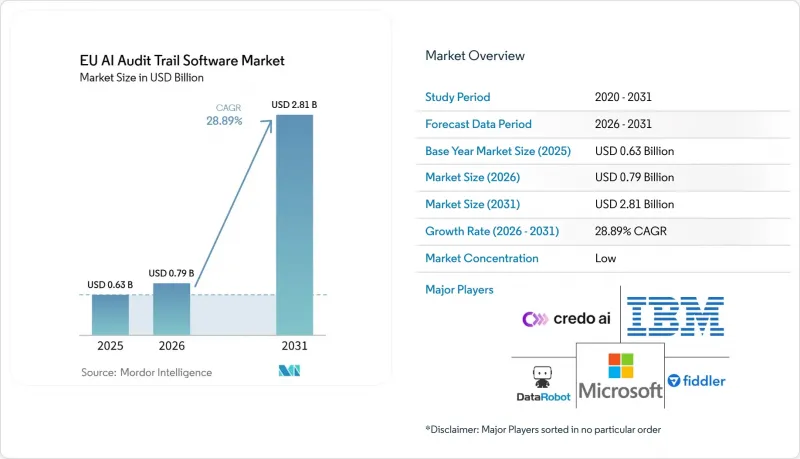
Mordor Intelligence에 의하면, EU의 AI 감사 추적 소프트웨어 시장은 2025년에 6억 3,000만 달러로 평가되었고, 2026년에 7억 9,000만 달러로 추정되고, 2026-2031년 CAGR 28.89%로 성장을 지속할 전망이며, 2031년에는 28억 1,000만 달러에 이를 것으로 예측됩니다.
본 보고서는 구성 요소별(소프트웨어 및 서비스), 규정 준수 기능별(규정 준수 증거 및 보고, 모델 및 데이터 계보 등), 배포 모델별(클라우드, 하이브리드, 온프레미스), 기업 규모별(대기업 및 중소기업), 최종 사용자별(IT 및 통신 등), 지역별로 분류되어 있습니다. 시장 예측은 금액(달러) 기준으로 제시되어 있습니다.
EU의 AI 감사 추적 소프트웨어 시장 동향 및 인사이트
단계적인 EU AI법 시행 및 단기적인 규정 준수 기한
EU AI 감사 추적 소프트웨어 시장은 규정(EU) 2024/1689에 기반한 명확한 법적 기한 순서에 따라 운영됩니다. 범용 AI 모델에 관한 규정은 2025년 8월 2일부터 적용되며, 유럽 AI 사무국은 2026년 8월 2일부터 관련 집행 책임을 맡게 됩니다. 제50조의 투명성 요건도 2026년 8월 2일부터 적용되지만, 디지털 옴니버스법에 따라 부속서 III의 의무는 2027년 12월 2일까지 연기되었습니다. 독일 연방내각은 2026년 2월 11일에 ‘KI-MIG’를 승인했습니다. 이 법은 연방 네트워크청(Bundesnetzagentur)을 국내 AI 감독 당국으로 지정하고, 국내 제재 규정을 정하고 있습니다. 이러한 일정에 따라, 조직은 단순한 정책 문서에만 의존하지 말고, 타임스탬프가 찍힌 기록, 기술 문서, 모델 카드, 적합성 평가 자료 및 시판 후 모니터링 보고서를 보관해야 합니다.
역외 적용 및 EU 시장 접근에 따른 위험
EU AI법은 AI 시스템이 EU 시장에 출시된 경우, 제공업체가 EU 역외에 기반을 두고 있더라도 적용됩니다. 이러한 영향으로 인해 EU의 규정 준수 요건이 전 세계의 제품, 계약, 거버넌스에 관한 의사 결정에 반영되게 될 것입니다. 이 규정에 따르면, 특정 위반 행위에 대해 최대 3,500만 유로(3,810만 달러) 또는 전 세계 연간 매출의 7%에 해당하는 벌금이 부과될 수 있습니다. 마이크로소프트는 2025년 1월 ‘EU AI 협정’에 서명하고, 유럽집행위원회의 후속 지침이 최종 확정되기 전에 제품 구성 및 계약을 금지 사항 규정에 부합하도록 조정했습니다. 이러한 대응은 전 세계 공급업체들이 EU 규정을 단순한 지역적 추가 요건으로 취급하지 않고, EU 대응 체계를 자사의 운영 모델에 통합하고 있는 이유를 보여줍니다. 다국적 공급업체가 여러 관할권에서 판매되는 제품에 공통된 증거 관리 아키텍처가 필요한 경우, EU의 AI 감사 추적 소프트웨어 시장이 그 혜택을 누리게 될 것입니다.
미확정된 기술 기준과 변동하는 해석 지침
EU의 AI 감사 추적 소프트웨어 시장은 상세한 기준 체계가 지속적으로 마련되고 있는 만큼 불확실성에 직면해 있습니다. 고위험 AI 분류에 관한 지침 초안이 2026년 5월 19일에 공표되었으며, 의견 수렴은 2026년 6월 23일까지 진행되었습니다. 가이드라인 및 조화 규격이 최종 확정될 경우, 구매자는 구성 재검토를 해야 할 수도 있습니다. 2026년 중반 시점에서 27개 회원국 중 12개국만이 국내 관할 당국을 지정하지 않았으며, 이로 인해 국가별로 상이한 집행 기대치가 발생할 가능성이 있습니다. 또한, 조직은 AI 시스템 설계와 EU 규제의 해석을 모두 이해하는 인력 부족 문제에도 직면해 있습니다. 이러한 상황은 구매 결정을 지연시키고, 도입 단계에서 서비스 수요를 증가시키는 요인이 될 수 있습니다.
부문 분석
2025년 매출에서 소프트웨어가 차지하는 비중은 73.41%로, AI 감사 추적 기능 분야의 주요 지출 카테고리입니다. SaaS형 거버넌스 플랫폼을 활용하면 조직은 막대한 자본 투자를 하지 않고도 분류, 증거 수집 및 보고 워크플로우를 시작할 수 있습니다. IBM watsonx.governance, Credo AI, Holistic AI 및 Saidot는 위험 분류, 증거 생성, 감사 대응 보고서 작성을 위한 도구를 제공합니다. 이러한 플랫폼들은 EU AI법, ISO/IEC 42001 및 NIST AI 위험 관리 프레임워크를 준수하는 관리 조치를 갖추고 있습니다. 마이크로소프트는 Azure AI Foundry Models 및 Microsoft Security Copilot이 2025년에 ISO/IEC 42001:2023 인증을 획득했다고 보고했습니다. IBM은 2026년 초에 ‘Sovereign Core’를 발표했으며, AI 감사 로그 및 텔레메트리 데이터를 국경 내에 보관하는 것을 목표로 2026년 중반에 일반 제공을 시작할 계획입니다. 이러한 기능들은 소프트웨어 선정 시 데이터 거주지 및 제3자에 의한 보증이 중요해지고 있는 이유를 보여줍니다.
서비스 시장은 2031년까지 연평균 성장률(CAGR) 30.82%를 나타낼 것으로 예측되며, 이 부문에서 가장 높은 성장률을 보이고 있습니다. 구체적인 작업에는 로깅 파이프라인 구성, 데이터 계보 매핑, 인증 기관의 심사를 위한 자료 준비 등이 포함됩니다. 또한, 조직은 ISO/IEC 42001 관리 시스템의 관리 조치와 AI법 요건을 연계하기 위한 지원도 필요로 하고 있습니다. 이러한 요구 사항은 단일 AI 도입에 여러 공급업체가 관여하는 경우 특히 두드러집니다. IBM과 Credo AI는 2025년 4월, Credo AI의 정책 팩을 watsonx.governance 내의 ‘IBM Compliance Accelerators’로 통합하는 OEM 제휴를 발표했습니다. 이 제휴는 전문적인 정책 컨텐츠를 대규모 플랫폼 서비스에 어떻게 통합할 수 있는지를 보여줍니다. 따라서 EU의 AI 감사 추적 소프트웨어 시장은 재사용 가능한 플랫폼 소프트웨어와 전문적인 구현 작업 모두를 지원하고 있습니다.
2025년 매출 중 규정 준수 증거 및 보고가 27.74%를 차지하며 가장 큰 기능 카테고리가 되었습니다. 많은 조직이 2026년 8월 마감 기한까지 구조화된 기록을 필요로 했기 때문에 수요는 부속서 IV 및 제17조에 따른 문서화 의무에서 비롯되었습니다. 제10조가 데이터 거버넌스를 의무화하고 있기 때문에 모델 및 데이터 계보 또한 확립된 분야 중 하나입니다. 실행 시 의사결정 로그는 운영 기록에 관한 제12조의 요건을 뒷받침합니다. 편향, 공정성, 설명 가능성에 대한 감사는 제9조에 기반한 위험 관리 업무를 뒷받침합니다. 이러한 기능들은 일반적인 정책 선언에서 보증 활동 중 검증 가능한 통제로의 전환을 반영하고 있습니다. 이러한 지속적인 활용으로 인해 증거 보고는 EU의 AI 감사 추적 소프트웨어 시장에 있어 중요한 기반이 되고 있습니다.
사고 조사 및 시판 후 감시는 2031년까지 연평균 성장률(CAGR) 29.94%를 나타낼 것으로 예측됩니다. 제72조에서는 감시 프레임워크를 의무화하고 있으며, 제73조에서는 중대한 사고에 대한 신속한 보고를 요구하고 있습니다. 의료 분야에서는 이러한 요구가 특히 강하며, 의료기기 제조업체는 MDR 제83조부터 제86조 및 AI법 제72조에 따라 지속적인 시판 후 감시를 유지해야 합니다. MDCG의 지침은 이러한 프레임워크 내의 문서화 및 감시에 관한 요건을 통합하고 있습니다. 『Frontiers in Digital Health』 저널의 2026년 기사에 따르면, 고위험 AI를 활용하는 의료시설에는 종합적인 감사 로그의 유지 관리에 관한 의무가 부과됩니다. 이러한 환경 하에서는 시스템 도입 후에도 계속해서 이용할 수 있는 기록에 대한 수요가 높아지고 있습니다. 또한, 경고, 조사, 시정 조치, 보고를 단일 관리 프로세스로 통합한 플랫폼이 선호되는 추세입니다.
기타 혜택 :
- 엑셀 형식 시장 예측(ME) 시트
- 3개월간의 애널리스트 지원
자주 묻는 질문
목차
제1장 서론
제2장 조사 방법
제3장 주요 요약
제4장 시장 구도
제5장 시장 규모 및 성장 예측
제6장 경쟁 구도
제7장 시장 기회 및 향후 전망
AJY 26.09.03According to Mordor Intelligence, the EU AI audit trail software market was valued at USD 0.63 billion in 2025, USD 0.79 billion in 2026, and is forecast to reach USD 2.81 billion by 2031, at a CAGR of 28.89% over 2026-2031.
This report is Segmented by Component (Software and Services), Compliance Function (Compliance Evidence and Reporting, Model and Data Lineage, and More), Deployment Model (Cloud, Hybrid, and On-Premises), Enterprise Size (Large Enterprises and Small and Medium-Sized Enterprises), End User (IT and Telecommunication, and More), and Geography. The Market Forecasts are Provided in Terms of Value (USD).
EU AI Audit Trail Software Market Trends and Insights
Phased EU AI Act Enforcement and Near-Term Compliance Deadlines
The EU AI Audit Trail Software Market is responding to a clear sequence of legal deadlines under Regulation (EU) 2024/1689. Rules for general-purpose AI models applied from August 2, 2025, and the European AI Office gained related enforcement responsibilities from August 2, 2026. Article 50 transparency requirements also apply from August 2, 2026, while the Digital Omnibus defers Annex III obligations until December 2, 2027. Germany's Cabinet approved the KI-MIG on February 11, 2026, which designates Bundesnetzagentur as the national AI supervisory authority and sets national sanction provisions. These dates require organizations to maintain time-stamped records, technical documentation, model cards, conformity assessment materials, and post-market monitoring reports, rather than relying solely on policy documents.
Extraterritorial Reach and EU Market-Access Exposure
The EU AI Act applies when an AI system is placed on the EU market, even when the provider is based outside the EU. This exposure places EU compliance requirements within global product, contracting, and governance decisions. The regulation allows fines of up to EUR 35 million (USD 38.1 million) or 7% of worldwide annual turnover for certain violations. Microsoft signed the EU AI Pact in January 2025 and aligned product configurations and contracts with prohibited-use provisions before the Commission's later guidance was finalized. This response shows why global providers are building EU-ready controls into their operating models instead of treating the rules as a regional add-on. The EU AI Audit Trail Software Market benefits when multinational providers need a common evidence architecture across products sold in several jurisdictions.
Unsettled Technical Standards and Moving Interpretive Guidance
The EU AI Audit Trail Software Market faces uncertainty due to the ongoing development of the detailed standards environment. Draft guidance on high-risk AI classification was published on May 19, 2026, and consultation ran through June 23, 2026. Buyers may need to revise configurations when guidance or harmonized standards become final. Only 12 of the 27 Member States had designated national competent authorities by mid-2026, which can create different enforcement expectations across countries. Organizations also face a shortage of staff who understand both AI system design and EU regulatory interpretation. These conditions can delay buying decisions and increase the need for services during implementation.
Other drivers and restraints analyzed in the detailed report include:
- Expansion of High-Risk AI Use Cases in Regulated Industries
- Need for Continuous Evidence Across the AI Lifecycle
- Fragmented Accountability Across Providers, Deployers, and Third-Party Model Vendors
For complete list of drivers and restraints, kindly check the Table Of Contents.
Segment Analysis
Software accounted for 73.41% of revenue in 2025, making it the primary spending category for AI audit trail capabilities. SaaS governance platforms allow organizations to start classification, evidence collection, and reporting workflows without major capital expenditure. IBM watsonx.governance, Credo AI, Holistic AI, and Saidot offer tools for risk classification, evidence creation, and audit-ready reports. Their platforms map controls to the EU AI Act, ISO/IEC 42001, and the NIST AI Risk Management Framework. Microsoft reported that Azure AI Foundry Models and Microsoft Security Copilot achieved ISO/IEC 42001:2023 certification in 2025. IBM announced Sovereign Core in early 2026, with general availability targeted for mid-2026, to keep AI audit logs and telemetry within national boundaries. These features show why data residency and third-party assurance have become important in software selection.
Services are projected to grow at a 30.82% CAGR through 2031, the fastest rate in this segmentation. The work includes configuring logging pipelines, mapping data lineage, and preparing material for notified-body reviews. Organizations also need support in connecting ISO/IEC 42001 management system controls with AI Act requirements. This requirement is particularly pronounced when several suppliers contribute to a single AI deployment. IBM and Credo AI announced an OEM collaboration in April 2025 that incorporated Credo AI Policy Packs as IBM Compliance Accelerators within watsonx. governance. The arrangement demonstrates how specialized policy content can be brought into a larger platform offering. The EU AI Audit Trail Software Market industry, therefore, supports both reusable platform software and specialized implementation work.
Compliance evidence and reporting accounted for 27.74% of revenue in 2025, the largest functional category. Demand began with documentary obligations under Annex IV and Article 17 because many organizations needed structured records before the August 2026 deadlines. Model and data lineage are another established area, as Article 10 requires data governance. Runtime decision logging supports Article 12 requirements for operational records. Bias, fairness, and explainability audit supports Article 9 risk-management work. These functions reflect a move from general policy statements to controls that can be examined during assurance activity. Their continued use makes evidence reporting an important foundation for the EU AI Audit Trail Software Market.
Incident investigation and post-market monitoring are projected to grow at a 29.94% CAGR through 2031. Article 72 requires a monitoring framework, while Article 73 requires rapid reporting of serious incidents. The need is particularly strong in healthcare, as device manufacturers must maintain active post-market surveillance under both MDR Articles 83-86 and the AI Act Article 72. The MDCG guidance connects the documentation and surveillance expectations of these frameworks. A 2026 article in Frontiers in Digital Health stated that healthcare facilities using high-risk AI have mandatory deployment obligations for comprehensive audit log maintenance. This environment increases demand for records that remain usable after systems are deployed. It also favors platforms that integrate alerts, investigations, corrective actions, and reporting into a single control process.
Complete Report Scope:
- By Component
- Software
- Services
- By Compliance Function
- Compliance Evidence and Reporting
- Model and Data Lineage
- Runtime Decision Logging
- Bias, Fairness and Explainability Audit
- Incident Investigation and Post-Market Monitoring
- By Deployment Model
- Cloud
- Hybrid
- On-Premises
- By Enterprise Size
- Large Enterprises
- Small and Medium-Sized Enterprises
- By End User
- IT and Telecommunication
- BFSI
- Automotive and Transportation
- Healthcare and Life Sciences
- Retail and E-Commerce
- Other End Users
- By Geography
- Germany
- United Kingdom
- France
- Russia
- Spain
- Rest of Europe
List of Companies Covered in this Report:
- IBM Corporation
- Microsoft Corporation
- DataRobot, Inc.
- Credo AI, Inc.
- Fiddler Labs, Inc.
- ArthurAI, Inc.
- Protect AI, Inc.
- Lakera AI AG
- HiddenLayer, Inc.
- CalypsoAI Corp.
- WhyLabs, Inc.
- Arize AI, Inc.
- Robust Intelligence, Inc.
- Aporia Technologies Ltd.
- Monitaur, LLC
- Naaia
- EVE NeuroSystems LLC
- Trustible, Inc.
- Holistic AI Ltd.
- ModelOp, Inc.
- Saidot Oy
- ParityBit, Inc.
- Kindo AI, Inc.
- Fairly AI, Inc.
Additional Benefits:
- The market estimate (ME) sheet in Excel format
- 3 months of analyst support
TABLE OF CONTENTS
1 INTRODUCTION
- 1.1 Study Assumptions and Market Definition
- 1.2 Scope of the Study
2 RESEARCH METHODOLOGY
3 EXECUTIVE SUMMARY
4 MARKET LANDSCAPE
- 4.1 Market Overview
- 4.2 Market Drivers
- 4.2.1 Phased EU AI Act Enforcement and Near-Term Compliance Deadlines
- 4.2.2 Extraterritorial Reach and EU Market-Access Exposure
- 4.2.3 Expansion of High-Risk AI Use Cases in Regulated Industries
- 4.2.4 Need for Continuous Evidence Across the AI Lifecycle
- 4.2.5 Convergence of EU AI Act, ISO/IEC 42001, and NIST AI RMF Controls
- 4.2.6 Procurement and Board-Level Demand for Demonstrable Responsible AI
- 4.3 Market Restraints
- 4.3.1 Unsettled Technical Standards and Moving Interpretive Guidance
- 4.3.2 Fragmented Accountability Across Providers, Deployers, and Third-Party Model Vendors
- 4.3.3 Limited Availability of AI Governance and Conformity-Assessment Expertise
- 4.3.4 Integration Friction Across Shadow AI, Legacy MLOps, and Multi-Cloud Estates
- 4.4 Impact of Macroeconomic Factors on the Market
- 4.5 Industry Value-Chain Analysis
- 4.6 Technology Outlook
- 4.7 Regulatory Landscape
- 4.8 Porter's Five Forces Analysis
- 4.8.1 Threat of New Entrants
- 4.8.2 Bargaining Power of Suppliers
- 4.8.3 Bargaining Power of Buyers
- 4.8.4 Threat of Substitutes
- 4.8.5 Intensity of Competitive Rivalry
5 MARKET SIZE AND GROWTH FORECASTS (VALUE)
- 5.1 By Component
- 5.1.1 Software
- 5.1.2 Services
- 5.2 By Compliance Function
- 5.2.1 Compliance Evidence and Reporting
- 5.2.2 Model and Data Lineage
- 5.2.3 Runtime Decision Logging
- 5.2.4 Bias, Fairness and Explainability Audit
- 5.2.5 Incident Investigation and Post-Market Monitoring
- 5.3 By Deployment Model
- 5.3.1 Cloud
- 5.3.2 Hybrid
- 5.3.3 On-Premises
- 5.4 By Enterprise Size
- 5.4.1 Large Enterprises
- 5.4.2 Small and Medium-Sized Enterprises
- 5.5 By End User
- 5.5.1 IT and Telecommunication
- 5.5.2 BFSI
- 5.5.3 Automotive and Transportation
- 5.5.4 Healthcare and Life Sciences
- 5.5.5 Retail and E-Commerce
- 5.5.6 Other End Users
- 5.6 By Geography
- 5.6.1 Germany
- 5.6.2 United Kingdom
- 5.6.3 France
- 5.6.4 Russia
- 5.6.5 Spain
- 5.6.6 Rest of Europe
6 COMPETITIVE LANDSCAPE
- 6.1 Market Concentration
- 6.2 Strategic Moves
- 6.3 Market Share Analysis
- 6.4 Company Profiles (includes Global Level Overview, Market Level Overview, Core Segments, Financials as available, Strategic Information, Market Rank/Share, Products and Services, Recent Developments)
- 6.4.1 IBM Corporation
- 6.4.2 Microsoft Corporation
- 6.4.3 DataRobot, Inc.
- 6.4.4 Credo AI, Inc.
- 6.4.5 Fiddler Labs, Inc.
- 6.4.6 ArthurAI, Inc.
- 6.4.7 Protect AI, Inc.
- 6.4.8 Lakera AI AG
- 6.4.9 HiddenLayer, Inc.
- 6.4.10 CalypsoAI Corp.
- 6.4.11 WhyLabs, Inc.
- 6.4.12 Arize AI, Inc.
- 6.4.13 Robust Intelligence, Inc.
- 6.4.14 Aporia Technologies Ltd.
- 6.4.15 Monitaur, LLC
- 6.4.16 Naaia
- 6.4.17 EVE NeuroSystems LLC
- 6.4.18 Trustible, Inc.
- 6.4.19 Holistic AI Ltd.
- 6.4.20 ModelOp, Inc.
- 6.4.21 Saidot Oy
- 6.4.22 ParityBit, Inc.
- 6.4.23 Kindo AI, Inc.
- 6.4.24 Fairly AI, Inc.
7 MARKET OPPORTUNITIES AND FUTURE OUTLOOK
- 7.1 White-Space and Unmet-Need Assessment


