

|
시장보고서
상품코드
2118196
신경 영상 진단 소프트웨어 시장 : 시장 점유율 분석, 업계 동향 및 통계, 성장 예측(2026-2031년)Neurological Imaging Software - Market Share Analysis, Industry Trends & Statistics, Growth Forecasts (2026 - 2031) |
||||||
 Mordor Intelligence
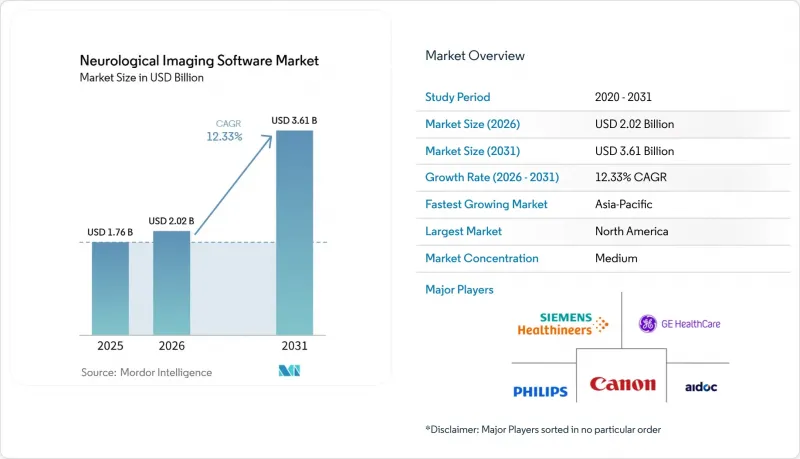
Mordor Intelligence에 의하면, 신경 영상 진단 소프트웨어 시장 규모는 2025년 17억 6,000만 달러로 평가되었고, 2026년에는 20억 2,000만 달러로 확대되어 2026-2031년 CAGR 12.33%로 성장을 지속할 전망이며, 2031년에는 36억 1,000만 달러에 이를 것으로 예측됩니다.
본 보고서는 소프트웨어 유형별(통합형, 독립형), 영상 진단법별(MRI, CT, PET, SPECT, EEG/MEG, 기타), 용도별(진단, 조사, 기타), 도입 형태별(온프레미스, 클라우드 기반, 하이브리드), 최종 사용자별(병원, 영상진단센터, 연구기관, 제약·바이오기술 기업, 기타), 지역별(북미, 유럽, 아시아태평양, 중동, 남미)로 분류되어 있습니다.
세계의 신경 영상 진단 소프트웨어 시장 동향 및 인사이트
질병 부담 증가로 인해 환자 1인당 영상 진단 기간이 장기화되고 있습니다.
신경 영상 진단 소프트웨어 시장은 장기적인 신경 질환 관리 수요 증가로 인해 혜택을 보고 있습니다. 38개국, 4억 7,000만 명을 대상으로 한 2026년 조사에 따르면, 연령 조정 사망률은 감소하고 있음에도 불구하고, 특히 알츠하이머병, 파킨슨병, 다발성 경화증, 뇌졸중의 경우 신경 장애 유병률이 여전히 높은 수준을 유지하고 있는 것으로 나타났습니다. 이러한 질환의 경우, 수년에 걸쳐 반복적으로 MRI 검사를 받아야 하는 경우가 많습니다. 따라서 다발성 경화증이나 알츠하이머병 환자는 단일 진단용 스캔이 아닌 일련의 영상 검사가 필요할 수 있습니다. 세계 뇌졸중 기구(World Stroke Organization)는 2050년까지 전 세계 뇌졸중 유병 수가 58% 증가할 것으로 예측했습니다. 뇌 용적 측정, 병변 추적, 병세 진행 평가를 지원하는 의료 제공업체는 신경 영상 진단 소프트웨어 시장에서 이러한 반복적인 임상적 요구에 부응할 수 있습니다.
AI를 활용한 정량화가 신경방사선학 워크플로우의 경제성을 혁신
또한, 임상 팀이 일상적인 영상 판독 업무 시간을 단축하고자 노력함에 따라 신경 영상 진단 소프트웨어 시장도 발전하고 있습니다. 2025년 조사에 따르면, 미국 신경방사선과 진료 현장에서 AI 도구의 도입률은 2017년 24.7%에서 2024년에는 61.4%로 상승했습니다. 같은 조사에서 신경방사선과 전문의의 78.7%가 적어도 한 가지 이상의 번아웃 증상을 겪고 있으며, 38.6%가 예정보다 일찍 은퇴할 의향이 있다고 보고한 것으로 밝혀졌습니다. 소프트웨어는 전문의에게 위양성 재검토라는 부담을 주지 않으면서 일상 업무를 줄여야 합니다. 신경방사선과 채용 인원과 훈련을 받은 졸업생 수 사이에 오랫동안 존재해 온 격차는 실용적인 정량화 도구의 필요성을 한층 더 시급하게 만들고 있습니다. 지멘스 헬스인어즈는 2026년 1월, ‘AI-Rad Companion Brain MR’에 대해 FDA의 510(k) 승인을 획득하며, 자동화된 정량적 뇌 MRI 분석에 대한 의료 기관의 관심이 여전히 높음을 보여주었습니다.
레거시 시스템 통합 비용이 도입의 구조적 장벽이 되고 있다.
신경 영상 진단 소프트웨어 시장은 새로운 도구를 기존 시스템에 통합할 때 실질적인 제약에 직면해 있습니다. 병원은 호환되지 않는 데이터 모델을 사용할 가능성이 있는 PACS, DICOM-SR, HL7 FHIR 및 전자의무기록과 AI 용도를 연동해야 합니다. 이 작업에는 맞춤형 미들웨어가 필요할 수 있으며, 이로 인해 임상 도입이 6-18개월 지연될 가능성이 있습니다. 이러한 부담은 구형 PACS 인프라를 운영 중인 유럽 및 아시아태평양의 지방 병원에서 더욱 두드러집니다. GE 헬스케어는 거점 간 통합된 워크플로우 구축을 목표로 하는 클라우드 네이티브 진단 뷰어 ‘View’에 대해 FDA 승인을 획득했습니다. 비록 이 기술로 인해 도입 장벽이 낮아졌습니다고 하더라도, 병원은 여전히 임상 및 IT 직원을 대상으로 교육을 실시하고, 각 도구를 현지의 장비 및 프로토콜에 맞추어 검증해야 합니다.
부문 분석
2025년에는 통합형 소프트웨어가 매출의 68.5%를 차지했습니다. 이는 방사선과 의사, 신경과 의사, 뇌신경외과 의사가 단일 워크플로우 내에서 데이터를 공유해야 하는 병원 환경에 적합합니다. 따라서 신경 영상 진단 소프트웨어 시장에서는 대규모 의료 시스템 내 플랫폼의 연속성이 계속해서 중요시되고 있습니다. 지멘스 헬스케어는 ECR 2025에서 스캐너 제품군 전반에 걸친 MRI, CT, AI 용도를 위한 구독형 제품군인 ‘Syngo Flexinity’를 발표했습니다. 이 모델을 통해 개별 용도마다 라이선스를 따로 결정해야 하는 번거로움이 줄어듭니다. 또한 의료 서비스 제공업체에게는 향후 소프트웨어 업데이트에 대한 로드맵도 제공됩니다.
독립형 소프트웨어는 2026-2031년 연평균 성장률(CAGR) 12.4%를 나타낼 것으로 예측됩니다. 알츠하이머병 임상시험 코호트나 다발성 경화증 모니터링을 관리하는 구매자는 단일 임상 작업에서 높은 성능을 발휘하는 전문적인 도구를 선택할 가능성이 높습니다. 따라서 신경 영상 진단 소프트웨어 업계에서는 통합형 시스템 외에도 전문 모듈을 제공할 수 있습니다. 이러한 모듈은 일반적으로 핵심 영상 진단 플랫폼을 대체하기보다는 기존 워크플로우에 추가되어 사용됩니다. 이를 통해 OEM 공급업체나 특화 소프트웨어 기업이 동일한 병원 고객에게 서비스를 제공할 여지가 생깁니다. 또한, 특정 질환 적응증에 대한 근거가 조달 결정에 있어 중요한 요소가 될 것입니다.
2025년 기준, MRI 소프트웨어는 매출의 42.2%를 차지했으며, 영상 진단 모달리티 중 가장 큰 신경 영상 진단 소프트웨어 시장 규모를 기록했습니다. MRI는 뇌졸중, 종양, 간질, 다발성 경화증 및 신경퇴행성 질환의 평가에 폭넓게 활용되고 있습니다. PET 소프트웨어는 2031년까지 연평균 성장률(CAGR) 13.3%를 나타낼 것으로 예측됩니다. 이 소프트웨어의 도입은 치료 프로그램 및 임상 연구에서 아밀로이드와 타우의 정량적 바이오마커 평가와 밀접하게 연관되어 있습니다. CT 소프트웨어는 치료까지의 시간이 극히 중요한 급성 뇌졸중의 분류 과정에서 여전히 중요한 역할을 하고 있습니다. Harrison.ai사는 2026년 3월, 6개 혈관 영역에 걸친 조영제 미사용 CT를 이용한 급성 경색 분류에 대해 FDA 승인을 획득했습니다.
SPECT 소프트웨어는 관류 영상 및 간질 병소 파악에서 여전히 명확한 역할을 유지하고 있습니다. EEG 및 MEG 시각화 소프트웨어는 소아 간질 센터와 수술 전 매핑 분야에서 활용이 확대되고 있습니다. 이러한 도구는 구조적 MRI만으로는 불충분한 경우 병소 위치를 파악하는 데 도움을 줄 수 있습니다. 다중 모드 소프트웨어 및 기능적 근적외선 분광법(fNIRS) 소프트웨어는 신경 영상 진단 소프트웨어 시장에서 여전히 발전 중인 분야입니다. 학술 기관 및 인지신경과학 연구소에서는 독자적인 연구 용도에 맞추어 이러한 기능을 확충하고 있습니다. 그 결과 발생하는 수요는 MRI나 CT 분석에 대한 광범위한 수요보다는 전문적이지만, 특정 임상 및 연구 환경에서 공급업체에게 비즈니스 기회를 제공합니다.
지역별 분석
2025년, 북미는 전 세계 매출의 41.1%를 차지하며 지역별 신경 영상 진단 소프트웨어 시장에서 가장 큰 점유율을 기록했습니다. 미국에는 학술 의료 센터가 밀집해 있으며, FDA 승인을 받은 신경 영상 진단 AI 제품도 다수 존재합니다. 지멘스,GE 헬스케어, Aidoc, Viz.ai, RapidAI 및 Cercare Medical은 2026년 1월부터 6월 사이에 새로운 승인을 획득했습니다. FDA의 ‘의료기기용 소프트웨어(Software as a Medical Device)’ 프레임워크는 미국 시장에 진출하는 공급업체에게 확립된 경로를 제공합니다. 또한, 첨단 신경 영상 진단에 대한 메디케어 및 민간 보험의 보상도 의료 제공업체들의 도입을 촉진하고 있습니다. 캐나다의 원격 뇌졸중 네트워크와 멕시코에서 지속적으로 성장하고 있는 민간 신경학 분야도 지역적 수요를 끌어올리고 있지만, 미국이 여전히 주요 수요 거점으로 자리 잡고 있습니다.
유럽은 신경 영상 진단 소프트웨어 시장에서 두 번째로 큰 규모를 자랑하는 지역입니다. 독일, 영국, 프랑스가 주요 수요 거점입니다. EU의 AI법 및 의료기기 규정 요건으로 인해 신경 영상 진단 도구에 대한 검증에 대한 기대가 높아지고 있습니다. 이러한 요건을 충족하는 공급업체는 유럽 전역에서의 조달 과정에서 신뢰도를 높일 수 있습니다. 독일에 본사를 둔 mediaire사와 VEObrain사는 DACH(독일, 오스트리아, 스위스) 시장의 임상 사용자에게 서비스를 제공하고 있으며, EBRAINS사는 공통된 데이터 거버넌스 하에서 다국간 연구를 지원하고 있습니다. 영국의 국민보건서비스(NHS)는 Heuron을 포함한 국제적인 공급업체와 제휴를 추진하고 있으며, 프랑스, 이탈리아, 스페인에서는 활발한 학술 신경학 네트워크가 전개되고 있습니다.
아시아태평양은 2026-2031년 연평균 성장률(CAGR) 12.6%를 나타낼 것으로 예측되며, 이는 신경 영상 진단 소프트웨어 시장에서 지역별 가장 높은 성장률입니다. 일본에서는 PMDA(의약품 및 의료기기 종합기구)가 규제하는 승인 절차가 채택되어 있으며, 이를 통해 국내 신경 영상 AI 제품이 지원되고 있습니다. LPixel사는 2025년 6월, 위양성을 줄이고 92.3%의 민감도를 보고한 EIRL 뇌동맥류 모델의 업데이트에 대해 PMDA의 승인을 획득했습니다. 후지필름 헬스케어는 2025년 1월, 3가지 뇌 MRI 판독 지원 기능을 갖춘 ‘SYNAPSE SAI 뷰어 Ver2.6’을 일본에서 출시했습니다. 중국의 UII 시스템은 111개의 뇌 영역을 자동으로 분할하는 한편, 한국의 Neurophet은 2026년 1월 세 번째 FDA 510(k) 승인을 획득하며 사업을 확대되고 있습니다. 인도와 호주에서는 신경과학 분야에 대한 학술 투자 및 의료의 디지털화를 통해 수요가 조성되고 있는 반면, GCC 국가, 브라질, 아르헨티나에서는 인프라 및 보험 환급 제도의 격차로 인해 제약을 받는 측면도 있으나, 장기적인 기회가 기대되고 있습니다.
기타 혜택 :
- 엑셀 형식 시장 예측(ME) 시트
- 3개월간의 애널리스트 지원
자주 묻는 질문
목차
제1장 서론
제2장 조사 방법
제3장 개요
제4장 시장 구도
제5장 시장 규모 및 성장 예측
제6장 경쟁 구도
제7장 시장 기회 및 향후 전망
AJY 26.09.01According to Mordor Intelligence, the neurological imaging software market size is expected to grow from USD 1.76 billion in 2025 to USD 2.02 billion in 2026 and is forecast to reach USD 3.61 billion by 2031 at 12.33% CAGR over 2026-2031.
This report is Segmented by Software Type (Integrated, Standalone), Imaging Modality (MRI, CT, PET, SPECT, EEG/MEG, Others), Application (Diagnostics, Research, Others), Deployment (On-Premises, Cloud-Based, Hybrid), End User (Hospitals, Imaging Centers, Research Institutes, Pharma/Biotech, Others), and Geography (North America, Europe, Asia Pacific, Middle East, South America)
Global Neurological Imaging Software Market Trends and Insights
Rising Disease Burden Extends the Per-Patient Imaging Window
The neurological imaging software market benefits from a growing need to manage long-duration neurological conditions. A 2026 study covering 470 million people in 38 countries found that neurological disability remained high even as age-adjusted death rates declined, particularly for Alzheimer's disease, Parkinson's disease, multiple sclerosis, and stroke. These conditions often require repeated MRI examinations over many years. A patient with multiple sclerosis or Alzheimer's disease may therefore generate serial imaging needs rather than one diagnostic scan. The World Stroke Organization projects a 58% increase in prevalent stroke cases worldwide by 2050. Providers that support brain volume measurement, lesion tracking, and progression review can serve this repeated clinical demand within the neurological imaging software market.
AI-Assisted Quantification Reshapes Neuroradiology Workflow Economics
The neurological imaging software market is also advancing as clinical teams seek to shorten routine interpretation work. AI tool availability in United States neuroradiology practices rose from 24.7% in 2017 to 61.4% in 2024, according to a 2025 survey. The same survey found that 78.7% of neuroradiologists had at least 1 burnout symptom, while 38.6% reported an intention to retire earlier than planned. Software must reduce routine work without creating false-positive review burdens for specialists. The long-running gap between neuroradiology job listings and trained graduates adds urgency to practical quantification tools. Siemens Healthineers received FDA 510(k) clearance for AI-Rad Companion Brain MR in January 2026, demonstrating continued institutional interest in automated quantitative brain MRI analysis.
Legacy System Integration Costs Create a Structural Adoption Barrier
The neurological imaging software market faces a practical constraint in the integration of new tools with existing systems. Hospitals must connect AI applications with PACS, DICOM-SR, HL7 FHIR, and electronic health records that may use incompatible data models. This work can require custom middleware and delay clinical activation by 6 to 18 months. The burden is more pronounced for regional hospitals in Europe and Asia Pacific that operate older PACS infrastructure. GE HealthCare received FDA clearance for its cloud-native View diagnostic viewer, which is intended to create a unified workflow across locations. Even where the technology reduces friction, hospitals must still train clinical and information technology staff and validate each tool against local equipment and protocols.
Other drivers and restraints analyzed in the detailed report include:
- Cloud-Native Platforms Enable Multi-Site Clinical and Research Collaboration
- Imaging Biomarkers in CNS Drug Development Create a New Software Demand Category
- Regulatory Evidence Demands Limit Generalizability of Neuroimaging AI
For complete list of drivers and restraints, kindly check the Table Of Contents.
Segment Analysis
Integrated software held 68.5% of revenue in 2025. It fits hospital environments where radiologists, neurologists, and neurosurgeons need to share data in one workflow. The neurological imaging software market therefore continues to favor platform continuity in large health systems. Siemens Healthineers introduced Syngo Flexinity at ECR 2025 as a subscription suite for MRI, CT, and AI applications across scanner fleets. The model reduces separate licensing decisions for individual applications. It also gives providers a path to future software updates.
Standalone software is projected to grow at a 12.4% CAGR from 2026 to 2031. Buyers who manage Alzheimer's trial cohorts or multiple sclerosis monitoring may select specialized tools for strong performance in a single clinical task. The neurological imaging software industry can therefore support specialist modules alongside integrated systems. These modules are usually added to an existing workflow rather than used to replace the core imaging platform. This creates room for OEM suppliers and focused software firms to serve the same hospital account. It also makes evidence for a specific disease indication an important part of procurement decisions.
MRI software held 42.2% of revenue in 2025, the largest neurological imaging software market size among imaging modalities. MRI is used across stroke, tumors, epilepsy, multiple sclerosis, and neurodegenerative disease assessment. PET software is forecast to grow at a 13.3% CAGR through 2031. Its adoption is tied to quantitative amyloid and tau biomarker assessment in treatment programs and clinical studies. CT software remains important in acute stroke triage, where time to treatment is critical. Harrison.ai received FDA clearance in March 2026 for acute infarct triage on non-contrast CT across 6 vascular territories.
SPECT software retains a defined role in perfusion imaging and epileptic focus localization. EEG and MEG visualization software is gaining use in pediatric epilepsy centers and pre-surgical mapping. These tools can support source localization where structural MRI alone is insufficient. Multimodal software and functional near-infrared spectroscopy software remain earlier-stage areas of the neurological imaging software market. Academic centers and cognitive neuroscience laboratories are expanding these capabilities for differentiated research use. The resulting demand is more specialized than the broad demand for MRI and CT analysis, but it provides suppliers with opportunities in focused clinical and research settings.
Complete Report Scope:
- Software Type
- Integrated Software
- Standalone Software
- Imaging Modality
- MRI Software
- CT Software
- PET Software
- SPECT Software
- EEG and MEG Visualization and Analysis Software
- Others (fNIRS Software, Multimodal Neuroimaging Software, etc)
- Application
- Clinical Diagnostics
- Research Applications
- Others (Drug Development, Clinical Trials, etc.)
- Deployment
- On-Premises
- Cloud-Based
- Hybrid
- End User
- Hospitals and Health Systems
- Diagnostic Imaging Centers
- Academic Medical Centers and Research Institutes
- Pharmaceutical and Biotechnology Companies
- Others (Contract Research Organizations, Specialty Neurology and Neurosurgery Clinics)
- Geography
- North America
- United States
- Canada
- Mexico
- Europe
- Germany
- United Kingdom
- France
- Italy
- Spain
- Rest of Europe
- Asia-Pacific
- China
- Japan
- India
- South Korea
- Australia
- Rest of Asia-Pacific
- Middle East
- GCC
- South Africa
- Rest of Middle East
- South America
- Brazil
- Argentina
- Rest of South America
- North America
Geography Analysis
North America held 41.1% of global revenue in 2025, the leading neurological imaging software market share by region. The United States has a dense base of academic medical centers and a high number of FDA-cleared neuroimaging AI products. Siemens, GE HealthCare, Aidoc, Viz.ai, RapidAI, and Cercare Medical obtained new clearances between January and June 2026. The FDA Software as a Medical Device framework offers an established route for suppliers entering the United States. Medicare and commercial reimbursement for advanced neuroimaging also supports provider adoption. Canada's telestroke networks and Mexico's growing private neurology sector add regional demand, although the United States remains the main volume center.
Europe is the second-largest regional area for the neurological imaging software market. Germany, the United Kingdom, and France are the main demand centers. EU AI Act and Medical Device Regulation requirements have raised validation expectations for neuroimaging tools. Suppliers that meet those requirements can gain credibility in broader European procurement. Germany-based mediaire and VEObrain serve clinical users in DACH markets, while EBRAINS supports multi-country research under common data governance. The United Kingdom National Health Service is engaging with international vendors, including Heuron, while France, Italy, and Spain provide active academic neurology networks.
Asia Pacific is forecast to grow at a 12.6% CAGR from 2026 to 2031, the fastest regional growth rate in the neurological imaging software market. Japan uses a PMDA-regulated pathway that has supported domestic neuroimaging AI products. LPixel received PMDA approval in June 2025 for an EIRL Brain Aneurysm model update that reduced false positives and reported 92.3% sensitivity. FUJIFILM Healthcare launched SYNAPSE SAI viewer Ver2.6 in Japan in January 2025 with 3 brain MRI reading support functions. China's UII system automatically segments 111 brain regions, while South Korea's Neurophet is expanding after a third FDA 510(k) clearance in January 2026. India and Australia are building demand through academic neuroscience investment and healthcare digitization, while GCC countries, Brazil, and Argentina offer longer-term opportunities constrained by infrastructure and reimbursement gaps.
- Siemens Healthineers
- GE HealthCare Technologies Inc.
- Koninklijke Philips
- Canon
- Agfa-Gevaert
- FUJIFILM Healthcare Corporation
- Brain Lab
- MIM Software
- QMENTA Inc.
- Viz.ai Inc.
- Aidoc Medical Ltd.
- RapidAI Inc.
- TeraRecon Inc.
- Pro Medicus Limited
- Novarad
- Esaote S.p.A.
- AQUILAB
- IXICO
- Brainomix Ltd.
- Quibim S.L.
- Pixyl SAS
- Imaging Biometrics, LLC
- NeuroLogica
Additional Benefits:
- The market estimate (ME) sheet in Excel format
- 3 months of analyst support
TABLE OF CONTENTS
1 INTRODUCTION
- 1.1 Study Assumptions and Market Definition
- 1.2 Scope of the Study
2 RESEARCH METHODOLOGY
3 EXECUTIVE SUMMARY
4 MARKET LANDSCAPE
- 4.1 Market Overview
- 4.2 Market Drivers
- 4.2.1 Rising Burden of Stroke, Dementia, Multiple Sclerosis, Epilepsy, Brain Tumors, and Traumatic Brain Injury
- 4.2.2 AI-Assisted Quantification and Shorter Neurological Imaging Turnaround Times
- 4.2.3 Expansion of Cloud-Native Imaging and Cross-Site Neuroimaging Data Collaboration
- 4.2.4 Growing Demand for Imaging Biomarkers in Precision Neurology and CNS Clinical Trials
- 4.2.5 Rising Need to Standardize Longitudinal Brain Measurement Across Scanners and Sites
- 4.2.6 Neurovascular Care Coordination and Time-to-Treatment Optimization
- 4.3 Market Restraints
- 4.3.1 High Integration, Validation, and Lifecycle Cost Across Legacy PACS, EHR, and Modalities
- 4.3.2 Regulatory and Evidence Burden for Generalizable Neuroimaging AI
- 4.3.3 Inter-Scanner, Protocol, and Population Variability That Weakens Algorithm Reproducibility
- 4.3.4 Shortage of Neuro-Radiology, Imaging Informatics, and AI Validation Expertise
- 4.4 Value and Supply-Chain Analysis
- 4.5 Regulatory Landscape
- 4.6 Technological Outlook
- 4.7 Porters Five Forces Analysis
5 MARKET SIZE AND GROWTH FORECASTS
- 5.1 Software Type
- 5.1.1 Integrated Software
- 5.1.2 Standalone Software
- 5.2 Imaging Modality
- 5.2.1 MRI Software
- 5.2.2 CT Software
- 5.2.3 PET Software
- 5.2.4 SPECT Software
- 5.2.5 EEG and MEG Visualization and Analysis Software
- 5.2.6 Others (fNIRS Software, Multimodal Neuroimaging Software, etc)
- 5.3 Application
- 5.3.1 Clinical Diagnostics
- 5.3.2 Research Applications
- 5.3.3 Others (Drug Development, Clinical Trials, etc.)
- 5.4 Deployment
- 5.4.1 On-Premises
- 5.4.2 Cloud-Based
- 5.4.3 Hybrid
- 5.5 End User
- 5.5.1 Hospitals and Health Systems
- 5.5.2 Diagnostic Imaging Centers
- 5.5.3 Academic Medical Centers and Research Institutes
- 5.5.4 Pharmaceutical and Biotechnology Companies
- 5.5.5 Others (Contract Research Organizations, Specialty Neurology and Neurosurgery Clinics)
- 5.6 Geography
- 5.6.1 North America
- 5.6.1.1 United States
- 5.6.1.2 Canada
- 5.6.1.3 Mexico
- 5.6.2 Europe
- 5.6.2.1 Germany
- 5.6.2.2 United Kingdom
- 5.6.2.3 France
- 5.6.2.4 Italy
- 5.6.2.5 Spain
- 5.6.2.6 Rest of Europe
- 5.6.3 Asia-Pacific
- 5.6.3.1 China
- 5.6.3.2 Japan
- 5.6.3.3 India
- 5.6.3.4 South Korea
- 5.6.3.5 Australia
- 5.6.3.6 Rest of Asia-Pacific
- 5.6.4 Middle East
- 5.6.4.1 GCC
- 5.6.4.2 South Africa
- 5.6.4.3 Rest of Middle East
- 5.6.5 South America
- 5.6.5.1 Brazil
- 5.6.5.2 Argentina
- 5.6.5.3 Rest of South America
- 5.6.1 North America
6 COMPETITIVE LANDSCAPE
- 6.1 Market Concentration
- 6.2 Market Share Analysis
- 6.3 Company Profiles (includes Global Level Overview, Market Level Overview, Core Segments, Financials as available, Strategic Information, Market Rank/Share, Products and Services, Recent Developments)
- 6.3.1 Siemens Healthineers AG
- 6.3.2 GE HealthCare Technologies Inc.
- 6.3.3 Koninklijke Philips N.V.
- 6.3.4 Canon Medical Systems Corporation
- 6.3.5 Agfa-Gevaert Group
- 6.3.6 FUJIFILM Healthcare Corporation
- 6.3.7 Brainlab AG
- 6.3.8 MIM Software Inc.
- 6.3.9 QMENTA Inc.
- 6.3.10 Viz.ai Inc.
- 6.3.11 Aidoc Medical Ltd.
- 6.3.12 RapidAI Inc.
- 6.3.13 TeraRecon Inc.
- 6.3.14 Pro Medicus Limited
- 6.3.15 Novarad Corporation
- 6.3.16 Esaote S.p.A.
- 6.3.17 AQUILAB SAS
- 6.3.18 IXICO plc
- 6.3.19 Brainomix Ltd.
- 6.3.20 Quibim S.L.
- 6.3.21 Pixyl SAS
- 6.3.22 Imaging Biometrics, LLC
- 6.3.23 NeuroLogica Corporation
7 MARKET OPPORTUNITIES AND FUTURE OUTLOOK
- 7.1 White-Space and Unmet-Need Assessment
- 7.2 Future Outlook


