
|
시장보고서
상품코드
2118204
차아염소산 나트륨 시장 : 시장 점유율 분석, 업계 동향 및 통계, 성장 예측(2026-2031년)Sodium Hypochlorite - Market Share Analysis, Industry Trends & Statistics, Growth Forecasts (2026 - 2031) |
||||||
 Mordor Intelligence
Mordor Intelligence에 의하면, 차아염소산 나트륨 시장 규모는 2025년에 3억 5,276만 달러로 평가되었고, 2026년 3억 6,843만 달러에서 2031년까지 4억 7,172만 달러에 이를 것으로 예측되며, 예측 기간(2026-2031년) CAGR은 5.07%를 나타낼 전망입니다.
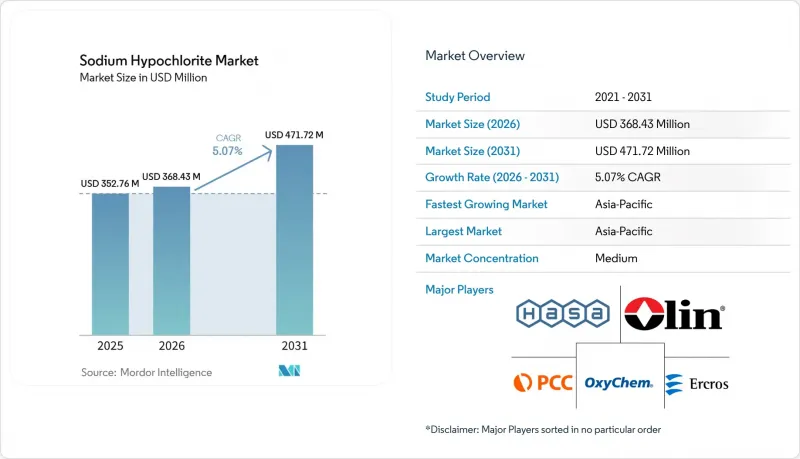
본 보고서는 용도별(소독·위생 관리, 표백, 산화제, 탈취(악취 제어), 기타), 분야별(수처리, 가정용, 섬유, 펄프·제지, 의료, 화학 처리, 기타), 지역별(아시아태평양, 북미, 유럽, 남미, 중동 및 아프리카)로 분류되어 있습니다. 시장 전망은 금액(달러) 기준으로 제시되어 있습니다.
세계의 차아염소산 나트륨 시장 동향 및 인사이트
상수도 처리 분야에서 차아염소산 나트륨의 채택 확대
상수도 처리 분야에서 차아염소산 나트륨으로의 전환은 여전히 차아염소산 나트륨 시장의 최대 수요 요인으로 작용하고 있습니다. 상수도 유틸리티자들은 염소 가스에서 차아염소산 나트륨으로의 전환을 추진하고 있으며, 처리 시설에서는 보다 안전한 보관, 더 간편한 취급, 그리고 대중에 대한 위험 감소가 요구되고 있습니다. 미국에서는 2026 회계연도 차아염소산 나트륨 염소 주입 시스템 업그레이드를 위한 프로젝트 자금이 계상되어 있으며, 이는 이러한 전환이 단순한 운영상의 선호뿐만 아니라 직접적인 공공 지출에 의해 뒷받침되고 있음을 보여줍니다. 인도에서는 확대된 ‘잘 지반 미션(Jal Jivan Mission)’에 따라 농촌 지역의 상수도 공급 계획에 염소 소독 시스템이 요구되고 있으며, 이로 인해 기본적인 상수도 서비스 확대와 연계된 명확한 다년간 수요 흐름이 차아염소산 나트륨 시장에 발생하고 있습니다. 또한 현장에서 직접 생산함으로써 장거리 화학약품 운송에 대한 의존도가 낮아지므로, 지자체 운영은 공급 중단이나 보관 중 손실의 영향을 덜 받게 됩니다. 이처럼 안전성, 정책 지원, 그리고 운영의 회복력이 결합되어 예측 기간 동안 차아염소산 나트륨 시장에는 유틸리티 분야에서 안정적인 수요 기반이 형성될 것입니다.
의료 및 식품 가공 분야의 살균 용도 확대
의료 분야는 2031년까지 연평균 성장률(CAGR)이 6.4%로 예측되며, 여전히 차아염소산 나트륨 시장에서 가장 빠르게 성장하는 용도입니다. 병원, 진료소, 진단 시설에서는 일상적인 위생 프로토콜 및 대규모 시설의 업무 흐름에 부합하는 신뢰할 수 있는 표면 소독이 요구됨에 따라 수요가 증가하고 있습니다. 이러한 추세는 의료 인프라 확장에 따라 새로운 시설이 늘어나고 일일 청소량이 증가하고 있는 아시아태평양 및 중동에서 특히 두드러집니다. 식품 가공 분야도 차아염소산 나트륨 시장을 뒷받침하고 있습니다. 이 분야의 위생 관리에 대한 지출은 선택적 구매라기보다는 규제 준수, 공장 가동률 유지 및 오염 방지와 직결되기 때문입니다. 이러한 최종 용도 구매자들은 보다 신뢰할 수 있는 품질 관리가 이루어진 검증된 배합 제품을 선호하는 경향이 있으며, 이는 고사양 제품에 대한 수요 증가를 뒷받침하고 있습니다. 이러한 변화는 차아염소산 나트륨 시장의 성장 일부를 순수한 원자재 가격의 영향을 덜 받는 용도로 전환하는 데 도움이 되므로 중요한 의미를 지닙니다.
보관 및 운송 중 열화로 인한 제품 안정성의 한계
제품의 불안정성은 차아염소산 나트륨 시장에서 여전히 가장 뿌리 깊은 운영상의 제약으로 남아 있습니다. 올린(Olin)사는 2025년 제품 스튜어드십 매뉴얼에서 보관 온도가 10°C 상승할 때마다 분해 속도가 2-4배 가속화될 가능성이 있다고 밝혔습니다. 이는 특히 12.5% 용액이 고온 기후 하에서 장거리 운송될 경우, 보관 및 운송 중에 유효 염소량이 현저히 감소할 가능성이 있음을 의미합니다. 따라서 주변 온도가 높아 실용적인 보관 기간이 단축되는 지역에서는 차아염소산 나트륨 시장에서 현지 생산자나 현장 생산이 유리해집니다. 이러한 제약은 운송 거리나 보관 조건이 납품 시 품질에 직접적인 영향을 미치는 동남아시아, 중동 및 남미의 일부 지역에서 특히 두드러집니다. 또한 유럽에서도 음용수 처리에 사용되는 차아염소산 나트륨의 순도 및 보관에 관한 지침이 EN 901:2024로 개정됨에 따라 규정 준수에 대한 기대치가 더욱 엄격해졌습니다.
부문 분석
2025년, 소독 및 위생 분야는 차아염소산 나트륨 시장 점유율의 51.83%를 차지했으며, 수요의 대부분이 여전히 핵심적인 위생 이용 사례에서 비롯되고 있음이 확인되었습니다. 이러한 위상은 수처리, 의료, 식품 가공, 가정용 세척과 같은 분야에 뿌리를 두고 있으며, 이러한 분야에서는 차아염소산 나트륨이 널리 수용되고 도입도 용이합니다. 또한, 이 부문은 식수 처리 관련 규제에 대한 익숙함도 호재로 작용하고 있으며, 규정 준수 체계에서는 확립된 소독용 화학 물질이 계속해서 우선시되고 있습니다. 차아염소산 나트륨 시장의 표백 용도는 아시아태평양 산업 거점의 섬유, 펄프 및 제지 업계 수요에 의해 뒷받침되고 있습니다. 산화제 및 기타 기능은 비록 주요 성장이 다른 용도에서 발생하더라도, 화학 합성 및 농업 위생 분야 수요를 유지함으로써 차아염소산 나트륨 시장의 안정성에 기여하고 있습니다.
탈취(악취 제어)는 2031년까지 연평균 성장률(CAGR) 5.72%를 나타낼 것으로 예측되며, 차아염소산 나트륨 시장에서 가장 빠르게 성장하는 용도가 될 전망입니다. 이러한 성장은 폐수 처리, 축산 시설 관리 및 도시 쓰레기 처리와 관련이 있으며, 이러한 분야에서는 종종 악취 억제와 미생물 제어를 병행해야 할 필요가 있습니다. 또한, 북미와 유럽에서는 하수도망의 노후화가 진행되고 있어, 유틸리티자가 오래된 시스템을 갱신함에 따라 인라인 악취 관리 프로그램에 대한 지속적인 수요가 발생하고 있습니다. 동시에, 펄프 표백 분야에서 지속가능성에 대한 압박으로 인해 염소계 표백의 장기적인 매력이 제한되고 있으며, 이로 인해 차아염소산 나트륨 시장에서 소독 및 탈취의 상대적 위상이 높아지고 있습니다.
지역별 분석
아시아태평양은 2025년에 차아염소산 나트륨 시장 점유율의 41.63%를 차지한 것으로 평가되었으며, 2031년까지 연평균 성장률(CAGR) 5.87%로 성장할 것으로 전망되어 가장 크고 가장 빠르게 성장하는 지역 블록이 될 것입니다. 이 지역은 도시 상수도 인프라의 확대, 활발한 산업 활동, 그리고 지자체 및 상업시설에서의 광범위한 위생 수요의 혜택을 받고 있습니다. 인도는 차아염소산 나트륨 시장의 주요 견인차 역할을 하고 있습니다. 이는 ‘자르 지반 미션(Jal Jivan Mission)’을 통해 2019년 이후 농촌 지역의 상수도 보급률이 가구의 16.7%에서 80% 이상으로 확대되었으며, 해당 미션의 연장 단계에서도 계속해서 염소 소독 시스템이 필요하기 때문입니다. 일본과 한국은 의료 위생, 식품 가공의 위생 관리, 그리고 산업용 세정 용도를 통해 품질을 중시하는 안정적인 수요층을 형성하고 있습니다.
북미 수요는 지속적인 수질 안전에 대한 투자와 성숙한 산업용 세척 인프라에 의해 뒷받침되고 있습니다. 미국에서는 지자체 상수도 시스템에서 염소 가스 사용 폐지가 진행되고 있으며, 캘리포니아주 상수도 관리자 협회(ACWA)의 2026 회계연도 자금 배분 사례에서도 차아염소산 나트륨 시스템으로의 전환이 그 이행 과정에서 여전히 중요한 역할을 하고 있음을 알 수 있습니다. 2026년 1월 버크셔 해서웨이(Berkshire Hathaway)가 옥시켐(Oxychem)을 인수함에 따라, 해당 지역의 염소·알칼리 산업 내 생산 능력 집중이 더욱 강화되어 향후 대규모 구매자와공급 협상에 영향을 미칠 가능성이 있습니다. 캐나다와 멕시코는 상수도 인프라 사업 및 식품 및 음료 가공을 통해 차아염소산 나트륨 시장에 점진적인 성장을 가져오고 있으며, 멕시코는 미국 공급원과의 지리적 근접성이라는 이점도 누리고 있습니다.
유럽은 여전히 차아염소산 나트륨 시장에서 중요한 위치를 차지하고 있지만, 규제 강화와 높은 전력 비용으로 인해 전망이 다소 제한적입니다. EN 901:2024 규격에 따라 음용수 처리에 사용되는 차아염소산 나트륨에 대한 순도 및 표시 요건이 강화됨에 따라, 보다 견고한 품질 관리 체제와 엄격한 공급망 관리를 갖춘 공급업체가 유리해질 것입니다. 국제에너지기구(IEA) 보고서에 따르면, 2025년 EU의 산업용 전력 가격은 미국의 2배 이상을 유지하고 있으며, 이는 유럽의 염소-알칼리 사업의 이익률에 지속적인 압박을 가하고 있습니다. 남미는 차아염소산 나트륨 시장에 있어 유망한 성장 지역이며, 특히 브라질에서는 도시 확장과 펄프 관련 화학물질에 대한 수요가 염소 밸류체인 전반에 걸친 투자를 촉진하고 있습니다. 중동 및 아프리카는 차아염소산 나트륨 시장에서 여전히 신흥 지역이며, 해수 담수화, 물 재이용 및 도시 하수 처리를 통해 수요가 필수적인 인프라와 밀접하게 연결되어 있습니다.
기타 혜택 :
- 엑셀 형식 시장 예측(ME) 시트
- 3개월간의 애널리스트 지원
자주 묻는 질문
목차
제1장 서론
제2장 조사 방법
제3장 개요
제4장 시장 구도
제5장 시장 규모 및 성장 예측
제6장 경쟁 구도
제7장 시장 기회 및 향후 전망
AJY 26.09.01According to Mordor Intelligence, the sodium hypochlorite market size was valued at USD 352.76 million in 2025 and is estimated to grow from USD 368.43 million in 2026 to reach USD 471.72 million by 2031, at a CAGR of 5.07% during the forecast period (2026-2031).
This report is Segmented by Function (Disinfection & Sanitization, Bleaching, Oxidizing Agent, Deodorization (Odor Control), and Other Functions), Application (Water Treatment, Household, Textile, Pulp & Paper, Healthcare, Chemical Processing, and More), and Geography (Asia-Pacific, North America, Europe, South America, and Middle-East and Africa). The Market Forecasts are Provided in Terms of Value (USD).
Global Sodium Hypochlorite Market Trends and Insights
Increasing Adoption of Sodium Hypochlorite for Municipal Water Treatment
The shift toward sodium hypochlorite for municipal water treatment remains the largest demand support in the sodium hypochlorite market. Utilities are moving away from chlorine gas, where treatment sites need safer storage, simpler handling, and lower public risk exposure. In the United States, FY2026 project funding for a sodium hypochlorite chlorination system upgrade shows that this transition is being backed by direct public spending rather than only operating preference. In India, the extended Jal Jeevan Mission requires chlorination systems for rural piped water supply schemes, which gives the sodium hypochlorite market a visible multi-year demand stream linked to basic water service expansion. On-site generation also reduces dependence on long-haul chemical deliveries, which makes municipal operations less exposed to supply interruptions and storage loss. This combination of safety, policy support, and operating resilience gives the sodium hypochlorite market a steady public-utility demand base through the forecast period.
Expanding Use in Healthcare and Food Processing Sanitization
Healthcare remains the fastest-growing application in the sodium hypochlorite market, with a projected 6.4% CAGR through 2031. Demand is rising because hospitals, clinics, and diagnostic settings need dependable surface disinfection that fits routine sanitation protocols and large facility workflows. This trend is especially relevant in Asia-Pacific and the Middle East, where healthcare infrastructure expansion is adding new facilities and increasing daily cleaning volumes. Food processing is also supporting the sodium hypochlorite market because sanitation spending in this channel is tied to compliance, plant uptime, and contamination prevention rather than discretionary purchasing. Buyers in these end uses tend to prefer validated formulations with more reliable quality control, which supports stronger demand for higher-specification products. That shift matters because it helps the sodium hypochlorite market move part of its growth toward applications that are less exposed to pure commodity pricing.
Limited Product Stability Due to Degradation During Storage and Transportation
Product instability remains the most persistent operational limit in the sodium hypochlorite market. Olin stated in its 2025 product stewardship manual that decomposition can accelerate by a factor of 2 to 4 for every 10 °C rise in storage temperature. That means active chlorine can decline materially during storage and transport, especially when a 12.5% solution is shipped over longer distances in hot climates. The sodium hypochlorite market, therefore, favors local producers and on-site generation in regions where high ambient temperature shortens practical shelf life. The constraint is especially relevant in Southeast Asia, the Middle East, and parts of South America, where transport radius and storage conditions directly affect delivered quality. Europe is also tightening compliance expectations because EN 901:2024 updated purity and storage guidance for sodium hypochlorite used in drinking water treatment.
Other drivers and restraints analyzed in the detailed report include:
- Increasing Preference for On-Site Sodium Hypochlorite Generation
- Growing Demand for Household Cleaning and Surface Disinfection
- Volatility in Chlor-Alkali Raw Material and Energy Costs
For complete list of drivers and restraints, kindly check the Table Of Contents.
Segment Analysis
Disinfection & sanitization held 51.83% of the sodium hypochlorite market share in 2025, which confirms that the largest part of demand still comes from core sanitation use cases. This position is rooted in water treatment, healthcare, food processing, and household cleaning, where sodium hypochlorite remains widely accepted and simple to deploy. The segment also benefits from regulatory familiarity in drinking water treatment, where compliance frameworks continue to favor established disinfection chemistries. Bleaching usage of the sodium hypochlorite market is supported by textile, pulp and paper demand across industrial centers in Asia-Pacific. Oxidizing agents and other functions add stability to the sodium hypochlorite market because they keep demand present in chemical synthesis and agricultural sanitation, even when headline growth comes from other uses.
Deodorization (odor control) is projected to grow at a 5.72% CAGR through 2031, making it the fastest-growing function in the sodium hypochlorite market. Growth is tied to wastewater treatment, livestock facility management, and municipal waste handling, where odor suppression and microbial control often need to happen together. Aging sewer networks in North America and Europe are also creating recurring demand for in-line odor management programs as utilities upgrade older systems. At the same time, sustainability pressure in pulp bleaching is limiting the long-run appeal of chlorine-based bleaching, which improves the relative position of disinfection and deodorization in the sodium hypochlorite market.
Complete Report Scope:
- By Function
- Disinfection & Sanitization
- Bleaching
- Oxidizing Agent
- Deodorization (Odor Control)
- Other Functions
- By Application
- Water Treatment
- Household
- Textile Industry
- Pulp & Paper Industry
- Healthcare
- Chemical Processing
- Agriculture
- Other Applications
- By Geography
- Asia-Pacific
- China
- India
- Japan
- South Korea
- Rest of Asia-Pacific
- North America
- United States
- Canada
- Mexico
- Europe
- Germany
- United Kingdom
- France
- Italy
- Russia
- Rest of Europe
- South America
- Brazil
- Argentina
- Rest of South America
- Middle-East and Africa
- Saudi Arabia
- South Africa
- Rest of Middle-East and Africa
- Asia-Pacific
Geography Analysis
Asia-Pacific held 41.63% of the sodium hypochlorite market share in 2025 and is projected to grow at a 5.87% CAGR through 2031, which makes it both the largest and fastest-growing regional block. The region benefits from urban water infrastructure expansion, strong industrial activity, and broad sanitation demand across municipal and commercial settings. India is a major support point for the sodium hypochlorite market because the Jal Jeevan Mission has expanded rural tap-water coverage from 16.7% to over 80% of households since 2019 and continues to require chlorination systems under its extended phase. Japan and South Korea contribute a steadier quality-driven layer of demand through healthcare sanitation, food processing hygiene, and industrial cleaning applications.
North America's demand is supported by ongoing water safety spending and a mature industrial cleaning base. The United States continues to move municipal systems away from chlorine gas, and the FY2026 Association of California Water Administrators (ACWA) funding example shows that sodium hypochlorite system upgrades remain an active part of that transition. Berkshire Hathaway's acquisition of OxyChem in January 2026 strengthens capacity concentration in the regional chlor-alkali base and may influence future supply negotiations for large buyers. Canada and Mexico add incremental growth to the sodium hypochlorite market through water infrastructure programs and food and beverage processing, while Mexico also benefits from geographic proximity to the U.S. supply.
Europe remains important in the sodium hypochlorite market, but its outlook is more constrained by regulatory stringency and high-power costs. EN 901:2024 raised purity and labeling expectations for sodium hypochlorite used in drinking water treatment, which favors suppliers with stronger quality systems and tighter supply-chain control. The International Energy Agency reported that EU industrial electricity prices in 2025 stayed more than twice U.S. levels, which continues to pressure European chlor-alkali margins. South America presents a useful growth pocket for the sodium hypochlorite market, especially in Brazil, where urban expansion and pulp-related chemical demand support broader chlorine value-chain investment. Middle-East and Africa remains an emerging zone in the sodium hypochlorite market, where desalination, water reuse, and municipal water treatment keep demand linked to essential infrastructure.
- Aditya Birla Chemicals (India) Limited
- AGC Inc.
- BONDALTI
- Ennore India Chemical
- Ercros S.A.
- Gujarat Alkalies and Chemicals Ltd.
- HASA, Inc.
- Nouryon
- Occidental Chemical Corporation (OxyChem)
- Olin Corporation
- PCC Group
- Tokuyama Corporation
- Tosoh Corporation
- Vynova Group
- Westlake Corporation
Additional Benefits:
- The market estimate (ME) sheet in Excel format
- 3 months of analyst support
TABLE OF CONTENTS
1 Introduction
- 1.1 Study Assumptions and Market Definition
- 1.2 Scope of the Study
2 Research Methodology
3 Executive Summary
4 Market Landscape
- 4.1 Market Overview
- 4.2 Market Drivers
- 4.2.1 Increasing Adoption of Sodium Hypochlorite for Municipal and Industrial Water Treatment
- 4.2.2 Growing Demand for Household Cleaning and Surface Disinfection Products
- 4.2.3 Rising Utilization in Textile, Pulp & Paper, and Chemical Processing Industries
- 4.2.4 Expanding Use in Healthcare and Food Processing Sanitation Applications
- 4.2.5 Increasing Preference for On-Site Sodium Hypochlorite Generation Systems
- 4.3 Market Restraints
- 4.3.1 Limited Product Stability Due to Degradation During Storage and Transportation
- 4.3.2 Stringent Safety, Handling, and Corrosion Management Requirements
- 4.3.3 Volatility in Chlor-Alkali Raw Material and Energy Costs
- 4.4 Value Chain Analysis
- 4.5 Porter's Five Forces Analysis
- 4.5.1 Threat of New Entrants
- 4.5.2 Bargaining Power of Suppliers
- 4.5.3 Bargaining Power of Buyers
- 4.5.4 Threat of Substitutes
- 4.5.5 Competitive Rivalry
5 Market Size and Growth Forecasts (Value)
- 5.1 By Function
- 5.1.1 Disinfection & Sanitization
- 5.1.2 Bleaching
- 5.1.3 Oxidizing Agent
- 5.1.4 Deodorization (Odor Control)
- 5.1.5 Other Functions
- 5.2 By Application
- 5.2.1 Water Treatment
- 5.2.2 Household
- 5.2.3 Textile Industry
- 5.2.4 Pulp & Paper Industry
- 5.2.5 Healthcare
- 5.2.6 Chemical Processing
- 5.2.7 Agriculture
- 5.2.8 Other Applications
- 5.3 By Geography
- 5.3.1 Asia-Pacific
- 5.3.1.1 China
- 5.3.1.2 India
- 5.3.1.3 Japan
- 5.3.1.4 South Korea
- 5.3.1.5 Rest of Asia-Pacific
- 5.3.2 North America
- 5.3.2.1 United States
- 5.3.2.2 Canada
- 5.3.2.3 Mexico
- 5.3.3 Europe
- 5.3.3.1 Germany
- 5.3.3.2 United Kingdom
- 5.3.3.3 France
- 5.3.3.4 Italy
- 5.3.3.5 Russia
- 5.3.3.6 Rest of Europe
- 5.3.4 South America
- 5.3.4.1 Brazil
- 5.3.4.2 Argentina
- 5.3.4.3 Rest of South America
- 5.3.5 Middle-East and Africa
- 5.3.5.1 Saudi Arabia
- 5.3.5.2 South Africa
- 5.3.5.3 Rest of Middle-East and Africa
- 5.3.1 Asia-Pacific
6 Competitive Landscape
- 6.1 Market Concentration
- 6.2 Strategic Moves
- 6.3 Market Share (%)/Ranking Analysis
- 6.4 Company Profiles (includes Global Overview, Market Overview, Core Segments, Financials as available, Strategic Information, Products and Services, and Recent Developments)
- 6.4.1 Aditya Birla Chemicals (India) Limited
- 6.4.2 AGC Inc.
- 6.4.3 BONDALTI
- 6.4.4 Ennore India Chemical
- 6.4.5 Ercros S.A.
- 6.4.6 Gujarat Alkalies and Chemicals Ltd.
- 6.4.7 HASA, Inc.
- 6.4.8 Nouryon
- 6.4.9 Occidental Chemical Corporation (OxyChem)
- 6.4.10 Olin Corporation
- 6.4.11 PCC Group
- 6.4.12 Tokuyama Corporation
- 6.4.13 Tosoh Corporation
- 6.4.14 Vynova Group
- 6.4.15 Westlake Corporation
7 Market Opportunities and Future Outlook
- 7.1 White-Space and Unmet-Need Assessment