

|
시장보고서
상품코드
2118219
강판 지붕재 시장 : 시장 점유율 분석, 업계 동향 및 통계, 성장 예측(2026-2031년)Steel Roofing - Market Share Analysis, Industry Trends & Statistics, Growth Forecasts (2026 - 2031) |
||||||
 Mordor Intelligence
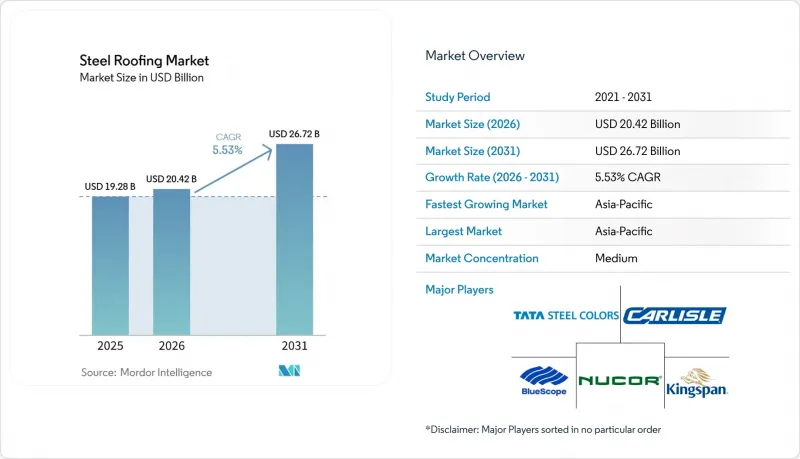
Mordor Intelligence에 의하면, 강판 지붕재 시장 규모는 2025년 192억 8,000만 달러로 평가되었고, 2026년 204억 2,000만 달러에서 2031년에는 267억 2,000만 달러로 확대될 것으로 예측되며, 2026-2031년 CAGR 5.53%를 나타낼 전망입니다.
본 보고서는 제품 유형별(컬러 코팅, 아연 도금, 갈바륨, 프로파일, 타일, 곡면, 기타 지붕용 시트), 건설 유형별(신축, 개보수·리모델링), 최종 사용자 산업별(주거, 상업, 산업, 농업), 지역별(아시아태평양, 북미, 유럽, 남미, 중동 및 아프리카)로 분류되어 있습니다. 시장 예측은 금액(달러) 기준으로 제시되어 있습니다.
세계의 강판 지붕재 시장 동향 및 인사이트
조립식 건축의 채택 확대가 강판 지붕재 시스템 수요를 견인하고 있습니다.
강판 지붕재 시장은 산업 및 물류 프로젝트에서 조립식 건축물의 활용이 확대됨에 따라 안정적인 수요원을 확보하고 있습니다. 2026년에는 연면적 기준으로 조립식 건축물 총 수요의 57% 이상을 창고 및 물류 시설이 차지할 것으로 예상되며, 이러한 시설에서는 대체 자재가 클리어 스팬,처마 높이의 유연성, 시공 속도 및 비용 효율성의 조합 측면에서 동등한 성능을 발휘할 수 없기 때문에 거의 예외 없이 강판 패널이 채택되고 있습니다. 이는 강판 지붕재 시장에 중요한 의미를 지닙니다. 왜냐하면 새로 건설되는 물류 창고, 공장 셸, 또는 물류 센터 각각이 장래에 도장 유지보수, 수리 작업, 그리고 궁극적으로는 패널 교체가 필요하게 될 설치 기반을 확대하기 때문입니다. 공급 측도 이미 이러한 추세에 대응하고 있으며, POSCO와 JSW Steel은 2025년 7월, 오디샤 주에 연간 600만메트리톤의 생산 능력을 갖춘 아연 도금 설비를 보유한 통합 제철소를 건설하는 50대 50 합작 계약을 체결하고, 2031년까지 가동을 시작하는 것을 목표로 하고 있습니다. 품질 기준도 중요한 요소입니다. 인도 표준국(BIS)의 규격 IS 10748이 인도 내 지붕용 아연 도금 강판에 사용되는 코팅 및 기계적 기준을 계속해서 규정하고 있기 때문입니다.
에너지 효율이 뛰어나고 반사율이 높은 강판 지붕재 솔루션에 대한 수요 증가
에너지 규제로 인해 구매자들이 반사율이 더 높고 성능이 우수한 지붕 시스템을 요구하게 되면서, 강판 지붕재 시장에서는 제품 선정에 꾸준한 변화가 나타나고 있습니다. ‘ENERGY STAR 지붕재 프로그램’에서는 경사가 완만한 쿨 루프(cool roof)에 대해 초기 총 태양 반사율을 0.65, 경과 후 총 태양 반사율을 0.50으로 하는 최저 기준을 정하고 있으며, 갈바륨 강판 제품은 많은 상업용 분야에서 이러한 기준을 충족하고 있습니다. 반사율이 높은 갈바륨 강판 지붕은 냉방 에너지 비용을 최대 20% 절감할 수 있어, 냉방 부하가 증가하고 있는 고온의 도시 지역 시장에서 그 가치가 더욱 높아지고 있습니다. 이러한 변화로 인해 개보수 공사에서는 기존의 아연 도금 강판에서 갈바륨 강판이나 프리페인트 시스템으로의 전환이 진행되고 있으며, 지붕 면적 증가가 완만하더라도 프로젝트당 수익을 끌어올리고 있습니다. 아르셀로미탈(ArcelorMittal)도 2025년 3월, XCarbon 전기 아크로 강을 사용한 ‘Granite Storm’ 지붕용 강재를 통해 이러한 추세를 강조했습니다. 이 회사에 따르면, 이 제품은 고로 제조 방식에 비해 제조 시 탄소 발자국이 67% 감소했다고 합니다.
철강 및 보호 코팅용 원자재 가격 변동이 생산 비용에 영향
강판 지붕재 시장은 코팅된 지붕 제품이 열간 압연 코일, 알루미늄, 아연, 실리콘에 의존하고 있기 때문에 여전히 원자재 가격 변동의 영향을 받기 쉬운 상황입니다. 2026년 갈바륨 강판 코일 가격은 FOB(선적지 인도) 기준으로 1메트릭톤당 평균 1,150-1,250달러로 전년 대비 5.8% 상승했으며, 월간 변동 폭은 1메트릭톤당 50-80달러였습니다. 지붕 자재 계약이 이미 최종 소비자와 체결된 상황에서는 가공업체로서는 이러한 가격 변동을 가격에 전가하기 어렵습니다. 또한, 생산자가 생산 능력을 확대하기 위해서는 스프레드에 대한 확신이 필요하기 때문에 새로운 코팅 라인이나 가공 라인에 대한 투자가 둔화될 가능성도 있습니다. 유럽에서는 탄소국경조정메커니즘(CBAM)의 2단계가 배출량이 많은 제조 공정을 통해 생산된 수입품에 구조적인 비용 부담을 추가하고 있어, 이로 인해 일부 수입 코팅 강판이 과거에 가졌던 착륙 비용 측면의 우위가 약화되고 있습니다.
부문 분석
2025년, 컬러 코팅 지붕용 강판은 철제 지붕 시장 규모의 36.85%를 차지하며 전체 제품 카테고리에서 1위를 유지했습니다. 이러한 우위는 다양한 기후 조건에서의 폭넓은 활용, 산업용 및 주거용 건축물 모두에서 높은 수용성, 그리고 현대 건축의 시각적 취향에 쉽게 부합할 수 있다는 점에 기인합니다. 강판 지붕재 시장에서는 구매자들이 단일 패널 형태로 내식성, 외관, 그리고 유지보수 부담 경감의 균형을 원하기 때문에 이 카테고리는 계속해서 지지를 받고 있습니다. 아연 도금 지붕재는 초기 비용이 낮다는 점이 여전히 주요 구매 기준이 되는 비용에 민감한 아프리카 및 남아시아의 일부 지역에서 여전히 많은 설치 실적을 자랑하고 있습니다.
이러한 ‘비용 우선’ 경향은 갈바륨 제품에 의해 서서히 뒤바뀌고 있습니다. 갈바륨 제품은 현재 초기 구매 가격뿐만 아니라 5-7년에 걸친 수명 주기 비용 측면에서도 경쟁력을 발휘하고 있습니다. 프로파일 시트는 단순한 형상과 신속한 시공이 가장 중요시되는 농업 및 경공업 용도에서 여전히 주류를 차지하고 있습니다. 타일형 지붕 시트는 강재의 장점을 희생하지 않으면서도 전통적인 지붕 형상에 맞추어야 하는 주택 프로젝트에서 계속해서 채택되고 있습니다. 곡면 지붕용 시트 시장 규모는 여전히 작지만, 경기장, 공항, 교통 허브 등에서 점유율을 확대되고 있습니다. 이는 경량 지붕 형태를 구현할 때 기존 대체 소재보다 강재가 시공이 용이하기 때문입니다. 갈바륨 지붕용 시트는 2031년까지 연평균 성장률(CAGR) 6.42%를 나타낼 것으로 예측되며, 건축 기준 요건과 프로젝트에 대한 기대가 높아짐에 따라 강판 지붕재 시장이 고성능 코팅 제품으로 전환되고 있음을 보여줍니다.
지역별 분석
아시아태평양은 2025년에 강판 지붕재 시장의 44.27%를 차지한 것으로 평가되었으며, 2031년까지 연평균 성장률(CAGR) 6.71%로 성장할 것으로 전망되어 가장 크고 가장 빠르게 성장하는 지역 블록으로 자리매김하고 있습니다. 중국은 산업, 상업, 인프라 활동을 통해 지속적으로 시장 규모를 확대하고 있으며, 친환경 건축자재의 광범위한 사용이 요구되는 2026년 건설 계획이 내화성 및 재활용성 요건을 충족하는 금속 지붕의 채택을 촉진하고 있습니다. 인도 역시 성장의 원동력이 되고 있으며, 세계철강협회(World Steel Association)는 인프라 및 건설 활동이 견조한 흐름을 보이는 가운데, 인도의 철강 수요가 2026년에 7.4% 증가할 것으로 예측했습니다. 일본과 한국에서는 고품질의 스탠딩 심 지붕 및 건축 일체형 태양광 발전(BIPV) 대응 지붕 자재에 대한 수요가 증가하고 있으며, 이로 인해 이 지역의 제품 구성은 더욱 고도화된 코팅 강판 솔루션에 치우친 상태가 지속되고 있습니다.
2026년 북미와 유럽은 철강 지붕 시장에 호재가 될 것으로 보이지만, 운영 측면에서는 더 복잡한 상황이 형성되고 있습니다. 미국에서는 인프라 투자와 주택 시장의 완만한 회복에 힘입어 철강 수요가 증가하고 있지만, 높은 차입 비용이 여전히 주택 착공 건수 확대를 저해하고 있습니다. 도장 강판 수입에 대한 무역 조치로 인해 공급이 부족해지면서 열연 코일과 도장 제품 간의 가격 차이가 확대되고 있습니다. 이에 따라 뉴코어가 버클리 카운티에 건설 중인 연간 50만 쇼트톤 규모의 연속 아연 도금 라인 등 국내 투자의 타당성이 더욱 높아지고 있습니다. 해당 라인은 2026년 중반 가동 개시를 목표로 예정대로 진행되고 있습니다. 유럽에서는 2026년에 철강 수요가 1.3% 회복될 전망이며, 리모델링 공사에서는 더욱 엄격한 건축 기준 및 수입 규제를 충족하는 저탄소 고성능 코팅 강판 제품이 선호되고 있습니다.
남미, 중동 및 아프리카는 기본적인 수요 규모는 여전히 작지만, 강판 지붕재 시장에 있어 의미 있는 장기적인 기회를 내포하고 있습니다. 남미에서는 2025년에 브라질이 지역 건설 활동을 주도했으며, 라틴아메리카 철강협회(ALACERO)에 따르면 건설 부문이 해당 지역의 명목 철강 수요의 49.2%를 차지했습니다. 멕시코에서는 2025년에 철강의 명목 소비량이 10.5% 감소하여 지역 전체의 총 소비량에 부정적인 영향을 미쳤지만, 아르헨티나, 칠레, 페루, 콜롬비아에서는 건설 활동이 확대되었습니다. 이 지역 전체에서 프로젝트 팀이 내구성과 신속한 설치를 중시함에 따라, 산업단지, 니어쇼어링 관련 시설, 농업 및 식품 인프라 분야에서 금속 지붕재의 채택이 확대되고 있습니다. 아프리카에서는 세계철강협회(World Steel Association)가 2026년에 3.8%, 2027년에 4.6%의 철강 수요 증가를 예측하고 있으며, 이는 도시 개발 및 인프라 프로젝트에서 내식성 강판 지붕재에 대한 견고한 장기 수요 전망을 뒷받침하고 있습니다. 사우디아라비아의 NEOM 관련 개발과 남아프리카공화국의 물류·광업 인프라 확충도 혹독한 사막 및 연안 환경에서 고사양 지붕재에 대한 수요를 뒷받침하고 있습니다.
기타 혜택 :
- 엑셀 형식 시장 예측(ME) 시트
- 3개월간의 애널리스트 지원
자주 묻는 질문
목차
제1장 서론
제2장 조사 방법
제3장 주요 요약
제4장 시장 구도
제5장 시장 규모 및 성장 예측
제6장 경쟁 구도
제7장 시장 기회 및 향후 전망
AJY 26.09.03According to Mordor Intelligence, the steel roofing market size is projected to expand from USD 19.28 billion in 2025 and USD 20.42 billion in 2026 to USD 26.72 billion by 2031, and is expected to register a CAGR of 5.53% between 2026 and 2031.
This report is Segmented by Product Type (Color Coated, Galvanized, Galvalume, Profile, Tile, Curved, Other Roofing Sheets), Construction Type (New Construction, Renovation & Remodeling), End-User Industry (Residential, Commercial, Industrial, Agricultural), and Geography (Asia-Pacific, North America, Europe, South America, Middle-East and Africa). The Market Forecasts are Provided in Terms of Value (USD).
Global Steel Roofing Market Trends and Insights
Rising Adoption of Pre-Engineered Buildings Driving Demand for Steel Roofing Systems
The steel roofing market is gaining a stable demand channel from the wider use of pre-engineered buildings across industrial and logistics projects. Warehousing and logistics structures represent more than 57% of total pre-engineered building demand by floor area in 2026, and these facilities almost always use steel panel enclosures because alternative materials do not match the same combination of clear spans, eave height flexibility, installation speed, and cost efficiency. This matters for the steel roofing market because every new logistics shed, factory shell, or distribution center expands the installed base that will later require coating maintenance, repair work, and eventual panel replacement. The supply side is already adjusting to this pattern, as POSCO and JSW Steel signed a 50/50 agreement in July 2025 to build a 6-million-metric ton-per-year integrated steel mill in Odisha with galvanizing capacity, with commissioning targeted by 2031. Quality rules also matter here, because Bureau of Indian Standards (BIS) IS:10748 continues to shape the coating and mechanical standards used in galvanized steel sheets for roofing applications in India.
Increasing Preference for Energy-Efficient and Reflective Steel Roofing Solutions
The steel roofing market is seeing a steady change in product selection as energy codes push buyers toward more reflective and better-performing roof systems. The ENERGY STAR Roof Products program sets minimum initial total solar reflectance of 0.65 and aged total solar reflectance of 0.50 for low-slope cool roofs, and Galvalume-coated steel products meet those thresholds in many commercial applications. Reflective Galvalume roofing can lower cooling energy costs by up to 20%, which makes the value case stronger in hot urban markets where cooling loads are rising. That shift is moving renovation work away from standard galvanized sheets and toward coated Galvalume and pre-painted systems, which raises revenue per project even when roof area growth is moderate. ArcelorMittal also highlighted this move in March 2025 through Granite Storm roofing steel made with XCarb electric-arc-furnace steel, which the company said carries a 67% lower manufacturing carbon footprint than blast furnace routes.
Fluctuations in Steel and Protective Coating Raw Material Prices Impact Production Costs
The steel roofing market remains exposed to raw material swings because coated roof products depend on hot-rolled coil, aluminum, zinc, and silicon. The galvalume steel coil prices averaged USD 1,150 to USD 1,250 per metric ton Free on Board (FOB)s in 2026, with year-over-year growth of 5.8% and monthly movement of USD 50 to USD 80 per metric ton. That kind of movement is hard for fabricators to pass through when roofing contracts have already been fixed with end customers. It can also slow investment in new coating and fabrication lines because producers need greater confidence in spreads before adding capacity. In Europe, Carbon Border Adjustment Mechanism (CBAM) Phase 2 is adding a structural cost layer for imports produced through higher-emission routes, which reduces the landed cost advantage that some imported coated sheets once held.
Other drivers and restraints analyzed in the detailed report include:
- Growing Installation of Rooftop Solar Systems Supporting Metal Roof Adoption
- Expansion of Warehousing, Logistics, Manufacturing, and Cold Storage Infrastructure
- Higher Initial Installation Cost Compared with Conventional Roofing Materials
For complete list of drivers and restraints, kindly check the Table Of Contents.
Segment Analysis
Color coated roofing sheets accounted for 36.85% of the steel roofing market size in 2025, which kept them in the leading position across product categories. Their lead came from broad use across climates, strong acceptance in both industrial and residential buildings, and easier alignment with visual preferences in modern construction. The steel roofing market continues to favor this category because buyers want a balance of corrosion protection, appearance, and lower maintenance burden in a single panel format. Galvanized roofing sheets still serve a large installed base in cost-sensitive parts of Africa and South Asia, where low upfront cost remains the main purchase filter.
That cost-first pattern is slowly being challenged by Galvalume products, which are now competing on a life-cycle cost basis over 5 to 7 years rather than only on initial purchase price. Profile sheets still dominate agricultural and light industrial uses where simple geometry and quick installation matter most. Tile roofing sheets remain tied to residential projects where the roof needs to match traditional forms without giving up the benefits of steel. Curved roofing sheets remain smaller in value, but they are gaining ground in stadiums, airports, and transport hubs because lightweight roof forms are easier to deliver with steel than with conventional alternatives. Galvalume roofing sheets are projected to grow at a 6.42% CAGR through 2031, which shows that the steel roofing market is moving toward higher-performance coated products as code demands and project expectations rise.
Complete Report Scope:
- By Product Type
- Color Coated Roofing Sheets
- Galvanized Roofing Sheets
- Galvalume Roofing Sheets
- Profile Roofing Sheets
- Tile Roofing Sheets
- Curved Roofing Sheets
- Other Product Types
- By Construction Type
- New Construction
- Renovation & Remodeling
- By End-User Industry
- Residential
- Commercial
- Industrial
- Agricultural
- By Geography
- Asia-Pacific
- China
- India
- Japan
- South Korea
- Rest of Asia-Pacific
- North America
- United States
- Canada
- Mexico
- Europe
- Germany
- United Kingdom
- France
- Italy
- Russia
- Rest of Europe
- South America
- Brazil
- Argentina
- Rest of South America
- Middle-East and Africa
- Saudi Arabia
- South Africa
- Rest of Middle-East and Africa
- Asia-Pacific
Geography Analysis
Asia-Pacific held 44.27% of the steel roofing market share in 2025 and is projected to grow at a 6.71% CAGR through 2031, which makes it both the largest and the fastest-growing regional block. China continues to provide scale through industrial, commercial, and infrastructure activity, and 2026 construction programs that require high use of green building materials are supporting metal roofing formats that meet fire resistance and recyclability needs. India adds another growth engine, with the World Steel Association forecasting that the country's steel demand is expected to rise 7.4% in 2026 as infrastructure and construction activity stay strong. Japan and South Korea add demand for higher-grade standing seam and Building-Integrated Photovoltaics (BIPV)-ready roofing, which keeps the regional mix tilted toward more advanced coated steel solutions.
North America and Europe form a supportive but more operationally complex setting for the steel roofing market in 2026. In the United States, steel demand is growing, supported by infrastructure spending and a gradual residential recovery, but high borrowing costs are still holding back broader housing starts. Trade actions on coated steel imports are tightening availability and widening the spread between hot-rolled coil and coated products, which strengthens the case for domestic investments such as Nucor's 500,000 short-ton-per-year continuous galvanizing line in Berkeley County that remained on track for mid-2026 commissioning. In Europe, steel demand is recovering at 1.3% in 2026, and renovation work is favoring lower-carbon and more advanced coated flat steel products that fit stricter building and import rules.
South America and Middle-East and Africa remain smaller in base value, but they carry meaningful long-run opportunities for the steel roofing market. In South America, Brazil supported regional construction activity in 2025, and construction represented 49.2% of regional apparent steel demand according to the Latin American Steel Association (ALACERO). Mexico saw a 10.5% drop in apparent steel consumption in 2025, which weighed on the regional total, but Argentina, Chile, Peru, and Colombia posted construction expansion. Across the region, metal roofing is gaining place inside industrial parks, nearshoring-linked facilities, and agri-food infrastructure because project teams value durability and quick installation. In Africa, the World Steel Association forecasts steel demand growth of 3.8% in 2026 and 4.6% in 2027, which supports a durable long-term case for corrosion-resistant steel roofing in urban and infrastructure projects. Saudi Arabia's NEOM-related development and South Africa's logistics and mining infrastructure work also support demand for higher-specification roofing in harsh desert and coastal conditions.
- ArcelorMittal
- Bilka Steel
- BlueScope Steel Limited
- Carlisle Companies Inc.
- Cornerstone Building Brands, Inc.
- Interlock Roofing Ltd.
- Isopan S.p.A.
- Kingspan Group
- Metecno Group
- Nucor Corporation
- POSCO
- Safal Group
- SSAB AB
- TATA STEEL COLORS
- The OmniMax International, Inc.
- voestalpine Stahl GmbH
Additional Benefits:
- The market estimate (ME) sheet in Excel format
- 3 months of analyst support
TABLE OF CONTENTS
1 Introduction
- 1.1 Study Assumptions and Market Definition
- 1.2 Scope of the Study
2 Research Methodology
3 Executive Summary
4 Market Landscape
- 4.1 Market Overview
- 4.2 Market Drivers
- 4.2.1 Increasing Replacement of Aging Roofing Systems Across Developed Economies
- 4.2.2 Rising Adoption of Pre-Engineered Buildings Driving Demand for Steel Roofing Systems
- 4.2.3 Increasing Preference for Energy-Efficient and Reflective Steel Roofing Solutions
- 4.2.4 Growing Installation of Rooftop Solar Systems Supporting Metal Roof Adoption
- 4.2.5 Expansion of Warehousing, Logistics, Manufacturing, and Cold Storage Infrastructure
- 4.3 Market Restraints
- 4.3.1 Fluctuations in Steel and Protective Coating Raw Material Prices Impact Production Costs
- 4.3.2 Higher Initial Installation Cost Compared with Conventional Roofing Materials
- 4.3.3 Dependence on Skilled Installation to Ensure Long-Term Weather Resistance and Structural Performance
- 4.4 Value Chain Analysis
- 4.5 Porter's Five Forces Analysis
- 4.5.1 Threat of New Entrants
- 4.5.2 Bargaining Power of Suppliers
- 4.5.3 Bargaining Power of Buyers
- 4.5.4 Threat of Substitutes
- 4.5.5 Competitive Rivalry
5 Market Size and Growth Forecasts (Value)
- 5.1 By Product Type
- 5.1.1 Color Coated Roofing Sheets
- 5.1.2 Galvanized Roofing Sheets
- 5.1.3 Galvalume Roofing Sheets
- 5.1.4 Profile Roofing Sheets
- 5.1.5 Tile Roofing Sheets
- 5.1.6 Curved Roofing Sheets
- 5.1.7 Other Product Types
- 5.2 By Construction Type
- 5.2.1 New Construction
- 5.2.2 Renovation & Remodeling
- 5.3 By End-User Industry
- 5.3.1 Residential
- 5.3.2 Commercial
- 5.3.3 Industrial
- 5.3.4 Agricultural
- 5.4 By Geography
- 5.4.1 Asia-Pacific
- 5.4.1.1 China
- 5.4.1.2 India
- 5.4.1.3 Japan
- 5.4.1.4 South Korea
- 5.4.1.5 Rest of Asia-Pacific
- 5.4.2 North America
- 5.4.2.1 United States
- 5.4.2.2 Canada
- 5.4.2.3 Mexico
- 5.4.3 Europe
- 5.4.3.1 Germany
- 5.4.3.2 United Kingdom
- 5.4.3.3 France
- 5.4.3.4 Italy
- 5.4.3.5 Russia
- 5.4.3.6 Rest of Europe
- 5.4.4 South America
- 5.4.4.1 Brazil
- 5.4.4.2 Argentina
- 5.4.4.3 Rest of South America
- 5.4.5 Middle-East and Africa
- 5.4.5.1 Saudi Arabia
- 5.4.5.2 South Africa
- 5.4.5.3 Rest of Middle-East and Africa
- 5.4.1 Asia-Pacific
6 Competitive Landscape
- 6.1 Market Concentration
- 6.2 Strategic Moves
- 6.3 Market Share (%)/Ranking Analysis
- 6.4 Company Profiles (includes Global Overview, Market Overview, Core Segments, Financials as available, Strategic Information, Products and Services, and Recent Developments)
- 6.4.1 ArcelorMittal
- 6.4.2 Bilka Steel
- 6.4.3 BlueScope Steel Limited
- 6.4.4 Carlisle Companies Inc.
- 6.4.5 Cornerstone Building Brands, Inc.
- 6.4.6 Interlock Roofing Ltd.
- 6.4.7 Isopan S.p.A.
- 6.4.8 Kingspan Group
- 6.4.9 Metecno Group
- 6.4.10 Nucor Corporation
- 6.4.11 POSCO
- 6.4.12 Safal Group
- 6.4.13 SSAB AB
- 6.4.14 TATA STEEL COLORS
- 6.4.15 The OmniMax International, Inc.
- 6.4.16 voestalpine Stahl GmbH
7 Market Opportunities and Future Outlook
- 7.1 White-Space and Unmet-Need Assessment


