

|
시장보고서
상품코드
2118229
BFSI 기업 컨텐츠 관리(ECM) 시장 : 시장 점유율 분석, 업계 동향 및 통계, 성장 예측(2026-2031년)BFSI Enterprise Content Management (ECM) - Market Share Analysis, Industry Trends & Statistics, Growth Forecasts (2026 - 2031) |
||||||
 Mordor Intelligence
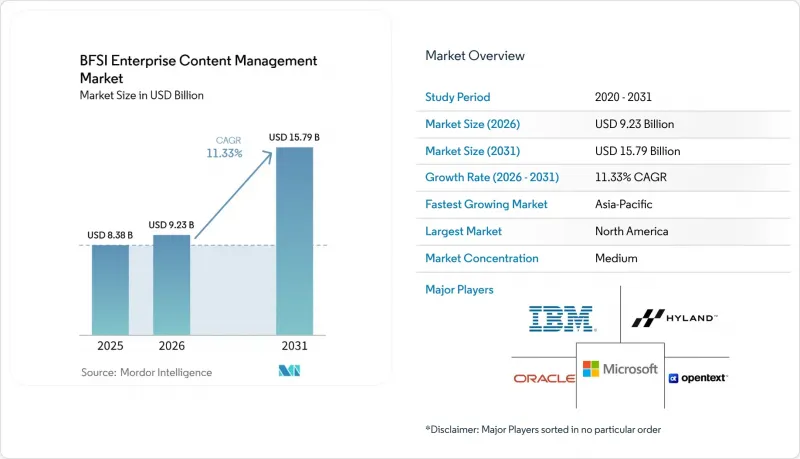
Mordor Intelligence에 의하면, BFSI(은행 및 금융 및 보험) 분야의 기업 컨텐츠 관리(ECM) 시장 규모는 2025년 83억 8,000만 달러로 평가되었고, 2026년에는 92억 3,000만 달러로 추정되고, 2026-2031년 CAGR 11.33%로 성장을 지속할 전망이며, 2031년에는 157억 9,000만 달러에 이를 것으로 예측됩니다.
본 보고서는 솔루션 유형별(문서 관리, 기록 관리, 워크플로우 및 비즈니스 프로세스 관리, 디지털 자산 관리, 웹 컨텐츠 관리 등), 도입 형태별(온프레미스, 클라우드, 하이브리드), 기업 규모별(중소기업, 대기업) 및 지역별로 분류되어 있습니다. 시장 전망은 금액(달러) 기준으로 제시되어 있습니다.
세계의 BFSI 엔터프라이즈 컨텐츠 관리(ECM) 시장 동향 및 인사이트
디지털 온보딩 및 페이퍼리스 뱅킹 도입 확대
지점 중심 및 종이 중심의 은행 업무에서 벗어나려는 움직임이 BFSI 엔터프라이즈 컨텐츠 관리(ECM) 시장 전체에 걸쳐 꾸준한 수요를 창출하고 있습니다. 은행들은 현재, 한 번 수집한 고객 파일을 올바르게 분류하고, 감사 추적에 누락이 발생하지 않도록 하여 온보딩, 심사 및 서비스 워크플로우 전반에 걸쳐 활용할 수 있도록 해야 합니다. 금융시장표준위원회(FMSB)는 고객 온보딩 관련 서류 및 프로세스에 대한 2025년 기준을 발표했습니다. 이는 금융 기관의 기록 수집, 검증 및 보존에 대한 보다 엄격한 접근 방식을 뒷받침하기 위한 것입니다. 이에 따라 BFSI 엔터프라이즈 컨텐츠 관리(ECM) 시장은 데이터 수집, 검증 및 하류 거버넌스를 단일한 관리된 흐름으로 통합하는 플랫폼으로 진화하고 있습니다. 프런트엔드 온보딩을 디지털화했더라도 미들오피스 문서 관리 체계를 혁신하지 않은 금융 기관은 여전히 지연, 중복 점검, 기록의 파편화 등의 과제에 직면해 있습니다.
감사 대응 가능한 컨텐츠 보존에 대한 규제 압력 확대
규제적 압력으로 인해, 감사에 대응 가능한 컨텐츠 보관은 BFSI 엔터프라이즈 컨텐츠 관리(ECM) 시장에서 핵심적인 구매 요인이 되고 있습니다. EU의 자금 세탁 방지 규정 및 DORA(데이터 보호 규정)에 따라, 금융 기관 전반에 걸쳐 고객 실사 파일, 메타데이터,접근 제어, 인프라 선택에 관한 문서화 및 거버넌스 기준이 높아지고 있습니다. 이러한 변화는 단순히 기록을 더 오랫동안 보관하는 데 그치지 않습니다. 기업은 누가 파일을 처리했는지, 파일이 어디에 있는지, 그리고 승인 절차를 어떻게 거쳤는지를 보여줄 수 있는 시스템도 필요로 하기 때문입니다. 따라서 BFSI(은행 및 금융 및 보험) 분야의 엔터프라이즈 컨텐츠 관리(ECM) 시장에서는 위조가 불가능한 추적 기록, 더욱 강력한 정책 적용, 그리고 각 관할 구역 고유의 운영 규칙에 부합하는 아키텍처 옵션을 지원할 수 있는 벤더가 선호되고 있습니다. ISO 27001이나 SOC 2 Type II와 같은 인증은 더 이상 차별화 요소가 아니라, 플랫폼 선정 시 최소한의 요건으로 중요하게 여겨지고 있습니다.
레거시 코어 뱅킹과의 통합 복잡성
레거시 코어 뱅킹 환경은 BFSI 엔터프라이즈 컨텐츠 관리(ECM) 시장에 여전히 큰 장벽으로 남아 있습니다. 많은 금융 기관에서는 레거시 코어 시스템, 새로운 디지털 계층, 그리고 수년에 걸쳐 구축된 문서화되지 않은 인터페이스에 걸쳐 컨텐츠 처리가 이루어지고 있습니다. 그 결과, ECM 프로그램은 기존 환경과 새로운 환경을 동시에 운영할 수밖에 없어 도입이 지연되고 테스트도 어려워지고 있습니다. 또한, BFSI 엔터프라이즈 컨텐츠 관리(ECM) 시장에서는 최신 플랫폼이 깔끔한 API 연결을 필요로 하는 반면, 기존 레코드 흐름이 여전히 배치 처리나 사용자 지정 매핑에 의존하고 있어 마찰이 발생하고 있습니다. 구매 측이 더 신속한 현대화를 원하더라도, 통합의 복잡성으로 인해 가치 창출이 지연되고, 프로젝트 일정이 중규모 금융 기관이 자금 조달을 감당할 수 있는 범위를 넘어 장기화될 가능성이 있습니다.
부문 분석
2025년, 문서 관리는 BFSI 엔터프라이즈 컨텐츠 관리(ECM) 시장 점유율의 28.19%를 차지하며 이 시장에서 가장 큰 솔루션 카테고리가 되었습니다. 이러한 우위는 BFSI 엔터프라이즈 컨텐츠 관리(ECM) 시장 전체에서 대출 파일, 계좌 개설 기록, 보험 증서, 규제 관련 문서 등을 거버넌스가 적용된 저장소에 통합해야 하는 기본적인 요구를 반영한 것입니다. 기록 관리 및 웹 컨텐츠 관리는 보다 제한적인 이용 사례를 다루며, 전자는 보존 및 아카이빙에 중점을 두고, 후자는 고객을 대상으로 한 디지털 커뮤니케이션과 밀접하게 관련되어 있습니다. 또한, 디지털 자산 관리는 여러 채널에 걸쳐 브랜드 컨텐츠, 멀티미디어 파일, 제품 자료를 관리하는 보험사 및 투자 회사에 있어 점점 더 중요해지고 있습니다.
워크플로우 및 비즈니스 프로세스 관리는 2031년까지 연평균 성장률(CAGR) 12.41%로 가장 빠른 성장세를 기록할 것으로 예상되며, 이는 BFSI 엔터프라이즈 컨텐츠 관리 업계의 향후 방향성을 보여줍니다. 디지털 온보딩 도구의 개선에 따라 BFSI 엔터프라이즈 컨텐츠 관리(ECM) 시장 내에서는 라우팅,승인, 예외 처리 및 감사 추적 생성에 주목이 쏠리고 있습니다. Oracle은 자사의 금융 서비스용 엔터프라이즈 케이스 관리 플랫폼이 다양한 알림에 걸친 구조화된 조사 워크플로우를 지원하며, 규제가 엄격한 금융 업무에서 케이스 관리 강화에 대한 요구를 충족한다고 밝혔습니다. 하이랜드는 2026년 6월, 자사의 ‘Agentic Bank’ 솔루션을 통해 추가 서류 요청을 최대 50% 줄이고, 대출 신청을 몇 주가 아닌 며칠 만에 심사 담당자가 처리할 수 있는 단계까지 진행할 수 있다고 발표했습니다. 이는 워크플로우 주도형 제품이 BFSI 엔터프라이즈 컨텐츠 관리(ECM) 시장에서 어떻게 확대되고 있는지를 여실히 보여줍니다.
지역별 분석
2025년, 북미는 BFSI 엔터프라이즈 컨텐츠 관리(ECM) 시장에서 40.06%의 점유율을 차지하며 지역별로는 가장 큰 기여도를 보였습니다. 이 지역은 주요 금융 기관이 집중되어 있고, IT 지출이 견조하며, 기록 관리를 투자 우선순위의 상위에 두는 규제 환경의 혜택을 받고 있습니다. 미국은 여전히 수요의 주요 원천이지만, 캐나다와 멕시코에서도 은행들이 오픈 뱅킹 및 국경을 넘는 규정 준수 요건에 대응하기 위해 문서 업무의 현대화를 추진함에 따라 수요가 확대되고 있습니다. 유럽은 DORA, EU의 AMLR 및 AI 관련 규제가 플랫폼의 기능과 도입 옵션 모두에 영향을 미치고 있기 때문에 BFSI 엔터프라이즈 컨텐츠 관리(ECM) 시장에게는 더 제한적인 환경이 되고 있습니다. BFSI 엔터프라이즈 컨텐츠 관리(ECM) 시장에서 영국, 독일, 프랑스는 여전히 유럽 내 주요 수요 거점으로 자리 잡고 있습니다. 한편, 브라질과 아르헨티나를 필두로 한 남미는 전자 문서화 및 공공 부문의 디지털 개혁과 관련하여 규모는 작지만 성장 여지가 있는 시장으로 부상하고 있습니다.
아시아태평양은 2031년까지 연평균 성장률(CAGR) 12.89%를 나타낼 것으로 예측되며, BFSI 엔터프라이즈 컨텐츠 관리(ECM) 시장에서 가장 빠르게 성장하는 지역이 될 전망입니다. 인더스트리얼 뱅크는 2026년 4월, 46개 사업 분야에 DeepSeek-V4를 도입했다고 발표했습니다. 이는 해당 지역의 주요 금융 기관들이 BFSI 엔터프라이즈 컨텐츠 관리(ECM) 시장의 일환으로 독자적인 컨텐츠 인텔리전스에 직접 투자하고 있음을 보여줍니다. 중국, 인도, 일본, 한국, 호주에서는 은행들이 디지털 서비스 확대, KYC(고객 신원 확인) 및 기록 관리 강화, 보다 효율적인 문서 워크플로우 구축을 추진함에 따라 시장 성장세에 기여하고 있습니다. 따라서 아시아태평양의 BFSI 엔터프라이즈 컨텐츠 관리(ECM) 시장에서는 지역 특성에 맞춘 규정 준수 대응과 확장성이 뛰어난 클라우드 및 AI 기능을 결합할 수 있는 벤더가 우위를 점하고 있습니다.
남미, 중동 및 아프리카는 BFSI 엔터프라이즈 컨텐츠 관리(ECM) 시장에서 비교적 작은 비중을 차지하고 있지만, 금융 기관들이 기록 관리 및 업무 워크플로우 개선을 추진함에 따라 수요는 여전히 증가하고 있습니다. Newgen은 2025년 11월, 아부다비의 Vision Bank를 대상으로 전체 라이프사이클 자동화 및 은행 핵심 시스템과의 통합 기능을 갖춘 ‘AI 퍼스트’ 전자 문서·기록 관리 시스템을 도입했다고 발표했습니다. 티에트(Tiet)사는 2026년, 덴마크 국립은행이 전자 케이스 및 문서 관리를 위해 자사의 ‘Public 360°’ SaaS 플랫폼을 채택했다고 발표했습니다. 이는 공공 금융 기관들도 규제 대상 기록에 대한 관리 체제를 강화하고 있음을 보여줍니다. BFSI(은행 및 금융 및 보험) 분야의 엔터프라이즈 컨텐츠 관리(ECM) 시장 전반에서 지역별 도입 속도는 다르지만, 컨텐츠, 워크플로우, 보존 규칙에 대한 감사 가능한 관리 체제가 공통된 요건으로 자리 잡고 있습니다.
기타 혜택 :
- 엑셀 형식 시장 예측(ME) 시트
- 3개월간의 애널리스트 지원
자주 묻는 질문
목차
제1장 서론
제2장 조사 방법
제3장 개요
제4장 시장 구도
제5장 시장 규모 및 성장 예측
제6장 경쟁 구도
제7장 시장 기회 및 향후 전망
AJY 26.09.01According to Mordor Intelligence, the BFSI enterprise content management (ECM) market size is expected to grow from USD 8.38 billion in 2025 to USD 9.23 billion in 2026 and is forecast to reach USD 15.79 billion by 2031 at 11.33% CAGR over 2026-2031.
This report is Segmented by Solution Type (Document Management, Records Management, Workflow and Business Process Management, Digital Asset Management, Web Content Management, and More), Deployment Mode (On-Premises, Cloud, and Hybrid), Enterprise Size (Small and Medium Enterprises, and Large Enterprises), and Geography. The Market Forecasts are Provided in Terms of Value (USD).
Global BFSI Enterprise Content Management (ECM) Market Trends and Insights
Rising Digital Onboarding and Paperless Banking Adoption
The move away from branch-heavy and paper-heavy banking is creating steady demand across the BFSI Enterprise Content Management (ECM) market. Banks now need customer files that can be captured once, classified correctly, and made available across onboarding, review, and service workflows without creating gaps in the audit trail. The Financial Markets Standards Board issued a 2025 standard on client onboarding documentation and processes, which supports a more disciplined approach to record collection, verification, and retention in financial institutions. This is pushing the BFSI Enterprise Content Management (ECM) market toward platforms that integrate intake, validation, and downstream governance into a single, managed flow. Institutions that digitize front-end onboarding without upgrading document control in the middle office still face delays, duplicate checks, and fragmented records.
Expanding Regulatory Pressure for Audit-Ready Content Retention
Regulatory pressure is making auditable content retention a core buying factor in the BFSI Enterprise Content Management (ECM) market. The EU Anti-Money Laundering Regulation and DORA are raising the standard for documenting and governing customer due diligence files, metadata, access controls, and infrastructure choices across financial institutions. This shift is no longer just about storing records for longer periods, because firms also need systems that can show who handled a file, where it resides, and how it moved through approval steps. The BFSI Enterprise Content Management (ECM) market is therefore favoring vendors that can support immutable trails, stronger policy enforcement, and architecture choices that align with jurisdiction-specific operating rules. Certifications such as ISO 27001 and SOC 2 Type II now matter less as a point of distinction and more as a minimum requirement for platform consideration.
Legacy Core Banking Integration Complexity
Legacy core banking environments remain a major barrier for the BFSI Enterprise Content Management (ECM) market. Many institutions still run content processes across legacy core systems, newer digital layers, and undocumented interfaces built over long periods. That forces ECM programs to operate across both old and new environments simultaneously, slowing implementation and making testing more difficult. The BFSI Enterprise Content Management (ECM) market also faces friction when modern platforms require clean API connections, while existing record flows still rely on batch logic and custom mappings. Even when buyers want faster modernization, integration complexity can delay value capture and extend project timelines beyond what mid-sized institutions are comfortable funding.
Other drivers and restraints analyzed in the detailed report include:
- Growth in Cloud-Native ECM Modernization Programs
- AI-Based Document Classification and Intelligent Search Adoption
- High Data Migration and Records Normalization Effort
For complete list of drivers and restraints, kindly check the Table Of Contents.
Segment Analysis
Document Management retained 28.19% of the BFSI Enterprise Content Management (ECM) market share in 2025, making it the largest solution category in this market. Its lead reflects the basic need to centralize loan files, account opening records, insurance policy documents, and regulatory correspondence in governed repositories across the BFSI Enterprise Content Management (ECM) market. Records Management and Web Content Management serve narrower use cases, with one focused more on retention and archiving, and the other more closely tied to customer-facing digital communication. Digital Asset Management is also becoming more relevant for insurers and investment firms that manage branded content, multimedia files, and product materials across several channels.
Workflow and Business Process Management is expected to post the fastest growth at a 12.41% CAGR through 2031, indicating where the BFSI enterprise content management industry is moving. As digital onboarding tools improve, attention is shifting to routing, approvals, exception handling, and audit trail creation inside the BFSI Enterprise Content Management (ECM) market. Oracle states that its Financial Services Enterprise Case Management platform supports structured investigation workflows across alert types, which fits the need for stronger case control in regulated financial operations. Hyland said in June 2026 that its Agentic Bank solution can reduce follow-up document requests by up to 50% and move loan applications to underwriter-ready status in days rather than weeks, highlighting how workflow-led products are expanding in the BFSI Enterprise Content Management (ECM) market.
Complete Report Scope:
- By Solution Type
- Document Management
- Records Management
- Workflow and Business Process Management
- Case Management
- Digital Asset Management
- Web Content Management
- Other Solutions
- By Deployment Mode
- On-Premises
- Cloud
- Hybrid
- By Enterprise Size
- Small and Medium Enterprises
- Large Enterprises
- By Geography
- North America
- United States
- Canada
- Mexico
- South America
- Brazil
- Argentina
- Rest of South America
- Europe
- United Kingdom
- Germany
- France
- Rest of Europe
- Asia Pacific
- China
- Japan
- India
- South Korea
- Australia
- Rest of Asia Pacific
- Middle East
- United Arab Emirates
- Saudi Arabia
- Rest of Middle East
- Africa
- South Africa
- Kenya
- Rest of Africa
- North America
Geography Analysis
North America held a 40.06% share of the BFSI Enterprise Content Management (ECM) market in 2025, making it the largest regional contributor. The region benefits from a concentration of large financial institutions, strong IT spending, and a regulatory environment that keeps record-keeping high on the investment agenda. The United States remains the main source of demand, while Canada and Mexico are also advancing as banks modernize document operations to meet open banking and cross-border compliance requirements. Europe is a more tightly constrained environment for the BFSI Enterprise Content Management (ECM) market, because DORA, the EU AMLR, and AI-related rules shape both platform features and deployment choices. Within the BFSI Enterprise Content Management (ECM) market, the United Kingdom, Germany, and France remain the main European demand centers, while South America, led by Brazil and Argentina, represents a smaller but developing opportunity linked to electronic documentation and public-sector digital reform.
Asia-Pacific is projected to grow at a 12.89% CAGR through 2031, making it the fastest-growing geography in the BFSI Enterprise Content Management (ECM) market. Industrial Bank said in April 2026 that it deployed DeepSeek-V4 across 46 business domains, which shows that leading institutions in the region are investing directly in proprietary content intelligence as part of the BFSI Enterprise Content Management (ECM) market. China, India, Japan, South Korea, and Australia are all contributing to momentum as banks expand digital services, strengthen KYC and recordkeeping, and seek more efficient document workflows. The BFSI Enterprise Content Management (ECM) market in Asia-Pacific, therefore, rewards vendors that can combine localized compliance support with scalable cloud and AI capabilities.
South America, the Middle East, and Africa are smaller parts of the BFSI Enterprise Content Management (ECM) market, but demand is still rising as institutions improve records handling and case workflows. Newgen announced in November 2025 that it had deployed an AI-first Electronic Document and Record Management System for Vision Bank in Abu Dhabi, with full lifecycle automation and integration into the bank's core systems. Tieto said in 2026 that Danmarks Nationalbank selected its Public 360° SaaS platform for electronic case and document management, indicating that public financial institutions are also upgrading their control over regulated records. Across the BFSI Enterprise Content Management (ECM) market, regional adoption is moving at different speeds, but the shared requirement is auditable control over content, workflows, and retention rules.
- OpenText Corporation
- Hyland Software, Inc.
- M-Files Corporation
- DocuWare GmbH
- Laserfiche
- Box, Inc.
- Newgen Software Technologies Limited
- IBM Corporation
- Microsoft Corporation
- Oracle Corporation
- SAP SE
- Alfresco Software, Inc.
- SER Group Holding GmbH
- Canon Inc.
- Toshiba Tec Corporation
- Fujitsu Limited
- Kofax, Inc.
- Tungsten Automation Corporation
- Amazon Web Services, Inc.
- Google LLC
Additional Benefits:
- The market estimate (ME) sheet in Excel format
- 3 months of analyst support
TABLE OF CONTENTS
1 INTRODUCTION
- 1.1 Study Assumptions and Market Definition
- 1.2 Scope of the Study
2 RESEARCH METHODOLOGY
3 EXECUTIVE SUMMARY
4 MARKET LANDSCAPE
- 4.1 Market Overview
- 4.2 Market Drivers
- 4.2.1 Rising Digital Onboarding and Paperless Banking Adoption
- 4.2.2 Expanding Regulatory Pressure for Audit-Ready Content Retention
- 4.2.3 Growth in Cloud-Native ECM Modernization Programs
- 4.2.4 AI-Based Document Classification and Intelligent Search Adoption
- 4.2.5 Demand for Unified Customer File and Case Management Across Channels
- 4.2.6 Need for Cross-Border Compliance Automation in Multinational Banks
- 4.3 Market Restraints
- 4.3.1 Legacy Core Banking Integration Complexity
- 4.3.2 High Data Migration and Records Normalization Effort
- 4.3.3 Data Sovereignty Constraints on Public Cloud Deployment
- 4.3.4 Change Management Friction in Branch-Heavy Institutions
- 4.4 Industry Value Chain Analysis
- 4.5 Impact of Macroeconomic Factors on the Market
- 4.6 Regulatory Landscape
- 4.7 Technological Outlook
- 4.8 Porter's Five Forces Analysis
- 4.8.1 Bargaining Power of Suppliers
- 4.8.2 Bargaining Power of Buyers
- 4.8.3 Threat of New Entrants
- 4.8.4 Threat of Substitutes
- 4.8.5 Competitive Rivalry
5 MARKET SIZE AND GROWTH FORECASTS (VALUE)
- 5.1 By Solution Type
- 5.1.1 Document Management
- 5.1.2 Records Management
- 5.1.3 Workflow and Business Process Management
- 5.1.4 Case Management
- 5.1.5 Digital Asset Management
- 5.1.6 Web Content Management
- 5.1.7 Other Solutions
- 5.2 By Deployment Mode
- 5.2.1 On-Premises
- 5.2.2 Cloud
- 5.2.3 Hybrid
- 5.3 By Enterprise Size
- 5.3.1 Small and Medium Enterprises
- 5.3.2 Large Enterprises
- 5.4 By Geography
- 5.4.1 North America
- 5.4.1.1 United States
- 5.4.1.2 Canada
- 5.4.1.3 Mexico
- 5.4.2 South America
- 5.4.2.1 Brazil
- 5.4.2.2 Argentina
- 5.4.2.3 Rest of South America
- 5.4.3 Europe
- 5.4.3.1 United Kingdom
- 5.4.3.2 Germany
- 5.4.3.3 France
- 5.4.3.4 Rest of Europe
- 5.4.4 Asia Pacific
- 5.4.4.1 China
- 5.4.4.2 Japan
- 5.4.4.3 India
- 5.4.4.4 South Korea
- 5.4.4.5 Australia
- 5.4.4.6 Rest of Asia Pacific
- 5.4.5 Middle East
- 5.4.5.1 United Arab Emirates
- 5.4.5.2 Saudi Arabia
- 5.4.5.3 Rest of Middle East
- 5.4.6 Africa
- 5.4.6.1 South Africa
- 5.4.6.2 Kenya
- 5.4.6.3 Rest of Africa
- 5.4.1 North America
6 COMPETITIVE LANDSCAPE
- 6.1 Market Concentration
- 6.2 Strategic Moves
- 6.3 Market Share Analysis
- 6.4 Company Profiles (includes Global Level Overview, Market Level Overview, Core Segments, Financials as available, Strategic Information, Market Rank/Share, Products and Services, Recent Developments)
- 6.4.1 OpenText Corporation
- 6.4.2 Hyland Software, Inc.
- 6.4.3 M-Files Corporation
- 6.4.4 DocuWare GmbH
- 6.4.5 Laserfiche
- 6.4.6 Box, Inc.
- 6.4.7 Newgen Software Technologies Limited
- 6.4.8 IBM Corporation
- 6.4.9 Microsoft Corporation
- 6.4.10 Oracle Corporation
- 6.4.11 SAP SE
- 6.4.12 Alfresco Software, Inc.
- 6.4.13 SER Group Holding GmbH
- 6.4.14 Canon Inc.
- 6.4.15 Toshiba Tec Corporation
- 6.4.16 Fujitsu Limited
- 6.4.17 Kofax, Inc.
- 6.4.18 Tungsten Automation Corporation
- 6.4.19 Amazon Web Services, Inc.
- 6.4.20 Google LLC
7 MARKET OPPORTUNITIES AND FUTURE OUTLOOK
- 7.1 White-Space and Unmet-Need Assessment


