

|
시장보고서
상품코드
2118260
머신 고객 플랫폼 시장 : 시장 점유율 분석, 업계 동향 및 통계, 성장 예측(2026-2031년)Machine Customer Platform - Market Share Analysis, Industry Trends & Statistics, Growth Forecasts (2026 - 2031) |
||||||
 Mordor Intelligence
Mordor Intelligence에 의하면, 머신 고객 플랫폼 시장 규모는 2025년에 4억 2,000만 달러로 평가되었고, 2026년 5억 1,000만 달러에서 2031년까지 16억 3,000만 달러에 이를 것으로 예측되며, 예측 기간(2026-2031년) CAGR은 26.16%를 나타낼 전망입니다.
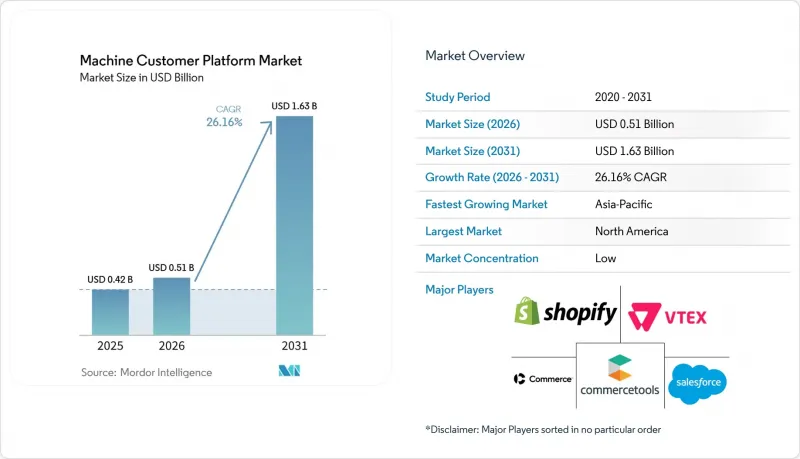
본 보고서는 플랫폼별(머신·고객·커머스 플랫폼 등), 도입 모델별(클라우드, 하이브리드, 온프레미스), 기업 규모별(대기업, 중소기업), 용도별(IT 및 통신, 은행, 금융서비스 및 보험(BFSI), 자동차 및 운송, 헬스케어 및 생명과학 등), 지역별로 분류되어 있습니다. 시장 예측은 금액(달러)으로 표시됩니다.
세계의 머신 고객 플랫폼 시장 동향 및 인사이트
AI를 활용한 구매 및 재주문의 확산
AI를 활용한 구매는 상품 발견에서 상품 선택, 주문 설정, 그리고 재구매로 점차 전환되고 있습니다. Shopify의 보고서에 따르면, 해당 플랫폼에서 AI 기반 주문은 2025년에 15배 증가할 것이며, AI 카탈로그를 통한 전환율은 스크래핑된 데이터를 기반으로 한 추천의 2배에 달했습니다. 이러한 결과는 에이전트가 적절한 상품을 식별한 후 거래를 관리하기 위해 머신 고객 플랫폼 시장이 필요함을 뒷받침합니다. 또한, 이러한 결과는 시장이 신뢰할 수 있는 제품 기록과 명확한 권한 설정을 필요로 하는 이유도 보여줍니다. 연결된 기기는 재고 부족이나 유지보수 필요성을 감지하고, 승인된 재고 보충 워크플로를 시작할 수 있습니다. 이를 통해 에이전트가 사용자나 조직이 설정한 제한 범위 내에서 행동하는 지속적인 상거래 관계가 가능해집니다.
기계 판독 가능한 제품 및 서비스 데이터의 확대
기계 판독 가능한 카탈로그 데이터는 자동화된 상거래를 위한 실질적인 요건이 되어가고 있습니다. Mirakl은 2026년 4월, 대규모 언어 모델이 읽고, 비교하며, 거래에 활용할 수 있는 상태인 상품 페이지가 1% 미만이라고 밝혔습니다. 기존 카탈로그의 대부분은 정확한 상품 용어나 상업 용어가 아닌, 키워드 검색이나 시각적 열람을 목적으로 구축되었습니다. OpenAI의 상품 피드 사양에서는 최신 가격, 재고, 반품 정책 필드가 필수로 지정되어 있습니다. 카탈로그 관리는 판촉 업무라기보다는 상업 운영 기능으로 자리매김하고 있습니다. 완전한 상품 레코드를 보유한 판매자는 에이전트를 통한 수요를 수용하는 데 유리한 입장에 있습니다.
비인간 구매자와 관련된 신원, 동의 및 책임의 공백
상거래 규칙에서는 일반적으로 구매 결정이나 승인은 인간이 하는 것으로 가정하고 있습니다. 따라서 에이전트가 정해진 권한 범위 내에서 상품을 선택하거나, 대체품 승인을 하거나, 결제를 전송하는 경우 불확실성이 발생합니다. CERRE의 조사에 따르면, 유럽 소비자법에서는 대리인에 의해 야기된 결함에 대한 명확한 책임 체계가 마련되어 있지 않은 것으로 밝혀졌습니다. 미해결 문제에는 동의, 위임된 권한, 그리고 잘못된 결과에 대한 책임 등이 포함됩니다. Visa의 Trusted Agent Protocol과 Experian의 Agent Trust는 승인된 에이전트와 신원이 확인된 사용자 또는 조직을 연결하는 것을 목표로 합니다. 비인간 구매자에 대한 법적 처우는 완전한 자율 구매를 실현하는 데 있어 계속해서 제약 요인으로 작용할 것입니다.
부문 분석
2025년, 머신 커스터머 커머스 플랫폼은 시장 점유율의 34.82%를 차지했습니다. 이 부문은 상품 검색, 장바구니 생성, 결제 및 주문 관리를 포괄합니다. 이러한 기능은 수익 및 구매 활동과 직접적으로 연결되므로, 기업들은 일반적으로 이 부분부터 도입을 시작합니다. 또한, 이 부문은 단계적 도입에도 대응하고 있어, 기업은 멀티 에이전트 프로세스를 추가하기 전에 상용 자동화를 도입할 수 있습니다. Shopify의 커머스 기능은 카탈로그 접근 및 거래 흐름을 AI 채널에 어떻게 공개할 수 있는지를 보여줍니다.
에이전트 ID 및 신뢰 플랫폼 시장은 2026-2031년 연평균 성장률(CAGR) 27.34%를 나타낼 것으로 예측됩니다. 이 플랫폼들은 AI 에이전트가 특정 개인이나 기업을 대신해 행동할 권한이 있는지 여부를 판단합니다. 에이전트의 역할이 단순한 추천에서 결제, 계약, 조달과 같은 행동으로 전환됨에 따라 이러한 필요성은 더욱 절실해질 것입니다. Experian은 2026년 4월에 Agent Trust를 도입한 반면, Visa는 2026년 7월에 유럽 전역의 은행 네트워크에서 Trusted Agent Protocol을 추진했습니다. 그 후, 오케스트레이션, 분석, 거버넌스 각 플랫폼이 다단계 작업, 모니터링, 정책 적용 및 문서화를 지원하게 될 것입니다.
2025년, 머신 고객 플랫폼 시장에서 클라우드 배포의 점유율은 68.14%를 차지했습니다. 클라우드 서비스는 모델의 신속한 업데이트, 탄력적인 컴퓨팅 능력, 그리고 프로토콜의 손쉬운 통합을 지원합니다. 이러한 기능은 팀이 워크플로를 신속하게 조정해야 하는 초기 실험 단계에서 유용합니다. 이 모델은 전체 기술 스택을 관리하고 싶지 않은 기업의 운영 부담을 줄여줄 수 있습니다. 데이터 관리 규정이 외부 처리를 허용하는 경우, 클라우드는 여전히 주요 선택지로 남아 있습니다.
하이브리드 배포는 2026-2031년 연평균 성장률(CAGR) 26.91%를 나타낼 것으로 예측됩니다. 이 방식에서는 클라우드에서 관리되는 에이전트 인터페이스를 활용하면서도, 기밀성이 높은 가격 정보, 규정 준수 관련 정보 또는 고객 기록을 로컬 시스템 내에 보관합니다. 이러한 구조는 거래의 전체 맥락이 제3자 AI 계층을 거칠 가능성이 있다는 우려에 대응하기 위한 것입니다. 온프레미스 배포는 건강 데이터, 주권 또는 국가 안보 관련 규제로 인해 퍼블릭 클라우드 사용이 제한되는 상황에서 여전히 중요한 역할을 수행하고 있습니다. Salesforce는 Agentforce Commerce를 가맹점이 소유한 데이터 인프라와 연동되는 이동 가능한 계층으로 설명하고 있습니다.
지역별 분석
2025년, 북미는 머신 고객 플랫폼 시장의 32.59%를 차지했습니다. 미국은 대규모 벤더 기반과 에이전트 기반 상용 시스템을 조기에 도입한 기업들을 모두 보유하고 있습니다. 미국에 본사를 둔 기업들은 상거래, 결제 및 에이전트 검증에 관한 프로토콜 개발에서 중심적인 역할을 해왔습니다. 캘리포니아주의 AB 316 법안이 2026년 1월 1일에 시행됨에 따라 AI에 의해 시작된 상업 행위에 대한 책임에 대한 관심이 높아지고 있습니다. 또한, 2025년에 Shopify의 AI 기반 주문이 15배 증가한 것은 소비자 대상 상거래 플랫폼에서 활발한 수요가 있음을 보여줍니다.
아시아태평양은 2026-2031년 연평균 성장률(CAGR) 27.28%를 나타낼 것으로 예측됩니다. 이 지역에는 중국의 디지털 커머스 인프라, 인도의 디지털 서비스 수요, 그리고 동남아시아의 모바일 우선 결제 생태계가 융합되어 있습니다. Meituan은 2025년 후반에 Xiaomei AI 에이전트를 출시하여 사용자의 의도를 해석하고, 화면 조작을 최소화하면서 거래를 완료할 수 있도록 했습니다. 이 지역의 성장은 신뢰할 수 있는 결제 수단과 에이전트의 권한에 관한 명확한 규칙에 달려 있습니다.
유럽에서는 거버넌스 도구의 필요성을 높이는 규제 요건이 시장을 형성하고 있습니다. EU AI법 제9조에 규정된 고위험 시스템에 대한 문서화 요건의 제출 기한은 2026년 8월입니다. CERRE는 에이전트로 인한 장애와 관련된 소비자 보호상의 미해결 문제를 지적하고 있습니다. 남미는 초기 단계에 있는 반면, 중동 및 아프리카에서는 의료 및 공공 서비스 분야의 AI 조달 활동을 통해 탄력을 받고 있습니다. 도입 현황은 결제 인프라의 성숙도, 규제, 그리고 체계화된 공급업체 데이터에 따라 달라집니다.
기타 혜택 :
- 엑셀 형식 시장 예측(ME) 시트
- 3개월간의 애널리스트 지원
자주 묻는 질문
목차
제1장 서론
제2장 조사 방법
제3장 주요 요약
제4장 시장 구도
제5장 시장 규모 및 성장 예측
제6장 경쟁 구도
제7장 시장 기회 및 향후 전망
AJY 26.09.03According to Mordor Intelligence, the machine customer platform market size was valued at USD 0.42 billion in 2025 and estimated to grow from USD 0.51 billion in 2026 to reach USD 1.63 billion by 2031, at a CAGR of 26.16% during the forecast period (2026-2031).
This report is Segmented by Platform (Machine Customer Commerce Platforms, and More), Deployment Model (Cloud, Hybrid, and On-Premises), Enterprise Size (Large Enterprises, and Small and Mid-Sized Enterprises), Application, (IT and Telecommunication, BFSI, Automotive and Transportation, Healthcare and Life Sciences, and More), and Geography. The Market Forecasts are Provided in Terms of Value (USD).
Global Machine Customer Platform Market Trends and Insights
Rising Adoption of AI-Mediated Buying and Reordering
AI-assisted buying is moving from product discovery into product selection, order setup, and repeat purchasing. Shopify reported that AI-driven orders on its platform increased 15-fold during 2025, while AI catalog surfaces converted at twice the rate of recommendations based on scraped data. These results support the need for a Machine Customer Platform Market to manage transactions after an agent identifies a suitable product. They also show why the Machine Customer Platform Market needs dependable product records and clear authority settings. Connected devices can identify depletion or maintenance needs and initiate approved replenishment workflows. This enables an ongoing commercial relationship in which an agent acts within the limits set by its user or organization.
Expansion of Machine-Readable Product and Service Data
Machine-readable catalog data is becoming a practical requirement for automated commerce. Mirakl stated in April 2026 that fewer than 1% of product pages were ready for large language models to read, compare, and use in transactions. Many existing catalogs were built for keyword search and visual browsing rather than for exact product and commercial terms. The OpenAI product feed specification requires current pricing, inventory, and return policy fields. Catalog management is becoming a commercial operations function rather than a promotional task. Merchants with complete product records are better positioned to receive agent-mediated demand.
Identity, Consent, and Liability Gaps for Nonhuman Buyers
Commercial rules generally assume that a person makes or accepts a purchase. This creates uncertainty when an agent selects an item, approves a substitution, or submits payment within a pre-set authority. CERRE found that European consumer law does not provide a clear liability structure for agent-initiated failures. The unresolved issues include consent, delegated authority, and responsibility for an incorrect result. Visa's Trusted Agent Protocol and Experian Agent Trust seek to connect an authorized agent with a verified user or organization. Legal treatment of nonhuman buyers will remain a constraint on fully autonomous purchasing.
Other drivers and restraints analyzed in the detailed report include:
- Standardization of Agentic Commerce Protocols
- Enterprise Demand for Autonomous B2B Transaction Workflows
- Incomplete Catalog, Pricing, and Policy Data for Agents
For complete list of drivers and restraints, kindly check the Table Of Contents.
Segment Analysis
Machine Customer Commerce Platforms accounted for 34.82% of the Machine Customer Platform Market share in 2025. This segment covers product discovery, cart assembly, checkout, and order management. Enterprises commonly begin here because these functions have a direct connection to revenue and purchasing activity. The segment also supports a phased deployment, allowing firms to introduce commercial automation before adding multi-agent processes. Shopify's commerce capabilities show how catalog access and transaction flows can be exposed to AI channels.
Agent Identity and Trust Platforms are projected to grow at a 27.34% CAGR from 2026 to 2031. They determine whether an AI agent has authority to act on behalf of a named person or business. This need becomes more pressing when agents move from recommendations to payment, contract, and procurement actions. Experian introduced Agent Trust in April 2026, while Visa advanced Trusted Agent Protocol across European banking networks in July 2026. Orchestration, analytics, and governance platforms then support multi-step work, monitoring, policy enforcement, and documentation.
Cloud deployment held 68.14% of the Machine Customer Platform Market share in 2025. Cloud services support rapid model updates, elastic computing capacity, and easier protocol integration. These features are useful during early experiments when teams need to adjust workflows quickly. The model can lower the operational burden for firms that do not want to manage a full technical stack. It remains the leading choice where data controls permit external processing.
Hybrid deployment is projected to grow at a 26.91% CAGR from 2026 to 2031. It uses cloud-managed agent interfaces while retaining sensitive pricing, compliance, or customer records within local systems. The structure responds to the concern that the full transaction context could pass through third-party AI layers. On-premises deployment remains relevant where health data, sovereignty, or national security controls limit public cloud use. Salesforce described Agentforce Commerce as a portable layer that works with merchant-owned data infrastructure.
Complete Report Scope:
- By Platform
- Machine Customer Commerce Platforms
- Agent Orchestration Platforms
- Agent Identity and Trust Platforms
- Analytics and Governance Platforms
- By Deployment Model
- Cloud
- Hybrid
- On-Premises
- By Enterprise Size
- Large Enterprises
- Small and Mid-sized Enterprises
- By Application
- IT and Telecommunication
- BFSI
- Automotive and Transportation
- Healthcare and Life Sciences
- Energy and Utilities
- Industrial Manufacturing
- Travel and Hospitality
- Other End Users
- By Geography
- North America
- United States
- Canada
- Mexico
- South America
- Brazil
- Argentina
- Rest of South America
- Europe
- Germany
- United Kingdom
- France
- Russia
- Spain
- Rest of Europe
- Asia-Pacific
- China
- Japan
- India
- South Korea
- Southeast Asia
- Rest of Asia-Pacific
- Middle East and Africa
- Middle East
- Saudi Arabia
- United Arab Emirates
- Rest of Middle East
- Africa
- South Africa
- Nigeria
- Rest of Africa
- Middle East
- North America
Geography Analysis
North America held 32.59% of the Machine Customer Platform Market share in 2025. The United States combines a substantial vendor base with early enterprise users of agent-based commercial systems. U.S.-based companies have played a central role in protocol development for commerce, payments, and agent verification. California's AB 316 took effect on January 1, 2026, increasing focus on responsibility for AI-initiated commercial actions. Shopify's 15-fold increase in AI-driven orders during 2025 also showed active demand on consumer-facing commerce surfaces.
Asia-Pacific is projected to grow at a 27.28% CAGR from 2026 to 2031. The region combines China's digital commerce infrastructure, India's demand for digital services, and Southeast Asia's mobile-first payment ecosystems. Meituan launched the Xiaomei AI agent in late 2025 to interpret user intent and complete transactions with minimal screen interaction. Regional growth will depend on trusted payment methods and clear rules for agent authority.
Europe is shaped by regulatory requirements that increase the need for governance tools. The EU AI Act's Article 9 documentation requirements for high-risk systems have an August 2026 deadline. CERRE has noted unresolved consumer protection questions regarding agent-initiated failures. South America is at an earlier stage, while the Middle East and Africa are building momentum through AI procurement activity in healthcare and public services. Adoption will vary with payment maturity, regulation, and structured supplier data.
- commercetools GmbH
- VTEX
- Shopify Inc.
- BigCommerce Holdings, Inc.
- Elastic Path Software Inc.
- Spryker Systems GmbH
- Salesforce, Inc.
- Kibo Software, Inc.
- Intershop Communications AG
- Sana Commerce B.V.
- Shopware AG
- Virto Commerce, Inc.
- Oro, Inc.
- Mirakl SAS
- SCAYLE GmbH
- Commerce Layer, Inc.
- Fabric, Inc.
- Constructor.io, Inc.
- Algolia, Inc.
- Bloomreach, Inc.
Additional Benefits:
- The market estimate (ME) sheet in Excel format
- 3 months of analyst support
TABLE OF CONTENTS
1 INTRODUCTION
- 1.1 Study Assumptions and Market Definition
- 1.2 Scope of the Study
2 RESEARCH METHODOLOGY
3 EXECUTIVE SUMMARY
4 MARKET LANDSCAPE
- 4.1 Market Overview
- 4.2 Market Drivers
- 4.2.1 Rising Adoption of AI-Mediated Buying and Reordering
- 4.2.2 Expansion of Machine-Readable Product and Service Data
- 4.2.3 Standardization of Agentic Commerce Protocols
- 4.2.4 Enterprise Demand for Autonomous B2B Transaction Workflows
- 4.2.5 Rising Connected-Device and IoT Transaction Triggers
- 4.2.6 Decision-Grade Agentic AI and Lower Inference Costs
- 4.3 Market Restraints
- 4.3.1 Identity, Consent, and Liability Gaps for Nonhuman Buyers
- 4.3.2 Incomplete Catalog, Pricing, and Policy Data for Agents
- 4.3.3 Merchant Disintermediation and First-Party Data Leakage Risk
- 4.3.4 Error, Fraud, and Irreversible Purchase Risk
- 4.4 Impact of Macroeconomic Factors on the Market
- 4.5 Industry Value-Chain Analysis
- 4.6 Technology Outlook
- 4.7 Regulatory Landscape
- 4.8 Porter's Five Forces Analysis
- 4.8.1 Threat of New Entrants
- 4.8.2 Bargaining Power of Suppliers
- 4.8.3 Bargaining Power of Buyers
- 4.8.4 Threat of Substitutes
- 4.8.5 Intensity of Competitive Rivalry
5 MARKET SIZE AND GROWTH FORECASTS (VALUE)
- 5.1 By Platform
- 5.1.1 Machine Customer Commerce Platforms
- 5.1.2 Agent Orchestration Platforms
- 5.1.3 Agent Identity and Trust Platforms
- 5.1.4 Analytics and Governance Platforms
- 5.2 By Deployment Model
- 5.2.1 Cloud
- 5.2.2 Hybrid
- 5.2.3 On-Premises
- 5.3 By Enterprise Size
- 5.3.1 Large Enterprises
- 5.3.2 Small and Mid-sized Enterprises
- 5.4 By Application
- 5.4.1 IT and Telecommunication
- 5.4.2 BFSI
- 5.4.3 Automotive and Transportation
- 5.4.4 Healthcare and Life Sciences
- 5.4.5 Energy and Utilities
- 5.4.6 Industrial Manufacturing
- 5.4.7 Travel and Hospitality
- 5.4.8 Other End Users
- 5.5 By Geography
- 5.5.1 North America
- 5.5.1.1 United States
- 5.5.1.2 Canada
- 5.5.1.3 Mexico
- 5.5.2 South America
- 5.5.2.1 Brazil
- 5.5.2.2 Argentina
- 5.5.2.3 Rest of South America
- 5.5.3 Europe
- 5.5.3.1 Germany
- 5.5.3.2 United Kingdom
- 5.5.3.3 France
- 5.5.3.4 Russia
- 5.5.3.5 Spain
- 5.5.3.6 Rest of Europe
- 5.5.4 Asia-Pacific
- 5.5.4.1 China
- 5.5.4.2 Japan
- 5.5.4.3 India
- 5.5.4.4 South Korea
- 5.5.4.5 Southeast Asia
- 5.5.4.6 Rest of Asia-Pacific
- 5.5.5 Middle East and Africa
- 5.5.5.1 Middle East
- 5.5.5.1.1 Saudi Arabia
- 5.5.5.1.2 United Arab Emirates
- 5.5.5.1.3 Rest of Middle East
- 5.5.5.2 Africa
- 5.5.5.2.1 South Africa
- 5.5.5.2.2 Nigeria
- 5.5.5.2.3 Rest of Africa
- 5.5.5.1 Middle East
- 5.5.1 North America
6 COMPETITIVE LANDSCAPE
- 6.1 Market Concentration
- 6.2 Strategic Moves
- 6.3 Market Share Analysis
- 6.4 Company Profiles (includes Global Level Overview, Market Level Overview, Core Segments, Financials as available, Strategic Information, Market Rank/Share, Products and Services, Recent Developments)
- 6.4.1 commercetools GmbH
- 6.4.2 VTEX
- 6.4.3 Shopify Inc.
- 6.4.4 BigCommerce Holdings, Inc.
- 6.4.5 Elastic Path Software Inc.
- 6.4.6 Spryker Systems GmbH
- 6.4.7 Salesforce, Inc.
- 6.4.8 Kibo Software, Inc.
- 6.4.9 Intershop Communications AG
- 6.4.10 Sana Commerce B.V.
- 6.4.11 Shopware AG
- 6.4.12 Virto Commerce, Inc.
- 6.4.13 Oro, Inc.
- 6.4.14 Mirakl SAS
- 6.4.15 SCAYLE GmbH
- 6.4.16 Commerce Layer, Inc.
- 6.4.17 Fabric, Inc.
- 6.4.18 Constructor.io, Inc.
- 6.4.19 Algolia, Inc.
- 6.4.20 Bloomreach, Inc.
7 MARKET OPPORTUNITIES AND FUTURE OUTLOOK
- 7.1 White-Space and Unmet-Need Assessment


