

|
시장보고서
상품코드
2118862
중동 및 아프리카의 넷 제로 에너지 빌딩 시장 : 시장 점유율 분석, 업계 동향 및 통계, 성장 예측(2026-2031년)Middle East and Africa Net-Zero Energy Buildings - Market Share Analysis, Industry Trends & Statistics, Growth Forecasts (2026 - 2031) |
||||||
 Mordor Intelligence
Mordor Intelligence에 의하면, 중동 및 아프리카의 넷 제로 에너지 빌딩 시장 규모는 2025년 17억 5,000만 달러로 평가되었고, 2026년 18억 9,000만 달러에서 2031년까지 38억 8,000만 달러로 확대될 것으로 예측되며, 2026-2031년 연평균 복합 성장률(CAGR)은 15.47%를 나타낼 전망입니다.
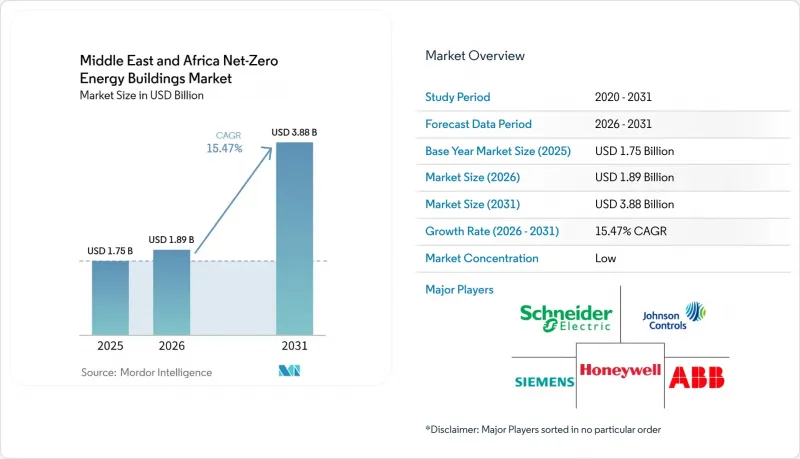
본 보고서는 건축물 유형별(주거, 상업, 공공, 산업), 제공 형태별(솔루션, 서비스), 건설 유형별(신축, 개보수), 지역별(아랍에미리트, 사우디아라비아, 남아프리카공화국, 이집트 등)로 분류되어 있습니다. 시장 예측은 금액(달러)으로 표시되어 있습니다.
중동 및 아프리카의 넷 제로 에너지 빌딩 시장 동향 및 인사이트
각국의 넷제로 의무화 및 그린빌딩 기준이 도입을 가속화
규제 상의 의무는 중동 및 아프리카의 넷-제로 에너지 건축물 시장에서 수요의 직접적인 원천이 되고 있습니다. 두바이에서는 신축 건축 허가에 알 사파트 실버 기준의 적용을 의무화하고 있으며, 지속가능성 관련 문서를 승인 및 준공 절차와 연계하고 있습니다. 사우디아라비아는 건축 기준 및 평가 체계에 지속가능성 요건을 통합하여, 이 노력을 시범 프로젝트 단계에서 한 단계 더 발전시켰습니다. 케냐는 2026년부터 2040년까지의 국가 건축 및 건설 탈탄소화 로드맵을 발표하고, 2030년까지 신축되는 공공 건축물에 대한 최소 에너지 성능 기준을 포함시켰습니다. 남아프리카공화국의 기후 변화법과 이에 따른 탄소세율 인상은 건축물의 배출량을 감축하기 위한 보다 명확한 경제적 근거를 마련했습니다. 이러한 조치로 인해 건축물 소유주, 설계자 및 공급업체는 프로젝트 초기 단계부터 에너지 성능에 주력해야 할 분명한 이유를 갖게 되었습니다.
태양광 발전, 에너지 저장, 스마트 HVAC 시스템의 비용 감소가 프로젝트의 실현 가능성을 높입니다.
기술 비용의 하락으로 인해 중동 및 아프리카의 순제로 에너지 건축물 시장에서 사업 타당성이 개선되고 있습니다. 고온 기후 하에서의 개조에 관한 동료 심사 연구에 따르면, 사우디아라비아에서 건축 외피 개조와 태양광 발전(PV) 시스템을 결합함으로써 외피 부분에 대한 투자 회수 기간을 3년으로 단축할 수 있는 것으로 밝혀졌습니다. 동 연구에서는 복합적인 개보수 패키지를 통해 에너지 수요를 니어 제로 에너지 건축물의 기준치 수준까지 낮출 수 있음도 밝혀졌습니다. 난방, 환기, 공조(HVAC) 시스템의 제어 성능을 향상시킴으로써 일상 운영 시 발생하는 에너지 낭비를 줄일 수 있습니다. 투자 회수 기간이 단축됨에 따라, 건물을 재건축할 수 없는 소유주에게도 기존 건물의 개보수가 경제적으로 더 현실적인 선택지가 됩니다. 이러한 변화로 인해 중동 및 아프리카의 순제로 에너지 건물 시장은 신축 프로젝트 파이프라인을 넘어 확대되고 있습니다.
높은 초기 투자 비용이 보급을 제한
높은 초기 비용이 여전히 중동 및 아프리카의 넷 제로 에너지 빌딩 시장을 제약하고 있습니다. 남아프리카공화국에 대한 조사에 따르면, 넷 제로 에너지 빌딩의 건설 비용은 기존 건축물에 비해 5%에서 10% 더 비쌀 가능성이 있습니다. 남아프리카공화국의 차입 비용은 2024년에 15%에 달했으며, 이로 인해 에너지 절약 및 재생에너지에 대한 투자 회수 기간이 길어질 우려가 있습니다. 킹 압둘라 석유 연구센터의 조사에 따르면, 137명의 응답자 중 20.4%가 걸프 지역 국가 건물의 에너지 절약에 있어 초기 비용의 높음을 장벽으로 꼽았습니다. 또한, 같은 조사에서 주거용 건물이 개조가 가장 어려운 부문임이 밝혀졌습니다. 프로젝트를 추진하기 위해서는 보다 장기적인 자금 조달 구조의 정비와 에너지 성능 계약에 대한 적절한 평가가 계속해서 중요할 것입니다.
부문별 분석
2025년, 중동 및 아프리카의 넷 제로 에너지 빌딩 시장에서 상업용 건물이 48.20%의 점유율을 차지했습니다. 이러한 상황은 걸프 지역 도심에 사무실, 호텔, 소매 시설, 대규모 복합 개발이 집중되어 있음을 반영합니다. 개발업자들은 인증 요건과 더 신뢰할 수 있는 에너지 성능을 요구하는 임차인의 요청에 부응하고 있습니다. 두바이에 위치한 슈나이더 일렉트릭(Schneider Electric)의 NEST 본사는 2025년에 연간 에너지 사용량을 37% 감축하여 LEED(Leadership in Energy and Environmental Design) ID+C 플래티넘 인증을 획득했습니다. 이 사례는 상업용 사무실이 건물 제어 및 현장 발전 분야에서 눈에 띄는 모범 사례가 될 수 있음을 보여줍니다. 또한, 상업시설 소유주는 검증된 운영 데이터를 활용하여 환경·사회·지배구조(ESG) 관련 공시를 뒷받침할 수도 있습니다.
공공시설은 2031년까지 16.30%라는 가장 높은 연평균 성장률(CAGR)을 나타낼 전망입니다. 공공기관, 대학, 병원, 캠퍼스는 더 대규모의 자산 포트폴리오를 관리하고 있으며, 여러 시설에 걸쳐 공통 기준을 설정할 수 있습니다. 지멘스와 아랍에미리트 고등기술대학은 에너지, 물, 폐기물, 청정 모빌리티 시스템을 아우르는 5년간의 스마트 캠퍼스 프레임워크에 합의했습니다. 이러한 합의는 일회성 설비 발주가 아닌, 지속적인 기술 및 서비스 제공을 뒷받침하는 것입니다. 남아프리카공화국과 이집트에서는 전력 공급이 불안정한 상황에서 건물 소유주들이 자급자족을 더욱 중시함에 따라 주택 분야 수요가 확대되고 있습니다. 또한 제조업체들이 신규 공장에 고성능 설계를 도입함에 따라 산업 시설도 대상 시장을 확대되고 있습니다.
기타 혜택 :
- 엑셀 형식 시장 예측(ME) 시트
- 3개월간의 애널리스트 지원
자주 묻는 질문
목차
제1장 서론
제2장 조사 방법
제3장 주요 요약
제4장 시장 구도
제5장 시장 규모 및 성장 예측
제6장 경쟁 구도
제7장 시장 기회 및 향후 전망
AJY 26.09.03According to Mordor Intelligence, the Middle East and Africa net-Zero energy buildings market size is projected to expand from USD 1.75 billion in 2025 and USD 1.89 billion in 2026 to USD 3.88 billion by 2031, registering a CAGR of 15.47% between 2026 to 2031.
This report is Segmented by Building Type (Residential, Commercial, Institutional, and Industrial), by Offerings (Solutions and Services), by Construction Type (New Construction and Renovation), and by Geography (United Arab Emirates, Saudi Arabia, South Africa, Egypt, and More). The Market Forecasts are Provided in Terms of Value (USD).
Middle East and Africa Net-Zero Energy Buildings Market Trends and Insights
National Net-Zero Mandates and Green Building Codes Accelerate Adoption
Regulatory mandates are a direct source of demand for the Middle East and Africa net-zero energy buildings market. Dubai requires its Al Sa'fat Silver baseline for new building permits, linking sustainability documentation to approval and completion processes. Saudi Arabia has embedded sustainability requirements into its building code and assessment framework, moving the subject beyond pilot projects. Kenya launched its National Buildings and Construction Decarbonization Roadmap for 2026 to 2040, including minimum energy performance standards for new public buildings by 2030. South Africa's Climate Change Act and its higher carbon tax rate created a clearer financial reason to reduce building emissions. These measures give building owners, designers, and suppliers clearer reasons to address energy performance earlier in a project.
Declining Costs of Solar, Storage, and Smart HVAC Systems Improve Project Viability
Lower technology costs are improving the business case for the Middle East and Africa net-zero energy buildings market. A peer-reviewed study of hot-climate retrofits found that envelope upgrades combined with photovoltaic (PV) systems could yield a 3-year payback for the envelope component in Saudi Arabia. The same source showed that combined retrofit packages can bring energy demand close to the thresholds for near-zero energy buildings. Better controls for heating, ventilation, and air conditioning, or HVAC, systems can reduce waste during daily operation. Shorter payback periods make upgrades to existing buildings more financially credible for owners who cannot replace their properties. This shift broadens the Middle East and Africa net-zero energy buildings market beyond new construction pipelines.
High Upfront Capital Requirements Limit Adoption
High upfront costs continue to constrain the Middle East and Africa net-zero energy buildings market. Net-zero buildings can cost 5% to 10% more to construct than conventional buildings, according to research on South Africa. South African borrowing costs reached 15% in 2024, potentially lengthening the payback periods for efficiency and renewable energy investments. A King Abdullah Petroleum Studies and Research Center survey found that 20.4% of 137 respondents identified high initial cost as a barrier to energy conservation in Gulf buildings. The survey also identified residential buildings as the most difficult segment to retrofit. Longer financing structures and better evaluation of energy performance contracts remain important for advancing projects.
Other drivers and restraints analyzed in the detailed report include:
- Utility Costs and Grid Reliability Challenges Increase Demand for Energy-Efficient Buildings
- Green Finance and Certification Incentives Support Building Investments
- Shortage of Specialized Professionals Delays Project Delivery
For complete list of drivers and restraints, kindly check the Table Of Contents.
Segment Analysis
Commercial buildings held 48.20% of the Middle East and Africa net-zero energy buildings market share in 2025. Their position reflects the concentration of offices, hotels, retail properties, and large mixed-use developments in Gulf urban centers. Developers are responding to certification requirements and to tenant requests for more credible energy performance. Schneider Electric's NEST headquarters in Dubai achieved a 37% reduction in annual energy use and Leadership in Energy and Environmental Design, or LEED, ID+C Platinum certification in 2025. The example shows how a commercial office can serve as a visible reference project for building controls and on-site generation. Commercial owners can also use verified operating data to support environmental, social, and governance disclosures.
Institutional buildings are forecast to post the fastest CAGR of 16.30% through 2031. Public agencies, universities, hospitals, and campuses control larger portfolios and can set common standards across multiple facilities. Siemens and the United Arab Emirates Higher Colleges of Technology agreed on a 5-year Smart Campus Framework that covers energy, water, waste, and clean mobility systems. Such agreements support recurring technology and services rather than a single equipment order. Residential demand is growing in South Africa and Egypt because building owners value greater self-sufficiency during unreliable power supply. Industrial facilities also widen the addressable base when manufacturers use high-performance designs for new plants.
Complete Report Scope:
- By Building Type
- Residential
- Commercial
- Institutional
- Industrial
- By Offerings
- Solutions (New Net-Zero Energy Building Development, Net-Zero Building Retrofit, Integrated Design & Delivery and Smart Net-Zero Building Solutions)
- Services (Architectural & Engineering Design, Construction Services, Commissioning & Certification Services and Consulting Services)
- By Construction Type
- New Construction
- Renovation
- By Country
- United Arab Emirates
- Saudi Arabia
- South Africa
- Egypt
- Rest of Middle East and Africa
List of Companies Covered in this Report:
- Johnson Controls International plc
- Schneider Electric SE
- Siemens AG
- Honeywell International Inc.
- ABB Ltd.
- Daikin Industries, Ltd.
- Trane Technologies plc
- Carrier Global Corporation
- Mitsubishi Electric Corporation
- Saint-Gobain S.A.
- Kingspan Group plc
- ROCKWOOL A/S
- Bosch Building Technologies
- Legrand SA
- ENGIE SA
- Masdar
- ACCIONA, S.A.
- Al-Futtaim Engineering and Technologies
- ELSEWEDY ELECTRIC
- Dalkia
Additional Benefits:
- The market estimate (ME) sheet in Excel format
- 3 months of analyst support
TABLE OF CONTENTS
1 Introduction
- 1.1 Study Assumptions and Market Definition
- 1.2 Scope of the Study
2 Research Methodology
3 Executive Summary
4 Market Landscape
- 4.1 Market Overview
- 4.2 Market Drivers
- 4.2.1 National Net-Zero Mandates and Green Building Codes Accelerate Market Adoption
- 4.2.2 Utility Cost and Grid Reliability Challenges Increase Demand for Energy-Efficient Buildings
- 4.2.3 Declining Costs of Solar, Storage, and Smart HVAC Systems Improve Project Viability
- 4.2.4 Green Finance and Certification Incentives Support Net-Zero Building Investments
- 4.2.5 Cooling-Dominant Building Loads Enhance Retrofit Payback Potential
- 4.2.6 Building Energy Performance Data Improves Access to Green Financing
- 4.3 Market Restraints
- 4.3.1 High Upfront Capital Requirements Limit Net-Zero Building Adoption
- 4.3.2 Shortage of Specialized Net-Zero Building Professionals Delays Project Delivery
- 4.3.3 Split Incentives and Weak Operational Performance Monitoring Reduce Investment Returns
- 4.3.4 Extreme Heat, Water Stress, and Renewable Energy Variability Challenge Building Performance
- 4.4 Value and Supply-Chain Analysis
- 4.5 Regulatory Landscape
- 4.6 Technological Outlook
- 4.7 Market Evolution and Adoption Trends
- 4.8 Key Net-Zero Energy Building Projects
- 4.9 Porter's Five Forces Analysis
- 4.9.1 Bargaining Power of Suppliers
- 4.9.2 Bargaining Power of Consumers
- 4.9.3 Threat of New Entrants
- 4.9.4 Threat of Substitutes
- 4.9.5 Intensity of Competitive Rivalry
5 Market Size & Growth Forecasts (Value, USD)
- 5.1 By Building Type
- 5.1.1 Residential
- 5.1.2 Commercial
- 5.1.3 Institutional
- 5.1.4 Industrial
- 5.2 By Offerings
- 5.2.1 Solutions (New Net-Zero Energy Building Development, Net-Zero Building Retrofit, Integrated Design & Delivery and Smart Net-Zero Building Solutions)
- 5.2.2 Services (Architectural & Engineering Design, Construction Services, Commissioning & Certification Services and Consulting Services)
- 5.3 By Construction Type
- 5.3.1 New Construction
- 5.3.2 Renovation
- 5.4 By Country
- 5.4.1 United Arab Emirates
- 5.4.2 Saudi Arabia
- 5.4.3 South Africa
- 5.4.4 Egypt
- 5.4.5 Rest of Middle East and Africa
6 Competitive Landscape
- 6.1 Market Concentration
- 6.2 Strategic Moves
- 6.3 Market Share Analysis
- 6.4 Company Profiles (Includes Global Level Overview, Market Level Overview, Core Segments, Financials as Available, Strategic Information, Products & Services, and Recent Developments)
- 6.4.1 Johnson Controls International plc
- 6.4.2 Schneider Electric SE
- 6.4.3 Siemens AG
- 6.4.4 Honeywell International Inc.
- 6.4.5 ABB Ltd.
- 6.4.6 Daikin Industries, Ltd.
- 6.4.7 Trane Technologies plc
- 6.4.8 Carrier Global Corporation
- 6.4.9 Mitsubishi Electric Corporation
- 6.4.10 Saint-Gobain S.A.
- 6.4.11 Kingspan Group plc
- 6.4.12 ROCKWOOL A/S
- 6.4.13 Bosch Building Technologies
- 6.4.14 Legrand SA
- 6.4.15 ENGIE SA
- 6.4.16 Masdar
- 6.4.17 ACCIONA, S.A.
- 6.4.18 Al-Futtaim Engineering and Technologies
- 6.4.19 ELSEWEDY ELECTRIC
- 6.4.20 Dalkia
7 Market Opportunities & Future Outlook
- 7.1 White-Space and Unmet-Need Assessment


