

|
시장보고서
상품코드
2118867
자동 의사결정 관리 소프트웨어 시장 : 시장 점유율 분석, 업계 동향 및 통계, 성장 예측(2026-2031년)Automated Decision Management Software - Market Share Analysis, Industry Trends & Statistics, Growth Forecasts (2026 - 2031) |
||||||
 Mordor Intelligence
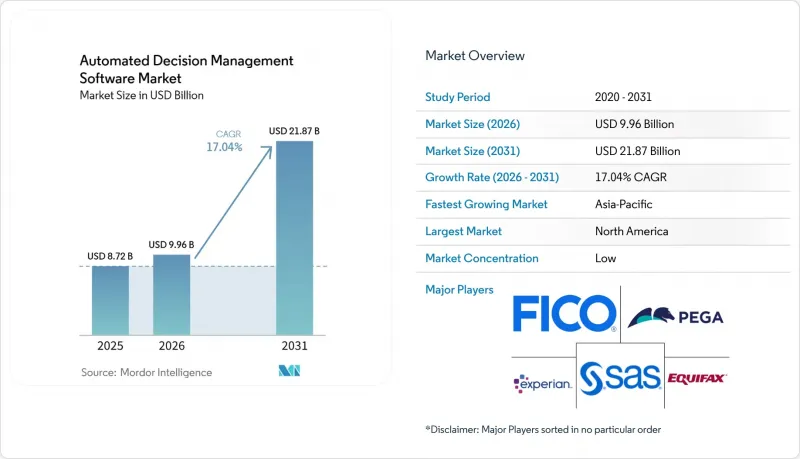
Mordor Intelligence에 의하면, 자동 의사결정 관리 소프트웨어 시장 규모는 2025년에 87억 2,000만 달러로 평가되었고, 2026년 99억 6,000만 달러에서 2031년까지 218억 7,000만 달러에 이를 것으로 예측되며, 예측 기간(2026-2031년)에서 CAGR은 17.04%를 나타낼 전망입니다.
본 보고서는 제공 형태별(소프트웨어 및 서비스), 도입 모델별(클라우드, 하이브리드, 온프레미스), 기능별(리스크 및 컴플라이언스 관리 등), 기업 규모별(대기업, 중소기업), 최종 사용자별(IT 및 통신, 은행, 금융서비스 및 보험(BFSI), 에너지·유틸리티 등), 그리고 지역별로 분류되어 있습니다. 시장 예측은 금액(달러) 기준으로 제시되어 있습니다.
세계의 자동 의사결정 관리 소프트웨어 시장 동향 및 인사이트
실시간 및 대량의 업무상 의사결정에 대한 수요
대량의 결제, 보험금 청구, 온라인 거래를 처리하는 조직은 특히 대응 지연이 손실 확대나 고객과의 상호작용 중단으로 이어질 가능성이 있는 경우, 일상적인 의사결정 전부를 사람의 검토에만 의존할 수 없습니다. 이러한 필요성은 사기 관리 분야에서 특히 두드러집니다. 2025년 AWS와 Stripe의 사례 연구에 따르면, 자동화 엔진이 카드 테스트 공격의 95%를 실시간으로 감지하여 고객과의 불필요한 마찰을 20% 줄였다고 보고되었습니다. 이는 자동화된 의사결정 관리 소프트웨어 시장에 대한 수요를 뒷받침하는 것입니다. 왜냐하면 구매자들은 더 신속한 결과와 함께, 계속 증가하는 모든 채널 전반에 걸쳐 정책이 일관되게 적용되기를 동시에 요구하고 있기 때문입니다. 실시간 의사결정이 보편화됨에 따라, 구매자들은 의사결정의 근거를 설명하고, 관련 데이터를 기록하며, 추후 검증을 위해 증거를 보존하는 시스템을 더욱 중요하게 여기게 되었습니다. 또한, 사기 패턴이 변화하고 신상품의 등장으로 평가가 필요한 거래 프로파일이 변화함에 따라 은행에는 적응력 있는 관리 체제도 요구되고 있습니다. OCC는 2026년 봄 리스크 전망 보고서에서 리스크 관리에 대한 동적이고 적응적인 접근 방식을 제안하고 있으며, 이는 자동화된 리스크 프로세스에 대한 지속적인 투자를 뒷받침하는 것입니다.
설명 가능한 AI 및 모델 거버넌스 요건의 확대
유럽연합(EU)의 AI 법은 개인, 서비스 이용 또는 안전과 관련된 프로세스에 영향을 미치는 고위험 자동 의사결정에서 거버넌스의 중요성을 강조하고 있습니다. 유럽 집행위원회는 이 법이 특정 AI 시스템에 대한 투명성 의무와 공급자 및 도입 사업자에 대한 관련 정보 공개 의무를 규정하고 있다고 설명합니다. 이에 따라 설명 가능성, 감사 가능성 및 인간에 의한 감독은 도입 후 추가되는 선택적 기능이 아니라, 많은 기업의 이용 사례 운영 요건의 일부가 됩니다. 조직이 개별 거버넌스 프로세스를 수반하는 고립된 모델을 도입하는 대신, 의사결정 기록 및 제어 기능을 제공하는 플랫폼을 선택함으로써 자동 의사결정 관리 소프트웨어 시장은 혜택을 받게 될 것입니다. 이러한 기능을 통해 신용,보험, 고용, 임상 분류 등 향후 정책 결과를 검토해야 할 가능성이 있는 분야에서 의사결정을 문서화하는 데 필요한 업무를 줄일 수 있습니다. 또한, 컴플라이언스 팀이 고객이나 환자에게 영향이 미치기 전에 정책 변경 사항을 검토하거나, 의사결정에 인간의 개입이 필요한 시점을 파악하는 것도 용이해집니다.
높은 도입 및 통합 비용
의사결정 관리 소프트웨어를 도입하려면 대부분의 경우 데이터 파이프라인, 모델 레지스트리, 규칙 생성 도구, 모니터링 시스템, 그리고 비즈니스 의사결정이 이루어지는 핵심 용도과의 연동이 필요합니다. 이러한 연동은 특히 클라이언트가 시스템 간에 일관성 없는 데이터 정의를 조정해야 하는 경우, 프로젝트 일정을 연장하고 초기 라이선스 비용 이외의 비용을 증가시킬 가능성이 있습니다. 조직이 AI 관련 업무에 예산을 편성했더라도 거버넌스, 보안 및 통합에 관한 요구 사항이 계속해서 장벽이 될 수 있습니다. 중견 기업의 경우, 비용에는 초기 도입 후의 모니터링, 모델 업데이트, 사용자 교육 및 규정 준수 심사 지원이 포함됩니다. 은행 및 보험 업계의 레거시 시스템은 기존 정책 규칙이 오래되었고 문서화되지 않은 코드에 분산되어 있을 가능성이 있어, 이를 체계화하기 어렵기 때문에 추가적인 부담이 될 수 있습니다. 이러한 제약은 서비스 수요를 뒷받침하고 있지만, 도입 능력이 제한적인 구매자의 경우 자동 의사결정 관리 소프트웨어 시장 진입을 지연시키는 요인이 될 수 있습니다.
부문 분석
2025년, 소프트웨어는 자동 의사결정 관리 소프트웨어 시장 점유율의 71.26%를 차지했습니다. 기업들은 규칙 엔진, 모델 배포, 설명 가능성 기능, 모니터링 대시보드 및 정책 관리를 위한 공통 작업 공간을 결합한 통합형 구독 모델을 선호하여 채택했습니다. 단일 플랫폼을 활용함으로써 규정 준수 심사 시 평가해야 할 공급업체 수를 줄이고, 업데이트에 대한 책임 소재를 명확히 할 수 있습니다. 또한 대규모 조직의 경우, 사업 부문, 제품 및 지역별 사업 거점에 걸친 정책 변경을 일관된 방식으로 관리할 수 있게 됩니다. 이 소프트웨어 모델은 의사결정 규칙과 분석 모델이 동일한 거버넌스가 적용된 워크플로우 내에서 연계되어 작동해야 하는 경우에 특히 효과적입니다. 이러한 추세로 인해 이 소프트웨어는 자동 의사결정 관리 소프트웨어 시장에서 계속해서 주요 상용 구성 요소로서의 지위를 유지하고 있습니다.
서비스 분야는 2026-2031년 연평균 성장률(CAGR) 18.14%를 나타낼 것으로 예측됩니다. 구매 기업은 의사결정 시스템을 레거시 용도과 연동하거나, 자사의 운영 절차에 부합하는 문서, 감사 추적 기록, 테스트 케이스 및 통제를 구성하기 위한 지원을 필요로 합니다. 또한, 벤더가 모델 모니터링, 드리프트 감지, 정책 업데이트 및 적용, 변화하는 요구 사항에 대한 대응을 지원하는 책임을 맡게 됨에 따라 관리형 의사 결정 운영의 중요성도 높아지고 있습니다. IBM은 2025년 12월, 비즈니스 정책을 의사결정 로직으로 변환하는 데 도움을 주는 ‘Decision Assistant’를 통합한 ODM 9.5.0.1을 출시했습니다. 내장된 도구를 통해 기술적인 작업의 일부는 경감될 수 있지만, 특히 문서화되지 않은 규칙을 대체하는 경우, 복잡한 도입에는 여전히 구현 및 거버넌스에 관한 전문 지식이 필요합니다. 따라서 서비스 제공업체는 초기 소프트웨어 설정이 완료된 시점에서 역할을 끝내는 것이 아니라, 실제 운영 후에도 계속 관여할 수 있습니다.
2025년 자동 의사결정 관리 소프트웨어 시장에서 클라우드가 66.83%를 차지했습니다. 기술 기업과 소매 기업은 신속한 업데이트, 유연한 용량, 사내 인프라 관리 부담을 줄일 수 있기 때문에 클라우드 기반 제공을 선호하는 경향이 있습니다. 또한 클라우드 시스템은 데이터 규칙이 유연하여, 고객과의 상호작용이나 거래에 계절적 피크 등 수요 변동이 있는 조직에도 적합합니다. 벤더가 관리하는 업그레이드를 통해 사용자는 자체 관리형 도입보다 더 신속하게 새로운 거버넌스 기능이나 분석 기능을 도입할 수 있습니다. 이 모델은 제품 출시부터 비즈니스 사용자가 이용할 수 있게 되는 기간을 단축할 수도 있습니다. 이러한 장점 덕분에 클라우드는 여전히 가장 큰 비중을 차지하는 도입 모델입니다.
하이브리드 배포는 2031년까지 연평균 성장률(CAGR) 17.92%를 나타낼 것으로 예측됩니다. 은행이나 의료 기관에서는 하이브리드 설계를 채택하여 기밀성이 높은 워크로드를 사설 인프라에 유지하면서, 수요 변화나 기밀성이 낮은 프로세스를 외부에서 처리할 수 있는 경우에는 클라우드 용량을 활용하고 있습니다. 이러한 접근 방식을 통해 모든 구성 요소가 동일한 환경을 사용할 필요 없이 데이터 상주 요건, 응답 시간 요건, 사업 연속성 계획 및 클라우드 서비스 접근을 지원할 수 있습니다. 온프레미스 도입은 격리된 운영이나 시스템에 대한 직접적인 통제가 요구되는 국방, 정부, 중앙은행 분야에서 여전히 중요한 역할을 수행하고 있습니다. 또한 하이브리드 모델은 벤더와의 관계 조정이나 환경 간 워크로드 이전이 필요한 경우 구매자에게 더 높은 유연성을 제공합니다. 따라서 자동 의사결정 관리 소프트웨어 시장은 단일 아키텍처로 완전히 전환하기보다는 여러 가지 실행 가능한 도입 경로를 유지할 가능성이 높다고 볼 수 있습니다.
지역별 분석
2025년, 북미는 지역별 부문의 39.82%를 차지했습니다. 이 지역에는 신용 평가, 사기 방지, 규정 준수, 고객 온보딩 워크플로우에서 이미 자동화된 의사 결정을 활용하고 있는 BFSI(은행 및 금융 및 보험) 기관이 다수 존재합니다. 또한, 이 지역의 기술 기업들은 고도의 AI 엔지니어링 역량, 확립된 기업 소프트웨어 구매 프로세스, 그리고 규제 대상 도입 경험을 갖춘 다수공급업체를 보유하고 있습니다. 지역 내 수요의 대부분은 미국이 주도하고 있으며, 캐나다는 금융 서비스 및 공공 부문의 디지털화를 통해 기여하고 있습니다. 멕시코에서는 은행업 및 제조업의 규정 준수 분야에서 이용 사례가 개발되고 있으며, 이러한 성숙한 사용자와 기술 제공업체의 조합이 자동화된 의사결정 관리 소프트웨어 시장에서 북미의 선도적 지위를 뒷받침하고 있습니다.
아시아태평양은 2026-2031년 연평균 성장률(CAGR) 18.08%를 나타낼 것으로 예측됩니다. 성장은 인도, 중국, 일본 및 동남아시아에 집중되어 있으며, 이들 지역에서는 기업의 AI 활용이 진전되는 한편, 자동화된 의사결정을 관리해야 할 필요성도 높아지고 있습니다. 인도에서는 기업용 AI 기반이 확대되고 있으며, 컴퓨팅 인프라 접근을 지원하는 공공 프로그램도 마련되어 있습니다. 이 지역의 디지털 은행들은 대량의 거래를 처리할 수 있는 자동화된 신용 심사 및 사기 감지 의사결정 시스템에 대한 수요를 주도하고 있습니다. 따라서 아시아태평양은 벤더들에게 현지화된 제품, 현지 도입 지원, 그리고 다양한 데이터 및 규제 요건을 충족하는 시스템을 필요로 하는 대규모 구매자층을 제공합니다. 이 지역의 디지털 금융 서비스 도입 속도는 의사결정 플랫폼이 초기 시범 단계를 넘어 발전할 수 있는 현실적인 경로를 제시하고 있습니다.
유럽에서는 기업들이 AI 규제에 대비하고 자동화된 결과를 명확하게 문서화하는 방법을 모색함에 따라 거버넌스 도구에 대한 수요가 증가하고 있습니다. 독일에서는 기업들의 AI 도입이 진행되고 있으며, 이는 의사 결정 및 관련 기록을 관리하는 소프트웨어의 보다 광범위한 배포를 뒷받침하고 있습니다. 남미, 특히 브라질에서는 모멘텀이 증가하고 있으며, 기업들은 AI를 전략적으로 더욱 중시하게 되면서 금융 서비스 및 기업 운영에서의 AI 활용을 검토하고 있습니다. 중동 및 아프리카에서는 은행 및 정부 서비스 분야에서 초기 검토 단계에서 보다 체계적인 시범 단계로 전환되고 있습니다. 사우디아라비아, 아랍에미리트, 남아프리카공화국, 나이지리아 등은 관련 초기 활동이 관찰되는 시장의 일부입니다. 데이터 현지화 규제와 각국 고유의 도입 요구 사항이 이 지역에서공급업체 선정에 영향을 미칠 것으로 예측됩니다.
기타 혜택 :
- 엑셀 형식 시장 예측(ME) 시트
- 3개월간의 애널리스트 지원
자주 묻는 질문
목차
제1장 서론
제2장 조사 방법
제3장 개요
제4장 시장 구도
제5장 시장 규모 및 성장 예측
제6장 경쟁 구도
제7장 시장 기회 및 향후 전망
AJY 26.09.01According to Mordor Intelligence, the automated decision management software market size was valued at USD 8.72 billion in 2025 and is estimated to grow from USD 9.96 billion in 2026 to reach USD 21.87 billion by 2031, at a CAGR of 17.04% during the forecast period (2026-2031).
This report is Segmented by Offering (Software, and Services), Deployment Model (Cloud, Hybrid, and On-Premises), Function (Risk and Compliance Management, and More), Enterprise Size (Large Enterprises, and Small and Mid-Sized Enterprises), End Users (IT and Telecommunication, BFSI, Energy and Utilities, and More), and Geography. The Market Forecasts are Provided in Terms of Value (USD).
Global Automated Decision Management Software Market Trends and Insights
Demand for Real-Time, High-Volume Operational Decisions
Organizations that process large volumes of payments, insurance claims, and online transactions cannot rely on human review for every routine decision, particularly when delayed action can increase losses or interrupt a customer interaction. The need is especially clear in fraud management, where a 2025 AWS and Stripe case study reported that automated engines identified 95% of card-testing attacks in real time and reduced unnecessary customer friction by 20%. This supports demand for the Automated Decision Management Software Market because buyers need both faster outcomes and consistent application of policy across a growing number of channels. As real-time decisioning becomes more common, buyers place greater value on systems that explain why a decision was made, record the relevant data, and retain evidence for later review. Banks also need adaptable controls as fraud patterns change and as new products alter the profile of transactions that must be assessed. The OCC called for a dynamic and adaptive approach to risk management in its Spring 2026 risk perspective, which supports continued investment in automated risk processes.
Expansion of Explainable AI and Model Governance Requirements
The European Union AI Act increases the importance of governance for high-risk automated decisions that affect individuals, access to services, or safety-related processes. The European Commission explains that the Act establishes transparency obligations for certain AI systems and related information duties for providers and deployers. This makes explainability, auditability, and human oversight part of the operating requirements for many enterprise use cases, rather than optional features added after deployment. The Automated Decision Management Software Market benefits when organizations choose platforms that provide decision records and controls instead of deploying isolated models with separate governance processes. These capabilities can reduce the work needed to document decisions in areas such as credit, insurance, employment, and clinical triage, where a policy outcome may later need to be examined. They also make it easier for compliance teams to review policy changes before they affect customers or patients, and to identify when a decision requires human intervention.
High Implementation and Integration Costs
Deploying decision management software often requires connections to data pipelines, model registries, rule-authoring tools, monitoring systems, and the core applications where business decisions are carried out. These connections can extend project schedules and add costs beyond the initial license, especially when the client has to reconcile inconsistent data definitions across systems. Governance, security, and integration requirements can remain barriers even when an organization has budgeted for AI-related work. For mid-sized companies, the cost includes monitoring, model updates, user training, and support for compliance reviews after the first implementation. Legacy systems in banking and insurance can create an additional burden because existing policy rules may be dispersed across old, undocumented code, making them difficult to formalize. This constraint supports demand for services, but it can delay entry into the Automated Decision Management Software Market for buyers with limited implementation capacity.
Other drivers and restraints analyzed in the detailed report include:
- Low-Code Decision Modeling Expanding Business-User Adoption
- Embedded Decisioning Across Digital Channels and Core Applications
- Shortage of Domain-Specific Data and Decision Expertise
For complete list of drivers and restraints, kindly check the Table Of Contents.
Segment Analysis
Software held 71.26% of the Automated Decision Management Software Market share in 2025. Enterprises favored integrated subscriptions that combine rules engines, model deployment, explainability functions, monitoring dashboards, and a common workspace for policy management. A single platform can reduce the number of vendors to be assessed during a compliance review and simplify responsibility for updates. It can also give large organizations a more consistent way to manage policy changes across business units, products, and geographic operations. The software model is particularly relevant where decision rules and analytical models need to work together within the same governed workflow. This preference keeps software as the leading commercial component of the Automated Decision Management Software Market.
Services is projected to grow at a CAGR of 18.14% from 2026 to 2031. Buyers need support to connect decision systems with legacy applications and to configure documentation, audit trails, test cases, and controls that align with their operating procedures. Managed decision operations are also becoming more important as vendors assume responsibility for monitoring models, detecting drift, applying policy updates, and helping teams respond to changing requirements. IBM released ODM 9.5.0.1 in December 2025 with Decision Assistant integration to help translate business policy into decision logic. Embedded tools may reduce some technical work, but complex deployments still require implementation and governance expertise, particularly when a company is replacing undocumented rules. Service providers can therefore remain involved after go-live rather than ending their role when the initial software configuration is complete.
Cloud accounted for 66.83% of the Automated Decision Management Software Market in 2025. Technology and retail companies often favor cloud delivery because it enables rapid updates, flexible capacity, and reduced internal infrastructure management. Cloud systems also suit organizations with flexible data rules and variable demand, including seasonal peaks in customer interactions or transactions. Vendor-managed upgrades can help users adopt new governance or analytics features more quickly than they could through a self-managed installation. The model can also shorten the time between a product release and its availability to business users. These advantages keep the cloud as the largest deployment model.
Hybrid deployment is projected to grow at a 17.92% CAGR through 2031. Banking and healthcare organizations use hybrid designs to retain sensitive workloads on private infrastructure while using cloud capacity when demand changes or when less sensitive processes can be handled externally. This approach can support data residency needs, response-time requirements, continuity planning, and access to cloud services without requiring every component to use the same environment. On-premises installations retain a role in defense, government, and central-bank settings that require isolated operations and direct control over systems. A hybrid model can also give buyers more flexibility when they need to adjust a vendor relationship or move a workload between environments. The Automated Decision Management Software Market is therefore likely to retain more than one viable deployment route rather than move entirely to a single architecture.
Complete Report Scope:
- By Offering
- Software
- Services
- By Deployment Model
- Cloud
- Hybrid
- On-Premises
- By Function
- Risk and Compliance Management
- Customer Experience and Personalization
- Fraud Management
- Pricing and Revenue Optimization
- Credit Decisioning
- Other Functions
- By Enterprise Size
- Large Enterprises
- Small and Mid-sized Enterprises
- By End Users
- IT and Telecommunication
- BFSI
- Automotive and Transportation
- Healthcare and Life Sciences
- Energy and Utilities
- Industrial Manufacturing
- Travel and Hospitality
- Other End Users
- By Geography
- North America
- United States
- Canada
- Mexico
- South America
- Brazil
- Argentina
- Rest of South America
- Europe
- Germany
- United Kingdom
- France
- Russia
- Spain
- Rest of Europe
- Asia-Pacific
- China
- Japan
- India
- South Korea
- Southeast Asia
- Rest of Asia-Pacific
- Middle East and Africa
- Middle East
- Saudi Arabia
- United Arab Emirates
- Rest of Middle East
- Africa
- South Africa
- Nigeria
- Rest of Africa
- Middle East
- North America
Geography Analysis
North America held 39.82% of the geographic segment in 2025. The region has a large base of BFSI institutions that already use automated decisions in credit, fraud, compliance, and customer onboarding workflows. Its technology companies also have deep AI engineering capabilities, established enterprise software buying processes, and a large base of suppliers with experience in regulated deployments. The United States drives most regional demand, while Canada contributes through financial services and public-sector digitization. Mexico is developing use cases in banking and manufacturing compliance, while this mix of mature users and technology providers supports North America's leading position in the Automated Decision Management Software Market.
Asia-Pacific is projected to grow at a CAGR of 18.08% from 2026 to 2031. Growth is concentrated in India, China, Japan, and Southeast Asia, where enterprise AI activity is being matched by a growing need to control automated decisions. India has an expanding base of enterprise AI and public programs that support access to computing infrastructure. The region's digital banks are driving demand for automated credit and fraud decision-making systems capable of handling high transaction volumes. Asia-Pacific, therefore, offers vendors a large group of buyers who need localized products, local implementation support, and systems that meet diverse data and regulatory requirements. The region's pace of digital financial services adoption offers a practical path for decision platforms to move beyond early pilots.
Europe is seeing stronger demand for governance tools as companies prepare for AI regulation and seek clearer ways to document automated outcomes. Germany's enterprise adoption of AI has increased, supporting broader deployment of software that manages decisions and related records. South America is gaining momentum, particularly in Brazil, where companies are giving AI a higher strategic priority and are examining its use in financial services and enterprise operations. The Middle East and Africa are moving from early exploration into more structured pilots in banking and government services. Saudi Arabia, the United Arab Emirates, South Africa, and Nigeria are among the markets with relevant early activity. Data localization rules and sovereign deployment needs will influence vendor selection across these regions.
- Fair Isaac Corporation
- Pegasystems Inc.
- SAS Institute Inc.
- ACTICO GmbH
- Sparkling Logic, Inc.
- InRule Technology, Inc.
- FlexRule Inc.
- DecisionRules s.r.o.
- Sapiens International Corporation N.V.
- Progress Software Corporation
- Software AG
- Camunda Services GmbH
- Appian Corporation
- Decisions.com, Inc.
- Nected Technologies Private Limited
- Rulebricks, Inc.
- OpenL Tablets
- Drools
- Experian plc
- Equifax Inc.
- Moody's Analytics, Inc.
- Verisk Analytics, Inc.
- MeridianLink, Inc.
- Cognizant Technology Solutions Corporation
Additional Benefits:
- The market estimate (ME) sheet in Excel format
- 3 months of analyst support
TABLE OF CONTENTS
1 INTRODUCTION
- 1.1 Study Assumptions and Market Definition
- 1.2 Scope of the Study
2 RESEARCH METHODOLOGY
3 EXECUTIVE SUMMARY
4 MARKET LANDSCAPE
- 4.1 Market Overview
- 4.2 Market Drivers
- 4.2.1 Demand for Real-Time, High-Volume Operational Decisions
- 4.2.2 Expansion of Explainable AI and Model Governance Requirements
- 4.2.3 Low-Code Decision Modeling Expanding Business-User Adoption
- 4.2.4 Embedded Decisioning Across Digital Channels and Core Applications
- 4.2.5 Decision Intelligence Investment in Regulated Industries
- 4.2.6 Agentic AI Requiring Governed Action and Policy Execution
- 4.3 Market Restraints
- 4.3.1 High Implementation and Integration Costs
- 4.3.2 Shortage of Domain-Specific Data and Decision Expertise
- 4.3.3 Vendor Lock-In Across Proprietary Cloud Decision Stacks
- 4.3.4 Uncertain Liability and Regulatory Treatment of Automated Decisions
- 4.4 Impact of Macroeconomic Factors on the Market
- 4.5 Industry Value-Chain Analysis
- 4.6 Technology Outlook
- 4.7 Regulatory Landscape
- 4.8 Porter's Five Forces Analysis
- 4.8.1 Threat of New Entrants
- 4.8.2 Bargaining Power of Suppliers
- 4.8.3 Bargaining Power of Buyers
- 4.8.4 Threat of Substitutes
- 4.8.5 Intensity of Competitive Rivalry
5 MARKET SIZE AND GROWTH FORECASTS (VALUE)
- 5.1 By Offering
- 5.1.1 Software
- 5.1.2 Services
- 5.2 By Deployment Model
- 5.2.1 Cloud
- 5.2.2 Hybrid
- 5.2.3 On-Premises
- 5.3 By Function
- 5.3.1 Risk and Compliance Management
- 5.3.2 Customer Experience and Personalization
- 5.3.3 Fraud Management
- 5.3.4 Pricing and Revenue Optimization
- 5.3.5 Credit Decisioning
- 5.3.6 Other Functions
- 5.4 By Enterprise Size
- 5.4.1 Large Enterprises
- 5.4.2 Small and Mid-sized Enterprises
- 5.5 By End Users
- 5.5.1 IT and Telecommunication
- 5.5.2 BFSI
- 5.5.3 Automotive and Transportation
- 5.5.4 Healthcare and Life Sciences
- 5.5.5 Energy and Utilities
- 5.5.6 Industrial Manufacturing
- 5.5.7 Travel and Hospitality
- 5.5.8 Other End Users
- 5.6 By Geography
- 5.6.1 North America
- 5.6.1.1 United States
- 5.6.1.2 Canada
- 5.6.1.3 Mexico
- 5.6.2 South America
- 5.6.2.1 Brazil
- 5.6.2.2 Argentina
- 5.6.2.3 Rest of South America
- 5.6.3 Europe
- 5.6.3.1 Germany
- 5.6.3.2 United Kingdom
- 5.6.3.3 France
- 5.6.3.4 Russia
- 5.6.3.5 Spain
- 5.6.3.6 Rest of Europe
- 5.6.4 Asia-Pacific
- 5.6.4.1 China
- 5.6.4.2 Japan
- 5.6.4.3 India
- 5.6.4.4 South Korea
- 5.6.4.5 Southeast Asia
- 5.6.4.6 Rest of Asia-Pacific
- 5.6.5 Middle East and Africa
- 5.6.5.1 Middle East
- 5.6.5.1.1 Saudi Arabia
- 5.6.5.1.2 United Arab Emirates
- 5.6.5.1.3 Rest of Middle East
- 5.6.5.2 Africa
- 5.6.5.2.1 South Africa
- 5.6.5.2.2 Nigeria
- 5.6.5.2.3 Rest of Africa
- 5.6.5.1 Middle East
- 5.6.1 North America
6 COMPETITIVE LANDSCAPE
- 6.1 Market Concentration
- 6.2 Strategic Moves
- 6.3 Market Share Analysis
- 6.4 Company Profiles (includes Global Level Overview, Market Level Overview, Core Segments, Financials as available, Strategic Information, Market Rank/Share, Products and Services, Recent Developments)
- 6.4.1 Fair Isaac Corporation
- 6.4.2 Pegasystems Inc.
- 6.4.3 SAS Institute Inc.
- 6.4.4 ACTICO GmbH
- 6.4.5 Sparkling Logic, Inc.
- 6.4.6 InRule Technology, Inc.
- 6.4.7 FlexRule Inc.
- 6.4.8 DecisionRules s.r.o.
- 6.4.9 Sapiens International Corporation N.V.
- 6.4.10 Progress Software Corporation
- 6.4.11 Software AG
- 6.4.12 Camunda Services GmbH
- 6.4.13 Appian Corporation
- 6.4.14 Decisions.com, Inc.
- 6.4.15 Nected Technologies Private Limited
- 6.4.16 Rulebricks, Inc.
- 6.4.17 OpenL Tablets
- 6.4.18 Drools
- 6.4.19 Experian plc
- 6.4.20 Equifax Inc.
- 6.4.21 Moody's Analytics, Inc.
- 6.4.22 Verisk Analytics, Inc.
- 6.4.23 MeridianLink, Inc.
- 6.4.24 Cognizant Technology Solutions Corporation
7 MARKET OPPORTUNITIES AND FUTURE OUTLOOK
- 7.1 White-Space and Unmet-Need Assessment


