

|
시장보고서
상품코드
2118869
디아세톤 알코올 시장 : 시장 점유율 분석, 업계 동향 및 통계, 성장 예측(2026-2031년)Diacetone Alcohol - Market Share Analysis, Industry Trends & Statistics, Growth Forecasts (2026 - 2031) |
||||||
 Mordor Intelligence
Mordor Intelligence에 의하면, 디아세톤 알코올 시장 규모는 2025년 13억 5,000만 달러로 평가되었고, 2026년 14억 2,000만 달러에서 2031년까지 18억 2,000만 달러로 확대될 것으로 예측되며, 2026-2031년 CAGR 5.09%를 나타낼 전망입니다.
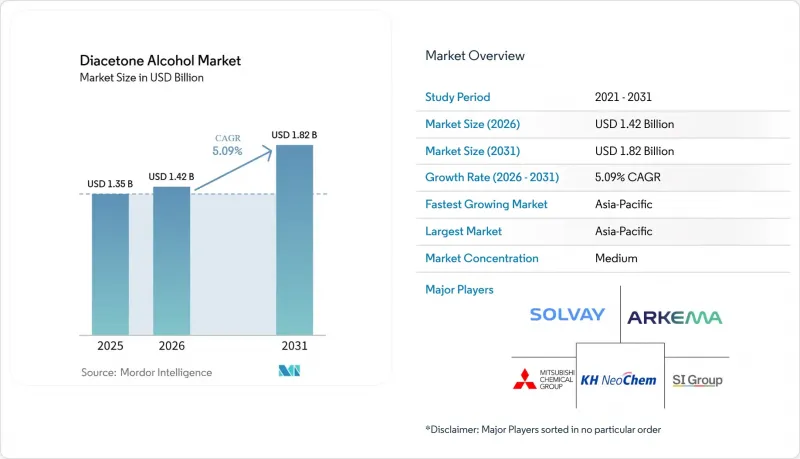
본 보고서는 용도별(용제, 화학 중간체, 첨가제), 최종 이용 산업별(페인트 및 코팅, 화학제품 제조, 폴리머·플라스틱, 건설, 자동차, 섬유·가죽, 농약, 인쇄 잉크 등), 지역별(아시아태평양, 북미, 유럽, 남미, 중동 및 아프리카)로 분류되어 있습니다. 시장 예측은 금액(달러) 기준으로 제시되어 있습니다.
세계의 디아세톤 알코올 시장 동향 및 인사이트
도료, 코팅 및 산업용 배합제 분야에서 저VOC 용제에 대한 수요 증가
휘발성 유기 화합물(VOC) 규제가 강화됨에 따라, 건축용 도료 및 산업용 표면 처리 공정에서 배합 변경이 진행되고 있습니다. 미국 환경보호청(EPA)은 2025년 1월 에어로졸 도료 배출 기준에 관한 개정안을 최종 확정하고, 2025년 7월에는 시행 일정을 조정했습니다. 디아세톤 알코올은 그 증발 속도로 인해 배합 담당자가 오픈 타임 및 피막 형성을 관리하기 쉬워지므로, 이러한 시스템을 뒷받침하고 있습니다. 알케마(Arkema)사는 순도 99.5% 이상, 비등점 168°C, 완전한 수용성을 갖춘 자사 제품을 라인업하고 있습니다. 이러한 특성 덕분에 용제형 및 수성 코팅 시스템 모두에서 사용할 수 있습니다. 또한 오리건주도 2025년에 건축용 도료를 대상으로 한 휘발성 유기 화합물(VOC) 규제안을 제시하며, 이 정책의 방향성을 주 차원까지 확대되고 있습니다. 이 제안으로 인해 도료 공급업체는 규정 준수를 독립적인 구매 결정으로 취급하기보다는 용제 선정, 배합 성능 및 보고 의무를 일체적으로 평가할 필요성이 더욱 커지고 있습니다. 고객들은 기존 도료 공정을 유지하면서도 진화하는 대기질 기대치에 부응하는 용제를 원하고 있기 때문에 이러한 규제 환경은 디아세톤 알코올 시장을 뒷받침하고 있습니다.
세정 및 특수 용도 분야에서 악취가 심한 용제나 고VOC 용제의 대체가 진행되고 있습니다.
산업용 세정, 금속 탈지 및 정밀 세정 용도에서 일부 방향족 용제 및 할로겐화 용제의 사용이 감소하는 추세입니다. 유럽연합 집행위원회 규정(EU) 2025/1090은 REACH 프레임워크에 따라 2026년 12월 이후 N,N-디메틸아세토아미드 및 1-에틸피롤리딘-2-온의 사용을 제한하고 있습니다. 이러한 변경으로 인해 유럽의 산업 사용자들이 선택할 수 있는 용매의 폭이 좁아지고 있습니다. 디아세톤 알코올의 경우, 산소 함유 용매에 관한 유럽 용매 산업 그룹(ESIG)의 체계를 통해 REACH 준수 경로가 확립되어 있습니다. 이러한 상황은 필요한 규정 준수 기록 및 제품 문서를 적절히 관리하고 있는 공급업체에게 유리하게 작용할 가능성이 있습니다. 농약 및 의약품 분야 수요 또한 용제의 성능과 추적 가능성이 중시되는 상황에서 고순도 원료에 대한 수요를 뒷받침하는 요인이 됩니다. 이러한 고객들은 용제의 기본적인 효능 외에도 문서화, 재현성, 공급의 지속성을 평가하는 경향이 있어, 이에 따라 인증된 제품 등급의 중요성이 높아집니다. 공급업체가 이러한 특수 용도에 필요한 기술 기록과 생산 관리를 모두 갖추고 있다면, 디아세톤 알코올 시장은 그 혜택을 누릴 수 있습니다.
아세톤 및 기타 석유화학 원료 가격 변동
디아세톤 알코올은 아세톤의 염기 촉매에 의한 알돌 축합을 통해 제조되므로, 원료 비용은 생산자와 구매자 모두에게 중요한 변수가 됩니다. 아세톤 비용의 하락은 투입 비용의 경제성을 개선하지만, 가격의 급격한 변동은 고정 가격 공급 계약 하에서의 조달 계획을 복잡하게 만들 가능성이 있습니다. 또한, 아세톤 선물이 거래소에서 거래되지 않는 점도 일부 참여자들에게 헤지 선택지를 제한하는 요인이 됩니다. 자체적으로 아세톤을 공급할 수 있는 통합형 생산자는 가격 변동이 심한 시기에도 유리한 입장에 있습니다. 반면, 수탁 제조업체나 특수 제품 재조제 업체는 원료 시세가 급격히 변동할 경우 이익 마진의 변동에 더 쉽게 노출됩니다. 구매 계약, 제품 가격 책정, 고객에 대한 납기 약속이 서로 다른 시간대에 진행될 경우, 그 위험은 더욱 커집니다. 그 결과, 최종 용도 수요가 안정적인 경우에도 디아세톤 알코올 시장에서는 공급망 전반에 걸쳐 수익성에 편차가 발생할 수 있습니다.
부문 분석
2025년, 디아세톤 알코올 시장 규모의 59.34%를 용매가 차지했으며, 이는 기능별 카테고리 중 가장 큰 비중을 차지했습니다. 이 부문은 도료, 잉크, 산업용 세정, 섬유 가공 및 농약용 캐리어 등의 용도로 사용되고 있습니다. 이러한 폭넓은 최종 용도 기반 덕분에 이 제품은 주요 판매처로 자리매김하고 있습니다. 디아세톤 알코올은 용제계 및 수성 배합에서 도막 형성과 증발 제어를 돕습니다. 입증된 수용성 및 물리적 특성이 이러한 시스템 전반에서의 사용을 뒷받침하고 있습니다. 첨가제는 규모 면에서 가장 작은 기능별 카테고리로, 중합 억제나 특수 화학물질 합성과 같은 보다 제한적인 요구 사항을 충족합니다. 이 카테고리 수요는 정밀 화학 및 제약 공정에서 증발 제어용 용매에 대한 수요와 밀접하게 연관되어 있습니다.
화학 중간체는 2031년까지 연평균 성장률(CAGR) 5.61%를 나타낼 것으로 예측되며, 이는 기능별 용도 중 가장 높은 성장률입니다. 이 범주는 메틸이소부틸케톤 및 헥실렌글리콜의 합성 경로에서 디아세톤 알코올이 수행하는 역할에 의존하고 있습니다. 조사 결과, 메틸이소부틸케톤 제조 과정에서 디아세톤 알코올과 메틸옥사이드를 사용하는 촉매 경로가 보고되었습니다. 자동차용 도료, 윤활유 가공, 가소제 관련 용도에서 수요가 이러한 파생 제품 체인을 뒷받침하고 있습니다. 생산자는 균형 잡힌 제품 포트폴리오를 통해 기본적인 용제 수요와 고부가가치 중간체 수요 모두에 대응할 수 있습니다. 고순도 용제공급은 광범위한 용제 카테고리 내에서 독자적인 프리미엄 계층을 창출할 가능성이 있습니다. KH Neochem사가 반도체 소재에 투자 중점을 두고 있다는 점은 이 고사양 부문의 상업적 중요성을 보여줍니다.
지역별 분석
아시아태평양은 2025년 디아세톤 알코올 시장 점유율의 44.92%를 차지했으며, 2031년까지 연평균 성장률(CAGR) 5.73%를 나타낼 것으로 예측됩니다. 중국은 통합된 석유화학 기반과 대규모 도료 생산에 힘입어 이 지역의 주요 수요 거점으로 자리매김하고 있습니다. 일본과 한국은 반도체 관련 용도를 위한 고순도 재료 공급에서 각각 고유한 역할을 수행하고 있습니다. KH 네오켐이 요카이치에서 진행하는 품질 관리에 대한 투자는 이 지역이 전자 재료의 엄격한 사양을 중시하고 있음을 반영합니다. 이 지역 수요는 도료, 접착제, 화학 중간체 및 정밀 등급 용매에 이릅니다. 이러한 수요 구성 덕분에 아시아태평양은 표준 용도 분야에서 규모의 경제를 실현하고, 특수 등급 분야에서의 입지를 강화하고 있습니다.
유럽은 디아세톤 알코올 시장에서 지역별 2위의 규모를 차지하고 있습니다. 독일, 프랑스, 영국이 산업 용도료, 자동차 제조, 특수 화학제품을 통해 수요를 주도하고 있습니다. REACH는 산소 함유 용매에 대한 규정 준수 체계를 제공할 뿐만 아니라, 공급업체에 대한 문서화 요건을 규정하고 있습니다. 이러한 요건은 시장 진입 비용을 증가시킬 가능성이 있지만, 한편으로는 이미 등록된 기존 공급업체를 지원하는 효과도 있습니다. 2026년 6월에 발표된 독일 브룬스부텔에서 사솔(Sasol)이 첨단 소재 및 특수 화학제품에 6,000만 유로를 투자한 소식은 해당 지역의 특수 화학제품 생산 능력에 대한 지속적인 투자를 여실히 보여주고 있습니다. 이탈리아와 프랑스 역시 자동차용 도료 및 섬유 가공을 통해 수요를 뒷받침하고 있습니다.
북미는 미국 수요 증가로 혜택을 보고 있습니다. 미국에서는 휘발성 유기 화합물(VOC) 규제가 도료 배합 요건에 영향을 미치고 있습니다. 미국 환경보호청(EPA)의 에어로졸 도료 기준은 산소 함유 용매 대체재를 사용하는 배합 업체들이 규정 준수 여부를 판단하는 지침이 되고 있습니다. 기념물 케미컬(Monument Chemical)사는 이 지역에 도료, 코팅제, 세정제 및 화학 합성 용도 제품을 공급하고 있습니다. 캐나다와 멕시코에서는 유지보수용 코팅, 접착제 생산 및 농약 용도를 통해 수요가 확대되고 있습니다. 남미는 브라질과 아르헨티나를 필두로 한 신흥 수요 지역이며, 건설 및 인프라 정비 활동이 코팅 및 접착제 수요를 뒷받침하고 있습니다. 중동 및 아프리카에서는 석유화학 관련 코팅과 산업·광업 환경에서의 유지보수 용도를 통해 비교적 소량 수요가 발생하고 있습니다.
기타 혜택 :
- 엑셀 형식 시장 예측(ME) 시트
- 3개월간의 애널리스트 지원
자주 묻는 질문
목차
제1장 서론
제2장 조사 방법
제3장 개요
제4장 시장 구도
제5장 시장 규모 및 성장 예측
제6장 경쟁 구도
제7장 시장 기회 및 향후 전망
AJY 26.09.01According to Mordor Intelligence, the diacetone alcohol market size is projected to expand from USD 1.35 billion in 2025 and USD 1.42 billion in 2026 to USD 1.82 billion by 2031, and is expected to register a CAGR of 5.09% between 2026 and 2031.
This report is Segmented by Function (Solvents, Chemical Intermediates, Additives), End-Use Industry (Paints & Coatings, Chemical Manufacturing, Polymer & Plastics, Construction, Automotive, Textile & Leather, Agrochemicals, Printing Inks, and More), and Geography (Asia-Pacific, North America, Europe, South America, Middle East and Africa). The Market Forecasts are Provided in Terms of Value (USD).
Global Diacetone Alcohol Market Trends and Insights
Growing Demand for Low-VOC Solvents in Paints, Coatings, and Industrial Formulations
Architectural coatings and industrial surface-finishing operations are changing formulations as volatile organic compound limits become stricter. The U.S. Environmental Protection Agency finalized amendments to aerosol-coating emission standards in January 2025 and adjusted implementation timelines in July 2025. Diacetone alcohol supports these systems because its evaporation rate helps formulators manage open time and film formation. Arkema lists its product with a purity of at least 99.5%, a boiling point of 168°C, and complete water solubility. These properties support its use in both solvent-borne and waterborne coating systems. Oregon also proposed volatile organic compound limits for architectural coatings in 2025, extending this policy direction to the state level. The proposal reinforces the need for coatings suppliers to evaluate solvent selection, formulation performance, and reporting obligations together, rather than treating compliance as a separate purchasing decision. This regulatory environment supports the diacetone alcohol market, as customers require a solvent that serves established coating processes while meeting evolving air-quality expectations.
Rising Substitution of High-Odor and High-VOC Solvents in Cleaning and Specialty Applications
Industrial cleaning, metal degreasing, and precision cleaning applications are moving away from some aromatic and halogenated solvents. Commission Regulation (EU) 2025/1090 restricts N,N-dimethylacetamide and 1-ethylpyrrolidin-2-one after December 2026 under the REACH framework. The change narrows the available solvent options for European industrial users. Diacetone alcohol has a documented REACH pathway through the European Solvent Industry Group framework for oxygenated solvents. This status can favor suppliers that maintain the required compliance records and product documentation. Demand from agrochemical and pharmaceutical applications can also support higher-purity material where solvent performance and traceability matter. These customers tend to assess documentation, repeatability, and supply continuity alongside basic solvent effectiveness, which raises the importance of qualified product grades. The diacetone alcohol market can benefit when a supplier has both the technical records and the production controls needed for these specialized uses.
Volatility in Acetone and Other Petrochemical Feedstock Prices
Diacetone alcohol is produced through the base-catalyzed aldol condensation of acetone, making feedstock cost a key variable for producers and buyers. Lower acetone costs can improve input economics, while rapid price changes can complicate procurement planning under fixed-price supply arrangements. The absence of exchange-traded acetone futures can also limit hedging options for some participants. Integrated producers with internal acetone supply are better positioned during periods of price volatility. In contrast, toll manufacturers and specialty reformulators can face more variable margins when feedstock conditions shift quickly. Their exposure increases when purchase contracts, product pricing, and customer commitments operate across different timeframes. As a result, the diacetone alcohol market can show uneven profitability across the supply chain, even when end-use demand remains stable.
Other drivers and restraints analyzed in the detailed report include:
- Expanding Use as a Chemical Intermediate for Specialty Chemicals and Downstream Derivatives
- Process Optimization and Capacity Expansion Improving Production Efficiency and Cost Competitiveness
- Stringent Product Quality and Purity Requirements Increasing Manufacturing and Qualification Costs
For complete list of drivers and restraints, kindly check the Table Of Contents.
Segment Analysis
Solvents accounted for 59.34% of the diacetone alcohol market size in 2025, making this the largest functional category. The segment serves applications in paints, inks, industrial cleaning, textile processing, and agrochemical carriers. Its broad end-use base makes it the primary volume outlet for the product. Diacetone alcohol supports coating film formation and controlled evaporation in solvent-borne and waterborne formulations. Its documented water solubility and physical properties help explain its use across these systems. Additives represent the smallest functional category and serve narrower requirements in polymerization inhibition and specialty chemical synthesis. Demand in this category is linked to controlled-evaporation solvent needs in precision chemical and pharmaceutical processes.
Chemical intermediates are forecast to grow at a CAGR of 5.61% through 2031, the fastest rate among functional uses. This category depends on diacetone alcohol's role in synthesis routes for methyl isobutyl ketone and hexylene glycol. Research has described the catalytic route that uses diacetone alcohol and mesityl oxide in methyl isobutyl ketone production. Demand from automotive coatings, lubricant processing, and plasticizer-related applications supports these derivative chains. Producers can address both baseline solvent demand and higher-value intermediate requirements through a balanced portfolio. High-purity solvent offerings can create a separate premium layer within the broader solvents category. KH Neochem's investment focus on semiconductor materials illustrates the commercial importance of this higher-specification layer.
Complete Report Scope:
- By Function
- Solvents
- Chemical Intermediates
- Additives
- By End-Use Industry
- Paints & Coatings
- Chemical Manufacturing
- Polymer & Plastics
- Construction
- Automotive
- Textile & Leather
- Agrochemicals
- Printing Inks
- Adhesives & Sealants
- Other End-Use Industries
- By Geography
- Asia-Pacific
- China
- India
- Japan
- South Korea
- Rest of Asia-Pacific
- North America
- United States
- Canada
- Mexico
- Europe
- Germany
- United Kingdom
- France
- Italy
- Russia
- Rest of Europe
- South America
- Brazil
- Argentina
- Rest of South America
- Middle-East and Africa
- Saudi Arabia
- South Africa
- Rest of Middle-East and Africa
- Asia-Pacific
Geography Analysis
Asia-Pacific accounted for 44.92% of the diacetone alcohol market share in 2025 and is forecast to grow at a CAGR of 5.73% through 2031. China serves as a major regional demand center, supported by its integrated petrochemical base and extensive coatings production. Japan and South Korea play distinct roles in supplying high-purity materials for semiconductor-related applications. KH Neochem's quality-control investment at Yokkaichi reflects the region's emphasis on stringent electronics material specifications. Regional demand spans coatings, adhesives, chemical intermediates, and precision-grade solvents. This demand mix gives Asia-Pacific scale in standard applications and strengthens its role in specialized grades.
Europe holds the second-largest regional position in the diacetone alcohol market. Germany, France, and the United Kingdom drive demand through industrial coatings, automotive manufacturing, and specialty chemicals. REACH provides a compliance framework for oxygenated solvents and creates documentation requirements for suppliers. These requirements can increase entry costs, but they also support established registered suppliers. Sasol's EUR 60 million investment in advanced materials and specialty chemicals at Brunsbuttel, Germany, announced for June 2026, highlights continued regional investment in specialty chemical capacity. Italy and France also support demand through automotive coatings and textile processing.
North America benefits from demand in the United States, where volatile organic compound regulations influence coating formulation requirements. The United States EPA's aerosol coatings standards guide compliance decisions for formulators that use oxygenated solvent alternatives. Monument Chemical supplies the region with products for paints, coatings, cleaners, and chemical synthesis applications. Canada and Mexico add demand through maintenance coatings, adhesive production, and agricultural chemical applications. South America is an emerging demand area, led by Brazil and Argentina, where construction and infrastructure activity support coatings and adhesives. The Middle East and Africa generate smaller volumes through petrochemical-linked coatings and maintenance applications in industrial and mining environments.
- Arkema
- Chang Chun Group
- Daigin Co., Ltd.
- Haihang Industry Co., Ltd.
- Jiangsu Hualun Chemical Co., Ltd.
- KH Neochem Co., Ltd.
- MGC Pure Chemicals America
- Mitsubishi Chemical Corporation
- Monument Chemical
- Prasol Chemicals Ltd.
- Recochem Inc.
- Sasol Limited
- SI Group, Inc.
- Solvay
- Zhejiang Xinhua Chemical Co., Ltd.
Additional Benefits:
- The market estimate (ME) sheet in Excel format
- 3 months of analyst support
TABLE OF CONTENTS
1 Introduction
- 1.1 Study Assumptions and Market Definition
- 1.2 Scope of the Study
2 Research Methodology
3 Executive Summary
4 Market Landscape
- 4.1 Market Overview
- 4.2 Market Drivers
- 4.2.1 Growing Demand for Low-VOC Solvents in Paints, Coatings, and Industrial Formulations
- 4.2.2 Rising Substitution of High-Odor and High-VOC Solvents in Cleaning and Specialty Applications
- 4.2.3 Expanding Use as a Chemical Intermediate for the Production of Specialty Chemicals and Downstream Derivatives
- 4.2.4 Increasing Demand for High-Purity Solvent Grades to Meet Stringent Environmental and Product Quality Standards
- 4.2.5 Process Optimization and Capacity Expansion Improving Production Efficiency and Cost Competitiveness
- 4.3 Market Restraints
- 4.3.1 Volatility in Acetone and Other Petrochemical Feedstock Prices
- 4.3.2 Stringent Product Quality and Purity Requirements Increasing Manufacturing and Qualification Costs
- 4.3.3 Regional Concentration of Production Capacity Leading to Supply Chain and Pricing Risks
- 4.4 Value Chain Analysis
- 4.5 Porter's Five Forces Analysis
- 4.5.1 Threat of New Entrants
- 4.5.2 Bargaining Power of Suppliers
- 4.5.3 Bargaining Power of Buyers
- 4.5.4 Threat of Substitutes
- 4.5.5 Competitive Rivalry
5 Market Size and Growth Forecasts (Value)
- 5.1 By Function
- 5.1.1 Solvents
- 5.1.2 Chemical Intermediates
- 5.1.3 Additives
- 5.2 By End-Use Industry
- 5.2.1 Paints & Coatings
- 5.2.2 Chemical Manufacturing
- 5.2.3 Polymer & Plastics
- 5.2.4 Construction
- 5.2.5 Automotive
- 5.2.6 Textile & Leather
- 5.2.7 Agrochemicals
- 5.2.8 Printing Inks
- 5.2.9 Adhesives & Sealants
- 5.2.10 Other End-Use Industries
- 5.3 By Geography
- 5.3.1 Asia-Pacific
- 5.3.1.1 China
- 5.3.1.2 India
- 5.3.1.3 Japan
- 5.3.1.4 South Korea
- 5.3.1.5 Rest of Asia-Pacific
- 5.3.2 North America
- 5.3.2.1 United States
- 5.3.2.2 Canada
- 5.3.2.3 Mexico
- 5.3.3 Europe
- 5.3.3.1 Germany
- 5.3.3.2 United Kingdom
- 5.3.3.3 France
- 5.3.3.4 Italy
- 5.3.3.5 Russia
- 5.3.3.6 Rest of Europe
- 5.3.4 South America
- 5.3.4.1 Brazil
- 5.3.4.2 Argentina
- 5.3.4.3 Rest of South America
- 5.3.5 Middle-East and Africa
- 5.3.5.1 Saudi Arabia
- 5.3.5.2 South Africa
- 5.3.5.3 Rest of Middle-East and Africa
- 5.3.1 Asia-Pacific
6 Competitive Landscape
- 6.1 Market Concentration
- 6.2 Strategic Moves
- 6.3 Market Share (%)/Ranking Analysis
- 6.4 Company Profiles (includes Global Overview, Market Overview, Core Segments, Financials as available, Strategic Information, Products and Services, and Recent Developments)
- 6.4.1 Arkema
- 6.4.2 Chang Chun Group
- 6.4.3 Daigin Co., Ltd.
- 6.4.4 Haihang Industry Co., Ltd.
- 6.4.5 Jiangsu Hualun Chemical Co., Ltd.
- 6.4.6 KH Neochem Co., Ltd.
- 6.4.7 MGC Pure Chemicals America
- 6.4.8 Mitsubishi Chemical Corporation
- 6.4.9 Monument Chemical
- 6.4.10 Prasol Chemicals Ltd.
- 6.4.11 Recochem Inc.
- 6.4.12 Sasol Limited
- 6.4.13 SI Group, Inc.
- 6.4.14 Solvay
- 6.4.15 Zhejiang Xinhua Chemical Co., Ltd.
7 Market Opportunities and Future Outlook
- 7.1 White-Space and Unmet-Need Assessment


