

|
시장보고서
상품코드
2118877
검색 엔진 마케팅 소프트웨어 시장 : 시장 점유율 분석, 업계 동향 및 통계, 성장 예측(2026-2031년)Search Engine Marketing Software - Market Share Analysis, Industry Trends & Statistics, Growth Forecasts (2026 - 2031) |
||||||
 Mordor Intelligence
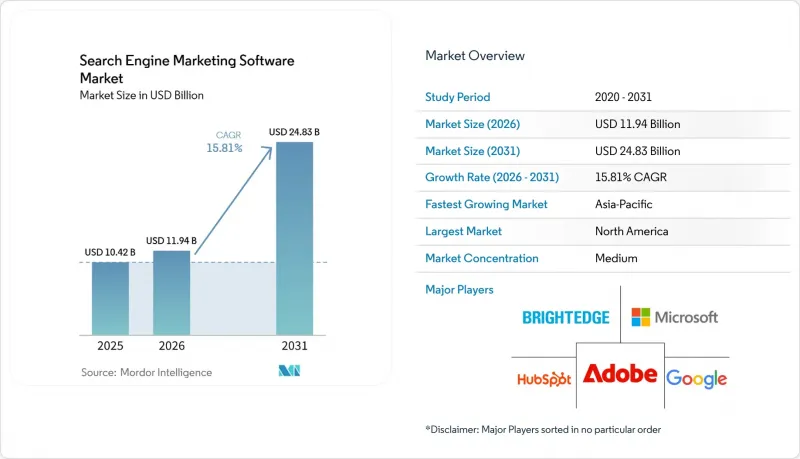
Mordor Intelligence에 의하면, 검색 엔진 마케팅 소프트웨어 시장 규모는 2025년에 104억 2,000만 달러로 평가되었고, 2026년 119억 4,000만 달러에서 2031년까지 248억 3,000만 달러에 이를 것으로 예측되며, 예측 기간(2026-2031년) CAGR은 15.81%를 나타낼 전망입니다.
본 보고서는 도입 형태별(클라우드 기반 및 온프레미스형), 조직 규모별(대기업 및 중소기업(SME)), 용도별(검색 광고 캠페인 관리, 전자상거래 트래픽 확보 등), 최종 사용자별(브랜드 및 광고주, 디지털 마케팅 대행사 등), 그리고 지역별로 분류되어 있습니다. 시장 전망은 금액(달러) 단위로 제시되어 있습니다.
세계의 검색 엔진 마케팅 소프트웨어 시장 동향 및 인사이트
전체 디지털 채널에서 증가하는 유료 검색 광고 비용
AI 답변 엔진, 리테일 미디어 네트워크, 소셜 검색이 상업적 의도를 가진 지출을 놓고 경쟁하는 가운데, 기존의 유료 검색은 성장할 것으로 예측됩니다. 이러한 채널 구성의 다양화로 인해 Google AI 모드, Microsoft Copilot Search, Amazon에 걸친 도달 범위, 예산, 측정 관리에 소요되는 업무량이 증가하고 있습니다. 이는 팀이 일관된 예산 결정을 내리기 전에 서로 다른 캠페인 구조, 보고서 항목, 경매 동향, 타이밍을 조정해야 하기 때문입니다. 광고주가 서로 다른 경매 규칙과 보고서 시스템을 아우르는 단일 운영 계층을 필요로 할 경우, 검색 엔진 마케팅 소프트웨어 시장은 혜택을 볼 것입니다. 특히, 공통된 승인 기준을 적용하면서 개별 플랫폼을 효과적으로 관리하기 위해 충분한 세부 정보를 보유해야 하는 대행사나 대형 브랜드의 경우 더욱 그렇습니다. 공통된 시스템을 통해 수작업으로 이루어지던 대조 작업이 줄어들고, 단순히 플랫폼별 정보를 늘리는 데 그치지 않고 관리자가 대응이 필요한 변경 사항을 파악할 수 있게 된다면, 그 비즈니스상의 이점은 더욱 커질 것입니다. 덴츠는 2028년까지 알고리즘 기반 활동이 총 광고비의 75%를 차지할 것으로 예측하고 있으며, 구조화된 캠페인 데이터, 입찰 규칙 및 모니터링 도구에 대한 필요성이 높아지고 있습니다.
AI를 활용한 입찰 및 예산 최적화 도입
네이티브 AI 입찰은 검색 엔진 마케팅 소프트웨어의 필요성을 없앤 것이 아니라, 그 역할을 변화시켰습니다. 광고주는 여전히 독립적인 보고서 작성, 예외 처리, 정책 관리, 그리고 서로 다른 자동화 시스템 간의 결과를 비교할 수 있는 실용적인 방법을 필요로 하기 때문입니다. 구글은 2025년 5월, 검색 캠페인을 위한 ‘AI Max’를 도입하여 AI 기반 타겟팅 및 크리에이티브 기능을 추가했습니다. 구글의 보고에 따르면, AI Max를 사용했을 때 동등한 CPA 및 ROAS 목표에서 전환이 평균 14% 증가했으며, 완전 일치나 구문 일치에서 광범위 일치로 전환한 캠페인에서는 27%의 개선이 나타났습니다. 다이나믹 검색 광고는 2026년 9월까지 ‘AI Max’로 전환될 예정이며, 이를 통해 광고주와 소프트웨어 제공업체의 조정 주기가 단축될 것입니다. Microsoft Advertising은 2026년 5월, 모든 광고주를 대상으로 ‘AI Max for Search’ 파일럿 프로그램을 시작했으며, 캠페인의 도달 범위를 Copilot Search 및 Copilot Answers로 확대했습니다. 검색 엔진 마케팅 소프트웨어 시장에서는 네이티브 대시보드를 넘어, 여러 검색 엔진을 아우르는 진단 기능, 제어 기능 및 다중 계정 분석 기능을 제공하는 공급업체가 점점 더 높은 평가를 받고 있습니다.
쿠키 기능 저하 및 플랫폼의 개인정보 보호 제어에 따른 신호 손실
신호 품질 저하는 2026년 검색 엔진 마케팅 소프트웨어 사용자에게 핵심적인 측정 과제가 되고 있습니다. 구글은 2025년 4월 크롬의 제3자 쿠키에 대해 사용자 선택 모델을 도입했으나, 캠페인 측정은 여전히 지속되는 브라우저 제한 및 개인정보 보호 제어의 영향을 받고 있습니다. 사파리와 파이어폭스는 계속해서 타사 쿠키를 차단하고 있으며, iOS의 ‘앱 추적 투명성(App Tracking Transparency)’으로 인해 모바일 광고 식별자의 가용성이 감소하고 있습니다. 구글의 ‘동의 모드’ 지침과 함께 검증된 데이터에 따르면, 독일의 동의 거부율은 40%에서 54% 사이이며, 이로 인해 관찰 가능한 캠페인 행동 데이터가 제한되고 있습니다. IAB Tech Lab은 프라이버시 샌드박스(Privacy Sandbox)의 제한으로 인해 관련성 높고 효과적인 광고를 전달하는 업계의 능력이 저하될 수 있다고 경고하고 있습니다. 동의 모드 v2가 올바르게 구현되지 않을 경우, 유럽의 Google Ads 캠페인은 불완전한 행동 데이터를 기반으로 최적화될 가능성이 있어, 예산 결정의 부정확성 위험이 높아집니다.
부문 분석
2025년 현재, 클라우드 기반 도입은 검색 엔진 마케팅 소프트웨어 시장 점유율의 72.14%를 차지했으며, 2031년까지 연평균 성장률(CAGR) 18.05%를 나타낼 것으로 예측됩니다. 이러한 조합은 클라우드 제공 방식이 도입 옵션 중 가장 큰 도입 기반과 가장 강력한 성장을 동시에 달성하고 있음을 보여줍니다. 이는 구매자가 온프레미스로 관리되는 시스템에 수반되는 자본 투자나 장기적인 기술적 설정 없이도 용량, 사용자 액세스, 통합 기능을 추가할 수 있기 때문입니다. 현대적인 SEM 운영에서는 입찰 데이터, 검색 쿼리 보고서, AI 생성 경매 인사이트를 얻기 위해 클라우드 API가 필수적입니다. 구글과 마이크로소프트는 지속적으로 업데이트되는 소프트웨어 환경에 적합한 클라우드 엔드포인트를 통해 이러한 정보의 상당 부분을 제공합니다. 클라우드 제공업체는 별도의 온프레미스 소프트웨어 업데이트 없이도 플랫폼 통합, 모델 업데이트, 보고서 변경 사항을 고객에게 제공할 수 있습니다. 이를 통해 광고 플랫폼이 캠페인 요건이나 측정 방식을 변경하더라도 광고주는 신속하게 대응할 수 있습니다. 또한, 멀티테넌트형 SaaS 제공 모델은 벤더의 전체 고객 기반에 걸쳐 제품 개선 사항을 공유하는 데도 기여합니다. 이러한 운영상의 이점으로 인해, 빈번한 캠페인 변경을 관리하는 팀에게 클라우드 시스템은 더욱 실용적인 선택지가 됩니다. 게다가 구매자들이 더 신속한 도입과 정기적인 제품 업데이트를 요구하는 가운데, 클라우드 시스템은 검색 엔진 마케팅 소프트웨어 시장을 뒷받침하고 있습니다. 반면, 엄격한 내부 데이터 관리가 조달 결정을 좌우하는 경우에는 온프레미스형 도구가 여전히 유효합니다.
온프레미스 배포는 금융 서비스나 정부 관련 기관 등 규제가 엄격한 기업 환경에서 여전히 현실적인 선택지로 남아 있습니다. 이러한 사용자는 특정 데이터 거주 규정, 내부 보안 심사 또는 관리된 통합 프로세스가 필요할 수 있습니다. 이러한 경우에도 캠페인 데이터와 광고 플랫폼의 기능은 외부 클라우드 인터페이스에 대한 의존도를 높이고 있습니다. 이로 인해 완전히 온프레미스로 배포할 경우, 클라우드 제품에서 제공되는 기능 업데이트를 따라가기 어려워집니다. 구매자들이 플랫폼 기능에 대한 시기적절한 접근을 우선시함에 따라, 이러한 제약은 검색 엔진 마케팅 소프트웨어 시장의 성장을 가속하고 있습니다. 중소기업이 클라우드를 채택하는 이유는 구독형 요금 체계 덕분에 수동 또는 온프레미스로 관리되는 도구를 도입할 때 발생하는 초기 부담이 줄어들기 때문입니다. 소규모 팀은 특정 기능부터 시작하여 캠페인 규모가 증가함에 따라 자동화 기능을 추가할 수 있습니다. 대기업의 경우, 인프라 유지보수, 업그레이드 및 통합 작업으로 인해 온프레미스 시스템의 비용이 동등한 구독 서비스보다 더 높을 수 있습니다. 이러한 차이는 캠페인 플랫폼이 새로운 AI 기반 형식이나 보고서 요구 사항을 도입할 때 특히 중요해집니다. 클라우드 기반 제공은 여러 광고 계정에 걸쳐 현재 기능을 유지하기 위한 보다 간단한 수단을 제공합니다. 이에 따라 예측 기간 동안 온프레미스 배포에서 클라우드로의 전환이 지속적으로 진행될 것으로 예측됩니다.
2025년에는 대기업이 검색 엔진 마케팅 소프트웨어 시장의 70.23% 점유율을 차지했으나, 중소기업은 2031년까지 연평균 성장률(CAGR) 18.37%를 나타낼 것으로 예측됩니다. 대기업의 매출이 여전히 높은 이유는 계약에 온보딩, 고객 지원, 맞춤형 API 접근, 보안 조치 등이 포함되는 경우가 많기 때문입니다. 또한, 광고 포트폴리오의 규모가 크기 때문에 개별 계정 수준 도구보다 표준화된 운영 프로세스의 가치가 더 높습니다. 아울러 대규모 광고주는 수많은 캠페인, 브랜드, 지역 시장에 걸쳐 막대한 예산을 관리하고 있습니다. 이러한 상황은 전환 비용을 발생시켜 공급업체와의 장기적인 관계를 촉진하고 있습니다. 엔터프라이즈 부문의 구매 담당자는 통합된 승인 관리, 상세한 보고서, 캠페인 로직에 대한 관리 권한을 필요로 하는 경우가 많습니다. 또한 사내 분석 도구, 고객 데이터, 재무 시스템과의 연동도 요구됩니다. 이러한 요구로 인해 네이티브 광고 도구가 개선되더라도 견고한 소프트웨어에 대한 수요는 유지되고 있습니다. 검색 엔진 마케팅(SEM) 소프트웨어 시장은 여전히 현재 수익의 대부분을 엔터프라이즈 계약에 의존하고 있습니다. 그러나 엔터프라이즈 부문의 성장세는 소규모 조직에서 나타나는 급속한 확장세에는 미치지 못하고 있습니다. 따라서 벤더는 엔터프라이즈 부문에 대한 대응력을 유지하면서, 소규모 구매 담당자를 위한 복잡성을 줄여야 합니다.
중소기업(SME)에서의 도입 확대는 대규모 전문 팀이 필요 없는 AI 기반 캠페인 관리 도구가 보급되고 있음을 반영합니다. 자동화를 통해 키워드, 예산, 크리에이티브 자산 및 캠페인 조정을 관리하는 데 필요한 기술적 작업을 줄일 수 있습니다. 구글의 2026년 MSME 조사에 따르면, AI 기반 도구는 타겟팅 정확도 향상과 자동화를 통해 중소기업의 수익성을 30%-35% 향상시킬 수 있는 것으로 나타났습니다. 소규모 기업은 전자상거래 스토어프론트와의 연동, 간편한 설정, 낮은 최소 이용 금액 요건 등을 기준으로 제품을 선택하는 경우가 많습니다. 세계 기업에 중요한 ‘다중 사업체 관리’ 기능에 대해서는 그다지 중시하지 않습니다. 이로 인해 검색 엔진 마케팅 소프트웨어 업계에서 독자적인 제품 및 가격 책정 수요가 생겨나며, 기존에 지배적이었던 엔터프라이즈 고객층을 넘어 시장이 확대되고 있습니다. 중소기업에 적합한 서비스를 제공하는 벤더는 향후 더 광범위한 기능이 필요할 가능성이 있는 기업과 초기 단계부터 관계를 구축할 수 있습니다. 이들의 과제는 엔터프라이즈용 소프트웨어와 같은 도입 부담을 유발하지 않으면서 유용한 자동화 기능을 제공하는 것입니다. 또한, 중소기업 기반의 확대에 따라 전용 SEM 도구를 활용할 수 있는 조직의 수도 증가하고 있습니다. 따라서 이 부문은 2031년까지의 플랫폼 매출 성장에 있어 중요한 역할을 하게 될 것입니다.
지역별 분석
2025년, 북미는 검색 엔진 마케팅 소프트웨어 시장 점유율의 37.12%를 차지했습니다. 이는 해당 지역의 확고한 광고주 기반, 성숙한 SaaS 조달 관행, 그리고 플랫폼 및 소프트웨어 제공업체의 기능 집중을 반영한 것입니다. 이 지역에는 소프트웨어 공급업체, 경험이 풍부한 광고주, 확립된 SaaS 구매 프로세스가 고도로 집중되어 있을 뿐만 아니라, 새로운 AI 기반 캠페인 유형을 시범적으로 도입하고 성공적인 기법을 보다 광범위한 포트폴리오로 확장할 수 있는 대규모 광고주도 존재합니다. 미국에서는 구글, 마이크로소프트, 아마존이 주요 광고 환경을 제공합니다. 이로 인해 여러 플랫폼에 걸친 포트폴리오 분배와 보고 기능을 결합한 제품에 대한 수요가 발생하고 있습니다. 한편, 캐나다에서는 이중 언어 광고 요건이 추가되었으며, 멕시코에서는 확대되는 전자상거래 분야를 통해 시장의 깊이가 더해지고 있습니다.
아시아태평양은 2031년까지 17.04%라는 지역별 최고 수준의 연평균 성장률(CAGR)을 나타낼 전망입니다. 이는 모바일 우선 행동 양식, 확대되는 전자상거래 활동, 중소기업의 디지털화, 그리고 변화하는 검색 습관이 맞물려 여러 다른 국내 시장 전반에 걸쳐 대상 고객 기반이 확대되고 있기 때문입니다. 인도는 MSME(중소·영세기업)의 디지털화와 전자상거래 확대에 힘입어, 2025년에는 인도의 MSME 대상 디지털 광고와 관련된 경제적 효과가 59억 6,000만 달러에 달할 것으로 전망됩니다. 닛케이가 보도한 야노 경제연구소의 조사에 따르면, 2025년 일본의 디지털 마케팅 활동은 전년 대비 14.1% 증가했습니다. 한편, 하쿠호도 DY 홀딩스는 키워드 검색에서 AI 플랫폼으로의 전환이 일본의 상업적 검색 행동을 재구성하는 중요한 요인이라고 지적하고 있습니다. 중국에서는 바이두(Baidu)가 자사의 ERNIE 모델이 하루 평균 15억 건의 API 호출을 처리하고 있다고 보고한 반면, ‘개인정보보호법’에 따른 데이터 거주 요건이 현지 조달 환경을 형성하고 있습니다. 한국, 호주, 인도네시아, 태국, 베트남에서는 성숙하거나 모바일 우선의 디지털 광고 활동을 통해 수요가 확대되고 있습니다.
유럽은 여전히 검색 엔진 마케팅 소프트웨어 시장의 중요한 부분을 차지하고 있으며, 규정 준수 요건이 제품 선정에 영향을 미치고 있습니다. 구매자는 표준 캠페인 관리 요건 외에도 데이터 수집, 동의 전달, 오디언스 관리, 보고서 설계도 고려해야 하기 때문입니다. 덴츠의 지역별 조사에 따르면, 2026년 독일의 온라인 광고비는 356억 유로(383억 달러)에 달할 것으로 추정됩니다. Bitkom의 조사에 따르면, 독일 기업들 사이에서 데이터 보호 비용이 여전히 높은 수준을 유지하고 있는 것으로 나타났으며, 이는 ‘Consent Mode v2’나 서버 측 추적 기능을 갖춘 도구에 대한 관심을 부추기고 있습니다. 한편, 영국과 프랑스에서는 성숙한 전자상거래 활동이 수요를 뒷받침하고 있습니다. 남미에서는 브라질과 아르헨티나가 전자상거래 및 지역 검색 시장을 확대함에 따라 시장이 부상하고 있지만, 인프라 제약과 환율 변동이 기업의 조달 활동에 영향을 미치고 있습니다. 중동 및 아프리카는 여전히 도입 초기 단계에 있는 지역으로, 성장은 대도시와 정부 주도의 디지털 커머스 프로그램에 집중되어 있습니다.
기타 혜택 :
- 엑셀 형식 시장 예측(ME) 시트
- 3개월간의 애널리스트 지원
자주 묻는 질문
목차
제1장 서론
제2장 조사 방법
제3장 개요
제4장 시장 구도
제5장 시장 규모 및 성장 예측
제6장 경쟁 구도
제7장 시장 기회 및 향후 전망
AJY 26.09.01According to Mordor Intelligence, the search engine marketing software market size was valued at USD 10.42 billion in 2025 and estimated to grow from USD 11.94 billion in 2026 to reach USD 24.83 billion by 2031, at a CAGR of 15.81% during the forecast period (2026-2031).
This report is Segmented by Deployment Mode (Cloud-Based and On-Premises), Organization Size (Large Enterprises and Small and Medium Enterprises [SMEs]), Application (Search Advertising Campaign Management, E-Commerce Traffic Acquisition, and More), End User (Brands and Advertisers, Digital Marketing Agencies, and More), and Geography. The Market Forecasts are Provided in Terms of Value (USD).
Global Search Engine Marketing Software Market Trends and Insights
Rising Paid Search Spend Across Digital Channels
Traditional paid search is projected to grow as AI answer engines, retail media networks, and social search compete for commercial-intent spending. This broader channel mix increases the work involved in managing reach, budgets, and measurement across Google AI Mode, Microsoft Copilot Search, and Amazon, because teams must reconcile different campaign structures, reporting fields, auction behavior, and timing before they can make a consistent budget decision. The search engine marketing software market benefits when advertisers need a single operating layer across different auction rules and reporting systems, especially for agencies and large brands that need to apply common approval standards while retaining enough detail to manage individual platforms effectively. The business case is stronger where a common system reduces manual reconciliations and helps managers identify which changes require action rather than simply generating more platform-specific information. Dentsu projects that algorithm-driven activity will account for 75% of total advertising spending by 2028, increasing the need for structured campaign data, bidding rules, and oversight tools.
Adoption of AI-Driven Bid and Budget Optimization
Native AI bidding has changed the work expected from search engine marketing software rather than removing the need for it, as advertisers still need independent reporting, exception handling, policy controls, and a practical way to compare results from different automated systems. Google introduced AI Max for Search campaigns in May 2025, adding AI-based targeting and creative capabilities. Google reported an average 14% increase in conversions at similar CPA and ROAS targets for AI Max, with a 27% uplift for campaigns moving from exact and phrase match to broad match. Dynamic Search Ads are scheduled to move to AI Max by September 2026, which shortens the adjustment cycle for advertisers and software providers. Microsoft Advertising opened an AI Max for Search pilot to all advertisers in May 2026, extending campaign reach into Copilot Search and Copilot Answers. The search engine marketing software market increasingly rewards providers that offer cross-engine diagnostics, controls, and multi-account intelligence beyond native dashboards.
Signal Loss From Cookie Degradation and Platform Privacy Controls
Signal degradation is a central measurement issue for search engine marketing software users in 2026. Google adopted a user-choice model for Chrome third-party cookies in April 2025, but campaign measurement remains affected by continuing browser restrictions and privacy controls. Safari and Firefox continue to block third-party cookies, while iOS App Tracking Transparency has reduced the availability of mobile advertising identifiers. Consent rejection rates in Germany ranged from 40% to 54% in the data reviewed alongside Google's Consent Mode guidance, limiting observable campaign behavior. The IAB Tech Lab warned that Privacy Sandbox restrictions could reduce the industry's ability to deliver relevant and effective advertising. Without a correct Consent Mode v2 implementation, European Google Ads campaigns may optimize based on incomplete behavioral data, increasing the risk of inaccurate budget decisions.
Other drivers and restraints analyzed in the detailed report include:
- Expansion of E-Commerce and Performance Marketing Budgets
- Growing Need for First-Party Audience Activation
- High Competitive Saturation and Feature Parity Across Vendors
For complete list of drivers and restraints, kindly check the Table Of Contents.
Segment Analysis
Cloud-based deployment held 72.14% of the search engine marketing software market share in 2025 and is projected to grow at an 18.05% CAGR through 2031. This combination shows that cloud delivery has both the largest installed base and the strongest growth within deployment choices, because buyers can add capacity, user access, and integrated functions without the capital outlay and prolonged technical setup associated with locally managed systems. Modern SEM operations depend on cloud APIs for bidding data, search query reports, and AI-generated auction insights. Google and Microsoft provide much of this information through cloud endpoints that are better suited to continuously updated software environments. Cloud providers can distribute platform integrations, model updates, and reporting changes to customers without a separate local software update. This helps advertisers respond when advertising platforms change campaign requirements or measurement methods. Multi-tenant SaaS delivery also supports shared product improvements across a vendor's customer base. These operating advantages make cloud systems more practical for teams that manage frequent campaign changes. They also support the search engine marketing software market as buyers seek faster implementation and routine product updates. On-premises tools remain relevant where strict internal data controls shape procurement decisions.
On-premises deployment remains a viable option in regulated enterprise settings, including financial services and government-adjacent organizations. These users may require specific data residency rules, internal security reviews, or controlled integration processes. Even in these cases, campaign data and advertising-platform functionality increasingly depend on external cloud interfaces. This limits the ability of a fully local deployment to keep pace with feature updates available to cloud products, a constraint that supports the search engine marketing software market, as buyers prioritize timely access to platform functions. SMEs are adopting the cloud because subscription pricing reduces the upfront implementation burden of manual or locally managed tools. Smaller teams can begin with focused functions and add automation as campaign volume increases. For large organizations, infrastructure maintenance, upgrades, and integration work can make local systems more expensive than comparable subscriptions. The difference is particularly important when campaign platforms introduce new AI-based formats or reporting requirements. Cloud delivery offers a simpler route to maintain current capabilities across multiple advertising accounts. This supports continued movement away from on-premises deployment during the forecast period.
Large enterprises held 70.23% of the search engine marketing software market share in 2025, while SMEs are projected to register an 18.37% CAGR through 2031. Enterprise revenue remains high because contracts often include onboarding, customer support, custom API access, and security controls, while the size of advertising portfolios makes a standardized operating process more valuable than separate account-level tools. Large advertisers also manage substantial budgets across many campaigns, brands, and geographic markets. These conditions create switching costs and support longer vendor relationships. Enterprise buyers often need centralized approval controls, detailed reporting, and ownership of campaign logic. They also require integrations with internal analytics, customer data, and financial systems. These needs sustain demand for robust software even as native advertising tools improve. The search engine marketing software market continues to rely on enterprise contracts for a large share of its current revenue. However, enterprise growth trails the faster expansion recorded among smaller organizations. Vendors must therefore maintain enterprise depth while reducing complexity for smaller buyers.
SME adoption reflects the growing availability of AI-supported campaign management without the need for large specialist teams. Automation can reduce the technical work needed to manage keywords, budgets, creative assets, and campaign adjustments. Google's 2026 MSME survey found that AI-driven tools could improve SME profitability by 30%-35% through improved targeting and automation. Smaller businesses often select products based on e-commerce storefront integration, a simple setup, and low minimum spend requirements. They place less value on the multi-entity management features that are important to global enterprises. This creates a distinct product and pricing need within the search engine marketing software industry and broadens the market beyond the historically dominant enterprise customer base. Vendors that serve SMEs well can build early relationships with firms that may later require broader capabilities. Their challenge is to provide useful automation without creating the implementation burden of enterprise software. The expanding SME base also broadens the number of organizations that can use dedicated SEM tools. This makes the segment important to platform revenue growth through 2031.
Complete Report Scope:
- By Deployment Mode
- Cloud-Based
- On-Premises
- By Organization Size
- Large Enterprises
- Small and Medium Enterprises (SMEs)
- By Application
- Search Advertising Campaign Management
- Performance Marketing and Conversion Optimization
- E-Commerce Traffic Acquisition
- Brand Awareness and Share of Voice Management
- Local Search and Location-Based Marketing
- By End User
- Brands and Advertisers
- Digital Marketing Agencies
- E-Commerce Businesses
- Enterprises and In-House Marketing Teams
- By Geography
- North America
- United States
- Canada
- Mexico
- South America
- Brazil
- Argentina
- Rest of South America
- Europe
- Germany
- United Kingdom
- France
- Italy
- Spain
- Russia
- Rest of Europe
- Asia-Pacific
- China
- Japan
- India
- South Korea
- Australia and New Zealand
- Rest of Asia-Pacific
- Middle East
- Saudi Arabia
- United Arab Emirates
- Turkey
- Rest of Middle East
- Africa
- South Africa
- Nigeria
- Rest of Africa
- North America
Geography Analysis
North America held 37.12% of the search engine marketing software market share in 2025, reflecting the region's established advertiser base, mature SaaS procurement practices, and concentration of platform and software-provider capabilities. The region has a deep concentration of software vendors, experienced advertisers, and established SaaS buying processes, alongside large advertisers that can test new AI-enabled campaign types and then apply successful practices across broader portfolios. Google, Microsoft, and Amazon each provide important advertising environments in the United States. This creates a need for products that combine portfolio allocation and reporting across multiple platforms, while Canada adds bilingual advertising requirements and Mexico adds depth through an expanding e-commerce sector.
Asia-Pacific is projected to record the fastest regional CAGR of 17.04% through 2031, as a mix of mobile-first behavior, expanding e-commerce activity, small-business digitalization, and changing search habits expands the addressable customer base across several distinct national markets. India is supported by MSME digitalization and e-commerce expansion, including USD 5.96 billion in 2025 economic output linked to digital advertising for Indian MSMEs. Japan's digital marketing activity grew 14.1% year over year in 2025, according to Yano Research Institute data reported by Nikkei, while Hakuhodo DY Holdings identified movement from keyword search to AI platforms as an important factor reshaping Japanese commercial search behavior. In China, Baidu reported that its ERNIE model processed 1.5 billion API calls per day, while data-residency requirements under the Personal Information Protection Law shape the local procurement environment. South Korea, Australia, Indonesia, Thailand, and Vietnam add demand through mature or mobile-first digital advertising activity.
Europe remains a significant part of the search engine marketing software market, with compliance requirements shaping product selection, as buyers must consider data collection, consent transmission, audience management, and reporting design alongside standard campaign management requirements. Germany's online advertising spending reached EUR 35.6 billion (USD 38.3 billion) in 2026, based on Dentsu regional tracking. Bitkom found that data-protection costs remained high among German companies, supporting interest in tools with Consent Mode v2 and server-side tracking capabilities, while the United Kingdom and France support demand through mature e-commerce activity. South America is emerging as Brazil and Argentina expand e-commerce and local search inventory, although infrastructure limits and currency volatility affect enterprise procurement. The Middle East and Africa remain earlier-stage adoption areas, with growth concentrated in large cities and government-backed digital commerce programs.
- Google LLC
- Microsoft Corporation
- Adobe Inc.
- Semrush Holdings, Inc.
- Ahrefs Pte. Ltd.
- BrightEdge Technologies, Inc.
- Conductor, Inc.
- Moz, Inc.
- WordStream, Inc.
- Marin Software Incorporated
- Optmyzr, Inc.
- Adthena Limited
- SpyFu, Inc.
- SE Ranking Limited
- SISTRIX GmbH
- Botify SAS
- Similarweb Ltd.
- HubSpot, Inc.
- Yoast B.V.
- WebFX, Inc.
Additional Benefits:
- The market estimate (ME) sheet in Excel format
- 3 months of analyst support
TABLE OF CONTENTS
1 INTRODUCTION
- 1.1 Study Assumptions and Market Definition
- 1.2 Scope of the Study
2 RESEARCH METHODOLOGY
3 EXECUTIVE SUMMARY
4 MARKET LANDSCAPE
- 4.1 Market Overview
- 4.2 Market Drivers
- 4.2.1 Rising Paid Search Spend Across Digital Channels
- 4.2.2 Adoption of AI-Driven Bid and Budget Optimization
- 4.2.3 Expansion of E-Commerce and Performance Marketing Budgets
- 4.2.4 Growing Need for First-Party Audience Activation
- 4.2.5 Shift Toward Privacy-Resilient Demand Generation Workflows
- 4.2.6 Increased Demand for Cross-Channel Attribution and Reporting
- 4.3 Market Restraints
- 4.3.1 Signal Loss From Cookie Degradation and Platform Privacy Controls
- 4.3.2 High Competitive Saturation and Feature Parity Across Vendors
- 4.3.3 Dependence on Search Engine Policy and Auction Rule Changes
- 4.3.4 Rising Enterprise Integration and Change-Management Costs
- 4.4 Industry Value Chain Analysis
- 4.5 Regulatory Landscape
- 4.6 Technological Outlook
- 4.7 Impact of Macroeconomic Factors on the Market
- 4.8 Porter's Five Forces Analysis
- 4.8.1 Threat of New Entrants
- 4.8.2 Bargaining Power of Suppliers
- 4.8.3 Bargaining Power of Buyers
- 4.8.4 Threat of Substitutes
- 4.8.5 Intensity of Competitive Rivalry
5 MARKET SIZE AND GROWTH FORECASTS (VALUE)
- 5.1 By Deployment Mode
- 5.1.1 Cloud-Based
- 5.1.2 On-Premises
- 5.2 By Organization Size
- 5.2.1 Large Enterprises
- 5.2.2 Small and Medium Enterprises (SMEs)
- 5.3 By Application
- 5.3.1 Search Advertising Campaign Management
- 5.3.2 Performance Marketing and Conversion Optimization
- 5.3.3 E-Commerce Traffic Acquisition
- 5.3.4 Brand Awareness and Share of Voice Management
- 5.3.5 Local Search and Location-Based Marketing
- 5.4 By End User
- 5.4.1 Brands and Advertisers
- 5.4.2 Digital Marketing Agencies
- 5.4.3 E-Commerce Businesses
- 5.4.4 Enterprises and In-House Marketing Teams
- 5.5 By Geography
- 5.5.1 North America
- 5.5.1.1 United States
- 5.5.1.2 Canada
- 5.5.1.3 Mexico
- 5.5.2 South America
- 5.5.2.1 Brazil
- 5.5.2.2 Argentina
- 5.5.2.3 Rest of South America
- 5.5.3 Europe
- 5.5.3.1 Germany
- 5.5.3.2 United Kingdom
- 5.5.3.3 France
- 5.5.3.4 Italy
- 5.5.3.5 Spain
- 5.5.3.6 Russia
- 5.5.3.7 Rest of Europe
- 5.5.4 Asia-Pacific
- 5.5.4.1 China
- 5.5.4.2 Japan
- 5.5.4.3 India
- 5.5.4.4 South Korea
- 5.5.4.5 Australia and New Zealand
- 5.5.4.6 Rest of Asia-Pacific
- 5.5.5 Middle East
- 5.5.5.1 Saudi Arabia
- 5.5.5.2 United Arab Emirates
- 5.5.5.3 Turkey
- 5.5.5.4 Rest of Middle East
- 5.5.6 Africa
- 5.5.6.1 South Africa
- 5.5.6.2 Nigeria
- 5.5.6.3 Rest of Africa
- 5.5.1 North America
6 COMPETITIVE LANDSCAPE
- 6.1 Market Concentration
- 6.2 Strategic Moves
- 6.3 Market Share Analysis
- 6.4 Company Profiles (includes Global Level Overview, Market Level Overview, Core Segments, Financials as available, Strategic Information, Market Rank/Share, Products and Services, Recent Developments)
- 6.4.1 Google LLC
- 6.4.2 Microsoft Corporation
- 6.4.3 Adobe Inc.
- 6.4.4 Semrush Holdings, Inc.
- 6.4.5 Ahrefs Pte. Ltd.
- 6.4.6 BrightEdge Technologies, Inc.
- 6.4.7 Conductor, Inc.
- 6.4.8 Moz, Inc.
- 6.4.9 WordStream, Inc.
- 6.4.10 Marin Software Incorporated
- 6.4.11 Optmyzr, Inc.
- 6.4.12 Adthena Limited
- 6.4.13 SpyFu, Inc.
- 6.4.14 SE Ranking Limited
- 6.4.15 SISTRIX GmbH
- 6.4.16 Botify SAS
- 6.4.17 Similarweb Ltd.
- 6.4.18 HubSpot, Inc.
- 6.4.19 Yoast B.V.
- 6.4.20 WebFX, Inc.
7 MARKET OPPORTUNITIES AND FUTURE OUTLOOK
- 7.1 White-Space and Unmet-Need Assessment


