

|
시장보고서
상품코드
2118899
OTT용 비디오 트랜스코딩 시장 : 시장 점유율 분석, 업계 동향 및 통계, 성장 예측(2026-2031년)Video Transcoding For OTT - Market Share Analysis, Industry Trends & Statistics, Growth Forecasts (2026 - 2031) |
||||||
 Mordor Intelligence
Mordor Intelligence에 의하면, OTT용 비디오 트랜스코딩 시장 규모는 2025년 10억 8,000만 달러로 평가되었고, 2026년 12억 1,000만 달러에서 2031년까지 20억 8,000만 달러로 확대될 것으로 예측되며, 2026-2031년 연평균 성장률(CAGR)은 11.39%를 나타낼 전망입니다.
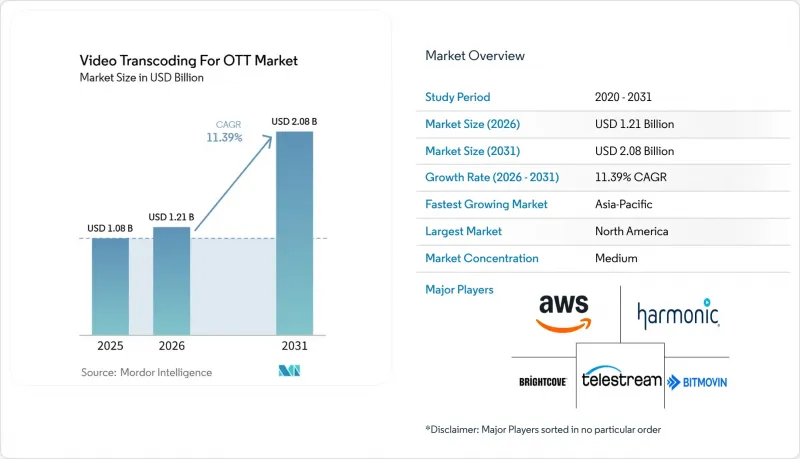
본 보고서는 구성 요소별(솔루션 및 서비스), 처리 유형별(파일 기반 및 VOD(Video-on-Demand) 트랜스코딩, 라이브 및 리니어 실시간 트랜스코딩), 최종 사용자별(OTT 및 DTC(Direct-to-Consumer) 스트리밍 플랫폼, 방송사 및 TV 네트워크 등), 그리고 지역별로 분류되어 있습니다. 시장 전망은 금액(달러) 기준으로 제시되어 있습니다.
세계의 OTT용 비디오 트랜스코딩 시장 동향 및 인사이트
OTT 및 멀티스크린을 통한 동영상 소비 확대
OTT용 비디오 트랜스코딩은 스마트 TV, 휴대전화, 태블릿 및 커넥티드 디바이스에서의 시청을 지원합니다. 각 디바이스 그룹마다 지원 코덱, 해상도 제한 및 비트레이트 요구 사항이 다릅니다. 따라서 플랫폼은 단순히 파일 수를 늘리는 것이 아니라, 보다 폭넓은 인코딩 라더를 유지해야 합니다. OTT 시장의 동영상 트랜스코딩에서는 성숙한 스트리밍 시장에서 커넥티드 TV의 이용이 확대됨에 따라 전송도 4K로 전환되고 있어, 타이틀별로 필요한 작업량이 증가하고 있습니다. 새로운 시청 기기가 계속 등장함에 따라 호환성 요구 사항이 지속적으로 발생하므로, 시장이 성숙해지더라도 이러한 추세는 사라지지 않을 것입니다. 이러한 변화로 인해 OTT 시장의 동영상 트랜스코딩 수요가 증가하고 있으며, 플랫폼을 통해 사업자는 기기 카테고리별로 워크플로우를 재구성할 필요 없이 여러 렌디션을 관리할 수 있게 됩니다.
라이브 스포츠, FAST 채널 및 인터랙티브 스트리밍의 성장
라이브 스포츠 및 FAST 채널은 사업자가 사전 처리된 자산이나 일괄 처리 일정에 의존할 수 없기 때문에 부하가 높은 워크로드를 발생시킵니다. 주요 스트리밍 플랫폼의 스포츠 프로그램은 2026년 초에 전년 대비 52% 증가했으며, 한편 스포츠 전문 FAST 채널은 2024년 중반부터 2025년 2월까지 105% 증가했습니다. 평균 트래픽이 아닌, 피크 시간대의 동시 개최 이벤트에 대응할 수 있는 용량을 확보해야 하므로 탄력적인 인프라가 적합합니다. 소규모 리그에서도 기존 방송 경제 구조 하에서는 활용하기 어려웠던 FAST 전송에 나설 수 있게 되었습니다. Amagi의 보고서에 따르면, 2026년 6월에는 약 6,500개의 채널 스트리밍에서 FAST 시청 시간이 전년 대비 55% 증가했고, 광고 노출 수도 53% 증가했습니다. OTT(Over-The-Top) 시장을 위한 동영상 트랜스코딩은 여러 시청자와 기기를 대상으로 병렬적이고 실시간 렌디션이 필요하기 때문에 이러한 혜택을 누리고 있습니다.
높은 연산 능력, 스토리지 및 에너지 요구 사항
다중 포맷 및 다중 코덱을 통한 전송으로 인해, 인프라 비용 절감 속도를 능가하는 속도로 연산 능력, 스토리지 및 전력 요구 사항이 증가하고 있습니다. NETINT의 조사에 따르면, 조사 대상인 동영상 전문가의 72%가 GPU 기반 HEVC 인코딩을 이용하고 있으며, 39%는 전력 소비를 중요한 도입 과제로 꼽았습니다. 이 회사는 자사의 비디오 처리 장치인 ‘Quadra T1U’가 H.264, HEVC, AV1 형식으로 최대 32개의 1080p 30fps 스트림을 병렬로 처리하면서도 전력 소비는 17와트에 불과하다고 보고했습니다. 북미 및 유럽 데이터센터의 전력 제약은 동영상 수요가 견조한 경우에도 용량 확장을 제한할 가능성이 있습니다. 이에 따라 플랫폼 사업자들 사이에서는 인코딩 효율을 향상시키는 전용 설계의 비디오 처리 유닛 및 기타 하드웨어 도입을 검토하는 움직임이 활발해지고 있습니다. 또한 NETINT의 조사에 따르면, 응답자의 49%가 2026년에 비디오 처리 유닛을 평가할 계획인 반면, GPU를 평가할 계획인 응답자는 53.6%였습니다.
부문 분석
2025년에는 솔루션이 매출의 77.13%를 차지했으며, 소프트웨어 기반 플랫폼이 가장 큰 구성 요소가 되었습니다. OTT 시장을 위한 동영상 트랜스코딩 분야에서 이러한 플랫폼들은 전용 하드웨어 어플라이언스에서 물리적 교체 주기 없이도 포맷 지원을 추가할 수 있는 클라우드 배포 가능한 소프트웨어로 주목을 옮기고 있습니다. OTT 시장을 위한 소프트웨어 주도형 비디오 트랜스코딩은 GPU 클러스터, 비디오 처리 장치 및 표준 CPU 리소스를 가로질러 실행 가능한 코덱 독립적인 소프트웨어의 매력을 반영한 것입니다. 인코딩 로직을 기반 컴퓨팅 하드웨어에서 분리함으로써, 사업자는 워크로드 비용 관리에 있어 더 많은 선택권을 얻을 수 있습니다. 또한, 모든 작업을 동일한 어플라이언스에 국한하지 않고, 이용 사례에 따라 플랫폼 인프라를 조정할 수도 있습니다. 대규모 제공업체는 기존 라이브러리 전체에 이러한 유연성을 적용할 수 있으며, 소규모 서비스도 대규모 하드웨어 투자 없이 이를 도입할 수 있습니다.
Bitmovin은 2026년 5월, AWS 마켓플레이스를 통해 MUBI를 클라우드 VOD 인코딩 고객사로 확보했습니다. MUBI는 기존의 온프레미스 환경을 AVC, HEVC, AV1, UHD 및 3패스 인코딩을 지원하는 매니지드 서비스로 대체했습니다. 이 사례는 여러 코덱이 필요하거나 전문 엔지니어링 팀을 유지하고 싶지 않은 OTT 동영상 트랜스코딩 서비스에서 매니지드 플랫폼이 왜 중요한지를 명확히 보여줍니다. 서비스 시장은 2031년까지 연평균 성장률(CAGR) 11.91%로 확대될 것으로 예측됩니다. 라이브 이벤트 운영은 관리형 스트리밍에 특히 적합합니다. 이는 동시에 개최되는 이벤트로 인해 운영상의 피크가 발생하여 사내 팀만으로는 대응하기 어려운 경우가 있기 때문입니다. 인프라 지원과 모니터링 및 워크플로우에 대한 전문 지식을 결합한 제공업체라면 이러한 요구에 대응할 수 있습니다. 따라서 OTT 시장을 위한 동영상 트랜스코딩은 소프트웨어 플랫폼과 관리형 운영 지원을 결합한 형태로 전환되고 있습니다.
지역별 분석
2025년, 북미는 매출의 44.37%를 차지하며 지역별로는 가장 큰 기여도를 보였습니다. OTT 시장을 위한 비디오 트랜스코딩 분야에서 북미의 위상은 주요 스트리밍 플랫폼, 하이퍼스케일 데이터센터, 그리고 조기에 도입된 클라우드 네이티브 미디어 인프라에 의해 뒷받침되고 있습니다. AWS Elemental, Azure Media Services, Google Cloud Transcoder는 이 지역에서 막대한 처리 능력을 보유하고 있으며, 사업자는 확립된 미디어 처리 서비스를 이용할 수 있습니다. C-밴드 위성 전송에서 IP 워크플로로 전환하는 방송 사업자들은 하이브리드 방송에서 스트리밍으로의 처리에 대한 새로운 수요를 창출하고 있습니다. 이러한 전환으로 인해 사업자들이 전송 시스템을 현대화하는 과정에서 전송 및 인코딩에 관한 의사결정이 하나로 통합되고 있습니다.
아시아태평양은 2031년까지 연평균 성장률(CAGR) 11.93%로 확대될 것으로 예측됩니다. 인도, 인도네시아, 한국 및 동남아시아에서는 커넥티드 TV 이용 확대와 현지 스트리밍 컨텐츠 카탈로그 확충에 따라 OTT 시장을 위한 동영상 트랜스코딩이 발전하고 있습니다. 이 지역의 ‘모바일 퍼스트’ 시청 패턴과 다양한 네트워크 환경으로 인해 효율적인 전송이 특히 중요해지고 있습니다. 또한, 현지 언어 컨텐츠 카탈로그 증가로 인해 플랫폼이 관리해야 하는 컨텐츠 및 전송 프로파일의 수도 늘어나고 있습니다. 텐센트 클라우드와 록스트리머는 2026년 7월, 방글라데시 및 기타 아시아 신흥 시장에서 클라우드, AI, 컨텐츠 전송 네트워크(CDN), 엔터프라이즈용 OTT 솔루션을 제공하기 위한 제휴를 발표했습니다.
2025년에는 유럽이 3위를 차지했습니다. 차세대 방송으로의 전환, OTT의 발전, 그리고 데이터 주권에 대한 기대감의 고조가 해당 지역의 OTT(Over-The-Top) 시장에서 동영상 트랜스코딩의 방향을 형성하고 있습니다. Qvest, ATEME, Scaleway 등 3사는 2026년, 전적으로 유럽 기술을 기반으로 구축된 상용 가능한 OTT 플랫폼을 개발하기 위한 제휴를 발표했습니다. 남미에서는 브라질의 DTV+ 전환이 추진력을 얻고 있으며, Harmonic사는 2026년 3월, 이러한 전환에 대응하기 위해 XOS Advanced Media Processor를 업데이트했습니다. 중동 및 아프리카는 절대적인 규모로는 여전히 작지만, 모바일 우선 스트리밍과 스포츠 중계권 투자를 통해 발전하고 있습니다. 세로형 동영상 및 저대역폭 전송에 대한 수요가 아프리카 시장에서 사용되는 인코딩 구성을 형성하고 있습니다.
기타 혜택 :
- 엑셀 형식 시장 예측(ME) 시트
- 3개월간의 애널리스트 지원
자주 묻는 질문
목차
제1장 서론
제2장 조사 방법
제3장 개요
제4장 시장 구도
제5장 시장 규모 및 성장 예측
제6장 경쟁 구도
제7장 시장 기회 및 향후 전망
AJY 26.09.01According to Mordor Intelligence, the OTT video transcoding market size is projected to expand from USD 1.08 billion in 2025 and USD 1.21 billion in 2026 to USD 2.08 billion by 2031, registering a CAGR of 11.39% between 2026 and 2031.
This report is Segmented by Component (Solutions, and Services), Processing Type (File-Based and Video-On-Demand Transcoding, and Live and Linear Real-Time Transcoding), End User (OTT and Direct-To-Consumer Streaming Platforms, Broadcasters and Television Networks, and More), and Geography. The Market Forecasts are Provided in Terms of Value (USD).
Global Video Transcoding For OTT Market Trends and Insights
OTT and Multiscreen Video Consumption Expansion
The OTT video transcoding supports viewing across smart TVs, mobile phones, tablets, and connected devices. Each device group has different codec support, resolution limits, and bitrate needs. Platforms must therefore maintain broader encoding ladders rather than simply process more files. In video transcoding for the OTT market, connected TV use in mature streaming markets is also shifting delivery toward 4K, increasing the work required for each title. This effect does not disappear as markets mature because new viewing devices continue to create compatibility requirements. The change increases demand for video transcoding in the OTT market, enabling platforms to manage multiple renditions without requiring operators to rebuild their workflows for every device category.
Live Sports, FAST Channels, and Interactive Streaming Growth
Live sports and FAST channels create demanding workloads because operators cannot rely on pre-processed assets or batch scheduling. Sports programming on major streaming platforms increased 52% year over year in early 2026, while dedicated sports FAST channels had grown 105% between mid-2024 and February 2025. Capacity must be available for peak concurrent events, rather than average traffic, which favors elastic infrastructure. Smaller leagues can now pursue FAST distribution, which was previously less accessible under traditional broadcast economics. Amagi reported that FAST viewing hours grew 55% year over year, and ad impressions increased 53% across nearly 6,500 channel deliveries in June 2026. Video transcoding for the over-the-top (OTT) market benefits from the need for parallel, real-time renditions for multiple viewers and devices.
High Compute, Storage, and Energy Requirements
Multi-format and multi-codec delivery increases compute, storage, and power requirements faster than infrastructure costs can fall. NETINT found that 72% of surveyed video professionals used GPU-based HEVC encoding, and 39% identified power consumption as a critical deployment challenge. The company reported that its Quadra T1U video processing unit used 17 watts while supporting up to 32 parallel 1080p 30fps streams across H.264, HEVC, and AV1. Data center power constraints in North America and Europe can limit capacity expansion even when video demand remains strong. This encourages platforms to assess purpose-built video processing units and other hardware that improve encoding efficiency. NETINT also found that 49% of respondents planned to evaluate video processing units in 2026, compared with 53.6% who planned to evaluate GPUs.
Other drivers and restraints analyzed in the detailed report include:
- Cloud Migration and Elastic Media Processing Demand
- 4K, 8K, HDR, and Immersive Video Format Adoption
- Legacy Workflow Integration and Format Compatibility Complexity
For complete list of drivers and restraints, kindly check the Table Of Contents.
Segment Analysis
Solutions accounted for 77.13% of revenue in 2025, giving software-based platforms the largest component position. In the video transcoding for the OTT market, these platforms have shifted attention away from dedicated hardware appliances and toward cloud-deployable software that can add format support without a physical replacement cycle. The software-led video transcoding for the OTT market reflected the appeal of codec-agnostic software that can run across GPU clusters, video processing units, and standard CPU resources. This separation of encoding logic from underlying compute hardware gives operators more choice when managing workload costs. It also allows a platform to adjust its infrastructure by use case instead of tying every job to the same appliance. Larger providers can apply this flexibility across established libraries, while smaller services can adopt it without making a broad hardware investment.
Bitmovin signed MUBI as a cloud video-on-demand encoding client through AWS Marketplace in May 2026. MUBI replaced its legacy on-premises stack with a managed service supporting AVC, HEVC, AV1, UHD, and three-pass encoding. This case provides a clear example of why managed platforms are relevant for OTT video transcoding, services that need multiple codecs but do not want to maintain specialist engineering teams. Services are projected to expand at a CAGR of 11.91% through 2031. Live-event operations are particularly suited to managed delivery because parallel events can create operational peaks that an internal team struggles to manage. Providers that combine infrastructure support with monitoring and workflow expertise can address this need. The video transcoding for the OTT market is therefore moving toward a mix of software platforms and managed operational support.
Complete Report Scope:
- By Component
- Solutions
- Software-Based Transcoding Platforms
- Hardware Transcoding Appliances
- Services
- Solutions
- By Processing Type
- File-Based and Video-on-Demand Transcoding
- Live and Linear Real-Time Transcoding
- By End User
- OTT and Direct-to-Consumer Streaming Platforms
- Broadcasters and Television Networks
- Pay-TV and Telecom Operators with OTT/IP Video Services
- Studios, Content Owners, and Digital Publishers
- Sports Rights Holders and Live-Event Streaming Providers
- Social Video and User-Generated Content Platforms
- By Geography
- North America
- United States
- Canada
- Mexico
- South America
- Brazil
- Argentina
- Rest of South America
- Europe
- Germany
- United Kingdom
- France
- Italy
- Spain
- Russia
- Rest of Europe
- Asia-Pacific
- China
- India
- Japan
- South Korea
- Southeast Asia
- Australia and New Zealand
- Rest of Asia-Pacific
- Middle East
- United Arab Emirates
- Saudi Arabia
- Turkey
- Israel
- Rest of Middle East
- Africa
- South Africa
- Nigeria
- Egypt
- Rest of Africa
- North America
Geography Analysis
North America held 44.37% of revenue in 2025, making it the largest regional contributor. The regional position in the video transcoding for the OTT market is supported by major streaming platforms, hyperscale data centers, and early cloud-native media infrastructure. AWS Elemental, Azure Media Services, and Google Cloud Transcoder have substantial capacity in the region, giving operators access to established media-processing services. Broadcasters moving from C-band satellite distribution to IP workflows create another source of demand for hybrid broadcast-to-streaming processing. The shift brings distribution and encoding decisions together as operators modernize their delivery systems.
Asia-Pacific is projected to expand at a CAGR of 11.93% through 2031. Video transcoding for the OTT market is developing in India, Indonesia, South Korea, and Southeast Asia as connected television use and local streaming catalogs grow. The region's mobile-first viewing patterns and varied network conditions make efficient delivery particularly important. Local-language catalogs also widen the number of content and distribution profiles platforms must manage. Tencent Cloud and Rockstreamer announced a partnership in July 2026 to provide cloud, AI, content delivery network, and enterprise OTT solutions in Bangladesh and other emerging Asian markets.
Europe ranked third in 2025. Next-generation broadcast changes, OTT development, and stronger expectations around data sovereignty shape the video transcoding for the over-the-top (OTT) market in the region. Qvest, ATEME, and Scaleway announced a 2026 partnership to develop production-ready OTT platforms built entirely on European technology. South America is gaining support from Brazil's DTV+ transition, and Harmonic updated its XOS Advanced Media Processor in March 2026 to support that migration. The Middle East and Africa remain smaller in absolute value but are developing through mobile-first streaming and sports rights investment. Vertical video and low-bandwidth delivery needs are shaping the encoding configurations used in African markets.
- Amazon Web Services, Inc.
- Harmonic Inc.
- Telestream, LLC
- Brightcove Inc.
- Bitmovin GmbH
- Akamai Technologies, Inc.
- Haivision Systems Inc.
- Synamedia Limited
- MediaKind Global Limited
- Imagine Communications Corp.
- Google LLC
- Tencent Holdings Limited
- Huawei Technologies Co., Ltd.
- Qencode, Inc.
- Kaltura, Inc.
- Wowza Media Systems, LLC
- ATEME S.A.
- Avid Technology, Inc.
- NETINT Technologies Inc.
- Vimeo, Inc.
Additional Benefits:
- The market estimate (ME) sheet in Excel format
- 3 months of analyst support
TABLE OF CONTENTS
1 INTRODUCTION
- 1.1 Study Assumptions and Market Definition
- 1.2 Scope of the Study
2 RESEARCH METHODOLOGY
3 EXECUTIVE SUMMARY
4 MARKET LANDSCAPE
- 4.1 Market Overview
- 4.2 Market Drivers
- 4.2.1 OTT and Multiscreen Video Consumption Expansion
- 4.2.2 Growth in Live Sports, FAST Channels, and Interactive Streaming
- 4.2.3 Cloud Migration and Elastic Media Processing Demand
- 4.2.4 Adoption of 4K, 8K, HDR, and Immersive Video Formats
- 4.2.5 Codec Portfolio Diversification Across AV1, HEVC, and VVC
- 4.2.6 Edge-Based Transcoding for Low-Latency and Localized Delivery
- 4.3 Market Restraints
- 4.3.1 High Compute, Storage, and Energy Requirements
- 4.3.2 Legacy Workflow Integration and Format Compatibility Complexity
- 4.3.3 Codec Patent Royalty Stacking and Licensing Uncertainty
- 4.3.4 Multi-Codec Duplication and Cache Inefficiency
- 4.4 Industry Value Chain Analysis
- 4.5 Impact of Macroeconomic Factors on the Market
- 4.6 Regulatory Landscape
- 4.7 Technological Outlook
- 4.8 Porter's Five Forces Analysis
- 4.8.1 Bargaining Power of Suppliers
- 4.8.2 Bargaining Power of Buyers
- 4.8.3 Threat of New Entrants
- 4.8.4 Threat of Substitutes
- 4.8.5 Intensity of Competitive Rivalry
5 MARKET SIZE AND GROWTH FORECASTS (VALUE)
- 5.1 By Component
- 5.1.1 Solutions
- 5.1.1.1 Software-Based Transcoding Platforms
- 5.1.1.2 Hardware Transcoding Appliances
- 5.1.2 Services
- 5.1.1 Solutions
- 5.2 By Processing Type
- 5.2.1 File-Based and Video-on-Demand Transcoding
- 5.2.2 Live and Linear Real-Time Transcoding
- 5.3 By End User
- 5.3.1 OTT and Direct-to-Consumer Streaming Platforms
- 5.3.2 Broadcasters and Television Networks
- 5.3.3 Pay-TV and Telecom Operators with OTT/IP Video Services
- 5.3.4 Studios, Content Owners, and Digital Publishers
- 5.3.5 Sports Rights Holders and Live-Event Streaming Providers
- 5.3.6 Social Video and User-Generated Content Platforms
- 5.4 By Geography
- 5.4.1 North America
- 5.4.1.1 United States
- 5.4.1.2 Canada
- 5.4.1.3 Mexico
- 5.4.2 South America
- 5.4.2.1 Brazil
- 5.4.2.2 Argentina
- 5.4.2.3 Rest of South America
- 5.4.3 Europe
- 5.4.3.1 Germany
- 5.4.3.2 United Kingdom
- 5.4.3.3 France
- 5.4.3.4 Italy
- 5.4.3.5 Spain
- 5.4.3.6 Russia
- 5.4.3.7 Rest of Europe
- 5.4.4 Asia-Pacific
- 5.4.4.1 China
- 5.4.4.2 India
- 5.4.4.3 Japan
- 5.4.4.4 South Korea
- 5.4.4.5 Southeast Asia
- 5.4.4.6 Australia and New Zealand
- 5.4.4.7 Rest of Asia-Pacific
- 5.4.5 Middle East
- 5.4.5.1 United Arab Emirates
- 5.4.5.2 Saudi Arabia
- 5.4.5.3 Turkey
- 5.4.5.4 Israel
- 5.4.5.5 Rest of Middle East
- 5.4.6 Africa
- 5.4.6.1 South Africa
- 5.4.6.2 Nigeria
- 5.4.6.3 Egypt
- 5.4.6.4 Rest of Africa
- 5.4.1 North America
6 COMPETITIVE LANDSCAPE
- 6.1 Market Concentration
- 6.2 Strategic Moves
- 6.3 Market Positioning Analysis
- 6.4 Company Profiles (includes Global Level Overview, Market Level Overview, Core Segments, Financials as available, Strategic Information, Market Rank/Share, Products and Services, Recent Developments)
- 6.4.1 Amazon Web Services, Inc.
- 6.4.2 Harmonic Inc.
- 6.4.3 Telestream, LLC
- 6.4.4 Brightcove Inc.
- 6.4.5 Bitmovin GmbH
- 6.4.6 Akamai Technologies, Inc.
- 6.4.7 Haivision Systems Inc.
- 6.4.8 Synamedia Limited
- 6.4.9 MediaKind Global Limited
- 6.4.10 Imagine Communications Corp.
- 6.4.11 Google LLC
- 6.4.12 Tencent Holdings Limited
- 6.4.13 Huawei Technologies Co., Ltd.
- 6.4.14 Qencode, Inc.
- 6.4.15 Kaltura, Inc.
- 6.4.16 Wowza Media Systems, LLC
- 6.4.17 ATEME S.A.
- 6.4.18 Avid Technology, Inc.
- 6.4.19 NETINT Technologies Inc.
- 6.4.20 Vimeo, Inc.
7 MARKET OPPORTUNITIES AND FUTURE OUTLOOK
- 7.1 White-Space and Unmet-Need Assessment


