

|
시장보고서
상품코드
2118915
단백질 가수분해 효소 시장 : 시장 점유율 분석, 업계 동향 및 통계, 성장 예측(2026-2031년)Protein Hydrolysis Enzymes - Market Share Analysis, Industry Trends & Statistics, Growth Forecasts (2026 - 2031) |
||||||
 Mordor Intelligence
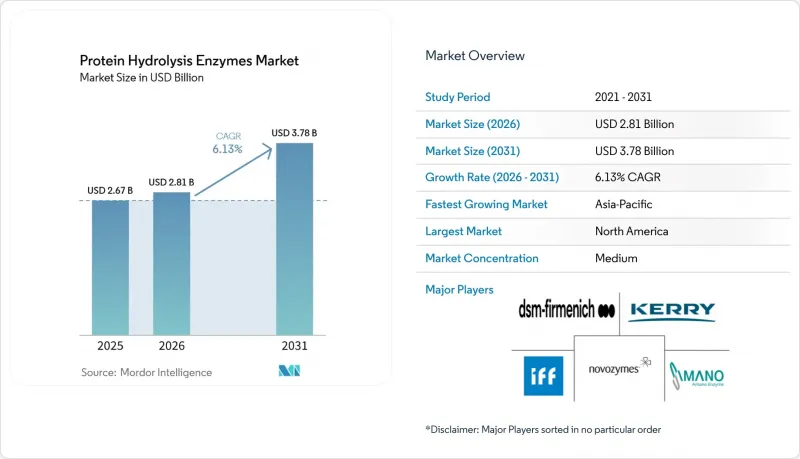
Mordor Intelligence에 의하면, 세계의 단백질 가수분해 효소 시장은 2025년에 26억 7,000만 달러로 평가되었고, 2026년에는 28억 1,000만 달러로 추정되고, 2031년까지 37억 8,000만 달러로 한층 더 확대해, 2026-2031년 CAGR 6.13%를 나타낼 것으로 예측됩니다.
본 보고서는 원료별(동물성 단백질, 식물성 단백질, 미생물), 형태별(액체, 분말), 용도별(식품 및 음료, 세제·세정제, 의약품, 동물사료, 섬유·가죽, 기타), 지역별(북미, 유럽, 아시아태평양, 남미, 중동 및 아프리카)로 분류되어 있습니다. 시장 예측은 금액(달러)으로 표시되어 있습니다.
세계의 단백질 가수분해 효소 시장 동향 및 인사이트
고단백·기능성 식품에 대한 수요
고단백·기능성 식품에 대한 수요 증가는 단백질 가수분해 효소 시장의 주요 성장 동인으로 작용하고 있습니다. 식품 제조업체들은 단백질의 구조를 변경하고 원료의 기능성을 높이기 위해 효소 기술에 대한 수요를 점점 더 높이고 있습니다. 단백질 가수분해 효소는 분해되지 않은 단백질을 더 작은 펩타이드나 아미노산으로 분해하여 용해성, 소화성, 분산성, 유화성, 발포성 및 수분 유지력을 향상시킵니다. 이를 통해 현대적인 식품 배합에 적합한 고성능 단백질 원료의 개발이 가능해집니다. 기존 단백질 원료와 비교하여, 효소 처리를 통해 제조된 가수분해 단백질은 뛰어난 기능적 특성을 갖추고 있습니다. 이러한 특성 덕분에 식감이나 가공 효율에 큰 영향을 미치지 않으면서 음료, 유제품, 단백질 파우더, 영양 바, 임상 영양 제품, 유아용 조제 분유, 제빵 제품 및 특수 영양 제제에 배합할 수 있습니다.
영유아용 및 의료용 영양제에서의 활용 확대
영유아용 및 의료용 영양 제제에서 단백질 가수분해 효소의 사용 확대는 단백질 가수분해 효소 시장의 중요한 촉진요인이 되고 있습니다. 이러한 효소를 통해 소화성이 향상되고 알레르기 유발성이 감소된 부분 가수분해 단백질 및 고도로 가수분해된 단백질을 제조할 수 있게 됩니다. 통제된 효소 가수분해를 통해 복잡한 유단백질 및 기타 식이 단백질이 흡수되기 쉬운 더 작은 펩타이드로 분해됩니다. 이러한 펩타이드는 특수 유아용 조제분유, 경장영양 제품 및 임상 영양 보조 식품에 널리 사용되고 있습니다. 가수분해 정도를 정밀하게 제어할 수 있기 때문에 제조업체는 단백질의 품질과 기능성을 일관되게 유지하면서 엄격한 영양 기준 및 규제 요건을 충족하는 제제를 제조할 수 있습니다. 이러한 특수 제제에 대한 수요는 영유아의 영양 요구가 확대됨에 따라 지속적으로 증가하고 있습니다. 예를 들어, 세계은행에 따르면 2024년 인도의 총 특수 출생률은 여성 1명당 1.96명이며, 이는 세계 최대 규모의 출생 코호트 중 하나에서 영유아용 영양 제품에 대한 상당하고 지속적인 수요가 있음을 나타냅니다.
특수 효소의 높은 제조 및 정제 비용
특수 효소의 높은 제조 및 정제 비용은 단백질 가수분해 효소 시장에 여전히 큰 제약 요인으로 작용하고 있습니다. 고성능 단백질 가수분해 효소를 제조하려면 첨단 발효 시스템, 다운스트림 공정 정제 기술, 그리고 엄격한 품질 관리 절차가 필요합니다. 제조 과정에는 미생물 균주 개발, 제어된 발효, 효소 회수, 농축, 정제, 안정화, 배합 등 여러 단계가 포함되어 있으며, 각 단계는 운영의 복잡성과 제조 비용을 증가시킵니다. 높은 효소 순도와 안정적인 활성을 확보하기 위해서는 대부분의 경우 고도의 여과, 한외여과, 크로마토그래피 및 건조 기술이 필요합니다. 특히 엄격한 품질 기준을 충족해야 하는 식품, 의약품, 임상 영양 용도의 효소에서는 이러한 필요성이 두드러집니다. 무균 생산 환경의 유지, 배치 간 일관성 검증, 그리고 규제 요건 준수는 제조 비용을 더욱 상승시킵니다.
부문 분석
2025년 원료별 시장 규모에서 미생물 유래 효소는 51.23%를 차지했습니다. 이 부문이 주도적인 위치를 유지하고 있는 이유는 미생물 균주가 일관된 활성과 높은 순도를 갖춘 특이성이 높은 단백질 분해 효소를 생산할 수 있기 때문입니다. 미생물 효소 생산에서는 표준화된 조건 하에서 제어된 발효가 가능하여, 제조업체는 엄격한 품질 사양을 유지하면서 균일한 가수분해 성능을 실현할 수 있습니다. 미생물 유래 효소에 대한 규제 당국의 신뢰가 지속적으로 높아짐에 따라 시장 내 채택이 더욱 촉진되고 있습니다. 예를 들어, 유럽식품안전청(EFSA)은 11가지 식품 제조 공정에서의 사용을 대상으로 한 미생물 유래 식품 효소의 안전성 평가를 갱신하여, 미생물 효소 기술의 수용을 뒷받침함과 동시에 시장의 지속적인 성장을 지지하고 있습니다.
식물 유래 단백질 가수분해 효소는 2026-2031년 연평균 성장률(CAGR) 7.87%로 확대될 것으로 예측됩니다. 이러한 성장은 파파인, 브로멜라인, 피신 등 천연 유래 효소의 혁신적 발전에 힘입은 것으로, 이러한 효소들은 온화한 가공 조건에서 폭넓은 기질 특이성과 효과적인 단백질 분해 활성을 발휘합니다. 이러한 효소는 가혹한 가공 요건을 완화하면서도 단백질의 기능을 유지할 수 있다는 점에서 높이 평가받고 있으며, 천연 유래 가공 보조제를 찾는 제조업체에 적합합니다. 효소의 안정성, 추출 효율 및 촉매 성능 향상을 목표로 한 지속적인 연구를 통해 식물 유래 효소의 상업적 실현 가능성은 더욱 높아지고 있습니다. 또한, 지속 가능한 재배 및 추출 기술의 발전으로 식물성 효소 원료의 품질 안정성과 공급이 개선되어, 이 부문의 장기적인 성장 전망을 더욱 공고히 하고 있습니다.
지역별 분석
2025년, 북미는 전 세계 단백질 가수분해 효소 시장 규모의 32.12%를 차지하며 지역별 1위를 유지했습니다. 이 지역은 확립된 산업용 생명공학 생태계, 첨단 효소 제조 능력, 그리고 정밀 발효 기술의 광범위한 도입이라는 이점을 누리고 있습니다. 효소 개발 기업, 생명공학 연구 기관 및 대규모 제조 시설 간의 견고한 협력은 효소 공학 및 상업적 생산 분야에서 지속적인 혁신을 뒷받침하고 있습니다. 고도로 자동화된 생산 인프라와 엄격한 품질 관리 시스템을 통해 제조업체는 일관된 품질과 확장성을 갖춘 고성능 단백질 가수분해 효소를 생산할 수 있게 되었습니다.
아시아태평양은 2026-2031년 7.61%라는 가장 높은 연평균 성장률(CAGR)을 보일 것으로 전망됩니다. 이 지역의 성장은 산업용 효소 생산 능력의 급속한 확대, 미생물 발효 인프라에 대한 투자 증가, 그리고 바이오테크놀러지 파크 및 생명과학 클러스터의 개발에 힘입어 이루어지고 있습니다. 이 지역 각국은 발효 기술의 진보, 바이오프로세스 최적화, 산학 연구 협력을 통해 국내 효소 생산 체계를 지속적으로 강화하고 있습니다. 수탁 생산 능력의 확대와 숙련된 생명공학 전문 인력 확보가 진행되고 있는 점도 세계 효소 생산에서 이 지역의 경쟁력을 높이고 있습니다.
유럽, 남미, 중동 및 아프리카는 산업용 생명공학 및 효소 제조 능력의 발전을 통해 그 위상을 지속적으로 강화하고 있습니다. 유럽은 강력한 규제 감독, 미생물 균주 개발에 대한 지속적인 혁신, 그리고 지속 가능한 바이오공정 기술에 대한 투자에 힘입어 효소 연구의 주요 거점으로 자리매김하고 있습니다. 남미에서는 산업용 생명공학에 활용되는 풍부한 농업 원료에 힘입어 발효 기반 제조가 점차 확대되고 있습니다. 중동 및 아프리카에서는 생명공학 인프라에 대한 투자와 산업 다각화 노력이 증가하고 있으며, 이를 통해 특수 효소의 도입 및 현지 생산이 촉진되고 있습니다.
기타 혜택 :
- 엑셀 형식 시장 예측(ME) 시트
- 3개월간의 애널리스트 지원
자주 묻는 질문
목차
제1장 서론
제2장 조사 방법
제3장 개요
제4장 시장 구도
제5장 시장 규모 및 성장 예측
제6장 경쟁 구도
제7장 시장 기회 및 향후 전망
AJY 26.09.01According to Mordor Intelligence, the global protein hydrolysis enzymes market was valued at USD 2.67 billion in 2025 and is projected to reach USD 2.81 billion in 2026, further expanding to USD 3.78 billion by 2031, registering a CAGR of 6.13% during 2026-2031.
This report is Segmented by Source (Animal Protein, Plant Protein, and Microorganisms), Form (Liquid and Powder), Application (Food and Beverages, Detergent and Cleansing, Pharmaceutical, Animal Feed, Textile and Leather, and Others), and Geography (North America, Europe, Asia-Pacific, South America, and Middle East and Africa). The Market Forecasts are Provided in Value (USD).
Global Protein Hydrolysis Enzymes Market Trends and Insights
Demand for high-protein and functional food products
The growing demand for high-protein and functional food products is a major driver of the protein hydrolysis enzymes market. Food manufacturers increasingly require enzymatic technologies to modify protein structures and enhance ingredient functionality. Protein hydrolysis enzymes break intact proteins into smaller peptides and amino acids, improving solubility, digestibility, dispersibility, emulsification, foaming, and water-binding properties. This enables the development of high-performance protein ingredients for modern food formulations. Compared to conventional protein ingredients, hydrolyzed proteins produced through enzymatic processing offer superior functional characteristics. These properties support their incorporation into beverages, dairy products, protein powders, nutritional bars, clinical nutrition products, infant formula, bakery products, and specialized nutritional formulations without significantly affecting texture or processing efficiency.
Increasing utilization in infant and medical nutrition formulations
The increasing use of protein hydrolysis enzymes in infant and medical nutrition formulations is a significant driver of the protein hydrolysis enzymes market. These enzymes enable the production of partially and extensively hydrolyzed proteins with improved digestibility and reduced allergenic potential. Controlled enzymatic hydrolysis breaks down complex milk and other dietary proteins into smaller peptides that are easier to absorb. These peptides are widely used in specialized infant formulas, enteral nutrition products, and clinical nutritional supplements. The ability to precisely control the degree of hydrolysis allows manufacturers to produce formulations that meet stringent nutritional and regulatory specifications while maintaining consistent protein quality and functionality. Demand for these specialized formulations continues to grow alongside infant nutrition requirements. For instance, according to the World Bank, India's total fertility rate stood at 1.96 children per woman in 2024, indicating a substantial and continuous need for infant nutrition products in one of the world's largest birth cohorts .
High production and purification costs of specialty enzymes
High production and purification costs of specialty enzymes remain a significant restraint on the protein hydrolysis enzymes market. Manufacturing high-performance proteolytic enzymes requires sophisticated fermentation systems, downstream purification technologies, and rigorous quality control procedures. Production involves multiple stages, including microbial strain development, controlled fermentation, enzyme recovery, concentration, purification, stabilization, and formulation, each adding to operational complexity and manufacturing costs. Achieving high enzyme purity and consistent activity often requires advanced filtration, ultrafiltration, chromatography, and drying technologies, particularly for enzymes intended for food, pharmaceutical, and clinical nutrition applications where stringent quality standards must be met. Maintaining sterile production environments, validating batch consistency, and complying with regulatory requirements further increase production expenses.
Other drivers and restraints analyzed in the detailed report include:
- Expansion of plant-based protein ingredient manufacturing
- Advancements in enzyme engineering improving efficiency and specificity
- Strict regulatory requirements for approval and food safety
For complete list of drivers and restraints, kindly check the Table Of Contents.
Segment Analysis
Microorganisms accounted for 51.23% of the market value by source in 2025. The segment maintains its leading position due to the ability of microbial strains to produce highly specific proteolytic enzymes with consistent activity and high purity. Microbial enzyme production enables controlled fermentation under standardized conditions, allowing manufacturers to achieve uniform hydrolysis performance while maintaining stringent quality specifications. Regulatory confidence in microbial enzymes continues to strengthen market adoption; for instance, the European Food Safety Authority (EFSA) updated the safety evaluation of a microbial food enzyme for use across 11 food manufacturing processes, reinforcing the acceptance of microbial enzyme technologies and supporting continued market growth .
Plant-derived protein hydrolysis enzymes are projected to expand at a CAGR of 7.87% during 2026-2031. Growth is supported by increasing innovation in naturally sourced enzymes such as papain, bromelain, and ficin, which offer broad substrate specificity and effective proteolytic activity under mild processing conditions. These enzymes are valued for their ability to preserve protein functionality while reducing harsh processing requirements, making them suitable for manufacturers seeking naturally derived processing aids. Ongoing research aimed at improving enzyme stability, extraction efficiency, and catalytic performance is further enhancing the commercial viability of plant-derived enzymes. In addition, advancements in sustainable cultivation and extraction technologies are improving the consistency and availability of botanical enzyme sources, strengthening the long-term growth outlook for this segment.
Complete Report Scope:
- By Source
- Animal Protein
- Plant Protein
- Microorganisms
- By Form
- Liquid
- Powder
- By Application
- Food and Beverages
- Detergent and Cleansing
- Pharmaceutical
- Animal Feed
- Textile and Leather
- Others
- By Geography
- North America
- United States
- Canada
- Mexico
- Rest of North America
- Europe
- United Kingdom
- Germany
- France
- Italy
- Spain
- Netherlands
- Rest of Europe
- Asia-Pacific
- China
- Japan
- India
- Australia
- Rest of Asia-Pacific
- South America
- Middle East and Africa
- North America
Geography Analysis
North America accounted for 32.12% of the global protein hydrolysis enzymes market value in 2025, maintaining its leading regional position. The region benefits from a well-established industrial biotechnology ecosystem, advanced enzyme manufacturing capabilities, and widespread adoption of precision fermentation technologies. Strong integration between enzyme developers, biotechnology research institutions, and large-scale manufacturing facilities supports continuous innovation in enzyme engineering and commercial production. Highly automated production infrastructure and stringent quality management systems further enable manufacturers to produce high-performance protein hydrolysis enzymes with consistent quality and scalability.
Asia-Pacific is projected to register the fastest CAGR of 7.61% during 2026-2031. The region's growth is supported by the rapid expansion of industrial enzyme manufacturing capacity, increasing investments in microbial fermentation infrastructure, and the development of biotechnology parks and life science clusters. Countries across the region continue to strengthen domestic enzyme production through advancements in fermentation technology, bioprocess optimization, and research collaborations between academia and industry. Expanding contract manufacturing capabilities and growing availability of skilled biotechnology expertise are also enhancing regional competitiveness in global enzyme production.
Europe, South America, and the Middle East and Africa continue to strengthen their positions through advancements in industrial biotechnology and enzyme manufacturing capabilities. Europe remains a key center for enzyme research, supported by strong regulatory oversight, continuous innovation in microbial strain development, and investments in sustainable bioprocessing technologies. South America is gradually expanding fermentation-based manufacturing, supported by its abundant agricultural feedstocks used in industrial biotechnology. The Middle East and Africa are witnessing increasing investments in biotechnology infrastructure and industrial diversification initiatives that are fostering the adoption and local production of specialty enzymes.
- Novonesis A/S
- dsm-firmenich AG
- International Flavors & Fragrances Inc.
- Kerry Group plc
- Amano Enzyme Inc.
- BASF SE
- Associated British Foods plc
- DuPont de Nemours, Inc.
- Advanced Enzyme Technologies Limited
- AB Enzymes GmbH
- Dyadic International, Inc.
- Specialty Enzymes and Biotechnologies Co.
- Biocatalysts Ltd.
- Solvay S.A.
- Chr. Hansen Holding A/S
- Jiangsu Boli Bioproducts Co., Ltd.
- Rossari Biotech Limited
- Enzyme Development Corporation
- Aumgene Biosciences
- Enzybel International S.A.
Additional Benefits:
- The market estimate (ME) sheet in Excel format
- 3 months of analyst support
TABLE OF CONTENTS
1 INTRODUCTION
- 1.1 Study Assumptions and Market Definition
- 1.2 Scope of the Study
2 RESEARCH METHODOLOGY
3 EXECUTIVE SUMMARY
4 MARKET LANDSCAPE
- 4.1 Market Overview
- 4.2 Market Drivers
- 4.2.1 Demand for high-protein and functional food products
- 4.2.2 Increasing utilization in infant and medical nutrition formulations
- 4.2.3 Expansion of plant-based protein ingredient manufacturing
- 4.2.4 Advancements in enzyme engineering improving efficiency and specificity
- 4.2.5 Demand for flavor enhancement and food formulation optimization
- 4.2.6 Growing preference for sustainable enzyme-based food processing solutions
- 4.3 Market Restraints
- 4.3.1 High production and purification costs of specialty enzymes
- 4.3.2 Strict regulatory requirements for approval and food safety
- 4.3.3 Sensitivity of enzymes to processing conditions
- 4.3.4 Challenges in achieving consistent degree of protein hydrolysis
- 4.4 Supply Chain Analysis
- 4.5 Regulatory Landscape
- 4.6 Technological Outlook
- 4.7 Porter's Five Forces Analysis
- 4.7.1 Threat of New Entrants
- 4.7.2 Bargaining Power of Buyers
- 4.7.3 Bargaining Power of Suppliers
- 4.7.4 Threat of Substitutes
- 4.7.5 Intensity of Competitive Rivalry
5 MARKET SIZE AND GROWTH FORECASTS (VALUE)
- 5.1 By Source
- 5.1.1 Animal Protein
- 5.1.2 Plant Protein
- 5.1.3 Microorganisms
- 5.2 By Form
- 5.2.1 Liquid
- 5.2.2 Powder
- 5.3 By Application
- 5.3.1 Food and Beverages
- 5.3.2 Detergent and Cleansing
- 5.3.3 Pharmaceutical
- 5.3.4 Animal Feed
- 5.3.5 Textile and Leather
- 5.3.6 Others
- 5.4 By Geography
- 5.4.1 North America
- 5.4.1.1 United States
- 5.4.1.2 Canada
- 5.4.1.3 Mexico
- 5.4.1.4 Rest of North America
- 5.4.2 Europe
- 5.4.2.1 United Kingdom
- 5.4.2.2 Germany
- 5.4.2.3 France
- 5.4.2.4 Italy
- 5.4.2.5 Spain
- 5.4.2.6 Netherlands
- 5.4.2.7 Rest of Europe
- 5.4.3 Asia-Pacific
- 5.4.3.1 China
- 5.4.3.2 Japan
- 5.4.3.3 India
- 5.4.3.4 Australia
- 5.4.3.5 Rest of Asia-Pacific
- 5.4.4 South America
- 5.4.5 Middle East and Africa
- 5.4.1 North America
6 COMPETITIVE LANDSCAPE
- 6.1 Market Concentration
- 6.2 Strategic Moves
- 6.3 Market Positioning Analysis
- 6.4 Company Profiles (includes Global level Overview, Market level overview, Core Segments, Financials as available, Strategic Information, Market Rank/Share for key companies, Products and Services, and Recent Developments)
- 6.4.1 Novonesis A/S
- 6.4.2 dsm-firmenich AG
- 6.4.3 International Flavors & Fragrances Inc.
- 6.4.4 Kerry Group plc
- 6.4.5 Amano Enzyme Inc.
- 6.4.6 BASF SE
- 6.4.7 Associated British Foods plc
- 6.4.8 DuPont de Nemours, Inc.
- 6.4.9 Advanced Enzyme Technologies Limited
- 6.4.10 AB Enzymes GmbH
- 6.4.11 Dyadic International, Inc.
- 6.4.12 Specialty Enzymes and Biotechnologies Co.
- 6.4.13 Biocatalysts Ltd.
- 6.4.14 Solvay S.A.
- 6.4.15 Chr. Hansen Holding A/S
- 6.4.16 Jiangsu Boli Bioproducts Co., Ltd.
- 6.4.17 Rossari Biotech Limited
- 6.4.18 Enzyme Development Corporation
- 6.4.19 Aumgene Biosciences
- 6.4.20 Enzybel International S.A.


