

|
시장보고서
상품코드
2118924
재택 병원 시장 : 시장 점유율 분석, 업계 동향 및 통계, 성장 예측(2026-2031년)Hospital At Home - Market Share Analysis, Industry Trends & Statistics, Growth Forecasts (2026 - 2031) |
||||||
 Mordor Intelligence
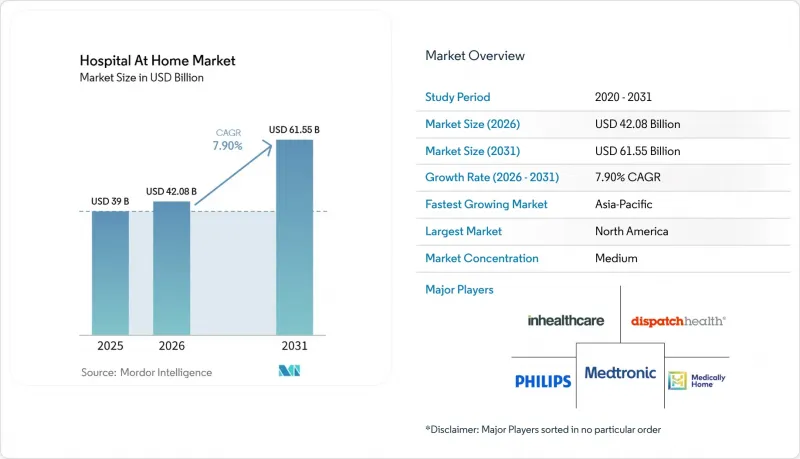
재택 병원 시장 규모는 2025년에 390억 달러로 평가되었고, 2026년 420억 8,000만 달러에서 2031년까지 615억 5,000만 달러에 이를 것으로 예측되며, 예측 기간(2026-2031년) CAGR은 7.90%를 나타낼 전망입니다.
본 보고서는 구성 요소별(기기·디바이스, 소프트웨어 및 서비스), 서비스 유형별, 케어 모델별, 제공 형태별, 환자층별(성인, 소아, 고령자), 적응증별, 케어 제공업체 및 지역별(북미, 유럽, 아시아태평양, 중동 및 아프리카, 남미)로 분류되어 있습니다. 시장 예측은 금액(달러)으로 표시되어 있습니다.
세계의 ‘재택 병원(Hospital-at-Home)’ 시장 동향 및 인사이트
고령화 및 다중 질환 병존 증가
재택 병원 시장 수요는 여전히 인구 고령화 및 여러 만성 질환을 앓고 있는 환자 수 증가와 밀접한 관련이 있습니다. 유엔의 예측에 따르면, 2050년까지 전 세계 65세 이상 인구는 16억 명에 달할 것으로 보입니다. 이러한 환자들은 빈번한 간병이 필요한 경우가 많으며, 장기 입원 중에는 섬망, 운동 기능 저하, 병원 내 감염 등 더 높은 위험에 직면합니다. 싱가포르의 ‘MICHome’ 모델의 경우, 동등한 임상 성과를 거두면서도 1회당 비용을 23% 절감할 수 있었습니다고 보고되어, 재택 급성기 치료에 대한 정책적 관심이 높아지고 있습니다.
병원의 수용 능력 제약과 병상 부족
입원 수용 능력에 대한 압박이 가중됨에 따라, 병원 수준의 치료를 가정에서 제공하는 것의 사업적 타당성이 강화되었습니다. 2024년 말까지 미국 급성기 병원의 평균 가동률은 85%를 넘어섰으며, 도시 및 교외 시설에서는 수요로 인해 병상 확보에 대한 압박이 지속되었습니다. DispatchHealth와 Saint Francis Health System은 2026년 2월 털사에서 합작 사업을 시작하며, 동시에 40명의 환자를 수용할 수 있도록 확장 가능한 가상 병동을 설계했습니다. 독일의 ‘AOK Krankenhaus-Report 2026’에 따르면, 현재 입원 서비스의 56%는 외래 또는 재택 환경으로 전환 가능하며, 응급실을 통해 입원한 환자의 11%는 입원 없이도 관리가 가능한 것으로 밝혀졌습니다.
인력 부족과 임상 대응 범위의 제한
2026년에도 인력 부족은 ‘재택 병원(Hospital-at-Home)’ 시장에서 주요 운영 제약 요인으로 남아 있었습니다. HRSA의 예측에 따르면, 2038년까지 정간호사 10만 8,960명, 준간호사 24만 5,950명이 부족할 것으로 예상되며, 대도시권에서는 2%인 반면, 비대도시권에서는 정간호사 부족률이 11%를 나타낼 것으로 예측됩니다. 커먼웰스 펀드의 보고서에 따르면, 재택 간호 기관들은 인력 부족을 이유로 재택 간호를 의뢰받은 환자의 25% 이상에 대해 수용을 거절할 수밖에 없었다고 합니다.
이러한 인력 부족은 신뢰할 수 있는 임상 간호와 신속한 에스컬레이션 체계를 필요로 하는 중증 환자나 지방 거주 환자에게 특히 큰 영향을 미쳤습니다. 또한, ‘재택 병원(Hospital-at-Home)’ 기관에서는 현장 직원의 이직률이 70%에서 80%에 달하고, 채용 비용 증가와 방문 일정 혼란을 초래하고 있다는 보고도 있었습니다. 지역 구급대원이 지원하는 원격 병원 의사 모델은 지역 인력 부족의 부담을 완화할 가능성이 있지만, 보수 및 자격 인증에 관한 규정에 대해서는 여전히 추가적인 표준화가 요구되고 있습니다.
부문 분석
2025년 기준으로 ‘기기 및 장치’ 부문은 재택 병원 시장의 64.55%를 차지했습니다. 이 범주에는 원격 환자 모니터링 기기, 진단 기기, 연결 도구, 약물 투여 시스템 및 수액 기기가 포함됩니다. 지속 모니터링 기기는 심박수, 산소 포화도, 호흡수 데이터를 수집하여 지휘 센터에서 확인할 수 있도록 합니다. 재택 병원 프로그램에는 신뢰할 수 있는 임상 기기와 안전한 데이터 전송이 필수적이기 때문에 이 구성 요소는 여전히 필수적입니다.
‘소프트웨어 및 서비스’는 가장 빠르게 성장하는 분야로, 이 부문의 재택 병원 시장 규모는 2026-2031년 연평균 성장률(CAGR) 9.15%를 나타낼 것으로 예측됩니다. 이 범주에는 재택 병원용 소프트웨어 플랫폼, 임상 지휘 센터용 소프트웨어, 원격 의료 서비스,도입 지원, 컨설팅 및 관리형 서비스가 포함됩니다. 2023년 및 2024년에 장비의 조기 도입을 완료한 의료 시스템은 현재 방문 조정, 진료 기록, 경보 관리, 환자 경과 관찰을 위한 워크플로우 도구에 대한 투자를 확대되고 있습니다. Philips는 2025년 12월, 사우던 NSW 지역 보건국과 제휴하여 재택 급성기 치료를 위한 웨어러블 모니터링 솔루션 ‘Respiree’를 도입했습니다.
2025년, ‘가정 내 급성기 치료’는 가정 병원 시장의 33.56%를 차지했습니다. 이 서비스는 만성 폐쇄성 폐질환(COPD) 악화, 폐렴, 봉와직염, 심부전, 패혈증 및 기타 대상 사례와 같은 급성 질환을 포괄합니다. CMS는 의료 제공업체가 입원 시설 밖에서 안전하게 관리할 수 있는 급성기 입원 환자를 대상으로 ‘재택 급성기 병원 치료(Acute Hospital Care at Home)’ 면제 제도를 마련했습니다. 이 모델을 통해 병원은 물리적 병상 수를 확보하면서도 입원과 동등한 서비스를 제공할 수 있게 됩니다.
재택 만성 질환 관리는 2026-2031년 연평균 성장률(CAGR) 8.80%를 나타낼 것으로 예측됩니다. 장기적인 질환 유병률 증가와 총 치료비 절감을 장려하는 계약이 만성 질환 관리 프로그램을 뒷받침하고 있습니다. 재택 관리를 통해 외래 진료의 필요성을 줄이고, 연계된 후속 관리를 지원하며, 케어 팀이 상태 악화를 조기에 파악할 수 있게 됩니다. 메이요 클리닉의 ‘Cancer CARE Beyond Walls’ 연구에서는 ASCO 2025에서 재택 암 치료와 표준 진료소 치료를 비교한 2상 타당성 데이터가 발표되었으며, 안전성과 환자의 선호도에 부합하는 이점이 보고되었습니다.
2025년, ‘조기 지원 퇴원(Early-Supported Discharge)’은 재택 병원 서비스 시장 점유율의 56.77%를 차지했습니다. 이 모델은 이미 병원에서 평가를 받은 환자 중, 임상적 지원 하에 자택에서 회복을 완료할 수 있는 환자를 대상으로 합니다. 이 모델은 영국의 가상 병동, 호주의 ‘Hospital in the Home’ 프로그램, 그리고 싱가포르의 ‘MIC&Home’ 모델을 통해 확립되었습니다. 싱가포르의 ‘NUHS&Home’은 1회 치료당 비용이 23% 감소했다고 보고했습니다.
‘입원 회피’ 시장은 2031년까지 연평균 성장률(CAGR) 10.45%로 확대될 것으로 예측됩니다. 이 모델은 입원이 발생하기 전에 응급실, 1차 진료 현장 또는 의뢰 경로를 통해 대상 환자를 평가하는 것입니다. 치료 과정의 초기 단계에서 개입함으로써 더 큰 비용 절감을 실현할 수 있지만, 신속한 분류, 재택 치료 준비 상태 평가, 물류 계획 및 치료 팀 배치가 필요합니다. DispatchHealth와 Saint Francis Health System은 이 모델을 바탕으로 털사(Tulsa)의 프로그램을 설계했으며, 서비스 제공 범위 20마일 이내에서 30분 이내 파견을 목표로 하고 있습니다.
지역 분석
2025년, 북미는 전 세계 ‘재택 급성기 병원 치료’ 시장의 42.45%를 차지했습니다. 이는 미국 CMS(의료보험 및 의료보조 서비스 센터)의 정책 프레임워크, 확립된 보험 제도, 그리고 기술을 활용하는 의료 제공업체의 견고한 기반에 힘입은 결과입니다. 2026년 통합 지출법에 따라 ‘재택 급성기 병원 치료’에 대한 면제 조치가 2030년 9월 30일까지 연장되어, 의료 제공업체에게는 더 장기적인 투자 기간이 주어졌습니다. 미국에서는 인력 배치, 기술, 응급 대응 체계의 확충으로 인해 프로그램이 대도시권에 집중된 상태를 유지했으나, 반면 지방에서는 간호사 부족, 지역 응급구조사 자격 인증의 제한, 그리고 보상액의 격차가 사업 확장의 걸림돌이 되었습니다. 캐나다에서는 주 정부 의료 제도를 통해 가상 병동 프로그램이 추진되었으며, 멕시코에서는 민간 보험 보급률과 재택 간호 인프라가 제한적임에도 불구하고 성장 가능성이 보였습니다.
유럽은 ‘재택 병원(Hospital-at-Home)’ 시장에서 지속적인 확장을 보이지만 여전히 다양성이 남아 있는 지역이며, 영국은 이 지역에서 가장 확립된 가상 병동 시스템 중 하나를 운영하고 있습니다. NHS 그레이터 글래스고 앤 클라이드는 2025년 4월, Doccla사와 제휴하여 3년에 걸친 단계적 프로그램을 통해 1,000개의 가상 병상을 구축하기로 했습니다. 한편, 스코틀랜드는 2026년 말까지 전국적으로 2,000개의 가상 병상을 확보하겠다고 약속했습니다. Philips와 스톡홀름 지역 간의 계약은 원격 모니터링 및 ‘홈 호스피털’ 기술에 대한 장기적인 지역 계약에 대한 관심이 높아지고 있음을 여실히 보여주었습니다. 독일은 여전히 큰 비즈니스 기회를 품고 있었지만, 부문 간 상환 제도 개혁, 간호사 면허 요건 및 데이터 보호 규정이 더 광범위한 도입을 계속해서 제한하고 있었습니다.
아시아태평양은 가장 빠르게 성장하는 지역 부문으로, ‘재택 병원(Hospital-at-Home)’ 시장 규모는 2026-2031년 연평균 성장률(CAGR) 9.45%로 확대될 것으로 예측됩니다. 싱가포르의 ‘MIC&Home’ 프로그램은 공립 병원 전체로 확대되어 2024년 말까지 약 7,000명의 환자를 치료하는 동시에 42,000일 이상의 입원 일수를 줄였습니다. 내셔널 유니버시티 헬스 시스템(National University Health System)은 2030년까지 가상 병상을 400개까지 확대할 계획이며, 호주에서는 보건 구역과의 파트너십 및 환자 원격 모니터링을 통해 ‘재택 병원’의 성장을 지원했습니다. 중동 및 아프리카은 걸프협력회의(GCC) 회원국 의료 시스템의 디지털 인프라 투자에도 불구하고 여전히 초기 단계에 머물러 있는 반면, 남미에서의 확장은 브라질과 아르헨티나를 중심으로 진행되었습니다.
기타 혜택 :
- 엑셀 형식 시장 예측(ME) 시트
- 3개월간의 애널리스트 지원
자주 묻는 질문
목차
제1장 서론
제2장 조사 방법
제3장 주요 요약
제4장 시장 구도
제5장 시장 규모 및 성장 예측
제6장 경쟁 구도
제7장 시장 기회 및 향후 전망
AJY 26.09.03According to Mordor Intelligence, the hospital at home market size was valued at USD 39 billion in 2025 and is estimated to grow from USD 42.08 billion in 2026 to reach USD 61.55 billion by 2031, at a CAGR of 7.90% during the forecast period (2026-2031).
This report is Segmented by Component (Equipment and Devices; Software and Services), Service Type, Care Model, Delivery Mode, Patient Demographic (Adults; Pediatric; Older Adults), Indication, Care Provider, and Geography (North America, Europe, Asia-Pacific, Middle East and Africa, South America). Market Forecasts are in Value (USD).
Global Hospital At Home Market Trends and Insights
Aging Population and Rising Multimorbidity
Demand in the hospital at home market remains closely linked to population aging and the rising number of patients with multiple chronic conditions. The United Nations projects that the global population aged 65 years and above will reach 1.6 billion by 2050. These patients often require frequent care episodes and face higher risks during extended inpatient stays, including delirium, reduced mobility, and hospital-acquired infections. Singapore's MICHome model reported a 23% lower cost per episode with equivalent clinical outcomes, supporting policy interest in home-based acute care.
Hospital Capacity Constraints and Bed Shortages
Inpatient capacity pressure strengthened the business case for delivering hospital-level care at home. Average US acute hospital occupancy exceeded 85% by late 2024, while demand continued to pressure beds in urban and suburban facilities. DispatchHealth and Saint Francis Health System launched a joint venture in Tulsa in February 2026, with a virtual unit designed to scale to 40 concurrent patients. Germany's AOK Krankenhaus-Report 2026 found that 56% of current inpatient services could shift to ambulatory or home settings, while 11% of emergency department admissions could be managed without inpatient admission.
Workforce Shortages and Limited Clinical Coverage
Workforce shortages remained a key operating constraint in the hospital at home market in 2026. HRSA projected shortages of 108,960 registered nurses and 245,950 licensed practical nurses by 2038, while non-metropolitan areas faced a projected registered nurse gap of 11%, compared with 2% in metropolitan areas.The Commonwealth Fund reported that home care agencies turned away more than 25% of patients referred for home care due to staffing gaps.
These shortages particularly affected high-acuity and rural patients, as they required reliable clinical coverage and rapid escalation pathways. Home health agencies also reported frontline turnover of 70% to 80%, increasing recruitment costs and disrupting visit schedules. Tele-hospitalist models supported by community paramedics may reduce local staffing pressure, but reimbursement and credentialing rules still required greater standardization.
Other drivers and restraints analyzed in the detailed report include:
- Expansion of Value-Based and Episode-Based Reimbursement
- Hospital-at-Home Command Centers and AI-Enabled Escalation
- Reimbursement and Regulatory Uncertainty
For complete list of drivers and restraints, kindly check the Table Of Contents.
Segment Analysis
Equipment and Devices held 64.55% of the hospital at home market in 2025. This category includes remote patient monitoring devices, diagnostic equipment, connectivity tools, medication delivery systems, and infusion equipment. Continuous monitoring devices collect heart rate, oxygen saturation, and respiratory rate data for command-center review. The component remains essential as hospital-at-home programs require dependable clinical equipment and secure data transmission.
Software and Services is the fastest-growing component, with the hospital at home market size for this segment projected to register a 9.15% CAGR during 2026-2031. The category includes hospital-at-home software platforms, clinical command-center software, telehealth services, implementation support, consulting, and managed services. Health systems that completed early device deployments during 2023 and 2024 are now investing more in workflow tools to coordinate visits, document care, manage alerts, and monitor patient progress. Philips partnered with Southern NSW Local Health District in December 2025 to deploy its Respiree wearable monitoring solution for acute care in the home.
Acute Care at Home accounted for 33.56% of the hospital at home market share in 2025. The service covers acute conditions such as chronic obstructive pulmonary disease exacerbations, pneumonia, cellulitis, heart failure, sepsis, and other eligible cases. CMS designed the Acute Hospital Care at Home waiver for acute-level admissions that providers can safely manage outside inpatient facilities. This model helps hospitals deliver inpatient-equivalent services while preserving physical bed capacity.
Chronic Disease Management at Home is projected to record an 8.80% CAGR from 2026 to 2031. The increasing prevalence of long-term conditions and contracts that reward lower total treatment costs support chronic care programs. Home-based management can reduce travel needs, support coordinated follow-up, and help care teams identify deterioration earlier. Mayo Clinic's Cancer CARE Beyond Walls study presented phase-2 feasibility data at ASCO 2025 on home-based cancer therapy compared with standard in-clinic care and reported safety and patient-preference benefits.
Early-Supported Discharge commanded 56.77% of the hospital at home market share in 2025. The model serves patients who have already received hospital assessment and can complete recovery at home with clinical support. It is established across United Kingdom virtual wards, Australian Hospital in the Home programs, and Singapore's MIC@Home model. Singapore's NUHS@Home reported a 23% lower cost per episode in the input.
Admission Avoidance is forecast to expand at a 10.45% CAGR through 2031. This model assesses eligible patients in emergency departments, primary care settings, or referral pathways before an inpatient admission occurs. It can generate greater cost savings by intervening earlier in the care journey, but it requires rapid triage, home-readiness assessment, logistics planning, and care-team deployment. DispatchHealth and Saint Francis Health System designed their Tulsa program around this model, targeting deployment within 30 minutes across a 20-mile service radius.
Complete Report Scope:
- By Component
- Equipment and Devices
- Remote Patient Monitoring Devices
- Diagnostic and Point-of-Care Devices
- Connectivity and Communication Equipment
- Medication Delivery and Infusion Equipment
- Software and Services
- Hospital-at-Home Software Platforms
- Clinical Command Center Software
- Telehealth and Virtual Care Services
- Implementation, Consulting, and Managed Services
- Equipment and Devices
- By Service Type
- Acute Care at Home
- Chronic Disease Management at Home
- Post-Acute and Transitional Care
- Palliative Care and Hospice Care
- Rehabilitation Services
- By Care Model
- Admission Avoidance
- Early-Supported Discharge
- Hybrid Admission Avoidance and Early-Supported Discharge
- Virtual Ward Model
- By Delivery Mode
- Remote Monitoring and Telehealth
- In-Person Home Visits
- Hybrid Virtual and In-Person Care
- By Patient Demographic
- Adult Patients
- Pediatric Patients
- Older Adults
- By Indication
- Cardiovascular Conditions
- Respiratory Diseases
- Infectious Diseases
- Neurological Conditions
- Orthopedic and Post-Surgical Recovery
- Renal and Metabolic Conditions
- Oncology and Immunocompromised Care
- Other Clinical Indications
- By Care Provider
- Hospitals and Health Systems
- Home Health Agencies
- Primary Care and Physician Groups
- Private Hospital-at-Home Providers
- Health Plans and Integrated Delivery Networks
- By Geography
- North America
- United States
- Canada
- Mexico
- Europe
- Germany
- United Kingdom
- France
- Italy
- Spain
- Rest of Europe
- Asia-Pacific
- China
- India
- Japan
- Australia
- South Korea
- Rest of Asia-Pacific
- Middle East and Africa
- GCC
- South Africa
- Rest of Middle East and Africa
- South America
- Brazil
- Argentina
- Rest of South America
- North America
Geography Analysis
North America held 42.45% of the global hospital at home market in 2025, supported by the U.S. CMS policy framework, established insurance systems, and a strong base of technology-enabled care providers. The Consolidated Appropriations Act of 2026 extended the Acute Hospital Care at Home waiver through September 30, 2030, giving providers a longer investment horizon. U.S. programs remained concentrated in metropolitan areas due to better staffing, technology, and emergency response availability, while nursing shortages, limited community paramedic credentialing, and reimbursement gaps constrained rural expansion. Canada advanced virtual ward programs through provincial health systems, while Mexico showed growth potential despite limited private insurance penetration and home-care infrastructure.
Europe remained an expanding but diverse part of the hospital at home market, with the United Kingdom operating one of the region's most established virtual ward systems. NHS Greater Glasgow and Clyde partnered with Doccla in April 2025 to deploy 1,000 virtual ward beds through a phased three-year program, while Scotland had committed to 2,000 national virtual ward beds by the end of 2026. Philips' Region Stockholm agreement highlighted rising interest in long-term regional contracts for remote monitoring and hospital-at-home technology. Germany remained a substantial opportunity, although cross-sector reimbursement reform, nursing licensing requirements, and data protection rules continued to limit broader adoption.
Asia-Pacific was the fastest-growing regional segment, with the hospital at home market size projected to grow at a 9.45% CAGR from 2026 to 2031. Singapore's MIC@Home program expanded across public hospitals and treated nearly 7,000 patients while saving more than 42,000 hospital bed-days by late 2024. The National University Health System planned to expand to 400 virtual ward beds by 2030, while Australia supported Hospital in the Home growth through health-district partnerships and connected patient monitoring. The Middle East and Africa remained at an earlier stage despite digital infrastructure investments by Gulf Cooperation Council health systems, while South American expansion centered on Brazil and Argentina.
- Addus HomeCare Corporation
- Air Liquide S.A.
- Amedisys
- Aveanna Healthcare Holdings Inc.
- B. Braun
- Baxter
- Best Buy Co., Inc.
- Biofourmis, Inc.
- DispatchHealth Management, LLC
- Doccla Limited
- Enhabit, Inc.
- GE HealthCare Technologies Inc.
- Huma Therapeutics Limited
- Inhealthcare Limited
- Koninklijke Philips
- Liva Healthcare A/S
- Medically Home Group, Inc.
- Medtronic
- Microsoft
- Option Care Health, Inc.
- Oracle
- Siemens Healthineers
- Teladoc Health
Additional Benefits:
- The market estimate (ME) sheet in Excel format
- 3 months of analyst support
TABLE OF CONTENTS
1 INTRODUCTION
- 1.1 Study Assumptions and Market Definition
- 1.2 Scope of the Study
2 RESEARCH METHODOLOGY
3 EXECUTIVE SUMMARY
4 MARKET LANDSCAPE
- 4.1 Market Overview
- 4.2 Market Drivers
- 4.2.1 Aging Population and Rising Multimorbidity
- 4.2.2 Hospital Capacity Constraints and Bed Shortages
- 4.2.3 Expansion of Value-Based and Episode-Based Reimbursement
- 4.2.4 Patient Preference for Care in the Home
- 4.2.5 Hospital-at-Home Command Centers and AI-Enabled Escalation
- 4.2.6 Home Infrastructure Readiness as a New Eligibility Filter
- 4.3 Market Restraints
- 4.3.1 Workforce Shortages and Limited Clinical Coverage
- 4.3.2 Reimbursement and Regulatory Uncertainty
- 4.3.3 Unequal Broadband, Housing, and Caregiver Availability
- 4.3.4 Liability, Escalation, and Patient-Safety Risk in the Home
- 4.4 Value/Supply-Chain Analysis
- 4.5 Regulatory Landscape
- 4.6 Technological Outlook
- 4.7 Porter's Five Forces Analysis
- 4.7.1 Threat of New Entrants
- 4.7.2 Bargaining Power of Suppliers
- 4.7.3 Bargaining Power of Buyers
- 4.7.4 Threat of Substitutes
- 4.7.5 Competitive Rivalry
5 MARKET SIZE AND GROWTH FORECASTS (VALUE, USD)
- 5.1 By Component
- 5.1.1 Equipment and Devices
- 5.1.1.1 Remote Patient Monitoring Devices
- 5.1.1.2 Diagnostic and Point-of-Care Devices
- 5.1.1.3 Connectivity and Communication Equipment
- 5.1.1.4 Medication Delivery and Infusion Equipment
- 5.1.2 Software and Services
- 5.1.2.1 Hospital-at-Home Software Platforms
- 5.1.2.2 Clinical Command Center Software
- 5.1.2.3 Telehealth and Virtual Care Services
- 5.1.2.4 Implementation, Consulting, and Managed Services
- 5.1.1 Equipment and Devices
- 5.2 By Service Type
- 5.2.1 Acute Care at Home
- 5.2.2 Chronic Disease Management at Home
- 5.2.3 Post-Acute and Transitional Care
- 5.2.4 Palliative Care and Hospice Care
- 5.2.5 Rehabilitation Services
- 5.3 By Care Model
- 5.3.1 Admission Avoidance
- 5.3.2 Early-Supported Discharge
- 5.3.3 Hybrid Admission Avoidance and Early-Supported Discharge
- 5.3.4 Virtual Ward Model
- 5.4 By Delivery Mode
- 5.4.1 Remote Monitoring and Telehealth
- 5.4.2 In-Person Home Visits
- 5.4.3 Hybrid Virtual and In-Person Care
- 5.5 By Patient Demographic
- 5.5.1 Adult Patients
- 5.5.2 Pediatric Patients
- 5.5.3 Older Adults
- 5.6 By Indication
- 5.6.1 Cardiovascular Conditions
- 5.6.2 Respiratory Diseases
- 5.6.3 Infectious Diseases
- 5.6.4 Neurological Conditions
- 5.6.5 Orthopedic and Post-Surgical Recovery
- 5.6.6 Renal and Metabolic Conditions
- 5.6.7 Oncology and Immunocompromised Care
- 5.6.8 Other Clinical Indications
- 5.7 By Care Provider
- 5.7.1 Hospitals and Health Systems
- 5.7.2 Home Health Agencies
- 5.7.3 Primary Care and Physician Groups
- 5.7.4 Private Hospital-at-Home Providers
- 5.7.5 Health Plans and Integrated Delivery Networks
- 5.8 By Geography
- 5.8.1 North America
- 5.8.1.1 United States
- 5.8.1.2 Canada
- 5.8.1.3 Mexico
- 5.8.2 Europe
- 5.8.2.1 Germany
- 5.8.2.2 United Kingdom
- 5.8.2.3 France
- 5.8.2.4 Italy
- 5.8.2.5 Spain
- 5.8.2.6 Rest of Europe
- 5.8.3 Asia-Pacific
- 5.8.3.1 China
- 5.8.3.2 India
- 5.8.3.3 Japan
- 5.8.3.4 Australia
- 5.8.3.5 South Korea
- 5.8.3.6 Rest of Asia-Pacific
- 5.8.4 Middle East and Africa
- 5.8.4.1 GCC
- 5.8.4.2 South Africa
- 5.8.4.3 Rest of Middle East and Africa
- 5.8.5 South America
- 5.8.5.1 Brazil
- 5.8.5.2 Argentina
- 5.8.5.3 Rest of South America
- 5.8.1 North America
6 COMPETITIVE LANDSCAPE
- 6.1 Market Concentration
- 6.2 Market Share Analysis
- 6.3 Company Profiles (includes Global Level Overview, Market Level Overview, Core Segments, Financials as available, Strategic Information, Market Rank/Share, Products and Services, Recent Developments)
- 6.3.1 Addus HomeCare Corporation
- 6.3.2 Air Liquide S.A.
- 6.3.3 Amedisys, Inc.
- 6.3.4 Aveanna Healthcare Holdings Inc.
- 6.3.5 B. Braun SE
- 6.3.6 Baxter International Inc.
- 6.3.7 Best Buy Co., Inc.
- 6.3.8 Biofourmis, Inc.
- 6.3.9 DispatchHealth Management, LLC
- 6.3.10 Doccla Limited
- 6.3.11 Enhabit, Inc.
- 6.3.12 GE HealthCare Technologies Inc.
- 6.3.13 Huma Therapeutics Limited
- 6.3.14 Inhealthcare Limited
- 6.3.15 Koninklijke Philips N.V.
- 6.3.16 Liva Healthcare A/S
- 6.3.17 Medically Home Group, Inc.
- 6.3.18 Medtronic plc
- 6.3.19 Microsoft Corporation
- 6.3.20 Option Care Health, Inc.
- 6.3.21 Oracle Corporation
- 6.3.22 Siemens Healthineers AG
- 6.3.23 Teladoc Health, Inc.
7 MARKET OPPORTUNITIES AND FUTURE OUTLOOK
- 7.1 White-Space and Unmet-Need Assessment


