

|
시장보고서
상품코드
2118926
병원 전자건강기록(EMR) 시스템 시장 : 시장 점유율 분석, 업계 동향 및 통계, 성장 예측(2026-2031년)Hospital EMR Systems - Market Share Analysis, Industry Trends & Statistics, Growth Forecasts (2026 - 2031) |
||||||
 Mordor Intelligence
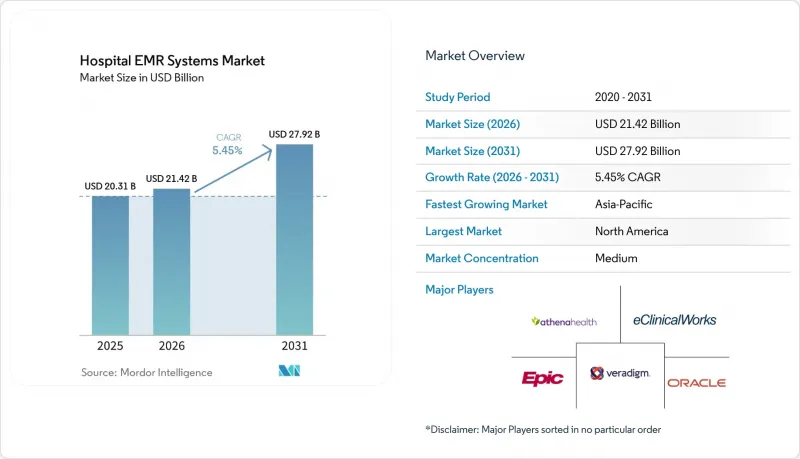
병원 전자건강기록 시스템 시장 규모는 2025년 203억 1,000만 달러로 평가되었고, 2026년 214억 2,000만 달러에서 2031년까지 279억 2,000만 달러로 확대될 것으로 예측되며, 2026-2031년 연평균 복합 성장률(CAGR)은 5.45%를 나타낼 전망입니다.
본 보고서는 구성 요소별(소프트웨어, 서비스, 하드웨어), 도입 모델별(클라우드 기반, 온프레미스형, 하이브리드형), EMR 유형별(일반, 전문 분야별), 적용 분야별(순환기, 신경, 방사선, 종양, 응급, 산부인과, 기타), 병원 규모별(소규모, 중규모, 대규모), 지역별(북미, 남미, 유럽, 아시아태평양, 중동 및 아프리카)로 분류되어 있습니다. 예측치는 금액(달러)으로 표시되어 있습니다.
세계의 병원 전자건강기록(EHR) 시스템 시장 동향 및 인사이트
정부 주도의 디지털 헬스 및 인증 EHR 도입
정부 정책에 따라 인증된 전자건강기록(EHR)은 병원의 진료 보상과 규정 준수에 있어 필수적인 요소가 되었습니다. 미국 메디케어·메디케이드 서비스 센터(CMS)는 ‘상호운용성 촉진 프로그램(Promoting Interoperability Program)’을 통해 메디케어 의사 지급액의 9%를 EMR을 활용한 품질 보고와 연계하고 있습니다. 유럽연합 집행위원회는 2025년 3월, ‘디지털 유럽 프로그램’의 일환으로 의료 데이터 인프라에 12억 유로(약 13억 달러)를 투자하기로 결정했습니다. 이러한 노력은 의료 현장 간 안전한 환자 데이터 교환을 촉진하고, 수요를 정책, 공공 자금 및 보상 구조와 연계함으로써 병원 전자건강기록(EMR) 시스템 시장을 뒷받침하고 있습니다.
AI를 활용한 진료 기록 작성 및 임상 의사결정 지원
AI를 활용한 기록 작성은 제한적인 시범 단계에서 병원의 일상적인 업무 흐름으로 전환되었습니다. 제공된 초안에 따르면, Epic사는 2026년 2월, AI를 통한 진료 기록 작성 및 진료 기록 요약 기능을 포함한 임상의용 ‘Art’ 제품군을 도입했습니다. Abridge사는 2026년 6월, 임상의용 인텔리전스 플랫폼을 확장하여 문서 작성, 청구 대조 및 근거 기반 의사 결정 지원을 포함하게 되었습니다. 병원들이 문서 작성 부담을 줄이고, 확립된 임상 워크플로우에 AI를 통합하는 플랫폼을 점점 더 선호함에 따라, 이러한 동향은 병원용 전자 의료 기록 시스템 시장에 영향을 미치고 있습니다.
사이버 보안, 개인정보 보호 및 랜섬웨어 노출
사이버 보안은 환자 안전에 대한 우려 사항일 뿐만 아니라, 병원에 있어 재정적 및 운영상의 위험 요소이기도 합니다. 2025년 5월, 케터링 헬스(Kettering Health)에서 발생한 랜섬웨어 공격으로 인해, 이 회사의 Epic EMR을 포함한 약 600개의 애플리케이션이 2주 이상 사용할 수 없게 되었습니다. 2026년 2월에는 미시시피 대학 의료 센터에서도 랜섬웨어 공격으로 인해 Epic 시스템이 오프라인 상태가 되었습니다. 이러한 사례들은 EMR 가동 중단이 임상 업무, 환자와의 소통, 예약 관리 및 진료 기록 접근을 방해할 수 있음을 여실히 보여주었으며, 병원들은 조달 시 공급업체의 복원력, 백업 프로세스 및 사이버 복구 능력을 우선시하게 되었습니다.
부문 분석
2025년에는 소프트웨어가 병원 전자건강기록 시스템 시장 점유율의 58.88%를 차지한 것으로 평가되었습니다. 병원들이 기록 관리, 처방 입력, 일정 관리, 청구, 보고, 환자와의 소통을 위해 임상 용도에 의존하고 있기 때문에 이 부문은 여전히 최대 규모를 유지하고 있습니다. 오래된 벤더들은 기존 병원 고객으로부터 지속적인 소프트웨어 수익을 창출하고 있습니다. 또한 소프트웨어 플랫폼은 AI 기반 문서 작성, 분석, 전문용도과 같은 연계 도구의 주요 접근 지점이 되고 있습니다. 이러한 입지 덕분에 핵심 소프트웨어 제공업체들은 병원이 지원 기술을 선택할 때 큰 영향력을 행사하게 되었습니다.
서비스 부문은 2031년까지 연평균 성장률(CAGR) 7.15%를 나타낼 것으로 예측되며, 이는 구성 요소 카테고리 중 가장 높은 성장률입니다. 클라우드 전환, FHIR 통합, AI 워크플로우 설정 및 규정 준수 업데이트에 대한 수요가 병원 전자건강기록(EHR) 시스템 시장의 서비스 부문 규모를 뒷받침하고 있습니다. 병원에서는 일회성 도입 서비스보다 지속적인 지원을 요구하는 경향이 강해지고 있습니다. 가상화 및 클라우드 호스팅 아키텍처로 인해 온프레미스 서버 인프라의 필요성이 감소함에 따라, 신규 도입에서 하드웨어의 중요성은 낮아지고 있습니다. 그 결과, 병원용 전자차트 시스템 업계는 도입, 교육, 최적화, 데이터 변환, 관리형 지원 등을 포함하는 보다 장기적인 벤더 계약으로 전환되고 있습니다.
2025년에는 클라우드 기반 도입이 매출의 56.34%를 차지한 것으로 평가되었으며, 병원용 전자차트 시스템 시장에서 가장 큰 비중을 차지하는 도입 모델이 될 전망입니다. 병원에서는 클라우드 시스템을 활용하여 시설 간 용도를 확장하고, 로컬 서버의 관리 비용을 절감하고 있습니다. 또한 의료 서비스 제공업체는 소프트웨어 업데이트 및 보안 강화에 대해 보다 일관된 접근성을 확보할 수 있습니다. 클라우드 도입은 임상의의 원격 접근을 가능하게 하며, 여러 시설에 걸쳐 있는 의료 시스템을 위한 공통 환경을 구축합니다. 이러한 이점은 병원이 시설 간에 임상 데이터를 통합해야 하는 경우에 특히 중요합니다.
하이브리드 도입은 2031년까지 연평균 성장률(CAGR) 5.80%를 나타낼 것으로 예측됩니다. 이 모델을 통해 병원은 기밀성이 높은 워크로드를 온프레미스 인프라에 유지하면서 특정 용도를 클라우드로 이전할 수 있습니다. 이는 데이터 저장 위치에 관한 규제, 사이버 보안 요건, 그리고 레거시 시스템 통합을 관리해야 하는 의료 기관에 유용합니다. 온프레미스형 도입은 광범위한 맞춤 설정이 이루어진 구형 병원 시스템에서 여전히 중요한 역할을 하고 있습니다. 많은 의료 기관이 온프레미스 데이터 관리에서 완전히 그리고 즉시 벗어나지 않으면서도 유연성을 추구하고 있기 때문에 병원 전자건강기록(EMR) 시스템 시장에서는 하이브리드형에 대한 수요가 계속될 것으로 예측됩니다.
지역별 분석
2025년, 북미는 전 세계 매출의 39.89%를 차지했으며 지역별로는 가장 큰 병원 전자건강기록(EMR) 시스템 시장 규모를 보였습니다. 미국에서는 ‘의미 있는 활용(Meaningful Use)’ 요건과 상환 연계형 보고 프로그램에 의해 형성된 성숙한 인증 EHR 환경이 구축되어 있습니다. 도입 기반이 광범위하기 때문에 수요는 시스템 교체, 업그레이드, 클라우드 이전, AI 통합 및 상호 운용성 요건에 의해 점점 더 주도되고 있습니다. 2026년 7월 USCDI v3 요건으로 인해 병원들은 데이터 공유 기능 업데이트를 지속적으로 요구받고 있으며, 캐나다와 멕시코도 지역적 수요를 뒷받침하고 있지만 지출 규모는 미국이 더 큽니다.
아시아태평양은 2031년까지 연평균 성장률(CAGR) 6.58%를 나타낼 것으로 예측되며, 이는 주요 지역 중 가장 높은 성장률입니다. 공공 디지털 헬스 프로그램과 민간 병원의 투자가 EMR 성숙도가 각기 다른 시장들의 성장을 뒷받침하고 있습니다. 인도의 디지털 헬스 프로그램은 연계형 의료 기록의 확대를 추진하고 있으며, 이는 공립 병원 및 민간 병원 그룹 수요를 뒷받침하고 있습니다. 중국에서는 병원의 디지털화 인프라가 정비되고 있는 반면, 일본과 한국은 국가 의료 기술 역량 강화를 지속하고 있어, 이 지역 전체적으로 신규 도입의 여지가 여전히 크게 남아 있습니다.
유럽은 병원 전자건강기록(EMR) 시스템 시장에서 여전히 2위 규모를 차지하고 있으며, 독일, 영국, 프랑스가 핵심 시장으로 자리 잡고 있습니다. 유럽 건강 데이터 공간(European Health Data Space) 규제에 따라 회원국들은 보다 일관된 의료 데이터 교환과 더욱 강력한 상호운용성 요건을 충족해야 합니다. 남미는 소규모 기반에서 확장되고 있으며, 브라질에서는 연방립 대학 병원 전체를 대상으로 디지털 병원 프로그램이 진행되고 있습니다. 한편, 중동에서는 AI를 활용한 병원 기록에 대한 투자가 증가하고 있으며, 아프리카는 구조화된 병원용 EMR 도입에 있어 여전히 초기 단계에 있습니다.
기타 혜택 :
- 엑셀 형식 시장 예측(ME) 시트
- 3개월간의 애널리스트 지원
자주 묻는 질문
목차
제1장 서론
제2장 조사 방법
제3장 주요 요약
제4장 시장 구도
제5장 시장 규모 및 성장 예측
제6장 경쟁 구도
제7장 시장 기회 및 향후 전망
AJY 26.09.03According to Mordor Intelligence, the hospital EMR systems market size is projected to expand from USD 20.31 billion in 2025 and USD 21.42 billion in 2026 to USD 27.92 billion by 2031, registering a CAGR of 5.45% between 2026 to 2031.
This report is Segmented by Component (Software, Services, Hardware), Deployment Model (Cloud-Based, On-Premise, Hybrid), EMR Type (General, Specialty-Specific), Application (Cardiology, Neurology, Radiology, Oncology, Emergency, OB/GYN, Others), Hospital Size (Small, Medium, Large), and Geography (North America, South America, Europe, Asia-Pacific, Middle East, Africa). Forecasts are in Terms of Value (USD).
Global Hospital EMR Systems Market Trends and Insights
Government-Led Digital Health and Certified EHR Adoption
Government policies are making certified electronic medical records essential for hospital reimbursement and compliance. The U.S. Centers for Medicare & Medicaid Services links 9% of Medicare physician payments to EMR-enabled quality reporting through its Promoting Interoperability Program. The European Commission committed EUR 1.2 billion (approximately USD 1.3 billion) in March 2025 for health data infrastructure under the Digital Europe Programme. These initiatives support the hospital EMR systems market by encouraging secure patient data exchange across care settings and linking demand to policy, public funding, and reimbursement structures.
AI-Assisted Documentation and Clinical Decision Support
AI-assisted documentation moved from limited pilots into regular hospital workflows. Epic introduced its clinician-facing Art suite in February 2026, including AI charting and chart summary functions, according to the supplied draft. Abridge expanded its clinician intelligence platform in June 2026 to cover documentation, billing reconciliation, and evidence-based decision support. These developments are influencing the hospital EMR systems market as hospitals increasingly favor platforms that reduce documentation workloads and integrate AI into established clinical workflows.
Cybersecurity, Privacy, and Ransomware Exposure
Cybersecurity has become a patient safety concern and a financial and operational risk for hospitals. In May 2025, a ransomware incident at Kettering Health disrupted nearly 600 applications, including its Epic EMR, for more than two weeks. In February 2026, the University of Mississippi Medical Center also had its Epic system taken offline during a ransomware attack. These incidents highlight that EMR downtime can disrupt clinical operations, patient communication, scheduling, and access to records, prompting hospitals to prioritize vendor resilience, backup processes, and cyber recovery capabilities during procurement.
Other drivers and restraints analyzed in the detailed report include:
- Cloud Migration and Subscription-Based Hospital IT
- Interoperability, FHIR APIs and Nationwide Health Information Exchange
- Implementation Complexity and Workflow Disruption
For complete list of drivers and restraints, kindly check the Table Of Contents.
Segment Analysis
Software is expected to hold 58.88% of the hospital EMR systems market share in 2025. The segment remains the largest because hospitals rely on clinical applications for records management, order entry, scheduling, billing, reporting, and patient communication. Established vendors continue to generate recurring software revenue from existing hospital accounts. Software platforms are also becoming the primary access point for connected tools, such as AI documentation, analytics, and specialty applications. This position gives core software providers significant influence over how hospitals select supporting technologies.
Services are forecast to grow at a CAGR of 7.15% through 2031, the highest rate among component categories. Demand for cloud migration, FHIR integration, AI workflow configuration, and compliance updates supports the hospital EMR systems market size for services. Hospitals increasingly require ongoing assistance rather than one-time installation services. Hardware is losing relevance in new deployments as virtualized and cloud-hosted architectures reduce the need for on-site server infrastructure. As a result, the hospital EMR systems industry is shifting toward longer vendor engagements that include implementation, training, optimization, data conversion, and managed support.
Cloud-based deployment is expected to account for 56.34% of revenue in 2025, making it the largest deployment model in the hospital EMR systems market. Hospitals use cloud systems to scale applications across sites and reduce the cost of managing local servers. Providers also gain more consistent access to software updates and security improvements. Cloud deployment supports remote access for clinicians and creates a common environment for multi-site health systems. These advantages are particularly relevant when hospitals need to integrate clinical data across facilities.
Hybrid deployment is projected to grow at a CAGR of 5.80% through 2031. This model allows hospitals to keep sensitive workloads on local infrastructure while moving selected applications to the cloud. It is useful for providers managing data residency rules, cybersecurity requirements, and legacy system integrations. On-premise deployment remains relevant for older hospital systems with extensive custom configurations. The hospital EMR systems market is likely to retain hybrid demand because many providers need flexibility without making a complete and immediate move away from local data control.
Complete Report Scope:
- By Component
- Software
- Services
- Hardware
- By Deployment Model
- Cloud-Based
- On-Premise
- Hybrid
- By EMR Type
- General EMR
- Specialty-Specific EMR
- By Application
- Cardiology
- Neurology
- Radiology
- Oncology
- Emergency and Trauma
- Obstetrics and Gynecology
- Other Applications
- By Hospital Size
- Small Hospitals
- Medium Hospitals
- Large Hospitals
- By Geography
- North America
- United States
- Canada
- Mexico
- Europe
- Germany
- United Kingdom
- France
- Italy
- Spain
- Rest of Europe
- Asia-Pacific
- China
- India
- Japan
- Australia
- South Korea
- Rest of Asia-Pacific
- Middle East and Africa
- GCC
- South Africa
- Rest of Middle East and Africa
- South America
- Brazil
- Argentina
- Rest of South America
- North America
Geography Analysis
North America held 39.89% of global revenue in 2025, representing the largest regional hospital EMR systems market size. The United States has a mature certified EHR environment shaped by meaningful use requirements and reimbursement-linked reporting programs. With a large installed base, demand is increasingly driven by system replacement, upgrades, cloud migration, AI integration, and interoperability requirements. The July 2026 USCDI v3 requirement maintained pressure on hospitals to update data-sharing capabilities, while Canada and Mexico also supported regional demand, with spending intensity higher in the United States.
Asia-Pacific is forecast to grow at a CAGR of 6.58% through 2031, the highest rate among major regions. Public digital health programs and private hospital investment support growth across markets with varying levels of EMR maturity. India's digital health program is expanding connected health records and supporting demand from public hospitals and private hospital groups. China is developing hospital digitization infrastructure, while Japan and South Korea continue to strengthen national health technology capabilities, leaving substantial room for new installations across the region.
Europe remained the second-largest regional contributor to the hospital EMR systems market, with Germany, the United Kingdom, and France serving as core markets. The European Health Data Space regulation pushed member states toward more consistent health data exchange and stronger interoperability requirements. South America is expanding from a smaller base, with Brazil advancing digital hospital programs across federal university hospitals, while the Middle East is increasing investment in AI-enabled hospital records and Africa remains at an earlier stage of structured hospital EMR adoption.
- Altera Digital Health
- Amazon Web Services, Inc.
- Athenahealth
- CompuGroup Medical SE & Co. KGaA
- Dedalus S.p.A.
- eClinicalWorks LLC
- Epic Systems
- GE HealthCare Technologies Inc.
- Greenway Health
- Harris Computer Corporation
- Infor, Inc.
- Intersystems
- Koninklijke Philips
- MEDFAR Clinical Solutions
- Medhost
- Medical Information Technology
- Netsmart Technologies, Inc.
- NextGen Healthcare
- Oracle
- Siemens Healthineers
- Tietoevry Corporation
- TruBridge, Inc.
- Veradigm
- WellSky Corporation
- Wolters Kluwer
Additional Benefits:
- The market estimate (ME) sheet in Excel format
- 3 months of analyst support
TABLE OF CONTENTS
1 INTRODUCTION
- 1.1 Study Assumptions and Market Definition
- 1.2 Scope of the Study
2 RESEARCH METHODOLOGY
3 EXECUTIVE SUMMARY
4 MARKET LANDSCAPE
- 4.1 Market Overview
- 4.2 Market Drivers
- 4.2.1 Government-Led Digital Health and Certified EHR Adoption
- 4.2.2 Cloud Migration and Subscription-Based Hospital IT
- 4.2.3 Demand for Integrated Clinical and Administrative Workflows
- 4.2.4 Interoperability, FHIR APIs and Nationwide Health Information Exchange
- 4.2.5 AI-Assisted Documentation and Clinical Decision Support
- 4.2.6 Shared Data Foundations for Hospital Research and Population Health
- 4.3 Market Restraints
- 4.3.1 Implementation Complexity and Workflow Disruption
- 4.3.2 Cybersecurity, Privacy and Ransomware Exposure
- 4.3.3 EHR Downtime Safety and Local Resilience Requirements
- 4.3.4 Clinician Trust, Alert Fatigue and AI Liability
- 4.4 Value/Supply-Chain Analysis
- 4.5 Regulatory Landscape
- 4.6 Technological Outlook
- 4.7 Porter's Five Forces Analysis
- 4.7.1 Threat of New Entrants
- 4.7.2 Bargaining Power of Suppliers
- 4.7.3 Bargaining Power of Buyers
- 4.7.4 Threat of Substitutes
- 4.7.5 Industry Rivalry
5 MARKET SIZE AND GROWTH FORECASTS (VALUE, USD)
- 5.1 By Component
- 5.1.1 Software
- 5.1.2 Services
- 5.1.3 Hardware
- 5.2 By Deployment Model
- 5.2.1 Cloud-Based
- 5.2.2 On-Premise
- 5.2.3 Hybrid
- 5.3 By EMR Type
- 5.3.1 General EMR
- 5.3.2 Specialty-Specific EMR
- 5.4 By Application
- 5.4.1 Cardiology
- 5.4.2 Neurology
- 5.4.3 Radiology
- 5.4.4 Oncology
- 5.4.5 Emergency and Trauma
- 5.4.6 Obstetrics and Gynecology
- 5.4.7 Other Applications
- 5.5 By Hospital Size
- 5.5.1 Small Hospitals
- 5.5.2 Medium Hospitals
- 5.5.3 Large Hospitals
- 5.6 By Geography
- 5.6.1 North America
- 5.6.1.1 United States
- 5.6.1.2 Canada
- 5.6.1.3 Mexico
- 5.6.2 Europe
- 5.6.2.1 Germany
- 5.6.2.2 United Kingdom
- 5.6.2.3 France
- 5.6.2.4 Italy
- 5.6.2.5 Spain
- 5.6.2.6 Rest of Europe
- 5.6.3 Asia-Pacific
- 5.6.3.1 China
- 5.6.3.2 India
- 5.6.3.3 Japan
- 5.6.3.4 Australia
- 5.6.3.5 South Korea
- 5.6.3.6 Rest of Asia-Pacific
- 5.6.4 Middle East and Africa
- 5.6.4.1 GCC
- 5.6.4.2 South Africa
- 5.6.4.3 Rest of Middle East and Africa
- 5.6.5 South America
- 5.6.5.1 Brazil
- 5.6.5.2 Argentina
- 5.6.5.3 Rest of South America
- 5.6.1 North America
6 COMPETITIVE LANDSCAPE
- 6.1 Market Concentration
- 6.2 Market Share Analysis
- 6.3 Company Profiles (includes Global Level Overview, Market Level Overview, Core Segments, Financials as available, Strategic Information, Market Rank/Share, Products and Services, Recent Developments)
- 6.3.1 Altera Digital Health Inc.
- 6.3.2 Amazon Web Services, Inc.
- 6.3.3 athenahealth, Inc.
- 6.3.4 CompuGroup Medical SE & Co. KGaA
- 6.3.5 Dedalus S.p.A.
- 6.3.6 eClinicalWorks LLC
- 6.3.7 Epic Systems Corporation
- 6.3.8 GE HealthCare Technologies Inc.
- 6.3.9 Greenway Health, LLC
- 6.3.10 Harris Computer Corporation
- 6.3.11 Infor, Inc.
- 6.3.12 InterSystems Corporation
- 6.3.13 Koninklijke Philips N.V.
- 6.3.14 MEDFAR Clinical Solutions
- 6.3.15 MEDHOST, Inc.
- 6.3.16 Medical Information Technology, Inc.
- 6.3.17 Netsmart Technologies, Inc.
- 6.3.18 NextGen Healthcare, Inc.
- 6.3.19 Oracle Corporation
- 6.3.20 Siemens Healthineers AG
- 6.3.21 Tietoevry Corporation
- 6.3.22 TruBridge, Inc.
- 6.3.23 Veradigm LLC
- 6.3.24 WellSky Corporation
- 6.3.25 Wolters Kluwer N.V.
7 MARKET OPPORTUNITIES AND FUTURE OUTLOOK
- 7.1 White-Space and Unmet-Need Assessment


