

|
시장보고서
상품코드
2118954
양자 통합 개발 환경 소프트웨어 시장 : 시장 점유율 분석, 업계 동향 및 통계, 성장 예측(2026-2031년)Quantum Integrated Development Environment Software - Market Share Analysis, Industry Trends & Statistics, Growth Forecasts (2026 - 2031) |
||||||
 Mordor Intelligence
양자 통합 개발 환경 소프트웨어 시장 규모는 2025년에 4억 3,000만 달러로 평가되었고, 2031년까지 24억 5,000만 달러에 이를 것으로 예측되며, 2026-2031년 CAGR 37.65%로 성장할 전망입니다.
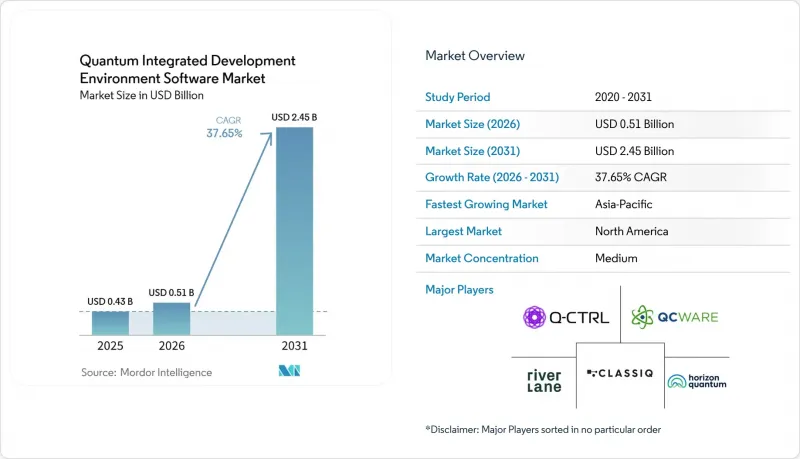
본 보고서는 제품 유형별(양자 시뮬레이션 및 에뮬레이션 소프트웨어 등), 도입 형태별(클라우드 기반 등), 프로그래밍 추상화 수준별(회로 수준 프로그래밍 등), 용도별(양자 머신러닝 등), 최종 사용자 산업별(에너지·유틸리티 등) 및 지역별로 분류되어 있습니다. 시장 전망은 금액(달러) 기준으로 제시되어 있습니다.
세계의 양자 통합 개발 환경(IDE) 소프트웨어 시장 동향 및 인사이트
정부의 자금 지원과 각국의 양자 전략이 대규모 조달을 촉진
공공 투자를 통해 양자 통합 개발 환경 소프트웨어 시장의 구매자 기반이 확대되고 있습니다. 2026년 5월, 미국 상무부는 9개 기업과 ‘CHIPS 법’에 근거한 20억 1,000만 달러 규모의 인센티브에 관한 의향서(LOI)를 발표했습니다. 여기에는 IBM의 자회사인 양자 파운드리 ‘앤더슨(Anderon)’에 대한 10억 달러의 지원도 포함되어 있습니다. 2026년 6월, 대통령령 제14413호에 따라 각 기관에 양자 정보 과학·기술의 상업화를 조정하고 국가 양자 전략을 갱신하도록 지시되었습니다. 동 대통령령에서는 인재 양성 기관의 설립과, 개발 환경의 장기적인 이용자가 될 수 있는 양자 사용자 시설에 대한 지원도 요구하고 있습니다. 캐나다는 국가 양자 생태계를 위해 5년간 3억 3,430만 캐나다 달러(2억 4,600만 달러)를 배정했습니다. 여기에는 ‘캐나다 양자 챔피언 프로그램’ 1단계에 대한 9,200만 캐나다 달러(6,800만 달러)가 포함됩니다. 이러한 프로그램에서는 다양한 하드웨어 유형에서 작동하며, 표준, 관리 및 재현 가능한 워크플로우에 관한 공공 부문의 요구 사항을 충족하는 도구가 우선적으로 선정됩니다.
클라우드를 통해 이용 가능한 양자 컴퓨팅의 확대가 개발자층을 넓히고 있습니다.
클라우드 서비스를 통해 양자 하드웨어를 운영하지 않는 사용자도 양자 소프트웨어를 이용할 수 있게 되었습니다. IBM은 2026년 4월, 뉴욕주 포키프시에 위치한 ‘Quantum Data Center’를 확장하고, 독일 에닝겐에도 새로운 시설을 건설할 계획을 세웠습니다. 인프라 확충으로 인해 개발자들은 원격 접속을 통해 워크로드를 테스트할 기회가 늘어나고 있습니다. 클라우드 서비스를 통해 개발 시작에 필요한 비용과 시간이 절감되므로, 이러한 움직임은 양자 통합 개발 환경 소프트웨어 시장의 확대로 이어집니다. 또한, 단일 워크플로우 내에서 하드웨어 선택, 실행, 시뮬레이션, 결과 관리를 수행하는 도구의 가치도 높아지고 있습니다.
양자 소프트웨어 엔지니어링 인력 부족이 기업 도입을 제약
양자 소프트웨어 인력공급은 개발자, 시스템 운영자 및 기업 사용자의 요구를 충족시키기에는 여전히 부족합니다. 『Nature Reviews Physics』지의 조사에 따르면, 영국 내 양자 분야 인재 채용은 해당 국가의 국가 양자 미션에서 요구하는 기술과 완전히 일치하지 않았습니다. 이 연구에서는 구인 광고가 전략에서 특정된 일부 감지 능력보다는 컴퓨팅 및 통신에 중점을 두고 있는 것으로 나타났습니다. 미국에서는 2011년부터 2024년 중반에 걸쳐 양자 기술을 요구하는 채용 공고가 전체 채용 공고에서 차지하는 비중이 3배로 증가했으나, 국내에서 이용 가능한 인재의 수는 여전히 제한적입니다. 유럽연합 집행위원회의 ‘디지털 유럽’ 프로그램은 2025년부터 2027년까지 ‘양자 디지털 기술 아카데미’에 1,000만 유로(1,130만 달러)를 배정했습니다. 이러한 인재 부족으로 인해 양자 통합 개발 환경 소프트웨어 시장의 도입이 주춤하고 있습니다. 이는 조직이 비즈니스 과제를 양자 워크플로로 전환하고, 결과를 평가하며, 코드를 유지 관리할 수 있는 인재를 필요로 하기 때문입니다.
부문 분석
2025년, 양자 통합 개발 환경 소프트웨어 시장에서 ‘양자 소프트웨어 개발 키트(SDK) 및 라이브러리’는 33.12%의 점유율을 차지했습니다. 이러한 위상은 양자 프로그래밍을 배우거나 알고리즘을 테스트하는 개발자들에게 SDK가 일반적인 진입점 역할을 하고 있음을 반영합니다. Qiskit이나 PennyLane과 같은 오픈소스 프레임워크는 사용자가 엔터프라이즈 지원이나 클라우드 용량을 필요로 하게 되기 전에, 벤더가 개발자 커뮤니티를 구축하는 데 도움을 주고 있습니다. IBM은 2026년, 양자 인프라와 서비스를 확대하는 과정에서 소프트웨어 스택 개발을 지속했습니다. 통합 개발 환경 플랫폼은 보다 통일된 환경에서 회로 설계, 시뮬레이션, 최적화, 프로젝트 관리가 필요한 기업 팀에 도움이 되고 있습니다. Horizon Quantum은 IonQ와 포춘 50대 기술 기업 등이 참여한, 신청 건수가 모집 인원을 초과한 비공개 투자 라운드를 거쳐 총 1억 3,700만 달러의 자금 조달을 보고했습니다. 제한적이고 고가의 양자 하드웨어에 코드를 배포하기 전에는 시뮬레이션, 에뮬레이션, 디버깅, 테스트 및 리소스 추정 도구가 여전히 필수적입니다. 따라서 제품 라인업은 저비용의 커뮤니티용 도구부터 검증 및 운영을 지원하는 고부가가치 엔터프라이즈용 도구까지 다양합니다.
양자 컴파일, 트랜스파일 및 최적화 소프트웨어 시장은 2031년까지 연평균 성장률(CAGR) 38.63%를 나타낼 것으로 예측됩니다. 이 부문이 확대되고 있는 이유는 높은 수준의 알고리즘을 다양한 큐비트(qubit) 아키텍처, 게이트 세트 및 오류 허용도에서 작동하는 명령어로 변환해야 하기 때문입니다. Zapata Quantum과 NVIDIA는 2026년 6월, 양자 리소스 추정을 위한 에이전트형 AI 워크플로우에 대해 협력했습니다. 이러한 워크플로우는 알고리즘이 향후 내결함성 시스템에서 실행 가능한지 여부를 평가하는 데 필요한 시간을 단축해 줍니다. 양자 통합 개발 환경(IDE) 소프트웨어 업계는 하드웨어 선택지가 늘어남에 따라 변환 및 최적화 작업량도 증가하기 때문에 컴파일러 도구에 의존하고 있습니다. 알고리즘 개발에 투자하기 전에 자원에 대한 현실적인 전망이 필요한 조직에서 수요가 가장 높습니다. 이에 따라 프로젝트가 단순한 회로 실험 단계를 넘어 진행됨에 따라 컴파일러의 역할은 더욱 중요해집니다.
2025년, 양자 통합 개발 환경 소프트웨어 시장에서 클라우드 기반 배포가 71.30%를 차지했습니다. 클라우드를 통해 조직은 양자 프로세서를 구매하거나 관리할 필요 없이 양자 알고리즘을 검증할 수 있습니다. IBM은 340개가 넘는 고객 및 파트너로 구성된 네트워크를 보고하고 있어, 원격 액세스 프로그램의 광범위한 보급 현황을 엿볼 수 있습니다. Amazon Braket의 멀티벤더 모델 역시 공통의 클라우드 서비스를 통해 개발자에게 다양한 백엔드에 대한 액세스를 제공합니다. 클라우드를 통한 제공은 지속적인 수익을 뒷받침하며, 벤더는 로컬 설치 없이도 소프트웨어를 업데이트할 수 있습니다. 이는 시스템 및 이용 사례를 지속적으로 비교 검토하고 있는 연구 그룹과 기업에게 특히 유용합니다. 또한 이 모델을 통해 벤더는 도구 사용 현황에 대한 데이터를 확보하여 향후 플랫폼 설계의 지침으로 삼을 수 있습니다.
하이브리드 배포는 2031년까지 연평균 성장률(CAGR) 39.70%를 나타낼 것으로 예측됩니다. 복잡한 워크로드의 경우, 기존 프로세서, 가속기, 양자 프로세서가 별도의 시스템으로 작동하는 것이 아니라 상호 연동하여 작동해야 합니다. Qilimanjaro는 2026년 6월, NVIDIA CUDA-Q와의 통합 및 디지털, 아날로그, GPU 가속 실행을 지원하는 백엔드 독립형 Python 인터페이스를 갖춘 ‘QiliSDK 0.2.0’을 출시했습니다. 2026년에 발표된 모듈형 양자 컴퓨터의 레이어 모델에 관한 연구에서는 고전 계층과 양자 계층에 걸친 오케스트레이션의 필요성이 지적되었습니다. 하이브리드 설계는 데이터를 보호해야 하는 기업, 고전 시스템을 내부 기록 근처에 배치해야 하는 기업, 또는 로컬 계산과 클라우드 양자 서비스를 결합해야 하는 기업에게 중요합니다. 양자 통합 개발 환경 소프트웨어 시장은 이 모델로부터 혜택을 받고 있습니다. 이는 이 모델에서 조정, 스케줄링, 모니터링 및 백엔드 선택이 필요하기 때문입니다. 이러한 요구 사항으로 인해 하이브리드 플랫폼은 단순한 원격 액세스 서비스보다 더 복잡해집니다. 또한 용도 팀이 인프라 세부 사항을 신경 쓰지 않아도 되도록 해주는 도구의 중요성도 높아지고 있습니다.
지역별 분석
2025년, 북미는 37.41%의 점유율을 차지했습니다. 이 지역의 양자 통합 개발 환경 소프트웨어 시장은 양자 하드웨어 기업, 클라우드 제공업체, 기업 사용자, 연구 기관 및 공공 자금 지원 프로그램이 고도로 집중되어 있어 혜택을 받고 있습니다. 2026년 6월, 대통령령 제14413호에 따라 상용화를 위한 연방 정부의 협력적 노력이 확립되었습니다. 2026년 5월 CHIPS법에 따른 의향서에서는 양자 파운드리 생산 능력 지원을 포함하여 9개 기업에 20억 1,000만 달러의 인센티브가 추가로 제공되었습니다. IBM은 2026년 6월, 연구, 설비 투자, 제조 및 파트너십을 아우르는 5년간 100억 달러가 넘는 양자 분야 투자 계획을 발표했습니다. 캐나다의 자금 지원은 소프트웨어, 인프라, 기술 인력에 대한 수요를 충족시키는 새로운 공공 자금원이 되고 있습니다. 멕시코의 역할은 여전히 학술 기관과의 제휴에 중점을 두고 있습니다. 이 지역은 견고한 고객 기반과 양자 도구를 클라우드 서비스와 결합한 대규모 기술 기업들의 직접적인 경쟁이 공존하고 있습니다.
아시아태평양은 2031년까지 연평균 성장률(CAGR) 38.91%를 나타낼 것으로 예측됩니다. 양자 통합 개발 환경 소프트웨어 시장은 대학, 통신 사업자, 정부 지원 프로그램을 연결하는 협력을 통해 발전하고 있습니다. KDDI, 와세다 대학, 게이오기주쿠 대학은 NEDO 프로그램을 통해 생성형 AI를 활용한 API 및 양자 워크로드의 부하 분산 기능 등을 갖춘 양자·AI 통합 개발 환경 개발에 착수했습니다. 오사카 대학, 후지쯔, TIS 및 SUCC는 2025년 3월 ‘OQTOPUS’를 오픈소스 소프트웨어로 공개하고, 오사카 대학의 양자 클라우드 서비스에서 운영했습니다. 일본의 공공 프로그램은 보다 광범위한 클라우드 및 하드웨어 생태계와의 연계를 유지하면서 국내 도구를 강화하고 있습니다. 중국은 독자적인 양자 소프트웨어 환경을 확대하고 있지만, 정보 출처의 신뢰성에 관한 요건 때문에 권위 없는 언론 보도의 주장을 무비판적으로 받아들일 수는 없습니다. 인도는 IBM이 양자 컴퓨팅과 클라우드 인프라에 대한 관심을 표명한 데 따라, 향후 중요한 진출 지역이 될 것입니다. 또한, 한국이 양자 소프트웨어 자금 조달에 재정적으로 참여하고 있는 것은 금융 용도에 대한 해당 지역의 관심과도 부합합니다. 이러한 각국의 다양한 접근 방식은 국경을 초월한 상호 운용성을 제한하지 않으면서도 지역의 요구를 지원할 수 있는 플랫폼에 기회를 창출하고 있습니다.
유럽은 영국, 독일, 프랑스, 스페인에서의 활동을 바탕으로 양자 통합 개발 환경 소프트웨어 시장에서 확고한 입지를 구축하고 있습니다. 영국은 2026년 3월, 양자 기술에 20억 파운드(25억 달러)를 투자하여 조달 프로그램 ‘ProQure’를 시작했습니다. 이 발표에는 IonQ사와 케임브리지 대학교가 256큐비트 시스템 개발을 위해 협력한다는 내용도 포함되었습니다. 또한 Riverlane사, Quantinuum사, 롤스로이스, 에든버러 대학교는 2026년 7월, 산업 설계 및 시뮬레이션 용도 검토를 위한 협약을 체결했습니다. Multiverse Computing사는 2026년 7월, 프리머니 기업 가치 17억 달러로 5억 7,000만 달러 규모의 시리즈 C 자금 조달을 발표했습니다. 중동에서는 정부계 펀드의 출자나 특정 인프라 프로젝트 참여를 통해 시장 진출이 진행되고 있습니다. 남미와 아프리카는 여전히 초기 단계에 있으며, 브라질이나 남아프리카공화국 등에서는 학술·연구 파트너십을 중심으로 한 활동이 이루어지고 있습니다.
기타 혜택 :
- 엑셀 형식 시장 예측(ME) 시트
- 3개월간의 애널리스트 지원
자주 묻는 질문
목차
제1장 서론
제2장 조사 방법
제3장 주요 요약
제4장 시장 구도
제5장 시장 규모 및 성장 예측
제6장 경쟁 구도
제7장 시장 기회 및 향후 전망
AJY 26.09.03According to Mordor Intelligence, the quantum integrated development environment software market size was valued at USD 0.43 billion in 2025 and is projected to reach USD 2.45 billion by 2031, growing at a CAGR of 37.65% over 2026-2031.
This report is Segmented by Product Type (Quantum Simulation and Emulation Software, and More), Deployment Mode (Cloud-Based, and More), Programming Abstraction (Circuit-Level Programming, and More), Application (Quantum Machine Learning, and More), End-User Industry (Energy and Utilities, and More), and Geography. The Market Forecasts are Provided in Terms of Value (USD).
Global Quantum Integrated Development Environment Software Market Trends and Insights
Government Funding and National Quantum Strategies Drive Procurement at Scale
Public investment is creating a broader base of buyers for the quantum integrated development environment software market. In May 2026, the U.S. Department of Commerce announced letters of intent with 9 companies for USD 2.01 billion in CHIPS Act incentives, including USD 1 billion for IBM's Anderon quantum foundry subsidiary. In June 2026, Executive Order 14413 directed agencies to coordinate quantum information science and technology commercialization and to update the National Quantum Strategy. The order also called for workforce institutes and support for quantum user facilities, which can become long-term users of development environments. Canada allocated CAD 334.3 million (USD 246 million) over 5 years for its national quantum ecosystem, including CAD 92 million (USD 68 million) for the Canadian Quantum Champions Program Phase 1. These programs favor tools that can operate across hardware types and meet public-sector requirements for standards, controls, and repeatable workflows.
Expansion of Cloud-Accessible Quantum Computing Broadens the Developer Base
Cloud delivery is making quantum software accessible to users who do not operate quantum hardware. IBM expanded its Quantum Data Center in Poughkeepsie, New York, in April 2026 and planned another facility in Ehningen, Germany. The expanded infrastructure gives developers more opportunities to test workloads through remote access. These developments expand the quantum integrated development environment software market, as cloud services reduce the cost and time required to begin development. They also increase the value of tools that manage hardware selection, execution, simulation, and results within one workflow.
Shortage of Quantum Software Engineering Talent Constrains Enterprise Adoption
The supply of quantum software talent remains insufficient to meet the needs of developers, system operators, and enterprise users. Research in Nature Reviews Physics found that quantum hiring in the United Kingdom did not fully align with the skills required by its national quantum missions. The study showed that job advertisements focused more on computing and communications than on some sensing capabilities identified by the strategy. U.S. postings requesting quantum skills had tripled as a share of all postings between 2011 and mid-2024, while the number of available domestic workers remained limited. The European Commission's Digital Europe program allocated EUR 10 million (USD 11.3 million) for a Quantum Digital Skills Academy in 2025-2027. The shortage slows adoption in the quantum integrated development environment software market because organizations need people who can translate business problems into quantum workflows, assess results, and maintain code.
Other drivers and restraints analyzed in the detailed report include:
- AI-Assisted Quantum Programming Reshapes IDE Feature Priorities
- Growth of Quantum Algorithm Development in Financial Services Drives Production-Grade Tool Demand
- Fragmentation Across Quantum Hardware Architectures and Programming Stacks Limits Portability
For complete list of drivers and restraints, kindly check the Table Of Contents.
Segment Analysis
Quantum Software Development Kits and Libraries held 33.12% of the quantum integrated development environment software market share in 2025. This position reflects the role of SDKs as the usual entry point for developers learning quantum programming and testing algorithms. Open-source frameworks such as Qiskit and PennyLane help vendors build developer communities before users require enterprise support or cloud capacity. IBM continued to develop its software stack in 2026 as it expanded quantum infrastructure and services. Integrated development environment platforms serve enterprise teams that need circuit design, simulation, optimization, and project management in a more unified setting. Horizon Quantum reported combined funding of USD 137 million after an oversubscribed private investment round that included IonQ and a Fortune 50 technology company. Simulation, emulation, debugging, testing, and resource-estimation tools remain necessary before code is deployed to limited and costly quantum hardware. The product mix, therefore, spans low-cost community tools and higher-value enterprise tools that support verification and operational use.
Quantum Compilation, Transpilation, and Optimization Software is projected to grow at a 38.63% CAGR through 2031. The segment expands because high-level algorithms must be translated into instructions that work across different qubit architectures, gate sets, and error tolerances. Zapata Quantum and NVIDIA collaborated in June 2026 on agentic AI workflows for quantum resource estimation. These workflows address the time needed to evaluate whether an algorithm can run on future fault-tolerant systems. The quantum integrated development environment software industry depends on compilation tools because more hardware options create more translation and optimization work. Demand is strongest where organizations need a realistic view of resources before investing in algorithm development. This gives compilers a more important role as projects move beyond simple circuit experiments.
Cloud-based deployment accounted for 71.30% of the quantum-integrated development environment software market in 2025. Cloud access lets organizations explore quantum algorithms without buying or managing a quantum processor. IBM reported a network of more than 340 clients and partners, showing the broad reach of remote-access programs. Amazon Braket's multi-vendor model also provides developers with access to different backends through a common cloud service. Cloud delivery supports recurring revenue and lets vendors update software without requiring local installation. It is especially useful for research groups and enterprises still comparing systems and use cases. The model also gives vendors data on how tools are used, which can guide future platform design.
Hybrid deployment is projected to grow at a 39.70% CAGR through 2031. Complex workloads require classical processors, accelerators, and quantum processors to work together rather than operate as separate systems. Qilimanjaro released QiliSDK 0.2.0 in June 2026 with NVIDIA CUDA-Q integration and a backend-agnostic Python interface for digital, analog, and GPU-accelerated execution. A 2026 study on layer models for modular quantum computers described the need for orchestration across classical and quantum layers. Hybrid designs are relevant for companies that need to protect data, keep classical systems close to internal records, or combine local computation with cloud quantum services. The quantum integrated development environment software market gains from this model because it requires coordination, scheduling, monitoring, and backend selection. These needs make hybrid platforms more complex than simple remote-access services. They also raise the importance of tools that make infrastructure details less visible to application teams.
Complete Report Scope:
- By Product Type
- Quantum Integrated Development Environment Platforms
- Quantum Software Development Kits and Libraries
- Quantum Simulation and Emulation Software
- Quantum Compilation, Transpilation and Optimization Software
- Quantum Debugging, Testing and Resource Estimation Tools
- Other Product Types
- By Deployment Mode
- Cloud-Based
- On-Premises
- Hybrid
- By Programming Abstraction
- Circuit-Level Programming
- Intermediate-Level / Gate-Based Programming
- High-Level Algorithmic Programming
- Natural-Language and AI-Assisted Quantum Programming
- By Application
- Optimization and Financial Modeling
- Quantum Simulation and Scientific Computing
- Quantum Machine Learning
- Cryptography and Security
- Other Applications
- By End-User Industry
- Banking, Financial Services, and Insurance (BFSI)
- Pharmaceutical and Biotechnology
- Information Technology and Telecommunication
- Aerospace and Defense
- Energy and Utilities
- Automotive and Mobility
- Government and Public Administration
- Other End-User Industries
- By Geography
- North America
- United States
- Canada
- Mexico
- South America
- Brazil
- Argentina
- Rest of South America
- Europe
- Germany
- United Kingdom
- France
- Italy
- Spain
- Russia
- Rest of Europe
- Asia-Pacific
- China
- Japan
- India
- South Korea
- Australia and New Zealand
- Rest of Asia-Pacific
- Middle East
- Saudi Arabia
- United Arab Emirates
- Turkey
- Rest of Middle East
- Africa
- South Africa
- Nigeria
- Rest of Africa
- North America
Geography Analysis
North America held 37.41% share in 2025. The quantum integrated development environment software market in the region benefits from a high concentration of quantum hardware companies, cloud providers, enterprise users, research institutions, and public funding programs. Executive Order 14413 established a coordinated federal approach to commercialization in June 2026. The May 2026 CHIPS Act letters of intent added USD 2.01 billion in incentives for 9 companies, including support for quantum foundry capacity. IBM announced more than USD 10 billion in planned quantum investment over 5 years in June 2026, covering research, capital expenditure, manufacturing, and partnerships. Canada's funding adds another public source of demand for software, infrastructure, and skills. Mexico's role remains focused on academic partnerships. The region combines a deep customer base with direct competition from large technology companies that bundle quantum tools with cloud services.
Asia-Pacific is projected to grow at a 38.91% CAGR through 2031. The quantum integrated development environment software market is developing through collaborations that link universities, telecommunications providers, and government-backed programs. KDDI, Waseda University, and Keio University worked on a quantum-AI integrated development environment through a NEDO program, including generative-AI-informed APIs and load balancing for quantum workloads. Osaka University, Fujitsu, TIS, and SUCC released OQTOPUS as open-source software in March 2025 and used it on Osaka University's quantum cloud service. Japan's public programs strengthen local tools while keeping links to broader cloud and hardware ecosystems. China is expanding its own quantum software environment, but source-quality requirements prevent reliance on claims from non-authoritative media reports. India is an important future activation area following IBM's stated interest in quantum computing and cloud infrastructure. South Korea's financial participation in quantum software funding also aligns with the regional interest in financial applications. These varied national approaches create opportunities for platforms that can support local needs without limiting cross-border interoperability.
Europe has a substantial position in the quantum integrated development environment software market, supported by activity in the United Kingdom, Germany, France, and Spain. The United Kingdom committed GBP 2 billion (USD 2.5 billion) to quantum technology in March 2026 and launched the ProQure procurement program. The announcement included a partnership involving IonQ and the University of Cambridge for a 256-qubit system. Riverlane, Quantinuum, Rolls-Royce, and the University of Edinburgh signed an agreement in July 2026 to explore industrial design and simulation applications. Multiverse Computing announced a USD 570 million Series C in July 2026 at a USD 1.7 billion pre-money valuation. The Middle East is entering through sovereign investment participation and targeted infrastructure projects. South America and Africa remain at an earlier stage, with activity centered on academic and research partnerships in countries such as Brazil and South Africa.
- Classiq Technologies Ltd.
- Horizon Quantum Holdings Ltd.
- Q-CTRL Pty Ltd
- QC Ware Corp.
- Riverlane Limited
- Zapata Computing Holdings Inc.
- 1QB Information Technologies Inc.
- Xanadu Quantum Technologies Inc.
- Strangeworks, Inc.
- Aliro Technologies, Inc.
- QunaSys Inc.
- Multiverse Computing S.L.
- Phasecraft Limited
- BlueQubit, Inc.
- Haiqu, Inc.
- Quantum Machines Ltd.
- SoftQuantus, Inc.
- aQuantum Technologies S.L.
- Qbraid, Inc.
- Quantum Inspire B.V.
Additional Benefits:
- The market estimate (ME) sheet in Excel format
- 3 months of analyst support
TABLE OF CONTENTS
1 INTRODUCTION
- 1.1 Study Assumptions and Market Definition
- 1.2 Scope of the Study
2 RESEARCH METHODOLOGY
3 EXECUTIVE SUMMARY
4 MARKET LANDSCAPE
- 4.1 Market Overview
- 4.2 Market Drivers
- 4.2.1 Government Funding and National Quantum Strategies
- 4.2.2 Expansion of Cloud-Accessible Quantum Computing
- 4.2.3 Demand for Hardware-Agnostic Quantum Development
- 4.2.4 Growth of Quantum Algorithm Development in Financial Services
- 4.2.5 Increasing Need for Post-Quantum Cryptography Development Tools
- 4.2.6 AI-Assisted Quantum Programming and Workflow Automation
- 4.3 Market Restraints
- 4.3.1 Shortage of Quantum Software Engineering Talent
- 4.3.2 Fragmentation Across Quantum Hardware Architectures and Programming Stacks
- 4.3.3 Limited Demonstrable Return on Investment from Enterprise Pilots
- 4.3.4 High Complexity of Error Mitigation, Debugging, and Production Deployment
- 4.4 Industry Value Chain Analysis
- 4.5 Regulatory Landscape
- 4.6 Technological Outlook
- 4.7 Impact of Macroeconomic Factors on the Market
- 4.8 Porter's Five Forces Analysis
- 4.8.1 Threat of New Entrants
- 4.8.2 Bargaining Power of Suppliers
- 4.8.3 Bargaining Power of Buyers
- 4.8.4 Threat of Substitutes
- 4.8.5 Intensity of Competitive Rivalry
5 MARKET SIZE AND GROWTH FORECASTS (VALUE)
- 5.1 By Product Type
- 5.1.1 Quantum Integrated Development Environment Platforms
- 5.1.2 Quantum Software Development Kits and Libraries
- 5.1.3 Quantum Simulation and Emulation Software
- 5.1.4 Quantum Compilation, Transpilation and Optimization Software
- 5.1.5 Quantum Debugging, Testing and Resource Estimation Tools
- 5.1.6 Other Product Types
- 5.2 By Deployment Mode
- 5.2.1 Cloud-Based
- 5.2.2 On-Premises
- 5.2.3 Hybrid
- 5.3 By Programming Abstraction
- 5.3.1 Circuit-Level Programming
- 5.3.2 Intermediate-Level / Gate-Based Programming
- 5.3.3 High-Level Algorithmic Programming
- 5.3.4 Natural-Language and AI-Assisted Quantum Programming
- 5.4 By Application
- 5.4.1 Optimization and Financial Modeling
- 5.4.2 Quantum Simulation and Scientific Computing
- 5.4.3 Quantum Machine Learning
- 5.4.4 Cryptography and Security
- 5.4.5 Other Applications
- 5.5 By End-User Industry
- 5.5.1 Banking, Financial Services, and Insurance (BFSI)
- 5.5.2 Pharmaceutical and Biotechnology
- 5.5.3 Information Technology and Telecommunication
- 5.5.4 Aerospace and Defense
- 5.5.5 Energy and Utilities
- 5.5.6 Automotive and Mobility
- 5.5.7 Government and Public Administration
- 5.5.8 Other End-User Industries
- 5.6 By Geography
- 5.6.1 North America
- 5.6.1.1 United States
- 5.6.1.2 Canada
- 5.6.1.3 Mexico
- 5.6.2 South America
- 5.6.2.1 Brazil
- 5.6.2.2 Argentina
- 5.6.2.3 Rest of South America
- 5.6.3 Europe
- 5.6.3.1 Germany
- 5.6.3.2 United Kingdom
- 5.6.3.3 France
- 5.6.3.4 Italy
- 5.6.3.5 Spain
- 5.6.3.6 Russia
- 5.6.3.7 Rest of Europe
- 5.6.4 Asia-Pacific
- 5.6.4.1 China
- 5.6.4.2 Japan
- 5.6.4.3 India
- 5.6.4.4 South Korea
- 5.6.4.5 Australia and New Zealand
- 5.6.4.6 Rest of Asia-Pacific
- 5.6.5 Middle East
- 5.6.5.1 Saudi Arabia
- 5.6.5.2 United Arab Emirates
- 5.6.5.3 Turkey
- 5.6.5.4 Rest of Middle East
- 5.6.6 Africa
- 5.6.6.1 South Africa
- 5.6.6.2 Nigeria
- 5.6.6.3 Rest of Africa
- 5.6.1 North America
6 COMPETITIVE LANDSCAPE
- 6.1 Market Concentration
- 6.2 Strategic Moves
- 6.3 Market Share Analysis
- 6.4 Company Profiles (includes Global Level Overview, Market Level Overview, Core Segments, Financials as available, Strategic Information, Market Rank/Share, Products and Services, Recent Developments)
- 6.4.1 Classiq Technologies Ltd.
- 6.4.2 Horizon Quantum Holdings Ltd.
- 6.4.3 Q-CTRL Pty Ltd
- 6.4.4 QC Ware Corp.
- 6.4.5 Riverlane Limited
- 6.4.6 Zapata Computing Holdings Inc.
- 6.4.7 1QB Information Technologies Inc.
- 6.4.8 Xanadu Quantum Technologies Inc.
- 6.4.9 Strangeworks, Inc.
- 6.4.10 Aliro Technologies, Inc.
- 6.4.11 QunaSys Inc.
- 6.4.12 Multiverse Computing S.L.
- 6.4.13 Phasecraft Limited
- 6.4.14 BlueQubit, Inc.
- 6.4.15 Haiqu, Inc.
- 6.4.16 Quantum Machines Ltd.
- 6.4.17 SoftQuantus, Inc.
- 6.4.18 aQuantum Technologies S.L.
- 6.4.19 Qbraid, Inc.
- 6.4.20 Quantum Inspire B.V.
7 MARKET OPPORTUNITIES AND FUTURE OUTLOOK
- 7.1 White-Space and Unmet-Need Assessment


