

|
시장보고서
상품코드
2118957
벤츄리 마스크 시장 : 시장 점유율 분석, 업계 동향 및 통계, 성장 예측(2026-2031년)Venturi Masks - Market Share Analysis, Industry Trends & Statistics, Growth Forecasts (2026 - 2031) |
||||||
 Mordor Intelligence
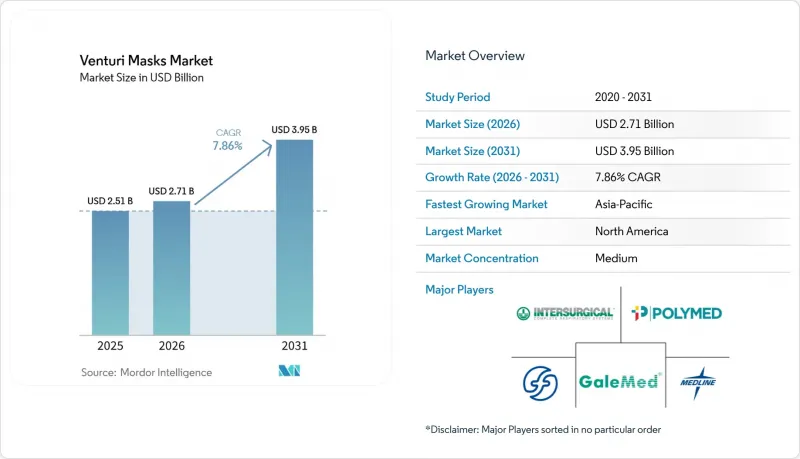
벤츄리 마스크 시장 규모는 2025년에 25억 1,000만 달러로 평가되었고, 2026년 27억 1,000만 달러에서 2031년까지 39억 5,000만 달러에 이를 것으로 예측되며, 예측 기간(2026-2031년) CAGR은 7.86%를 나타낼 전망입니다.
본 보고서는 제품 유형별(싱글, 멀티, 조절 가능, 소아용, 성인용), 재질 유형별(PVC, 실리콘, 고무, 기타), 산소 유량별(저, 중, 고, 기타), 용도별(COPD, 천식, 폐렴, 에어로졸 등), 최종 사용자별(병원, 재택치료, 당일 수술센터, 기타), 지역별(북미, 유럽, 아시아태평양, 기타)로 분류되어 있습니다. 시장 예측은 금액(달러) 기준으로 제시되어 있습니다.
세계의 벤츄리 마스크 시장 동향 및 인사이트
COPD 및 기타 만성 호흡기 질환 유병률 증가
COPD는 악화 시 조절된 산소 투여가 필요하기 때문에 벤츄리 마스크 시장의 주요 수요 요인으로 계속 작용하고 있습니다. 세계보건기구(WHO)는 COPD를 전 세계 3대 사망 원인으로 지목하고 있으며, 2023년에는 340만 명의 사망자가 보고되었습니다. 2025년 CHEST 저널의 연구에 따르면, COPD와 관련된 직접 의료비는 2025년에 7,786억 6,000만 달러로 추산되며, 2050년까지 8,624억 2,000만 달러에 달할 것으로 예측됩니다. 동 조사에 따르면, 2025년 COPD 악화 건수는 연간 4억 5,600만 건으로 추정되며, 이로 인해 조절된 산소 공급 장치가 필요할 수 있는 치료가 반복적으로 이루어지게 될 것입니다. COPD 관리 지침에서는 일반적으로 산소 포화도를 88%에서 92% 범위 내로 유지할 것을 권장하고 있으며, 이는 보정되지 않은 산소 공급이 아닌 공기 혼합형 마스크의 임상적 사용을 지지하는 것입니다. 동아시아, 북미 및 유럽의 고령화 진행에 따라 이러한 수요는 응급 치료의 범위를 넘어 만성 호흡기 관리 영역까지 확대되고 있습니다.
재택 산소 요법의 확대
가정 산소 요법의 확대에 따라 일회용 벤츄리 마스크를 조달할 가능성이 있는 의료 환경이 늘어나고 있습니다. 안정된 환자가 병원 밖에서 모니터링을 동반한 호흡 관리를 받을 수 있게 되면, 급성기 의료시설에 대한 부담이 경감됩니다. 미국에서는 H.R. 2902 ‘2025년 보조 산소 접근성 개혁법’이 산소를 경쟁 입찰 주기에서 제외하는 것을 목표로 했습니다. 이 법안 제안은 가정용 산소 공급 확보에 있어 상환 정책이 여전히 중요함을 보여줍니다. 의료 제공업체가 호흡기 소모품을 충분히 확보할 수 있다면 벤츄리 마스크 시장은 혜택을 볼 수 있겠지만, 보상액 인하는 의료 제공업체공급 능력을 제한할 가능성이 있습니다. 재택 간호 시장은 2031년까지 연평균 성장률(CAGR) 9.55%를 나타낼 것으로 예측되며, 이는 공급업체들이 병원뿐만 아니라 요양 기관, 도매업체, 환자에게 적합한 유통 전략을 마련해야 함을 시사합니다.
비강 캐뉼라, 고유량 비강 캐뉼라 및 비침습적 인공호흡의 가용성
고유량 비강 캐뉼라 및 비침습적 인공호흡 시스템은 일부 중증도 높은 이용 사례에서 수요를 제한하고 있습니다. 2024년에 실시된 다기관 무작위 대조 시험에서는 수술 후 저산소혈증에 대해 고유량 비강 캐뉼라, 비침습적 인공호흡, 그리고 벤츄리 마스크를 비교했습니다. 이 연구에서는 이 세 가지 치료법 간에 P/F 비율 개선에 있어 통계적으로 유의미한 차이는 확인되지 않았습니다. 병원 측에서는 고유량 시스템이 서로 다른 환자 인터페이스를 제공하며, 더 폭넓은 호흡 관리 플랫폼에 대응할 수 있다는 점에서 여전히 해당 시스템을 선택할 가능성이 있습니다. 피셔 앤 페이켈(Fisher & Paykel)은 2026 회계연도 병원용 하드웨어 매출이 전년 대비 18% 증가한 15억 1,000만 달러를 기록했다고 보고했습니다. 중유량 마스크는 이러한 대체 수단과의 중복이 가장 크기 때문에 벤츄리 마스크 제조업체에게는 호흡 관리 제품 포트폴리오의 확충이 중요합니다.
부문 분석
2025년, 성인용 벤츄리 마스크는 제품 유형별 수요의 65.31%를 차지했으며, 이는 COPD, 폐렴, 수술 후 저산소혈증을 앓는 성인 환자 수가 매우 많음을 반영합니다. 성인 의료 현장에서는 일반 병동, 응급실, 중환자실(ICU)에서 관리된 산소 요법이 시행되고 있습니다. 소아용 벤츄리 마스크는 전문 병원 및 공중보건 기관의 조달에 힘입어 규모는 작지만 안정적인 부문을 차지하고 있습니다. 유니세프(UNICEF)는 성인용 일회용 벤츄리 마스크 제품의 사양을 규정하고 있으며, 이와 유사한 요건이 소아용 제품 구매 결정의 지침이 되고 있습니다. 멀티 벤츄리 마스크 및 싱글 벤츄리 마스크가 제품 라인업의 나머지를 구성하고 있습니다. 고정 농도 시스템은 직원이 이미 색상으로 구분된 밸브의 형태를 파악하고 있으며, 재고 관리 체계가 확립된 현장에서는 여전히 유용합니다. 벤츄리 마스크 시장에서 이러한 형태에 대한 수요가 유지되는 이유는 설정된 산소 농도를 공급하는 익숙한 방법을 제공하기 때문입니다. 병원 조달 팀은 여러 고정 농도 제품을 선택할 경우 여전히 개별 재고 관리 단위를 관리해야 합니다. 이러한 필요성으로 인해 환자 수가 많은 호흡기과 병동 전체에서 보관 및 발주 업무가 증가합니다. 따라서 고정형 제품 라인을 유지하는 공급업체는 기존 거래처를 유지하면서 조절 가능한 시스템으로의 전환 경로를 제공할 수 있습니다.
유량 조절이 가능한 벤츄리 마스크 시장은 2026-2031년 연평균 성장률(CAGR) 8.58%로 확대될 것으로 예상되며, 이는 해당 제품 카테고리 내에서 가장 높은 성장률입니다. 단일 조절 키트로 여러 개의 단일 희석기 제품을 대체할 수 있으므로, 병동에서 보관해야 하는 품목 수를 줄일 수 있습니다. 인터서지컬(InterSurgical)사는 이러한 다단계 농도 접근 방식을 구현한 ‘MultiOx’ 및 ‘Silente’라는 조절 가능한 벤츄리 제품을 판매하고 있습니다. 명확한 교정 표시 덕분에 직원 교육이 간소화되고, 환자에게 서로 다른 산소 농도가 필요할 때 선택 실수를 줄일 수 있습니다. 2025년 『중국 간호 잡지』에 게재된 연구에서는 가습 설정별 벤츄리 마스크의 토출 유량 차이를 조사했습니다. 이 조사 결과는 특히 병상에서 가습 설정이 서로 다른 경우 유량 검증에 주의를 기울이는 것이 중요함을 뒷받침합니다. 병원 네트워크가 여러 시설에서 제품을 표준화할 경우, 조절 가능한 형태는 조달 측면에서 가치를 제공할 수 있습니다. 또한 공급업체 입장에서는 마스크를 튜브, 커넥터, 산소 공급용 액세서리와 세트로 판매할 기회도 생깁니다. 이러한 제품 전환으로 인해 고정식 밸브에 대한 수요가 사라지는 것은 아니지만, 제품 포트폴리오의 폭이 넓어지는 가치가 높아집니다. 그 결과, 벤츄리 마스크 업계에서는 재고 관리의 복잡성을 줄여주는 단순하고 교정된 시스템이 더욱 중시되고 있습니다.
2025년, 폴리염화비닐(PVC)은 소재 수요의 72.24%를 차지했으며, 소재 부문에서 주요 원자재가 되었습니다. PVC는 확립된 제조 공급망을 갖추고 있으며, 일반적인 호흡용 튜브 및 커넥터 시스템과 호환됩니다. 낮은 원자재 비용은 병원이나 유통업체를 통해 공급되는 대량 생산형 일회용 제품을 뒷받침하고 있습니다. 아시아의 제조 시설에서는 이 소재 형태의 대규모 생산 능력이 확립되어 있습니다. 또한, 표준 일회용 호흡용 제품이 필요한 임상 현장의 구매 담당자에게도 PVC 제품은 친숙한 소재입니다. 고무나 기타 소재는 환자와의 접촉성이나 내구성 등 모든 측면에서 실리콘에 미치지 못하기 때문에 시장 점유율은 여전히 낮은 수준입니다. 확립된 금형 및 공급업체와의 관계 또한 기존 마스크 설계에서 PVC 사용을 더욱 뒷받침하고 있습니다. 구매자들이 여전히 가용성, 호환성 및 단가를 우선시함에 따라 이 소재는 여전히 중요한 위치를 차지하고 있습니다. PVC에서 전환을 고려할 때는 생산 능력뿐만 아니라 규제 요건도 고려해야 합니다. 이 때문에 기존의 일회용 제품은 급격하게 대체되기보다는 점진적인 전환이 이루어질 것입니다.
실리콘은 2026-2031년 연평균 성장률(CAGR) 8.22%를 나타낼 것으로 예측되며, 가장 빠르게 성장하는 소재 유형이 될 것입니다. EU 의료기기 규정에서는 중량비 0.1%를 초과하는 특정 CMR 물질이 포함된 경우, 특별한 정당화 및 표시가 의무화되어 있습니다. 따라서 DEHP와 같은 프탈레이트계 가소제는 유럽 시장에 제품을 판매하는 제조업체에게 제품 설계 시 고려해야 할 사항이 되고 있습니다. ISO 10993 시험은 환자와 접촉하는 의료기기에 사용되는 소재의 평가와도 관련이 있습니다. 인터서지컬(InterSurgical)사의 비PVC 마스크 본체 ‘EcoLite’는 호흡기 제품에서 대체 소재 선택에 대한 수요를 충족하는 사례를 보여줍니다. 스칸디나비아 및 독일의 병원 그룹은 조달 심사 시 비DEHP 사양을 중점적으로 고려할 가능성이 있습니다. 이러한 추세는 다국적 공급업체들이 공통의 제품 플랫폼을 모색할 때 전 세계적인 사양에 영향을 미칠 가능성이 있습니다. 실리콘은 공급업체에게 소재 선택, 환자와의 접촉, 규제 관련 문서를 통해 차별화를 꾀할 수 있는 수단을 제공합니다. 따라서 실리콘을 채택한 제품 형태에 대한 수요는 벤츄리 마스크 시장 전체보다 빠르게 확대될 것으로 예측됩니다. PVC는 계속해서 주요 소재로 자리매김할 것이지만, 실리콘 및 비PVC 설계 제품은 규정 준수를 중시하는 요구 사항 증가에 부응할 것입니다.
지역별 분석
2025년, 북미는 벤츄리 마스크 시장 수요의 38.61%를 차지하며 지역별 최대 점유율을 기록했습니다. 이 지역은 확립된 병원 조달 시스템과 중환자실 및 응급실 시설의 방대한 도입 실적을 바탕으로 혜택을 누리고 있습니다. 지역 수요의 대부분은 미국이 차지하고 있으며, 캐나다와 멕시코는 규모는 작지만 수요가 확대되고 있습니다. 병원 확장으로 새로운 수용 능력이 가동된 후, 호흡기 제품에 대한 지속적인 소비가 뒷받침되고 있습니다. 노스웨스턴 메모리얼 병원에서 승인된 9,550만 달러 규모의 프로젝트를 통해 시카고에 42개의 병상이 추가될 예정입니다. 서스캐처원주의 1,700만 캐나다 달러(약 1,200만 달러) 규모의 중환자실(ICU) 프로젝트를 통해 로열 대학 병원의 중환자실 병상이 19개에서 26개로 확대됩니다. 미국에서는 FDA의 의료기기 요건 및 CMS의 보상 규정이 제품 문서화 및 상업적 조건에 영향을 미치고 있습니다. 이러한 상황은 품질, 공급 신뢰성, 계약 가치를 중시하는 구매 결정이 이루어지는 성숙한 시장을 뒷받침하고 있습니다.
아시아태평양은 2026-2031년 연평균 성장률(CAGR) 10.25%를 나타낼 것으로 예측되며, 이는 지역별 성장률 중 가장 높은 수치입니다. 병원 수용 능력 확대, 국내 생산 증가, 그리고 재택 간호 모델의 발전이 이 지역의 성장 전망에 기여하고 있습니다. 인도의 의료기기 생산에 대한 우대 조치는 수입 인공호흡기 소모품에 대한 의존도를 낮추려는 노력을 뒷받침하고 있습니다. Polymedicure사는 2025년 8월 투자자 프레젠테이션에 따르면, 2026 회계연도에 35개의 신제품을 출시하고 인도, 이탈리아, 네덜란드에 걸쳐 90명의 연구개발 팀을 유지했습니다. 일본과 한국에서는 고령화와 높은 의료비 지출로 인해 고급 인공호흡기 제품에 대한 수요가 지속되고 있습니다. 지역 병원들에서도 응급 및 중환자 치료 서비스 수용 능력을 확충하고 있습니다. 신규 병원이 집중형 산소 공급 인프라와 표준화된 소모품 재고를 도입함에 따라 벤츄리 마스크 시장은 혜택을 볼 것입니다. 국내 제조업체는 신속한 공급과 비용 면에서 경쟁력을 발휘할 수 있는 반면, 해외 공급업체는 첨단 소재와 조절 가능한 제품에 집중할 수 있습니다. 이러한 조합을 통해 북미의 현재 시장 규모와 아시아태평양의 향후 성장률 간의 격차를 좁힐 수 있게 됩니다.
유럽은 여전히 2위 지역 시장이며, 독일, 영국, 프랑스, 이탈리아, 스페인이 주요 수요 거점입니다. EU의 의료기기 규제로 인해, 소재에 대한 문서화 및 추적 가능성이 명확한 제품으로의 조달 경향이 강해지고 있습니다. 영국의 산소 요법 관련 지침은 고탄산혈증성 호흡부전 위험이 있는 환자에 대한 관리된 산소 요법을 계속해서 권장하고 있습니다. 스칸디나비아와 독일의 구매 그룹은 DEHP 및 PVC가 포함되지 않은 대체재와 관련하여 특히 중요한 역할을 하고 있습니다. 브라질과 아르헨티나를 필두로 한 남미는 시장 규모는 작지만, 응급 의료 체계 확충이 요구되고 있습니다. 중동 및 아프리카 역시 수요 기반은 작지만, GCC(걸프협력회의) 국가들의 의료 인프라 투자가 호흡기용 소모품 조달을 뒷받침하고 있습니다. 호주의 피오나 스탠리 병원에서 진행 중인 40병상 규모의 중환자실 증설은 선진국 의료 시스템에서 수용 능력 확대가 갖는 광범위한 중요성을 보여줍니다. 이러한 지역은 공급업체가 입찰 요건, 현지 유통 요구 사항 및 자재 사양을 충족할 수 있다면 성장 기회를 제공하는 시장입니다.
기타 혜택 :
- 엑셀 형식 시장 예측(ME) 시트
- 3개월간의 애널리스트 지원
자주 묻는 질문
목차
제1장 서론
제2장 조사 방법
제3장 주요 요약
제4장 시장 구도
제5장 시장 규모 및 성장 예측
제6장 경쟁 구도
제7장 시장 기회 및 향후 전망
AJY 26.09.03According to Mordor Intelligence, the venturi masks market size was valued at USD 2.51 billion in 2025 and is estimated to grow from USD 2.71 billion in 2026 to reach USD 3.95 billion by 2031, at a CAGR of 7.86% during the forecast period (2026-2031).
This report is Segmented by Product Type (Single, Multi, Adjustable, Pediatric, Adult), Material Type (PVC, Silicone, Rubber, Others), Oxygen Flow Rate (Low, Medium, High, Others), Application (COPD, Asthma, Pneumonia, Aerosol, and More), End User (Hospitals, Homecare, Ascs, Others), and Geography (North America, Europe, Asia-Pacific, and More). The Market Forecasts are Provided in Terms of Value (USD).
Global Venturi Masks Market Trends and Insights
Rising Prevalence of COPD and Other Chronic Respiratory Diseases
COPD remains a central demand driver for the Venturi masks market because it requires controlled oxygen administration during exacerbations. The World Health Organization identified COPD as the third leading cause of death worldwide, with 3.4 million deaths reported for 2023. A 2025 CHEST study placed direct medical costs associated with COPD at USD 778.66 billion in 2025 and projected USD 862.42 billion by 2050. The same research estimated 456 million annual COPD exacerbations in 2025, creating repeated treatment events where controlled oxygen equipment may be required. Guidance for COPD care commonly targets oxygen saturation between 88% and 92%, which supports the clinical use of air-entrainment masks rather than uncalibrated oxygen delivery. Aging populations in East Asia, North America, and Europe extend this need beyond emergency treatment and into chronic respiratory care pathways.
Expansion of Home-Based Oxygen Therapy
Home-based oxygen therapy is expanding the number of care settings that may procure disposable Venturi masks. The shift reduces pressure on acute facilities when stable patients can receive monitored respiratory care outside hospitals. In the United States, H.R. 2902, the Supplemental Oxygen Access Reform Act of 2025, sought to exclude oxygen from a competitive-bidding cycle. The proposed legislation shows that reimbursement policy remains important to the availability of home oxygen supplies. The Venturi masks market can benefit when providers maintain adequate access to respiratory consumables, but lower reimbursement may limit provider capacity. Homecare Settings are forecast to grow at 9.55% CAGR through 2031, which indicates that suppliers need channel strategies suited to care agencies, distributors, and patients as well as hospitals.
Availability of Nasal Cannulas, High-Flow Nasal Cannulas, and Non-Invasive Ventilation
High-flow nasal cannula and non-invasive ventilation systems constrain demand in some higher-acuity use cases. A 2024 multicenter randomized study compared high-flow nasal cannula, non-invasive ventilation, and Venturi masks in postoperative hypoxemia. The study found no statistically significant difference in P/F ratio improvement among the three modalities. Hospitals may still select high-flow systems because they offer a different patient interface and fit wider respiratory-care platforms. Fisher & Paykel reported USD 1.51 billion in hospital hardware revenue for FY2026, up 18% year over year. Medium Flow Rate masks face the greatest overlap with these alternatives, making complementary respiratory portfolios important for Venturi mask manufacturers.
Other drivers and restraints analyzed in the detailed report include:
- Infection-Control Preference for Single-Patient and Disposable Products
- Hospital and Emergency-Care Respiratory Capacity Expansion
For complete list of drivers and restraints, kindly check the Table Of Contents.
Segment Analysis
Adult Venturi Masks held 65.31% of product-type demand in 2025, reflecting the large adult patient base for COPD, pneumonia, and post-surgical hypoxemia. Adult care settings use controlled oxygen therapy across wards, emergency departments, and critical care units. Pediatric Venturi Masks serve a smaller, stable segment that is supported by specialized hospitals and public-health procurement. UNICEF maintains specifications for adult single-use Venturi mask products, and comparable requirements guide pediatric purchasing decisions. Multi-Venturi Masks and Single Venturi Masks comprised the remainder of the product base. Fixed-concentration systems remain useful where staff already know the color-coded valve format and inventories are established. The Venturi masks market retains demand for these formats because they provide a familiar method of delivering set oxygen concentrations. Hospital purchasing teams must still manage separate stock-keeping units when they select several fixed-concentration products. This need adds storage and ordering work across high-volume respiratory units. Suppliers that retain fixed-format lines can therefore protect established accounts while offering a migration path to adjustable systems.
Adjustable Flow Venturi Masks are forecast to expand at 8.58% CAGR from 2026 to 2031, the highest rate in the product category. A single adjustable kit can replace several single-diluter products, reducing the number of items that a ward needs to hold. Intersurgical markets MultiOx and Silente adjustable Venturi products that illustrate this multiple-concentration approach. Clear calibration can simplify staff training and reduce selection errors when patients need different oxygen concentrations. A 2025 study in the Chinese Journal of Nursing examined differences in Venturi-mask output flow across humidification configurations. The finding supports attention to flow verification, particularly where humidification arrangements differ at the bedside. Adjustable formats may offer procurement value when hospital networks standardize products across multiple sites. They also create opportunities for suppliers to bundle masks with tubing, connectors, and oxygen-delivery accessories. This product shift does not eliminate demand for fixed valves, but it raises the value of portfolio breadth. The Venturi masks industry is consequently placing greater emphasis on simple, calibrated systems that reduce stock complexity.
Polyvinyl Chloride held 72.24% of material demand in 2025, making it the leading input in the material segment. PVC has established manufacturing supply chains and works with common respiratory tubing and connector systems. Its low input cost supports high-volume single-use products supplied through hospitals and distributors. Asian manufacturing facilities have developed large-scale production capabilities for this material format. PVC products also remain familiar to clinical purchasers that require standard disposable respiratory products. Rubber and other materials hold a smaller position because they do not match silicone on all patient-contact and durability considerations. Established tooling and supplier relationships further reinforce PVC use in existing mask designs. The material remains important because buyers continue to prioritize availability, compatibility, and unit cost. Any shift away from PVC must account for production capacity as well as regulatory requirements. This creates a gradual transition instead of a rapid replacement of conventional disposable products.
Silicone is forecast to grow at 8.22% CAGR from 2026 to 2031, making it the fastest-growing material type. The EU Medical Device Regulation requires special justification and labeling in cases involving certain CMR substances above 0.1% by weight. Phthalate plasticizers such as DEHP have therefore become a product-design consideration for manufacturers selling into Europe. ISO 10993 testing is also relevant to the assessment of materials used in patient-contact devices. Intersurgical's EcoLite non-PVC mask body illustrates a response to the need for alternative material options within respiratory products. Scandinavian and German hospital groups can give added weight to non-DEHP specifications in procurement reviews. That preference may influence global specifications when multinational suppliers seek common product platforms. Silicone offers suppliers a route to differentiate through material choice, patient contact, and regulatory documentation. Demand for silicone-supported formats is therefore positioned to increase faster than the overall Venturi masks market. PVC will remain the material base, while silicone and non-PVC designs serve an expanding compliance-oriented requirement.
Complete Report Scope:
- By Product Type
- Single Venturi Masks
- Multi-Venturi Masks
- Adjustable Flow Venturi Masks
- Pediatric Venturi Masks
- Adult Venturi Masks
- By Material Type
- Polyvinyl Chloride
- Silicone
- Rubber
- Other Material Types
- By Oxygen Flow Rate
- Low Flow Rate, 1-6 L/min
- Medium Flow Rate, 6-12 L/min
- High Flow Rate, 12-15 L/min
- Others
- By Application
- Chronic Obstructive Pulmonary Disease
- Asthma
- Pneumonia
- Myocardial Infarction
- Respiratory Distress Syndrome
- Aerosol Therapy
- Other Applications
- By End User
- Hospitals and Clinics
- Homecare Settings
- Ambulatory Surgery Centers
- Other End Users
- By Geography
- North America
- United States
- Canada
- Mexico
- Europe
- Germany
- United Kingdom
- France
- Italy
- Spain
- Rest of Europe
- Asia-Pacific
- China
- Japan
- India
- Australia
- South Korea
- Rest of Asia-Pacific
- Middle East and Africa
- GCC
- South Africa
- Rest of Middle East and Africa
- South America
- Brazil
- Argentina
- Rest of South America
- North America
Geography Analysis
North America held 38.61% of demand in 2025, the largest regional position in the Venturi masks market. The region benefits from established hospital procurement systems and a large installed base of critical-care and emergency facilities. The United States accounted for most regional demand, while Canada and Mexico added smaller but developing requirements. Hospital expansions support recurring consumption of respiratory products after new capacity becomes operational. Northwestern Memorial Hospital's approved USD 95.5 million project adds 42 beds in Chicago. Saskatchewan's CAD 17 million (~USD 12 million) ICU project, expands the Royal University Hospital ICU from 19 to 26 beds. FDA device requirements and CMS reimbursement rules influence product documentation and commercial terms in the United States. These conditions support a mature market where purchasing decisions focus on quality, supply reliability, and contract value.
Asia-Pacific is projected to grow at 10.25% CAGR from 2026 to 2031, the fastest regional rate. Hospital capacity growth, increasing domestic production, and developing homecare models contribute to the regional outlook. India's medical-device production incentives support efforts to reduce dependency on imported respiratory consumables. Polymedicure launched 35 new products in FY2026 and maintained an R&D team of 90 people across India, Italy, and the Netherlands, according to its August 2025 investor presentation. Japan and South Korea sustain demand for premium respiratory products through aging populations and high healthcare spending. Regional hospitals are also adding capacity for emergency and critical-care services. The Venturi masks market benefits when new hospitals adopt centralized oxygen-delivery infrastructure and standardized consumable inventories. Domestic manufacturers can compete on supply responsiveness and cost, while international suppliers can focus on advanced materials and adjustable products. This mix can narrow the difference between North America's current size and Asia-Pacific's future growth rate.
Europe remained the second-largest regional market, with Germany, the United Kingdom, France, Italy, and Spain as principal demand centers. EU medical-device rules are shaping procurement toward products with clearer material documentation and traceability. The United Kingdom's oxygen guidance continues to support controlled oxygen therapy for patients at risk of hypercapnic respiratory failure. Scandinavian and German purchasing groups have particular relevance for non-DEHP and non-PVC alternatives. South America, led by Brazil and Argentina, has a smaller base but requires growing emergency-care capacity. The Middle East and Africa also begin from a smaller demand base, with GCC health infrastructure investment supporting respiratory-consumable procurement. Fiona Stanley Hospital's 40-bed critical-care expansion in Australia illustrates the wider relevance of capacity additions in developed health systems. These regions offer growth opportunities where suppliers can meet tender requirements, local distribution needs, and material specifications.
- Airways Surgical Pvt. Ltd.
- Beckton Dickinson
- Besmed Health Business
- Dragerwerk
- Fisher & Paykel Healthcare Corporation Limited
- Flexicare
- For Care Enterprise Co. Ltd.
- GaleMed Corporation
- HSINER Co. Ltd.
- ICU Medical
- Intersurgical Ltd.
- JG Moriya
- Medline Industries
- PFM medical AG
- Polymedicure Limited
- PVS S.p.A.
- SunMed
- Teleflex
- Terumo
- Zoll Medical
Additional Benefits:
- The market estimate (ME) sheet in Excel format
- 3 months of analyst support
TABLE OF CONTENTS
1 Introduction
- 1.1 Study Assumptions and Market Definition
- 1.2 Scope of the Study
2 Research Methodology
3 Executive Summary
4 Market Landscape
- 4.1 Market Overview
- 4.2 Market Drivers
- 4.2.1 Rising Prevalence of COPD and Other Chronic Respiratory Diseases
- 4.2.2 Expansion of Home-Based Oxygen Therapy
- 4.2.3 Infection-Control Preference for Single-Patient and Disposable Products
- 4.2.4 Hospital and Emergency-Care Respiratory Capacity Expansion
- 4.2.5 Demand for PVC-Free and Lower-Impact Medical Consumables
- 4.2.6 Procurement Shift Toward Adjustable, Multi-Concentration Mask Systems
- 4.3 Market Restraints
- 4.3.1 Availability of Nasal Cannulas, High-Flow Nasal Cannulas and Non-Invasive Ventilation
- 4.3.2 Reimbursement Pressure on Home Oxygen Therapy Consumables
- 4.3.3 Concentration Accuracy Risk from Poor Fit, Incorrect Flow Settings and User Training Gaps
- 4.3.4 Dependence on Medical-Grade PVC, Elastomers and Imported Components
- 4.4 Supply-Chain Analysis
- 4.5 Regulatory Landscape
- 4.6 Technological Outlook
- 4.7 Porter's Five Forces Analysis
- 4.7.1 Bargaining Power of Suppliers
- 4.7.2 Bargaining Power of Buyers
- 4.7.3 Threat of New Entrants
- 4.7.4 Threat of Substitutes
- 4.7.5 Competitive Rivalry
5 Market Size & Growth Forecasts (Value, USD)
- 5.1 By Product Type
- 5.1.1 Single Venturi Masks
- 5.1.2 Multi-Venturi Masks
- 5.1.3 Adjustable Flow Venturi Masks
- 5.1.4 Pediatric Venturi Masks
- 5.1.5 Adult Venturi Masks
- 5.2 By Material Type
- 5.2.1 Polyvinyl Chloride
- 5.2.2 Silicone
- 5.2.3 Rubber
- 5.2.4 Other Material Types
- 5.3 By Oxygen Flow Rate
- 5.3.1 Low Flow Rate, 1-6 L/min
- 5.3.2 Medium Flow Rate, 6-12 L/min
- 5.3.3 High Flow Rate, 12-15 L/min
- 5.3.4 Others
- 5.4 By Application
- 5.4.1 Chronic Obstructive Pulmonary Disease
- 5.4.2 Asthma
- 5.4.3 Pneumonia
- 5.4.4 Myocardial Infarction
- 5.4.5 Respiratory Distress Syndrome
- 5.4.6 Aerosol Therapy
- 5.4.7 Other Applications
- 5.5 By End User
- 5.5.1 Hospitals and Clinics
- 5.5.2 Homecare Settings
- 5.5.3 Ambulatory Surgery Centers
- 5.5.4 Other End Users
- 5.6 By Geography
- 5.6.1 North America
- 5.6.1.1 United States
- 5.6.1.2 Canada
- 5.6.1.3 Mexico
- 5.6.2 Europe
- 5.6.2.1 Germany
- 5.6.2.2 United Kingdom
- 5.6.2.3 France
- 5.6.2.4 Italy
- 5.6.2.5 Spain
- 5.6.2.6 Rest of Europe
- 5.6.3 Asia-Pacific
- 5.6.3.1 China
- 5.6.3.2 Japan
- 5.6.3.3 India
- 5.6.3.4 Australia
- 5.6.3.5 South Korea
- 5.6.3.6 Rest of Asia-Pacific
- 5.6.4 Middle East and Africa
- 5.6.4.1 GCC
- 5.6.4.2 South Africa
- 5.6.4.3 Rest of Middle East and Africa
- 5.6.5 South America
- 5.6.5.1 Brazil
- 5.6.5.2 Argentina
- 5.6.5.3 Rest of South America
- 5.6.1 North America
6 Competitive Landscape
- 6.1 Market Concentration
- 6.2 Market Share Analysis
- 6.3 Company Profiles (includes Global Level Overview, Market Level Overview, Core Segments, Financials as available, Strategic Information, Market Rank/Share, Products and Services, Recent Developments)
- 6.3.1 Airways Surgical Pvt. Ltd.
- 6.3.2 Becton, Dickinson and Company
- 6.3.3 Besmed Health Business Corp.
- 6.3.4 Dragerwerk AG & Co. KGaA
- 6.3.5 Fisher & Paykel Healthcare Corporation Limited
- 6.3.6 Flexicare (Group) Limited
- 6.3.7 For Care Enterprise Co. Ltd.
- 6.3.8 GaleMed Corporation
- 6.3.9 HSINER Co. Ltd.
- 6.3.10 ICU Medical, Inc.
- 6.3.11 Intersurgical Ltd.
- 6.3.12 JG Moriya
- 6.3.13 Medline Industries, LP
- 6.3.14 PFM medical AG
- 6.3.15 Polymedicure Limited
- 6.3.16 PVS S.p.A.
- 6.3.17 SunMed
- 6.3.18 Teleflex Incorporated
- 6.3.19 Terumo Corporation
- 6.3.20 ZOLL Medical Corporation
7 Market Opportunities and Future Outlook
- 7.1 White-Space and Unmet-Need Assessment


