

|
시장보고서
상품코드
2119009
신재생 에너지 발전 산업용 대체 연료 및 원료(AFR) 시장 : 시장 점유율 분석, 산업 동향 및 통계 데이터, 성장 예측(2026-2031년)Alternate Fuel and Raw Materials (AFR) For New Energy Generation Industry - Market Share Analysis, Industry Trends & Statistics, Growth Forecasts (2026 - 2031) |
||||||
 Mordor Intelligence
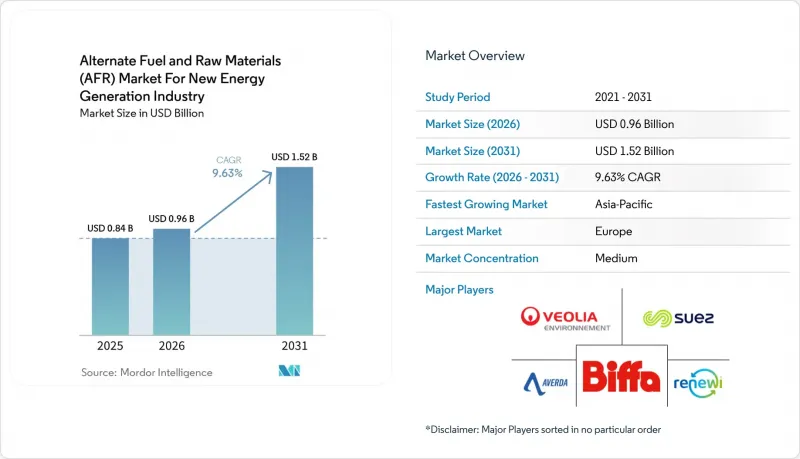
Mordor Intelligence에 의하면, 신재생 에너지 발전 산업용 대체 연료 및 원료(AFR) 시장 규모는 2025년 8억 4,000만 달러로 평가되었고, 2026년 9억 6,000만 달러에서 2031년까지 15억 2,000만 달러로 확대될 것으로 예측되며, 2026-2031년 연평균 복합 성장률(CAGR)은 9.63%를 나타낼 전망입니다.
본 보고서는 연료 유형별(RDF, SRF, 바이오매스, 폐플라스틱, 기타), 원자재 유형별(비산재, 고로 슬래그, 기타), 용도별(WtE 발전소, 바이오매스·바이오에너지 발전소, 기타), 지역별(북미, 유럽, 아시아태평양, 남미, 중동 및 아프리카)로 분류되어 있습니다. 시장 전망은 금액(달러) 기준으로 제시되어 있습니다.
신재생 에너지 발전 산업용 대체 연료 및 원료(AFR) 시장 인사이트 및 동향
탄소 가격 책정 및 산업의 탈탄소화
대체 연료 및 원료(AFR) 시장은 시멘트 및 기타 중공업 분야에서 탄소 집약적 연료의 사용 비용에 힘입어 성장하고 있습니다. 탄소 가격 책정 및 관련 수입 요건으로 인해 시멘트, 철강, 알루미늄 생산 과정에서 발생하는 배출 비용에 대한 관심이 높아지고 있습니다. 세계 시멘트·콘크리트 협회(Global Cement and Concrete Association)의 보고서에 따르면, 2025년 시점에서 전 세계 시멘트 가마의 에너지 소비량에서 폐기물이 차지하는 비율은 10% 미만이며, 운영 조건이 허용하는 한 더 광범위한 대체 여지가 남아 있습니다. 2026년 동료 심사를 거친 리뷰에 따르면, RDF(폐기물 유래 연료)로의 대체를 통해 클링커 생산의 지구 온난화 계수를 저감할 수 있는 것으로 밝혀졌으며, 그 효과는 대체율과 매립 회피 효과에 따라 달라집니다. 시멘트 업계의 무상 배출권 단계적 폐지 계획에 따라, 화석 연료 사용량 감축이 사업 운영상 더욱 중요해지고 있습니다. 이러한 상황은 특히 구매자가 사업 전반에 걸친 배출 감축 실적을 입증해야 하는 경우, 인증된 재생 연료에 대한 장기 연료 공급 계약을 촉진하고 있습니다.
매립 폐기물 감축 및 순환형 경제 의무화
매립 폐기물 감축 요건은 잔여 폐기물을 매립 처분에서 전환함으로써 대체 연료 및 원료(AFR) 시장을 뒷받침하고 있습니다. 개정된 EU 폐기물 기본 지침은 2025년에 분리 수거 및 식품 폐기물 감축에 관한 요건을 강화했습니다. EU의 폐기물 정책은 2035년까지 재활용률 향상과 매립 이용 감소를 연계하고 있습니다. 적절한 선별 후 남은 자재는 RDF 및 SRF 처리의 원료가 될 수 있지만, 가공업체는 해당 자재가 산업 사용자에게 전달되기 전에 품질 관리를 유지해야 합니다. 2025년 2월에 제시된 ‘클린 인더스트리얼 딜(Clean Industrial Deal)’은 산업의 탈탄소화와 순환성을 EU의 경쟁력 의제로 자리매김하고 있습니다. 발생원에서의 분리 수거를 개선함으로써, 폐기물 총량 증가를 초래하지 않으면서 적절한 잔여 물질공급을 늘릴 수 있으며, 동시에 폐기물 정책 하에서 재활용에 우선순위가 부여되는 상태를 유지할 수 있습니다.
원료의 품질 편차 및 오염
산업 사용자는 예측 가능한 재료 특성을 필요로 하기 때문에 원료의 편차는 여전히 대체 연료 및 원료(AFR) 시장의 제약 요인으로 작용하고 있습니다. 2026년 연구에 따르면, 각 재료의 조성을 시험하지 않고는 RDF의 품질 결과를 모든 원료에 적용할 수 없는 것으로 밝혀졌습니다. 특히 염소는 매우 중요한데, 그 농도가 높으면 시멘트 가마에서의 공동 처리 과정에서 바람직하지 않은 배출이 발생할 위험이 높아지기 때문입니다. 또한, 저장 시에는 화재, 습기, 오염에 대한 관리도 필요합니다. 이러한 요건들은 대체 연료 및 원료 시장의 소규모 처리 업체들의 운영 비용을 증가시킵니다. 유럽 및 영국에서 화학 물질 규제가 강화됨에 따라, 공급업체들의 사양 준수 부담이 더욱 커질 가능성이 있습니다.
부문 분석
RDF는 독일, 이탈리아, 폴란드의 시멘트 제조업체와의 공동 처리 계약에 힘입어 2025년 대체 연료 및 원료 시장에서 34.8%의 점유율을 차지했습니다. SRF는 2031년까지 연평균 성장률(CAGR) 10.9%를 나타낼 것으로 예측되며, 이는 연료 유형 중 가장 높은 성장률입니다. EN ISO 21644에 기반한 바이오매스 함량 인증은 감사 가능한 재생 가능 성분을 요건으로 하는 조달 결정을 뒷받침합니다. 대체 연료 및 원료 시장에서는 안정적인 사양과 추적 가능성이 있는 자재를 제공할 수 있는 SRF 공급업체가 높이 평가됩니다. 이는 산업용 구매자가 연료의 조성이나 재생 가능 성분에 대한 명확한 증거를 필요로 하기 때문입니다. 바이오제닉 성분의 비율이 높을수록 시멘트 제조업체는 배출량 보고 시 재생 가능 탄소와 화석 탄소를 구분하기 쉬워집니다.
대체 연료 및 원료 시장에서 폐플라스틱은 혼소 블렌드에서 높은 발열량을 제공하지만, 재활용 정책에 따라 에너지 회수 목적으로의 사용이 제한될 수 있습니다. 남미의 일부 지역에서는 타이어 유래 연료가 여전히 중요한 역할을 하고 있습니다. 브라질에서는 2024년, 이바마(Ibama)의 감독 하에 시멘트 가마에 타이어 유래 연료가 사용되었습니다. 멕시코 시멘트 업계에서도 타이어 유래 연료는 여전히 중요한 위치를 차지하고 있습니다. 분리 수거 체계가 충분히 갖춰지지 않은 지역에서는 제조 공정에서 발생하는 연료나 농업 잔재물의 역할은 여전히 제한적입니다.
지역별 분석
2025년, 유럽의 대체 연료 및 원료(AFR) 시장은 성숙한 분리 수거 시스템, 매립 규제, 그리고 시멘트 가마의 공동 처리 능력에 힘입어 전체 대체 연료 및 원료(AFR) 시장의 39.6% 점유율을 차지했습니다. 독일, 이탈리아, 폴란드, 프랑스 및 영국이 이 지역의 SRF 및 RDF 수요의 대부분을 차지했습니다. 폴란드와 독일에서는 시멘트 제조업체들이 석탄을 대체할 연료로 SRF를 채택함에 따라 SRF의 공동 소각 능력이 크게 향상되고 있습니다. 인다바(Indabar)사는 2026년 6월, 에식스주에 ‘리븐홀 통합 폐기물 관리 시설’을 개장했습니다. 이는 5억 8,900만 파운드가 투입된 프로젝트로, 연간 최대 59만 5,000톤의 잔류 폐기물을 처리하고 55MW의 전력을 생산합니다. EU의 폐기물 및 산업 정책은 해당 지역의 회수 연료 및 회수 원료에 대한 수요를 지속적으로 뒷받침하고 있는 반면, 통일된 분류 기준과 배출 기준치는 사업자가 처리 투자를 어떻게 구성할지에 영향을 미치고 있습니다.
아시아태평양은 2031년까지 연평균 성장률(CAGR) 11.1%를 나타낼 것으로 예측되며, 이는 대체 연료 및 원료(AFR) 시장에서 지역별 가장 높은 성장률입니다. 인도와 중국에서는 유럽의 주요 시설에 비해 시멘트 가마의 열 대체율이 낮습니다. 인도네시아, 인도, 베트남, 태국에서는 처리 능력 및 폐기물 발전 능력 확충이 진행되고 있습니다. 인도네시아는 2026년에 6억 달러를 초과하는 폐기물 발전 투자를 시작했습니다. 인도는 바이오매스 유래 재생 가능 연료를 뒷받침할 수 있는 풍부한 농업 바이오매스 자원을 보유하고 있습니다. 시멘트 가마의 열 대체율이 50-65%에 달하는 일본과 한국은 정책 체계가 잘 갖춰져 있으며, 인근 시장이 폐기물 확보와 연료 준비 개선을 위해 노력하는 가운데, 해당 지역의 모범 사례로 꼽히고 있습니다.
북미, 남미, 중동 및 아프리카에서는 수요 패턴이 다릅니다. 북미에서는 매립지 가스를 재생 가능 천연가스로 전환하는 것이 중요한 에너지 회수 수단이 되고 있습니다. 리퍼블릭 서비스(Republic Services)와 아케아 에너지(Arca Energy)는 2026년 6월 인디애나주 포트웨인에서 최초의 공동 재생 가능 천연가스 시설을 개장했습니다. 남미에서는 시멘트 공동 처리 과정에서 타이어 유래 연료의 사용이 계속되고 있습니다. 남아프리카, 모로코, 사우디아라비아는 규격이 관리되는 대체 연료 활동의 새로운 거점으로 부상하고 있습니다.
기타 혜택 :
- Excel 형식 시장 예측(ME) 시트
- 3개월간의 애널리스트 지원
자주 묻는 질문
목차
제1장 서론
제2장 분석 방법
제3장 주요 요약
제4장 시장 구도
제5장 시장 규모 및 성장률 예측
제6장 경쟁 구도
제7장 시장 기회 및 향후 전망
AJY 26.09.03According to Mordor Intelligence, the alternate fuel and Raw Materials Market for New Energy Generation Industry size is projected to expand from USD 0.84 billion in 2025 and USD 0.96 billion in 2026 to USD 1.52 billion by 2031, registering a CAGR of 9.63% between 2026 and 2031.
This report is Segmented by Fuel Type (RDF, SRF, Biomass, Waste Plastics, and Others), Raw Material Type (Fly Ash, Blast Furnace Slag, and Others), Application (WtE Power Plants, Biomass and Bioenergy Plants, and Others), and Geography (North America, Europe, Asia-Pacific, South America, and Middle East and Africa). The Market Forecasts are Provided in Terms of Value (USD).
Insights and Trends of Alternate Fuel and Raw Materials (AFR) Market For New Energy Generation Industry
Carbon Pricing and Industrial Decarbonization
The alternate fuel and raw materials market gains support from the cost of carbon-intensive fuel use in cement and other heavy industries. Carbon pricing and related import requirements have increased attention to the emissions cost of cement, steel, and aluminum production. The Global Cement and Concrete Association reported that waste supplied less than 10% of cement kiln energy worldwide in 2025, leaving room for broader substitution where operational conditions allow . A peer-reviewed 2026 review found that RDF substitution can reduce the global warming potential of clinker production, with the outcome depending on the substitution rate and avoided landfill effects. The planned phase-out of free emissions allowances for cement increases the operating relevance of reduced fossil fuel use. This setting supports longer fuel supply agreements for certified recovered fuels, especially where buyers must document emissions reductions across their operations.
Landfill Diversion and Circular-Economy Mandates
Landfill diversion requirements support the alternate fuel and raw materials market by directing residual waste away from disposal. The revised EU Waste Framework Directive strengthened requirements related to separate collection and food waste reduction in 2025. EU waste policy links higher recycling expectations with lower landfill use by 2035. Material that remains after appropriate sorting can become feedstock for RDF and SRF processing, although processors must maintain quality controls before the material reaches industrial users. The Clean Industrial Deal presented in February 2025 places industrial decarbonization and circularity within the EU competitiveness agenda. Better source separation can increase the supply of suitable residual material without requiring higher total waste volumes, while maintaining the priority given to recycling under waste policy.
Feedstock Quality Variability and Contamination
Feedstock variability remains a restraint on the alternate fuel and raw materials market because industrial users need predictable material properties. A 2026 study found that RDF quality results cannot be applied across feedstocks without testing each material composition. Chlorine is particularly important because higher concentrations can increase the risk of undesirable emissions during cement kiln co-processing. Storage also requires controls for fire prevention, moisture, and contamination. These requirements increase operating costs for smaller processors in the alternate fuel and raw materials market. Stronger chemical controls in Europe and the UK can further raise the specification burden for suppliers.
Other drivers and restraints analyzed in the detailed report include:
- Cement-Kiln Fuel Substitution Economics
- Expansion of Waste Sorting and Pre-Processing Infrastructure
- High Retrofit, Storage, and Permitting Costs
For complete list of drivers and restraints, kindly check the Table Of Contents.
Segment Analysis
RDF held 34.8% of the alternate fuel and raw materials market share in 2025, supported by co-processing agreements with cement manufacturers in Germany, Italy, and Poland. SRF is forecast to grow at a 10.9% CAGR through 2031, the highest rate among fuel types. Its EN ISO 21644 biomass-content certification can support procurement decisions that require auditable renewable content. The alternate fuel and raw materials market rewards SRF suppliers that can provide stable specifications and traceable material, because industrial buyers need clear evidence of fuel composition and renewable content. Higher biogenic content can help cement producers separate renewable and fossil carbon in emissions reporting.
Within the alternate fuel and raw materials market, waste plastics provide high calorific value in co-firing blends, but recycling policy can restrict their use for energy recovery. Tire-derived fuel remains important in parts of South America. Brazil used tire-derived fuel in cement kilns under Ibama monitoring in 2024. Tire-derived fuel also remains relevant to the cement sector in Mexico. Process-derived fuels and agricultural residues retain smaller roles where segregated waste collection is less developed.
Complete Report Scope:
- By Fuel Type
- Refuse-Derived Fuel (RDF)
- Solid Recovered Fuel (SRF)
- Biomass
- Waste Plastics
- Other Fuel Types
- By Raw Material Type
- Fly Ash
- Blast Furnace Slag
- Foundry Sand
- Steel Slag
- Other Raw Material Types
- By Application
- Waste-to-Energy (WtE) Power Plants
- Biomass and Bioenergy Plants
- Other Applications
- By Geography
- North America
- United States
- Canada
- Mexico
- Europe
- Germany
- France
- Italy
- Spain
- United Kingdom
- Poland
- Russia
- Rest of Europe
- Asia-Pacific
- China
- India
- Japan
- South Korea
- Australia
- Indonesia
- Vietnam
- Thailand
- Rest of Asia-Pacific
- South America
- Brazil
- Argentina
- Chile
- Rest of South America
- Middle East and Africa
- Saudi Arabia
- United Arab Emirates
- Egypt
- South Africa
- Morocco
- Rest of Middle East and Africa
- North America
Geography Analysis
The alternate fuel and raw materials market in Europe held 39.6% of the alternate fuel and raw materials market share in 2025, supported by mature sorting systems, landfill rules, and cement kiln co-processing capacity. Germany, Italy, Poland, France, and the United Kingdom accounted for much of the region's SRF and RDF demand. Poland and Germany have substantial SRF co-firing capacity as cement producers replace coal. Indaver opened the Rivenhall Integrated Waste Management Facility in Essex in June 2026, a GBP 589 million project that processes up to 595,000 tonnes of residual waste each year and produces 55 MW of electricity . EU waste and industrial policy continue to support demand for recovered fuels and materials in the region, while harmonized classifications and emissions thresholds influence how operators structure processing investments.
Asia-Pacific is forecast to grow at an 11.1% CAGR through 2031, the fastest geographic rate in the alternate fuel and raw materials market. India and China have lower cement kiln thermal substitution rates than leading European facilities. Indonesia, India, Vietnam, and Thailand are developing processing and waste-to-energy capacity. Indonesia launched more than USD 600 million in waste-to-energy investment during 2026. India has a substantial agricultural biomass resource that can support biomass-origin recovered fuels. Japan and South Korea, with 50-65% thermal substitution rates in cement kilns, provide regional reference points as policy frameworks develop and neighboring markets work to improve waste access and fuel preparation.
North America, South America, and the Middle East and Africa have different demand patterns. In North America, landfill gas conversion to renewable natural gas is an important energy-recovery route. Republic Services and Archaea Energy opened their first joint renewable natural gas facility in Fort Wayne, Indiana, in June 2026. South America continues to use tire-derived fuel within cement co-processing. South Africa, Morocco, and Saudi Arabia are emerging locations for specification-controlled alternative fuel activity.
- Averda International Limited
- Biffa Limited
- Enva Group Limited
- FCC Servicios Medio Ambiente Holding, S.A.U.
- Fomento de Construcciones y Contratas, S.A.
- Indaver NV
- PreZero International GmbH
- Ragn-Sells AB
- REMONDIS SE & Co. KG
- Renewi plc
- Republic Services, Inc.
- SARIA SE & Co. KG
- Sembcorp Industries Ltd.
- SUEZ S.A.
- Tradebe Environmental Services, LLC
- Veolia Environnement S.A.
- Viridor Limited
- Waste Management, Inc.
Additional Benefits:
- The market estimate (ME) sheet in Excel format
- 3 months of analyst support
TABLE OF CONTENTS
1 INTRODUCTION
- 1.1 Study Assumptions and Market Definition
- 1.2 Scope of the Study
2 RESEARCH METHODOLOGY
3 EXECUTIVE SUMMARY
4 MARKET LANDSCAPE
- 4.1 Market Overview
- 4.2 Market Drivers
- 4.2.1 Carbon Pricing and Industrial Decarbonization
- 4.2.2 Landfill Diversion and Circular-Economy Mandates
- 4.2.3 Cement-Kiln Fuel Substitution Economics
- 4.2.4 Expansion of Waste Sorting and Pre-Processing Infrastructure
- 4.2.5 Localized Industrial Symbiosis and Waste-to-Resource Platforms
- 4.2.6 Digital Fuel-Quality Certification and Traceability
- 4.3 Market Restraints
- 4.3.1 Feedstock Quality Variability and Contamination
- 4.3.2 High Retrofit, Storage, and Permitting Costs
- 4.3.3 Competition for Premium Waste Streams
- 4.3.4 Declining Availability of Traditional Secondary Raw Materials
- 4.4 Value Chain Analysis
- 4.5 Regulatory Landscape
- 4.6 Technological Outlook
- 4.7 Porter's Five Forces Analysis
- 4.7.1 Bargaining Power of Suppliers
- 4.7.2 Bargaining Power of Buyers
- 4.7.3 Threat of New Entrants
- 4.7.4 Threat of Substitutes
- 4.7.5 Competitive Rivalry
5 MARKET SIZE AND GROWTH FORECASTS
- 5.1 By Fuel Type
- 5.1.1 Refuse-Derived Fuel (RDF)
- 5.1.2 Solid Recovered Fuel (SRF)
- 5.1.3 Biomass
- 5.1.4 Waste Plastics
- 5.1.5 Other Fuel Types
- 5.2 By Raw Material Type
- 5.2.1 Fly Ash
- 5.2.2 Blast Furnace Slag
- 5.2.3 Foundry Sand
- 5.2.4 Steel Slag
- 5.2.5 Other Raw Material Types
- 5.3 By Application
- 5.3.1 Waste-to-Energy (WtE) Power Plants
- 5.3.2 Biomass and Bioenergy Plants
- 5.3.3 Other Applications
- 5.4 By Geography
- 5.4.1 North America
- 5.4.1.1 United States
- 5.4.1.2 Canada
- 5.4.1.3 Mexico
- 5.4.2 Europe
- 5.4.2.1 Germany
- 5.4.2.2 France
- 5.4.2.3 Italy
- 5.4.2.4 Spain
- 5.4.2.5 United Kingdom
- 5.4.2.6 Poland
- 5.4.2.7 Russia
- 5.4.2.8 Rest of Europe
- 5.4.3 Asia-Pacific
- 5.4.3.1 China
- 5.4.3.2 India
- 5.4.3.3 Japan
- 5.4.3.4 South Korea
- 5.4.3.5 Australia
- 5.4.3.6 Indonesia
- 5.4.3.7 Vietnam
- 5.4.3.8 Thailand
- 5.4.3.9 Rest of Asia-Pacific
- 5.4.4 South America
- 5.4.4.1 Brazil
- 5.4.4.2 Argentina
- 5.4.4.3 Chile
- 5.4.4.4 Rest of South America
- 5.4.5 Middle East and Africa
- 5.4.5.1 Saudi Arabia
- 5.4.5.2 United Arab Emirates
- 5.4.5.3 Egypt
- 5.4.5.4 South Africa
- 5.4.5.5 Morocco
- 5.4.5.6 Rest of Middle East and Africa
- 5.4.1 North America
6 COMPETITIVE LANDSCAPE
- 6.1 Market Concentration
- 6.2 Strategic Moves
- 6.3 Market Share Analysis
- 6.4 Company Profiles (includes Global Level Overview, Market Level Overview, Core Segments, Financials as available, Strategic Information, Market Rank/Share, Products and Services, Recent Developments)
- 6.4.1 Averda International Limited
- 6.4.2 Biffa Limited
- 6.4.3 Enva Group Limited
- 6.4.4 FCC Servicios Medio Ambiente Holding, S.A.U.
- 6.4.5 Fomento de Construcciones y Contratas, S.A.
- 6.4.6 Indaver NV
- 6.4.7 PreZero International GmbH
- 6.4.8 Ragn-Sells AB
- 6.4.9 REMONDIS SE & Co. KG
- 6.4.10 Renewi plc
- 6.4.11 Republic Services, Inc.
- 6.4.12 SARIA SE & Co. KG
- 6.4.13 Sembcorp Industries Ltd.
- 6.4.14 SUEZ S.A.
- 6.4.15 Tradebe Environmental Services, LLC
- 6.4.16 Veolia Environnement S.A.
- 6.4.17 Viridor Limited
- 6.4.18 Waste Management, Inc.
7 MARKET OPPORTUNITIES AND FUTURE OUTLOOK
- 7.1 White-Space and Unmet-Need Assessment


