

|
시장보고서
상품코드
2119029
자동차용 실리콘 : 시장 점유율 분석, 업계 동향 및 통계, 성장 예측(2026-2031년)Automotive Silicone - Market Share Analysis, Industry Trends & Statistics, Growth Forecasts (2026 - 2031) |
||||||
 Mordor Intelligence
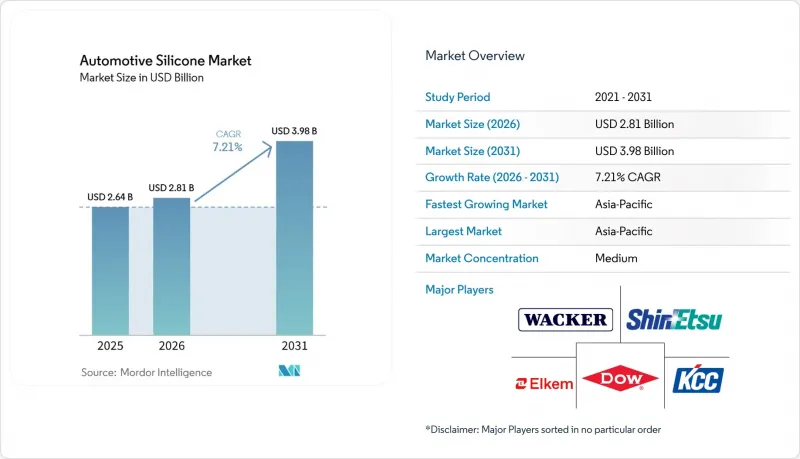
Mordor Intelligence에 의하면, 자동차용 실리콘 시장 규모는 2025년에 26억 4,000만 달러로 평가되었습니다. 2026년 28억 1,000만 달러에서 확대해, 2031년에는 39억 8,000만 달러에 이를 것으로 예측됩니다.
예측 기간(2026-2031년)의 연평균 성장률(CAGR)은 7.21%가 될 것으로 전망됩니다.
본 보고서는 제품 유형(실리콘 엘라스토머, 실리콘계 접착제 및 실란트 등), 차종(해치백·세단, SUV 등),용도(파워트레인·엔진 부품, 전기 및 전자 부품 등), 지역(아시아태평양, 북미, 유럽, 남미, 중동 및 아프리카)별로 분류되어 있습니다. 시장 예측은 금액(달러) 기준으로 제시되어 있습니다.
세계의 자동차용 실리콘 시장 동향 및 인사이트
전기차 생산 확대가 고전압 실링 솔루션 수요를 견인
800V 전기차 아키텍처로의 전환에 따라 배터리, 커넥터, 파워 일렉트로닉스에 대한 실링 요구 사항이 높아지고 있습니다. 기존의 에틸렌·프로파일렌·디엔·모노머(EPDM) 고무 컴파운드는 더 높은 온도나 전압 하에서 내구성이 뛰어난 전기 절연이 필요한 용도에서는 한계가 있습니다. 다우(Dow)는 2025년 9월, 400V에서 800V로 전환되는 시스템을 위해 180°C의 내열 성능을 공시하는 ‘DOWSIL EG-4175’ 실리콘 젤을 출시했습니다. 자동차용 실리콘 시장에서는 열 열화, 부분 방전 및 전기적 트래킹의 위험을 줄여주는 등급에 대한 수요가 증가하고 있습니다. 저유전율 및 백금 경화형 배합은 고전압 장비에서 이러한 요구 사항을 충족할 수 있습니다. 이러한 요구 사항으로 인해 배터리 및 전력 전자 응용 분야의 인증 기준을 충족할 수 있는 공급업체가 유리해집니다.
자동차용 전자기기의 엄격한 열 관리 및 화재 안전 요건
배터리의 열 폭주를 억제하려면 동일한 배터리 팩 내에 여러 보호 기능을 갖춰야 합니다. 실리콘 소재는 세라마이징 폼, 방화 배리어, 포팅 젤 및 고점도 고무 코팅으로 기능합니다. 와커 케미(Wacker Chemie)는 2025년 10월에 ‘ELASTOSIL R 531/60’을 발표했으며, 이 제품은 205°C에서 연속 사용이 가능하고 800°C에서 1,000°C 사이에서 세라믹 층을 형성한다고 밝혔습니다. 에보닉(Evonik)은 배터리 하우징용 ‘TEGO Therm’ 코팅에 대해 스프레이 도장이 가능하며 내화성이 뛰어나고 복잡한 3차원 표면에도 적합하다고 설명했습니다. 2025년 2월에 발표된 유럽연합 집행위원회의 지침에서는 지붕이 있는 주차장에서 전기차를 위한 다층식 방화 대책을 권장하고 있습니다. 자동차 제조업체가 단일 방화재가 아닌 통합된 소재 시스템을 채택할 경우, 자동차용 실리콘 시장은 그 혜택을 누리게 될 것입니다.
실리콘 원료 가격 변동과 공급망 집중
자동차용 실리콘 배합 제조업체는 특히 업스트림 소재 사업을 통합하지 않은 기업의 경우, 실리콘 원료공급 상황이나 가격 변동의 영향을 받기 쉬운 상황에 놓여 있습니다. 공급 차질로 인해 가격 변동이 발생하고, 공급업체가 비용을 자동차 제조업체에 신속하게 전가하지 못할 경우, 이익률이 압박받을 가능성이 있습니다. 금속 실리콘의 생산 능력 확대에는 긴 건설 기간과 환경 승인이 필요하며, 이로 인해 공급 대응이 지연될 우려가 있습니다. 이로 인해 공급이 집중된 상황에서는 구매자의 유연성이 제한됩니다. 그 결과, 자동차용 실리콘 시장은 단기적인 조달 측면 및 이익률 측면에서 지속적인 압박을 받고 있습니다.
부문별 분석
2025년 기준, 실리콘 엘라스토머는 자동차용 실리콘 시장 점유율의 38.75%를 차지하며 가장 큰 제품 카테고리가 되었습니다. 이들은 낮은 압축 영구 변형 성능과 150°C 이상의 내열성이 요구되는 개스킷, O-링, 호스, 파워트레인용 씰 등에 사용됩니다. 접착제 및 실란트는 2026년부터 2031년까지 연평균 성장률(CAGR) 8.63%를 나타낼 것으로 예측되며, 이는 언급된 제품 유형 중 가장 높은 성장률입니다. 셀-투-팩 방식의 배터리 설계에는 습기를 차단하고, 전기적 절연을 제공하며, 열 관리를 지원하는 소재가 필요합니다. 이러한 기능들이 더 적은 수의 부품으로 통합됨에 따라 자동차용 실리콘 시장은 혜택을 볼 것입니다.
실리콘 유체는 감쇠 메커니즘과 커넥터의 윤활을 지원하며, 수지는 배터리 커버용 방화 라미네이트를 형성할 수 있습니다. 젤과 폼은 진동에 민감한 전자 기기를 보호하고 밀봉합니다. D4, D5, D6 고리형 실록산에 대한 규제가 유체 및 접착제의 배합 변경에 영향을 미치고 있습니다. 다우(Dow)사는 2026년 6월, 특수 실리콘 제조에 1억 달러를 투자한다고 발표했습니다. 여기에는 2026년 가동 개시가 예상되는 마쓰에 및 후쿠이 지역의 엔지니어링 실리콘 소재 생산 능력이 포함됩니다. 그 결과, 자동차용 실리콘 시장에서는 자동차용 전자기기를 위한 고순도 접착제 및 젤이 더욱 중요시되고 있습니다.
지역별 분석
아시아태평양은 2025년 자동차용 실리콘 시장 점유율의 45.72%를 차지했으며, 2031년까지 연평균 성장률(CAGR) 8.51%를 나타낼 것으로 예측됩니다. 이에 따라 해당 지역은 가장 크고 가장 빠르게 성장하는 시장이 될 전망입니다. 중국은 신에너지차 생산 기반이 방대하기 때문에 배터리 등급 실링재 및 열 인터페이스 재료 수요를 주도하고 있습니다. 일본과 한국은 신에츠 화학공업이나 KCC 실리콘과 같은 기업을 통해 지역 혁신에 기여하고 있습니다. 2025년 7월 KCC 실리콘이 현대모비스와 제휴한 것은 자동차용 실리콘 시장에서 한국의 OEM 기업들과의 공동 개발 역할을 부각시켰습니다.
북미는 미국의 1차 자동차 부품 공급업체 기반과 국내 배터리 제조에 대한 투자에 힘입어 시장에서 중요한 위치를 차지하고 있습니다. 2025년 9월, 헨켈은 사우스다코타주 브랜든에 위치한 공장의 확장을 완료하여, 열 관리 소재 및 접착제 생산 면적을 6,500제곱미터로 두 배로 늘렸습니다. 또한, 헨켈은 2025년 9월 미시간주 매디슨 하이츠에 ‘북미 배터리 용도 센터’를 개설했습니다. 이러한 투자를 통해 기술 개발과 소재 공급이 OEM 엔지니어링 팀에게 더욱 가까워졌습니다. 멕시코는 미국-멕시코-캐나다 협정(USMCA)에 기반한 북미 자동차 조립 네트워크의 일환으로 수요 증가에 기여하고 있습니다.
유럽의 자동차용 실리콘 시장은 전동화를 촉진하고 배터리용 실링재 수요를 증가시키는 차량 평균 CO₂ 배출 규제에 힘입어 성장하고 있습니다. 독일은 OEM, 1차 공급업체 및 특수 소재 제조업체에게 여전히 중요한 공동 개발 거점으로 자리 잡고 있습니다. 엘켐(Elkem)의 재활용 관련 연구는 유럽 공급업체들에게 사용 후 실리콘 처리 분야에서 잠재적인 기술적 우위를 제공합니다. 남미, 중동 및 아프리카는 비교적 소규모 수요 거점이며, 이 지역에서는 전기차 보급률이 낮아 차량 1대당 실리콘 함량도 낮은 임베디드니다.
기타 혜택 :
- 엑셀 형식 시장 예측(ME) 시트
- 3개월간의 애널리스트 지원
자주 묻는 질문
목차
제1장 서론
제2장 조사 방법
제3장 개요
제4장 시장 구도
제5장 시장 규모 및 성장 예측
제6장 경쟁 구도
제7장 시장 기회 및 향후 전망
KTH 26.09.02According to Mordor Intelligence, the automotive silicone market size was estimated at USD 2.64 billion in 2025 and is estimated to grow from USD 2.81 billion in 2026 to reach USD 3.98 billion by 2031, at a CAGR of 7.21% during the forecast period (2026-2031).
This report is Segmented by Product Type (Silicone Elastomers, Silicone Adhesives and Sealants, and More), Vehicle Type (Hatchback and Sedan, SUV, and More), Application (Powertrain and Engine Components, Electrical and Electronics, and More), and Geography (Asia-Pacific, North America, Europe, South America, and Middle-East and Africa). The Market Forecasts are Provided in Terms of Value (USD).
Global Automotive Silicone Market Trends and Insights
Growing Electric Vehicle Production Driving Demand for High-Voltage Sealing Solutions
The shift to 800V electric vehicle architecture has raised sealing requirements for batteries, connectors, and power electronics. Conventional Ethylene Propylene Diene Monomer (EPDM) rubber compounds have limitations in applications that require durable electrical insulation at higher temperatures and voltages. Dow introduced DOWSIL EG-4175 Silicone Gel in September 2025 for systems transitioning from 400V to 800V, with a stated temperature capability of 180°C. The automotive silicone market has a growing need for grades that reduce the risks of thermal degradation, partial discharge, and electrical tracking. Low-permittivity and platinum-cured formulations can address these demands in high-voltage hardware. These requirements favor suppliers that can meet qualification standards for battery and power-electronics applications.
Stringent Thermal Management and Fire Safety Requirements in Automotive Electronics
Battery thermal runaway mitigation requires several protective functions within the same battery pack. Silicone materials can serve as ceramifying foams, fire barriers, potting gels, and high-consistency rubber coatings. Wacker Chemie presented ELASTOSIL R 531/60 in October 2025, stating that it can operate continuously at 205°C and form a ceramic layer at 800°C to 1,000°C. Evonik described TEGO Therm coatings for battery housings as sprayable, fire-resistant, and suitable for complex three-dimensional surfaces. European Commission guidance published in February 2025 supports layered fire-containment approaches for electric vehicles in covered parking areas. The automotive silicone market benefits when vehicle manufacturers opt for integrated material systems rather than single-barrier materials.
Volatility in Silicone Raw Material Prices and Supply Chain Concentration
Automotive silicone formulators are exposed to changes in silicone feedstock availability and pricing, particularly those without integrated upstream material positions. Supply disruptions can create price movements that compress margins when suppliers cannot pass costs to vehicle customers quickly. Silicon metal capacity requires long construction timelines and environmental approvals, which can delay supply responses. This limits buyer flexibility when supply is concentrated. As a result, the automotive silicone market remains exposed to short-term procurement and margin pressure.
Other drivers and restraints analyzed in the detailed report include:
- Increasing Adoption of Lightweight and Multi-Material Vehicle Architectures
- Rising Use of Silicone Materials for Enhanced Durability in Powertrain and Underbody Applications
- Growing Competition from Alternative Elastomers and Polymer Materials
For complete list of drivers and restraints, kindly check the Table Of Contents.
Segment Analysis
Silicone elastomers held 38.75% of the automotive silicone market share in 2025, making them the largest product category. They are used in gaskets, O-rings, hoses, and powertrain seals that require low compression set performance and heat resistance above 150°C. Adhesives and sealants are forecast to grow at 8.63% CAGR from 2026 to 2031, the highest rate among the listed product types. Cell-to-pack battery designs require materials that exclude moisture, provide electrical isolation, and support thermal management. The automotive silicone market benefits when these functions are combined in fewer components.
Silicone fluids support damping mechanisms and connector lubrication, while resins can form fire-barrier laminates for battery covers. Gels and foam protect and encapsulate vibration-sensitive electronics. Restrictions on D4, D5, and D6 cyclic siloxanes are influencing reformulation in fluids and adhesives. Dow announced a USD 100 million investment in specialty silicone manufacturing in June 2026, including engineered silicone materials capacity in Songjiang and Fukui, expected to come online in 2026. As a result, the automotive silicone market is placing greater emphasis on high-purity adhesives and gels for automotive electronics.
Complete Report Scope:
- By Product Type
- Silicone Elastomers
- Silicone Adhesives and Sealants
- Silicone Fluids
- Silicone Resins
- Silicone Gels and Foams
- By Vehicle Type
- Hatchback and Sedan
- SUV
- Light Commercial Vehicles (LCV)
- Heavy Commercial Vehicles (HCV)
- By Application
- Powertrain and Engine Components
- Electrical and Electronics
- Interior Applications
- Exterior Applications
- Thermal Management Systems
- By Geography
- Asia-Pacific
- China
- India
- Japan
- South Korea
- Rest of Asia-Pacific
- North America
- United States
- Canada
- Mexico
- Europe
- Germany
- United Kingdom
- France
- Italy
- Russia
- Rest of Europe
- South America
- Brazil
- Argentina
- Rest of South America
- Middle-East and Africa
- Saudi Arabia
- South Africa
- Rest of Middle-East and Africa
- Asia-Pacific
Geography Analysis
Asia-Pacific held 45.72% of the automotive silicone market share in 2025 and is expected to grow at a CAGR of 8.51% through 2031, making it both the largest and fastest-growing regional market. China drives demand for battery-grade sealing and thermal interface materials through its large base of new-energy vehicle production. Japan and South Korea contribute to regional innovation through companies such as Shin-Etsu Chemical and KCC Silicone. KCC Silicone's collaboration with Hyundai MOBIS in July 2025 highlighted the role of Korean OEM co-development in the automotive silicone market.
North America holds a significant position in the market, supported by the United States' Tier 1 automotive supply base and domestic battery manufacturing investment. In September 2025, Henkel completed an expansion of its Brandon, South Dakota, facility, doubling its production area to 6,500 square meters for thermal management materials and adhesives. Henkel also opened its North America Battery Application Center in Madison Heights, Michigan, in September 2025. These investments brought technical development and material supply closer to OEM engineering teams. Mexico contributes to demand as part of the North American vehicle assembly network under the United States-Mexico-Canada Agreement (USMCA).
Europe's automotive silicone market is supported by fleet-average CO2 regulations that encourage electrification and increase demand for battery sealing materials. Germany remains a key co-development location for OEMs, Tier 1 suppliers, and specialty material producers. Elkem's recycling research provides European suppliers with a potential technical advantage in end-of-life silicone processing. South America, the Middle-East, and Africa represent smaller demand centers, with lower silicone content per vehicle reflecting lower electric vehicle adoption rates in these regions.
- 3M
- Dow
- Elkem ASA
- Evonik Industries AG
- H.B. Fuller Company
- Henkel AG and Co. KGaA
- KCC Corporation
- Momentive
- Novagard
- Reiss Manufacturing, Inc.
- Rogers Corporation
- Shin-Etsu Chemical Co., Ltd.
- Sika AG
- Siltech Corporation
- Wacker Chemie AG
Additional Benefits:
- The market estimate (ME) sheet in Excel format
- 3 months of analyst support
TABLE OF CONTENTS
1 Introduction
- 1.1 Study Assumptions and Market Definition
- 1.2 Scope of the Study
2 Research Methodology
3 Executive Summary
4 Market Landscape
- 4.1 Market Overview
- 4.2 Market Drivers
- 4.2.1 Growing Electric Vehicle Production Driving Demand for High-Voltage Sealing Solutions
- 4.2.2 Stringent Thermal Management and Fire Safety Requirements in Automotive Electronics
- 4.2.3 Increasing Adoption of Lightweight and Multi-Material Vehicle Architectures
- 4.2.4 Rising Use of Silicone Materials for Enhanced Durability in Powertrain and Underbody Applications
- 4.2.5 Growing Adoption of Low-Volatile Silicone Materials in ADAS and Advanced Automotive Electronics
- 4.3 Market Restraints
- 4.3.1 Volatility in Silicone Raw Material Prices and Supply Chain Concentration
- 4.3.2 Growing Competition from Alternative Elastomers and Polymer Materials
- 4.3.3 Challenges Associated with Recycling and End-of-Life Management of Silicone Components
- 4.4 Value Chain Analysis
- 4.5 Porter's Five Forces Analysis
- 4.5.1 Threat of New Entrants
- 4.5.2 Bargaining Power of Suppliers
- 4.5.3 Bargaining Power of Buyers
- 4.5.4 Threat of Substitutes
- 4.5.5 Competitive Rivalry
5 Market Size and Growth Forecasts (Value)
- 5.1 By Product Type
- 5.1.1 Silicone Elastomers
- 5.1.2 Silicone Adhesives and Sealants
- 5.1.3 Silicone Fluids
- 5.1.4 Silicone Resins
- 5.1.5 Silicone Gels and Foams
- 5.2 By Vehicle Type
- 5.2.1 Hatchback and Sedan
- 5.2.2 SUV
- 5.2.3 Light Commercial Vehicles (LCV)
- 5.2.4 Heavy Commercial Vehicles (HCV)
- 5.3 By Application
- 5.3.1 Powertrain and Engine Components
- 5.3.2 Electrical and Electronics
- 5.3.3 Interior Applications
- 5.3.4 Exterior Applications
- 5.3.5 Thermal Management Systems
- 5.4 By Geography
- 5.4.1 Asia-Pacific
- 5.4.1.1 China
- 5.4.1.2 India
- 5.4.1.3 Japan
- 5.4.1.4 South Korea
- 5.4.1.5 Rest of Asia-Pacific
- 5.4.2 North America
- 5.4.2.1 United States
- 5.4.2.2 Canada
- 5.4.2.3 Mexico
- 5.4.3 Europe
- 5.4.3.1 Germany
- 5.4.3.2 United Kingdom
- 5.4.3.3 France
- 5.4.3.4 Italy
- 5.4.3.5 Russia
- 5.4.3.6 Rest of Europe
- 5.4.4 South America
- 5.4.4.1 Brazil
- 5.4.4.2 Argentina
- 5.4.4.3 Rest of South America
- 5.4.5 Middle-East and Africa
- 5.4.5.1 Saudi Arabia
- 5.4.5.2 South Africa
- 5.4.5.3 Rest of Middle-East and Africa
- 5.4.1 Asia-Pacific
6 Competitive Landscape
- 6.1 Market Concentration
- 6.2 Strategic Moves
- 6.3 Market Share (%)/Ranking Analysis
- 6.4 Company Profiles (includes Global Overview, Market Overview, Core Segments, Financials as available, Strategic Information, Products and Services, and Recent Developments)
- 6.4.1 3M
- 6.4.2 Dow
- 6.4.3 Elkem ASA
- 6.4.4 Evonik Industries AG
- 6.4.5 H.B. Fuller Company
- 6.4.6 Henkel AG and Co. KGaA
- 6.4.7 KCC Corporation
- 6.4.8 Momentive
- 6.4.9 Novagard
- 6.4.10 Reiss Manufacturing, Inc.
- 6.4.11 Rogers Corporation
- 6.4.12 Shin-Etsu Chemical Co., Ltd.
- 6.4.13 Sika AG
- 6.4.14 Siltech Corporation
- 6.4.15 Wacker Chemie AG
7 Market Opportunities and Future Outlook
- 7.1 White-Space and Unmet-Need Assessment


