

|
시장보고서
상품코드
2119142
심근허혈 : 시장 점유율 분석, 업계 동향 및 통계, 성장 예측(2026-2031년)Myocardial Ischemia - Market Share Analysis, Industry Trends & Statistics, Growth Forecasts (2026 - 2031) |
||||||
 Mordor Intelligence
Mordor Intelligence에 의하면, 심근허혈 시장은 2025년 49억 4,000만 달러로 평가되었습니다. 2026년 51억 3,000만 달러에서 2031년까지 64억 8,000만 달러로 확대되어 2026년부터 2031년에 걸쳐 CAGR 4.76%를 나타낼 것으로 예측됩니다.
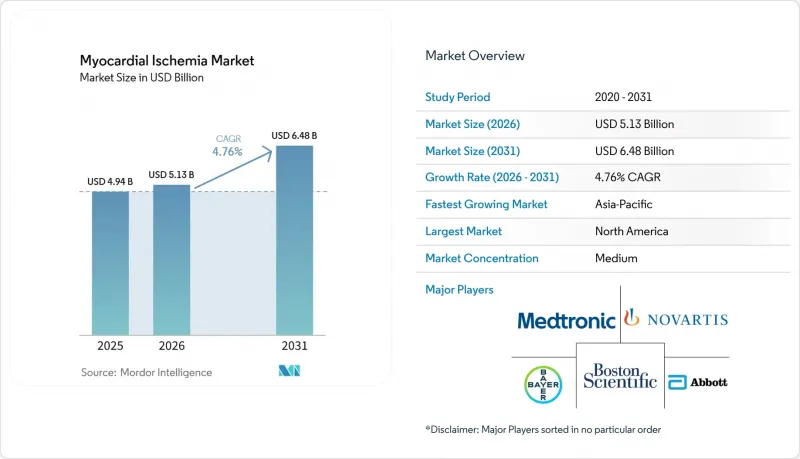
본 보고서는 유형별(증상성 심근허혈, 무증상성 심근허혈), 관리별(진단, 치료), 최종 사용자별(병원 및 진료소, 심장 전문 클리닉 등), 지역별(북미, 유럽, 아시아태평양, 중동 및 아프리카, 남미)로 분류되어 있습니다. 시장 전망은 금액(달러) 기준으로 제시되어 있습니다.
세계의 심근허혈 시장 동향 및 인사이트
전 세계적으로 증가하는 심혈관 질환의 부담
심근허혈 시장은 전 세계적으로 지속되는 허혈성 심장 질환의 부담에 의해 계속해서 뒷받침되고 있습니다. 『JACC』지에 게재된 2025년 모델링 연구에 따르면, 심혈관 질환으로 인한 총 사망자 수가 2025년 2,050만 명에서 2050년까지 3,560만 명으로 증가할 것으로 예측됩니다. 또한 『BMC Cardiovascular Disorders』 저널에 게재된 또 다른 2025년 연구에서도 허혈성 심장 질환이 전 세계적으로 장애 조정 생명년(DALY)의 주요 원인으로 계속 남아 있음을 확인했습니다. 이 때문에 심근허혈 시장은 시술 건수의 단기적인 변동이 아닌 구조적인 환자 수요에 의해 뒷받침되고 있습니다. 고령화, 체질량지수(BMI) 상승, 그리고 지속적인 심혈관 대사 위험으로 인해 선진국 및 개발도상국의 의료 시스템을 불문하고 치료 대상 환자층이 확대되고 있습니다. 이러한 수요가 심근허혈 시장 전체에서 영상 진단, 약물 요법 및 혈관 재건술의 꾸준한 이용을 뒷받침하고 있습니다.
조기 진단 및 선별 검사의 보급 확대
심근허혈 시장은 위험군 환자에 대한 조기 진단의 수용이 확산되고 있는 점도 뒷받침하고 있습니다. 2025년 ACC, AHA, ACEP, NAEMSP 및 SCAI 지침에서는 급성 관상동맥 증후군 관리에 있어 개별화된 위험 계층화 및 정밀 진단 검사의 중요성이 재확인되었습니다. 이러한 임상 지침에 따라 일상적인 진료 과정에서 심전도, 심초음파 검사, 부하 검사, 관상동맥 CT 및 기능적 영상 진단의 활용이 확대되고 있습니다. 이러한 전환의 경제적 타당성도 높아지고 있습니다. PRECISE 무작위 임상시험에서 안정형 흉통에 대한 정밀 진단 프로토콜을 적용했을 때, 일반 검사에 비해 45일 시점에서 환자 1인당 평균 진단 비용이 249달러 절감된 것으로 나타났기 때문입니다. 이로 인해 임상적 성과와 마찬가지로 비용 관리가 중시되는 가치 기반 의료 시스템에서 선별 검사의 확대를 정당화하기가 더 쉬워졌습니다. 또한, 중대한 사건이 발생하기 전에 더 많은 환자가 식별될 수 있게 됨에 따라, 심근허혈 시장의 진단 분야도 강화됩니다.
진단 및 중재 치료 프로토콜의 높은 비용
심근허혈 시장은 진단 및 중재 치료 측면에서 여전히 명백한 경제적 장벽에 직면해 있습니다. 보스턴 사이언티피크(Boston Scientific)의 2025년판 보험 환급 가이드에 따르면, 관상동맥 내 장치를 이용한 PCI에 대한 메디케어의 전국 평균 지급액은 합병증 유무에 따라 1만 2,911달러에서 3만 397달러 사이입니다. 자원이 부족한 지역에서는 카테터실이나 첨단 영상 진단에 대한 접근이 제한되어 있어, 특히 대도시권 외의 병원에서는 치료 지연의 추가 요인이 되고 있습니다. 그 결과, 수요 부족 때문은 아니지만 아시아태평양, 중동 및 아프리카, 남미의 일부 지역에서 심근허혈 시장의 확산이 지연되고 있습니다.
부문별 분석
2025년에는 증상성 심근허혈이 심근허혈 시장 점유율의 52.22%를 차지했으며, 이는 흉통, 부하 검사, 혈관조영술 및 표준 치료 경로를 통해 치료를 받은 환자 수가 매우 많음을 반영합니다. 반면, 무증상 부문은 2031년까지 연평균 성장률(CAGR) 5.24%를 나타낼 것으로 예측되며, 유형별로 볼 때 심근허혈 시장에서 가장 빠르게 성장하는 분야가 될 것입니다. 이러한 변화는 무증상 질환이 빈번하게 발생하는 당뇨병 및 만성 신장 질환과 같은 고위험군에 대한 선별 검사의 확대에 의해 주도되고 있습니다.
현재 웨어러블 모니터링은 심근허혈 시장에서 이러한 변화의 배후에 있는 주요 구조적 요인이 되고 있습니다. 지침은 여전히 보편적이기보다는 선택적인 성격을 띠고 있어, 가장 위험이 높은 그룹에 초점을 맞추고 광범위한 과잉 검사의 가능성을 줄이고 있습니다. 2024년 『Biomedicines』지에 게재된 총설에 따르면, 무증상 심근허혈은 특히 증상이 경미하거나 전혀 나타나지 않는 경우, 여전히 중요한 임상적 과제로 남아 있습니다. 이러한 균형에 따라 심근허혈 시장의 유형 구성은 광범위한 집단 선별 검사에서 보다 표적화된 검출로 계속 전환되고 있습니다.
지역별 분석
2025년, 북미는 심근허혈 시장의 47.35% 점유율을 차지하며 여전히 지역별 압도적인 1위를 유지했습니다. 이 지역은 성숙한 카테터실 인프라, 광범위한 보험 환급 체계, 그리고 첨단 영상 진단 플랫폼의 높은 보급률이라는 이점을 누리고 있습니다. 미국은 지침에 기반한 급성 관상동맥 증후군 치료로 인해 병원 및 중재 시술 프로그램 전반에 걸쳐 안정적인 진단 및 치료 건수가 확보되고 있어 여전히 핵심 수요 거점으로 자리 잡고 있습니다. 캐나다와 멕시코도 수요를 보완하고 있지만, 북미의 우위는 여전히 주로 미국 시스템의 규모와 보험 급여의 충실도에 의해 뒷받침되고 있습니다.
유럽은 심근허혈 시장에서 여전히 2위 지역 블록이며, 독일, 영국, 프랑스, 이탈리아, 스페인이 유럽 대륙 내 시술 및 약물 치료 수요의 대부분을 차지하고 있습니다. 독일은 디지털 헬스 관련 보험 환급 제도 덕분에 일상 진료에서 장기적인 심혈관 관리 도구의 도입 경로가 명확하다는 점에서 두드러집니다. 유럽 내 의료기기 및 의약품에 대한 접근성은 EMA(유럽의약품청)의 심사 절차나 심장용 의료기기를 대상으로 한 EU의 MDR(의료기기 규정) 체계 등 확립된 규제 시스템에 의해서도 형성되고 있습니다. 동유럽 국가들은 여전히 질병 부담이 높은 반면, 중재 시술 수행 능력은 서유럽에 미치지 못하기 때문에 심근허혈 시장에서 중기적인 성장 여지가 예상됩니다.
지역별로는 아시아태평양이 심근허혈 시장에서 가장 빠른 성장을 보일 것으로 예상되며, 2026년부터 2031년까지 연평균 성장률(CAGR) 7.13%를 나타낼 것으로 전망됩니다. 중국과 인도는 더 광범위한 환자층에서 심장 의료에 대한 접근성이 확대됨에 따라 해당 지역 시장 규모 확대를 주도하고 있습니다. 일본은 강력한 혁신 기반을 제공하고 있으며, 한국과 호주는 첨단 영상 진단 기술 및 중재적 치료의 도입에 기여하고 있습니다. 중동, 아프리카 및 남미는 전체 시장 규모는 여전히 작지만, 주요 도시 지역에서 심장 의료 체계가 확충되고 있어 심근허혈 시장은 성장을 지속하고 있습니다. 다만, 지방이나 자원이 부족한 지역에서는 카테터실 및 영상 진단에 대한 접근성이 제한적이기 때문에 시장 침투 속도는 여전히 둔화되고 있습니다.
기타 혜택 :
- 엑셀 형식 시장 예측(ME) 시트
- 3개월간의 애널리스트 지원
자주 묻는 질문
목차
제1장 서론
제2장 조사 방법
제3장 개요
제4장 시장 구도
제5장 시장 규모 및 성장 예측
제6장 경쟁 구도
제7장 시장 기회 및 향후 전망
KTH 26.09.02According to Mordor Intelligence, the myocardial ischemia market is projected to expand from USD 4.94 billion in 2025 and USD 5.13 billion in 2026 to USD 6.48 billion by 2031, registering a CAGR of 4.76% between 2026 and 2031.
This report is Segmented by Type (Symptomatic Myocardial Ischemia, Asymptomatic Myocardial Ischemia), Management (Diagnosis, Treatment), End-User (Hospitals and Clinics, Cardiac Specialty Clinics, and More), and Geography (North America, Europe, Asia-Pacific, Middle East and Africa, South America). The Market Forecasts are Provided in Terms of Value (USD).
Global Myocardial Ischemia Market Trends and Insights
Rising Global Burden of Cardiovascular Disease
The myocardial ischemia market continues to draw support from the persistent global burden of ischemic heart disease. A 2025 modeling study published in JACC projected that total cardiovascular disease deaths will rise from 20.5 million in 2025 to 35.6 million by 2050. A separate 2025 study in BMC Cardiovascular Disorders also confirmed that ischemic heart disease remains the leading cause of disability adjusted life years worldwide. This keeps the myocardial ischemia market tied to structural patient need rather than short-cycle fluctuations in procedure volumes. Aging populations, higher body mass index, and persistent cardiometabolic risk are widening the treatment pool across both developed and developing health systems. That demand supports steady use of imaging, medication, and revascularization across the myocardial ischemia market.
Expanding Early Diagnosis and Screening Adoption
The myocardial ischemia market is also being lifted by the wider acceptance of earlier diagnosis in at-risk patients. The 2025 ACC, AHA, ACEP, NAEMSP, and SCAI guideline reinforced individualized risk stratification and precision diagnostic testing in acute coronary syndrome management. That clinical direction supports higher use of ECG, echocardiography, stress testing, coronary CT, and functional imaging in routine care pathways. The economic case for this shift is also improving, as the PRECISE randomized trial showed that a precision diagnostic pathway for stable chest pain reduced mean diagnostic costs at 45 days by USD 249 per patient versus usual testing. This makes wider screening easier to defend in value-based care systems where cost control matters as much as clinical yield. It also strengthens the diagnostic side of the myocardial ischemia market because more patients are being identified before severe events occur.
High Cost of Diagnostic and Interventional Care Pathways
The myocardial ischemia market still faces a clear affordability barrier in diagnosis and intervention. Boston Scientific's 2025 reimbursement guide showed Medicare national average payments for PCI with an intraluminal device ranging from USD 12,911 to USD 30,397, depending on complication status. Limited access to cath labs and advanced imaging in lower resource settings adds another layer of delay, especially outside large urban hospitals. The result is not a lack of need, but slower penetration of the myocardial ischemia market across parts of Asia-Pacific, the Middle East, Africa, and South America.
Other drivers and restraints analyzed in the detailed report include:
- Shift Toward Minimally Invasive Revascularization and Precision Imaging
- Wearable Monitoring and Remote Cardiac Triage Adoption
- Adverse Events and Long-Term Medication Non-Adherence
For complete list of drivers and restraints, kindly check the Table Of Contents.
Segment Analysis
Symptomatic myocardial ischemia held 52.22% of the myocardial ischemia market share in 2025, reflecting the large volume of patients who entered care through chest pain, stress testing, angiography, and standard intervention pathways. The asymptomatic segment, however, is forecasted to grow at a 5.24% CAGR through 2031, which makes it the fastest-moving part of the myocardial ischemia market by type. The shift is being driven by wider screening in high-risk groups such as people with diabetes and chronic kidney disease, where silent disease is common.
Wearable monitoring is now the main structural force behind this change in the myocardial ischemia market. Guidance remains selective rather than universal, which keeps the focus on the highest risk groups and reduces the chance of broad overtesting. A 2024 review in Biomedicines showed that silent myocardial ischemia continues to pose a meaningful clinical challenge, especially when symptom presentation is weak or absent. That balance keeps the type mix of the myocardial ischemia market moving toward more targeted detection rather than broad population screening.
Complete Report Scope:
- By Type
- Symptomatic Myocardial Ischemia
- Asymptomatic Myocardial Ischemia
- By Management
- Diagnosis
- Electrocardiogram
- Echocardiography
- Stress Testing
- Coronary Angiography
- CT and MRI Imaging
- Treatment
- Medication Therapy
- Percutaneous Coronary Intervention
- Coronary Artery Bypass Grafting
- Lifestyle Management and Rehabilitation
- Diagnosis
- By End-User
- Hospitals and Clinics
- Cardiac Specialty Clinics
- Diagnostic Centers
- Ambulatory Surgical Centers
- Research and Academic Institutes
- By Geography
- North America
- United States
- Canada
- Mexico
- Europe
- Germany
- United Kingdom
- France
- Italy
- Spain
- Rest of Europe
- Asia-Pacific
- China
- Japan
- India
- Australia
- South Korea
- Rest of Asia-Pacific
- Middle East and Africa
- GCC
- South Africa
- Rest of Middle East and Africa
- South America
- Brazil
- Argentina
- Rest of South America
- North America
Geography Analysis
North America held 47.35% of the myocardial ischemia market share in 2025, which kept it as the clear regional leader. The region benefits from mature cath lab infrastructure, broad reimbursement support, and high adoption of advanced imaging platforms. The United States remains the core demand center because guideline-driven acute coronary syndrome care creates stable diagnostic and treatment volume across hospitals and interventional programs. Canada and Mexico add supplementary volume, but North America's lead still rests mainly on the scale and reimbursement depth of the U.S. system.
Europe remains the second largest regional block in the myocardial ischemia market, with Germany, the United Kingdom, France, Italy, and Spain supporting most of the continent's procedural and pharmacotherapy demand. Germany stands out because its digital health reimbursement pathway creates a clearer route for longer-term cardiovascular management tools in routine care. European device and drug access is also shaped by established regulatory systems, including EMA review processes and the EU MDR framework for cardiac devices. Eastern European countries offer a medium-term opening within the myocardial ischemia market because disease burden remains high while interventional capacity still trails Western Europe.
Asia-Pacific shows the fastest projected myocardial ischemia market expansion by region, at a projected 7.13% CAGR from 2026 to 2031. China and India are leading the regional volume build-out as access to cardiac care widens across larger patient pools. Japan adds a strong innovation base, while South Korea and Australia contribute advanced imaging and interventional adoption. Middle East and Africa, along with South America, remain smaller in total size, but the myocardial ischemia market is still growing there as cardiac capacity expands in major urban centers even though limited cath lab and imaging access continues to slow penetration in rural and lower resource settings.
- Abbott Laboratories
- Abbvie
- Amgen
- B. Braun
- Bayer
- Boehringer Ingelheim
- Boston Scientific
- Canon
- Daiichi Sankyo
- GE Healthcare
- Gilead Sciences
- Medtronic
- Merck
- Novartis
- Otsuka
- Pfizer
- Sanofi
- Siemens Healthineers
- Terumo
- Teva Pharmaceutical Industries
Additional Benefits:
- The market estimate (ME) sheet in Excel format
- 3 months of analyst support
TABLE OF CONTENTS
1 Introduction
- 1.1 Study Assumptions and Market Definition
- 1.2 Scope of the Study
2 Research Methodology
3 Executive Summary
4 Market Landscape
- 4.1 Market Overview
- 4.2 Market Drivers
- 4.2.1 Rising Global Burden of Cardiovascular Disease
- 4.2.2 Expanding Early Diagnosis and Screening Adoption
- 4.2.3 Shift Toward Minimally Invasive Revascularization and Precision Imaging
- 4.2.4 Wearable Monitoring and Remote Cardiac Triage Adoption
- 4.2.5 Underdiagnosis of Silent Ischemia in High-Risk Patients
- 4.3 Market Restraints
- 4.3.1 High Cost of Diagnostic and Interventional Care Pathways
- 4.3.2 Adverse Events and Long-Term Medication Non-Adherence
- 4.3.3 Limited Access to Cath Labs and Advanced Imaging in Low-Resource Settings
- 4.4 Supply/Value Chain Analysis
- 4.5 Regulatory Landscape
- 4.6 Technological Outlook
- 4.7 Porter's Five Forces Analysis
- 4.7.1 Threat of New Entrants
- 4.7.2 Bargaining Power of Suppliers
- 4.7.3 Bargaining Power of Buyers
- 4.7.4 Threat of Substitutes
- 4.7.5 Competitive Rivalry
5 Market Size & Growth Forecasts (Value, USD)
- 5.1 By Type
- 5.1.1 Symptomatic Myocardial Ischemia
- 5.1.2 Asymptomatic Myocardial Ischemia
- 5.2 By Management
- 5.2.1 Diagnosis
- 5.2.1.1 Electrocardiogram
- 5.2.1.2 Echocardiography
- 5.2.1.3 Stress Testing
- 5.2.1.4 Coronary Angiography
- 5.2.1.5 CT and MRI Imaging
- 5.2.2 Treatment
- 5.2.2.1 Medication Therapy
- 5.2.2.2 Percutaneous Coronary Intervention
- 5.2.2.3 Coronary Artery Bypass Grafting
- 5.2.2.4 Lifestyle Management and Rehabilitation
- 5.2.1 Diagnosis
- 5.3 By End-User
- 5.3.1 Hospitals and Clinics
- 5.3.2 Cardiac Specialty Clinics
- 5.3.3 Diagnostic Centers
- 5.3.4 Ambulatory Surgical Centers
- 5.3.5 Research and Academic Institutes
- 5.4 By Geography
- 5.4.1 North America
- 5.4.1.1 United States
- 5.4.1.2 Canada
- 5.4.1.3 Mexico
- 5.4.2 Europe
- 5.4.2.1 Germany
- 5.4.2.2 United Kingdom
- 5.4.2.3 France
- 5.4.2.4 Italy
- 5.4.2.5 Spain
- 5.4.2.6 Rest of Europe
- 5.4.3 Asia-Pacific
- 5.4.3.1 China
- 5.4.3.2 Japan
- 5.4.3.3 India
- 5.4.3.4 Australia
- 5.4.3.5 South Korea
- 5.4.3.6 Rest of Asia-Pacific
- 5.4.4 Middle East and Africa
- 5.4.4.1 GCC
- 5.4.4.2 South Africa
- 5.4.4.3 Rest of Middle East and Africa
- 5.4.5 South America
- 5.4.5.1 Brazil
- 5.4.5.2 Argentina
- 5.4.5.3 Rest of South America
- 5.4.1 North America
6 Competitive Landscape
- 6.1 Market Concentration
- 6.2 Market Share Analysis
- 6.3 Company Profiles (includes Global level Overview, Market level overview, Core Segments, Financials as available, Strategic Information, Market Rank/Share for key companies, Products & Services, Recent Developments)
- 6.3.1 Abbott Laboratories
- 6.3.2 AbbVie Inc.
- 6.3.3 Amgen Inc.
- 6.3.4 B. Braun Melsungen AG
- 6.3.5 Bayer AG
- 6.3.6 Boehringer Ingelheim International GmbH
- 6.3.7 Boston Scientific Corporation
- 6.3.8 Canon Medical Systems Corporation
- 6.3.9 Daiichi Sankyo Company, Limited
- 6.3.10 GE HealthCare
- 6.3.11 Gilead Sciences, Inc.
- 6.3.12 Medtronic plc
- 6.3.13 Merck and Co., Inc.
- 6.3.14 Novartis AG
- 6.3.15 Otsuka Holdings Co., Ltd.
- 6.3.16 Pfizer Inc.
- 6.3.17 Sanofi S.A.
- 6.3.18 Siemens Healthineers AG
- 6.3.19 Terumo Corporation
- 6.3.20 Teva Pharmaceutical Industries Ltd.
7 Market Opportunities & Future Outlook
- 7.1 White-space & Unmet-need Assessment


