|
시장보고서
상품코드
2119143
신생아 체온 조절 : 시장 점유율 분석, 업계 동향 및 통계, 성장 예측(2026-2031년)Neonatal Thermoregulation - Market Share Analysis, Industry Trends & Statistics, Growth Forecasts (2026 - 2031) |
||||||
 Mordor Intelligence
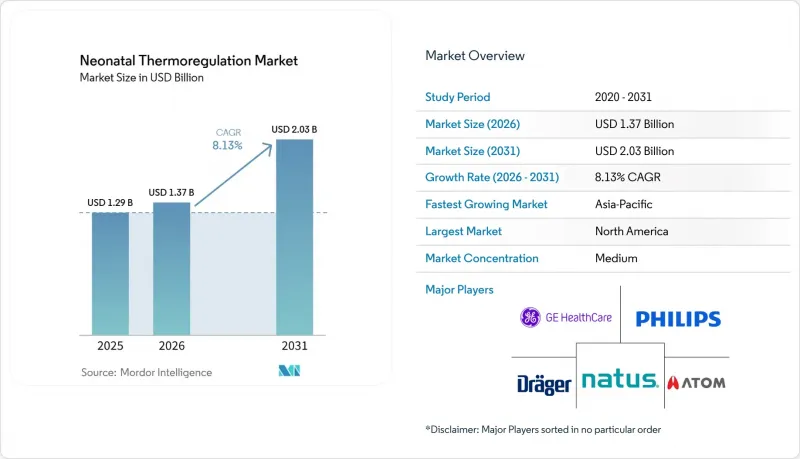
Mordor Intelligence에 의하면, 신생아 체온 조절 시장은 2025년 12억 9,000만 달러로 평가되었습니다. 2026년 13억 7,000만 달러에서 2031년까지 20억 3,000만 달러로 확대되며 2026년부터 2031년까지 연평균 성장률(CAGR)은 8.13%를 나타낼 전망입니다.
본 보고서는 제품 유형(인큐베이터, 복사식 가온기 등), 기술(서보 제어 시스템, 공기식 시스템 등), 용도(저체온증 관리 등), 최종 사용자(병원, 신생아 집중 치료실 등), 지역(북미, 유럽, 아시아태평양, 중동 및 아프리카, 남미)별로 분류되어 있습니다. 시장 예측은 금액(달러)으로 표시되어 있습니다.
세계의 신생아 체온 조절 시장 동향 및 인사이트
조산 및 저체중아 발생률 증가
조산은 신생아 체온 조절 시장에서 가장 뚜렷한 장기적 수요 기반 중 하나로 계속 남아 있습니다. 이는 치료 시작 후 첫 며칠 동안 체온의 안정성이 영아의 생존에 필수적이기 때문입니다. WHO 및 유니세프의 추산에 따르면, 연간 1,340만 건의 조산이 기록되고 있으며, 이는 전 세계 신생아 10명 중 1명꼴이 조산아임을 의미합니다. 2025년 메타분석에 따르면, 신생아 사망률은 전체 조산아의 경우 100명당 8명, 극조산아의 경우 100명당 40명으로 보고되었으며, 이러한 상황으로 인해 체온 관리 기기 조달 수요를 미루기 어려운 상황이 지속되고 있습니다. 이 문제의 지리적 부담은 남아시아와 사하라 이남 아프리카로 더욱 크게 이동하고 있습니다. 이 지역들에서는 첨단 체온 조절 시스템의 도입 기반이 여전히 미흡하여, 신생아 체온 조절 시장은 기존 고소득 국가를 기반으로 하던 범위를 넘어 더욱 확대될 여지가 있습니다.
서보 제어식 폐쇄 루프 체온 조절로의 전환
임상팀이 허약한 미숙아에 대해 보다 엄격한 체온 관리와 조작자에 의한 편차를 줄이기를 요구함에 따라, 신생아 체온 조절 시장은 서보 제어 시스템으로 전환되고 있습니다. 2024년 연구 결과에 따르면, 재태 주수 34-35주의 조산아에서 서보 제어식 체온 조절의 실현 가능성과 안전성이 입증되어, 적용 대상이 극소아에만 국한되지 않는다는 사실이 밝혀졌습니다. 이러한 변화는 상업적으로도 중요한데, 과거에는 저비용의 오픈 케어 시스템에 의존하던 병원들도 가이드라인과 조달 기준이 엄격해짐에 따라 시스템 업그레이드를 요구하는 압박이 커지고 있기 때문입니다. 또한, IEC 60601-2-19 및 IEC 60601-2-21과 관련된 2024년 개정으로 인해 제조업체에 대한 기술적 요건 및 인증 기준이 상향 조정되었으며, 이미 체계적인 규정 준수 체제를 구축한 벤더들이 유리한 입장에 서 있습니다. 따라서 신생아 체온 조절 시장은 단순한 하드웨어 경쟁에서 체온 관리, 문서화 지원, 병원 정보 시스템과의 연동이 가능한 플랫폼으로 전환되고 있습니다.
고성능 인큐베이터 및 가온기의 높은 초기 투자 비용
신생아 체온 조절 시장은 여전히 명확한 수량적 제약에 직면해 있습니다. 이는 의료 부담이 큰 국가의 공립 병원에 있어 첨단 폐쇄 루프형 인큐베이터가 고가이기 때문입니다. 남아시아와 사하라 이남 아프리카의 일부 지역에서는 정부의 입찰 상한액으로 인해 구매자가 저사양 시스템을 선택할 수밖에 없는 경우가 많으며, 그 결과 통합형 모니터링, 습도 제어, 경보 중복성을 갖춘 기기의 도입이 억제될 가능성이 있습니다. 이로 인해 신생아 체온 조절 시장 내 양극화가 발생하고 있으며, 고급 시스템은 도시 지역의 레벨 III NICU에 집중되어 있는 반면, 지방 병원에서는 여전히 더 단순한 기기에 의존하고 있습니다. 그 결과, 수요가 가장 빠르게 증가하는 계층은 대개 가격에 가장 민감하기 때문에 세계 벤더들은 이익률 압박을 받고 있습니다. 아시아 일부 지역에서는 리스나 종량제 모델이 등장하기 시작했지만, 그 도입 상황은 여전히 고르지 못하며, 신생아 체온 조절 시장 전체에서 이러한 가격 장벽을 제거할 만큼 널리 보급되지는 않았습니다.
부문별 분석
2025년에는 인큐베이터가 매출의 40.13%를 차지하며 신생아 체온 조절 시장에서 가장 큰 제품 카테고리로서의 지위를 유지했습니다. 이는 극저체중아 및 극조산아의 밀폐형 미세 환경 관리에서 인큐베이터가 여전히 중심적인 역할을 하고 있기 때문입니다. 또한, IEC 60601-2-19 및 IEC 60601-2-21과 관련된 2026년 시행 기한으로 인해, 이미 도입된 장비 중 일부가 규정 준수를 목적으로 한 업데이트를 진행 중이며, 이는 신생아 체온 조절 업계의 지속적인 구매를 촉진하고 있습니다. 복사식 가온기는 여전히 2위 제품 부문을 차지하고 있습니다. 이는 분만실이나 소생 현장에서 의료진이 처치를 중단하지 않고 체온 관리를 수행해야 하는 상황에서 개방형 사용이 여전히 중요하게 여겨지기 때문입니다.
체온 모니터링 장치는 2031년까지 연평균 성장률(CAGR) 8.24%를 나타낼 것으로 예측되며, 신생아 체온 조절 시장에서 가장 빠르게 성장하는 제품 카테고리가 되고 있습니다. 또한, 배터리나 기동성의 제약으로 인해 복사열의 이용이 현실적이지 않은 이송 상황에서도 가열 매트리스나 패드의 중요성이 높아지고 있습니다. 따라서 신생아 체온 조절 시장은 제품 수준에서 핵심적인 가온 기기에서 더 많은 케어 환경에서 모니터링의 가치를 확대할 수 있는 센서가 풍부하게 탑재된 플랫폼으로 그 범위가 넓어지고 있습니다.
2025년에는 서보 제어 시스템이 기술 부문 매출의 39.22%를 차지했으며, 중증도가 높은 신생아 중환자실(NICU)에서 더욱 엄격한 체온 조절이 기준으로 점점 더 중요시됨에 따라 신생아 체온 조절 시장 전체에서 1위를 유지했습니다. 또한, 2024년 규제 개정에 따라 폐쇄 루프 제어에 대한 성능 및 안전성 요건이 강화됨에 따라 이러한 시스템의 입지는 더욱 공고해졌습니다. 한편, 공기식 시스템은 단순한 설계로 인해 도입 비용을 낮게 유지할 수 있어, 치료의 긴급도가 낮고 예산에 제약이 있는 시설에서는 여전히 일반적입니다.
하이브리드 폐쇄 루프 시스템은 2031년까지 연평균 성장률(CAGR) 9.16%를 나타낼 것으로 예측되며, 신생아 체온 조절 시장에서 가장 빠른 성장세를 보이고 있습니다. 병원에서는 단일 피드백 아키텍처 하에서 복사, 대류, 전도 각 열원을 결합한 플랫폼의 채택이 점점 늘어나고 있습니다. 이는 수동 개입을 줄이고 체온 조절을 원활하게 하기 위함입니다. 따라서 신생아 체온 조절 시장은 기술적으로 병원이 별도의 워크플로우를 따를 필요 없이 일상적인 가온과 특수한 냉각 모두를 지원할 수 있는 통합 시스템으로 전환되고 있습니다.
지역별 분석
2025년, 북미는 신생아 체온 조절 시장 점유율의 46.36%를 차지하며 여전히 가장 규모가 큰 지역 기여자로서의 지위를 유지했습니다. 이는 미국이 밀집된 3차 NICU 네트워크를 보유하고, 더 강력한 보험 환급 지원이 있으며, 활발한 교체 주기가 있기 때문입니다. 캐나다는 주 정부 조달 시스템을 통해 판매량을 늘리고 있는 반면, 멕시코는 평균 판매 가격이 낮은 가운데 중규모 수요를 더 많이 뒷받침하고 있습니다. 유럽은 신생아 체온 조절 시장에서 여전히 중요한 지역입니다. 독일, 영국, 프랑스, 이탈리아, 스페인에 확립된 NICU 네트워크가 더 엄격한 증거 및 규정 준수 요건을 충족하는 장비를 지속적으로 구매하고 있기 때문입니다. 또한, IEC 개정에 관한 2026년 이행 기한도 일반적인 교체 주기를 넘어 유럽 일부 지역에서 규정 준수를 주도하는 업그레이드 주기를 만들어내고 있습니다.
아시아태평양은 2031년까지 연평균 성장률(CAGR) 10.24%를 나타낼 것으로 예측되며, 신생아 체온 조절 시장에서 가장 빠르게 확대되고 있는 지역이 될 것입니다. 주요 성장 요인은 인도의 신생아 중환자실(NICU) 확대, 중국의 각 성별 장비 갱신, 그리고 일본의 고사양 신생아용 시스템에 대한 활발한 수요입니다. 또한, 이 지역에서는 이미 도입된 장비의 대부분이 북미나 서유럽에서 볼 수 있는 높은 수준에 미치지 못하기 때문에 초기 조달 여지도 훨씬 더 크다고 할 수 있습니다. 일본에서는 특히 이송이나 전원(轉院)과 같은 이용 사례에서 제품이 워크플로우의 요구 사항에 밀접하게 부합할 경우, 도입이 얼마나 빠르게 진행되는지가 이미 입증되었습니다. 기타 아시아태평양의 신생아 체온 조절 시장도 베트남, 인도네시아, 태국 등 국가의 병원 투자를 통해 확대되고 있으며, 이들 국가에서는 예산 제약으로 인해 여전히 중급급 플랫폼이 주류를 이루고 있습니다.
중동 및 아프리카의 신생아 체온 조절 시장은 양극화된 양상을 보이고 있습니다. 걸프 국가들에서는 프리미엄급 신생아 집중 치료실(NICU) 인프라에 대한 투자가 진행되고 있는 반면, 사하라 이남 아프리카의 대부분 지역에서는 구매 비용 부담과 기부자에 의존하는 조달 체계로 인해 계속해서 제약을 받고 있기 때문입니다. 이로 인해 임상적 필요성이 여전히 높고, 조산으로 인한 부담이 크며, 조달 예산이 제한된 지역에서는 프리미엄 의료기기에 대한 수요 전환이 더딘 실정입니다. 남미에서는 브라질과 아르헨티나가 주도적인 역할을 하고 있으며, 브라질은 비용 경쟁력이 있는 지역 공급을 뒷받침하는 현지 생산의 혜택을 누리고 있습니다. 콜롬비아와 칠레를 포함한 기타 남미에서는 도시 지역 병원이 신생아 치료 체계에 대한 투자를 지속하고 있어, 규모는 작지만 기회는 확대되고 있습니다.
기타 혜택 :
- 엑셀 형식 시장 예측(ME) 시트
- 3개월간의 애널리스트 지원
자주 묻는 질문
목차
제1장 서론
제2장 조사 방법
제3장 개요
제4장 시장 구도
제5장 시장 규모 및 성장 예측
제6장 경쟁 구도
제7장 시장 기회 및 향후 전망
KTH 26.09.02According to Mordor Intelligence, the neonatal thermoregulation market is projected to expand from USD 1.29 billion in 2025 and USD 1.37 billion in 2026 to USD 2.03 billion by 2031, registering a CAGR of 8.13% between 2026 and 2031.
This report is Segmented by Product Type (Incubators, Radiant Warmers, and More), Technology (Servo-Controlled Systems, Air-Based Systems, and More), Application (Hypothermia Management, and More), End-User (Hospitals, Neonatal Intensive Care Units, and More), and Geography (North America, Europe, Asia-Pacific, Middle East and Africa, South America). The Market Forecasts are Provided in Value (USD).
Global Neonatal Thermoregulation Market Trends and Insights
Rising Preterm Births and Low Birth Weight Incidence
Preterm birth remains one of the clearest long-run demand anchors for the neonatal thermoregulation market because temperature stability is essential for infant survival in the first days of care. WHO and UNICEF estimates show that 13.4 million preterm births were recorded annually, which means close to 1 in 10 live births worldwide were premature. A 2025 meta-analysis reported neonatal mortality at 8 per 100 preterm births overall and 40 per 100 among extremely preterm infants, which keeps procurement demand for thermal care equipment difficult to defer. The geographic burden has shifted more heavily toward South Asia and Sub-Saharan Africa, where the installed base for advanced thermoregulation remains underserved and where the neonatal thermoregulation market still has room to widen beyond its traditional high-income base.
Shift Toward Servo-Controlled Closed-Loop Thermoregulation
The neonatal thermoregulation market is moving toward servo-controlled systems because clinical teams want tighter temperature control and less operator-dependent variability in fragile infants. Evidence from 2024 showed the feasibility and safety of servo-controlled thermoregulation in preterm infants at 34 to 35 weeks of gestational age, which broadens the clinical case beyond only the smallest infants. This shift matters commercially because hospitals that once relied on lower-cost open-care systems are now under more pressure to upgrade as guidelines and procurement standards become stricter. The 2024 amendments tied to IEC 60601-2-19 and IEC 60601-2-21 also raise the engineering and certification bar for manufacturers, which favors vendors that already operate within structured compliance systems. The neonatal thermoregulation market is therefore shifting from pure hardware competition toward platforms that can manage temperature, support documentation, and connect with hospital information systems.
High Capital Cost of Advanced Incubators and Warmers
The neonatal thermoregulation market still faces a clear volume constraint because advanced closed-loop incubators are expensive for public hospitals in high-burden countries. Government tender ceilings in parts of South Asia and Sub-Saharan Africa often push buyers toward lower-specification systems, which can reduce uptake of devices with integrated monitoring, humidity control, and alarm redundancy. This creates a split structure inside the neonatal thermoregulation market where premium systems are concentrated in level-III urban NICUs while district hospitals continue to depend on simpler devices. The result is margin pressure for global vendors because the fastest-growing demand pools often remain the most price sensitive. Leasing and pay-per-use models are starting to appear in parts of Asia, but adoption is still uneven and not yet broad enough to remove this pricing barrier across the neonatal thermoregulation market.
Other drivers and restraints analyzed in the detailed report include:
- NICU Capacity Expansion in High-Burden Health Systems
- Demand for Portable Warmers in Transport and Referral Networks
- Kangaroo Mother Care and Low-Tech Thermal Care Substitution for Stable Neonates
For complete list of drivers and restraints, kindly check the Table Of Contents.
Segment Analysis
Incubators held 40.13% of revenue in 2025, which kept them as the largest product category in the neonatal thermoregulation market because they remain central to enclosed microenvironment management for very low-birth-weight and extremely preterm infants. The 2026 implementation deadlines linked to IEC 60601-2-19 and IEC 60601-2-21 are also pushing parts of the installed base toward compliance-led replacement, which supports ongoing purchasing in the neonatal thermoregulation industry. Radiant warmers remained the second-largest product segment because open-access use in delivery rooms and resuscitation settings still matters where clinicians need thermal support without interrupting procedures.
Temperature monitoring devices are forecasted to grow at 8.24% CAGR through 2031, which makes them the fastest-growing product category in the neonatal thermoregulation market. Heated mattresses and pads are also gaining relevance in transport scenarios where radiant heat may be less practical under battery and mobility constraints. The neonatal thermoregulation market is therefore broadening at the product level from core warming hardware toward sensor-rich platforms that can extend monitoring value across more care environments.
Servo-controlled systems held 39.22% of technology-segment revenue in 2025, which kept them in the lead across the neonatal thermoregulation market because tighter thermal control is increasingly treated as a baseline standard in higher-acuity NICUs. The 2024 compliance amendments also reinforced the position of these systems by raising the performance and safety expectations attached to closed-loop control. Air-based systems still remain common in lower-acuity and budget-constrained facilities because their simpler design keeps acquisition costs lower.
Hybrid closed-loop systems are forecasted to grow at 9.16% CAGR through 2031, which gives them the fastest expansion path in the neonatal thermoregulation market. Hospitals are increasingly specifying platforms that combine radiant, convective, and conductive heat sources under a single feedback architecture because that reduces manual intervention and smooths thermal control. The neonatal thermoregulation market is therefore shifting technologically toward integrated systems that can support both routine warming and specialized cooling without forcing hospitals into separate workflows.
Complete Report Scope:
- By Product Type
- Incubators
- Radiant Warmers
- Heated Mattresses and Pads
- Temperature Monitoring Devices
- Thermal Blankets and Mattresses
- Infant Warmers
- Other Product Types
- By Technology
- Servo-Controlled Systems
- Air-Based Systems
- Water-Based Systems
- Hybrid Closed-Loop Systems
- By Application
- Hypothermia Management
- Normal Thermoregulation
- Hyperthermia Management
- Neonatal Intensive Care
- Postnatal Care
- By End-User
- Hospitals
- Neonatal Intensive Care Units
- Specialty Clinics
- Homecare Settings
- By Geography
- North America
- United States
- Canada
- Mexico
- Europe
- Germany
- United Kingdom
- France
- Italy
- Spain
- Rest of Europe
- Asia-Pacific
- China
- Japan
- India
- Australia
- South Korea
- Rest of Asia-Pacific
- Middle East and Africa
- GCC
- South Africa
- Rest of Middle East and Africa
- South America
- Brazil
- Argentina
- Rest of South America
- North America
Geography Analysis
North America accounted for 46.36% of the neonatal thermoregulation market share in 2025, which kept it as the largest regional contributor because the United States has a dense tertiary NICU network, stronger reimbursement support, and active replacement cycles. Canada adds volume through provincial purchasing systems, while Mexico supports more mid-tier demand at lower average selling prices. Europe remains an important region for the neonatal thermoregulation market because established NICU networks across Germany, the United Kingdom, France, Italy, and Spain continue to buy devices that can meet tighter evidence and compliance expectations. The 2026 implementation deadlines around IEC amendments are also creating a compliance-led upgrade cycle across parts of Europe beyond the normal replacement pattern.
Asia-Pacific is forecasted to grow at 10.24% CAGR through 2031, which makes it the fastest-expanding region in the neonatal thermoregulation market. The main support comes from NICU expansion in India, provincial upgrades in China, and strong demand in Japan for higher-specification neonatal systems. The region also has more room for first-time procurement because large parts of the installed base remain below the sophistication seen in North America and Western Europe. Japan has already shown how fast adoption can move when products match workflow needs closely, especially in transport and referral use cases. The neonatal thermoregulation market in the rest of Asia-Pacific is also being widened by hospital investment in countries such as Vietnam, Indonesia, and Thailand, where budget limits still favor mid-tier platforms.
The Middle East and Africa present a split picture in the neonatal thermoregulation market because Gulf countries are investing in premium NICU infrastructure while much of Sub-Saharan Africa remains constrained by affordability and donor-linked purchasing. This leaves a strong clinical need in place, but it slows conversion into premium device demand where preterm birth burdens are high, and procurement budgets are thin. South America is led by Brazil and Argentina, with Brazil benefiting from local manufacturing that supports a cost-competitive regional supply. The rest of South America, including Colombia and Chile, offers a smaller but improving opportunity as urban hospitals continue to invest in neonatal care capacity.
- Atom Medical
- Bistos Co., Ltd.
- Cobams S.r.l.
- Dragerwerk
- Fanem Ltda.
- Fisher & Paykel Healthcare
- GE Healthcare
- Ginevri Srl
- Inspiration Healthcare Group plc
- International Biomedical, Ltd.
- Koninklijke Philips
- Masimo
- Medicor Elektronika Zrt.
- Medtronic
- Natus Medical
- Neonatech Medical Devices Pvt. Ltd.
- Ningbo David Medical Device
- Phoenix Medical Systems
- Pluss Advanced Technologies Pvt. Ltd.
- Vyaire Medical
Additional Benefits:
- The market estimate (ME) sheet in Excel format
- 3 months of analyst support
TABLE OF CONTENTS
1 Introduction
- 1.1 Study Assumptions and Market Definition
- 1.2 Scope of the Study
2 Research Methodology
3 Executive Summary
4 Market Landscape
- 4.1 Market Overview
- 4.2 Market Drivers
- 4.2.1 Rising Preterm Births and Low Birth Weight Incidence
- 4.2.2 Shift Toward Servo-Controlled Closed-Loop Thermoregulation
- 4.2.3 NICU Capacity Expansion in High-Burden Health Systems
- 4.2.4 Infection Control and Thermal Stability Prioritization in Delivery Rooms
- 4.2.5 Demand for Portable Warmers in Transport and Referral Networks
- 4.2.6 Microprocessor Supply Risk Driving Platform Redesign and Local Sourcing
- 4.3 Market Restraints
- 4.3.1 High Capital Cost of Advanced Incubators and Warmers
- 4.3.2 Clinical Workflow Dependence on Skilled Biomedical Maintenance
- 4.3.3 Regulatory Approval and Recertification Burden
- 4.3.4 Kangaroo Mother Care and Low-Tech Thermal Care Substitution for Stable Neonates
- 4.4 Supply/Value Chain Analysis
- 4.5 Regulatory Landscape
- 4.6 Technological Outlook
- 4.7 Porter's Five Forces Analysis
- 4.7.1 Threat of New Entrants
- 4.7.2 Bargaining Power of Suppliers
- 4.7.3 Bargaining Power of Buyers
- 4.7.4 Threat of Substitutes
- 4.7.5 Competitive Rivalry
5 Market Size & Growth Forecasts (Value, USD)
- 5.1 By Product Type
- 5.1.1 Incubators
- 5.1.2 Radiant Warmers
- 5.1.3 Heated Mattresses and Pads
- 5.1.4 Temperature Monitoring Devices
- 5.1.5 Thermal Blankets and Mattresses
- 5.1.6 Infant Warmers
- 5.1.7 Other Product Types
- 5.2 By Technology
- 5.2.1 Servo-Controlled Systems
- 5.2.2 Air-Based Systems
- 5.2.3 Water-Based Systems
- 5.2.4 Hybrid Closed-Loop Systems
- 5.3 By Application
- 5.3.1 Hypothermia Management
- 5.3.2 Normal Thermoregulation
- 5.3.3 Hyperthermia Management
- 5.3.4 Neonatal Intensive Care
- 5.3.5 Postnatal Care
- 5.4 By End-User
- 5.4.1 Hospitals
- 5.4.2 Neonatal Intensive Care Units
- 5.4.3 Specialty Clinics
- 5.4.4 Homecare Settings
- 5.5 By Geography
- 5.5.1 North America
- 5.5.1.1 United States
- 5.5.1.2 Canada
- 5.5.1.3 Mexico
- 5.5.2 Europe
- 5.5.2.1 Germany
- 5.5.2.2 United Kingdom
- 5.5.2.3 France
- 5.5.2.4 Italy
- 5.5.2.5 Spain
- 5.5.2.6 Rest of Europe
- 5.5.3 Asia-Pacific
- 5.5.3.1 China
- 5.5.3.2 Japan
- 5.5.3.3 India
- 5.5.3.4 Australia
- 5.5.3.5 South Korea
- 5.5.3.6 Rest of Asia-Pacific
- 5.5.4 Middle East and Africa
- 5.5.4.1 GCC
- 5.5.4.2 South Africa
- 5.5.4.3 Rest of Middle East and Africa
- 5.5.5 South America
- 5.5.5.1 Brazil
- 5.5.5.2 Argentina
- 5.5.5.3 Rest of South America
- 5.5.1 North America
6 Competitive Landscape
- 6.1 Market Concentration
- 6.2 Market Share Analysis
- 6.3 Company Profiles (includes Global level Overview, Market level overview, Core Segments, Financials as available, Strategic Information, Market Rank/Share for key companies, Products & Services, Recent Developments)
- 6.3.1 Atom Medical Corporation
- 6.3.2 Bistos Co., Ltd.
- 6.3.3 Cobams S.r.l.
- 6.3.4 Dragerwerk AG & Co. KGaA
- 6.3.5 Fanem Ltda.
- 6.3.6 Fisher & Paykel Healthcare Ltd
- 6.3.7 GE HealthCare
- 6.3.8 Ginevri Srl
- 6.3.9 Inspiration Healthcare Group plc
- 6.3.10 International Biomedical, Ltd.
- 6.3.11 Koninklijke Philips N.V.
- 6.3.12 Masimo Corporation
- 6.3.13 Medicor Elektronika Zrt.
- 6.3.14 Medtronic plc
- 6.3.15 Natus Medical Incorporated
- 6.3.16 Neonatech Medical Devices Pvt. Ltd.
- 6.3.17 Ningbo David Medical Device Co., Ltd.
- 6.3.18 Phoenix Medical Systems Pvt Ltd
- 6.3.19 Pluss Advanced Technologies Pvt. Ltd.
- 6.3.20 Vyaire Medical, Inc.
7 Market Opportunities & Future Outlook
- 7.1 White-space & Unmet-need Assessment