

|
시장보고서
상품코드
2119155
유럽의 5G 코어 네트워크 : 시장 점유율 분석, 업계 동향 및 통계, 성장 예측(2026-2031년)Europe 5G Core Network - Market Share Analysis, Industry Trends & Statistics, Growth Forecasts (2026 - 2031) |
||||||
 Mordor Intelligence
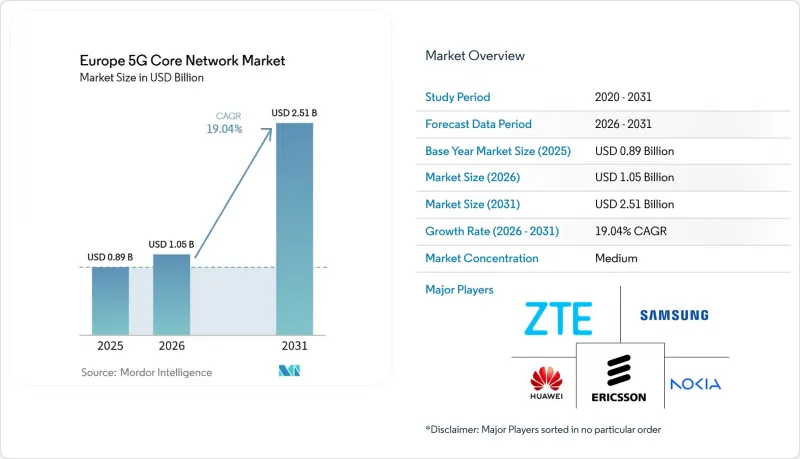
Mordor Intelligence에 의하면, 유럽의 5G 코어 네트워크 시장 규모는 2025년 8억 9,000만 달러로 평가되었습니다. 2026년 10억 5,000만 달러에서 2031년까지 25억 1,000만 달러로 확대되며 2026년부터 2031년까지 연평균 성장률(CAGR)은 19.04%를 나타낼 전망입니다.
본 보고서는 구성 요소(솔루션 및 서비스),구축 모델(On-Premise/전용, 퍼블릭 클라우드, 하이브리드 및 텔레콤 엣지 클라우드), 최종 사용자(통신 사업자 및 기업), 네트워크 기능(네트워크 노출 기능, 사용자 플레인 기능, 용도 기능, 통합 데이터 관리 등), 그리고 국가별로 분류되어 있습니다. 시장 전망은 금액(미화) 기준으로 제시되어 있습니다.
유럽의 5G 코어 네트워크 시장 동향 및 인사이트
유럽의 성숙한 네트워크에서 클라우드 네이티브 독립형 코어로의 전환
통신 사업자들이 신속한 커버리지 확장을 위해 구축된 비독립형 오버레이를 대체함에 따라, 클라우드 네이티브 독립형 코어로의 전환은 유럽의 5G 코어 네트워크 시장에서 가장 영향력 있는 구조적 촉진요인이 되고 있습니다. 독립형 아키텍처를 통해 통신 사업자는 서비스 구축, 정책 관리 및 네트워크 자동화를 보다 세밀하게 제어할 수 있게 됩니다. 도이치 텔레콤은 ‘Horizontal TelCo Cloud’ 프로그램의 일환으로 Mavenir사의 컨테이너화된 패킷 코어를 통해 독립형 트래픽을 전송했습니다. 테리아는 2025년 핀란드, 스웨덴, 노르웨이, 에스토니아, 리투아니아 전역에서 노키아의 클라우드 네이티브 5G 스탠드얼론 코어 네트워크 도입을 완료했습니다. 이러한 지역적 접근 방식을 통해 여러 국가 네트워크에 걸쳐 공통된 운영 도구를 활용할 수 있게 됩니다. 또한 코어 네트워크 전환에는 과금, 정책, 오케스트레이션 기능에 대한 병행 작업이 필요하기 때문에 유럽의 5G 코어 네트워크 시장에도 이점을 가져다줍니다.
기업 및 프라이빗 5G 이용 사례를 위한 네트워크 슬라이싱의 수익화
네트워크 슬라이싱은 기술적 시험 단계를 넘어 산업 및 기업 고객을 위한 상용 서비스로 전환되고 있습니다. 보더폰 독일은 2025년에 ‘Campus Flex Exclusive’ 및 ‘Campus Flex Starter’라는 요금제를 도입했습니다. 여기에는 미션 크리티컬 용도를 위한, 1개 지점당 월 2,000유로(2,310.14달러)의 전용 요금제가 포함되어 있습니다. 이 서비스는 자동화된 생산 및 자율주행차 제어와 같은 이용 사례에 대응합니다. 또한, 보다폰은 서비스 수준 보장이 포함된 서비스 모델을 영국으로도 확대했습니다. 도이체 텔레콤은 iOS 26을 통한 애플 페이스타임(FaceTime)과의 소비자 규모 통합을 포함한 상용 네트워크 슬라이스를 도입했습니다. 이러한 움직임은 유럽의 5G 코어 네트워크 시장이 기본적인 모바일 연결과는 다른 수익 모델을 어떻게 지원할 수 있는지를 보여줍니다.
독립형 코어로의 업그레이드에 수반되는 막대한 초기 설비 투자와 불확실한 투자 회수
자본 집약성은 유럽 전역에서 독립형 코어 구축의 당면한 제약 요인으로 계속 남아 있습니다. GSMA 유럽은 2026년 5월, 유럽의 이동통신 사업자들이 2035년까지 4,750억 유로(5,486억 6,000만 달러)의 모바일 네트워크 투자가 필요한 반면, 현재 시점에서는 2,700억 유로(3,118억 7,000만 달러)의 투자가 실현될 것으로 전망된다고 보고했습니다. 이 2,050억 유로(2,367억 9,000만 달러)의 자금 부족으로 인해, 코어 소프트웨어 전환, 하드웨어 업데이트 및 주파수 대역 갱신을 동시에 수행하기 위한 자금 조달 여지가 제한되고 있습니다. 유럽의 통신 사업자들은 2020년 이후 주파수 대역 확보에 300억 유로(346억 5,000만 달러) 이상을 지출해 왔습니다. 2024년 유럽의 연결 1건당 설비 투자액은 35유로(40.43달러)였으나, 세계 통신 업계 선도 기업들의 경우 70유로(80.85달러)였습니다.
부문별 분석
2025년에는 솔루션이 유럽의 5G 코어 네트워크 시장 점유율의 62.59%를 차지했습니다. 패킷 코어 소프트웨어, 네트워크 기능 가상화(NFV) 인프라, 그리고 오케스트레이션 및 관리 도구가 독립형 네트워크 프로그램의 주요 지출 부문을 형성하고 있습니다. 패킷 코어 소프트웨어에는 AMF, SMF, UPF, PCF 및 관련 5G 코어 기능 등이 포함됩니다. 통신 사업자들은 다년 라이선스 계약에 따라 이러한 기능을 가상화되거나 컨테이너화된 소프트웨어 번들로 구매하고 있습니다. 노키아, 에릭슨,마베니어 등이 이러한 기능을 제공하는 공급업체입니다. 네트워크 기능 가상화(NFV) 인프라에는 가상화된 기능을 호스팅하는 상용 서버 및 클라우드 플랫폼이 포함됩니다. 일부 대형 통신 사업자는 하이퍼스케일러와의 제휴를 활용하는 반면, 다른 사업자는 계속해서 자체 클라우드 스택을 운영하고 있습니다.
유럽의 5G 코어 네트워크 서비스 시장 규모에서 서비스 부문은 2031년까지 연평균 성장률(CAGR) 20.98%로 확대될 것으로 예측됩니다. 통합 및 도입 서비스는 전환 초기 단계에서 가장 높은 수요가 예상됩니다. 지원 및 유지보수 계약은 Vodafone Three의 현대화 프로젝트와 같은 대규모 프로그램의 경우 5-8년에 걸쳐 지속될 수 있습니다. 전담 클라우드 엔지니어링 팀을 보유하지 않은 통신 사업자들도 컨테이너화, 지속적인 통합(CI), 지속적인 배포(CD), 그리고 Open RAN 통합과 관련된 지원이 필요합니다. 표준 변경으로 인해 노출 API 및 정책 제어와 관련된 자문 서비스에 대한 수요가 증가할 가능성이 있습니다. 릴리스 18에서는 5G 시스템 내의 네트워크 노출 기능(NEF) API 및 정책 기능이 확장되었습니다. 이러한 요구 사항은 시스템 통합사업자와 클라우드 네이티브 전문가들에게 지속적인 업무 기회를 창출하고 있습니다.
2025년에는 On-Premise 및 전용 배포가 시장의 55.00%를 차지했습니다. 이 모델에서 통신 사업자는 지연에 민감한 제어 플레인 기능에 대한 물리적 제어권을 유지합니다. 기존의 전용 인프라는 합법적 감청 및 데이터 주권 요건도 지원할 가능성이 있기 때문에 이를 교체하는 데는 여전히 막대한 비용이 소요됩니다. 독일, 프랑스, 영국의 보안 및 주권 관련 규제는 통신 사업자가 관리하거나 국가가 통제하는 데이터 환경의 활용을 촉진하고 있습니다. 통신 사업자들은 또한 산업용 사설 네트워크 환경에서 하이브리드 모델이나 텔레콤 엣지 클라우드 모델도 채택하고 있습니다. BMW는 2025년 10월 헝가리 데브레첸 공장에서 iX3 생산을 시작했으며, 이때 Magyar Telekom이 운영하는 공공-민간 혼합형 5G 네트워크가 활용될 전망입니다. 이러한 전개로 인해 400헥타르 이상의 면적에 걸쳐 로봇, 자율주행차, 디지털 트윈이 상호 연결될 것으로 기대됩니다.
유럽의 5G 코어 네트워크 시장에서 퍼블릭 클라우드는 2026년부터 2031년에 걸쳐 연평균 성장률(CAGR) 23.87%로 확대될 것으로 예측됩니다. O2 텔레포니카는 2026년 3월 자사 데이터센터 내의 AWS Outposts에서 노키아의 기술을 활용하여 프로덕션 환경 규모의 5G 코어 기능을 구축할 전망입니다. 이를 통해 100만 명의 고객에게 서비스를 제공하게 되며, 유지보수 워크플로우에서는 Amazon Bedrock의 모델이 활용될 전망입니다. 퍼블릭 클라우드 인프라는 신규 기능 도입에 필요한 시간을 단축하고, 전용 하드웨어의 수명 주기에 대한 의존도를 줄일 수 있습니다. 하이브리드 구성을 통해 기밀성이 높은 기능을 통신 사업자의 관리 하에 두면서, 특정 워크로드를 엣지에 배치할 수 있습니다. ETSI 표준은 엣지에서 호스팅되는 사용자 플레인 기능과 엣지 용도 플랫폼 간의 상호 운용성을 위한 공통 기반을 제공합니다.
기타 혜택 :
- 엑셀 형식 시장 예측(ME) 시트
- 3개월간의 애널리스트 지원
자주 묻는 질문
목차
제1장 서론
제2장 조사 방법
제3장 개요
제4장 시장 구도
제5장 시장 규모 및 성장 예측
제6장 경쟁 구도
제7장 시장 기회 및 향후 전망
KTH 26.09.02According to Mordor Intelligence, the Europe 5G core network market size is projected to expand from USD 0.89 billion in 2025 and USD 1.05 billion in 2026 to USD 2.51 billion by 2031, registering a CAGR of 19.04% between 2026 to 2031.
This report is Segmented by Component (Solutions, and Services), Deployment Model (On-Premises/Dedicated, Public Cloud, and Hybrid and Telco Edge Cloud), End-User (Telecom Operators, and Enterprises), Network Function (Network Exposure Function, User Plane Function, Application Function, Unified Data Management, and More), and Country. The Market Forecasts are Provided in Terms of Value (USD).
Europe 5G Core Network Market Trends and Insights
Cloud-Native Standalone Core Migration in Mature European Networks
Cloud-native standalone core migration is the most influential structural driver in the Europe 5G core network market, as operators replace non-standalone overlays built for rapid coverage deployment. A standalone architecture gives operators greater control over service creation, policy management, and network automation. Deutsche Telekom moved standalone traffic through Mavenir's containerized packet core under its Horizontal TelCo Cloud program. Telia completed Nokia's cloud-native 5G standalone core deployment across Finland, Sweden, Norway, Estonia, and Lithuania in 2025. This regional approach supports common operating tools across several national networks. The Europe 5G core network market also benefits because core migration requires concurrent work on charging, policy, and orchestration functions.
Network Slicing Monetization for Enterprise and Private 5G Use Cases
Network slicing is moving from technical testing toward commercial offerings for industrial and enterprise customers. Vodafone Germany introduced the Campus Flex Exclusive and Campus Flex Starter tariffs in 2025, including an exclusive tier priced at EUR 2,000 (USD 2,310.14) per location per month for mission-critical applications. The offering supports use cases such as automated production and autonomous vehicle control. Vodafone also extended service models with service-level commitments to the United Kingdom. Deutsche Telekom implemented commercial network slices, including consumer-scale integration with Apple FaceTime through iOS 26. These actions show how the European 5G core network market can support revenue models distinct from basic mobile connectivity.
High Up-Front Capital Expenditure and Uncertain Payback for Standalone Core Upgrades
Capital intensity remains the immediate constraint on standalone core deployment across Europe. GSMA Europe reported in May 2026 that European mobile operators require EUR 475 billion (USD 548.66 billion) in mobile network investment by 2035, while EUR 270 billion (USD 311.87 billion) is currently expected to materialize. The EUR 205 billion (USD 236.79 billion) gap limits the ability to fund core software migration, hardware refreshes, and spectrum renewal simultaneously. European operators had spent more than EUR 30 billion (USD 34.65 billion) on spectrum since 2020. Capital expenditure per connection stood at EUR 35 (USD 40.43) in Europe in 2024, compared with EUR 70 (USD 80.85) in global connectivity leaders.
Other drivers and restraints analyzed in the detailed report include:
- Regulatory Push for Resilient, Secure, and Sovereign Telecom Infrastructure
- 5G Core Modernization Through Vendor Diversification and Open Architectures
- Integration Complexity With Legacy EPC and Multi-Vendor Environments
For complete list of drivers and restraints, kindly check the Table Of Contents.
Segment Analysis
Solutions are expected to account for 62.59% of the Europe 5G core network market share in 2025. Packet-core software, network functions virtualization infrastructure, and orchestration and management tools form the primary spending layer for standalone network programs. Packet-core software includes functions such as AMF, SMF, UPF, PCF, and related 5G core functions. Operators purchase these functions as virtualized or containerized software bundles under multiyear license agreements. Nokia, Ericsson, and Mavenir are among the suppliers providing these capabilities. Network functions virtualization infrastructure includes commercial off-the-shelf servers and cloud platforms that host virtualized functions. Some large operators use hyperscaler arrangements, while others continue to operate proprietary cloud stacks.
The services segment in the Europe 5G core network services market size is projected to expand at a CAGR of 20.98% through 2031. Integration and deployment services see the highest demand during the initial migration stage. Support and maintenance agreements can extend for 5-8 years in large programs, such as the VodafoneThree modernization. Operators without dedicated cloud engineering teams also require support for containerization, continuous integration, continuous delivery, and Open RAN integration. Standards changes can increase demand for advisory work on exposure APIs and policy control. Release 18 expanded the Network Exposure Function API and policy capabilities within the 5G system. These requirements create recurring work for system integrators and cloud-native specialists.
On-premises and dedicated deployments are expected to account for 55.00% of the market in 2025. Under this model, operators retain physical control over latency-sensitive control-plane functions. Existing dedicated infrastructure remains expensive to replace because it may also support lawful interception and data sovereignty requirements. Security and sovereignty rules in Germany, France, and the United Kingdom reinforce the use of operator-controlled or nationally governed data environments. Operators also use hybrid and telco-edge-cloud models in industrial private-network environments. BMW is expected to begin production of the iX3 at its Debrecen facility in Hungary in October 2025, using a hybrid public-private 5G network operated by Magyar Telekom. The deployment is expected to connect robots, autonomous vehicles, and digital twins across more than 400 hectares.
The public cloud is projected to expand at a CAGR of 23.87% from 2026 to 2031 in the Europe 5G core network market. O2 Telefonica is expected to deploy production-scale 5G core functions on AWS Outposts in its own data center in March 2026 using Nokia technology. The deployment is expected to serve 1 million customers and use Amazon Bedrock models in maintenance workflows. Public-cloud infrastructure can reduce the time required to introduce new functions and limit commitments to dedicated hardware cycles. Hybrid configurations can keep sensitive functions under operator control while placing selected workloads at the edge. ETSI standards provide a common basis for interoperability between edge-hosted user-plane functions and edge application platforms.
Complete Report Scope:
- By Component
- Solutions
- Packet-Core Software
- NFV Infrastructure
- Orchestration and Management
- Services
- Integration and Deployment
- Consulting and Advisory
- Support and Maintenance
- Solutions
- By Deployment Model
- On-Premise/Dedicated
- Public Cloud
- Hybrid and Telco Edge Cloud
- By End-User
- Telecom Operators
- Enterprises
- Manufacturing
- Energy and Utilities
- Transportation and Logistics
- Public Safety and Emergency
- Smart Cities and Municipalities
- By Network Function
- Network Exposure Function (NEF)
- User Plane Function (UPF)
- Application Function (AF)
- Unified Data Management (UDM)
- Session Management Function (SMF)
- Network Slice Selection Function (NSSF)
- Policy Control Function (PCF)
- Network Repository Function (NRF)
- Authentication Server Function (AUSF)
- Access and Mobility Management (AMF)
- By Country
- Germany
- United Kingdom
- France
- Spain
- Russia
- Rest of Europe
List of Companies Covered in this Report:
- Nokia Corporation
- Ericsson
- Huawei Technologies Co., Ltd.
- ZTE Corporation
- Samsung Electronics Co., Ltd.
- Cisco Systems, Inc.
- Mavenir Systems, Inc.
- Ciena Corporation
- Hewlett Packard Enterprise Company
- Oracle Corporation
- Amazon Web Services, Inc.
- Microsoft Corporation
- Google Cloud LLC
- Amdocs Limited
- Broadcom Inc.
- Dell Technologies Inc.
- Red Hat, Inc.
Additional Benefits:
- The market estimate (ME) sheet in Excel format
- 3 months of analyst support
TABLE OF CONTENTS
1 INTRODUCTION
- 1.1 Study Assumptions and Market Definition
- 1.2 Scope of the Study
2 RESEARCH METHODOLOGY
3 EXECUTIVE SUMMARY
4 MARKET LANDSCAPE
- 4.1 Market Overview
- 4.2 Market Drivers
- 4.2.1 Cloud-Native Standalone Core Migration in Mature European Networks
- 4.2.2 Network Slicing Monetization for Enterprise and Private 5G Use Cases
- 4.2.3 5G Core Modernization Linked to Vendor Diversification and Open Architectures
- 4.2.4 Growth in Edge-Enabled Low-Latency Services Across Industrial Hubs
- 4.2.5 Energy-Efficient Core Network Upgrades to Reduce Operating Costs
- 4.2.6 Regulatory Push for Resilient, Secure, and Sovereign Telecom Infrastructure
- 4.3 Market Restraints
- 4.3.1 High Up-Front Capex and Uncertain Payback for SA Core Upgrades
- 4.3.2 Integration Complexity With Legacy EPC and Multi-Vendor Environments
- 4.3.3 Shortage of Cloud-Native Core and Telco DevOps Skills
- 4.3.4 Security and Compliance Burden from Advanced Core Automation and Exposure APIs
- 4.4 Value Chain Analysis
- 4.5 Regulatory Landscape
- 4.6 Technological Outlook
- 4.7 PESTLE Analysis
- 4.8 Porter's Five Forces Analysis
- 4.8.1 Threat of New Entrants
- 4.8.2 Bargaining Power of Buyers
- 4.8.3 Bargaining Power of Suppliers
- 4.8.4 Threat of Substitutes
- 4.8.5 Competitive Rivalry
5 MARKET SIZE AND GROWTH FORECASTS (VALUE)
- 5.1 By Component
- 5.1.1 Solutions
- 5.1.1.1 Packet-Core Software
- 5.1.1.2 NFV Infrastructure
- 5.1.1.3 Orchestration and Management
- 5.1.2 Services
- 5.1.2.1 Integration and Deployment
- 5.1.2.2 Consulting and Advisory
- 5.1.2.3 Support and Maintenance
- 5.1.1 Solutions
- 5.2 By Deployment Model
- 5.2.1 On-Premise/Dedicated
- 5.2.2 Public Cloud
- 5.2.3 Hybrid and Telco Edge Cloud
- 5.3 By End-User
- 5.3.1 Telecom Operators
- 5.3.2 Enterprises
- 5.3.2.1 Manufacturing
- 5.3.2.2 Energy and Utilities
- 5.3.2.3 Transportation and Logistics
- 5.3.2.4 Public Safety and Emergency
- 5.3.2.5 Smart Cities and Municipalities
- 5.4 By Network Function
- 5.4.1 Network Exposure Function (NEF)
- 5.4.2 User Plane Function (UPF)
- 5.4.3 Application Function (AF)
- 5.4.4 Unified Data Management (UDM)
- 5.4.5 Session Management Function (SMF)
- 5.4.6 Network Slice Selection Function (NSSF)
- 5.4.7 Policy Control Function (PCF)
- 5.4.8 Network Repository Function (NRF)
- 5.4.9 Authentication Server Function (AUSF)
- 5.4.10 Access and Mobility Management (AMF)
- 5.5 By Country
- 5.5.1 Germany
- 5.5.2 United Kingdom
- 5.5.3 France
- 5.5.4 Spain
- 5.5.5 Russia
- 5.5.6 Rest of Europe
6 COMPETITIVE LANDSCAPE
- 6.1 Market Concentration
- 6.2 Strategic Moves
- 6.3 Market Share Analysis
- 6.4 Company Profiles (includes Global Level Overview, Market Level Overview, Core Segments, Financials as available, Strategic Information, Market Rank/Share, Products and Services, Recent Developments)
- 6.4.1 Nokia Corporation
- 6.4.2 Ericsson
- 6.4.3 Huawei Technologies Co., Ltd.
- 6.4.4 ZTE Corporation
- 6.4.5 Samsung Electronics Co., Ltd.
- 6.4.6 Cisco Systems, Inc.
- 6.4.7 Mavenir Systems, Inc.
- 6.4.8 Ciena Corporation
- 6.4.9 Hewlett Packard Enterprise Company
- 6.4.10 Oracle Corporation
- 6.4.11 Amazon Web Services, Inc.
- 6.4.12 Microsoft Corporation
- 6.4.13 Google Cloud LLC
- 6.4.14 Amdocs Limited
- 6.4.15 Broadcom Inc.
- 6.4.16 Dell Technologies Inc.
- 6.4.17 Red Hat, Inc.
7 MARKET OPPORTUNITIES AND FUTURE OUTLOOK
- 7.1 White-Space and Unmet-Need Assessment


