

|
시장보고서
상품코드
2119162
첨단 고강도강(AHSS) : 시장 점유율 분석, 업계 동향 및 통계, 성장 예측(2026-2031년)Advanced High Strength Steel - Market Share Analysis, Industry Trends & Statistics, Growth Forecasts (2026 - 2031) |
||||||
 Mordor Intelligence
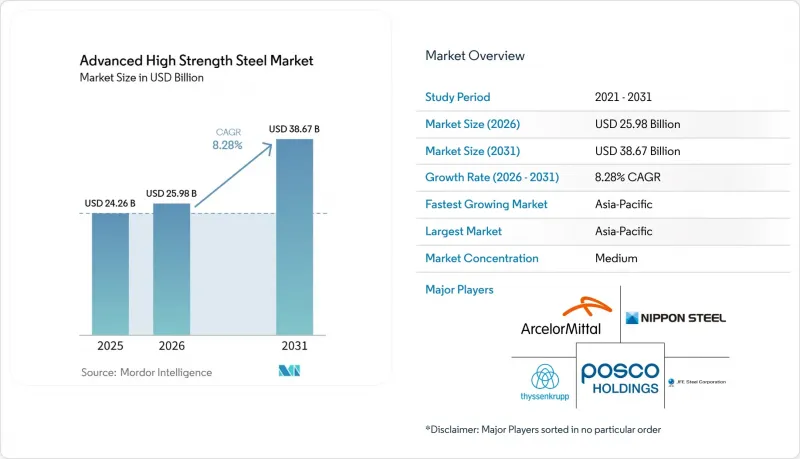
Mordor Intelligence에 의하면, 첨단 고강도강(AHSS) 시장 규모는 2025년에 242억 6,000만 달러로 평가되었습니다. 예측 기간(2026-2031년) CAGR 8.28%로 확대되어 2026년 259억 8,000만 달러에서 2031년에는 386억 7,000만 달러에 이를 전망입니다.
본 보고서는 등급(듀얼 페이즈(DP) 강, 마르텐사이트계 강 등), 인장 강도(400-600 MPa, 600-800 MPa 등), 용도(자동차, 건설 등),및 지역(아시아태평양, 북미, 유럽, 남미, 중동 및 아프리카)별로 분류되어 있습니다. 시장 전망은 금액(미 달러) 기준으로 제시되어 있습니다.
세계의 첨단 고강도강(AHSS) 시장 동향 및 인사이트
연비 및 주행 거리 향상을 위한 경량 차량에 대한 수요 증가
전기차 플랫폼에는 무게가 큰 배터리 팩이 탑재되게 되었기 때문에 차량 경량화는 설계상의 핵심 요건이 되었습니다. 차체 구조의 무게를 줄임으로써 배터리 셀을 추가하지 않고도 주행 거리를 연장할 수 있습니다. 미국 에너지부에 따르면, 첨단 고강도강(AHSS)은 기존 강재에 비해 차량의 구조 중량을 15-25% 줄일 수 있다고 합니다. 또한, 미국 자동차 보유 대수의 4분의 1에 경량 부품을 채택함으로써 2030년까지 연간 50억 갤런 이상의 연료를 절약할 수 있다고 밝혔습니다. 3세대 강종은 쉐보레 블레이저 EV와 토요타 bZ4X의 B필러 및 도어 링에 양산 적용되어, 더 얇은 판 두께임에도 불구하고 충돌 안전 기준 달성에 기여하고 있습니다. 대형 차량 섀시에 대한 조사 결과, 프레스 경화재를 사용하면 냉간 프레스 성형된 첨단 고장력강에 비해 섀시 무게를 최대 34% 줄일 수 있을 뿐만 아니라, 지구 온난화 지수를 21-32% 낮출 수 있는 것으로 밝혀졌습니다.
엄격해지는 차량 안전성, 연비, 배기가스 규제
안전 규제가 강화됨에 따라 측면 충돌, 루프 충돌 및 대향측 보호 영역에서 더 높은 강도의 강재에 대한 수요가 증가하고 있습니다. Euro NCAP의 2026년 프로토콜 개정에서는 평가가 4단계의 안전 등급에 따라 체계화되며, 2028년 이후부터 5성급 평가 요건이 상향 조정됩니다. 향후 프로토콜에서는 5성급 평가를 획득하기 위해 각 단계에서 최소 80%를 달성해야 합니다. 이로 인해 충돌 보호 성능을 정해진 차량 중량 범위 내에 맞추어야 하는 경우, 초고장력 열간 프레스 강재의 사용이 촉진될 것입니다. 또한, 유엔 유럽 경제 위원회(UNECE)의 규정 R94 및 R95 역시 정면 충돌 및 측면 충돌에 대한 탑승자 보호 요건을 강화하고 있습니다. 유럽 자동차 차량군의 CO₂ 배출량 목표와 미국 기업의 평균 연비 기준(CAFE) 체계로 인해 차량 중량 감축에 대한 압박이 커지고 있는 만큼, 첨단 고장력 강재 시장은 안전성과 배기가스 감축이라는 두 가지 목표 모두에 기여하고 있습니다.
첨단 고장력강 가공에 수반되는 높은 제조 및 금형 비용
980 MPa를 초과하는 등급의 가공에는 전용 금형과 성형 조건의 치밀한 관리가 필요합니다. 핫 스탬핑 라인에서는 성형 전에 블랭크를 900°C까지 가열하기 때문에 설비 및 가동 요건이 까다로워집니다. 또한, 금형의 경우 스프링백을 보정하기 위해 고경도 금형용 강재와 정밀한 형상이 요구됩니다. 2025년에 실시된 DP450-DP1000 강재에 관한 조사에 따르면, 고강도 등급에서 스프링백을 해결하려면 치수 정밀도를 확보하기 위해 금형 형상을 10° 미만으로 최적화해야 하는 것으로 밝혀졌습니다. 금형의 반복적인 수정은 대규모 프로젝트의 비용을 증가시키고, 소규모 프레스 가공 업체 시장 진입을 어렵게 만듭니다. 이러한 상황으로 인해 인증 공급업체로 조달처가 집중되어, 가격에 민감한 분야의 첨단 고장력강 시장 보급이 지연될 가능성이 있습니다.
부문별 분석
2025년 기준, 듀얼 페이즈 강은 첨단 고장력 강 시장의 25.18%를 차지하며 가장 큰 등급 카테고리가 되었습니다. 이 강종의 광범위한 사용은 화이트 바디의 외판, 플로어 크로스 멤버, 도어 침입 빔에의 적용을 반영합니다. TRIP 강은 프론트 레일 및 범퍼 시스템의 충돌 에너지 흡수를 지원하며, 한편 마르텐사이트계 및 복합상 강종은 시트 트랙이나 실 보강재와 같은 고응력 부품에 사용됩니다. HSLA 강은 최대 중량 감축보다 MPa당 비용이 중시되는 상황에서 여전히 중요한 역할을 하고 있습니다. TWIP 강은 특정 침입 방지 용도에 적합하지만, 용접 적합성의 제약으로 인해 더 광범위한 도입에는 한계가 있습니다.
프레스 경화강은 2031년까지 연평균 성장률(CAGR) 9.35%를 나타낼 것으로 예측되며, 이는 첨단 고장력강 시장의 각 등급 중 가장 높은 성장률입니다. 이 강재를 통해 제조업체는 900°C에서 복잡한 형상을 성형하고, 대규모 생산에서 최대 2,000 MPa의 완제품 강도를 실현할 수 있게 됩니다. 2025년까지 전기차(EV) 플랫폼은 화이트 바디 중량의 최대 38%를 차지하게 되었습니다. 일본제철이 마쓰다에 공급하는 2.0 GPa의 높은 굽힘 강도 등급은 이 소재가 국부적인 충돌 부재에서 더 대규모의 구조 설계로 전환되고 있음을 보여줍니다. 이러한 동향으로 인해 생산자들은 생산량뿐만 아니라 강종의 성능을 통해 차별화를 꾀할 필요성이 높아지고 있습니다.
지역별 분석
아시아태평양은 2025년에 지역별 매출의 49.37%를 차지했으며, 2031년까지 연평균 성장률(CAGR) 9.32%로 성장할 것으로 전망됩니다. 중국은 철강 생산 능력, 자동차 제조 거점 및 전기차 생산을 통해 이러한 위상을 뒷받침하고 있습니다. 2026년 3월에 공표되어 2026년 10월에 시행될 GB/T 3273-2026은 자동차 프레임용 열간 압연 강판 및 스트립의 요건을 개정하는 것입니다. 일본과 한국은 계속해서 고부가가치의 자동차용 등급을 공급하고 있습니다. JFE 스틸은 2026년 2월, 자사의 고성형성 AHSS 시리즈 ‘JEFORMA’로 제72회 오코우치 기념 기술상을 수상했습니다.
유럽 및 북미에서는 안전 규제, 차량 배기가스 기준, 그리고 저탄소 조달 요건이 시장을 더욱 직접적으로 좌우하고 있습니다. Euro NCAP의 2026년 프로토콜 개정에 따라 차량 충돌 보호 구역에서 고장력강의 중요성이 더욱 커지고 있습니다. BMW 그룹은 2030년까지 유럽 공장의 철강 수요 중 40% 이상을 저탄소 공급업체로부터 조달하는 것을 목표로 하고 있습니다. SSAB와 볼보 카스는 2025년 6월 ‘SSAB Zero’ 강재의 양산에 관한 합의를 체결했습니다. 이러한 노력을 통해 차량용 자재 조달에 있어 저탄소 공급이 더욱 직접적인 고려 사항이 되고 있습니다.
남미, 중동 및 아프리카는 수요 상황이 각기 다른 소규모의 선진 고장력강 시장입니다. 브라질은 자동차 조립 거점 및 인프라 구축 활동을 통해 남미 지역 수요를 주도하고 있습니다. 사우디아라비아의 ‘비전 2030’ 프로그램은 건축용 프레임, 산업 단지, 에너지 관련 자산 및 신규 주택 개발 분야에서 고장력강 수요를 뒷받침하고 있습니다. 고급 등급 강재에 대한 수입 의존도와 국내 핫 스탬핑 생산 능력 부족이 여전히 지역 전체의 보급을 제약하고 있습니다.
기타 혜택 :
- 엑셀 형식 시장 예측(ME) 시트
- 3개월간의 애널리스트 지원
자주 묻는 질문
목차
제1장 서론
제2장 조사 방법
제3장 개요
제4장 시장 구도
제5장 시장 규모 및 성장 예측
제6장 경쟁 구도
제7장 시장 기회 및 향후 전망
KTH 26.09.02According to Mordor Intelligence, the advanced high strength steel market size was estimated at USD 24.26 billion in 2025 and is estimated to grow from USD 25.98 billion in 2026 to USD 38.67 billion by 2031, at a CAGR of 8.28% during the forecast period (2026-2031).
This report is Segmented by Grade (Dual Phase (DP) Steel, Martensitic Steel, and More), Tensile Strength (400-600 MPa, 600-800 MPa, and More), Application (Automotive, Construction, and More), and Geography (Asia-Pacific, North America, Europe, South America, and Middle-East and Africa). The Market Forecasts are Provided in Terms of Value (USD).
Global Advanced High Strength Steel Market Trends and Insights
Increasing Demand for Lightweight Vehicles to Improve Fuel Efficiency and Driving Range
Vehicle lightweighting has become a core design requirement as electric vehicle platforms carry heavier battery packs. Removing weight from the body structure can extend driving range without requiring additional battery cells. The Department of Energy states that advanced high-strength steel can reduce a vehicle's structural weight by 15-25% compared with conventional steel. It also states that lightweight components used in one-quarter of the US vehicle fleet could save more than 5 billion gallons of fuel each year by 2030. Third-generation grades are in serial production for B-pillars and door rings in the Chevrolet Blazer EV and Toyota bZ4X, helping meet crash targets with thinner gauges. Research on heavy-duty vehicle chassis found that press-hardened material can reduce chassis weight by up to 34% compared with cold-stamped advanced high-strength steel, while reducing global warming potential by 21-32%.
Stringent Vehicle Safety, Fuel Economy, and Emission Regulations
Safety regulations are increasing the need for stronger steel in side-impact, roof-crush, and far-side protection areas. Euro NCAP's 2026 protocol revision organizes assessment around four safety stages and raises the requirements for a 5-star rating from 2028. A vehicle must achieve at least 80% in each stage for that rating under the future protocol. This supports the use of ultra-high-strength, hot-stamped steel when crash protection needs to fit within a defined vehicle weight. United Nations Economic Commission for Europe (UNECE) Regulations R94 and R95 also reinforce occupant protection requirements for frontal and side impacts. European fleet CO2 targets and the US Corporate Average Fuel Economy (CAFE) framework add pressure to reduce vehicle mass, so the advanced high-strength steel market serves both safety and emissions objectives.
High Manufacturing and Tooling Costs for Advanced High Strength Steel Processing
Processing grades above 980 MPa requires specialized tooling and careful control of forming conditions. Hot-stamping lines heat blanks to 900°C before forming, which raises equipment and operating requirements. Tooling also requires hard-die steels and precise geometries to compensate for springback. A 2025 study on DP450 to DP1000 steels found that springback in higher-strength grades can require mold geometry optimized to below 10° for dimensional accuracy. Repeated die revisions add cost to large-scale programs and make entry harder for smaller press shops. These conditions can concentrate sourcing among qualified suppliers and slow adoption in price-sensitive segments of the advanced high-strength steel market.
Other drivers and restraints analyzed in the detailed report include:
- Expanding Adoption of Press Hardened Steel in Automotive Body Structures
- Scope 3 and Low-Carbon Steel Procurement Pressure
- Technical Processing and Recycled Feedstock Constraints
For complete list of drivers and restraints, kindly check the Table Of Contents.
Segment Analysis
Dual-phase steel held 25.18% of the advanced high-strength steel market share in 2025, making it the largest grade category. Its broad use reflects deployment in body-in-white outer panels, floor cross-members, and door intrusion beams. TRIP steel supports crash-energy absorption in front rails and bumper systems, while Martensitic and Complex Phase grades serve high-stress parts such as seat tracks and sill reinforcements. HSLA steel remains relevant where cost per MPa is more important than maximum weight reduction. TWIP steel is suitable for selected anti-intrusion applications, but its welding compatibility limits wider deployment.
Press Hardened Steel is forecast to grow at a 9.35% CAGR through 2031, the highest rate among grades in the advanced high-strength steel market. It allows manufacturers to form complex geometries at 900°C and achieve finished component strength of up to 2,000 MPa at scale. Electric vehicle platforms reached up to 38% of body-in-white weight by 2025. Nippon Steel's 2.0 GPa high-bending grade for Mazda demonstrates how the material is moving from localized crash parts into larger structural designs. These developments increase the need for producers to differentiate through grade performance rather than solely on output.
Complete Report Scope:
- By Grade
- Dual Phase (DP) Steel
- Transformation-Induced Plasticity (TRIP) Steel
- Twinning-Induced Plasticity (TWIP) Steel
- Martensitic Steel
- High-Strength Low-Alloy (HSLA) Steel
- Complex Phase (CP) Steel
- Press Hardened Steel (PHS)
- By Tensile Strength
- 400-600 MPa
- 600-800 MPa
- 800-1000 MPa
- 1000-1200 MPa
- Over 1200 MPa
- By Application
- Automotive
- Construction
- Energy
- Heavy Equipment and Transportation
- Aerospace and Defense
- By Geography
- Asia-Pacific
- China
- India
- Japan
- South Korea
- Rest of Asia-Pacific
- North America
- United States
- Canada
- Mexico
- Europe
- Germany
- United Kingdom
- France
- Italy
- Russia
- Rest of Europe
- South America
- Brazil
- Argentina
- Rest of South America
- Middle-East and Africa
- Saudi Arabia
- South Africa
- Rest of Middle-East and Africa
- Asia-Pacific
Geography Analysis
Asia-Pacific accounted for 49.37% of regional revenue in 2025 and is forecast to grow at a 9.32% CAGR through 2031. China supports this position through its steel capacity, automotive manufacturing base, and electric vehicle production. GB/T 3273-2026, published in March 2026 and effective in October 2026, updates requirements for hot-rolled steel sheet and strip for automobile frames. Japan and South Korea continue to supply high-value automotive grades. JFE Steel won the 72nd Okochi Memorial Technical Prize in February 2026 for its JEFORMA high-formability AHSS series.
Europe and North America are shaped more directly by safety regulations, fleet emissions standards, and low-carbon procurement requirements. Euro NCAP's 2026 protocol revision increases the relevance of high-strength steel in vehicle crash-protection zones. The BMW Group aims to source more than 40% of its European plant steel demand from low-carbon suppliers by 2030. SSAB and Volvo Cars established a serial-production agreement for SSAB Zero steel in June 2025. These commitments make low-carbon supply a more direct consideration in vehicle material procurement.
South America, the Middle-East, and Africa represent smaller advanced high-strength steel markets with varying demand conditions. Brazil leads South American demand through its vehicle assembly base and infrastructure activity. Saudi Arabia's Vision 2030 program supports demand for high-strength steel in building frames, industrial zones, energy assets, and new residential development. Reliance on imports for premium grades and limited domestic hot-stamping capacity continue to constrain broader regional adoption.
- Acerinox S.A.
- ARCELORMITTAL
- China Baowu Steel Group Corperation Limited
- China Steel Corporation (CSC)
- Cleveland-Cliffs Inc.
- Hyundai Steel Co., Ltd.
- JFE Steel Corporation
- JSW Steel Limited
- NIPPON STEEL CORPORATION
- Nucor Corporation
- Outokumpu Oyj
- POSCO HOLDINGS
- SSAB AB
- Tata Steel Limited
- thyssenkrupp AG
- United States Steel Corporation
- voestalpine AG
Additional Benefits:
- The market estimate (ME) sheet in Excel format
- 3 months of analyst support
TABLE OF CONTENTS
1 Introduction
- 1.1 Study Assumptions and Market Definition
- 1.2 Scope of the Study
2 Research Methodology
3 Executive Summary
4 Market Landscape
- 4.1 Market Overview
- 4.2 Market Drivers
- 4.2.1 Increasing Demand for Lightweight Vehicles to Improve Fuel Efficiency and Driving Range
- 4.2.2 Stringent Vehicle Safety, Fuel Economy, and Emission Regulations
- 4.2.3 Increasing Demand for Low-Carbon and Sustainable Steel Solutions
- 4.2.4 Expanding Adoption of Press Hardened Steel in Automotive Body Structures and Safety Components
- 4.2.5 Scope 3 and Low-Carbon Steel Procurement Pressure
- 4.3 Market Restraints
- 4.3.1 High Manufacturing and Tooling Costs for Advanced High Strength Steel Processing
- 4.3.2 Technical Challenges Related to Formability, Springback, Welding, and Repairability
- 4.3.3 Limited Availability and Quality Consistency of High-Grade Recycled Steel Feedstock
- 4.4 Value Chain Analysis
- 4.5 Porter's Five Forces Analysis
- 4.5.1 Threat of New Entrants
- 4.5.2 Bargaining Power of Suppliers
- 4.5.3 Bargaining Power of Buyers
- 4.5.4 Threat of Substitutes
- 4.5.5 Competitive Rivalry
5 Market Size and Growth Forecasts (Value)
- 5.1 By Grade
- 5.1.1 Dual Phase (DP) Steel
- 5.1.2 Transformation-Induced Plasticity (TRIP) Steel
- 5.1.3 Twinning-Induced Plasticity (TWIP) Steel
- 5.1.4 Martensitic Steel
- 5.1.5 High-Strength Low-Alloy (HSLA) Steel
- 5.1.6 Complex Phase (CP) Steel
- 5.1.7 Press Hardened Steel (PHS)
- 5.2 By Tensile Strength
- 5.2.1 400-600 MPa
- 5.2.2 600-800 MPa
- 5.2.3 800-1000 MPa
- 5.2.4 1000-1200 MPa
- 5.2.5 Over 1200 MPa
- 5.3 By Application
- 5.3.1 Automotive
- 5.3.2 Construction
- 5.3.3 Energy
- 5.3.4 Heavy Equipment and Transportation
- 5.3.5 Aerospace and Defense
- 5.4 By Geography
- 5.4.1 Asia-Pacific
- 5.4.1.1 China
- 5.4.1.2 India
- 5.4.1.3 Japan
- 5.4.1.4 South Korea
- 5.4.1.5 Rest of Asia-Pacific
- 5.4.2 North America
- 5.4.2.1 United States
- 5.4.2.2 Canada
- 5.4.2.3 Mexico
- 5.4.3 Europe
- 5.4.3.1 Germany
- 5.4.3.2 United Kingdom
- 5.4.3.3 France
- 5.4.3.4 Italy
- 5.4.3.5 Russia
- 5.4.3.6 Rest of Europe
- 5.4.4 South America
- 5.4.4.1 Brazil
- 5.4.4.2 Argentina
- 5.4.4.3 Rest of South America
- 5.4.5 Middle-East and Africa
- 5.4.5.1 Saudi Arabia
- 5.4.5.2 South Africa
- 5.4.5.3 Rest of Middle-East and Africa
- 5.4.1 Asia-Pacific
6 Competitive Landscape
- 6.1 Market Concentration
- 6.2 Strategic Moves
- 6.3 Market Share (%)/Ranking Analysis
- 6.4 Company Profiles (includes Global Overview, Market Overview, Core Segments, Financials as available, Strategic Information, Products and Services, and Recent Developments)
- 6.4.1 Acerinox S.A.
- 6.4.2 ARCELORMITTAL
- 6.4.3 China Baowu Steel Group Corperation Limited
- 6.4.4 China Steel Corporation (CSC)
- 6.4.5 Cleveland-Cliffs Inc.
- 6.4.6 Hyundai Steel Co., Ltd.
- 6.4.7 JFE Steel Corporation
- 6.4.8 JSW Steel Limited
- 6.4.9 NIPPON STEEL CORPORATION
- 6.4.10 Nucor Corporation
- 6.4.11 Outokumpu Oyj
- 6.4.12 POSCO HOLDINGS
- 6.4.13 SSAB AB
- 6.4.14 Tata Steel Limited
- 6.4.15 thyssenkrupp AG
- 6.4.16 United States Steel Corporation
- 6.4.17 voestalpine AG
7 Market Opportunities and Future Outlook
- 7.1 White-Space and Unmet-Need Assessment


