

|
시장보고서
상품코드
2119165
건설자재 : 시장 점유율 분석, 업계 동향 및 통계, 성장 예측(2026-2031년)Construction Materials - Market Share Analysis, Industry Trends & Statistics, Growth Forecasts (2026 - 2031) |
||||||
 Mordor Intelligence
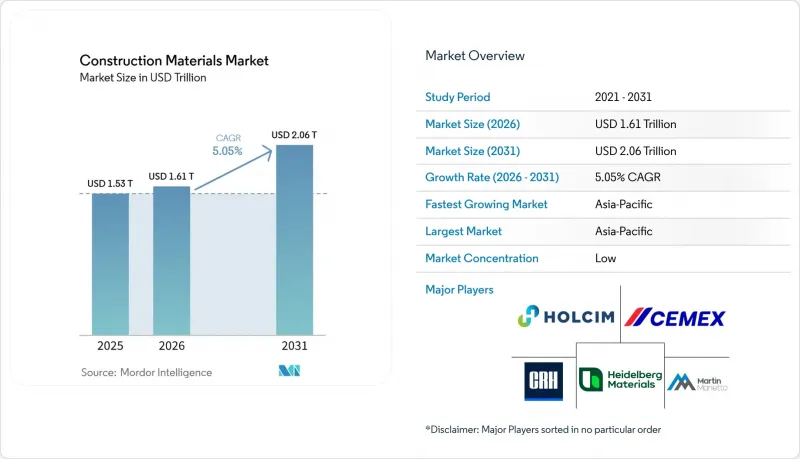
Mordor Intelligence에 의하면, 건설자재 시장 규모는 2025년에 1조 5,300억 달러로 평가되었습니다. 예측 기간(2026-2031년) CAGR 5.05%로 확대되어 2026년 1조 6,100억 달러에서 2031년에는 2조 600억 달러에 이를 전망입니다.
본 보고서는 자재 유형(골재, 시멘트 등), 건설 유형(신축, 개보수·수리), 최종 사용자 산업(주택, 인프라 등), 지역(아시아태평양, 북미, 유럽, 남미, 중동 및 아프리카)별로 분류되어 있습니다. 시장 예측은 금액(달러) 기준으로 제시되어 있습니다.
세계의 건설자재 시장 동향 및 인사이트
증가하는 개보수·수선 활동
2023년부터 2024년에 걸친 시장 위축기 동안, 유럽에서 플러스 성장을 유지한 건설 부문은 리노베이션 부문뿐이었습니다. 이러한 추세로 인해 리노베이션은 경기 사이클 후반의 일시적인 활동이 아니라 구조적인 수요원으로 자리 잡았습니다. ‘EU 리노베이션 웨이브(EU Renovation Wave)’는 회복·복원력 기금(Recovery and Resilience Facility)을 통해 2,750억 유로(약 3,136억 7,000만 달러)의 지원을 받고 있으며, 2030년까지 연간 리노베이션 비율을 2배로 늘리는 것을 목표로 하고 있습니다. 이러한 지원을 통해 단열재, 건식 벽체, 지붕용 방수 시트, 구조용 고정 장치에 대한 다년간 수요 기반이 형성될 것입니다. 건설자재 시장은 리노베이션 활동의 혜택을 받고 있으며, 이러한 활동에서는 일반적으로 대량 자재보다 더 높은 부가가치를 창출하는 더 얇고 전문적인 제품이 사용됩니다.
인프라 주도형 핵심 자재에 대한 수요
정부의 인프라 정비 프로그램은 골재, 구조용 강재, 시멘트 및 프리캐스트 콘크리트 부재에 대한 지속적인 수요를 창출하고 있습니다. 미국의 ‘초당적 인프라 법안’에서는 인프라 투자에 1조 2,000억 달러가 배정되었으며, 이 중 1,100억 달러는 도로 및 교량에, 660억 달러는 여객 및 화물 철도에 할당되었습니다. 이러한 지출은 여러 회계연도에 걸쳐 건설 프로젝트 파이프라인에 임베디드되어, 개별 민간 프로젝트를 넘어서는 자재 생산을 뒷받침하고 있습니다. 건설자재 시장은 데이터센터 및 전력망 전기화 프로젝트로부터도 혜택을 받고 있습니다. 이러한 프로젝트에는 고강도 철근, 조립식 설비 기초, 특수 코팅 등이 요구됩니다. 이러한 제품은 보다 구체적인 성능 요건이 요구되기 때문에 표준 토목용 등급보다 가격이 높게 책정되어 있습니다. 또한, 인프라 계획은 일관된 사양으로 대량 공급이 가능한 생산자에게 수요 전망을 명확히 하는 역할도 수행하고 있습니다.
변동이 심한 에너지 및 운송 비용
2026년에 에너지 및 물류 비용은 건축자재 제조업체와 건설업체에게 시급한 이익률 위험 요인이 될 것입니다. 시멘트, 철강, 알루미늄 생산에는 다량의 에너지가 필요하며, 연료비나 운송비 변동의 영향을 받기 쉽습니다. 전미종합건설업협회(AGC) 보고서에 따르면, 2026년 2월까지의 기간 동안 알루미늄 압연형 강재는 전년 동기 대비 39.1% 증가했고, 철강 제품은 20.9% 증가했으며, 2026년 1월 디젤 가격은 20.3% 상승했습니다. 이러한 가격 상승은 중동의 에너지 공급 혼란에 따른 것입니다. 이러한 가격 변동으로 인해 건설업체들은 고정가 계약의 가격 책정이 어려워져 입찰 철회로 이어질 가능성이 있습니다. 또한, 인허가 절차 지연 및 재활용 자재 조달 어려움으로 인해 프로젝트 착공이 지연되고, 일부 저탄소 자재의 조달도 제한되는 등 추가적인 압박이 가해지고 있습니다.
부문별 분석
금속은 2031년까지 연평균 성장률(CAGR) 5.82%를 기록하며, 건축자재 유형 중 가장 높은 성장률을 보일 것으로 예측됩니다. 수요는 인프라의 전기화, 데이터센터 건설, 재생에너지 인프라 및 송전망 현대화와 관련이 있습니다. 이러한 용도에서는 표준 탄소강 등급보다 더 엄격한 기술 사양을 충족하는 구조용 제품이 요구됩니다. 골재는 2025년 건설자재 시장에서 37.82%를 차지했으며, 이는 건설 활동 전반에 걸친 콘크리트, 노반, 배수 시스템에서 필수적인 역할을 하고 있음을 반영합니다. 또한, 이 부문은 신규 진입업체가 재현하기 어렵고 시간이 걸리는 허가된 채석장 매장량이라는 이점도 누리고 있습니다.
시멘트는 여전히 금액 기준 2위 카테고리이지만, 혼합 시멘트 및 보완성 시멘트 계열 제품이 표준 포틀랜드 시멘트의 사양 점유율을 점차 잠식하고 있습니다. 유럽의 수명 주기 기반 지구 온난화 계수(GWP) 요건이 클링커 함량이 적은 배합으로의 이러한 전환을 뒷받침하고 있습니다. 벽돌과 블록은 주택 건설 및 역사적 건축물 개보수에서 여전히 중요한 역할을 하고 있지만, 오프사이트 건설 활동이 활발한 시장에서는 조립식 패널 시장 점유율이 확대되고 있습니다. ‘기타’ 범주에는 단열재, 특수 도료, 실란트, 첨단 복합재료 등이 포함되며, 조달 결정 시 성능 요건의 비중이 높아짐에 따라 차별화의 여지가 더욱 커지고 있습니다.
지역별 분석
아시아태평양은 2025년에 건설자재 시장 점유율의 46.82%를 차지했으며, 2031년까지 연평균 성장률(CAGR) 6.02%로 성장할 것으로 전망됩니다. 중국, 인도, 동남아시아는 대규모 건설 생산량과 진행 중인 도시화를 동시에 갖추고 있습니다. 인도 수요는 주택 부동산보다 인프라에 의해 주도되고 있지만, 베트남, 인도네시아, 필리핀은 새로운 성장의 중심지로 부상하고 있습니다.
북미에서는 최종 용도별로 전망이 엇갈립니다. 인프라 및 데이터센터 프로젝트에서는 구조용 강재, 프리캐스트 콘크리트, 특수 도료가 대량으로 소비되고 있습니다. 주택 건설은 여전히 주택 구매 능력이라는 조건에 의해 제약을 받고 있습니다. 미국의 인프라 자금은 대량의 골재가 필요한 교통 및 상수도 프로젝트를 지원하고 있습니다. 2026년 4월 기준 연초 대비, 금속 및 연료 가격 상승을 배경으로 투입 가격은 6.2% 상승했습니다. 멕시코는 북부 제조 회랑에서 니어쇼어링 관련 산업 건설의 혜택을 받고 있습니다.
유럽은 2년간의 위축을 겪은 후, 토목 공사의 활성화와 아일랜드, 스페인, 포르투갈, 영국 시장의 안정화에 힘입어 서서히 회복되고 있습니다. 독일, 프랑스, 이탈리아에서는 건설 비용의 급등, 가계의 신중한 태도, 규제의 복잡성으로 인해 수요 부진이 지속되고 있습니다. 유럽의 조달 활동은 수명 주기에 기반한 지구온난화지수(GWP) 관련 규제와 배출권 거래 제도 2단계(ETS2) 도입 계획에 의해 점점 더 큰 영향을 받고 있습니다. 남미, 중동 및 아프리카가 나머지 시장 점유율을 차지하고 있습니다. 브라질은 여전히 라틴아메리카 최대의 건설 시장이며, 걸프 국가들에서는 계속해서 대규모 인프라 정비와 대형 프로젝트가 추진되고 있습니다.
기타 혜택 :
- 엑셀 형식 시장 예측(ME) 시트
- 3개월간의 애널리스트 지원
자주 묻는 질문
목차
제1장 서론
제2장 조사 방법
제3장 개요
제4장 시장 구도
제5장 시장 규모 및 성장 예측
제6장 경쟁 구도
제7장 시장 기회 및 향후 전망
KTH 26.09.02According to Mordor Intelligence, the construction materials market size was estimated at USD 1.53 trillion in 2025 and is estimated to grow from USD 1.61 trillion in 2026 to USD 2.06 trillion by 2031, at a CAGR of 5.05% during the forecast period (2026-2031).
This report is Segmented by Material Type (Aggregates, Cement, and More), Construction Type (New Construction and Renovation and Repairs), End-User Industry (Residential, Infrastructure, and More), and Geography (Asia-Pacific, North America, Europe, South America, and Middle-East and Africa). The Market Forecasts are Provided in Terms of Value (USD).
Global Construction Materials Market Trends and Insights
Rising Renovation and Repair Activity
Renovation was the only construction segment to maintain positive output in Europe during the 2023 to 2024 contraction. This pattern established renovation as a structural source of demand rather than a late-cycle activity. The EU Renovation Wave, supported by EUR 275 billion (~USD 313.67 billion) through the Recovery and Resilience Facility, seeks to double the annual renovation rate by 2030. This support creates a multi-year demand base for insulation, drywall, roofing membranes, and structural fixings. The construction materials market benefits from renovation activity, which typically uses thinner, specialized products that deliver higher value than bulk materials.
Infrastructure-Led Demand for Core Materials
Government infrastructure programs are creating durable demand for aggregates, structural steel, cement, and precast concrete elements. The US Bipartisan Infrastructure Law allocated USD 1.2 trillion for infrastructure investment, including USD 110 billion for roads and bridges and USD 66 billion for passenger and freight rail. These outlays enter construction pipelines over several fiscal years and support material output beyond individual private projects. The construction materials market also benefits from data centers and grid electrification projects, which require high-strength rebar, prefabricated equipment pads, and specialist coatings. Such products carry a premium over standard civil-engineering grades due to more specific performance requirements. Infrastructure programs also strengthen demand visibility for producers capable of supplying large quantities with consistent specifications.
Volatile Energy and Freight Costs
Energy and logistics costs represent an immediate margin risk for construction materials producers and contractors in 2026. Cement, steel, and aluminum production require substantial energy and are exposed to fluctuations in fuel and freight costs. The Associated General Contractors of America reported that aluminum mill shapes increased 39.1% year over year to February 2026, steel mill products rose 20.9%, and diesel prices increased 20.3% during January 2026. These increases followed disruptions to Middle-East energy supplies. This volatility makes it harder for contractors to price fixed-price contracts and can lead to bid withdrawals. Permitting delays and limited recycled-material availability add further pressure by slowing project starts and restricting access to some lower-carbon material grades.
Other drivers and restraints analyzed in the detailed report include:
- Urban Housing Shortages Supporting New Construction
- Decarbonization Pressure Accelerating Low-Carbon Material Adoption
- Carbon Compliance Increasing Production Cost
For complete list of drivers and restraints, kindly check the Table Of Contents.
Segment Analysis
Metals are forecast to record the fastest growth among material types at a 5.82% CAGR through 2031. Demand is linked to infrastructure electrification, data center construction, renewable energy infrastructure, and grid modernization. These applications require structural products that meet more demanding technical specifications than standard carbon-steel grades. Aggregates accounted for 37.82% of the construction materials market in 2025, reflecting their essential role in concrete, roadbeds, and drainage systems across construction activity. The segment also benefits from permitted quarry reserves, which are difficult and time-consuming for new suppliers to replicate.
Cement remains the second-largest category by value, while blended and supplementary cementitious products are gaining specification share from standard Portland cement. Lifecycle global-warming-potential requirements in Europe are supporting this shift toward lower-clinker formulations. Bricks and blocks remain relevant in residential construction and heritage renovation, although prefabricated panels are gaining market share in markets with strong off-site construction activity. The other category, which includes insulation, specialty coatings, sealants, and advanced composites, offers greater scope for differentiation, as performance requirements carry greater weight in procurement decisions.
Complete Report Scope:
- By Material Type
- Aggregates
- Cement
- Bricks and Blocks
- Metals
- Others by Material Type
- By Construction Type
- New Construction
- Renovation and Repairs
- By End-User Industry
- Residential
- Infrastructure
- Commercial
- Industrial
- By Geography
- Asia-Pacific
- China
- India
- Japan
- South Korea
- Rest of Asia-Pacific
- North America
- United States
- Canada
- Mexico
- Europe
- Germany
- United Kingdom
- France
- Italy
- Russia
- Rest of Europe
- South America
- Brazil
- Argentina
- Rest of South America
- Middle-East and Africa
- Saudi Arabia
- South Africa
- Rest of Middle-East and Africa
- Asia-Pacific
Geography Analysis
Asia-Pacific held 46.82% of the construction materials market share in 2025 and is forecast to grow at a 6.02% CAGR through 2031. China, India, and Southeast Asia combine large construction output with ongoing urbanization. India's demand is driven more by infrastructure than by residential property, while Vietnam, Indonesia, and the Philippines are emerging as secondary growth centers.
North America presents a mixed outlook across end uses. Infrastructure and data center projects are consuming large quantities of structural steel, precast concrete, and specialty coatings. Residential activity remains constrained by affordability conditions. US infrastructure funding supports transportation and water projects that require significant aggregate quantities. Input prices rose 6.2% year to date as of April 2026, driven by metals and fuel. Mexico benefits from nearshoring-related industrial construction in its northern manufacturing corridor.
Europe is recovering gradually after two years of contraction, supported by civil engineering activity and market stabilization in Ireland, Spain, Portugal, and the UK. Germany, France, and Italy continue to face weaker demand due to high construction costs, cautious households, and regulatory complexity. European procurement is increasingly shaped by lifecycle global warming potential rules and the planned rollout of Emissions Trading System 2 (ETS2). South America, the Middle-East, and Africa account for the remaining market share. Brazil remains Latin America's largest construction market, and the Gulf states continue to pursue major infrastructure and large-scale project programs.
- Buzzi S.p.A.
- Cemex S.A.B DE C.V.
- CRH
- CSR Limited
- Heidelberg Materials AG
- HOLCIM
- Kingspan
- Martin Marietta
- Owens Corning
- Saint-Gobain
- Taiheiyo Materials Corporation
- TATA Steel Limited
- Titan Cement International S.A.
- Vicat S.A.
- Vulcan Materials Company
Additional Benefits:
- The market estimate (ME) sheet in Excel format
- 3 months of analyst support
TABLE OF CONTENTS
1 Introduction
- 1.1 Study Assumptions and Market Definition
- 1.2 Scope of the Study
2 Research Methodology
3 Executive Summary
4 Market Landscape
- 4.1 Market Overview
- 4.2 Market Drivers
- 4.2.1 Rising Renovation and Repair Activity
- 4.2.2 Infrastructure-Led Demand for Core Materials
- 4.2.3 Urban Housing Shortages Supporting New Construction
- 4.2.4 Decarbonization Pressure Accelerating Low-Carbon Material Adoption
- 4.2.5 Prefabrication and Modular Construction Increasing Material Standardization
- 4.2.6 Digital Project Planning Improving Material Demand Visibility
- 4.3 Market Restraints
- 4.3.1 Volatile Energy and Freight Costs
- 4.3.2 Carbon Compliance Increasing Production Cost
- 4.3.3 Permitting Delays Slowing Project Starts
- 4.3.4 Recycled Material Supply Constraints in Certain Grades
- 4.4 Value Chain Analysis
- 4.5 Porter's Five Forces Analysis
- 4.5.1 Threat of New Entrants
- 4.5.2 Bargaining Power of Suppliers
- 4.5.3 Bargaining Power of Buyers
- 4.5.4 Threat of Substitutes
- 4.5.5 Competitive Rivalry
5 Market Size and Growth Forecasts (Value)
- 5.1 By Material Type
- 5.1.1 Aggregates
- 5.1.2 Cement
- 5.1.3 Bricks and Blocks
- 5.1.4 Metals
- 5.1.5 Others by Material Type
- 5.2 By Construction Type
- 5.2.1 New Construction
- 5.2.2 Renovation and Repairs
- 5.3 By End-User Industry
- 5.3.1 Residential
- 5.3.2 Infrastructure
- 5.3.3 Commercial
- 5.3.4 Industrial
- 5.4 By Geography
- 5.4.1 Asia-Pacific
- 5.4.1.1 China
- 5.4.1.2 India
- 5.4.1.3 Japan
- 5.4.1.4 South Korea
- 5.4.1.5 Rest of Asia-Pacific
- 5.4.2 North America
- 5.4.2.1 United States
- 5.4.2.2 Canada
- 5.4.2.3 Mexico
- 5.4.3 Europe
- 5.4.3.1 Germany
- 5.4.3.2 United Kingdom
- 5.4.3.3 France
- 5.4.3.4 Italy
- 5.4.3.5 Russia
- 5.4.3.6 Rest of Europe
- 5.4.4 South America
- 5.4.4.1 Brazil
- 5.4.4.2 Argentina
- 5.4.4.3 Rest of South America
- 5.4.5 Middle-East and Africa
- 5.4.5.1 Saudi Arabia
- 5.4.5.2 South Africa
- 5.4.5.3 Rest of Middle-East and Africa
- 5.4.1 Asia-Pacific
6 Competitive Landscape
- 6.1 Market Concentration
- 6.2 Strategic Moves
- 6.3 Market Share (%)/Ranking Analysis
- 6.4 Company Profiles (includes Global Overview, Market Overview, Core Segments, Financials as available, Strategic Information, Products and Services, and Recent Developments)
- 6.4.1 Buzzi S.p.A.
- 6.4.2 Cemex S.A.B DE C.V.
- 6.4.3 CRH
- 6.4.4 CSR Limited
- 6.4.5 Heidelberg Materials AG
- 6.4.6 HOLCIM
- 6.4.7 Kingspan
- 6.4.8 Martin Marietta
- 6.4.9 Owens Corning
- 6.4.10 Saint-Gobain
- 6.4.11 Taiheiyo Materials Corporation
- 6.4.12 TATA Steel Limited
- 6.4.13 Titan Cement International S.A.
- 6.4.14 Vicat S.A.
- 6.4.15 Vulcan Materials Company
7 Market Opportunities and Future Outlook
- 7.1 White-Space and Unmet-Need Assessment


