

|
시장보고서
상품코드
2119176
자가 지방 이식 시장 : 시장 점유율 분석, 업계 동향 및 통계, 성장 예측(2026-2031년)Autologous Fat Grafting - Market Share Analysis, Industry Trends & Statistics, Growth Forecasts (2026 - 2031) |
||||||
 Mordor Intelligence
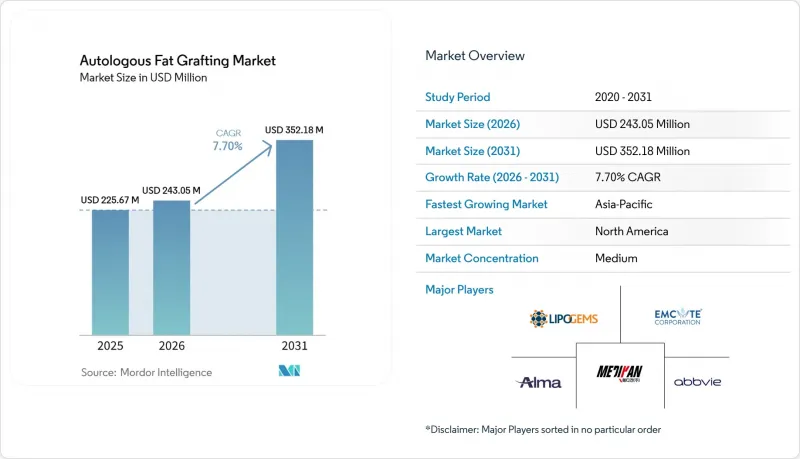
Mordor Intelligence에 의하면, 자가 지방 이식 시장 규모는 2025년 2억 2,567만 달러로 평가되었고, 2026년 2억 4,305만 달러에서 2031년까지 3억 5,218만 달러로 확대될 것으로 예측되며, 2026-2031년 연평균 복합 성장률(CAGR)은 7.70%를 나타낼 전망입니다.
본 보고서는 제품 유형별(통합형 지방 이식 시스템, 지방 처리 시스템, 지방 흡입 시스템, 기타), 용도별(유방 확대술, 둔부 성형술, 안면 지방 이식, 기타), 최종 사용자별(병원, 성형외과 센터, 기타), 지역별(북미, 유럽, 아시아태평양, 중동 및 아프리카, 남미)로 분류되어 있습니다. 시장 전망은 금액(달러) 기준으로 제시되어 있습니다.
세계의 자가 지방 이식 시장 동향 및 인사이트
자가 조직 및 생체 적합성을 갖춘 볼륨 회복에 대한 선호
자가 지방 이식 시장에서 환자와 외과의사는 환자 자신의 지방 조직을 이용한 볼륨 회복술을 선호하는 경향이 있습니다. 이러한 경향은 비자가 유래 물질에 수반되는 면역 반응에 대한 우려를 피할 수 있기 때문에 시장 성장을 뒷받침하고 있습니다. 2026년에 수행된 35건의 임상 연구와 3,757명의 유방 확대 수술 환자를 대상으로 한 리뷰에 따르면, 평균 생착률은 58%였으며, 그 결과는 44%에서 83% 범위에 달했다고 보고되었습니다. 동일한 증거에 따르면, 방사선 조사를 받은 부위나 섬유화가 진행된 부위에서도 혈관 통합 및 조직 개선이 확인되어, 미용 목적과 재건 목적 모두에서의 사용이 지지되고 있습니다. 임플란트 제거 후 대체 요법을 찾는 환자들 역시 수요를 더욱 부추길 가능성이 있습니다. 왜냐하면 지방 이식은 외부에서 공급되는 임플란트가 아닌, 치료를 받는 본인에게서 채취한 조직을 이용해 볼륨을 회복시킬 수 있기 때문입니다.
유방 절제술 후 및 유방 재건술의 확대
유방 절제술 후 재건은 자가 지방 이식 시장에 지속적으로 안정적인 임상적 기반을 제공합니다. 2026년에 수행된 13건의 비교 연구를 대상으로 한 체계적 문헌고찰 및 메타분석에 따르면, 외과의가 임플란트를 이용한 접근법 대신 지방 이식을 재건의 보조 수단으로 사용했을 때, 합병증의 통계적으로 유의미한 증가는 확인되지 않았습니다. 또한, 이 리뷰에서는 검증된 환자 만족도 평가 척도인 BREAST-Q에서 지방 이식법이 더 좋은 결과를 보인 것으로 보고되었습니다. 통합된 BREAST-I 및 BREAST-II 데이터에는 자가 지방 이식을 받은 환자 242명과 대조군 1만 9,936명이 포함되어 있으며, 평균 추적 관찰 기간은 8.0년이었고, 10년 전체 생존율은 지방 이식군에서 97.6%,대조군에서는 75.7%였습니다. 이러한 연구 결과는 유방 재건 분야가 재건 계획의 초기 단계에서 지방 이식을 도입하는 데 도움이 될 것이며, 신뢰성이 높은 처리 및 주입 기기에 대한 수요를 높일 가능성이 있습니다.
지방 생착률의 편차와 재시술의 필요성
지방 생착률의 편차는 자가 지방 이식 시장에서 계속해서 주요 제약 요인으로 남아 있으며, 시술자에게 지속적인 상업적 우려 사항이 되고 있습니다. 2026년 체계적 문헌고찰에 따르면, 기존 방식의 비농축 이식에서 통합 평균 생착률은 47%(95% 신뢰구간: 31.5%-62.5%)로 보고되었습니다. 이 문헌 고찰에 포함된 개별 연구에서는 3-12개월 사이에 26.0%에서 74.8% 범위의 생착률이 보고되어, 수술 전 정확한 이식량 계획을 세우기 어렵게 만들고 있습니다. 생착량이 예상 수준에 미치지 못할 경우, 환자는 재시술이 필요할 수 있으며, 이로 인해 치료 기간과 비용이 증가합니다.
부문 분석
2025년에는 통합형 지방 이식 시스템이 자가 지방 이식 시장의 35.45%를 차지한 것으로 평가되었습니다. 병원이나 잘 정립된 성형외과 센터에서는 단일 플랫폼에서 채취, 처리, 주입을 지원하여 업무 인계 과정을 최소화할 수 있기 때문에 이러한 시스템을 선호합니다. 이러한 통합형 구조를 통해 오염 위험을 줄이고, 시술 전반에 걸친 직원 교육을 간소화할 수 있습니다. 미국 식품의약국(FDA)의 510(k) 승인 및 유럽연합(EU)의 의료기기 규정(MDR) 인증을 포함한 규제 당국의 승인 또한 확립된 플랫폼의 채택을 뒷받침하고 있습니다.
자가 지방 이식 시장에서 지방 처리 시스템은 2026-2031년 연평균 성장률(CAGR) 9.15%를 나타낼 것으로 예측됩니다. 이러한 성장은 세포 생존율 및 장기적인 생착률에 영향을 미칠 수 있는 처리 방법에 대한 임상적 관심을 반영한 것입니다. 2026년 『Scientific Reports』지가 실시한 시판 중인 나노지방 조제 시스템에 대한 비교 조사에서는 제품 간 기술적 성능과 생물학적 품질에 유의미한 차이가 확인되었습니다. 흡입·채취 시스템, 지방 흡입 장치, 캐뉼라, 주사기, 필터,워셔, 채취 용기는 여전히 전체 워크플로우 전반에 걸쳐 필수적입니다. 폐쇄형 플랫폼이 확대됨에 따라, 단일 제품만을 제공하는 공급업체는 플랫폼 단위의 구매, 소모품, 서비스 계약, 교육, 표준화된 절차를 선호하는 의료 기관으로부터의 압박에 직면할 가능성이 있습니다.
지역별 분석
2025년, 북미는 자가 지방 이식 시장의 42.44%를 차지했습니다. 이 지역은 인증받은 성형외과 의사의 높은 밀집도, 확립된 재건 의료 지침, 병원 및 외래 진료 시설에서의 의료기기 활용이 성숙한 점의 혜택을 받았습니다. 미국에서는 유방 재건 및 바디 컨투어링 수술을 통해 수요가 뒷받침된 반면, 미국 식품의약국(FDA)의 승인 절차는 국내 사용을 위한 폐쇄형 시스템 처리 제품의 개발을 촉진했습니다. 캐나다는 재건 의료와 선택적 의료를 통해 기여했으며, 멕시코는 국경을 넘는 미용 의료 및 의료 관광을 통해 수요를 끌어올렸습니다.
유럽은 자가 지방 이식 시장에 있어 여전히 중요하지만, 지역에 따라 상황이 다른 시장입니다. 각국의 의료 제도 내 임상 실무, 보험 환급, 의료기기 감독 체계의 차이가 새로운 처리 기술의 도입 속도에 영향을 미치고 있습니다. 유럽연합(EU)의 의료기기 규정과 첨단치료의약품(ATMP) 프레임워크가 지방 유래 시술 시스템 및 세포 관련 제품에 대한 지침이 되고 있습니다. 독일, 영국, 프랑스, 이탈리아, 스페인이 해당 지역의 시술 건수의 대부분을 차지하고 있으며, 프랑스와 이탈리아의 학술 기관이 나노팻 및 마이크로팻 프로토콜 개발에 기여하고 있습니다.
아시아태평양은 2031년까지 연평균 성장률(CAGR) 10.88%를 나타낼 것으로 예측되며, 지역별로는 가장 높은 성장률을 보일 것으로 전망됩니다. 가처분 소득 증가, 민간 의료 체계의 확충, 의료 관광, 얼굴 및 신체 윤곽 성형에 대한 수요 증가가 이 지역의 성장 전망을 뒷받침하고 있습니다. 한국은 정밀한 안면 지방 이식을 선도하고 있는 반면, 중국의 저침습적 윤곽 성형에 대한 수요와 인도의 확대되는 민간 의료 네트워크가 시술 능력 향상에 기여하고 있습니다. 중동 및 아프리카에서는 걸프협력회의(GCC) 회원국들에 고가형 재건 플랫폼이 도입되고 있으며, 남미 지역은 브라질에서 확립된 미용 바디 컨투어링 시술 덕분에 계속해서 중요한 시장으로 자리 잡고 있습니다.
기타 혜택
- 엑셀 형식 시장 예측(ME) 시트
- 3개월간의 애널리스트 지원
자주 묻는 질문
목차
제1장 서론
제2장 조사 방법
제3장 주요 요약
제4장 시장 구도
제5장 시장 규모 및 성장 예측
제6장 경쟁 구도
제7장 시장 기회 및 향후 전망
AJY 26.09.03According to Mordor Intelligence, the autologous fat grafting market size is projected to expand from USD 225.67 million in 2025 and USD 243.05 million in 2026 to USD 352.18 million by 2031, registering a CAGR of 7.70% between 2026 to 2031.
This report is Segmented by Product Type (Integrated Fat Transfer Systems, Fat Processing Systems, Liposuction Systems, and Others), Application (Breast Augmentation, Buttock Augmentation, Facial Fat Grafting, and Others), End User (Hospitals, Plastic Surgery Centers, and Others), and Geography (North America, Europe, Asia-Pacific, MEA, South America). Market Forecasts are Provided in Terms of Value (USD).
Global Autologous Fat Grafting Market Trends and Insights
Preference for Autologous and Biocompatible Volume Restoration
In the autologous fat grafting market, patients and surgeons often prefer volume restoration procedures that use the patient's own adipose tissue. This preference supports market growth because the procedure avoids the immunogenic concerns associated with nonautologous materials. A 2026 review of 35 clinical studies and 3,757 breast augmentation patients reported mean volume retention of 58%, with results ranging from 44% to 83%. The same evidence showed vascular integration and tissue improvement in irradiated or fibrosed areas, supporting use in both cosmetic and reconstructive settings. Patients seeking alternatives after implant removal may further support demand, as fat transfer can restore volume using tissue collected from the individual receiving care rather than an externally supplied implant.
Expansion of Post-Mastectomy and Breast Reconstruction Procedures
Post-mastectomy reconstruction continues to provide a stable clinical base for the autologous fat grafting market. A 2026 systematic review and meta-analysis of 13 comparative studies found no statistically significant increase in complications when surgeons used fat grafting as a reconstructive adjunct instead of implant-based approaches. The review also reported better outcomes on validated BREAST-Q patient satisfaction measures for the fat-grafting approach. Its pooled BREAST-I and BREAST-II data included 242 autologous fat transfer patients and 19,936 controls, with an 8.0-year mean follow-up and 10-year overall survival of 97.6% for the fat transfer cohort versus 75.7% for controls. These findings may help breast units incorporate fat grafting earlier in reconstructive planning and increase demand for reliable processing and delivery equipment.
Variable Fat Retention and Need for Repeat Procedures
Variable fat retention remained a key limitation in the autologous fat grafting market and a continuing commercial concern for providers. The 2026 systematic review reported a 47% pooled mean volume retention rate for conventional non-enriched grafting, with a 95% confidence interval of 31.5% to 62.5%. Individual studies in the review reported retention rates ranging from 26.0% to 74.8% over 3 to 12 months, making precise preoperative volume planning difficult. Patients may require repeat procedures when retained volume falls below the expected level, increasing treatment time and cost.
Other drivers and restraints analyzed in the detailed report include:
- Body Contouring Demand After Major Weight Loss
- Growing Use of Fat Grafting for Scars, Radiation Injury, and Soft-Tissue Defects
- Procedure Cost and Limited Reimbursement for Elective Applications
For complete list of drivers and restraints, kindly check the Table Of Contents.
Segment Analysis
Integrated fat transfer systems are expected to account for 35.45% of the autologous fat grafting market share in 2025. Hospitals and established plastic surgery centers favor these systems because a single platform supports harvesting, processing, and injection with fewer handoffs. The integrated format can reduce contamination risk and simplify staff training across the procedure. Regulatory clearances, including U.S. Food and Drug Administration 510(k) clearances and European Union Medical Device Regulation certifications, also support the adoption of established platforms.
Within the autologous fat grafting market, fat processing systems are forecast to grow at a CAGR of 9.15% from 2026 to 2031. Their growth reflects clinical interest in processing methods that may affect cell viability and long-term retention. A 2026 Scientific Reports comparison of commercial nanofat preparation systems found meaningful differences in technical performance and biological quality across products. Aspiration and harvesting systems, liposuction equipment, cannulas, syringes, filters, washers, and collection vessels remain necessary across the workflow. As closed-loop platforms expand, vendors offering only point products may face pressure from facilities that prefer platform-level purchasing, consumables, service arrangements, training, and standardized procedural steps.
Complete Report Scope:
- By Product Type
- Integrated Fat Transfer Systems
- Aspiration and Harvesting Systems
- Liposuction Systems
- Fat Processing Systems
- De-epithelialization Devices
- Injection and Delivery Systems
- Single-Use Cannulas
- Transfer Syringes and Collection Vessels
- Filters, Washers and Processing Accessories
- Other Autologous Fat Grafting Products
- By Application
- Breast Augmentation
- Buttock Augmentation
- Facial Fat Grafting
- Hand Rejuvenation
- Others
- By End User
- Hospitals
- Plastic Surgery Centers
- Ambulatory Care Centers
- Academic and Research Hospitals
- Regenerative Medicine Clinics
- Others
- By Geography
- North America
- United States
- Canada
- Mexico
- Europe
- Germany
- United Kingdom
- France
- Italy
- Spain
- Rest of Europe
- Asia-Pacific
- China
- India
- Japan
- Australia
- South Korea
- Rest of Asia-Pacific
- Middle East and Africa
- GCC
- South Africa
- Rest of Middle East and Africa
- South America
- Brazil
- Argentina
- Rest of South America
- North America
Geography Analysis
North America held 42.44% of the autologous fat grafting market share in 2025. The region benefited from a high concentration of board-certified plastic surgeons, established reconstructive care guidelines, and mature device use across hospitals and ambulatory settings. The United States supported demand through breast reconstruction and body contouring procedures, while U.S. Food and Drug Administration pathways encouraged closed-system processing product development for domestic use. Canada contributed through reconstructive and elective care, and Mexico added demand through cross-border aesthetic care and medical tourism.
Europe remains an important but varied regional setting for the autologous fat grafting market. Differences in clinical practice, reimbursement, and device oversight across national healthcare systems influence the adoption pace of new processing technologies. The European Union Medical Device Regulation and Advanced Therapy Medicinal Product frameworks guide fat-derived processing systems and cell-related products. Germany, the United Kingdom, France, Italy, and Spain account for much of the region's procedure activity, with French and Italian academic institutions contributing to nanofat and microfat protocols.
Asia-Pacific is forecast to grow at a 10.88% CAGR through 2031, giving it the highest regional growth rate. Rising disposable incomes, expanding private healthcare capacity, medical tourism, and demand for facial and body contouring support the regional outlook. South Korea leads in precision facial fat grafting, while China's demand for minimally invasive contouring and India's expanding private healthcare network add procedure capacity. The Middle East and Africa absorb premium reconstructive platforms in Gulf Cooperation Council countries, while South America remains relevant due to Brazil's established aesthetic body-contouring practice.
- Abbvie
- Alma Lasers
- Andrew Technologies LLC
- Bimini Health Tech, Inc.
- Emcyte Corporation
- Genesis Biosystems, Inc.
- Harvest Technologies
- HK Surgical, Inc.
- Human Med
- Lipogems International S.p.A.
- Marizyme, Inc.
- Medical Device Resource Corporation
- Medikan International
- MicroAire
- Millennium Medical Technologies, Inc.
- Proteal Bioregenerative Solutions
- Ranfac
- Sterimedix Limited
- Syntr Health Technologies, Inc.
Additional Benefits:
- The market estimate (ME) sheet in Excel format
- 3 months of analyst support
TABLE OF CONTENTS
1 INTRODUCTION
- 1.1 Study Assumptions and Market Definition
- 1.2 Scope of the Study
2 RESEARCH METHODOLOGY
3 EXECUTIVE SUMMARY
4 MARKET LANDSCAPE
- 4.1 Market Overview
- 4.2 Market Drivers
- 4.2.1 Preference for Autologous and Biocompatible Volume Restoration
- 4.2.2 Expansion of Post-Mastectomy and Breast Reconstruction Procedures
- 4.2.3 Body Contouring Demand After Major Weight Loss
- 4.2.4 Growing Use of Fat Grafting for Scars, Radiation Injury and Soft-Tissue Defects
- 4.2.5 Improved Closed-System Fat Processing and Transfer Workflows
- 4.2.6 Integration of Fat Grafting With Regenerative and Precision-Aesthetic Protocols
- 4.3 Market Restraints
- 4.3.1 Variable Fat Retention and Need for Repeat Procedures
- 4.3.2 Procedure Cost and Limited Reimbursement for Elective Applications
- 4.3.3 Surgeon-Dependent Outcomes and Inconsistent Processing Protocols
- 4.3.4 Regulatory Uncertainty Around Stromal Vascular Fraction and Cell-Enriched Grafts
- 4.4 Value/Supply-Chain Analysis
- 4.5 Regulatory Landscape
- 4.6 Technological Outlook
- 4.7 Porter's Five Forces Analysis
- 4.7.1 Threat of New Entrants
- 4.7.2 Bargaining Power of Suppliers
- 4.7.3 Bargaining Power of Buyers
- 4.7.4 Threat of Substitutes
- 4.7.5 Competitive Rivalry
5 MARKET SIZE AND GROWTH FORECASTS (VALUE, USD)
- 5.1 By Product Type
- 5.1.1 Integrated Fat Transfer Systems
- 5.1.2 Aspiration and Harvesting Systems
- 5.1.3 Liposuction Systems
- 5.1.4 Fat Processing Systems
- 5.1.5 De-epithelialization Devices
- 5.1.6 Injection and Delivery Systems
- 5.1.7 Single-Use Cannulas
- 5.1.8 Transfer Syringes and Collection Vessels
- 5.1.9 Filters, Washers and Processing Accessories
- 5.1.10 Other Autologous Fat Grafting Products
- 5.2 By Application
- 5.2.1 Breast Augmentation
- 5.2.2 Buttock Augmentation
- 5.2.3 Facial Fat Grafting
- 5.2.4 Hand Rejuvenation
- 5.2.5 Others
- 5.3 By End User
- 5.3.1 Hospitals
- 5.3.2 Plastic Surgery Centers
- 5.3.3 Ambulatory Care Centers
- 5.3.4 Academic and Research Hospitals
- 5.3.5 Regenerative Medicine Clinics
- 5.3.6 Others
- 5.4 By Geography
- 5.4.1 North America
- 5.4.1.1 United States
- 5.4.1.2 Canada
- 5.4.1.3 Mexico
- 5.4.2 Europe
- 5.4.2.1 Germany
- 5.4.2.2 United Kingdom
- 5.4.2.3 France
- 5.4.2.4 Italy
- 5.4.2.5 Spain
- 5.4.2.6 Rest of Europe
- 5.4.3 Asia-Pacific
- 5.4.3.1 China
- 5.4.3.2 India
- 5.4.3.3 Japan
- 5.4.3.4 Australia
- 5.4.3.5 South Korea
- 5.4.3.6 Rest of Asia-Pacific
- 5.4.4 Middle East and Africa
- 5.4.4.1 GCC
- 5.4.4.2 South Africa
- 5.4.4.3 Rest of Middle East and Africa
- 5.4.5 South America
- 5.4.5.1 Brazil
- 5.4.5.2 Argentina
- 5.4.5.3 Rest of South America
- 5.4.1 North America
6 COMPETITIVE LANDSCAPE
- 6.1 Market Concentration
- 6.2 Market Share Analysis
- 6.3 Company Profiles (includes Global Level Overview, Market Level Overview, Core Segments, Financials as available, Strategic Information, Market Rank/Share, Products and Services, Recent Developments)
- 6.3.1 AbbVie Inc.
- 6.3.2 Alma Lasers Ltd.
- 6.3.3 Andrew Technologies LLC
- 6.3.4 Bimini Health Tech, Inc.
- 6.3.5 Emcyte Corporation
- 6.3.6 Genesis Biosystems, Inc.
- 6.3.7 Harvest Technologies Corporation
- 6.3.8 HK Surgical, Inc.
- 6.3.9 Human Med AG
- 6.3.10 Lipogems International S.p.A.
- 6.3.11 Marizyme, Inc.
- 6.3.12 Medical Device Resource Corporation
- 6.3.13 Medikan International Inc.
- 6.3.14 MicroAire Surgical Instruments, LLC
- 6.3.15 Millennium Medical Technologies, Inc.
- 6.3.16 Proteal Bioregenerative Solutions
- 6.3.17 Ranfac Corporation
- 6.3.18 Sterimedix Limited
- 6.3.19 Syntr Health Technologies, Inc.
7 MARKET OPPORTUNITIES AND FUTURE OUTLOOK
- 7.1 White-Space and Unmet-Need Assessment


