

|
시장보고서
상품코드
2119178
패브릭 벽지 시장 : 시장 점유율 분석, 업계 동향 및 통계, 성장 예측(2026-2031년)Fabric Wallpaper - Market Share Analysis, Industry Trends & Statistics, Growth Forecasts (2026 - 2031) |
||||||
 Mordor Intelligence
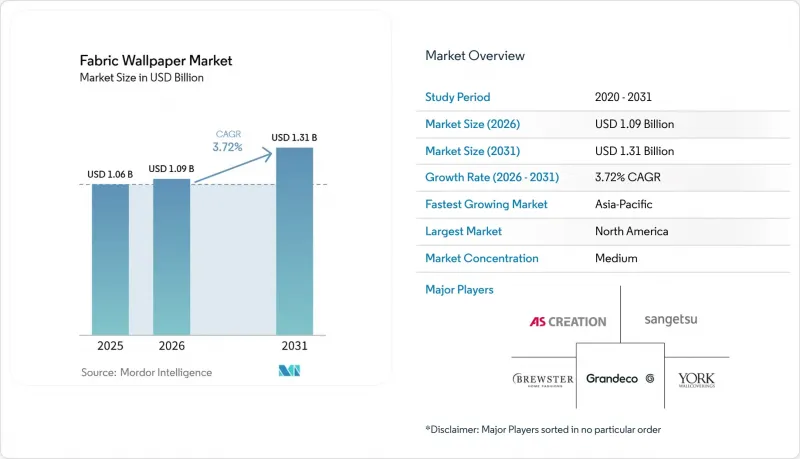
Mordor Intelligence에 의하면, 패브릭 벽지 시장 규모는 2025년에 10억 6,000만 달러로 평가되었고, 2026년 10억 9,000만 달러에서 2031년까지 13억 1,000만 달러에 이를 것으로 예측되며, 예측 기간(2026-2031년) CAGR은 3.72%를 나타낼 전망입니다.
본 보고서는 원단·소재 유형별(천연섬유, 합성 섬유), 용도별(신축, 개보수·리모델링), 최종 사용자별(주거용, 상업용), 유통 채널별(B2C, B2B), 지역별로 세분화되어 있습니다. 시장 예측은 금액(달러) 기준으로 제시되어 있습니다.
세계의 패브릭 벽지 시장 동향 및 인사이트
고급 인테리어 디자인과 럭셔리 장식에 대한 수요가 사양 향상을 주도하고 있습니다.
고급 인테리어 프로젝트에서는 단일 액센트 벽에 그치지 않고, 방 전체에 패브릭 벽지를 채택하는 사례가 증가하고 있습니다. 2026년 ‘미국 Houzz 및 Home Study’ 보고서에 따르면, 2025년에 미국 주택 소유자의 54%가 리모델링을 진행했으며, 지출 중앙값은 2만 달러, 상위 10% 프로젝트 지출은 15만 달러로 전년 대비 7% 증가했습니다. 이러한 지출 동향은 고부가가치 리모델링 공사에서 개성 있는 마감에 대한 수요를 뒷받침하고 있습니다. 또한, 벽지 선정은 설계 과정의 더 이른 단계에서 이루어지고 있어, 표면재가 가구, 조명, 색상 선택에 미치는 영향력이 커지고 있습니다. 5만 달러를 초과하는 프로젝트에서는 전문 시공업체를 기용하는 것이 일반적이며, 고급 사양 분야에서 전문 도급업체의 역할은 여전히 중요합니다. F. Schumacher, The Romo Group, Osborne & Little과 같은 기업들은 인테리어 건축가가 가격뿐만 아니라 디자인적 관점에서 자재를 선정할 때 혜택을 보고 있습니다. 따라서 패브릭 벽지 시장은 시각적 차별화와 전문 시공을 더욱 중시하는 리모델링 고객층으로부터 지지를 얻고 있습니다.
호텔, 사무실, 소매, 의료 분야의 상업용 리모델링이 수요를 뒷받침하고 있습니다.
호텔에서는 객실 인테리어를 정기적인 주기로 갱신하고 있으며, 그 기간은 일반적으로 건물의 내구 연한보다 짧습니다. 이러한 추세로 인해 신축과는 별개로 벽면 마감재 사양에 대한 수요가 발생하고 있습니다. 호텔 부문 프로젝트에서는 디자인의 일관성, 내구성, 음향적 쾌적성이 동시에 요구되는 객실, 복도, 공용 구역에 패브릭 소재가 채택되고 있습니다. 또한, 하이브리드 근무 방식의 확산에 따라 사무실 리모델링에서도 회의실이나 공유 업무 공간의 음향적 프라이버시가 더욱 중요시되고 있습니다. 의료시설 프로젝트는 항균성, 방균성, 세척성 요건을 충족하는 텍스타일 제품에 있어 추가적인 수요 창출원이 되고 있습니다. AATCC 147 항균성 시험과 ASTM G21 방균성 시험은 환자와 접촉하는 구역의 소재 선정과 관련이 있습니다. 이러한 용도가 모든 상황에서 비닐을 대체하는 것은 아니지만, 여러 소재를 조합한 사양 접근 방식을 뒷받침합니다. Momentum Textiles & Wallcovering은 현재 상업 디자인에서 고려해야 할 사항으로 디지털 노마드를 위한 숙박 시설과 화상 회의를 위해 설계된 호텔 및 리조트 시설의 인테리어를 꼽고 있습니다. 비디오 배경으로 질감이 있는 표면이 선택되는 경우가 있는데, 이는 이전의 상업용 리모델링 주기에는 존재하지 않았던 이용 사례를 추가하는 것입니다. 이로 인해 호스피탈리티, 직장, 소매, 의료 각 부문에 걸친 패브릭 벽지 시장의 대상 사양 기반이 확대됩니다.
높은 시공 기술 요건이 중저가 시장으로의 확산을 제약하고 있습니다.
패브릭 벽지의 시공에는 세심한 벽면 보수, 밑칠 도료 선정, 이음매 맞추기, 표면 처리가 필요합니다. 이러한 요건은 도장이나 대부분의 ‘벽에 풀을 바르는’ 방식의 부직포 벽지보다 더 엄격합니다. 그 결과, 시공 비용은 프로젝트 총비용에서 여전히 큰 비중을 차지하고 있습니다. 이러한 제약으로 인해 DIY 활용은 제한적이며, 수요는 전문 업체가 수행하는 리모델링 공사에 집중되어 있습니다. 북미와 유럽의 숙련된 건설 노동자 부족은 이러한 제약에 추가적인 압박을 가하고 있습니다. 이 문제는 구조적인 것입니다. 패브릭 벽지 시공 기술에는 훈련과 실습이 필요하며, 노동력 공급 상황을 단기간에 조정할 수 있는 성격이 아니기 때문입니다. 전문 시공업체는 높은 이익률을 유지할 수 있겠지만, 시공업체 네트워크가 제한적이라면 새로운 지역에서의 보급이 저해될 가능성이 있습니다. 벽에 직접 부착하는 유형이나 모듈식 패널 시스템은 이러한 부담을 일부 덜어줍니다. 그러나 이러한 도입으로 인해 직물 마감재에 대한 수요와 자격을 갖춘 시공업체공급 사이의 격차가 완전히 해소된 것은 아닙니다. 패브릭 벽지 산업은 제품 설계와 실용적인 시공 지원의 균형을 맞추고, 리모델링 공사의 상위 단계에 머무르지 않고 폭넓은 용도로의 보급을 도모해야 합니다.
부문 분석
2025년, 합성 섬유 패브릭 벽지는 패브릭 벽지 시장 점유율의 42.28%를 차지했습니다. 폴리에스터, 비스코스, 폴리프로필렌 기질은 주거 및 상업 프로젝트 전반에 걸쳐 인쇄 적합성, 치수 안정성, 내마모성을 갖추고 있습니다. 이러한 소재는 배면 시스템과 폭넓은 호환성을 갖추고 있어, 제조업체는 ‘벽에 직접 접착’ 형태의 제품뿐만 아니라 유형 II 상업용 제품도 제공할 수 있습니다. 또한, 합성 소재는 제품 설계 시마다 별도의 화학 처리를 거치지 않고도 내화 성능 요건을 충족할 수 있습니다. 이러한 특징 덕분에 이 부문은 폭넓은 가격대를 아우르고 있습니다. 천연섬유 원단 벽지는 2031년까지 연평균 성장률(CAGR) 4.8%를 나타낼 것으로 예측되며, 이는 모든 소재 유형 중 가장 높은 성장률입니다. 이러한 성장은 LEED v4.1, WELL 또는 Cradle to Cradle 요건을 준수하는 프로젝트에서 검증된 바이오 함량 및 환경 제품 선언(EPD)에 대한 수요를 반영한 것입니다. Carnegie Fabrics는 자사의 ‘Xorel’ 소재가 사탕수수 유래 바이오 성분을 최대 91% 함유하고 있으며, Cradle to Cradle 골드 인증을 획득했다고 밝혔습니다. 파비니(Favini)사는 2026년 5월 밀라노에서 ‘Refit’ 기재를 리뉴얼하여 회수 섬유를 40%, 총 재활용 함유율을 50%로 높이는 한편, FSC 및 세계 재활용 표준(Global Recycling Standard) 인증을 획득했습니다. 이러한 동향에 따라 친환경 제품으로서의 포지셔닝에서 안감 층의 중요성이 더욱 높아지고 있습니다. 지속 가능한 소재를 사용한 패브릭 벽지 시장 규모는 표면의 외관뿐만 아니라, 구성 및 추적 가능성이 문서화되어 있다는 점에 의해서도 뒷받침되고 있습니다.
천연섬유 제품으로는 면, 린넨, 비단, 황마, 유리 섬유, 양모 등이 있습니다. 이들은 고급 주택이나 호텔·리조트 프로젝트에서 원산지나 질감이 선택의 결정적인 요소가 되는 프리미엄 위치를 차지하고 있습니다. 이 제품군의 구매층은 합성 섬유 제품의 가격 변동 영향을 거의 받지 않습니다. 혼방 섬유 제품은 천연섬유의 외관과 합성사의 안정성을 겸비하고 있습니다. 이로 인해 ASTM 규격에 부합하는 일관된 성능이 요구되는 상업용(컨트랙트) 현장에 적합합니다. 플록 가공이나 엠보싱 가공을 거친 텍스타일 벽지는 디자인 요건의 핵심으로 입체적인 질감이 강조되는 소규모 하이엔드 주택의 이용 사례에 활용됩니다. EU의 REACH 규정이나 캘리포니아주 프로포지션 65 역시 섬유, 마감 처리, 화학 물질 함유량 선택에 영향을 미치고 있습니다. 건강 제품 선언(HPD)은 공공시설이나 그린 빌딩 프로젝트에서 추가적인 경쟁 우위를 가져다줄 가능성이 있습니다. 따라서 각 제조업체는 추적 가능성이 확보된 원자재와 문서화된 제품의 화학 조성에 더욱 주의를 기울이고 있습니다. 패브릭 벽지 업계에는 대량 생산되는 합성 제품과 고품질 천연 소재 및 재활용 소재를 사용한 제품 모두에 시장이 존재합니다.
2025년에는 개보수 및 리모델링이 패브릭 벽지 시장 규모의 60.06%를 차지한 것으로 평가되었으며, 2031년까지 연평균 성장률(CAGR) 4.3%로 성장할 것으로 전망됩니다. 이 부문은 가장 큰 용도 점유율과 가장 높은 용도 성장률을 동시에 갖추고 있습니다. 이러한 상황은 단순한 단기적인 보수 지출 증가가 아니라 지속적인 보수 수요를 반영한 것입니다. 고부가가치 보수 프로그램에서는 구조를 변경하지 않고 벽 마감재를 활용하여 공간의 분위기를 바꾸는 경우가 많습니다. 대규모 프로젝트에서는 내구성, 디자인의 독창성, 시공 품질을 종합적으로 고려하기 때문에 특수 벽 마감에 예산을 할당할 수 있습니다. 호텔 리모델링 주기 역시 이와 같은 지속적인 수요를 창출하고 있으며, 특히 객실 업그레이드 시 통일감 있는 마감 처리가 요구되는 경우에 두드러집니다. 하이브리드 근무와 관련된 사무실 리모델링에서도 음향 성능이 중요한 요소가 될 경우, 텍스타일 소재의 채택이 촉진되고 있습니다.
2025년 용도별 수요 중 나머지 39.94%는 신축이 차지했습니다. 이는 GCC, 인도, 동남아시아의 고급 주택 개발 및 상업 프로젝트와 가장 밀접한 관련이 있는 부문입니다. 국제적인 디자인 컨설팅 회사는 고급 호스피탈리티 프로젝트의 설계 의도 수립 단계에서 패브릭 벽지를 지정하는 경우가 많습니다. 이러한 과정을 통해 패브릭 표면이 프리미엄 객실 카테고리에서 기본 선택지가 되는 경우가 있습니다. 교육 시설 및 의료시설도 신축 분야의 또 다른 활용 사례입니다. 이러한 프로젝트에서는 저VOC 및 PVC 프리 소재에 대한 선호와 음향 목표에 부합하도록 음향 기능이 탑재된 패브릭 벽면 시스템을 통합할 수 있습니다. 이러한 활용 사례의 확대는 리모델링 수요와는 확연히 구분됩니다. 이에 따라 패브릭 벽지 시장은 입주 훨씬 이전에 자재 사양이 확정된 프로젝트로 그 영역을 넓히게 될 것입니다. 리모델링과 신축의 상대적 균형은 제조업체의 제품 계획에서 계속해서 중요한 요소가 될 것으로 보입니다.
지역별 분석
2025년에는 북미가 지역 점유율의 34.27%를 차지하며 1위를 차지했습니다. 이 지역은 리모델링 시장이 성숙 단계에 접어들었지만, 성장률이 둔화되었다고 해서 수요가 약한 것은 아닙니다. 저예산 리모델링 활동이 불안정한 경우에도 고부가가치 프로젝트가 있다면 고급 마감재에 대한 지출을 유지할 수 있습니다. 이 지역에서는 실적이 검증된 디자이너와 시공업체가 고급 프로젝트의 실행을 뒷받침하고 있어 패브릭 벽지 시장은 계속해서 견조한 모습을 보이고 있습니다. LEED v4.1 및 GREENGUARD Gold 기준은 저배출 및 친환경 건축 요건을 충족하는 제품의 사용을 촉진하고 있습니다. 캐나다의 리모델링 활동과 멕시코의 호스피탈리티 부문도 이 지역 수요를 더욱 끌어올리고 있습니다. 멕시코의 리조트 및 호텔 건설은 중급 및 프리미엄급 직물 벽지 시장에 상업적 기회를 창출할 가능성이 있습니다. 직물 벽지 시장은 지역별 계약 판매망과 다양한 프로젝트 예산에 적합한 자재 라인업을 통해 이러한 프로젝트에 대응할 수 있습니다.
아시아태평양은 2031년까지 연평균 성장률(CAGR) 5.5%를 나타낼 것으로 예측되며, 이는 지역별 성장률 중 가장 높은 수치입니다. 이러한 규모 덕분에 아시아 공급망은 비용 측면에서 우위를 점하고 있으며, 한편 중국도 주요 도시에서 프리미엄 소비 시장으로 부상하고 있습니다. 1급 및 2급 도시에 거주하는 도시 소비자들은 페인트의 대안으로 질감이 가미된 패브릭 벽 마감재를 점점 더 많이 고려하고 있습니다. 기술 및 금융 허브에서의 주거 및 상업용 부동산 활동이 이러한 수요를 뒷받침하고 있습니다. 중동 및 아프리카 역시 호텔 건설 및 고급 호스피탈리티 프로젝트의 혜택을 누리고 있습니다. 동남아시아에서는 유통 인프라 확충에 따라 호스피탈리티 및 코워킹 부문이 더 큰 잠재력을 창출하고 있습니다. 산게츠는 2026년 1분기, 호텔 및 공공시설 건설에 사용되는 내화 사양의 패브릭 벽지에 대해 동남아시아 지역 유통 파트너십을 발표했습니다. 패브릭 벽지 시장은 검증된 안전 성능을 갖춘 디자인 중심의 마감재를 원하는 상업 개발자들 수요를 충분히 누릴 수 있는 위치에 있습니다.
기타 혜택
- 엑셀 형식 시장 예측(ME) 시트
- 3개월간의 애널리스트 지원
자주 묻는 질문
목차
제1장 서론
제2장 조사 방법
제3장 주요 요약
제4장 시장 구도
제5장 시장 규모 및 성장 예측
제6장 경쟁 구도
제7장 시장 기회 및 향후 전망
AJY 26.09.03According to Mordor Intelligence, the fabric wallpaper market size was valued at USD 1.06 billion in 2025 and estimated to grow from USD 1.09 billion in 2026 to reach USD 1.31 billion by 2031, at a CAGR of 3.72% during the forecast period (2026-2031).
This report is Segmented by Fiber and Material Type (Natural Fiber and Synthetic Fiber), Application (New Construction, Renovation, and Remodeling), End User (Residential and Commercial), Distribution Channel (B2C and B2B), and Geography. The Market Forecasts are Provided in Terms of Value (USD).
Global Fabric Wallpaper Market Trends and Insights
Premium Interior Design and Luxury Decor Demand Drives Specification Upgrades
Premium interior projects increasingly use fabric wallcoverings beyond single-feature walls, specifying them throughout entire rooms. The 2026 United States Houzz and Home Study reported that 54% of United States homeowners renovated in 2025, with median spending of USD 20,000 and top-decile project spending of USD 150,000, up 7% year over year . This spending profile supports demand for distinctive finishes in higher-value renovation work. Wallpaper selection is also moving earlier in the design process, giving surface materials greater influence over furniture, lighting, and color choices. Projects exceeding USD 50,000 commonly use professional installers, preserving the role of specialty contractors in premium specifications. F. Schumacher, The Romo Group, and Osborne & Little benefit when interior architects select materials on design authority rather than price alone. The fabric wallpaper market, therefore, draws support from a renovation tier that places greater value on visual differentiation and professional execution.
Commercial Renovation across Hospitality, Offices, Retail, and Healthcare Supports Demand
Hotels renew room interiors on recurring cycles that are commonly shorter than a building's overall life. That pattern creates demand for wallcovering specifications that are separate from new construction. Hospitality projects use fabric surfaces in guest rooms, corridors, and public areas where design consistency, durability, and acoustic comfort matter together. Office refits also place greater weight on acoustic privacy in meeting rooms and shared work areas as hybrid work arrangements continue. Healthcare projects create another outlet for textile products that can meet antimicrobial, mold-resistance, and cleanability requirements. AATCC 147 antimicrobial testing and ASTM G21 mold-resistance testing are relevant to material selection in patient-facing areas. These uses do not replace vinyl in every setting, but they support a multi-material specification approach. Momentum Textiles & Wallcovering identified digital nomad accommodations and hospitality interiors designed for video conferencing as current commercial design considerations. Textured surfaces can be selected for video backgrounds, which adds a use case that was not present in earlier commercial renovation cycles. This broadens the addressable specification base for the fabric wallpaper market across hospitality, workplace, retail, and healthcare settings.
High Installation Skill Requirements Constrain Mid-Market Penetration
Fabric wallcovering installation requires careful wall repair, primer selection, seam matching, and surface preparation. These requirements are more demanding than those for paint application or for many paste-the-wall nonwoven formats. Installation cost, therefore, remains a meaningful part of the delivered project cost. These limits do-it-yourself use and concentrate demand in professionally managed renovation work. A shortage of skilled construction labor in North America and Europe adds pressure to this constraint. The issue is structural because fabric installation skills require training and practice, not a short adjustment in labor availability. Specialty installers may retain stronger margins, but thinner installer networks can limit adoption in new geographies. Paste-the-wall formats and modular panel systems reduce part of the burden. Their adoption has not fully closed the gap between demand for textile finishes and the availability of qualified installers. The fabric wallpaper industry must balance product design with practical installation support to broaden use beyond the upper end of renovation work.
Other drivers and restraints analyzed in the detailed report include:
- Demand for Acoustic and Indoor-Environmental Performance Reshapes Contract Specification
- Digital Printing and Bespoke Short-Run Customization Reshapes Production Economics
- Price Competition From Vinyl, Nonwoven, Paint, and Wall Panels Limits Value Growth
For complete list of drivers and restraints, kindly check the Table Of Contents.
Segment Analysis
Synthetic-fiber fabric wallpaper held 42.28% of the fabric wallpaper market share in 2025. Polyester, viscose, and polypropylene substrates support printability, dimensional stability, and abrasion resistance across residential and contract projects. Their broad compatibility with backing systems helps producers offer paste-the-wall formats as well as Type II commercial products. Synthetic materials can also support fire-rating requirements without adding a separate chemical treatment in every product design. These features help the segment serve a wide price range. Natural-fiber fabric wallpaper is forecast to grow at an 4.8% CAGR through 2031, the highest rate among material types. The growth reflects demand for verified bio-based content and Environmental Product Declarations (EPD) in projects guided by LEED v4.1, WELL, or Cradle to Cradle requirements. Carnegie Fabrics states that its Xorel material can contain up to 91% biobased content from sugarcane and carries Cradle to Cradle Gold certification. Favini updated its Refit substrate in Milan in May 2026, with 40% recovered textile fiber and 50% total recycled content, and is certified under FSC and the Global Recycled Standard. These developments make the backing layer more important to environmental product positioning. The fabric wallpaper market size for sustainable materials is supported by documented composition and traceability rather than surface appearance alone.
Natural-fiber products include cotton, linen, silk, jute, grasscloth, and wool. They occupy a premium position where provenance and texture influence selection in luxury homes and hospitality projects. Their buyer base is less exposed to the pricing dynamics of the synthetic tier. Blended-fiber products combine the appearance of natural fibers with the stability of synthetic yarns. This makes them relevant to contract settings that require consistent performance in accordance with ASTM standards. Flocked and embossed textile wallpaper serves a smaller high-design residential use case where three-dimensional texture is central to the design brief. EU REACH and California Proposition 65 also influence choices of fiber, finish, and chemical content . Health Product Declarations can provide an additional advantage in institutional and green-building projects. Producers are therefore placing more attention on traceable raw materials and documented product chemistry. The fabric wallpaper industry has room for both high-volume synthetic products and premium natural or circular material formats.
Renovation and remodeling accounted for 60.06% of the fabric wallpaper market size in 2025 and is forecast to grow at a 4.3% CAGR through 2031. The segment combines the largest application share with the fastest application growth rate. This position reflects recurring upgrades rather than only a short-term increase in renovation spending. High-value renovation programs often use wall finishes to change a room's feel without altering its structure. Larger projects can allocate funds to specialty wall finishes because they consider durability, design distinction, and installation quality together. Hotel refresh cycles create similar recurring demand, especially when room upgrades require coordinated finishes. Office refits connected to hybrid work also support textile specifications where acoustic performance is relevant.
New construction represented the remaining 39.94% of application demand in 2025. It is most relevant to premium residential developments and commercial projects in the GCC, India, and Southeast Asia. International design consultancies often specify fabric wallcoverings during the design intent stage of luxury hospitality projects. That process can make fabric surfaces a default choice for premium room categories. Educational and healthcare facilities provide another new-build use case. Those projects can integrate acoustic fabric wall systems that align with low-VOC and PVC-free material preferences and acoustic goals. This application pathway is distinct from renovation demand. It extends the fabric wallpaper market into projects where material specifications are established well before occupancy. The relative balance between renovation and construction will remain important to manufacturers' product planning.
Complete Report Scope:
- By Fabric/Material Type
- Natural-Fiber Fabric Wallpaper
- Cotton Wallpaper
- Linen Wallpaper
- Silk Wallpaper
- Jute and Grasscloth Wallpaper
- Recycled and Bio-Based Textile Wallpaper
- Wool and Other Natural-Fiber Wallpaper
- Synthetic-Fiber Fabric Wallpaper
- Polyester Wallpaper
- Viscose and Rayon Wallpaper
- Polypropylene Wallpaper
- Acrylic and Other Synthetic-Fiber Wallpaper
- Blended-Fiber Fabric Wallpaper
- Natural-Fiber Fabric Wallpaper
- By Application
- New Construction
- Renovation and Remodeling
- By End User
- Residential
- Commercial
- By Distribution Channel
- B2C Channels
- Hypermarkets and Supermarkets
- Specialty Stores
- Home Centers
- Online
- Local Shops
- Other Distribution Channels
- B2B Channels (Contractors and Installers, Interior Designers and Architects, Project Procurement and Institutional Sales)
- B2C Channels
- By Geography
- North America
- Canada
- United States
- Mexico
- South America
- Brazil
- Peru
- Chile
- Argentina
- Rest of South America
- Europe
- United Kingdom
- Germany
- France
- Spain
- Italy
- BENELUX (Belgium, Netherlands, Luxembourg)
- NORDICS (Denmark, Finland, Iceland, Norway, Sweden)
- Rest of Europe
- Asia-Pacific
- India
- China
- Japan
- Australia
- South Korea
- South-East Asia
- Rest of Asia-Pacific
- Middle East & Africa
- United Arab Emirates
- Saudi Arabia
- South Africa
- Nigeria
- Rest of Middle East & Africa
- North America
Geography Analysis
North America led with 34.27% regional share in 2025. The region has a mature renovation base, but its slower growth rate does not indicate weak demand. Higher-value projects can sustain spending on premium finishes even when lower-budget renovation activity is less stable. The fabric wallpaper market remains strong in this region, with established designers and installers supporting premium project execution. LEED v4.1 and GREENGUARD Gold thresholds support the use of products that can meet low-emission and green-building requirements. Canada's renovation activity and Mexico's hospitality sector provide additional regional demand. Construction of Mexican resorts and hotels can create commercial opportunities for mid-tier and premium textile wallcoverings. The fabric wallpaper market can serve these projects through regional contract distribution and material ranges suited to varied project budgets.
Asia-Pacific is forecast to grow at a 5.5% CAGR through 2031, the fastest regional rate. This scale gives Asian supply chains a cost advantage, while China also becomes a premium consumption market in major cities. Urban consumers in tier-1 and tier-2 cities increasingly consider textured fabric wall finishes as an alternative to paint. Housing and commercial real estate activity in technology and financial hubs support this demand. The Middle East and Africa also benefit from hotel construction and premium hospitality projects. Southeast Asia's hospitality and co-working sectors create further potential as distribution infrastructure expands. Sangetsu announced a regional distribution partnership in Southeast Asia during Q1 2026 for fire-rated fabric wallcoverings used in hospitality and institutional construction . The fabric wallpaper market is well-positioned to benefit from commercial developers seeking design-led finishes with documented safety performance.
- Sangetsu Corporation
- A.S. Creation Tapeten AG
- York Wallcoverings, Inc.
- Brewster Home Fashions LLC
- Grandeco Wallfashion Group NV
- F. Schumacher and Co.
- The Romo Group
- Osborne and Little Limited
- Sanderson Design Group plc
- Graham and Brown Limited
- Wolf-Gordon
- Erismann and Cie. GmbH
- Vescom
- Arte International BV
- Omexco NV
- Muraspec Group
- Desima GmbH
- Carnegie Fabrics LLC
- Texdecor
- Wall&deco Srl
Additional Benefits:
- The market estimate (ME) sheet in Excel format
- 3 months of analyst support
TABLE OF CONTENTS
1 Introduction
- 1.1 Study Assumptions & Market Definition
- 1.2 Scope of the Study
2 Research Methodology
3 Executive Summary
4 Market Landscape
- 4.1 Market Overview
- 4.2 Market Drivers
- 4.2.1 Premium Interior Design and Luxury Decor Demand
- 4.2.2 Commercial Renovation Across Hospitality, Offices, Retail, and Healthcare
- 4.2.3 Demand for Acoustic and Indoor-Environmental Performance
- 4.2.4 Digital Printing and Bespoke Short-Run Customization
- 4.2.5 Growth of Sustainable, PVC-Free, and Low-VOC Textile Wallcoverings
- 4.2.6 Design Specification Through Online Visualization and Digital Procurement
- 4.3 Market Restraints
- 4.3.1 High Installation Skill Requirements and Surface-Preparation Costs
- 4.3.2 Price Competition From Vinyl, Nonwoven, Paint, and Wall Panels
- 4.3.3 Textile Fiber, Backing, Adhesive, and Coating Complexity Limits Recycling
- 4.3.4 Fire, VOC, Cleanability, and Performance Certification Burden for Contract Projects
- 4.4 Industry Value Chain Analysis
- 4.5 Porter's Five Forces Analysis
- 4.5.1 Threat of New Entrants
- 4.5.2 Bargaining Power of Suppliers
- 4.5.3 Bargaining Power of Buyers
- 4.5.4 Threat of Substitutes
- 4.5.5 Competitive Rivalry
- 4.6 Insights into the Latest Trends and Innovations in the Industry
- 4.7 Insights into the Technological Landscape of Fabric Wallpapers: Printing, Surface Finishing, Digital Inkjet Printing, and Functional Performance Technologies
- 4.8 Insights into the Recent Developments (New Product Launches, Strategic Initiatives, Investments, Partnerships, JVs, Expansion, M&As, etc.) in the Industry
5 Market Size & Growth Forecasts
- 5.1 By Fabric/Material Type
- 5.1.1 Natural-Fiber Fabric Wallpaper
- 5.1.1.1 Cotton Wallpaper
- 5.1.1.2 Linen Wallpaper
- 5.1.1.3 Silk Wallpaper
- 5.1.1.4 Jute and Grasscloth Wallpaper
- 5.1.1.5 Recycled and Bio-Based Textile Wallpaper
- 5.1.1.6 Wool and Other Natural-Fiber Wallpaper
- 5.1.2 Synthetic-Fiber Fabric Wallpaper
- 5.1.2.1 Polyester Wallpaper
- 5.1.2.2 Viscose and Rayon Wallpaper
- 5.1.2.3 Polypropylene Wallpaper
- 5.1.2.4 Acrylic and Other Synthetic-Fiber Wallpaper
- 5.1.2.5 Blended-Fiber Fabric Wallpaper
- 5.1.1 Natural-Fiber Fabric Wallpaper
- 5.2 By Application
- 5.2.1 New Construction
- 5.2.2 Renovation and Remodeling
- 5.3 By End User
- 5.3.1 Residential
- 5.3.2 Commercial
- 5.4 By Distribution Channel
- 5.4.1 B2C Channels
- 5.4.1.1 Hypermarkets and Supermarkets
- 5.4.1.2 Specialty Stores
- 5.4.1.3 Home Centers
- 5.4.1.4 Online
- 5.4.1.5 Local Shops
- 5.4.1.6 Other Distribution Channels
- 5.4.2 B2B Channels (Contractors and Installers, Interior Designers and Architects, Project Procurement and Institutional Sales)
- 5.4.1 B2C Channels
- 5.5 By Geography
- 5.5.1 North America
- 5.5.1.1 Canada
- 5.5.1.2 United States
- 5.5.1.3 Mexico
- 5.5.2 South America
- 5.5.2.1 Brazil
- 5.5.2.2 Peru
- 5.5.2.3 Chile
- 5.5.2.4 Argentina
- 5.5.2.5 Rest of South America
- 5.5.3 Europe
- 5.5.3.1 United Kingdom
- 5.5.3.2 Germany
- 5.5.3.3 France
- 5.5.3.4 Spain
- 5.5.3.5 Italy
- 5.5.3.6 BENELUX (Belgium, Netherlands, Luxembourg)
- 5.5.3.7 NORDICS (Denmark, Finland, Iceland, Norway, Sweden)
- 5.5.3.8 Rest of Europe
- 5.5.4 Asia-Pacific
- 5.5.4.1 India
- 5.5.4.2 China
- 5.5.4.3 Japan
- 5.5.4.4 Australia
- 5.5.4.5 South Korea
- 5.5.4.6 South-East Asia
- 5.5.4.7 Rest of Asia-Pacific
- 5.5.5 Middle East & Africa
- 5.5.5.1 United Arab Emirates
- 5.5.5.2 Saudi Arabia
- 5.5.5.3 South Africa
- 5.5.5.4 Nigeria
- 5.5.5.5 Rest of Middle East & Africa
- 5.5.1 North America
6 Competitive Landscape
- 6.1 Market Concentration Overview
- 6.2 Strategic Moves
- 6.3 Market Share Analysis
- 6.4 Company Profiles (includes Global level Overview, Market level overview, Core Segments, Financials as available, Strategic Information, Market Rank/Share for key companies, Products & Services, and Recent Developments)
- 6.4.1 Sangetsu Corporation
- 6.4.2 A.S. Creation Tapeten AG
- 6.4.3 York Wallcoverings, Inc.
- 6.4.4 Brewster Home Fashions LLC
- 6.4.5 Grandeco Wallfashion Group NV
- 6.4.6 F. Schumacher and Co.
- 6.4.7 The Romo Group
- 6.4.8 Osborne and Little Limited
- 6.4.9 Sanderson Design Group plc
- 6.4.10 Graham and Brown Limited
- 6.4.11 Wolf-Gordon
- 6.4.12 Erismann and Cie. GmbH
- 6.4.13 Vescom
- 6.4.14 Arte International BV
- 6.4.15 Omexco NV
- 6.4.16 Muraspec Group
- 6.4.17 Desima GmbH
- 6.4.18 Carnegie Fabrics LLC
- 6.4.19 Texdecor
- 6.4.20 Wall&deco Srl
7 Market Opportunities & Future Outlook
- 7.1 Acoustic Fabric Wallpaper for Retrofit Offices and Education
- 7.2 Digitally Customized Short-Run Wallcoverings


