

|
시장보고서
상품코드
2119197
변성 알키드 수지 시장 : 시장 점유율 분석, 업계 동향 및 통계, 성장 예측(2026-2031년)Modified Alkyd Resin - Market Share Analysis, Industry Trends & Statistics, Growth Forecasts (2026 - 2031) |
||||||
 Mordor Intelligence
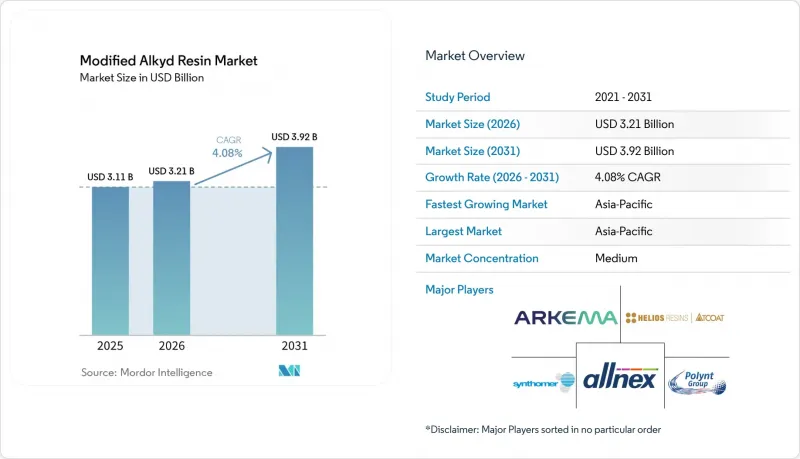
Mordor Intelligence에 의하면, 변성 알키드 수지 시장 규모는 2025년에 31억 1,000만 달러로 평가되었고, 예측 기간(2026-2031년) CAGR 4.08%로 확대될 전망이며, 2026년 32억 1,000만 달러에서 2031년에는 39억 2,000만 달러에 이를 전망입니다.
본 보고서는 유형별(아크릴, 실리콘, 기타), 기술별(용제형, 수성, 기타), 용도별(도료, 접착제 및 실란트, 기타), 최종 사용자 산업별(건축 및 건설, 자동차, 기타), 지역별(아시아태평양, 북미, 유럽, 남미, 중동 및 아프리카)로 분류되어 있습니다. 시장 전망은 금액(달러) 기준으로 제시되어 있습니다.
세계의 변성 알키드 수지 시장 동향 및 인사이트
저VOC 및 수성 도료 배합의 확대
변성 알키드 수지 시장은 배합 제조업체들이 더욱 엄격한 제품 요건을 충족함에 따라 수성 및 저 VOC 도료로 전환되고 있습니다. 도료 사양에서 저배출성이 점점 더 중요시되는 가운데, 기존 용제형 제품이 대상인 고객층이 축소될 가능성이 있으므로 이러한 전환은 중요한 의미를 지닙니다. 수성 알키드 분산액은 광택, 밀착성, 내식성이 향상되어, 전문 사용자들 사이에서 오랫동안 우려되어 온 성능상의 문제를 해결하고 있습니다. 미국 도료 협회(American Coatings Association)는 용제형 알키드 도료에 필적하는 성능을 발휘하도록 설계된, VOC가 거의 제로인 수성 알키드 분산액에 대해 설명하고 있습니다. 촉매 선정과 수지 설계 개선을 통해 도료 제조업체는 건조 성능과 환경 목표 간의 상충 관계를 완화할 수 있게 되었습니다. Arkema는 바이오 성분과 저배출 특성이 필요한 도료용으로 수성 알키드 에멀젼 ‘SYNAQUA 4804’를 포지셔닝하고 있습니다.
건설 및 인프라용 도료 시장의 성장
건설 및 인프라 유지 관리는 강재, 콘크리트, 목재, 외장재에 보호 도료가 필요하기 때문에 변성 알키드 수지 시장의 안정적인 수요를 뒷받침하고 있습니다. 시공업체가 간편한 시공, 신뢰할 수 있는 밀착성, 확립된 도료 시스템을 중시하는 상황에서는 알키드계 배합이 여전히 중요한 역할을 하고 있습니다. 신축 공사는 수요를 창출하는 한편, 성숙한 경제권에서는 개보수 공사도 지속적인 도료 제품 구매를 뒷받침하고 있습니다. 저취 및 수성 알키드계 시스템은 실내 공기질이나 작업 환경이 제품 선정에 영향을 미치는 개보수 프로젝트에서 중요하게 여겨지고 있습니다. 변성 알키드 수지 시장은 장식용 도료와 보호·유지관리용 제품 모두에 공급하고 있어, 특정 건설 활동에 대한 의존도를 낮추고 있습니다. 인프라 정비 사업에서 수요 또한 교통 자산, 공공 건축물, 산업 시설용 프라이머 및 유지관리용 도료를 뒷받침하고 있습니다.
석유화학제품 및 식물성 오일 원료 가격 변동
식물성 오일과 석유화학 중간체는 많은 수지 배합에서 필수적인 성분이기 때문에 원료 가격 변동은 변성 알키드 수지 시장을 제약하는 요인이 됩니다. 농업 공급, 바이오연료 수요, 석유화학 업계의 가동 상황 변화로 인해 원료 조달 예측이 어려워집니다. 이러한 위험에 대한 노출은 규모가 작고, 장기적인 공급 계약이나 후방 통합을 갖추지 않은 생산자일수록 커집니다. 이에 대응하여 배합 제조업체는 여러 식물성 오일 공급원을 확보하거나 대체 가능한 재생 가능 원료를 도입함으로써 대처할 수 있습니다. 폐식용유, 재생 유지, 톨유 유도체 등이 유력한 선택지이지만, 모두 신뢰성 높은 품질 관리가 요구됩니다. 폐식용유 유래 알키드 수지에 관한 연구는 이러한 접근 방식이 연구계의 주목을 받고 있는 이유를 여실히 보여줍니다.
부문 분석
2025년, 아크릴 변성 등급은 변성 알키드 수지 시장 점유율의 28.71%를 차지했습니다. 자외선 내구성, 색상 유지력, 경질 피막 형성 특성 덕분에 건축용 외장 도료 및 산업용 유지보수 용도로의 사용이 뒷받침되고 있습니다. 이러한 특성은 도료가 잦은 습도 변동과 강한 햇빛에 노출되는 남아시아 및 동남아시아에서 중요합니다. 하이브리드 유화 기법을 통해 수성 알키드계 도료의 안정성과 피막 형성의 일관성이 향상되었습니다. 아크릴 개질을 통해 배합 개발자는 알키드 화학 기술을 완전히 포기하지 않으면서도 내후성을 향상시킬 수 있는 검증된 수단을 확보할 수 있습니다. 이러한 입지 덕분에 아크릴계 등급은 외관과 색상 유지가 중요한 표면 보호 용도에서 계속해서 중요한 역할을 수행하고 있습니다. 또한, 이 부문은 도료 배합 개발자 및 시공 업체에게 널리 인지되고 있다는 점도 강점으로 작용하고 있습니다.
우레탄 개질 등급은 2031년까지 연평균 성장률(CAGR) 4.92%를 나타낼 것으로 예측됩니다. 이 등급은 2액 혼합 없이도 빠른 경화, 내마모성 및 유연성을 제공합니다. 이러한 특성은 실용적인 시공 방법이 필요한 인프라 유지보수, 자동차 재도장, 장비용 도료를 뒷받침하고 있습니다. 실리콘 변성 등급은 엔진 케이스나 배기 시스템과 같은 고온 용도에서 여전히 유용합니다. 페놀계 등급은 금속 포장 및 특정 OEM 마감에서 건조성과 내화학성의 이점을 제공합니다. 비닐계 및 폴리아미드계 개질 제품은 인쇄 잉크나 접착력이 중요한 용도에 적합합니다. 생분해성 프란지카르복실산(FDCA)을 기반으로 한 알키드 수지에 대한 연구에서는 불포화도를 높임으로써 턱 프리 시간과 가교성이 향상된다는 사실이 밝혀졌으며, 이는 바이오 하이브리드 성능 소재에 대한 지속적인 연구를 뒷받침하고 있습니다.
2025년 기준, 개질 알키드 수지 시장에서 용제계 시스템의 점유율은 54.33%를 차지했습니다. 이러한 위상은 실외용 도료, 선박용 제품, 접착성과 내식성이 중요한 산업용 배합에서 용제계 시스템이 확고히 자리 잡고 있음을 반영합니다. 많은 시공업체들은 일반적인 기질이나 현장 조건에서 이러한 시스템이 어떻게 작동하는지 잘 알고 있습니다. 이러한 숙련도는 신뢰할 수 있는 결과가 요구되고 기존 공정에 대한 변경을 최소화해야 하는 유지보수 작업에서 여전히 귀중한 자산으로 작용하고 있습니다. 또한, 높은 습도로 인해 수성 도료의 건조가 불안정해지기 쉬운 환경에서도 용제계 제품은 여전히 유용합니다. 호환 가능한 시공 기법이 널리 정착되어 있다는 점이 예측 기간 동안 지속적인 수요를 뒷받침하고 있습니다. 한편, 이 부문은 배출량 감축 및 제품 스튜어드십 향상을 위한 압력이 높아지고 있습니다.
수성 기술은 2031년까지 연평균 성장률(CAGR) 5.39%를 나타낼 것으로 예측되며, 이는 기술 카테고리 중 가장 빠른 속도입니다. 촉매 시스템의 개선과 수지 설계의 진보로 인해 배합 제조업체들은 용제계 제품과의 성능 격차를 좁혀가고 있습니다. Borchers GmbH는 수성 알키드 도료의 건조 특성과 세정성을 향상시키는 것을 목표로 하는 촉매 기술인 ‘OXY-Coat 1101’을 발표했습니다. 고고형분 알키드 수지는 1회 도포당 도막 두께를 유지하면서 용제 사용량을 줄일 수 있는 또 다른 수단이 됩니다. 자외선(UV) 경화형 시스템은 신속한 경화가 필수적인 특수 목재 용도나 산업용도에 적합합니다. 하이브리드형 알키드·폴리우레탄 및 알키드·아크릴 시스템은 단일 성분의 편의성과 더 높은 성능이 요구되는 프로젝트에 대응합니다. 이러한 대체 기술 덕분에 변성 알키드 수지 시장에서 이용 가능한 기술적 선택의 폭이 넓어지고 있습니다.
지역별 분석
아시아태평양은 2025년에 변성 알키드 수지 시장 점유율의 43.88%를 차지했으며, 2031년까지 연평균 성장률(CAGR) 4.77%로 성장했습니다. 이 지역은 활발한 건설 활동, 대규모 생산 능력, 운송 장비 수리 수요, 산업용 유지보수 수요의 혜택을 받고 있습니다. 중국은 건축 및 산업 용도료 수요에 힘입어 이 지역 최대의 소비 거점으로 자리매김했습니다. 인도와 동남아시아 국가들은 인프라 개발 및 산업 확장에 따른 수요를 주도하고 있습니다. 일본과 한국은 기존 수요를 기반으로 하는 비교적 성숙한 시장이지만, 특수 개질 등급 및 수성 시스템이 가치 향상 기회를 제공합니다. 이 지역 전체에서 공급업체들은 배출 규제 강화와 속건성 및 안정적인 도포 성능을 요구하는 고객의 기대 사이에서 균형을 맞추어야 합니다.
북미와 유럽은 변성 알키드 수지 시장에서 다음 주요 수요 거점으로 부상하고 있습니다. 북미 수요는 보수 관련 도장, 자동차 재도장 작업, 휘발성 유기 화합물(VOC) 함량이 낮은 제품으로의 지속적인 전환에 의해 뒷받침되고 있습니다. 유럽의 고객은 제품 스튜어드십, 저배출 시스템, 검증된 지속가능성 주장을 매우 중요하게 여기며, 이 지역은 수성, 고고형분, 바이오 제품 개발에서 중요한 위치를 차지하고 있습니다. 성숙한 시장에서는 신축보다 리모델링 및 유지보수 용도가 우선시되는 경향이 있습니다. 기술적 지침과 신뢰할 수 있는 자료를 제공할 수 있는 공급업체는 전문 도료 고객에 대한 입지를 강화할 수 있습니다. 또한, 두 지역 모두 새로운 수지 배합을 광범위하게 상용화하기 전의 중요한 시험장 역할도 수행하고 있습니다.
남미, 중동 및 아프리카는 현재 시장 규모는 작지만, 변성 알키드 수지 시장에서 여전히 중요한 위치를 차지하고 있습니다. 브라질에서는 주택 건설 및 건설 활동을 통해 건축용 도료 수요가 뒷받침되고 있으나, 현지 원료 사정이 배합의 경제성에 영향을 미칠 수 있습니다. 중동에서는 대규모 건설 프로젝트나 산업 자산에서 철강 및 콘크리트 표면을 보호하는 도료가 요구되고 있습니다. 아프리카의 일부 지역에서도 인프라 개보수나 산업 설비 유지보수에 사용되는 내구성이 높은 제품에 대한 수요가 발생하고 있습니다. 강한 자외선, 고온, 염분, 습기 등의 환경 조건으로 인해 부식 방지 성능과 시공의 신뢰성이 제품 선정의 중요한 요소가 됩니다. 이러한 조건으로 인해 실용적인 시공성과 비용 대비 효과가 높은 보호 성능을 겸비한 변성 알키드 수지에 대한 수요가 계속해서 예상됩니다.
기타 혜택
- 엑셀 형식 시장 예측(ME) 시트
- 3개월간의 애널리스트 지원
자주 묻는 질문
목차
제1장 서론
제2장 조사 방법
제3장 주요 요약
제4장 시장 구도
제5장 시장 규모 및 성장 예측
제6장 경쟁 구도
제7장 시장 기회 및 향후 전망
AJY 26.09.03According to Mordor Intelligence, the modified alkyd resin market size was estimated at USD 3.11 billion in 2025 and is estimated to grow from USD 3.21 billion in 2026 to USD 3.92 billion by 2031, at a CAGR of 4.08% during the forecast period (2026-2031).
This report is Segmented by Type (Acrylic, Silicone, and More), Technology (Solvent-Based, Water-Based, and More), Application (Coatings, Adhesives and Sealants, and More), End-User Industry (Building and Construction, Automotive, and More), and Geography (Asia-Pacific, North America, Europe, South America, and Middle-East and Africa). The Market Forecasts are Provided in Terms of Value (USD).
Global Modified Alkyd Resin Market Trends and Insights
Expansion of Low-VOC and Waterborne Coating Formulations
The modified alkyd resin market is shifting toward waterborne and low-VOC coatings as formulators respond to stricter product requirements. This transition is significant because traditional solvent-based products may face a smaller addressable customer base as coating specifications increasingly prioritize lower emissions. Waterborne alkyd dispersions have improved in gloss, adhesion, and corrosion resistance, addressing a long-standing performance concern among professional users. The American Coatings Association has described near-zero-VOC waterborne alkyd dispersions designed to deliver performance comparable to solventborne alkyds. Improved catalyst selection and resin design are helping coatings producers reduce the trade-off between drying performance and environmental objectives. Arkema positions its SYNAQUA 4804 waterborne alkyd emulsion for paints requiring bio-based content and lower-emission characteristics.
Growth of Construction and Infrastructure Coatings
Construction and infrastructure maintenance support steady consumption in the modified alkyd resin market, as steel, concrete, wood, and exterior trim require protective coatings. Alkyd-based formulations remain relevant where applicators value straightforward application, reliable adhesion, and established coating systems. New construction generates demand, while renovation activity also supports recurring coating purchases in mature economies. Low-odor and waterborne alkyd systems are relevant in renovation projects where indoor air quality and workplace conditions influence product selection. The modified alkyd resin market serves both decorative coatings and protective maintenance products, reducing reliance on any single construction activity. Demand from infrastructure programs also supports primers and maintenance coatings for transport assets, public buildings, and industrial facilities.
Volatility in Petrochemical and Vegetable-Oil Feedstock Prices
Feedstock price volatility constrains the modified alkyd resin market, as vegetable oils and petrochemical intermediates are essential components of many resin formulations. Changes in agricultural supply, biofuel demand, and petrochemical operating conditions make material purchasing less predictable. This exposure is greater for producers that lack scale, long-term supply arrangements, or backward integration. Formulators can respond by qualifying more than one source of vegetable oil or by introducing alternative renewable inputs. Waste cooking oil, recycled fats, and tall oil derivatives are potential options, although each requires reliable quality control. Research on waste cooking oil-derived alkyds illustrates why these pathways are receiving increased research attention.
Other drivers and restraints analyzed in the detailed report include:
- Automotive Refinishing and Transportation Coating Demand
- Demand for Corrosion-Resistant Industrial and Marine Coatings
- VOC and Hazardous-Substance Compliance Costs
For complete list of drivers and restraints, kindly check the Table Of Contents.
Segment Analysis
Acrylic-modified grades held 28.71% of the modified alkyd resin market share in 2025. Their UV durability, color retention, and hard-film properties support use in exterior architectural coatings and industrial maintenance applications. These attributes are relevant in South and Southeast Asia, where coatings face frequent humidity fluctuations and strong sunlight. Hybrid emulsification approaches have improved stability and film formation consistency in waterborne alkyd systems. Acrylic modification provides formulators with an established route to improve weathering performance without fully abandoning alkyd chemistry. This positioning keeps acrylic grades relevant for surface protection applications where appearance and retention matter. The segment also benefits from broad familiarity among coatings formulators and applicators.
Urethane-modified grades are forecast to grow at a CAGR of 4.92% through 2031. They offer faster hardness development, abrasion resistance, and flexibility without requiring two-component mixing. These characteristics support infrastructure maintenance, automotive refinishing, and equipment coatings that require practical application methods. Silicone-modified grades remain useful in high-temperature applications such as engine casings and exhaust systems. Phenolic grades provide drying and chemical-resistance benefits for metal packaging and selected original-equipment finishes. Vinyl and polyamide modifications address printing inks and adhesion-focused uses. A study of bio-renewable furandicarboxylic acid (FDCA)-based alkyds found that greater unsaturation improved tack-free time and cross-linking, supporting continued work on bio-based performance hybrids.
Solvent-based systems held 54.33% of the modified alkyd resin market share in 2025. Their position reflects established use in exterior coatings, marine products, and industrial formulations where adhesion and corrosion resistance are important. Many applicators are familiar with how these systems behave across common substrates and site conditions. This familiarity remains valuable in maintenance work that requires dependable results and minimal changes to existing processes. Solvent-based products can also remain relevant in environments where humidity makes waterborne drying less consistent. The large installed base of compatible application practices supports continued demand during the forecast period. At the same time, the segment faces increasing pressure to reduce emissions and improve product stewardship.
Water-based technology is forecast to grow at a CAGR of 5.39% through 2031, the fastest pace among technology categories. Improved catalyst systems and resin design are helping formulators narrow the performance gap with solvent-based products. Borchers GmbH presents OXY-Coat 1101 as a catalyst technology intended to improve drying behavior and cleanability in waterborne alkyd coatings. High-solids alkyds provide another route for reducing solvent use while maintaining a thicker coating film per coat. Ultraviolet (UV)-curable systems serve specialty wood and industrial uses where fast cure is essential. Hybrid alkyd-polyurethane and alkyd-acrylic systems address projects that require single-component convenience with higher-performance properties. These alternatives expand the technology choices available in the modified alkyd resin market.
Complete Report Scope:
- By Type
- Acrylic
- Silicone
- Urethane
- Vinyl
- Phenolic
- Polyamide
- Other Types
- By Technology
- Solvent-Based
- Water-Based
- High-Solids
- UV/Radiation-Curable
- Hybrid Resin Systems
- By Application
- Coatings
- Adhesives and Sealants
- Printing Inks
- Composites
- Electrical Insulating Coatings
- Composites
- Other Applications
- By End-User Industry
- Building and Construction
- Automotive
- Industrial Equipment
- Marine
- Furniture and Wood Finishing
- Electrical and Electronics
- Consumer Goods
- Other End-User Industries
- By Geography
- Asia-Pacific
- China
- India
- Japan
- South Korea
- Rest of Asia-Pacific
- North America
- United States
- Canada
- Mexico
- Europe
- Germany
- United Kingdom
- France
- Italy
- Russia
- Rest of Europe
- South America
- Brazil
- Argentina
- Rest of South America
- Middle-East and Africa
- Saudi Arabia
- South Africa
- Rest of Middle-East and Africa
- Asia-Pacific
Geography Analysis
Asia-Pacific held 43.88% of the modified alkyd resin market share in 2025 and grew at a CAGR of 4.77% through 2031. The region benefits from high construction activity, significant manufacturing capacity, demand for transportation repairs, and industrial maintenance needs. China is the largest regional consumption center, supported by architectural and industrial coating activity. India and Southeast Asian economies contribute demand from infrastructure development and industrial expansion. Japan and South Korea represent more mature markets with conventional demand, though specialty modified grades and waterborne systems offer opportunities for value growth. Across the region, suppliers must balance lower emission requirements with customer expectations for fast drying and consistent application.
North America and Europe represent the next major demand block for the modified alkyd resin market. North American demand is supported by renovation-related coatings, automotive refinish work, and a continued shift toward lower volatile organic compound (VOC) products. European customers place strong emphasis on product stewardship, lower-emission systems, and verified sustainability claims, making the region important for the development of waterborne, high-solids, and bio-based products. In mature markets, renovation and maintenance applications tend to take precedence over new construction. Suppliers that provide technical guidance and reliable documentation can strengthen their position with professional coatings customers. Both regions also serve as important testing grounds for new resin formulations before wider commercialization.
South America, the Middle-East, and Africa are smaller in current value but remain relevant to the modified alkyd resin market. Brazil supports demand for architectural coatings through housing and construction activity, while local feedstock conditions can influence formulation economics. In the Middle-East, large construction projects and industrial assets require coatings that protect steel and concrete surfaces. Parts of Africa also generate demand for durable products used in infrastructure renewal and industrial maintenance. High ultraviolet exposure, heat, salt, and humidity make corrosion protection and application reliability central to product selection. These conditions support continued demand for modified alkyds that offer practical application and cost-effective protection.
- Allnex GMBH
- Arakawa Chemical Industries,Ltd.
- Arkema
- Ciech Sarzyna S.A.
- Covestro AG
- D.S.V. Chemicals
- Deltech Corporation
- DIC Corporation
- Eternal Materials Co., Ltd.
- HELIOS RESINS
- Macro Polymers
- Polynt S.p.A.
- Spolchemie a.s.
- Synpol Products Private Limited
- Synthomer plc
- Uniform Synthetics
Additional Benefits:
- The market estimate (ME) sheet in Excel format
- 3 months of analyst support
TABLE OF CONTENTS
1 Introduction
- 1.1 Study Assumptions and Market Definition
- 1.2 Scope of the Study
2 Research Methodology
3 Executive Summary
4 Market Landscape
- 4.1 Market Overview
- 4.2 Market Drivers
- 4.2.1 Expansion of Low-VOC and Waterborne Coating Formulations
- 4.2.2 Growth of Construction and Infrastructure Coatings
- 4.2.3 Automotive Refinishing and Transportation Coating Demand
- 4.2.4 Demand for Corrosion-Resistant Industrial and Marine Coatings
- 4.2.5 Bio-Based Feedstock Adoption in Alkyd Resin Formulation
- 4.3 Market Restraints
- 4.3.1 Volatility in Petrochemical and Vegetable-Oil Feedstock Prices
- 4.3.2 VOC and Hazardous-Substance Compliance Costs
- 4.3.3 Drying-Time and Reformulation Trade-Offs in Waterborne Systems
- 4.4 Value Chain Analysis
- 4.5 Porter's Five Forces Analysis
- 4.5.1 Threat of New Entrants
- 4.5.2 Bargaining Power of Suppliers
- 4.5.3 Bargaining Power of Buyers
- 4.5.4 Threat of Substitutes
- 4.5.5 Competitive Rivalry
5 Market Size and Growth Forecasts (Value)
- 5.1 By Type
- 5.1.1 Acrylic
- 5.1.2 Silicone
- 5.1.3 Urethane
- 5.1.4 Vinyl
- 5.1.5 Phenolic
- 5.1.6 Polyamide
- 5.1.7 Other Types
- 5.2 By Technology
- 5.2.1 Solvent-Based
- 5.2.2 Water-Based
- 5.2.3 High-Solids
- 5.2.4 UV/Radiation-Curable
- 5.2.5 Hybrid Resin Systems
- 5.3 By Application
- 5.3.1 Coatings
- 5.3.2 Adhesives and Sealants
- 5.3.3 Printing Inks
- 5.3.4 Composites
- 5.3.5 Electrical Insulating Coatings
- 5.3.6 Composites
- 5.3.7 Other Applications
- 5.4 By End-User Industry
- 5.4.1 Building and Construction
- 5.4.2 Automotive
- 5.4.3 Industrial Equipment
- 5.4.4 Marine
- 5.4.5 Furniture and Wood Finishing
- 5.4.6 Electrical and Electronics
- 5.4.7 Consumer Goods
- 5.4.8 Other End-User Industries
- 5.5 By Geography
- 5.5.1 Asia-Pacific
- 5.5.1.1 China
- 5.5.1.2 India
- 5.5.1.3 Japan
- 5.5.1.4 South Korea
- 5.5.1.5 Rest of Asia-Pacific
- 5.5.2 North America
- 5.5.2.1 United States
- 5.5.2.2 Canada
- 5.5.2.3 Mexico
- 5.5.3 Europe
- 5.5.3.1 Germany
- 5.5.3.2 United Kingdom
- 5.5.3.3 France
- 5.5.3.4 Italy
- 5.5.3.5 Russia
- 5.5.3.6 Rest of Europe
- 5.5.4 South America
- 5.5.4.1 Brazil
- 5.5.4.2 Argentina
- 5.5.4.3 Rest of South America
- 5.5.5 Middle-East and Africa
- 5.5.5.1 Saudi Arabia
- 5.5.5.2 South Africa
- 5.5.5.3 Rest of Middle-East and Africa
- 5.5.1 Asia-Pacific
6 Competitive Landscape
- 6.1 Market Concentration
- 6.2 Strategic Moves
- 6.3 Market Share (%)/Ranking Analysis
- 6.4 Company Profiles (includes Global Overview, Market Overview, Core Segments, Financials as available, Strategic Information, Products and Services, and Recent Developments)
- 6.4.1 Allnex GMBH
- 6.4.2 Arakawa Chemical Industries,Ltd.
- 6.4.3 Arkema
- 6.4.4 Ciech Sarzyna S.A.
- 6.4.5 Covestro AG
- 6.4.6 D.S.V. Chemicals
- 6.4.7 Deltech Corporation
- 6.4.8 DIC Corporation
- 6.4.9 Eternal Materials Co., Ltd.
- 6.4.10 HELIOS RESINS
- 6.4.11 Macro Polymers
- 6.4.12 Polynt S.p.A.
- 6.4.13 Spolchemie a.s.
- 6.4.14 Synpol Products Private Limited
- 6.4.15 Synthomer plc
- 6.4.16 Uniform Synthetics
7 Market Opportunities and Future Outlook
- 7.1 White-Space and Unmet-Need Assessment


