

|
시장보고서
상품코드
2119208
Web3 마케팅 서비스 : 시장 점유율 분석, 업계 동향 및 통계, 성장 예측(2026-2031년)Web3 Marketing Services - Market Share Analysis, Industry Trends & Statistics, Growth Forecasts (2026 - 2031) |
||||||
 Mordor Intelligence
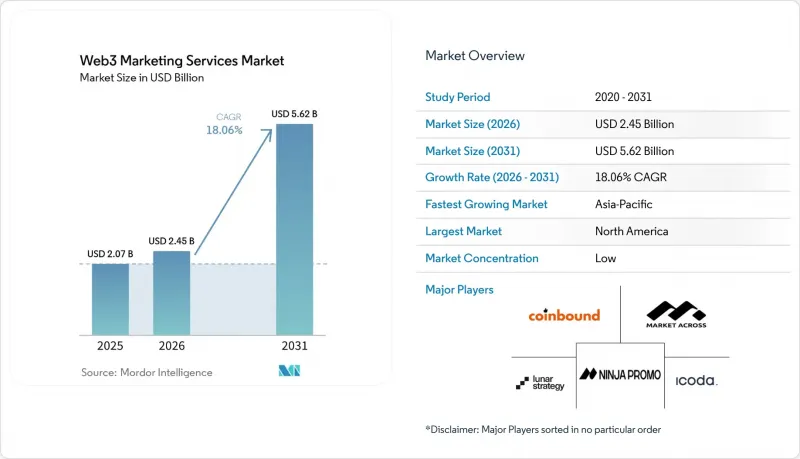
Mordor Intelligence에 의하면, Web3 마케팅 서비스 시장 규모는 2025년에 20억 7,000만 달러로 평가되었습니다. 2026년 24억 5,000만 달러에서 2031년까지 56억 2,000만 달러에 이를 것으로 예상되며, 예측 기간(2026-2031년) CAGR은 18.06%를 나타낼 전망입니다.
본 보고서는 서비스 유형별(커뮤니티 구축·관리, 토큰 기반 캠페인 및 인센티브 프로그램, NFT 기반 참여 및 로열티, Web3 광고 및 퍼포먼스 마케팅 등),최종 사용자별(Web3 인프라 제공업체, 탈중앙화 금융(DeFi) 플랫폼, NFT 및 게임 프로젝트 등), 그리고 지역별로 분류되어 있습니다. 시장 예측은 금액(달러)으로 표시되어 있습니다.
세계의 Web3 마케팅 서비스 시장 동향 및 인사이트
암호자산 네이티브 브랜드의 예산 배분 증가
프로토콜의 트레저리 및 분산형 자율 조직(DAO)은 비정기적인 프로모션 지출에서 공식적인 마케팅 예산으로 전환되고 있으며, 이에 따라 Web3 마케팅 서비스 시장에서 대행사는 리테이너 계약 및 다기간에 걸친 계획 수립을 위한 보다 명확한 근거를 확보할 수 있게 되었습니다. Aave의 거버넌스 기록에는 2025년 행사 및 스폰서십에 75만 달러를 배정하는 내용이 포함되어 있는 반면, Arbitrum의 거버넌스에서는 같은 기간 동안 행사 및 브랜드 활성화에 150만 달러를 배정하는 안건이 검토되었습니다. 이 사례들은 모두 프로모션을 출시 직전의 비용으로 취급하는 것이 아니라, 마케팅 자원을 공개적인 거버넌스 프로세스에 통합하고 있음을 보여줍니다. 토큰 보유자는 자금의 제안된 용도를 면밀히 검토할 수 있으므로, 대행사는 각 캠페인이 프로토콜의 실질적인 목표를 어떻게 지원하는지 설명해야 합니다. 지갑 확보 비용, 총 잠금 가치(TVL) 변동, 추천을 통한 전환율 등은 커뮤니티 심사를 위해 제시할 수 있는 지표의 예입니다. 이러한 지표를 명확한 온체인 성과와 연결할 수 있는 대행사는 창의적인 작업이나 표준적인 총 참여 수만 제공하는 대행사보다 선정될 근거가 더 강력합니다.
지갑 기반 오디언스 타겟팅의 성장
지갑 기반 타겟팅을 통해 캠페인은 브라우저 행동으로 추측된 오디언스가 아닌, 온체인 활동이 확인된 사용자에게 도달할 수 있으므로 Web3 마케팅 서비스 시장에서 중요한 획득 도구로 자리 잡고 있습니다. Addressable사는 자사의 데이터가 7개의 블록체인을 아우르는 2,300만 명 이상의 검증된 지갑 소유자와 450개 이상의 온체인 지표를 포괄한다고 보고했습니다. 2026년 6월, 이 회사는 세계 상위 3위권 암호화폐 거래소가 지갑을 타겟으로 한 캠페인을 통해 3,200건 이상의 고품질 앱 설치를 창출했다고 보고했습니다. 이 보고된 결과는 타겟 오디언스가 이미 암호화폐 제품을 이용하고 있는 경우, 클릭당 비용(CPC)보다 ‘검증된 지갑 연결당 비용’이 더 의미 있을 수 있는 이유를 보여줍니다. 지갑 식별자를 소셜 미디어 프로파일과 대조함으로써, 광고 대행사는 쿠키 기반 추적에 의존하지 않고도 주류 채널에서 암호화폐에 적극적인 타겟층을 리타게팅할 수 있게 됩니다. 또한, 광고 대행사는 프로토콜과의 상호작용, 토큰 보유 현황, 거버넌스 활동 등을 기반으로 타겟층을 정의할 수 있는데, 이는 일반적인 디지털 광고 대행사에서는 쉽게 재현할 수 없는 기능입니다.
플랫폼 및 광고 네트워크의 정책 변동
플랫폼의 광고 규정 변경은 진행 중인 암호화폐 캠페인에 차질을 빚게 하고, 광고 대행사에 시급한 운영 리스크를 초래할 가능성이 있습니다. Google, Meta, TikTok은 2024년부터 2026년 중반에 걸쳐 각각 적어도 한 번씩 암호화폐 및 디지털 자산 광고 관련 정책을 변경한 바 있으며, 광고 대행사는 계정 상태, 타겟팅 대상 목록, 광고 소재 승인 현황을 재확인해야 합니다. 연방거래위원회(FTC)의 ‘권장 지침’은 AI 생성 콘텐츠를 활용한 추천을 포함하여, 소셜 미디어상의 추천에 관한 공개 요건을 규정하고 있습니다. 따라서 대행사는 성과 기반 수수료 체계를 선호하는 클라이언트를 대상으로 플랫폼 규칙과 공개 의무를 동시에 관리해야 하는 경우가 많습니다. 이는 가격 책정을 통해 회수하기 어려운 업무 부담을 가중시킬 뿐만 아니라, 캠페인 성과 예측을 어렵게 만들 가능성이 있습니다. 또한, 광고 지출이 암호화폐 전용 광고 네트워크나 커뮤니티 배포로 이동함에 따라, 단일 주류 플랫폼에 의존하고 있는 대행사의 기회가 줄어들 수도 있습니다.
부문별 분석
2025년, Web3 마케팅 서비스 시장 점유율의 31.26%를 ‘커뮤니티 구축 및 관리’가 차지했습니다. 프로토콜이나 토큰 프로젝트에서 활성 참여자 수, 거버넌스 참여율, Discord에서의 참여도는 토큰의 유동성이나 프로토콜의 채택도를 나타내는 지표가 됩니다. 따라서 커뮤니티 활동은 단순한 커뮤니케이션 보조 기능이 아니라 브랜드 전략의 핵심 요소로 자리 잡았습니다. NFT를 활용한 참여 유도 및 로열티 서비스는 토큰 기반 캠페인 및 인센티브 프로그램과 함께 서비스 구성의 핵심을 차지했습니다. 이러한 서비스는 프로모션 도구인 동시에 제품 기능으로도 작용합니다. 예를 들어, NFT 로열티 크레덴셜은 브랜드를 홍보하는 동시에 수령자에게 검증 가능한 온체인 자산을 제공할 수 있습니다. Web3 광고 및 퍼포먼스 마케팅은 일반적으로 제품 초기 단계에서 측정 가능한 지갑 확보를 우선시하는 프로토콜에 의해 활용됩니다. 홍보, 콘텐츠 제작, 검색 엔진 최적화는 모든 유형의 클라이언트에게 여전히 보완적인 서비스로 자리 잡고 있습니다.
인플루언서 및 크리에이터 마케팅은 2026년부터 2031년까지 연평균 성장률(CAGR) 22.34%를 나타낼 것으로 예측됩니다. 주류 광고 채널은 암호화폐에 익숙한 청중에게 동등한 관련성을 가지고 도달하지 못할 가능성이 있기 때문에 프로토콜은 종종 크리에이터를 활용합니다. Coin Bureau는 2025년에 KOLLAB의 전략적 지분을 취득했는데, 이는 암호화폐 미디어 발굴과 크리에이터 캠페인 실행을 결합하려는 관심을 반영한 것입니다. KOLLAB은 엄선된 250명 이상의 크리에이터와의 제휴 관계와 전 세계 5,000만 명에 가까운 암호화폐 사용자에게 도달하고 있다고 보고하고 있습니다. 크리에이터 프로그램 또한 공시 요건을 포함한 성과 연동형 계약으로 전환되고 있습니다. 이는 유료 프로모션의 기준이 클라이언트와 규제 당국에게 더 명확해질 때, 정액 보상 계약을 대체할 가능성이 있습니다. Web3 마케팅 서비스 업계에서는 브랜드 안전성과 계약상 요건을 충족하면서 국제적인 KOL 네트워크를 활용할 수 있는 대행사가 중요시되고 있습니다. 이러한 역량은 클라이언트가 측정 가능한 성과와 신뢰할 수 있는 암호화폐 커뮤니티에 대한 접근을 요구하는 상황에서 가장 중요해집니다.
지역별 분석
2025년, 북미는 Web3 마케팅 서비스 시장 점유율의 36.72%를 차지했습니다. 이 지역은 집중된 암호화폐 자본 시장, 자금 조달을 완료한 프로토콜, 그리고 확립된 온체인 어트리뷰션 인프라의 혜택을 받고 있습니다. 미국은 이 지역에서 여전히 최대의 국내 시장으로 자리매김했습니다. 블록체인에 대한 벤처 투자, 개인 투자자의 암호화폐 보유, 그리고 X와 유튜브상의 광범위한 KOL 네트워크가 커뮤니티, 광고, 분석 서비스 전반에 걸친 수요를 뒷받침했습니다. 캐나다에서는 규정 준수를 중시하는 성장 전략이 중요한 핀테크와 연계된 블록체인 생태계에서 수요가 추가되었습니다. 멕시코에서는 스페인어권 사용자를 위해 설계된 커뮤니티 구축 서비스에 새로운 기회가 생겼습니다. 이러한 요인들이 결합되어 북미는 Web3 마케팅 서비스 시장에서 주도적인 위치를 유지할 수 있었습니다.
아시아태평양은 2026년부터 2031년까지 연평균 성장률(CAGR) 21.56%로 확대될 것으로 예측됩니다. 한국은 개인 투자자들의 암호화폐 거래가 활발한 시장으로, 업비트(Upbit)나 빗썸(Bithumb) 등 금융정보국(FIU)에 등록된 원화 거래소가 개인 투자자들의 유동성을 집약하고 있습니다. 한국어권 KOL을 활용한 활동이나 카카오 채널을 통한 캠페인은 타겟층의 질이 확인된다면 더 높은 가격 책정이 가능해집니다. 일본에서는 금융청에 의한 체계적인 감독 체제가 갖춰져 있어, 규정 준수를 준수하는 가상화폐 광고는 전문적인 활동으로 자리 잡고 있습니다. 싱가포르의 ‘금융서비스 및 시장법’에 근거한 디지털 토큰 서비스 제공업체(DTSP) 제도는 2025년 6월 30일에 시행되었습니다. 이 제도는 해외 고객에게 서비스를 제공하는 싱가포르 법인에 대한 요건을 규정함과 동시에, 규정 준수가 대행사의 포지셔닝에 영향을 미치는 지역 허브로서 싱가포르의 역할을 강화했습니다.
유럽 시장은 성숙 단계에 이르렀으나, 유럽연합(EU)의 ‘암호자산 시장 규제(MiCA)’에 따른 규정 준수 요건에 의해 재편되고 있습니다. 이 프레임워크를 통해 암호자산 서비스 제공업체로서의 요건을 충족하는 캠페인 인프라를 갖춘 대행사와 그렇지 않은 대행사 간에 명확한 구분이 마련되었습니다. 독일과 프랑스는 유럽 대륙 수요를 뒷받침했으나, 영국은 독자적인 금융행위감독청(FCA)에 의한 금융 홍보 체계를 유지했습니다. 이로 인해 유럽 시장 전반에서 사업을 전개하는 대행사에게는 이중적인 규정 준수 환경이 조성되고 있습니다. 남미에서는 브라질이 스마트폰 보급, Pix 결제를 기반으로 한 개인용 암호화폐 거래, 그리고 확대되는 탈중앙화 금융(DeFi) 활동을 통해 새로운 비즈니스 기회를 창출하고 있습니다. 중동 및 아프리카는 여전히 초기 단계에 머물러 있지만, 두바이와 아부다비에서는 프로토콜 본사 유치 움직임이 활발해지면서 영어 및 아랍어로 제공되는 KOL(키 오피니언 리더) 및 홍보 서비스에 대한 수요가 증가하고 있습니다. 남아프리카는 발전 중인 사하라 이남 생태계에서 핵심적인 위치를 계속 차지하고 있으며, Web3 마케팅 서비스 시장에서는 현지 언어 및 규정 준수 관련 지식이 중요해지고 있습니다.
기타 혜택 :
- 엑셀 형식 시장 예측(ME) 시트
- 3개월간의 애널리스트 지원
자주 묻는 질문
목차
제1장 서론
제2장 조사 방법
제3장 개요
제4장 시장 구도
제5장 시장 규모 및 성장 예측
제6장 경쟁 구도
제7장 시장 기회 및 향후 전망
KTH 26.09.02According to Mordor Intelligence, the web3 marketing services market size was valued at USD 2.07 billion in 2025 and is estimated to grow from USD 2.45 billion in 2026 to reach USD 5.62 billion by 2031, at a CAGR of 18.06% during the forecast period (2026-2031).
This report is Segmented by Service Type (Community Building and Management, Token-Based Campaigns and Incentives Programs, NFT-Based Engagement and Loyalty, Web3 Advertising and Performance Marketing, and More), by End User (Web3 Infrastructure Providers, Decentralized Finance Platforms, NFT and Gaming Projects, and More), and Geography. The Market Forecasts are Provided in Terms of Value (USD).
Global Web3 Marketing Services Market Trends and Insights
Rising Crypto-Native Brand Budget Allocation
Protocol treasuries and decentralized autonomous organizations have moved from irregular promotion spending toward formal marketing budgets, which gives agencies a clearer basis for retainer work and multi-period planning in the Web3 marketing services market. Aave governance records included a USD 750,000 allocation for events and sponsorships in 2025, while Arbitrum governance considered a USD 1.5 million events and brand activation allocation for the same cycle. Both examples place marketing resources within a public governance process instead of treating promotion as a last-minute launch expense. Token holders can review the proposed use of funds, so agencies must explain how each campaign supports practical protocol objectives. Wallet acquisition costs, changes in total value locked, and referral conversions are examples of measures that can be presented for community review. An agency that can connect these measures to clear on-chain outcomes has a stronger basis for selection than one that provides only creative work or standard engagement totals.
Growth of Wallet-Based Audience Targeting
Wallet-based targeting allows campaigns to reach users with verified on-chain activity instead of audiences inferred from browser behavior, making it an important acquisition tool in the Web3 marketing services market. Addressable reported that its data covered more than 23 million matched wallet owners across 7 blockchains and more than 450 on-chain metrics. In June 2026, it reported that a top-3 global crypto exchange generated more than 3,200 quality application installs through a wallet-targeted campaign. The reported result shows why the cost per verified wallet connection can be more meaningful than the cost per click when the intended audience already uses crypto products. Wallet identifiers can be matched to social media profiles, allowing agencies to retarget crypto-active audiences on mainstream channels without relying on cookie-based tracking. Agencies can also define audiences by protocol interactions, token holdings, or governance activity, giving them a capability that general digital agencies may not readily reproduce.
Platform and Ad Network Policy Volatility
Changes to platform advertising rules can disrupt live crypto campaigns and pose immediate operational risk for agencies. Google, Meta, and TikTok each changed policies for crypto and digital asset advertising at least once between 2024 and mid-2026, requiring agencies to revisit account conditions, audience lists, and creative approvals. The Federal Trade Commission's Endorsement Guides set disclosure expectations for social media endorsements, including endorsements that use AI-generated content. Agencies must therefore manage platform rules and disclosure obligations simultaneously, often for clients who prefer performance-based fees. This adds work that may be difficult to recover through pricing and can make campaign delivery less predictable. It can also shift spending toward crypto-native ad networks and community distribution, reducing the opportunity for agencies dependent on a single mainstream platform.
Other drivers and restraints analyzed in the detailed report include:
- Expansion of On-Chain Attribution and Analytics
- Token-Gated Community Monetization
- Attribution Gaps Across Wallet and Off-Chain Journeys
For complete list of drivers and restraints, kindly check the Table Of Contents.
Segment Analysis
Community Building and Management accounted for 31.26% of the Web3 marketing services market share in 2025. For protocols and token projects, active participants, governance turnout, and Discord engagement can indicate token liquidity and protocol adoption. This makes community activity a primary part of brand strategy rather than a supporting communication function. NFT-Based Engagement and Loyalty services, along with Token-Based Campaigns and Incentives Programs, occupied the middle of the service mix. These offerings can serve as promotional tools and product features simultaneously. An NFT loyalty credential, for example, can promote a brand while giving the recipient a verifiable on-chain asset. Web3 Advertising and Performance Marketing is generally used by protocols that prioritize measurable wallet acquisition during earlier product stages. Public relations, content production, and search engine optimization remain supporting services across client types.
Influencer and Creator Marketing is projected to expand at a CAGR of 22.34% from 2026 to 2031. Protocols often use creators because mainstream advertising channels may not reach crypto-native audiences with the same level of relevance. Coin Bureau acquired a strategic stake in KOLLAB in 2025, reflecting its interest in combining crypto media discovery with creator campaign execution. The KOLLAB reported more than 250 curated creator relationships and a reach of nearly 50 million crypto users globally. Creator programs are also shifting toward performance-linked agreements that include disclosure requirements. This can replace flat-fee arrangements when paid promotion standards become more visible to clients and regulators. The Web3 marketing services industry favors agencies that can activate international KOL networks while meeting brand-safety and contracting expectations. These capabilities matter most where clients seek measurable results and access to trusted crypto communities.
Complete Report Scope:
- By Service Type
- Community Building and Management
- Token-Based Campaigns and Incentives Programs
- NFT-Based Engagement and Loyalty
- Web3 Advertising and Performance Marketing
- Influencer and Creator Marketing
- Other Service Types
- By End User
- Web3 Infrastructure Providers
- Decentralized Finance Platforms
- NFT and Gaming Projects
- Traditional Enterprises and Consumer Brands
- Other End Users
- By Geography
- North America
- United States
- Canada
- Mexico
- South America
- Brazil
- Argentina
- Chile
- Rest of South America
- Europe
- Germany
- United Kingdom
- France
- Italy
- Spain
- Rest of Europe
- Asia-Pacific
- China
- Japan
- India
- South Korea
- Australia
- Rest of Asia-Pacific
- Middle East and Africa
- United Arab Emirates
- Saudi Arabia
- South Africa
- Rest of Middle East and Africa
- North America
Geography Analysis
North America accounted for 36.72% of the Web3 marketing services market share in 2025. The region benefits from concentrated crypto capital markets, funded protocols, and established on-chain attribution infrastructure. The United States remained the largest national market in the region. Blockchain venture investment, retail crypto ownership, and extensive KOL networks on X and YouTube supported demand across community, advertising, and analytics services. Canada added demand from a fintech-adjacent blockchain ecosystem where compliance-focused growth work is relevant. Mexico created a separate opportunity for community-building services designed for Spanish-language audiences. Together, these factors helped North America retain a leading position in the Web3 marketing services market.
Asia-Pacific is projected to expand at a CAGR of 21.56% from 2026 to 2031. South Korea is a high-intensity retail crypto setting, where Financial Intelligence Unit-registered won-denominated exchanges, including Upbit and Bithumb, concentrate retail liquidity. Korean-language KOL work and Kakao channel campaigns can carry higher prices when audience quality is verified. Japan has structured oversight under the Financial Services Agency, which makes compliant crypto advertising a specialized activity. Singapore's Digital Token Service Provider regime under the Financial Services and Markets Act took effect on June 30, 2025. The regime addressed requirements for Singapore-incorporated firms serving overseas clients and reinforced the city-state's role as a regional hub where compliance affects agency positioning.
Europe is mature but has been reshaped by compliance requirements under the European Union's Markets in Crypto-Assets Regulation. The framework separated agencies with crypto-asset service provider-ready campaign infrastructure from those without. Germany and France supported continental demand, while the United Kingdom retained a separate Financial Conduct Authority financial promotions framework. This creates a dual-compliance environment for agencies operating across European markets. In South America, Brazil has created a developing opportunity through smartphone use, retail crypto activity supported by Pix payments, and increasing decentralized finance activity. The Middle East and Africa remained at an earlier stage, although Dubai and Abu Dhabi attracted protocol headquarters and demand for English- and Arabic-language KOL and public relations services. South Africa remained an anchor for the developing sub-Saharan ecosystem, making regional language and compliance knowledge important for the Web3 marketing services market.
- Coinbound, LLC
- Lunar Strategy B.V.
- Blockchain Marketing Ninja
- MarketAcross Ltd.
- ReBlonde Ltd.
- Coinpresso
- NinjaPromo Ltd.
- ICODA
- Solus Agency
- Coinband
- Blockwiz
- CryptoVirally
- CryptoPR
- FINPR
- Buzz Dealer
- GuerrillaBuzz
- Flexe.io
- Hype Partners Ltd.
- Omni Agency
- Crynet
- Proleo.io
Additional Benefits:
- The market estimate (ME) sheet in Excel format
- 3 months of analyst support
TABLE OF CONTENTS
1 INTRODUCTION
- 1.1 Study Assumptions and Market Definition
- 1.2 Scope of the Study
2 RESEARCH METHODOLOGY
3 EXECUTIVE SUMMARY
4 MARKET LANDSCAPE
- 4.1 Market Overview
- 4.2 Market Drivers
- 4.2.1 Rising Crypto Native Brand Budget Allocation
- 4.2.2 Growth of Wallet Based Audience Targeting
- 4.2.3 Expansion of On-Chain Attribution and Analytics
- 4.2.4 Token-Gated Community Monetization
- 4.2.5 Metaverse and Virtual Event Brand Activation
- 4.2.6 Compliance First Web3 Growth Specialist Demand
- 4.3 Market Restraints
- 4.3.1 Platform and Ad Network Policy Volatility
- 4.3.2 Attribution Gaps Across Wallet and Off-Chain Journeys
- 4.3.3 Budget Pullback After Token and NFT Demand Cooling
- 4.3.4 Regulatory Sensitivity Around Crypto Promotions
- 4.4 Impact of Macroeconomic Factors on the Market
- 4.5 Industry Value Chain Analysis
- 4.6 Regulatory Landscape
- 4.7 Technological Outlook
- 4.8 Porter's Five Forces Analysis
- 4.8.1 Threat of New Entrants
- 4.8.2 Bargaining Power of Suppliers
- 4.8.3 Bargaining Power of Buyers
- 4.8.4 Threat of Substitutes
- 4.8.5 Intensity of Competitive Rivalry
5 MARKET SIZE AND GROWTH FORECASTS (VALUE)
- 5.1 By Service Type
- 5.1.1 Community Building and Management
- 5.1.2 Token-Based Campaigns and Incentives Programs
- 5.1.3 NFT-Based Engagement and Loyalty
- 5.1.4 Web3 Advertising and Performance Marketing
- 5.1.5 Influencer and Creator Marketing
- 5.1.6 Other Service Types
- 5.2 By End User
- 5.2.1 Web3 Infrastructure Providers
- 5.2.2 Decentralized Finance Platforms
- 5.2.3 NFT and Gaming Projects
- 5.2.4 Traditional Enterprises and Consumer Brands
- 5.2.5 Other End Users
- 5.3 By Geography
- 5.3.1 North America
- 5.3.1.1 United States
- 5.3.1.2 Canada
- 5.3.1.3 Mexico
- 5.3.2 South America
- 5.3.2.1 Brazil
- 5.3.2.2 Argentina
- 5.3.2.3 Chile
- 5.3.2.4 Rest of South America
- 5.3.3 Europe
- 5.3.3.1 Germany
- 5.3.3.2 United Kingdom
- 5.3.3.3 France
- 5.3.3.4 Italy
- 5.3.3.5 Spain
- 5.3.3.6 Rest of Europe
- 5.3.4 Asia-Pacific
- 5.3.4.1 China
- 5.3.4.2 Japan
- 5.3.4.3 India
- 5.3.4.4 South Korea
- 5.3.4.5 Australia
- 5.3.4.6 Rest of Asia-Pacific
- 5.3.5 Middle East and Africa
- 5.3.5.1 United Arab Emirates
- 5.3.5.2 Saudi Arabia
- 5.3.5.3 South Africa
- 5.3.5.4 Rest of Middle East and Africa
- 5.3.1 North America
6 COMPETITIVE LANDSCAPE
- 6.1 Market Concentration
- 6.2 Strategic Moves
- 6.3 Market Share Analysis
- 6.4 Company Profiles (includes Global Level Overview, Market Level Overview, Core Segments, Financials as available, Strategic Information, Market Rank/Share, Products and Services, Recent Developments)
- 6.4.1 Coinbound, LLC
- 6.4.2 Lunar Strategy B.V.
- 6.4.3 Blockchain Marketing Ninja
- 6.4.4 MarketAcross Ltd.
- 6.4.5 ReBlonde Ltd.
- 6.4.6 Coinpresso
- 6.4.7 NinjaPromo Ltd.
- 6.4.8 ICODA
- 6.4.9 Solus Agency
- 6.4.10 Coinband
- 6.4.11 Blockwiz
- 6.4.12 CryptoVirally
- 6.4.13 CryptoPR
- 6.4.14 FINPR
- 6.4.15 Buzz Dealer
- 6.4.16 GuerrillaBuzz
- 6.4.17 Flexe.io
- 6.4.18 Hype Partners Ltd.
- 6.4.19 Omni Agency
- 6.4.20 Crynet
- 6.4.21 Proleo.io
7 MARKET OPPORTUNITIES AND FUTURE OUTLOOK
- 7.1 White-Space and Unmet-Need Assessment


