

|
시장보고서
상품코드
2119214
석유 및 가스 갱정 개재 유선 압력 제어 장비 시장 : 시장 점유율 분석, 업계 동향 및 통계, 성장 예측(2026-2031년)Oil and Gas Well Intervention Wireline Pressure Control Equipment - Market Share Analysis, Industry Trends & Statistics, Growth Forecasts (2026 - 2031) |
||||||
 Mordor Intelligence
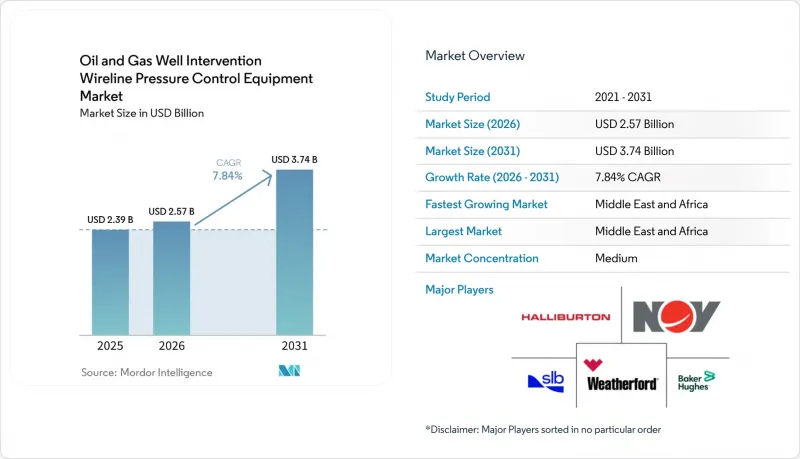
Mordor Intelligence에 의하면, 석유 및 가스 갱정 개재 유선 압력 제어 장비 시장 규모는 2025년 23억 9,000만 달러로 평가되었고, 2026년에는 25억 7,000만 달러로 추정되고, 2026-2031년 CAGR 7.84%로 성장을 지속할 전망이며, 2031년까지 37억 4,000만 달러에 이를 것으로 예측됩니다.
본 보고서는 장비 유형별(윤활 장치 및 그리스 주입 시스템, 와이어라인 압력 제어·안전 시스템, 기타), 내압 등급별(표준, 고압, 기타), 용도별(생산 시추 및 모니터링, 기타), 지역별(북미, 유럽, 아시아태평양, 남미, 중동 및 아프리카)로 분류되어 있습니다. 시장 전망은 금액(달러) 기준으로 제시되어 있습니다.
세계의 석유 및 가스 갱정 개재 유선 압력 제어 장비 시장 동향 및 인사이트
성숙 유정에서의 개입 작업 빈도
2030년까지 전 세계 생산 유정의 3분의 2 이상이 가동 개시 후 10년을 초과할 것으로 예상되며, 이에 따라 건전성 평가, 생산 지층 조사, 기계적 수리에 대한 수요가 증가하고 있습니다. 유선 압력 제어 장비 시장은 시추 장비 수보다 개입 빈도와 더 밀접한 관련이 있어, 이를 통해 시추 활동의 변화에 대한 일정한 내성을 확보하고 있습니다. 중동에서는 2025년에 석유 및 가스 공급에 대한 투자로 1,300억 달러(전 세계 총액의 15%)가 투입되었으며, 그 투자 기반의 일부를 성숙 유전 지원이 차지했습니다. 시추 작업 증가에 따라 지표면용 배리어 부품의 사용이 늘어나고, 스택 어셈블리의 교체 및 재인증 주기가 단축될 가능성이 있습니다. 이러한 추세는 추가 시추 장비의 동원을 필요로 하지 않으면서도 장비에 대한 정기적인 수요와 개조 수요를 뒷받침합니다. 또한, 신규 시추 프로그램에만 의존하는 제품 라인에 비해 제조업체에게 더 안정적인 수익원이 됩니다.
비전통 및 타이트 저류층 유정 서비스
북미의 비전통 유전에서 장거리 수평 시추공의 경우, 가혹한 지표면 압력 하에서 펌프 다운 유체 주입 및 다단계 천공에 대응할 수 있는 설비가 요구됩니다. 심부 고압·고온(HPHT) 타이트 저류층 프로그램에 관한 SPE 논문에서는 490바의 압력 차에서 작동하는 외경 0.28인치의 폴리머 락 방식 와이어라인 케이블(MP35N 사워 서비스용 아머 장착)에 대해 기술하고 있습니다. 이러한 조건에서는 기존 방식의 윤활 및 씰에 큰 부하가 가해지기 때문에 팩오프 방식의 그리스리스 시스템 채택이 권장됩니다. 포럼 에너지 테크놀로지스는 2025년 말 기준 수주 잔고가 같은 해 초 대비 46% 증가했다고 보고했으며, 그 원인 중 하나로 북미의 완공 공사 및 국제 개발 프로그램에서 발생한 와이어라인 케이블 수주를 꼽았습니다. 또한, 사업자가 기존 유정의 생산 회복에서 경제적 이점을 발견할 경우, 재파쇄 작업도 고사양 장비에 대한 투자를 촉진합니다. 신규 유정 시추를 대체하는 수단으로 개입 작업이 선택될 경우, 와이어라인용 압력 제어 장비 시장은 그 혜택을 받게 됩니다.
업스트림 부문의 설비 투자 주기성
설비 발주는 일반적으로 시추 장비 계약 승인이나 유전 개발의 주요 단계에 뒤따르기 때문에 원유 가격 변동에 대한 반응은 6-12개월 정도 늦어질 수 있습니다. 국제에너지기구(IEA) 보고서에 따르면, 걸프협력회의(GCC) 지역 외의 투자, 특히 비 OPEC 회원국인 아프리카와 라틴아메리카의 투자는 여전히 유가 조정의 영향을 받기 쉬운 상황입니다. 웨더포드(Weatherford)는 지정학적 긴장 고조를 배경으로 2026년 2분기 실적 발표에서 중동의 와이어라인 활동 감소를 보고했습니다. 사업자가 현장 작업을 연기하면 신규 설비 발주를 미루고 기존 자산을 더 오랫동안 계속 사용하게 됩니다. 이로 인해 갱신 주기에 의존하는 전문 공급업체의 개보수 프로젝트 수가 감소합니다. 와이어라인용 압력 제어 장비 시장은 유지보수 작업이 어느 정도 버팀목이 되고 있는 경우에도 여전히 이러한 위험에 노출되어 있습니다.
부문 분석
2025년, 유선 압력 제어 장비 시장에서 윤활 장치와 그리스 주입 시스템은 매출 점유율의 32.2%를 차지했습니다. 라이브웰 방식의 와이어라인 작업에서는 툴 스트링을 안전하게 투입 및 회수하기 위해 매번 내압성 윤활 장치 스트링이 필요합니다. 이러한 요건으로 인해 해당 카테고리는 일상적인 일렉트릭 라인 및 슬릭 라인 작업의 핵심을 이루고 있습니다. 폴리머 재킷이 적용된 그리스리스 케이블이나 팩오프 방식의 씰링 기술이 보급되면서 기존 그리스 주입 방식에 대한 의존도가 낮아지고 있어, 해당 분야의 도입 실적이 변화하고 있습니다. SLB는 ‘StreamLine’ 폴리머 락 방식 와이어라인 케이블을 제공하고 있으며, Forum Energy Technologies는 ‘Enviro-Lite E-Line’ 그리스리스 케이블을 제공합니다.
유선 압력 제어 장비 시장에서 윤활 장치와 그리스 주입 시스템은 2026-2031년 연평균 성장률(CAGR) 8.6%를 나타낼 것으로 예측됩니다. 와이어라인 압력 제어 및 안전 시스템과 스태핑 박스 어셈블리는 유정의 압력 장벽을 보호하는 환형 씰 기능을 제공합니다. 개입용 유량 제어 장비와 압력 제어용 액세서리는 스택 전체에 걸쳐 유체와 압력을 관리합니다. 디지털 계측 기능을 갖춘 기종은 유정 입구의 압력 및 온도 정보를 원격 제어 센터로 전송할 수 있습니다. 제공된 자료에 따르면, 리그업 시간을 단축하고 현장 유지보수를 간소화할 수 있는 모듈식 액세서리로의 전환이 진행되고 있는 것으로 나타났습니다.
지역별 분석
중동 및 아프리카는 2025년 유선 압력 제어 장비 시장의 33.8% 점유율을 차지했으며, 2031년까지 연평균 성장률(CAGR) 8.3%를 나타낼 것으로 예측됩니다. 이러한 상황은 활발한 심부 가스 및 타이트 탄산염암 프로젝트, 성숙 유전에서의 지속적인 작업, 서아프리카의 해체 요구 사항 증가를 반영합니다. 국제에너지기구(IEA)의 기록에 따르면, 2025년 중동의 석유 및 가스 공급에 대한 투자액은 1,300억 달러에 달했습니다. 사우디 아람코는 2026년 설비 투자 전망으로 500억-550억 달러를 제시하며, 그 중 65-70%가 업스트림 부문의 탐사 및 생산에 할당될 것이라고 밝혔습니다. 마르잔, 줄프, 자프라 각 프로젝트에서는 지속적인 개입 작업이 필요하며, 이것이 HPHT 장비 수요를 뒷받침하고 있습니다.
북미는 퍼미안, 헤인즈빌, 몬토니 각 유전에서 활발한 개입 활동으로 인해 2025년에도 계속해서 중요한 수익원이 되었습니다. 메탄 배출 규제로 인해 계약업체들은 제로 벤트형 윤활 장치 및 폐쇄 루프식 압력 제어 시스템의 도입을 촉진하고 있습니다. 유럽의 상황은 주로 북해의 기존 유전에 대한 폐쇄 조치에 의해 좌우되고 있습니다. 북해 전환청(North Sea Transition Authority)은 향후 10년 동안 1,000개의 유정이 영구적으로 봉쇄될 것으로 전망하고 있습니다. Expro는 자사의 ‘Solus’ 밸브가 2026년 2월 상용화에 앞서 북해의 유정 폐쇄(P&A) 작업에 채택되었다고 발표했습니다.
아시아태평양에서는 인도네시아, 말레이시아, 인도, 중국에서 표준 압력 개입 작업이 상당한 규모로 진행되고 있습니다. 또한 심부 가스 및 타이트 지층용 프로젝트로 인해 고정격 시스템에 대한 수요도 증가하고 있습니다. 유선 압력 제어 장비 시장에서 남미에서는 브라질의 고사양 프레스올트층 작업 외에도 콜롬비아, 가이아나, 아르헨티나의 성숙한 육상 유전에서 안정적인 수요가 나타나고 있습니다. 웨더포드(Weatherford)의 브라질 계약은 캄포스와 에스피리토 산토 해역에서의 해양 개입 및 P&A 장비의 지속적인 사용을 보여줍니다.
기타 혜택
- 엑셀 형식 시장 예측(ME) 시트
- 3개월간의 애널리스트 지원
자주 묻는 질문
목차
제1장 서론
제2장 조사 방법
제3장 주요 요약
제4장 시장 구도
제5장 시장 규모 및 성장 예측
제6장 경쟁 구도
제7장 시장 기회 및 향후 전망
AJY 26.09.03According to Mordor Intelligence, the oil and gas well intervention wireline pressure control equipment market size is expected to grow from USD 2.39 billion in 2025 to USD 2.57 billion in 2026 and is forecast to reach USD 3.74 billion by 2031 at 7.84% CAGR over 2026-2031.
This report is Segmented by Equipment Type (Lubricators, Safety Systems, and More), Pressure Rating (Standard, High Pressure, and More), Application (Production Logging, and More), and Geography (North America, Europe, Asia-Pacific, South America, and Middle East and Africa). The Market Forecasts are Provided in Terms of Value (USD).
Global Oil and Gas Well Intervention Wireline Pressure Control Equipment Market Trends and Insights
Mature-Well Intervention Intensity
More than two-thirds of producing wells globally are expected to exceed 10 years of age by 2030, creating a growing requirement for integrity evaluations, production logging, and mechanical remediation . The wireline pressure control equipment market is tied more closely to intervention frequency than to rig counts, which provides some protection from changes in drilling activity. The Middle East directed USD 130 billion to oil and gas supply investment in 2025, or 15% of the global total, and mature-field support formed part of that investment base. More well work increases the use of surface barrier components and can shorten the replacement and recertification cycle for stack assemblies. This pattern supports recurring equipment and refurbishment demand without requiring additional rig mobilization. It also gives manufacturers a steadier source of revenue than product lines that depend only on new drilling programs.
Unconventional and Tight-Reservoir Well Servicing
Long horizontal wells in North American unconventional fields require equipment that can support pump-down delivery and multistage perforating at demanding surface pressures. An SPE paper on a deep HPHT tight-reservoir program described a 0.28-in OD polymer-locked wireline cable with MP35N sour-service armor operating at a 490-bar pressure differential . Such conditions place greater strain on conventional lubrication and sealing, and support the use of packoff-based greaseless systems. Forum Energy Technologies reported that its backlog at the end of 2025 was 46% above the start of that year, supported in part by wireline cable orders from North American completions and international development programs . Refracturing work also supports investment in high-specification equipment when operators see an economic case for restoring production from existing wells. The wireline pressure control equipment market benefits when intervention work is selected as an alternative to drilling a new well.
Upstream Capital-Spending Cyclicality
Equipment orders usually follow rig-contract approvals and field-development milestones, so the response to changes in oil prices can be delayed by 6-12 months. The IEA reported that investment outside the Gulf Cooperation Council remains more exposed to oil-price corrections, particularly in non-OPEC Africa and Latin America . Weatherford reported lower Middle East wireline activity in its second-quarter 2026 results amid heightened geopolitical tensions. When operators delay field work, they can defer new equipment orders and retain installed assets longer. This weakens refurbishment volumes for specialist suppliers that rely on replacement cycles. The wireline pressure control equipment market remains exposed to this risk even where maintenance work provides a degree of support.
Other drivers and restraints analyzed in the detailed report include:
- Offshore and Deepwater Well Access
- High-Pressure, High-Temperature Well Complexity
- Stringent Pressure-Equipment Qualification Requirements
For complete list of drivers and restraints, kindly check the Table Of Contents.
Segment Analysis
Lubricators and Grease Injection Systems held 32.2% revenue share in 2025 within the wireline pressure control equipment market. Every live-well wireline run requires a pressure-bearing lubricator string to introduce and retrieve the tool string safely. This requirement makes the category a core part of routine electric-line and slickline work. Its installed base is changing as polymer-jacket greaseless cables and packoff-based sealing reduce reliance on conventional grease-injection configurations. SLB offers the StreamLine polymer-locked wireline cable, while Forum Energy Technologies offers the Enviro-Lite E-Line greaseless cable.
Within the wireline pressure control equipment market, Lubricators and Grease Injection Systems are projected to grow at an 8.6% CAGR from 2026 to 2031. Wireline Pressure Control and Safety Systems and Stuffing Box Assemblies provide the annular sealing function that protects the wellbore pressure barrier. Intervention Flow Control Equipment and Pressure Control Accessories manage fluids and pressure across the stack. Digitally instrumented variants can transmit wellhead pressure and temperature information to remote operations centers. The supplied material indicates a move toward modular accessories that can reduce rig-up time and simplify field servicing.
Complete Report Scope:
- By Equipment Type
- Lubricators and Grease Injection Systems
- Wireline Pressure Control and Safety Systems
- Stuffing Box Assemblies
- Intervention Flow Control Equipment
- Pressure Control Accessories
- By Pressure Rating Class
- Standard Pressure (5,000-10,000 psi)
- High Pressure (10,001-15,000 psi)
- HPHT / Extreme Service Applications
- By Application
- Production Logging and Monitoring
- Perforation and Stimulation
- Mechanical Interventions
- Well Abandonment and P&A
- By Geography
- North America
- United States
- Canada
- Mexico
- Europe
- United Kingdom
- Norway
- Netherlands
- Denmark
- Rest of Europe
- Asia-Pacific
- China
- India
- Australia
- ASEAN Countries
- Rest of Asia-Pacific
- South America
- Brazil
- Argentina
- Colombia
- Guyana
- Rest of South America
- Middle East and Africa
- Saudi Arabia
- United Arab Emirates
- Kuwait
- Qatar
- Oman
- Nigeria
- Angola
- Egypt
- North America
Geography Analysis
The Middle East and Africa held 33.8% of the wireline pressure control equipment market share in 2025 and is expected to grow at an 8.3% CAGR through 2031. This position reflects active deep-gas and tight-carbonate projects, continued mature-field work, and rising decommissioning requirements in West Africa. The IEA recorded USD 130 billion of oil and gas supply investment in the Middle East in 2025. Saudi Aramco provided 2026 capital-expenditure guidance of USD 50-55 billion and stated that 65-70% would be directed to upstream exploration and production. Marjan, Zuluf, and Jafurah's activity requires sustained intervention work and supports demand for HPHT equipment.
North America remained an important revenue contributor in 2025 because of high intervention activity in the Permian, Haynesville, and Montney plays. Methane-control requirements encourage contractors to use zero-venting lubricators and closed-loop pressure-control systems. Europe is shaped largely by North Sea brownfield decommissioning. The North Sea Transition Authority expects 1,000 wells to be permanently plugged over the coming decade. Expro stated that its Solus valve was used in a North Sea P&A campaign before its February 2026 commercial release.
Asia-Pacific has a substantial base of standard-pressure intervention work in Indonesia, Malaysia, India, and China. Deep-gas and tight-formation programs are also increasing demand for higher-rated systems. In the wireline pressure control equipment market, South America combines Brazil's high-specification pre-salt work with steady demand from mature onshore fields in Colombia, Guyana, and Argentina. Weatherford's Brazil contracts demonstrate continued use of offshore intervention and P&A equipment in Campos and Espirito Santo.
- Baker Hughes Company
- Brace Tool, Inc.
- Expro Group Holdings N.V.
- FHE USA, LLC
- Forum Energy Technologies, Inc.
- GKD Industries Ltd.
- Halliburton Company
- Hunting PLC
- Integrated Equipment Services, LLC
- NOV Inc.
- NXL Technologies, Inc.
- PROBUS Maschinenbau GmbH
- RMZ Oilfield Engineering LLC
- Schlumberger Limited
- TIS Manufacturing Ltd.
- Weatherford International plc
Additional Benefits:
- The market estimate (ME) sheet in Excel format
- 3 months of analyst support
TABLE OF CONTENTS
1 INTRODUCTION
- 1.1 Study Assumptions and Market Definition
- 1.2 Scope of the Study
2 RESEARCH METHODOLOGY
3 EXECUTIVE SUMMARY
4 MARKET LANDSCAPE
- 4.1 Market Overview
- 4.2 Market Drivers
- 4.2.1 Mature-Well Intervention Intensity
- 4.2.2 Unconventional and Tight-Reservoir Well Servicing
- 4.2.3 Offshore and Deepwater Well Access
- 4.2.4 High-Pressure, High-Temperature Well Complexity
- 4.2.5 Remote Certification and Digital Asset Tracking
- 4.2.6 Greaseless and Low-Emission Intervention Systems
- 4.3 Market Restraints
- 4.3.1 Upstream Capital-Spending Cyclicality
- 4.3.2 Stringent Pressure-Equipment Qualification Requirements
- 4.3.3 Skilled Intervention-Crew and Certification Shortages
- 4.3.4 Site-Specific Engineering and Long Qualification Cycles
- 4.4 Supply-Chain Analysis
- 4.5 Technology Outlook
- 4.6 Regulatory Landscape
- 4.7 Porter's Five Forces Analysis
- 4.7.1 Bargaining Power of Suppliers
- 4.7.2 Bargaining Power of Buyers
- 4.7.3 Threat of New Entrants
- 4.7.4 Threat of Substitutes
- 4.7.5 Competitive Rivalry
5 MARKET SIZE AND GROWTH FORECASTS
- 5.1 By Equipment Type
- 5.1.1 Lubricators and Grease Injection Systems
- 5.1.2 Wireline Pressure Control and Safety Systems
- 5.1.3 Stuffing Box Assemblies
- 5.1.4 Intervention Flow Control Equipment
- 5.1.5 Pressure Control Accessories
- 5.2 By Pressure Rating Class
- 5.2.1 Standard Pressure (5,000-10,000 psi)
- 5.2.2 High Pressure (10,001-15,000 psi)
- 5.2.3 HPHT / Extreme Service Applications
- 5.3 By Application
- 5.3.1 Production Logging and Monitoring
- 5.3.2 Perforation and Stimulation
- 5.3.3 Mechanical Interventions
- 5.3.4 Well Abandonment and P&A
- 5.4 By Geography
- 5.4.1 North America
- 5.4.1.1 United States
- 5.4.1.2 Canada
- 5.4.1.3 Mexico
- 5.4.2 Europe
- 5.4.2.1 United Kingdom
- 5.4.2.2 Norway
- 5.4.2.3 Netherlands
- 5.4.2.4 Denmark
- 5.4.2.5 Rest of Europe
- 5.4.3 Asia-Pacific
- 5.4.3.1 China
- 5.4.3.2 India
- 5.4.3.3 Australia
- 5.4.3.4 ASEAN Countries
- 5.4.3.5 Rest of Asia-Pacific
- 5.4.4 South America
- 5.4.4.1 Brazil
- 5.4.4.2 Argentina
- 5.4.4.3 Colombia
- 5.4.4.4 Guyana
- 5.4.4.5 Rest of South America
- 5.4.5 Middle East and Africa
- 5.4.5.1 Saudi Arabia
- 5.4.5.2 United Arab Emirates
- 5.4.5.3 Kuwait
- 5.4.5.4 Qatar
- 5.4.5.5 Oman
- 5.4.5.6 Nigeria
- 5.4.5.7 Angola
- 5.4.5.8 Egypt
- 5.4.1 North America
6 COMPETITIVE LANDSCAPE
- 6.1 Market Concentration
- 6.2 Strategic Moves
- 6.3 Market Share Analysis
- 6.4 Company Profiles (includes Global Level Overview, Market Level Overview, Core Segments, Financials as available, Strategic Information, Market Rank/Share, Products and Services, Recent Developments)
- 6.4.1 Baker Hughes Company
- 6.4.2 Brace Tool, Inc.
- 6.4.3 Expro Group Holdings N.V.
- 6.4.4 FHE USA, LLC
- 6.4.5 Forum Energy Technologies, Inc.
- 6.4.6 GKD Industries Ltd.
- 6.4.7 Halliburton Company
- 6.4.8 Hunting PLC
- 6.4.9 Integrated Equipment Services, LLC
- 6.4.10 NOV Inc.
- 6.4.11 NXL Technologies, Inc.
- 6.4.12 PROBUS Maschinenbau GmbH
- 6.4.13 RMZ Oilfield Engineering LLC
- 6.4.14 Schlumberger Limited
- 6.4.15 TIS Manufacturing Ltd.
- 6.4.16 Weatherford International plc
7 MARKET OPPORTUNITIES AND FUTURE OUTLOOK
- 7.1 White-Space and Unmet-Need Assessment


