

|
시장보고서
상품코드
2119218
인산철리튬(LFP) 배터리 시장 : 시장 점유율 분석, 업계 동향 및 통계, 성장 예측(2026-2031년)Lithium Iron Phosphate (LFP) Battery - Market Share Analysis, Industry Trends & Statistics, Growth Forecasts (2026 - 2031) |
||||||
 Mordor Intelligence
Mordor Intelligence에 의하면, 인산철리튬(LFP) 배터리 시장 규모는 2025년에 227억 2,000만 달러로 평가되었고, 2026년에 286억 2,000만 달러로 추정되고, 2031년까지 843억 7,000만 달러에 이를 것으로 예측되며, 2026-2031년 CAGR 24.14%로 성장할 전망입니다.
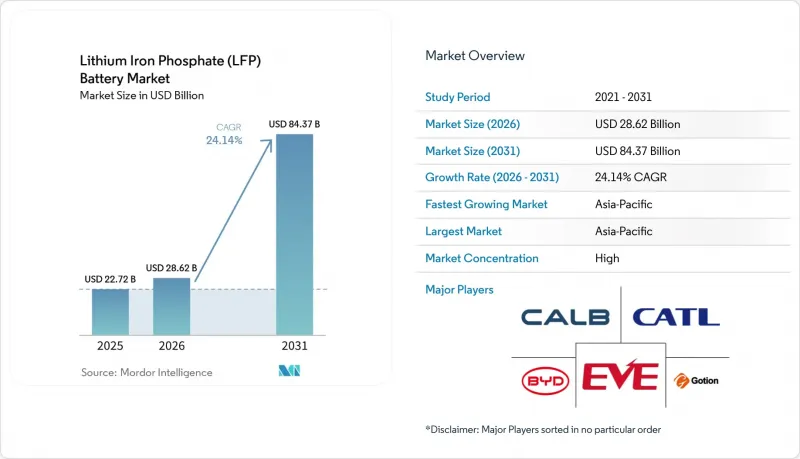
본 보고서는 배터리 형태별(원통형, 각형, 파우치형), 용도별(휴대용, 고정형, 전동 모빌리티, 전력망·재생에너지 저장), 지역별(북미, 유럽, 아시아태평양, 남미, 중동 및 아프리카)로 분류되어 있습니다. 시장 전망은 금액(달러) 기준으로 제시되어 있습니다.
세계의 인산철리튬(LFP) 배터리 시장 동향 및 인사이트
대중 시장용 전기차(EV)에서의 비용 경쟁력
자동차 제조업체들은 비용 효율성을 중시하는 전기차 모델에 LFP를 더 자주 채택하고 있으며, 이로 인해 승용차, 플릿 차량, 저가 모델에 걸쳐 리튬 인산철 배터리 시장이 확대되고 있습니다. LFP는 2024년 약 50%에서 증가하여 2025년에는 전 세계 전기차 배터리 장착량의 55% 이상을 차지할 것으로 보이며, LFP 팩의 kW시당 비용은 NMC 팩에 비해 평균 40% 이상 저렴합니다. 중국에서는 2025년에 LFP가 국내 전기차 배터리 탑재 대수의 81.2%를 차지할 것으로 예상되며, 이는 주행 거리 300-600km로 대량 생산되는 주류 승용차에서 LFP가 차지하는 역할을 반영한 것입니다. 신흥 시장 및 개발도상국에서의 판매에서도 이 화학 성분이 지지를 받았습니다. 중국 자동차 제조업체의 수출이 확대되고 합리적인 가격의 모델이 널리 보급됨에 따라, 2025년에는 판매된 전기차의 3분의 2에 LFP가 채택되었습니다. 고압축률 양극재는 화학 조성의 기본적인 비용 구조를 바꾸지 않으면서도 표준 배합에 비해 셀의 에너지 밀도를 15-20% 향상시키기 때문에 중국 모델의 모델 체인지에서 점점 더 중요해지고 있습니다. 이로 인해 리튬 인산철 배터리 시장에서는 단일하고 획일적인 제품 요구 사항보다는 저비용 표준 셀과 중국 국내용 모델을 위한 고성능 셀에 대한 수요가 생겨나고 있습니다. 또한, 특히 자동차 제조업체들이 양산차 플랫폼의 개발 주기 단축에 주력하고 있는 가운데, 신뢰성 높은 양극재공급, 제조 품질, 자동차 제조업체에 의한 신규 셀 설계의 신속한 인증의 중요성도 높아지고 있습니다.
재생에너지 통합 및 계통 규모 에너지 저장 도입
전력망 및 재생에너지 저장 분야는 인산철리튬 배터리 시장에서 가장 빠르게 성장하고 있는 용도입니다. 이는 전력 회사가 장기간에 걸쳐 정기적으로 충방전을 반복할 수 있는 배터리를 필요로 하기 때문입니다. 2025년에는 전 세계적으로 108GW의 에너지 저장 설비가 신설되어 2024년 대비 40% 증가했으며, 이 신규 도입분의 90%를 LFP가 차지했습니다. 미국에서는 2025년에 57.6GWh 규모의 에너지 저장 설비가 도입되어 전년 대비 30% 증가했습니다. 또한 2026년 1분기에는 9.7GWh가 추가되었습니다. 중국에서는 2만 사이클 이상의 인증 사이클 수명을 가진 LFP 셀과 재생에너지의 급속한 확대에 힘입어, 2025년 말 기준으로 신에너지 저장 설비의 누적 용량이 144.7GW에 달했습니다. 중국 대규모 데이터센터 캠퍼스 내 백업용 에너지 저장 수요는 재생 에너지 통합과 더불어 새로운 수요원을 창출하고 있습니다. 특히 사업자가 2-4시간의 예비 용량을 필요로 하는 경우에서 두드러집니다. LFP는 2-4시간 규모의 프로젝트에 적합합니다. 이는 해당 이용 사례에서 에너지 밀도보다 안전성, 수명, 비용이 더 중요하게 여겨지기 때문입니다. 이러한 적합성 덕분에 개발자는 고객의 운영 일정이나 지역 전력망 요구 사항이 서로 다르더라도, 서로 다른 운영 프로파일을 가진 유틸리티, 상업용 및 특정 백업 전원 프로젝트에서 공통된 화학 성분의 배터리를 사용할 수 있게 됩니다.
낮은 질량 에너지 밀도와 한랭지에서의 성능
에너지 밀도와 한랭지에서의 성능은 고급차나 장거리 주행형 전기차에서 인산철리튬 배터리 시장의 제약 요인으로 작용하고 있습니다. LFP 셀의 에너지 밀도는 170-205Wh/kg인 반면, NMC 셀은 255Wh/kg에 달하기 때문에 차량의 주행 거리가 600km를 초과하는 경우 LFP는 불리한 입장에 놓이게 됩니다. 셀-투-팩(cell-to-pack) 설계를 통해 공간 이용률은 65-72%로 향상되었지만, 셀 수준의 성능 차이는 여전히 존재하며, 영하의 기온에서는 그 차이가 더욱 두드러집니다. 나트륨 이온 배터리는 주행 거리가 짧아 한랭지에서의 사용을 상정한 용도에서 경쟁력을 발휘하는 반면, LMFP는 400-600km의 주행 거리에서 에너지 밀도 향상을 목표로 하고 있으며, 전고체 배터리는 프리미엄 차량을 대상으로 하고 있습니다. 유럽의 고급차 제조업체들은 플래그십 모델에는 계속해서 NMC를 채택하고 있으며, 엔트리 모델에 대해서는 LFP를 더욱 엄선하여 평가했습니다. 이로 인해 고압축 설계를 통해 LFP의 성능이 향상되고 있음에도 불구하고, LFP에는 기술적인 한계가 발생하고 있습니다.
부문 분석
2025년 현재, 각형 셀은 인산철리튬 배터리 시장 점유율의 61.2%를 차지했으며, 2026-2031년 연평균 성장률(CAGR) 26.1%를 나타낼 것으로 예측됩니다. 이러한 위상은 ‘셀-투-팩(cell-to-pack)’ 설계의 보급에 기인하며, 대형 각형 셀은 중간 모듈의 수를 줄이고 팩 구조를 단순화함으로써 이 설계를 효과적으로 지원하고 있습니다. BYD의 ‘Blade Battery’와 CATL의 셀-투-팩 플랫폼은 전기차용 팩 및 유틸리티 규모의 에너지 저장 컨테이너에서 각형 LFP의 정착에 기여해 왔습니다. 이러한 용도에서는 셀의 형상이 표준화된 대규모 시스템 레이아웃에 적합합니다. 더 큰 셀은 현재 고정형 에너지 저장 시스템 도입의 핵심을 이루고 있는 멀티 메가와트시(MWh)급 시스템에서 열 관리를 단순화하고 모듈 조립 비용을 절감할 수 있습니다. BYD의 4680 형식 LFP 원통형 셀에 대한 조사에서는 374.6Wh/L가 기록되었으며, 이는 특정 설계에서 원통형 셀이 여전히 기술적으로 경쟁력을 가지고 있음을 보여줍니다.
2026년 1분기 중국 에너지 저장용 배터리 출하량의 97% 이상을 각형 셀이 차지했습니다. 이는 프로젝트 규모가 확대됨에 따라 개발자들이 재현 가능한 설치 설계를 추구하는 가운데, 유틸리티 규모의 에너지 저장 시스템에서 대형 포맷이 선호되고 있음을 반영합니다. 원통형 셀은 테슬라의 ‘4680’ 프로그램, 이 형식이 확립된 자동차 공학적 접근 방식에 부합하는 특정 고성능 용도에서 여전히 중요한 역할을 하고 있습니다. 파우치형 셀은 한국 주도의 설계에서 여전히 중요한 위치를 차지하고 있습니다. 그 이유는 셀-투-팩 구성에서 더 높은 질량 에너지 밀도를 실현할 수 있고, 차량 하부 공간의 여유 공간을 효율적으로 활용할 수 있기 때문입니다. 각형 설계는 중국 및 전 세계 에너지 저장 시장을 주도하는 한편, 원통형 셀은 북미 시장과 고성능을 중시하는 분야에서 입지를 유지하고 있으며, 파우치형 셀은 유럽의 특정 전기차 플랫폼에 채택되고 있습니다.
지역별 분석
아시아태평양은 2025년 인산철리튬 배터리 시장 규모의 58.4%를 차지했으며, 2026-2031년 연평균 성장률(CAGR) 31.2%를 나타낼 것으로 예측됩니다. 중국은 2025년에 전 세계 신규 배터리 도입량의 60%를 차지하였고, 전 세계 리튬 이온 배터리 생산 능력의 80% 이상을 보유하고 있어, 이로 인해 지역 공급업체들은 생산량과 현지 고객 수요를 모두 갖춘 통합적인 기반을 갖추고 있습니다. 이러한 강점은 생산, 기술 개발, 소비 분야에서 중국의 역할을 뒷받침할 뿐만 아니라, 양극재 분야에서의 중국의 위상이 더 광범위한 인산철리튬 배터리 시장을 형성하고 있습니다. 인도의 전기차 보급 확대와 동남아시아의 제조 투자는 자동차 조립, 국내 배터리 계획, 새로운 재생에너지 발전을 통해 해당 지역의 LFP 수요를 창출하고 있습니다. 인도네시아에서는 일본과 한국을 능가하는 규모의 음극 활물질 공급 파이프라인이 구축되고 있습니다.
북미와 유럽은 리튬인산철 배터리 시장 활동의 다음 주요 축을 형성하고 있지만, 그 공급망과 정책 환경은 아시아태평양과는 다릅니다. 미국에서는 2025년에 ‘우려 대상 외국 기업’에 대한 규제가 강화되면서 전기차(EV)의 LFP 사용량은 감소했으나, 개발업체들이 대규모 프로젝트를 위해 LFP 시스템 조달을 지속한 결과, 에너지 저장 설비의 증설량은 57.6GWh에 달하고, 30% 증가했습니다. 2026년 1분기에는 9.7GWh가 추가되어 사상 최대의 1분기 실적을 기록했습니다. 이는 일부 전기차 프로그램용으로 사용되지 않는 자재를 고정형 수요가 흡수할 수 있음을 보여줍니다. 유럽에서는 2025년에 LFP가 전기차용 배터리 수요의 10%를 넘어섰지만, 공급의 거의 전부가 중국 수입에 의존하고 있으며 현지 공급은 여전히 제한적입니다. 현재, 배터리에 대한 실사 의무가 유럽의 조달 결정에 영향을 미치고 있어 현지 양극재 투자를 촉진할 가능성이 있지만, 이러한 생산 능력을 확립하는 데는 시간이 걸릴 것으로 보입니다.
남미, 중동 및 아프리카는 리튬 인산철 배터리 시장에서의 점유율은 작지만, 현지 생산 및 태양광 발전과 연계된 에너지 저장 분야에서 그 중요성이 높아지고 있습니다. 브라질에서는 국내 조달 요건을 충족하고 현지 생산 체제를 확립하기 위해 배터리 팩 조립 라인과 에너지 저장용 배터리 생산 라인을 신설하고 있습니다. 칠레와 아르헨티나는 리튬 염수 자원을 보유하고 있어, 양극재에 대한 투자가 뒤따른다면 업스트림 공정 통합을 뒷받침할 가능성이 있지만, 이것이 중국의 가공 능력을 즉시 대체하지는 못할 것으로 보입니다. 사우디아라비아와 아랍에미리트는 재생에너지 프로그램을 통해 LFP 도입을 지원하고 있는 반면, 모로코가 계획 중인 LFP 기가팩토리는 아프리카의 전기차 조립 및 유럽공급망을 지원하기 위한 목적으로 건설되고 있습니다. 이러한 지역들은 새로운 수요와 제조 거점을 제공하지만, 그 역할은 리튬 자원뿐만 아니라 가공, 셀, 시스템 통합에 대한 투자에 달려 있습니다.
기타 혜택
- 엑셀 형식 시장 예측(ME) 시트
- 3개월간의 애널리스트 지원
자주 묻는 질문
목차
제1장 서론
제2장 조사 방법
제3장 주요 요약
제4장 시장 구도
제5장 시장 규모 및 성장 예측
제6장 경쟁 구도
제7장 시장 기회 및 향후 전망
AJY 26.09.03According to Mordor Intelligence, the lithium iron phosphate battery market size is projected to be USD 22.72 billion in 2025, USD 28.62 billion in 2026, and reach USD 84.37 billion by 2031, growing at a CAGR of 24.14% from 2026 to 2031.
This report is Segmented by Battery Form Factor (Cylindrical, Prismatic, Pouch), Application (Portable, Stationary, Electric Mobility, Grid and Renewable Energy Storage), and Geography (North America, Europe, Asia-Pacific, South America, and Middle East and Africa). The Market Forecasts are Provided in Terms of Value (USD).
Global Lithium Iron Phosphate (LFP) Battery Market Trends and Insights
EV Cost-Competitiveness in Mass-Market Vehicles
Automakers are using LFP more often in cost-sensitive EV models, which is expanding the lithium iron phosphate battery market across passenger cars, fleet vehicles, and lower-priced models. LFP captured more than 55% of global EV battery deployments in 2025, up from nearly 50% in 2024, and LFP packs cost more than 40% less per kilowatt-hour than NMC packs on average. In China, LFP reached 81.2% of domestic EV battery installations in 2025, reflecting its role in mainstream passenger vehicles with 300-600 km driving ranges and high-volume production schedules. Emerging market and developing economy sales also favored the chemistry, with LFP powering 2-thirds of electric car sales in 2025 as Chinese OEM exports widened affordable model availability. Higher-compaction cathode materials are becoming important for Chinese model refreshes because they improve cell energy density by 15-20% over standard formulations without changing the chemistry's basic cost position. This leaves the lithium iron phosphate battery market with demand for lower-cost standard cells and more capable cells for domestic Chinese models, rather than a single uniform product requirement, and it also increases the importance of reliable cathode supply, manufacturing quality, and rapid qualification of new cell designs by vehicle makers, particularly as manufacturers work to shorten development cycles for mass-market vehicle platforms.
Renewable Integration and Grid-Scale Energy Storage Deployment
Grid and renewable energy storage is the fastest-growing application in the lithium iron phosphate battery market because utilities need batteries that can be cycled regularly over long operating periods. The world added 108 GW of battery storage during 2025, an increase of 40% from 2024, and LFP accounted for 90% of new additions. The United States installed 57.6 GWh of energy storage in 2025, up 30%, and added 9.7 GWh in the first quarter of 2026. China reached 144.7 GW of cumulative new-type energy storage capacity at the end of 2025, supported by LFP cells with certified cycle life above 20,000 cycles and the rapid buildout of renewable power. Backup storage requirements for large Chinese data center campuses are creating another source of demand alongside renewable integration, especially where operators require 2-4 hours of reserve capacity. LFP remains suited to 2-4 hour projects because safety, cycle life, and cost carry more weight than energy density in this use case, and this fit helps developers use a common chemistry across utility, commercial, and selected backup-power projects with different operating profiles, even where customers have different dispatch schedules and local grid requirements.
Lower Gravimetric Energy Density and Cold-Weather Performance
Energy density and cold-weather performance constrain the lithium iron phosphate battery market in premium and long-range EVs. LFP cells deliver 170-205 Wh/kg, while NMC cells can reach 255 Wh/kg, placing LFP at a disadvantage where vehicle range exceeds 600 km. Cell-to-pack designs improve space utilization to 65-72%, but the cell-level difference persists and becomes more pronounced in sub-zero temperatures. Sodium-ion cells compete in shorter-range and cold-climate uses, while LMFP seeks to raise energy density in the 400-600 km range, and solid-state batteries target premium vehicles. Premium European manufacturers continue to specify NMC for their flagship models and assess LFP more selectively for entry-level vehicles. This creates a technology boundary for LFP even as higher-compaction designs improve its performance.
Other drivers and restraints analyzed in the detailed report include:
- Safety, Cycle Life and Total-Cost-of-Ownership Advantages
- Battery-Manufacturing Localization and Supply-Chain Incentives
- Low Residual Material Value Weakening LFP Recycling Economics
For complete list of drivers and restraints, kindly check the Table Of Contents.
Segment Analysis
Prismatic cells held 61.2% of the lithium iron phosphate battery market share in 2025 and are forecast to grow at a 26.1% CAGR from 2026 to 2031. Their position follows the wider use of cell-to-pack designs, which large-format prismatic cells support effectively by reducing the number of intermediate modules and simplifying the pack structure. BYD Blade Battery and CATL cell-to-pack platforms have helped establish prismatic LFP for EV packs and utility-scale storage containers, where the cell shape works with standardized large-scale system layouts. Larger cells can simplify thermal management and reduce module assembly costs in multi-megawatt-hour systems, which are now a central part of stationary storage deployment. A study of BYD's 4680-format LFP cylindrical cell recorded 374.6 Wh/L, showing that cylindrical cells remain technically competitive in selected designs.
Prismatic cells accounted for more than 97% of China's energy storage battery shipments in the first quarter of 2026. This reflects the preference for larger formats in utility-scale storage as projects increase in size and developers seek repeatable installation designs. Cylindrical cells retain a role through Tesla's 4680 program and select high-performance applications where the format supports established vehicle engineering approaches. Pouch cells remain relevant in Korean-led designs because their packaging can support higher gravimetric energy density in cell-to-pack configurations and can use available vehicle underbody space efficiently. Prismatic designs lead China and global energy storage, while cylindrical cells retain a North American and performance-focused position and pouch cells serve selected European EV platforms.
Complete Report Scope:
- By Battery Form Factor
- Cylindrical
- Prismatic
- Pouch
- By Application
- Portable
- Stationary
- Electric Mobility
- Grid and Renewable Energy Storage
- By Geography
- North America
- United States
- Canada
- Mexico
- Europe
- Germany
- France
- Italy
- Spain
- United Kingdom
- Poland
- Russia
- Rest of Europe
- Asia-Pacific
- China
- India
- Japan
- South Korea
- Australia
- Indonesia
- Vietnam
- Thailand
- Rest of Asia-Pacific
- South America
- Brazil
- Argentina
- Chile
- Rest of South America
- Middle East and Africa
- Saudi Arabia
- United Arab Emirates
- Egypt
- South Africa
- Morocco
- Rest of Middle East and Africa
- North America
Geography Analysis
Asia-Pacific held 58.4% of the lithium iron phosphate battery market size in 2025 and is forecast to grow at a 31.2% CAGR from 2026 to 2031. China contributed 60% of global new battery storage additions in 2025 and holds more than 80% of global lithium-ion battery manufacturing capacity, giving regional suppliers an integrated base that combines production volume with local customer demand. These advantages support China's role in production, technology development, and consumption, while its position in cathode materials also shapes the wider lithium iron phosphate battery market. India's EV expansion and Southeast Asian manufacturing investment are building regional LFP demand through vehicle assembly, domestic battery plans, and new renewable generation. Indonesia is developing an anode active-material pipeline that exceeds Japan's and South Korea's in scale.
North America and Europe form the next major block of the lithium iron phosphate battery market activity, but their supply chains and policy settings differ from those in the Asia-Pacific. In the United States, LFP use in EVs contracted in 2025 as foreign entity of concern restrictions tightened, while storage additions reached 57.6 GWh and grew 30% as developers continued to procure LFP systems for large projects. The first quarter of 2026 added 9.7 GWh, the strongest opening quarter on record, showing that stationary demand can absorb material no longer directed to some EV programs. In Europe, LFP exceeded 10% of EV battery demand in 2025, with nearly all supply imported from China and local supply still limited. Battery due-diligence obligations now affect European procurement decisions and could encourage local cathode investment, although developing this capability will take time.
South America and the Middle East and Africa hold smaller shares of the lithium iron phosphate battery market but are becoming more relevant for localized manufacturing and solar-linked storage. Brazil is adding battery pack assembly and energy storage battery lines to support domestic content requirements and establish a local production presence. Chile and Argentina have lithium brine resources that could support upstream integration if cathode investment follows, although this would not immediately replace Chinese processing capacity. Saudi Arabia and the United Arab Emirates are supporting LFP deployment through renewable-energy programs, while Morocco's planned LFP gigafactory is intended to support African EV assembly and European supply chains. These regions offer new demand and manufacturing locations, but their role depends on investment in processing, cells, and system integration rather than lithium resources alone.
- BYD Company Limited
- CALB Group Co., Ltd.
- Contemporary Amperex Technology Co., Limited
- Envision AESC Group Ltd.
- EVE Energy Co., Ltd.
- Farasis Energy (Ganzhou) Co., Ltd.
- Gotion High-Tech Co., Ltd.
- LG Energy Solution, Ltd.
- Lithium Werks B.V.
- Microvast Holdings, Inc.
- Narada Power Source Co., Ltd.
- Phylion Battery Co., Ltd.
- REPT Battero Energy Co., Ltd.
- Samsung SDI Co., Ltd.
- SVOLT Energy Technology Co., Ltd.
- Tianneng Battery Group Co., Ltd.
- Wanxiang A123 Systems Corp.
Additional Benefits:
- The market estimate (ME) sheet in Excel format
- 3 months of analyst support
TABLE OF CONTENTS
1 INTRODUCTION
- 1.1 Study Assumptions and Market Definition
- 1.2 Scope of the Study
2 RESEARCH METHODOLOGY
3 EXECUTIVE SUMMARY
4 MARKET LANDSCAPE
- 4.1 Market Overview
- 4.2 Market Drivers
- 4.2.1 EV Cost-Competitiveness in Mass-Market Vehicles
- 4.2.2 Renewable Integration and Grid-Scale Energy Storage Deployment
- 4.2.3 Battery-Manufacturing Localization and Supply-Chain Incentives
- 4.2.4 Safety, Cycle Life and Total-Cost-of-Ownership Advantages
- 4.2.5 Cell-to-Pack Architecture Expanding LFP into 40-80 kWh Platforms
- 4.2.6 Data-Center Backup and Distributed-Storage Procurement
- 4.3 Market Restraints
- 4.3.1 Lower Gravimetric Energy Density and Cold-Weather Performance
- 4.3.2 Substitution by Sodium-Ion, LMFP, NMC and Solid-State Chemistries
- 4.3.3 Low Residual Material Value Weakening LFP Recycling Economics
- 4.3.4 Captive OEM Gigafactories Shrinking the Merchant Supplier Pool
- 4.4 Supply-Chain Analysis
- 4.5 Technology Outlook
- 4.6 Regulatory Landscape
- 4.7 Porter's Five Forces Analysis
- 4.7.1 Bargaining Power of Suppliers
- 4.7.2 Bargaining Power of Buyers
- 4.7.3 Threat of New Entrants
- 4.7.4 Threat of Substitutes
- 4.7.5 Competitive Rivalry
5 MARKET SIZE AND GROWTH FORECASTS
- 5.1 By Battery Form Factor
- 5.1.1 Cylindrical
- 5.1.2 Prismatic
- 5.1.3 Pouch
- 5.2 By Application
- 5.2.1 Portable
- 5.2.2 Stationary
- 5.2.3 Electric Mobility
- 5.2.4 Grid and Renewable Energy Storage
- 5.3 By Geography
- 5.3.1 North America
- 5.3.1.1 United States
- 5.3.1.2 Canada
- 5.3.1.3 Mexico
- 5.3.2 Europe
- 5.3.2.1 Germany
- 5.3.2.2 France
- 5.3.2.3 Italy
- 5.3.2.4 Spain
- 5.3.2.5 United Kingdom
- 5.3.2.6 Poland
- 5.3.2.7 Russia
- 5.3.2.8 Rest of Europe
- 5.3.3 Asia-Pacific
- 5.3.3.1 China
- 5.3.3.2 India
- 5.3.3.3 Japan
- 5.3.3.4 South Korea
- 5.3.3.5 Australia
- 5.3.3.6 Indonesia
- 5.3.3.7 Vietnam
- 5.3.3.8 Thailand
- 5.3.3.9 Rest of Asia-Pacific
- 5.3.4 South America
- 5.3.4.1 Brazil
- 5.3.4.2 Argentina
- 5.3.4.3 Chile
- 5.3.4.4 Rest of South America
- 5.3.5 Middle East and Africa
- 5.3.5.1 Saudi Arabia
- 5.3.5.2 United Arab Emirates
- 5.3.5.3 Egypt
- 5.3.5.4 South Africa
- 5.3.5.5 Morocco
- 5.3.5.6 Rest of Middle East and Africa
- 5.3.1 North America
6 COMPETITIVE LANDSCAPE
- 6.1 Market Concentration
- 6.2 Strategic Moves
- 6.3 Market Share Analysis
- 6.4 Company Profiles (includes Global Level Overview, Market Level Overview, Core Segments, Financials as available, Strategic Information, Market Rank/Share, Products and Services, Recent Developments)
- 6.4.1 BYD Company Limited
- 6.4.2 CALB Group Co., Ltd.
- 6.4.3 Contemporary Amperex Technology Co., Limited
- 6.4.4 Envision AESC Group Ltd.
- 6.4.5 EVE Energy Co., Ltd.
- 6.4.6 Farasis Energy (Ganzhou) Co., Ltd.
- 6.4.7 Gotion High-Tech Co., Ltd.
- 6.4.8 LG Energy Solution, Ltd.
- 6.4.9 Lithium Werks B.V.
- 6.4.10 Microvast Holdings, Inc.
- 6.4.11 Narada Power Source Co., Ltd.
- 6.4.12 Phylion Battery Co., Ltd.
- 6.4.13 REPT Battero Energy Co., Ltd.
- 6.4.14 Samsung SDI Co., Ltd.
- 6.4.15 SVOLT Energy Technology Co., Ltd.
- 6.4.16 Tianneng Battery Group Co., Ltd.
- 6.4.17 Wanxiang A123 Systems Corp.
7 MARKET OPPORTUNITIES AND FUTURE OUTLOOK
- 7.1 White-Space and Unmet-Need Assessment


