

|
시장보고서
상품코드
2119229
부분적 CMO 서비스 : 시장 점유율 분석, 업계 동향 및 통계, 성장 예측(2026-2031년)Fractional CMO Services - Market Share Analysis, Industry Trends & Statistics, Growth Forecasts (2026 - 2031) |
||||||
 Mordor Intelligence
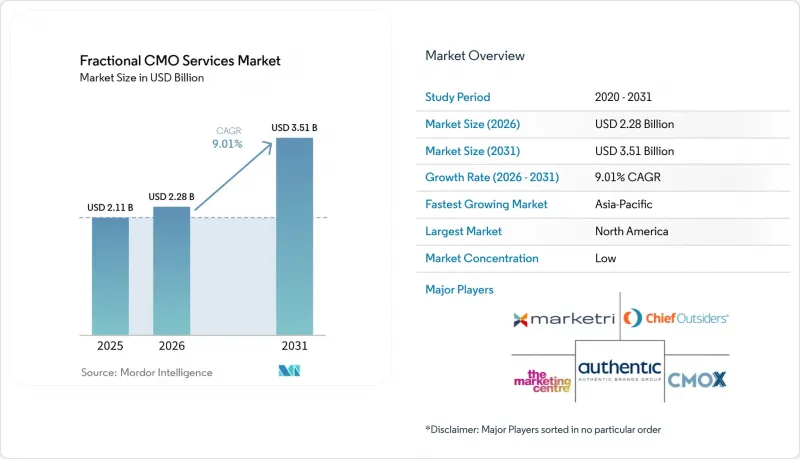
Mordor Intelligence에 의하면, 부분적 CMO 시장 규모는 2025년 21억 1,000만 달러로 평가되었습니다. 2026년에는 22억 8,000만 달러로 확대되어 2031년까지 35억 1,000만 달러에 이를 것으로 예측되며, 2026년부터 2031년에 걸쳐 CAGR 9.01%를 나타낼 전망입니다.
본 보고서는 서비스 유형(전략, 거버넌스 및 이용 사례 설계 서비스, 클린룸 도입·통합 서비스, 관리형 서비스 및 최적화, 교육, 변경 관리 등), 고객 기업 규모(대기업 등), 최종 사용자 산업(제조·산업 등), 그리고 지역별로 분류되어 있습니다. 시장 전망은 금액(달러) 기준으로 제시되어 있습니다.
세계의 부분적 CMO 서비스 시장 동향 및 인사이트
상근 CMO의 인건비 급등과 채용 리스크가 정규직 채용 모델에 압박을 가하고 있습니다.
중견 기업에서 정규직 CMO의 첫해 비용은 급여, 복리후생, 임원 채용 비용을 포함해 45만 달러에서 90만 달러 사이였습니다. 이러한 비용 구조로 인해, 고위 경영진의 감독이 필요한 경우, 상근 임원직을 유지할 수 없는 기업, 특히 수익 계획이 불확실하거나 경영진이 유연성을 유지해야 하는 경우, 부분적 CMO 시장의 매력이 높아지고 있습니다. 상근 CMO를 임명할 경우, 전략이 완전히 확립되기 전에 장기간에 걸친 인재 발굴, 온보딩 기간, 보수 협상, 나아가 리더십 변경이 발생할 위험도 수반됩니다. 월 8,000-2만 2,000달러 규모의 파트타임 CMO 계약은 기업에 보다 명확한 재정적 약속을 제공하며, 대안을 비교 검토하거나 합의된 업무 범위에 따라 마케팅 지출을 계획할 수 있게 해주었습니다. 이러한 계약은 30일 이내에 시작할 수 있었지만, 전임 임원의 채용과 업무 숙달에는 일반적으로 90-180일이 소요되어 조직이 시급한 경영상의 의사결정을 내려야 할 때 큰 시간적 지연이 발생하곤 했습니다. 이 모델은 매출액이 1,000만 달러에서 7,500만 달러인 기업에 특히 효과적이었습니다. 이러한 기업에서는 경영진의 간접비가 영업 이익률, 투자 능력 및 기타 성장 이니셔티브의 실행 시기에 직접적인 영향을 미치기 때문입니다.
장기적인 헌신이 수반되지 않는 고위 전문가에 대한 수요는 인재 배치의 변화를 반영하고 있습니다.
고위급 마케팅 실무자들은 포트폴리오 경력을 선택하는 경향이 강해지고 있으며, 이로 인해 부분적 업무를 수행할 수 있는 리더 풀이 확대되고, 독립적인 업무를 원하는 경험 많은 경영진에게 더 확고한 경로가 마련되고 있습니다. 이러한 변화로 인해 클라이언트는 여러 사업 환경에서 실무 경험을 쌓고, 조직의 영구적인 변경 없이 과거 업무에서 얻은 교훈을 활용할 수 있는 경영 간부에게 접근할 수 있게 됩니다. 부분적 CMO 시장은 구매자가 기존의 단일 기업 내 경력 경로보다 이러한 기업 간 경험을 중시할 때, 특히 유사한 상업적 상황에 대한 관점이 필요한 경우에 혜택을 받게 됩니다. 마케팅과 재무 간의 견고한 관계는 여전히 중요합니다. 마케팅 리더는 자사의 활동을 수익, 투자 결정, 예측 및 비즈니스 성과와 연계해야 하기 때문입니다. 리테이너 계약의 갱신은 가시적인 상업적 진전에 달려 있습니다. 따라서 프랙셔널 리더는 업무 배정 초기 단계에서 측정 기준, 보고 체계, 의사결정 권한, 그리고 조직이 무엇을 ‘성공’으로 간주하는지에 대한 명확한 정의를 확립하도록 권장받습니다. 이러한 인센티브는 보고 체계나 우선순위의 변화가 비교적 느린 정규직 고용 체계 내에서 여전히 해결하기 어려운 설명 책임의 격차를 기업이 해소하는 데 도움이 됩니다.
클라이언트 측의 실행 자원이 제한적이라는 점이 프랙셔널 모델의 유효성을 제약합니다.
부분적 CMO 시장이 가장 큰 효과를 발휘하는 경우는 클라이언트 기업이 경영진의 지시를 일상 업무에 반영하고, 임원 회의 사이에도 추진력을 유지하며, 합의된 행동에 주체적으로 임할 수 있는 충분한 사내 체제를 갖추고 있는 경우입니다. 마케팅 코디네이터, 콘텐츠 전문가, 혹은 데이터 분석가를 보유하고 있지 않은 기업에서는 설령 전략적 제안이 타당하더라도 전략 문서를 일관된 실행으로 이어가는 데 어려움을 겪을 수 있습니다. 이러한 제약은 기업 매출이 500만 달러 미만인 기업에서 가장 두드러집니다. 이러한 기업에서는 이 모델이 비용 면에서 합리적일 수 있지만, 팀 규모가 매우 작고 개인이 여러 업무 책임을 맡고 있는 경우가 많기 때문입니다. 일부 제공업체는 부분적 CMO와 전문적인 실행 지원을 결합하여 이 문제를 해결하고 있으며, 이를 통해 고객사는 일반적으로 직접 채용할 수 없는 기술을 활용할 수 있게 됩니다. Kalungi사는 B2B 성장 전략을 위한 노력의 일환으로, 고위 경영진과 광범위한 팀을 결합한 서비스를 제공합니다. 이러한 접근 방식을 통해 성과 향상을 기대할 수 있지만, 월 1만 달러에서 3만 2,000달러에 이르는 리테이너 계약은 소규모 클라이언트에게 경제적 이점을 제한할 가능성이 있으므로, 사내에서 지속해야 할 업무에 대해 보다 신중한 평가가 필요합니다.
부문별 분석
'전략, 거버넌스, 이용 사례 설계 서비스'는 2025년 부분적 CMO 시장의 36.11%를 차지했으며, 2031년까지 연평균 성장률(CAGR) 10.20%로 성장할 것으로 전망됩니다. 이러한 추세는 많은 구매자가 단순한 캠페인 제작이 아닌, 조직적인 설명 책임, 의사결정 구조, 그리고 보다 명확한 우선순위를 요구하고 있음을 보여줍니다. 이러한 업무에는 AI 이용 사례 프레임워크, 데이터 거버넌스 실천, 측정 설계, 그리고 초기 리더십 계약 종료 후에도 사내 팀이 지속적으로 운영해 나갈 실무적 책임 등이 포함됩니다. ‘클린룸’ 구현 및 통합 서비스와 개인정보 보호를 고려한 분석·측정·활성화 서비스는 제3자 데이터 확보가 어려워지는 상황에서 의사결정을 위해 더 신뢰할 수 있는 정보를 원하는 구매자의 요구에 부응하고, 측정 품질을 유지하기 위한 것입니다. 따라서 부분적 CMO 시장에서는 부서 간 접근 권한을 확보하고, 상업적 목표를 실행 가능한 운영 규칙으로 구체화하며, 이러한 규칙이 마케팅, 재무, 기술 및 비즈니스 리더에게 왜 중요한지 설명할 수 있는 경영진이 높이 평가됩니다.
나머지 서비스 수요의 상당 부분은 ‘관리형 서비스 및 최적화’가 차지하고 있는데, 이는 클라이언트가 초기 전략 수립 후에도 지속적인 캠페인 감독이 필요한 경우가 많으며, 새로운 방향성을 유지하기 위한 충분한 인력이 부족한 경우가 있기 때문입니다. 또한, 기업이 자사 팀에 계약 기간을 넘어 지속되는 새로운 프로세스, 보고 방식, 시장 출시 시스템 및 책임을 정착시켜야 하는 경우, ‘교육 및 변화 관리’도 여전히 중요합니다. 명확하게 정의된 산출물로 전환됨에 따라, 제공업체가 계약 범위 설정, 가격 책정, 설명 및 진행 상황 관리를 수행하는 방식이 변화하고 있으며, 클라이언트는 리테이너 계약에 포함된 업무 내용을 보다 명확하게 파악할 수 있게 되었습니다. Chief Outsiders는 2025년 2월, 프랙셔널 리더십에 플레이북, 워크플로우 지원, 실행 리소스를 결합한 ‘GrowthGears OS’ 및 ‘Team Outsiders’를 출시했습니다. 이 플랫폼에는 2,000건 이상의 고객 프로젝트를 통해 개발된 기법이 통합되어 있으며, 이는 확고한 입지를 갖춘 서비스 제공업체들이 재현성이 더 높은 서비스를 제공하고, 전략적 제안을 고객의 업무에 반영하기 위한 일관된 방법을 모색하고 있음을 보여줍니다.
지역별 분석
2025년, 북미는 부분적 CMO 시장의 62.23%를 차지했습니다. 이 지역은 경영진의 높은 보상 수준, 확립된 사모펀드 생태계,그리고 오랜 기간 축적된 프랙셔널 리더십 제공업체의 기반이라는 이점을 갖추고 있으며, 미국은 여전히 활동의 중심지로서 기업이 다양한 부문에 걸쳐 있는 기업에 서비스를 제공하고, 사모펀드 스폰서와의 관계를 구축하고 있습니다. Chief Outsiders사는 300개 이상의 사모펀드 회사와 500개의 포트폴리오 기업에 서비스를 제공해 왔다고 보고하며, 이 지역에서 플랫폼 모델이 달성할 수 있는 규모의 크기를 입증하고 있습니다. 캐나다와 멕시코는 비교적 소규모 시장이지만, 토론토, 밴쿠버, 몬트리올의 기술 허브에서는 벤처 캐피털 투자를 받은 기업들이 마케팅 역량을 강화하고 더 광범위한 고위 경영진을 구축하기 전에 외부 지원을 구함에 따라 유연한 리더십 모델이 채택되고 있습니다.
유럽은 여전히 중요한 기회를 품고 있습니다. 영국, 독일, 네덜란드, 북유럽 국가들에는 활발한 기술, 금융, SaaS 커뮤니티가 존재하기 때문입니다. 높은 인건비와 계약자에 관한 규제로 인해 명확한 계약 형태가 매력적으로 보일 수 있지만, 그 법적 구조는 더욱 복잡해지며, 외부 임원의 역할, 계약 기간, 책임에 관한 명확한 조건 설정이 필요합니다. 영국에서는 2025년 4월 고용주 국민보험 제도 변경이 시행되며, IR35 규정이 계속해서 기업이 계약자와 관계를 구축하는 방식에 영향을 미치고 있습니다. 또한, 독일의 분류 규정이나 네덜란드의 DBA(독립 사업자) 규제 집행에 대해서도 기업이 국경을 초월한 프랙셔널 리더를 활용할 때는 세심한 주의가 필요합니다. 남유럽 및 중동유럽의 기술 허브에서는 이 모델의 도입이 아직 초기 단계에 있으므로, 구매자들이 이 모델에 익숙해짐에 따라 부분적 CMO 시장은 장기적으로 발전할 여지가 남아 있습니다.
아시아태평양은 2031년까지 연평균 성장률(CAGR) 10.06%를 나타낼 것으로 예측됩니다. 인도, 중국, 한국, 호주에서는 급성장하는 기술 기업 및 SaaS 기업의 수에 비해, 세계 시장 진출(Go-to-Market) 경험을 갖춘 마케팅 리더 인재 풀이 제한적입니다. 따라서 프랙셔널 리더십은 단순한 비용 절감책이라기보다는 경험 부족에 대한 대응책으로 자리매김하고 있으며, 인도의 B2B SaaS 및 스타트업 생태계와 호주의 전문 서비스 업계가 수요의 초기 단계를 주도하고 있습니다. Proxi는 2025년 4월, 뉴질랜드의 기술 기업을 대상으로 풀서비스 ‘프랙셔널 Go-to-Market 리더십’ 서비스를 시작했습니다. 이는 지역 전문가들이 이 모델을 체계화해 나가고 있음을 보여줍니다. 남미, 특히 브라질과 칠레, 그리고 UAE와 사우디아라비아를 중심으로 한 중동 및 아프리카는 여전히 수요는 있으나 제공업체의 인프라가 제한적인 초기 단계의 지역이며, 부분적 CMO 시장이 발전함에 따라 현지 사정에 정통한 전문가들이 유리한 입지를 차지할 가능성이 있습니다.
기타 혜택 :
- 엑셀 형식 시장 예측(ME) 시트
- 3개월간의 애널리스트 지원
자주 묻는 질문
목차
제1장 서론
제2장 조사 방법
제3장 개요
제4장 시장 구도
제5장 시장 규모 및 성장 예측
제6장 경쟁 구도
제7장 시장 기회 및 향후 전망
KTH 26.09.02According to Mordor Intelligence, the fractional CMO market size is projected to expand from USD 2.11 billion in 2025 to USD 2.28 billion in 2026, and to USD 3.51 billion by 2031, registering a CAGR of 9.01% between 2026 and 2031.
This report is Segmented by Service Type (Strategy, Governance and Use-Case Design Services, Clean Room Implementation and Integration Services, Managed Services and Optimization, Training, Change Management, and More), Client Company Size (Large Enterprises, and More), End-User Industry (Manufacturing and Industrial, and More), and Geography. The Market Forecasts are Provided in Terms of Value (USD).
Global Fractional CMO Services Market Trends and Insights
Full-Time CMO Cost Inflation and Hiring Risk Pressures the Permanent-Hire Model
The first-year cost of a full-time CMO at a mid-market company ranged from USD 450,000 to USD 900,000, including salary, benefits, and executive search costs. That cost profile has increased the appeal of the fractional CMO market for businesses that need senior oversight but cannot support a permanent executive role, especially when revenue plans are uncertain, or management must preserve flexibility. A full-time appointment also carries the risk of a lengthy search, onboarding period, compensation negotiation, and a possible change in leadership before a strategy is fully established. Fractional retainers ranging from USD 8,000 to USD 22,000 per month offered a clearer financial commitment for companies, enabling them to compare alternatives and plan marketing expenditure against an agreed mandate. These engagements could begin within 30 days, while a permanent search and ramp cycle often took 90-180 days, leaving a meaningful gap when an organization faced an immediate commercial decision. The model was particularly relevant for companies with USD 10 million to USD 75 million in revenue, where executive overhead directly affected operating margins, investment capacity, and the timing of other growth initiatives.
Need for Senior Expertise Without Long-Term Commitment Reflects a Shift in Talent Deployment
Senior marketing operators are increasingly choosing portfolio careers, which has widened the pool of leaders available for fractional work and created a more established route for experienced executives seeking independent assignments. This shift gives clients access to executives who have worked across several operating contexts and can apply lessons from prior assignments without requiring a permanent organizational change. The fractional CMO market benefits when buyers value this cross-company experience more than a traditional single-employer career path, particularly when they need perspective from similar commercial situations. A strong relationship between marketing and finance remains important because marketing leaders must connect activity to revenue, investment choices, forecasting, and business outcomes. Retainer renewals depend on visible commercial progress, which encourages fractional leaders to establish measures, reporting routines, decision rights, and a clear definition of what the organization will treat as success early in an assignment. That incentive can help companies address accountability gaps that remain difficult to resolve within permanent employment structures, where reporting lines and priorities may change more slowly.
Limited Client-Side Execution Bandwidth Constrains Fractional Model Effectiveness
The fractional CMO market works best when a client has sufficient internal capacity to translate leadership direction into day-to-day work, maintain momentum between senior meetings, and take ownership of agreed-upon actions. Companies without a marketing coordinator, content specialist, or data analyst can struggle to translate a strategy document into consistent execution, even when the strategic recommendations are sound. This constraint is most evident among businesses with revenue below USD 5 million, where the model is affordable but teams are often very small, and individuals carry multiple operational responsibilities. Some providers address the issue by combining a fractional CMO with specialist execution support, which can give a client access to skills that it would not otherwise hire directly. Kalungi presents its offering as a combination of senior leadership and a broader team for B2B growth work. That approach can improve delivery, but retainers ranging from USD 10,000 to USD 32,000 per month may narrow the financial benefit for smaller clients and require a more careful assessment of the work that should remain in-house.
Other drivers and restraints analyzed in the detailed report include:
- Faster Time-to-Value Than Permanent Executive Hiring Reshapes the Build-or-Buy Decision
- Rising AI and Martech Orchestration Complexity Elevates the Strategic Governance Role
- Multi-Client Bandwidth and Continuity Constraints Create Engagement Risk
For complete list of drivers and restraints, kindly check the Table Of Contents.
Segment Analysis
Strategy, Governance and Use-Case Design Services accounted for 36.11% of the fractional CMO market in 2025 and are projected to grow at a 10.20% CAGR through 2031. Its leadership shows that many buyers are seeking organizational accountability, decision structures, and clearer priorities, not simply campaign production. These assignments can include AI use-case frameworks, data governance practices, measurement designs, and practical responsibilities that internal teams continue to operate after the initial leadership engagement. Clean Room Implementation and Integration Services and Privacy-Safe Analytics, Measurement, and Activation Services address the need to maintain measurement quality as third-party data becomes less available and buyers require more reliable information for decision-making. The fractional CMO market, therefore, rewards executives who can obtain cross-functional access, translate commercial goals into workable operating rules, and explain why those rules matter to marketing, finance, technology, and business leaders.
Managed Services and Optimization accounted for much of the remaining service demand, as clients often need ongoing campaign oversight after initial strategy work and may lack sufficient staff to sustain the new direction. Training and Change Management also remains important when a company needs its teams to adopt new processes, reporting methods, go-to-market systems, and responsibilities that extend beyond the engagement itself. The shift toward clearly defined deliverables is changing how providers scope, price, explain, and monitor their engagements, giving clients a clearer view of the work included in a retainer. Chief Outsiders launched GrowthGears OS and Team Outsiders in February 2025 to combine fractional leadership with playbooks, workflow support, and execution resources. The platform incorporated methods developed from more than 2,000 client engagements, showing how established providers are seeking more repeatable service delivery and a more consistent way to carry strategic recommendations into client operations.
Complete Report Scope:
- By Service Type
- Strategy, Governance and Use-Case Design Services
- Clean Room Implementation and Integration Services
- Privacy-Safe Analytics, Measurement and Activation Services
- Managed Services and Optimization
- Training, Change Management
- Other Service Types
- By Client Company Size
- Small and Mid-Market Businesses
- Large Enterprises
- By End-user Industry
- Technology, SaaS and Digital Services
- Manufacturing and Industrial
- Consumer, Retail and E-commerce
- Healthcare and Life Sciences
- Financial Services
- Education and EdTech
- Other End-user Industries
- By Geography
- North America
- United States
- Canada
- Mexico
- South America
- Brazil
- Argentina
- Chile
- Rest of South America
- Europe
- Germany
- United Kingdom
- France
- Italy
- Spain
- Rest of Europe
- Asia-Pacific
- China
- Japan
- India
- South Korea
- Australia
- Rest of Asia-Pacific
- Middle East
- United Arab Emirates
- Saudi Arabia
- Qatar
- Rest of Middle East
- Africa
- South Africa
- Egypt
- Nigeria
- Rest of Africa
- North America
Geography Analysis
North America held 62.23% of the fractional CMO market share in 2025. The region benefits from high executive compensation, an established private equity ecosystem, and a long-standing base of fractional leadership providers, with the United States remaining the center of activity where firms serve companies across many sectors and build relationships with private equity sponsors. Chief Outsiders reported that it had served more than 300 private equity firms and 500 portfolio companies, underscoring the scale a platform model can reach in the region. Canada and Mexico are smaller markets, but technology centers in Toronto, Vancouver, and Montreal are adopting flexible leadership models as venture-backed companies develop their marketing capabilities and seek external support before building a wider senior team.
Europe remains an important opportunity because the United Kingdom, Germany, the Netherlands, and Nordic countries have active technology, finance, and SaaS communities. Higher employment costs and contractor rules can make a defined engagement attractive, while also making its legal structure more complex and creating a need for clear terms around the role, duration, and responsibilities of an external executive. Employer National Insurance changes in the United Kingdom took effect in April 2025, and IR35 rules continue to affect how businesses structure contractor relationships. Germany's classification rules and Dutch DBA enforcement also require careful attention when companies use cross-border fractional leaders. Southern Europe and Central and Eastern European technology hubs are at an earlier stage of adoption, leaving room for the fractional CMO market to develop over a longer period as buyers become more familiar with the model.
Asia-Pacific is projected to grow at a 10.06% CAGR through 2031. India, China, South Korea, and Australia have a smaller pool of marketing leaders with global go-to-market experience relative to the number of growing technology and SaaS companies. This makes fractional leadership a response to an experience shortage rather than only a cost decision, with India's B2B SaaS and startup ecosystem and Australia's professional services base serving as early areas of demand. Proxi launched full fractional go-to-market leadership services for New Zealand technology companies in April 2025, indicating that regional specialists are formalizing the model. South America, particularly Brazil and Chile, and the Middle East and Africa, led by the UAE and Saudi Arabia, remain earlier-stage areas where demand exists but provider infrastructure is limited, which may favor locally informed specialists as the fractional CMO market develops.
- Chief Outsiders, LLC
- CMOx, LLC
- Authentic Brand, LLC
- Marketri, LLC
- The Marketing Centre Limited
- Fractional CMO, LLC
- The Geisheker Group, Inc.
- CMOvate, LLC
- Agni Consulting Inc.
- SaaSpire Marketing, LLC
- Simon Fractional, LLC
- Mahdlo, LLC
- Digital Division, LLC
- GrowthMode Marketing Inc.
- Bambino Agency, LLC
- New North, Inc.
- Boardroom Advisors Ltd.
Additional Benefits:
- The market estimate (ME) sheet in Excel format
- 3 months of analyst support
TABLE OF CONTENTS
1 INTRODUCTION
- 1.1 Study Assumptions and Market Definition
- 1.2 Scope of the Study
2 RESEARCH METHODOLOGY
3 EXECUTIVE SUMMARY
4 MARKET LANDSCAPE
- 4.1 Market Overview
- 4.2 Market Drivers
- 4.2.1 Full-Time CMO Cost Inflation and Hiring Risk
- 4.2.2 Need for Senior Expertise Without Long-Term Commitment
- 4.2.3 Faster Time-to-Value Than Permanent Executive Hiring
- 4.2.4 Rising AI and Martech Orchestration Complexity
- 4.2.5 Board and CFO Pressure for Revenue-Linked Marketing Accountability
- 4.2.6 Private Equity Value-Creation Playbooks
- 4.3 Market Restraints
- 4.3.1 Limited Client-Side Execution Bandwidth
- 4.3.2 Multi-Client Bandwidth and Continuity Constraints
- 4.3.3 Credential Ambiguity and No Qualification Standard
- 4.3.4 Cross-Border Tax and Contractor Compliance Risk
- 4.4 Industry Value Chain Analysis
- 4.5 Regulatory Landscape
- 4.6 Technological Outlook
- 4.7 Impact of Macroeconomic Factors on the Market
- 4.8 Porter's Five Forces Analysis
- 4.8.1 Threat of New Entrants
- 4.8.2 Bargaining Power of Buyers
- 4.8.3 Bargaining Power of Suppliers
- 4.8.4 Threat of Substitutes
- 4.8.5 Industry Rivalry
5 MARKET SIZE AND GROWTH FORECASTS (VALUE)
- 5.1 By Service Type
- 5.1.1 Strategy, Governance and Use-Case Design Services
- 5.1.2 Clean Room Implementation and Integration Services
- 5.1.3 Privacy-Safe Analytics, Measurement and Activation Services
- 5.1.4 Managed Services and Optimization
- 5.1.5 Training, Change Management
- 5.1.6 Other Service Types
- 5.2 By Client Company Size
- 5.2.1 Small and Mid-Market Businesses
- 5.2.2 Large Enterprises
- 5.3 By End-user Industry
- 5.3.1 Technology, SaaS and Digital Services
- 5.3.2 Manufacturing and Industrial
- 5.3.3 Consumer, Retail and E-commerce
- 5.3.4 Healthcare and Life Sciences
- 5.3.5 Financial Services
- 5.3.6 Education and EdTech
- 5.3.7 Other End-user Industries
- 5.4 By Geography
- 5.4.1 North America
- 5.4.1.1 United States
- 5.4.1.2 Canada
- 5.4.1.3 Mexico
- 5.4.2 South America
- 5.4.2.1 Brazil
- 5.4.2.2 Argentina
- 5.4.2.3 Chile
- 5.4.2.4 Rest of South America
- 5.4.3 Europe
- 5.4.3.1 Germany
- 5.4.3.2 United Kingdom
- 5.4.3.3 France
- 5.4.3.4 Italy
- 5.4.3.5 Spain
- 5.4.3.6 Rest of Europe
- 5.4.4 Asia-Pacific
- 5.4.4.1 China
- 5.4.4.2 Japan
- 5.4.4.3 India
- 5.4.4.4 South Korea
- 5.4.4.5 Australia
- 5.4.4.6 Rest of Asia-Pacific
- 5.4.5 Middle East
- 5.4.5.1 United Arab Emirates
- 5.4.5.2 Saudi Arabia
- 5.4.5.3 Qatar
- 5.4.5.4 Rest of Middle East
- 5.4.6 Africa
- 5.4.6.1 South Africa
- 5.4.6.2 Egypt
- 5.4.6.3 Nigeria
- 5.4.6.4 Rest of Africa
- 5.4.1 North America
6 COMPETITIVE LANDSCAPE
- 6.1 Market Concentration
- 6.2 Strategic Moves
- 6.3 Market Share Analysis
- 6.4 Company Profiles (includes Global Level Overview, Market Level Overview, Core Segments, Financials as available, Strategic Information, Market Rank/Share, Products and Services, Recent Developments)
- 6.4.1 Chief Outsiders, LLC
- 6.4.2 CMOx, LLC
- 6.4.3 Authentic Brand, LLC
- 6.4.4 Marketri, LLC
- 6.4.5 The Marketing Centre Limited
- 6.4.6 Fractional CMO, LLC
- 6.4.7 The Geisheker Group, Inc.
- 6.4.8 CMOvate, LLC
- 6.4.9 Agni Consulting Inc.
- 6.4.10 SaaSpire Marketing, LLC
- 6.4.11 Simon Fractional, LLC
- 6.4.12 Mahdlo, LLC
- 6.4.13 Digital Division, LLC
- 6.4.14 GrowthMode Marketing Inc.
- 6.4.15 Bambino Agency, LLC
- 6.4.16 New North, Inc.
- 6.4.17 Boardroom Advisors Ltd.
7 MARKET OPPORTUNITIES AND FUTURE OUTLOOK
- 7.1 White-Space and Unmet-Need Assessment


