

|
시장보고서
상품코드
2119287
클라우드 네이티브 네트워크 기능 마이그레이션 서비스 : 시장 점유율 분석, 업계 동향 및 통계, 성장 예측(2026-2031년)Cloud-Native Network Function Migration Services - Market Share Analysis, Industry Trends & Statistics, Growth Forecasts (2026 - 2031) |
||||||
 Mordor Intelligence
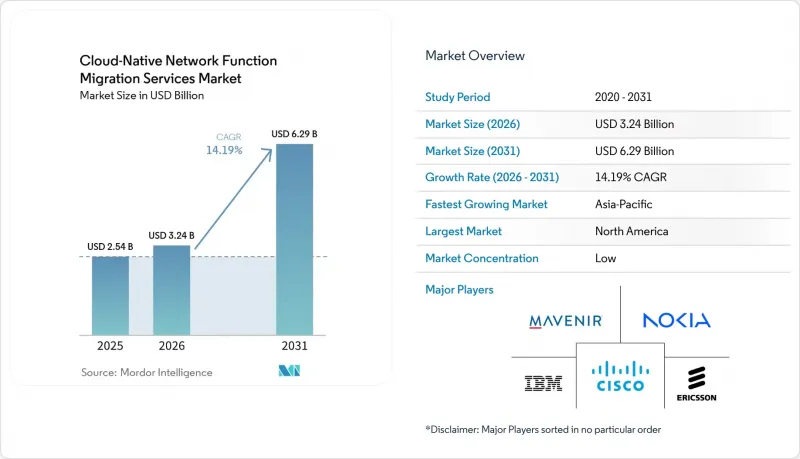
Mordor Intelligence에 의하면, 클라우드 네이티브 네트워크 기능 마이그레이션 서비스 시장 규모는 2025년에 25억 4,000만 달러로 평가되었습니다. 2026년에 32억 4,000만 달러에 달하고, 2031년까지 62억 9,000만 달러에 이를 것으로 예측되며, 2026년부터 2031년에 걸쳐 CAGR 14.19%로 성장할 전망입니다.
본 보고서는 구성 요소(솔루션 및 서비스),구축 모델(클라우드 서비스 제공업체 및 On-Premise), 네트워크 기능 도메인(5G 코어 및 에볼브드 패킷 코어, IP 멀티미디어 서브시스템 등), 최종 사용자(통신 서비스 제공업체, 클라우드 서비스 제공업체, 대기업 등), 그리고 지역별로 분류되어 있습니다. 시장 전망은 금액(달러) 기준으로 제시되어 있습니다.
세계의 클라우드 네이티브 네트워크 기능 마이그레이션 서비스 시장 동향 및 인사이트
5G 독립형 코어 및 네트워크 슬라이싱의 전개
5G 독립형 코어에는 클라우드 네이티브 기능이 필수적이기 때문에 마이그레이션 작업에 대한 직접적인 수요가 발생합니다. Telia Norge는 2026년에 전국 규모의 상용 5G 독립형 서비스를 시작했으며, 비독립형 5G의 15-18밀리초에 비해 10밀리초 미만의 지연을 실현했다고 보고했습니다. Proximus는 2026년 4월 벨기에에서 ‘5G+’를 출시하며, 클라우드 네이티브 코어 기능이 필요한 상용 구축 사례가 하나 더 추가되었습니다. 네트워크 슬라이싱은 사용자 및 서비스 간에 네트워크 리소스를 동적으로 할당해야 하므로 독립형 아키텍처에 의존합니다. 통신 사업자가 비독립형 네트워크를 유지하는 대신 이러한 기능을 상용화로 전환함에 따라, 클라우드 네이티브 네트워크 기능 마이그레이션 서비스 시장은 그 혜택을 누리게 될 것입니다. ETSI 표준은 이러한 전환 과정에서 서비스 기반 네트워크 아키텍처를 검증하기 위한 공통의 기술적 프레임워크를 제공합니다.
하이브리드 및 멀티클라우드를 통한 통신 사업자의 현대화
통신 사업자들은 퍼블릭 클라우드 리소스와 자사 데이터센터 내 인프라를 점점 더 많이 활용하고 있습니다. O2 Telefonica는 2026년 3월, 자사 데이터센터 내 AWS Outposts에서 실행되는 Nokia 소프트웨어에 5G 클라우드 코어를 도입하여, 이 하이브리드 모델을 통해 100만 명의 고객에게 서비스를 제공했습니다. 이 모델은 퍼블릭 클라우드 운영 도구와 클라우드 네이티브 네트워크 기능 마이그레이션 서비스 시장에서 클라우드상의 기밀성이 높은 네트워크 워크로드에 대한 로컬 제어를 결합한 것입니다. 또한, 통신 사업자는 서로 다른 거점이나 클라우드 환경을 넘나들며 기능을 운영해야 하기 때문에 플랫폼의 이식성이 더욱 중요해지고 있습니다. 마이그레이션 파트너는 클라우드 플랫폼 간의 연결을 설계, 테스트 및 운영해야 하므로, 클라우드 네이티브 네트워크 기능 마이그레이션 서비스 시장은 이러한 복잡성 덕분에 혜택을 보고 있습니다. 차이나텔레콤은 클라우드 네이티브 네트워크 요소의 진화와 엣지 AI 통합을 2026년부터 2030년까지의 ‘클라우드-네트워크 융합’ 단계의 핵심 축으로 삼고 있습니다.
레거시 OSS 및 BSS 통합의 복잡성
레거시 운영 지원 시스템(OSS) 및 과금 지원 시스템(BSS)은 여전히 클라우드 네이티브로의 전환에 있어 실질적인 장벽으로 남아 있습니다. 기존 통신 사업자들은 과거의 인수합병이나 개별적인 네트워크 구축으로 인해 여러 OSS 및 BSS 플랫폼을 운영하고 있는 경우가 많습니다. 이러한 시스템에는 컨테이너화된 네트워크 기능과의 연결이 어려운 독자적인 사양의 인터페이스나 문서화되지 않은 종속 관계가 포함되어 있을 수 있습니다. 클라우드 네이티브 네트워크 기능 마이그레이션 서비스 시장에서는 컷오버 기간 중에도 네트워크 프로비저닝, 과금, 서비스 보장을 지속적으로 유지해야 하므로, 경험이 풍부한 통합 팀이 필요합니다. 레거시 계층에 실용적인 프로그래밍 인터페이스가 부족한 경우, 여전히 수작업이 필요할 수 있습니다. 이로 인해 통신 사업자가 클라우드 네이티브 자동화에서 기대하는 속도와 비용상의 이점이 저해될 수 있습니다.
부문별 분석
2025년, 클라우드 네이티브 네트워크 기능 마이그레이션 서비스 시장에서 서비스 부문이 69.12%의 점유율을 차지했습니다. 이는 통신 사업자들이 통합, 컨설팅, 검증 및 관리형 마이그레이션 지원을 지속적으로 필요로 하고 있음을 반영합니다. 마이그레이션 프로그램에서는 일반적으로 상세한 기능 인벤토리, 마이그레이션 계획, 종속성 매핑, 병렬 운영 및 프로덕션 환경에서의 검증이 필요합니다. 네트워크에 여러 벤더나 구형 운영 플랫폼이 포함된 경우, 이러한 요구 사항은 서비스 계약 채택을 촉진합니다. 또한 전문 서비스 제공업체는 통신 사업자가 네트워크 운영 팀, 용도 소유자, 보안 팀 및 클라우드 인프라 파트너 간의 조정을 수행할 수 있도록 지원합니다.
솔루션 시장은 2031년까지 연평균 성장률(CAGR) 16.11%로 확대될 것으로 예상되며, 이는 클라우드 네이티브 네트워크 기능 마이그레이션 서비스 시장 전체의 성장률을 상회하는 속도입니다. 이 부문에는 마이그레이션 자동화 도구, 라이프사이클 관리 소프트웨어, 그리고 컨테이너화된 네트워크 기능을 지원하는 플랫폼이 포함됩니다. 상용화된 도구를 활용하면 서로 다른 클러스터, 릴리스 주기, 벤더를 아우르는 배포의 재현성을 높일 수 있습니다. 또한, 후속 마이그레이션 단계나 정기적인 소프트웨어 업데이트 시 필요한 맞춤형 설정 작업의 양을 줄일 수도 있습니다. 도이치 텔레콤의 ‘Operator-based Cloud Automation Solution’은 라이프사이클 관리에 쿠버네티스 오퍼레이터 패턴과 GitOps 원칙을 채택하고 있습니다. 이러한 접근 방식은 통신 사업자들이 상태 유지형 기능이나 클러스터 간 의존 관계를 보다 표준화된 방식으로 관리할 수 있는 도구를 원하고 있음을 보여줍니다.
클라우드 서비스 제공업체는 2025년에 매출의 53.62%를 차지했으며, 2031년까지 연평균 성장률(CAGR) 15.98%로 확대될 것으로 전망됩니다. 퍼블릭 클라우드로의 배포를 통해 통신 사업자는 새로운 데이터센터용량을 구축할 때 드는 전체 비용과 시간을 들이지 않고도 탄력적인 인프라를 활용할 수 있게 됩니다. 또한, 쿠버네티스 기반 배포 및 운영을 지원하는 관리형 플랫폼 서비스도 제공 가능합니다. 이를 통해 신속한 용량 변경이 필요한 새로운 독립형 코어 프로그램에 있어 클라우드 호스팅 환경은 매력적인 선택지가 됩니다. 따라서 클라우드 네이티브 네트워크 기능 마이그레이션 시장에서는 네트워크 고유 기능을 퍼블릭 클라우드의 운영 모델, 보안 제어 및 운영 절차와 연동시키는 서비스가 요구되고 있습니다.
Tune Talk사는 2026년 2월, AWS 인프라 위에 Mavenir사의 클라우드 네이티브 코어, OSS 및 BSS 솔루션을 도입함으로써 아세안(ASEAN) 지역에서 최초로 완전한 클라우드 네이티브 모바일 네트워크 사업자가 되었습니다. 또한 노키아(Nokia)와 Citymesh도 2026년 2월, AWS 상에서 5G 코어 SaaS를 활용한 상용 모바일 서비스 운영을 시작했습니다. 이러한 도입 사례는 필요한 성능, 보안 및 운영상의 안전 대책이 갖춰져 있다면 퍼블릭 클라우드가 상용 모바일 워크로드를 지원할 수 있음을 보여줍니다. 지연에 민감한 기능, 데이터 주권 요건, 그리고 기존 데이터센터용량이 풍부한 통신 사업자의 경우, On-Premise 환경은 여전히 중요합니다. 그 결과, 많은 기존 통신 사업자에게 하이브리드 오케스트레이션은 일시적인 과도기 단계가 아니라 여전히 핵심적인 요건으로 남아 있습니다.
지역별 분석
2025년, 북미는 클라우드 네이티브 네트워크 기능 마이그레이션 서비스 시장의 34.90% 점유율을 차지했습니다. 이 지역에는 초기 독립형 코어 도입에서 음성, 엣지, 엔터프라이즈 서비스, 서비스 보증 업무로 전환하고 있는 주요 통신 사업자들이 있습니다. FirstNet용 전용 5G 독립형 코어는 공공 안전 네트워크에서 클라우드 네이티브 아키텍처가 수행하는 역할을 보여줍니다. 또한, 이 지역은 클라우드 제공업체, 벤더, 시스템 통합사업자로 구성된 활발한 생태계의 혜택을 누리고 있습니다. O-RAN 얼라이언스의 상호운용성 테스트는 통신 사업자가 멀티벤더 액세스 네트워크 구축을 검증할 수 있는 기반을 제공합니다.
유럽에서는 독일, 영국, 프랑스 및 기타 서유럽 시장에서 성숙한 전환 프로그램이 진행되고 있는 반면, 중동부 유럽의 통신 사업자들은 여전히 도입 주기의 초기 단계에 있습니다. O2 텔레포니카의 하이브리드 클라우드 코어 도입은 지역 데이터 주권 요건과 퍼블릭 클라우드 운영 방식이 어떻게 공존할 수 있는지를 보여주고 있습니다. 유럽연합 집행위원회는 2025년 9월 ‘Telco Cloud Reference 아키텍처’를 발표하여, 상호 운용성과 데이터 주권을 양립시킨 통신 사업자용 클라우드 설계에 대한 지역적 지침을 제공했습니다. Proximus의 2026년 4월 5G+ 서비스 개시와 Teria Norge의 전국적인 상용 5G 독립형(SA)망 구축은 이러한 추세가 계속해서 탄력을 받고 있음을 보여줍니다.
아시아태평양은 2031년까지 연평균 성장률(CAGR) 16.13%로 확대될 것으로 예상되며, 이는 클라우드 네이티브 네트워크 기능 마이그레이션 서비스 시장에서 지역별 가장 높은 성장률입니다. NTT 도코모와 NEC는 2026년 3월, AWS 상에서 일본 최초의 상용 5G 코어를 가동했습니다. 여기에는 에이전트형 AI와 GitOps 자동화가 활용되어 설계 및 구축 시간을 80% 단축했습니다. 중국의 YD/T 6386-2025 규격은 클라우드 네이티브 통신 네트워크 요소의 설계 및 관리 원칙을 규정하고 있습니다. SK텔레콤은 2026년 6월, 차세대 OSS 혁신 및 AI 에이전트 표준화를 포함한 레벨 4 자율 네트워크 청사진을 발표했습니다. 인도의 Open RAN 확대와 동남아시아의 신규 통신 사업자 진입으로 인해 지역적 수요가 확대되고 있습니다. 한편, 중동, 남미, 아프리카는 여전히 초기 단계에 있으며, 선정된 클라우드 네이티브 프로젝트와 타겟을 좁힌 국제적 파트너십이 진행되고 있습니다.
기타 혜택 :
- 엑셀 형식 시장 예측(ME) 시트
- 3개월간의 애널리스트 지원
자주 묻는 질문
목차
제1장 서론
제2장 조사 방법
제3장 개요
제4장 시장 구도
제5장 시장 규모 및 성장 예측
제6장 경쟁 구도
제7장 시장 기회 및 향후 전망
KTH 26.09.02According to Mordor Intelligence, the cloud-native network function migration services market size is projected to be USD 2.54 billion in 2025, USD 3.24 billion in 2026, and reach USD 6.29 billion by 2031, growing at a CAGR of 14.19% from 2026 to 2031.
This report is Segmented by Component (Solutions, and Services), Deployment Model (Cloud Service Providers, and On-Premises), Network Function Domain (5G Core and Evolved Packet Core, IP Multimedia Subsystem, and More), End User (Telecom Service Providers, Cloud Service Providers, Large Enterprises, and More), and Geography. The Market Forecasts are Provided in Terms of Value (USD).
Global Cloud-Native Network Function Migration Services Market Trends and Insights
5G Standalone Core and Network Slicing Rollouts
5G standalone cores require cloud-native functions and therefore create direct demand for migration work. Telia Norge launched nationwide commercial 5G standalone service in 2026 and reported latency below 10 milliseconds, compared with 15-18 milliseconds on non-standalone 5G. Proximus launched 5G+ in Belgium in April 2026, adding another commercial rollout that requires cloud-native core capabilities. Network slicing depends on standalone architecture because it needs dynamic allocation of network resources across users and services. The cloud-native network function migration services market benefits when operators bring these capabilities into commercial use rather than maintaining non-standalone networks. ETSI standards provide a shared technical framework for validating service-based network architecture during these migrations.
Hybrid and Multi-Cloud Telco Modernization
Operators increasingly use both public cloud resources and infrastructure inside their own data centers. O2 Telefonica deployed a 5G cloud core on Nokia software running on AWS Outposts in its data centers in March 2026, while serving 1 million customers through this hybrid model. This model combines public-cloud operating tools with local control over sensitive network workloads in the cloud-native network function migration services market. It also makes platform portability more important because operators need functions to operate across different locations and cloud environments. The cloud-native network function migration services market gains from this complexity because migration partners must design, test, and operate the links between cloud platforms. China Telecom identified cloud-native network element evolution and edge AI integration as pillars of its 2026-2030 cloud-network fusion phase.
Legacy OSS and BSS Integration Complexity
Legacy operating support systems and billing support systems remain a practical barrier to cloud-native migration. Established operators often run several OSS and BSS platforms because of earlier acquisitions and separate network deployments. These systems can contain proprietary interfaces and undocumented dependencies that are difficult to connect to containerized network functions. The cloud-native network function migration services market needs experienced integration teams when network provisioning, billing, and service assurance must remain active throughout a cutover. Manual steps can remain necessary when the legacy layer lacks usable programmatic interfaces. This weakens the speed and cost benefits that operators expect from cloud-native automation.
Other drivers and restraints analyzed in the detailed report include:
- OPEX Optimization Through VNF-to-CNF Transformation
- Edge Cloud Deployment for Low-Latency Services
- Telco-Grade Interoperability and Performance Gaps
For complete list of drivers and restraints, kindly check the Table Of Contents.
Segment Analysis
Services held 69.12% of the cloud-native network function migration services market share in 2025, reflecting operators' continuing need for integration, consulting, validation, and managed migration support. Migration programs commonly require detailed function inventories, transition planning, dependency mapping, parallel operation, and production validation. Those requirements favor service engagements when a network includes multiple vendors and older operating platforms. Professional services providers also help operators coordinate network operations teams, application owners, security teams, and cloud infrastructure partners.
Solutions are projected to expand at a 16.11% CAGR through 2031, faster than the overall cloud-native network function migration services market. The segment includes migration automation tools, lifecycle management software, and platforms that support containerized network functions. Productized tools can make deployments more repeatable across separate clusters, release cycles, and technology vendors. They can also reduce the amount of bespoke configuration needed during later migration waves and routine software updates. Deutsche Telekom's Operator-based Cloud Automation Solution uses Kubernetes operator patterns and GitOps principles for lifecycle management. Its approach shows why operators are seeking tools that can manage stateful functions and cross-cluster dependencies in a more standardized way.
Cloud service providers held 53.62% of revenue in 2025 and are projected to expand at a 15.98% CAGR through 2031. Public-cloud deployment gives operators access to elastic infrastructure without the full cost and timing of building new data center capacity. It can also provide managed platform services that support Kubernetes-based deployment and operations. This makes cloud-hosted environments attractive for new standalone core programs that need rapid capacity changes. The cloud-native network function migration services market therefore requires services that connect network-specific functions to public-cloud operating models, security controls, and operating procedures.
Tune Talk became ASEAN's first fully cloud-native mobile network operator in February 2026 through a Mavenir deployment of cloud-native core, OSS, and BSS solutions on AWS infrastructure. Nokia and Citymesh also brought a commercial mobile service using 5G Core SaaS into operation on AWS in February 2026. These deployments indicate that public cloud can support commercial mobile workloads when the required performance, security, and operational safeguards are in place. On-premise environments still matter for latency-sensitive functions, data sovereignty needs, and operators with substantial existing data center capacity. As a result, hybrid orchestration remains a central requirement rather than a temporary transition stage for many established operators.
Complete Report Scope:
- By Component
- Solutions
- Services
- By Deployment Model
- Cloud Service Providers
- On-Premises
- By Network Function Domain
- 5G Core and Evolved Packet Core
- IP Multimedia Subsystem
- Radio Access Network and Open RAN
- Edge and Multi-Access Edge Computing
- Other Network Function Domains
- By End User
- Telecom Service Providers
- Cloud Service Providers
- Large Enterprises
- Small and Medium-Sized Enterprises
- Government and Defense Organizations
- By Geography
- North America
- United States
- Canada
- Mexico
- South America
- Brazil
- Argentina
- Colombia
- Rest of South America
- Europe
- Germany
- United Kingdom
- France
- Russia
- Rest of Europe
- Asia-Pacific
- China
- Japan
- South Korea
- India
- Rest of Asia-Pacific
- Middle East
- Saudi Arabia
- United Arab Emirates
- Turkey
- Rest of Middle East
- Africa
- South Africa
- Nigeria
- Egypt
- Rest of Africa
- North America
Geography Analysis
North America held 34.90% of the cloud-native network function migration services market share in 2025. The region has large operators that are moving from initial standalone core deployment into voice, edge, enterprise service, and service-assurance work. A dedicated 5G standalone core for FirstNet shows the role of cloud-native architecture in public safety networks. The region also benefits from an active ecosystem of cloud providers, network vendors, and systems integrators. Interoperability testing by the O-RAN Alliance gives operators a basis for validating multi-vendor access-network deployments.
Europe has mature migration programs in Germany, the United Kingdom, France, and other Western European markets, while Central and Eastern European operators remain earlier in deployment cycles. O2 Telefonica's hybrid cloud core deployment illustrates how regional data sovereignty requirements can coexist with public-cloud operating methods. The European Commission published the Telco Cloud Reference Architecture in September 2025, providing a regional reference for interoperable and sovereign telco cloud design. Proximus's April 2026 5G+ launch and Telia Norge's nationwide commercial 5G standalone rollout indicate continued momentum.
Asia-Pacific is projected to expand at a 16.13% CAGR through 2031, the highest regional growth rate in the cloud-native network function migration services market. NTT DOCOMO and NEC launched Japan's first commercial 5G core on AWS in March 2026, using agentic AI and GitOps automation that reduced design and construction time by 80%. China's YD/T 6386-2025 standard established design and management principles for cloud-native telecom network elements. SK Telecom released an autonomous network Level 4 blueprint in June 2026 that includes next-generation OSS transformation and AI agent standardization. India's Open RAN expansion and Southeast Asia's greenfield operators broaden regional demand, while the Middle East, South America, and Africa remain earlier-stage areas with selected cloud-native projects and targeted international partnerships.
- Accenture plc
- Cisco Systems, Inc.
- Dell Technologies Inc.
- Ericsson
- Fujitsu Limited
- Google LLC
- Hewlett Packard Enterprise Company
- Huawei Investment & Holding Co., Ltd.
- International Business Machines Corporation
- Infosys Limited
- Juniper Networks, Inc.
- Mavenir Systems, Inc.
- Microsoft Corporation
- Nokia Corporation
- Oracle Corporation
- Red Hat, Inc.
- Samsung Electronics Co., Ltd.
- Tech Mahindra Limited
- VMware LLC
- ZTE Corporation
Additional Benefits:
- The market estimate (ME) sheet in Excel format
- 3 months of analyst support
TABLE OF CONTENTS
1 INTRODUCTION
- 1.1 Study Assumptions and Market Definition
- 1.2 Scope of the Study
2 RESEARCH METHODOLOGY
3 EXECUTIVE SUMMARY
4 MARKET LANDSCAPE
- 4.1 Market Overview
- 4.2 Impact of Macroeconomic Factors on the Market
- 4.3 Market Drivers
- 4.3.1 5G Standalone Core and Network Slicing Rollouts
- 4.3.2 Hybrid and Multi-Cloud Telco Modernization
- 4.3.3 OPEX Optimization Through VNF-to-CNF Transformation
- 4.3.4 Edge Cloud Deployment for Low-Latency Services
- 4.3.5 AI-Assisted Orchestration and Service Assurance
- 4.3.6 Open, Kubernetes-Based Platforms Reduce Migration Lock-In
- 4.4 Market Restraints
- 4.4.1 Legacy OSS and BSS Integration Complexity
- 4.4.2 Telco-Grade Interoperability and Performance Gaps
- 4.4.3 Migration Freeze Risk During VNF and CNF Coexistence
- 4.4.4 Scarcity of Cross-Domain Cloud-Native Operations Talent
- 4.5 Industry Value Chain Analysis
- 4.6 Regulatory Landscape
- 4.7 Technological Outlook
- 4.8 Porter's Five Forces Analysis
- 4.8.1 Competitive Rivalry
- 4.8.2 Bargaining Power of Suppliers
- 4.8.3 Bargaining Power of Buyers
- 4.8.4 Threat of New Entrants
- 4.8.5 Threat of Substitutes
5 MARKET SIZE AND GROWTH FORECASTS (VALUE)
- 5.1 By Component
- 5.1.1 Solutions
- 5.1.2 Services
- 5.2 By Deployment Model
- 5.2.1 Cloud Service Providers
- 5.2.2 On-Premises
- 5.3 By Network Function Domain
- 5.3.1 5G Core and Evolved Packet Core
- 5.3.2 IP Multimedia Subsystem
- 5.3.3 Radio Access Network and Open RAN
- 5.3.4 Edge and Multi-Access Edge Computing
- 5.3.5 Other Network Function Domains
- 5.4 By End User
- 5.4.1 Telecom Service Providers
- 5.4.2 Cloud Service Providers
- 5.4.3 Large Enterprises
- 5.4.4 Small and Medium-Sized Enterprises
- 5.4.5 Government and Defense Organizations
- 5.5 By Geography
- 5.5.1 North America
- 5.5.1.1 United States
- 5.5.1.2 Canada
- 5.5.1.3 Mexico
- 5.5.2 South America
- 5.5.2.1 Brazil
- 5.5.2.2 Argentina
- 5.5.2.3 Colombia
- 5.5.2.4 Rest of South America
- 5.5.3 Europe
- 5.5.3.1 Germany
- 5.5.3.2 United Kingdom
- 5.5.3.3 France
- 5.5.3.4 Russia
- 5.5.3.5 Rest of Europe
- 5.5.4 Asia-Pacific
- 5.5.4.1 China
- 5.5.4.2 Japan
- 5.5.4.3 South Korea
- 5.5.4.4 India
- 5.5.4.5 Rest of Asia-Pacific
- 5.5.5 Middle East
- 5.5.5.1 Saudi Arabia
- 5.5.5.2 United Arab Emirates
- 5.5.5.3 Turkey
- 5.5.5.4 Rest of Middle East
- 5.5.6 Africa
- 5.5.6.1 South Africa
- 5.5.6.2 Nigeria
- 5.5.6.3 Egypt
- 5.5.6.4 Rest of Africa
- 5.5.1 North America
6 COMPETITIVE LANDSCAPE
- 6.1 Market Concentration
- 6.2 Strategic Moves
- 6.3 Market Share Analysis
- 6.4 Company Profiles (includes Global Level Overview, Market Level Overview, Core Segments, Financials as available, Strategic Information, Market Rank/Share, Products and Services, Recent Developments)
- 6.4.1 Accenture plc
- 6.4.2 Cisco Systems, Inc.
- 6.4.3 Dell Technologies Inc.
- 6.4.4 Ericsson
- 6.4.5 Fujitsu Limited
- 6.4.6 Google LLC
- 6.4.7 Hewlett Packard Enterprise Company
- 6.4.8 Huawei Investment & Holding Co., Ltd.
- 6.4.9 International Business Machines Corporation
- 6.4.10 Infosys Limited
- 6.4.11 Juniper Networks, Inc.
- 6.4.12 Mavenir Systems, Inc.
- 6.4.13 Microsoft Corporation
- 6.4.14 Nokia Corporation
- 6.4.15 Oracle Corporation
- 6.4.16 Red Hat, Inc.
- 6.4.17 Samsung Electronics Co., Ltd.
- 6.4.18 Tech Mahindra Limited
- 6.4.19 VMware LLC
- 6.4.20 ZTE Corporation
7 MARKET OPPORTUNITIES AND FUTURE OUTLOOK
- 7.1 White-Space and Unmet-Need Assessment


