

|
시장보고서
상품코드
2119315
아디포넥틴 검사 : 시장 점유율 분석, 업계 동향 및 통계, 성장 예측(2026-2031년)Adiponectin Testing - Market Share Analysis, Industry Trends & Statistics, Growth Forecasts (2026 - 2031) |
||||||
 Mordor Intelligence
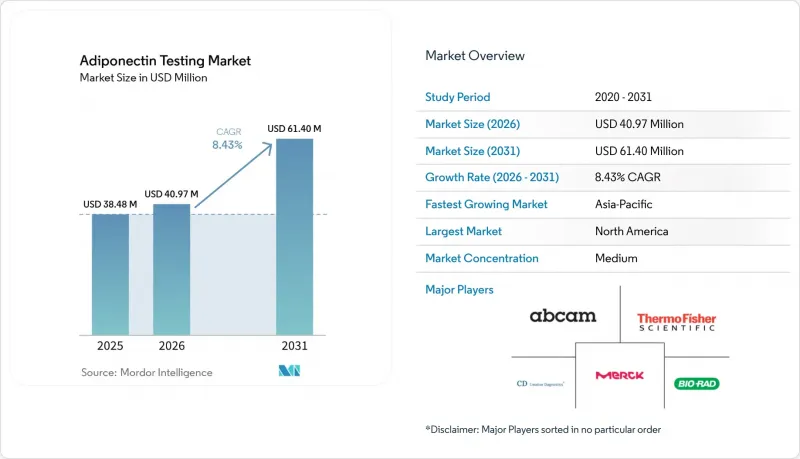
Mordor Intelligence에 의하면, 아디포넥틴 검사 시장 규모는 2025년 3,848만 달러로 평가되었습니다. 2026년에는 4,097만 달러로 확대되어 2031년까지 6,140만 달러에 이를 것으로 예상되고 2026년부터 2031년에 걸쳐 CAGR 8.43%로 성장할 전망입니다.
본 보고서는 제품별(분석 키트, 시약 및 소모품, 소프트웨어), 기술별(ELISA, CLIA, 멀티플렉스 면역측정법), 용도별(당뇨병·대사증후군,비만, 심혈관 질환, 바이오마커 발견), 최종 사용자(연구 기관, 제약·바이오기술 기업, 임상 실험실, 병원, 기타), 지역(북미, 유럽, 아시아태평양, 남미, 중동 및 아프리카)별로 분류되어 있습니다.
세계의 아디포넥틴 검사 시장 동향 및 인사이트
심혈관 및 대사성 질환 연구의 확대
아디포넥틴 검사 시장은 당뇨병, 비만, 심혈관 질환 및 관련 대사성 질환에 대한 연구에서 지속적인 수요를 얻고 있습니다. 2026년 3월에 실시된 대사증후군을 가진 성인 190명을 대상으로 한 연구에 따르면, 심혈관 위험 점수가 상위 사분위수에 가까워질수록 혈청 아디포넥틴 농도가 감소하는 것으로 밝혀졌습니다. 이 연구에서는 아디포넥틴 감소를 포함한 아디포카인의 불균형이 심혈관 위험 점수의 5가지 독립적인 예측 인자 중 하나로 확인되었으며, 이 요인에 의해 설명되는 총 분산은 9.48%인 것으로 보고되었습니다. 또한, ‘포메라니아 건강 연구(Study of Health in Pomerania)’ 참가자 3,199명을 대상으로 한 조사에서도 아디포넥틴 수치가 높을수록 항동맥경화성 지단백 프로파일이 양호한 것으로 나타났습니다. 연구 설계상 아디포넥틴을 염증 마커, 지질 측정값, 인슐린 저항성 지표와 함께 사용하므로, 검사 기관에는 고감도이며 검증된 측정법이 요구됩니다. 이러한 요건으로 인해 표준 연구용 키트뿐만 아니라, 더 높은 부가가치를 지닌 측정법에 대한 수요가 증가하고 있습니다.
비만 및 당뇨병 바이오마커 연구의 확대
아디포넥틴 검사 시장은 당뇨병 및 비만과 관련된 위험 요인의 조기 발견을 목적으로 하는 연구에 힘입어 성장하고 있습니다. 2024년 당뇨병을 앓고 있는 성인 5억 8,900만 명 중 2억 5,200만 명은 자신의 질환을 인지하지 못하고 있었습니다. 2025년 연구에 따르면, 아디포넥틴은 내장 비만과 관련된 2형 당뇨병의 인슐린 저항성에 대한 독립적인 예측 인자이며, HOMA-IR과의 역상관 관계도 확인되었습니다. 이러한 연구 결과는 명백한 질환이 나타나기 전에 대사 위험을 평가하는 연구 프로토콜에서 아디포넥틴의 활용을 뒷받침합니다. 따라서 아디포넥틴 검사 시장은 비만, 당뇨병 및 예방적 대사 건강을 연구하는 학술 기관 및 연구 기관의 프로그램에 기여하고 있습니다. 또한, 아디포넥틴이 연구용 마커에서 비만 및 2형 당뇨병 치료 분야로 전환됨에 따라 의약품 개발 워크플로우에도 기여하고 있습니다.
임상적 유용성의 표준화 미비
아디포넥틴 검사 시장은 전 세계적으로 통일된 기준 범위가 확립되지 않아 여전히 제약을 받고 있습니다. 이러한 격차로 인해 검사 키트 간, 검사 기관 간, 그리고 지역 간 결과 비교가 어려워지고 있습니다. 또한, 다기관 공동 연구에서 일관된 결과를 필요로 하는 병원 네트워크의 도입도 지연되고 있습니다. 관상동맥 질환에서 보고된 ‘아디포넥틴 역설’은 일부 전향적 연구에서 농도 상승이 장기적인 사망률 상승과 관련이 있는 것으로 나타남에 따라, 추가적인 불확실성을 야기하고 있습니다. 중국에서는 아디포넥틴을 포함한 당뇨병 위험 선별 검사에 관한 전문가 합의에 기반한 접근 방식이 확립되어 있으나, 이는 국제적 기준이라기보다는 어디까지나 국내적인 접근 방식에 그치고 있습니다. 그 결과, 수요는 일상적인 진단이 아닌 조사나 제약 회사가 후원하는 프로그램에 집중된 상태를 유지하고 있습니다.
부문별 분석
2025년 기준, 아디포넥틴 검사 시장 규모의 58.2%를 분석 키트가 차지했습니다. 이러한 위상은 동료 심사를 거친 아디포넥틴 연구에서 샌드위치 ELISA 플레이트 형식의 키트가 오랫동안 사용되어 온 사실을 반영합니다. 학술 연구소에서 키트를 선정할 때는 선행 연구의 영향이 종종 나타나며, 그로 인해 연구자들에게는 정평이 나 있는 ELISA 형식이 친숙하게 다가옵니다. 또한, 마이크로플레이트 리더기 도입 대수도 ELISA 대응 제품의 조달을 지속적으로 뒷받침하고 있습니다. 이러한 요인들로 인해 키트 공급업체들은 대학 및 연구 기관의 연구소에서 확고한 입지를 확보하고 있습니다.
시약 및 소모품 시장은 2026년부터 2031년까지 연평균 성장률(CAGR) 8.6%를 나타낼 것으로 예측됩니다. 아디포넥틴 검사 업계에서는 맞춤형 아디포카인 패널에서 매칭된 항체 쌍, 캘리브레이터, 버퍼의 사용이 증가하고 있습니다. 2025년에 검증된 면역 친화성 LC-MS/MS 워크플로는 바이오의약품 기업 및 계약 연구 기관이 카탈로그에 등재된 키트를 구매하는 대신 맞춤형 시약 시스템을 구축할 수 있음을 보여줍니다. 소프트웨어 및 분석 솔루션 시장 규모는 여전히 작지만, 고처리량 연구소에서는 규제 당국에 제출할 신청서를 위해 재현성 있는 데이터 분석과 문서화가 요구되고 있습니다. 시약, 플레이트, 교정제, 분석 도구를 통합한 솔루션을 제공하는 공급업체는 이러한 워크플로우에 대응하는 데 유리한 입장에 있습니다.
2025년 시점에서 ELISA는 아디포넥틴 검사 시장 규모의 46.5%를 차지했습니다. 이러한 우위는 혈청 아디포넥틴 농도 측정에 적합하다는 점과 마이크로플레이트 리더의 광범위한 도입 실적을 반영한 것입니다. 또한, ELISA는 발표된 연구 방법에서 널리 채택되고 있다는 점도 강점으로 작용합니다. 화학발광 면역분석법은 저농도 측정에서 감도 면에서 우위를 차지하는 독자적인 기술 계층을 형성하고 있습니다. 이 기술은 화학발광 분석기가 널리 사용되고 있는 동아시아의 연구소에서 중요한 위치를 차지합니다.
멀티플렉스 면역측정법은 2031년까지 연평균 성장률(CAGR) 9.8%를 나타낼 것으로 예측되며, 이는 각 기술 유형 중 가장 높은 성장률입니다. 제약 기업 후원사들은 이러한 시스템을 활용하여, 한 번의 분석 실행으로 아디포넥틴 외에도 렙틴, 레지스틴 및 염증성 사이토카인을 측정하고 있습니다. Meso Scale Diagnostics사는 아디포넥틴과 여러 관련 바이오마커를 포함하는 패널을 제공합니다. 이러한 접근 방식을 통해 시료 소비량을 줄이고 대규모 임상 코호트에 대한 분석이 가능해집니다. 아디포넥틴 검사 업계에서는 아디포넥틴과 렙틴을 동시에 측정하는 현장 진단용 바이오센서도 등장하고 있지만, 이러한 형태는 아직 초기 단계에 머물러 있습니다. 2025년 보고서에서는 이러한 목적을 위해 소형화된 포텐시오스타트와 스마트폰 앱을 갖춘 레이저 조각 그래핀 면역 센서가 소개되었습니다.
지역별 분석
2025년, 북미는 전 세계 아디포넥틴 검사 시장 점유율의 42.1%를 차지했습니다. 이 지역에는 대사성 질환 연구 기관, 미국 국립보건원(NIH)이 자금을 지원하는 바이오마커 프로그램, 제약 회사가 후원하는 임상시험, 계약 연구 기관(CRO) 및 임상 검사 네트워크가 집중되어 있습니다. 이러한 수요 기반 속에서 미국은 가장 큰 시장을 형성하고 있습니다. 이 나라의 학술 기관과 바이오의약품 인프라는 제품 및 기술 전반에 걸친 수요를 창출하고 있습니다. 또한 북미에서는 규제 대상 연구 환경에서 분석 성능 검증 결과에 대한 수요가 높습니다.
유럽은 아디포넥틴 검사 시장에서 두 번째로 큰 지역 블록입니다. 독일, 영국, 네덜란드에서는 분석 키트에 대한 학술적 수요가 뒷받침되고 있습니다. 규정(EU) 2017/746에 따라 규제 대상 조달 채널의 규정 준수 요건이 강화되어, 검증된 주요 제조업체에 유리하게 작용할 가능성이 있습니다. 2026년에 발표된 ‘포메라니아 건강 조사’에는 3,199명의 참가자가 포함되어 있으며, 이는 이 지역이 인구 수준에서의 아디포넥틴 연구에서 계속해서 중요한 역할을 하고 있음을 보여줍니다. 이러한 근거 기반은 학술 연구소의 장기적인 구매를 뒷받침하고 있습니다.
아시아태평양은 2026년부터 2031년까지 연평균 성장률(CAGR) 8.2%를 나타낼 것으로 예측됩니다. 중국과 일본은 예방 의료 활동과 임상 연구 역량을 바탕으로 각각 독립적인 성장 동력이 되고 있습니다. 중국의 당뇨병 위험 선별 노력은 고위험군에 대한 아디포넥틴 측정을 촉진했으며, 라텍스 증강 면역 탁도법을 통해 집단별 기준치를 확립했습니다. 일본의 종합적인 예방 건강검진 제도는 선택 사항으로 대사 바이오마커 확장 패널을 도입할 수 있는 길을 열어주고 있습니다. 한국에서는 활발한 임상시험 부문이 수요를 견인하고 있으며, 2025년에 실시된 에나보글리플로진에 대한 다기관 공동 임상시험에서 24주 후 혈청 아디포넥틴 수치가 위약군에 비해 0.98 mg/L 증가한 것으로 확인되었습니다. SPRINGER.COM 라틴아메리카, 중동 및 아프리카 시장 규모는 여전히 작은 임베디드니다. 이 지역에서는 연구 중심 대학, 의료 시스템의 현대화, 예방 의료 프로그램 및 지역 유통 네트워크를 통해 초기 수요가 예상됩니다.
기타 혜택 :
- 엑셀 형식 시장 예측(ME) 시트
- 3개월간의 애널리스트 지원
자주 묻는 질문
목차
제1장 서론
제2장 조사 방법
제3장 개요
제4장 시장 구도
제5장 시장 세분화
제6장 경쟁 구도
KTH 26.09.02According to Mordor Intelligence, the adiponectin testing market size is expected to increase from USD 38.48 million in 2025 to USD 40.97 million in 2026 and reach USD 61.40 million by 2031, growing at a CAGR of 8.43% over 2026-2031.
This report is Segmented by Product (Assay Kits, Reagents & Consumables, Software), Technology (ELISA, CLIA, Multiplex Immunoassay), Application (Diabetes & Metabolic Syndrome, Obesity, Cardiovascular, Biomarker Discovery), End User (Research Institutes, Pharma & Biotech, Clinical Labs, Hospitals, Cros), and Geography (North America, Europe, Asia Pacific, South America, MEA).
Global Adiponectin Testing Market Trends and Insights
Growing Cardiometabolic Disease Research
The adiponectin testing market draws sustained demand from research on diabetes, obesity, cardiovascular disease, and related metabolic conditions. A March 2026 study of 190 adults with metabolic syndrome found that serum adiponectin declined across higher cardiovascular risk score quartiles. The same study identified adipokine imbalance, including reduced adiponectin, as 1 of 5 independent predictors of cardiovascular risk score and reported 9.48% of total variance explained by this factor. Research involving 3,199 participants in the Study of Health in Pomerania also associated higher adiponectin with a favorable anti-atherogenic lipoprotein profile. As study designs use adiponectin with inflammation markers, lipid measures, and insulin-resistance indicators, laboratories need sensitive and validated formats. That requirement supports demand for higher-value assays rather than standard research kits alone.
Expansion of Obesity and Diabetes Biomarker Studies
The adiponectin testing market is supported by research aimed at earlier identification of diabetes and obesity-related risk. Of the 589 million adults living with diabetes in 2024, 252 million were unaware of their condition. A 2025 study reported that adiponectin was an independent predictor of insulin resistance in visceral obesity-associated type 2 diabetes and identified an inverse association with HOMA-IR. This evidence supports its use in research protocols that assess metabolic risk before overt disease becomes apparent. The adiponectin testing market therefore serves academic and institutional programs that examine obesity, diabetes, and preventive metabolic health. It also serves drug-development workflows as adiponectin advances from a research marker toward a therapeutic area in obesity and type 2 diabetes.
Limited Clinical-Utility Standardization
The adiponectin testing market remains constrained by the lack of globally harmonized reference intervals. This gap makes it difficult to compare results between kits, laboratories, and regions. It also slows adoption by hospital networks that require consistent results for multisite studies. The reported adiponectin paradox in coronary artery disease creates additional uncertainty because elevated concentrations have been associated with higher long-term mortality in some prospective studies. China has established an expert-consensus approach to diabetes risk screening that includes adiponectin, but it remains a national approach rather than an international standard. As a result, demand remains concentrated in research and pharmaceutical-sponsored programs instead of routine diagnostics.
Other drivers and restraints analyzed in the detailed report include:
- Rising Demand for Multiplex Biomarker Panels
- Translation of Adiponectin Testing Into Weight-Management Monitoring
- High Assay Validation and Regulatory Costs
For complete list of drivers and restraints, kindly check the Table Of Contents.
Segment Analysis
Assay Kits accounted for 58.2% of the adiponectin testing market size in 2025. Their position reflects the long use of sandwich ELISA plate-format kits in peer-reviewed adiponectin research. Literature precedent often influences kit selection in academic laboratories, which makes established ELISA formats familiar to researchers. The installed base of microplate readers also continues to support procurement of ELISA-compatible products. These factors give kit suppliers a dependable base across university and institutional laboratories.
Reagents & Consumables are forecast to grow at an 8.6% CAGR from 2026 to 2031. The adiponectin testing industry is seeing greater use of matched antibody pairs, calibrators, and buffers in custom adipokine panels. The validated 2025 immunoaffinity LC-MS/MS workflow shows how biopharma and contract research settings can assemble custom reagent systems instead of purchasing catalog kits. Software & Analysis Solutions remain smaller, but high-throughput laboratories need reproducible data analysis and documentation for regulatory submissions. Suppliers with integrated offerings across reagents, plates, calibrators, and analysis tools are better placed to serve these workflows.
ELISA held 46.5% of the adiponectin testing market size in 2025. Its lead reflects its suitability for serum adiponectin concentrations and the extensive installed base of microplate readers. ELISA also benefits from its broad presence in published research methods. Chemiluminescent Immunoassay represents a separate technology tier with sensitivity advantages for low-concentration measurement. It has relevance in East Asian laboratories where chemiluminescence analyzers are widely used.
Multiplex Immunoassay is forecast to grow at a 9.8% CAGR through 2031, the highest rate among technology types. Pharmaceutical sponsors use these systems to measure adiponectin with leptin, resistin, and inflammatory cytokines in 1 assay run. Meso Scale Diagnostics offers a panel that includes adiponectin with several related biomarkers. This approach reduces sample consumption and supports analysis across large clinical cohorts. The adiponectin testing industry may also see emerging point-of-care biosensors that measure adiponectin and leptin together, although these formats remain early-stage. A 2025 report described a laser-scribed graphene immunosensor with a miniaturized potentiostat and smartphone application for this purpose.
Complete Report Scope:
- By Product
- Assay Kits
- Reagents & Consumables
- Software & Analysis Solutions
- By Technology
- ELISA
- Chemiluminescent Immunoassay (CLIA)
- Multiplex Immunoassay
- Other Technologies
- Diabetes & Metabolic Syndrome Research
- Obesity Research
- Cardiovascular Research
- Biomarker Discovery & Clinical Research
- Other Applications
- By End User
- Research & Academic Institutes
- Pharmaceutical & Biotechnology Companies
- Clinical Laboratories
- Hospitals & Clinics
- Contract Research Organizations (CROs)
- By Geography
- North America
- United States
- Canada
- Mexico
- Europe
- Germany
- United Kingdom
- France
- Italy
- Spain
- Rest of Europe
- Asia-Pacific
- China
- India
- Japan
- South Korea
- Australia
- Rest of Asia-Pacific
- Middle East & Africa
- GCC
- South Africa
- Rest of Middle East and Africa
- South America
- Brazil
- Argentina
- Rest of South America
- North America
Geography Analysis
North America accounted for 42.1% of the global adiponectin testing market share in 2025. The region combines metabolic disease research institutions, National Institutes of Health-funded biomarker programs, pharmaceutical-sponsored trials, contract research organizations, and clinical testing networks. The United States is the largest national setting within this demand base. Its academic centers and biopharma infrastructure generate demand across products and technologies. North America also has a strong need for documented assay performance in regulated research settings.
Europe is the second-largest regional bloc in the adiponectin testing market. Germany, the United Kingdom, and the Netherlands support academic demand for assay kits. Regulation (EU) 2017/746 raises compliance requirements in regulated procurement channels and can favor larger validated manufacturers. The 2026 Study of Health in Pomerania publication included 3,199 participants and illustrates the region's continuing role in population-level adiponectin research. This evidence base supports long-cycle purchasing by academic laboratories.
Asia Pacific is forecast to grow at an 8.2% CAGR between 2026 and 2031. China and Japan serve as separate sources of growth, supported by preventive health activity and clinical research capacity. China's approach to diabetes risk screening has encouraged adiponectin measurement for high-risk groups and established population-specific reference values through latex-enhanced immunoturbidimetry. Japan's comprehensive preventive medical check-up system provides a channel for optional extended metabolic biomarker panels. South Korea adds demand through its active clinical trial sector, including the 2025 multicenter enavogliflozin study in which serum adiponectin increased by 0.98 mg/L versus placebo after 24 weeks. SPRINGER.COM Latin America and the Middle East and Africa remain smaller. They have early demand from research universities, health-system modernization, preventive care programs, and regional distribution networks.
- Bio-Techne
- Thermo Fisher Scientific
- Merck
- Abcam
- Bio-Rad Laboratories
- LabCorp
- Quest Diagnostics
- STRATEC SE
- Randox Laboratories
- Eagle Biosciences, Inc.
- Boster Biological Technology Co., Ltd.
- Assaypro LLC
- RayBiotech Life, Inc.
- Enzo Biochem, Inc.
- BioVendor Group
- AdipoGen Life Sciences, Inc.
- Meso Scale Diagnostics, LLC
- Mediagnost GmbH
- CUSABIO Technology LLC
- Elabscience Bionovation Inc.
- Creative Diagnostics
- Aviva Systems Biology Corporation
- ERBA Diagnostics, Inc.
- Zeus Scientific Inc.
- Trinity Biotech plc
Additional Benefits:
- The market estimate (ME) sheet in Excel format
- 3 months of analyst support
TABLE OF CONTENTS
1 INTRODUCTION
- 1.1 Study Assumptions and Market Definition
- 1.2 Scope of the Study
2 RESEARCH METHODOLOGY
3 EXECUTIVE SUMMARY
4 MARKET LANDSCAPE
- 4.1 Market Overview
- 4.2 Market Drivers
- 4.2.1 Growing Cardiometabolic Disease Research
- 4.2.2 Expansion of Obesity and Diabetes Biomarker Studies
- 4.2.3 Rising Demand for Multiplex Biomarker Panels
- 4.2.4 Translation of Adiponectin Testing Into Weight-Management Monitoring
- 4.2.5 Greater Need for Matrix-Validated Low-Concentration Assays
- 4.3 Market Restraints
- 4.3.1 Limited Clinical-Utility Standardization
- 4.3.2 High Assay Validation and Regulatory Costs
- 4.3.3 Biological Variability Across Patients and Sample Matrices
- 4.3.4 Substitution by Established Cardiometabolic Biomarkers
- 4.4 Value and Supply-Chain Analysis
- 4.5 Regulatory Landscape
- 4.6 Technological Outlook
- 4.7 Porters Five Forces Analysis
- 4.7.1 Threat of New Entrants
- 4.7.2 Bargaining Power of Suppliers
- 4.7.3 Bargaining Power of Buyers
- 4.7.4 Threat of Substitutes
- 4.7.5 Competitive Rivalry
5 Market Segmentation
- 5.1 By Product
- 5.1.1 Assay Kits
- 5.1.2 Reagents & Consumables
- 5.1.3 Software & Analysis Solutions
- 5.2 By Technology
- 5.2.1 ELISA
- 5.2.2 Chemiluminescent Immunoassay (CLIA)
- 5.2.3 Multiplex Immunoassay
- 5.2.4 Other Technologies
- 5.2.5 Diabetes & Metabolic Syndrome Research
- 5.2.6 Obesity Research
- 5.2.7 Cardiovascular Research
- 5.2.8 Biomarker Discovery & Clinical Research
- 5.2.9 Other Applications
- 5.3 By End User
- 5.3.1 Research & Academic Institutes
- 5.3.2 Pharmaceutical & Biotechnology Companies
- 5.3.3 Clinical Laboratories
- 5.3.4 Hospitals & Clinics
- 5.3.5 Contract Research Organizations (CROs)
- 5.4 By Geography
- 5.4.1 North America
- 5.4.1.1 United States
- 5.4.1.2 Canada
- 5.4.1.3 Mexico
- 5.4.2 Europe
- 5.4.2.1 Germany
- 5.4.2.2 United Kingdom
- 5.4.2.3 France
- 5.4.2.4 Italy
- 5.4.2.5 Spain
- 5.4.2.6 Rest of Europe
- 5.4.3 Asia-Pacific
- 5.4.3.1 China
- 5.4.3.2 India
- 5.4.3.3 Japan
- 5.4.3.4 South Korea
- 5.4.3.5 Australia
- 5.4.3.6 Rest of Asia-Pacific
- 5.4.4 Middle East & Africa
- 5.4.4.1 GCC
- 5.4.4.2 South Africa
- 5.4.4.3 Rest of Middle East and Africa
- 5.4.5 South America
- 5.4.5.1 Brazil
- 5.4.5.2 Argentina
- 5.4.5.3 Rest of South America
- 5.4.1 North America
6 Competitive Landscape
- 6.1 Market Concentration
- 6.2 Market Share Analysis
- 6.3 Company Profiles
- 6.3.1 Bio-Techne Corporation
- 6.3.2 Thermo Fisher Scientific Inc.
- 6.3.3 Merck KGaA
- 6.3.4 Abcam plc
- 6.3.5 Bio-Rad Laboratories, Inc.
- 6.3.6 Laboratory Corporation of America Holdings
- 6.3.7 Quest Diagnostics Incorporated
- 6.3.8 STRATEC SE
- 6.3.9 Randox Laboratories Ltd
- 6.3.10 Eagle Biosciences, Inc.
- 6.3.11 Boster Biological Technology Co., Ltd.
- 6.3.12 Assaypro LLC
- 6.3.13 RayBiotech Life, Inc.
- 6.3.14 Enzo Biochem, Inc.
- 6.3.15 BioVendor Group
- 6.3.16 AdipoGen Life Sciences, Inc.
- 6.3.17 Meso Scale Diagnostics, LLC
- 6.3.18 Mediagnost GmbH
- 6.3.19 CUSABIO Technology LLC
- 6.3.20 Elabscience Bionovation Inc.
- 6.3.21 Creative Diagnostics
- 6.3.22 Aviva Systems Biology Corporation
- 6.3.23 ERBA Diagnostics, Inc.
- 6.3.24 Zeus Scientific Inc.
- 6.3.25 Trinity Biotech plc
- 6.4 White-Space and Unmet-Need Assessment
- 6.5 Future Outlook


