
|
시장보고서
상품코드
2119330
리튬 이온 배터리 안전 시스템 : 시장 점유율 분석, 업계 동향 및 통계, 성장 예측(2026-2031년)Lithium-Ion Battery Safety Systems - Market Share Analysis, Industry Trends & Statistics, Growth Forecasts (2026 - 2031) |
||||||
 Mordor Intelligence
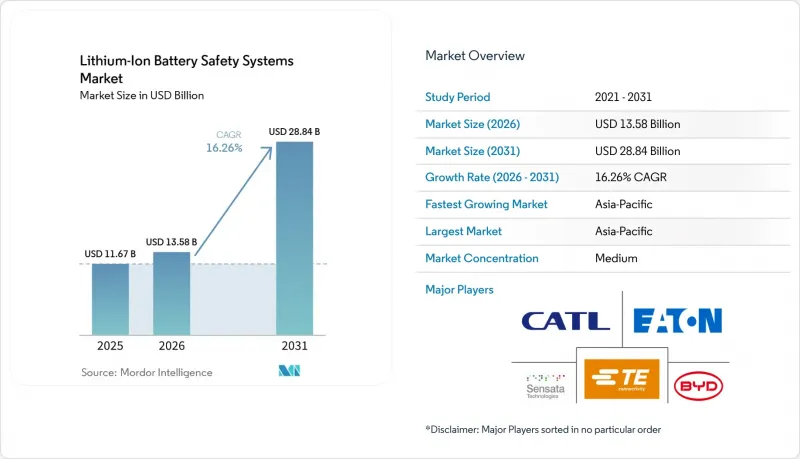
Mordor Intelligence에 의하면, 리튬 이온 배터리 요우안전시스템 시장 규모는 2025년에 116억 7,000만 달러로 평가되었습니다. 2026년 135억 8,000만 달러에서 2031년까지 288억 4,000만 달러에 이를 것으로 예상되며, 예측 기간(2026-2031년) CAGR은 16.26%를 나타낼 전망입니다.
본 보고서는 안전 시스템(BMS, 열 관리, CID, BDU, 퓨즈, 기타), 배터리 화학 조성(LFP, NMC, NCA, 기타), 용도(전기자동차, 소비자 가전, ESS, 산업용, 항공우주 및 방위, 선박용, 기타),및 지역(북미, 유럽, 아시아태평양, 남미, 중동 및 아프리카)별로 분류되어 있습니다. 시장 예측은 금액(달러) 기준으로 제시되어 있습니다.
세계의 리튬 이온 배터리 안전 시스템 시장 동향 및 인사이트
EV 및 E-모빌리티용 배터리 팩의 확대
2025년, 전 세계 전기차용 배터리 도입량은 1.2 TWh에 달했으며, 그중 85% 이상을 경차가 차지했습니다. 이러한 규모로 인해 자동차 관련 프로그램은 배터리 모니터링 및 고장 대응 시스템의 주요 수요 기반이 되고 있습니다. 800V 차량 아키텍처로의 전환에 따라 셀 간의 전압 스트레스와 온도 변동이 증가하고 있습니다. 이에 따라 기존의 400V 플랫폼보다 더 엄격한 아날로그 허용 오차와 더 신속한 고장 대응이 요구되고 있습니다. 텍사스 기기는 2026년 6월, 전기화학 임피던스 분광법(EIS) 엔진이 내장된 26셀용 배터리 모니터를 발표했습니다. 이를 통해 셀 수준에서 열 폭주 위험을 감지할 수 있게 되었으며, ISO 26262 ASIL-D 인증도 획득했습니다. 따라서 리튬 이온 배터리 안전 시스템 시장에서는 자동차용 기능 안전 규격 준수와 예측 진단 기능을 겸비한 공급업체가 우위를 점하고 있습니다.
전력망 규모의 에너지 저장 시스템 안전성 향상
2025년 전 세계 배터리 에너지 저장 용량 증가량은 108 GW에 달하고, 2024년 대비 40% 증가했습니다. 신규 용량의 90% 가까이를 LFP 배터리가 차지하고 있으며, 저장 용량의 확대는 화학 조성에 특화된 모니터링 및 냉각 요구 사항과 밀접한 관련이 있습니다. 변동하는 주변 환경 조건에서 작동하는 대형 각형 셀은 자동차 배터리 팩과는 다른 발열 패턴을 나타냅니다. 그 결과, 에너지 저장 프로젝트에는 자동차용 솔루션을 전용한 것이 아닌, 고정형으로 설계된 열 제어 로직이 필요합니다. 2025년 1월에 발생한 모스 랜딩 화재로 1,500명의 주민이 대피해야 했으며, 이는 대규모 시설에서 부실한 안전 대책이 초래하는 심각한 결과를 여실히 드러냈습니다. 에너지 저장 프로젝트의 설계 단계에서 설비 수준의 화재 시험 및 위험성 평가가 더 조기에 수행됨에 따라 리튬 이온 배터리 안전 시스템 시장은 혜택을 보고 있습니다.
높은 도입 비용과 기술적 복잡성이 보급을 제약
다중 구역 액체 냉각, 무선 BMS, 통합형 배터리 차단 장치와 같은 첨단 안전 시스템은 배터리 팩 총 비용의 8-15%를 증가시킵니다. 이 때문에 비용을 중시하는 자동차 제조업체나 신흥 경제국 고객들 사이에서는 도입이 제한되고 있습니다. 동남아시아와 인도에서는 초기 단계의 이륜차 및 삼륜차 전동화 프로그램에서 안전 장비가 규제상 최소 기준에 그치는 경우가 많습니다. 크라이슬러 ‘퍼시피카’ 플러그인 하이브리드 차량 및 LG 에너지 솔루션의 셀과 관련된 리콜 사례는 셀이나 BMS 사양의 미비함이 실제 운용에서 어떤 영향을 미칠 수 있는지를 보여주었습니다. 열 관리 및 BMS 기능을 위한 하드웨어 플랫폼을 공유함으로써 비용을 절감할 수 있지만, 이를 위해서는 중소규모 공급업체에 부족한 경우가 많은 연구개발 자원이 필요합니다. 또한, 리튬 이온 배터리 안전 시스템 시장에서는 ISO 26262, IEC 62619, UN 38.3 및 지역별 요구 사항을 준수하기 위한 인증 비용도 발생합니다.
부문별 분석
2025년 기준, 배터리 관리 시스템(BMS)은 리튬 이온 배터리 안전 시스템 시장의 38.4%를 차지했습니다. BMS는 다양한 배터리 화학 시스템에서 셀 전압, 전류, 온도, 상태(SOH) 및 밸런스 기능을 모니터링합니다. 또한, 고장 감지 및 대응을 위한 중앙 제어 기능도 제공합니다. BMS 기술은 임계값 기반의 보호에서 잠재적인 고장을 더 조기에 식별하는 시스템으로 전환되고 있습니다. 중국공급업체들은 엣지 신경망 통합을 활용하여 충전 상태(SOC) 추정 오차를 ±1.5% 미만으로 억제하고 있습니다. 이 기능은 LFP를 많이 사용하는 배터리 프로그램의 조달 요건에서 점점 더 중요해지고 있습니다.
열 관리 시스템은 2031년까지 연평균 성장률(CAGR) 17.2%를 나타낼 것으로 예측됩니다. 급속 충전, 에너지 밀도 향상 및 에너지 저장 설비의 확대로 인해 이러한 시스템이 관리해야 하는 열 부하가 증가하고 있습니다. 중국은 2026년에 ‘T/CQPRA 0173-2026’을 공표하여, 스마트 커넥티드 신에너지 차량의 배터리 열 관리에 대한 기술 요건을 규정했습니다. 차단 장치, 배터리 차단 장치 및 퓨즈는 과전류, 과열 및 단락 사고로부터 보호하는 역할을 합니다. 2025년 11월 CATL이 맞춤형 퓨즈 공급업체로 메르센을 선정한 것과 2026년 7월 포드 및 Leapmotor와 계약을 체결한 것은 여러 고객사로부터 인증을 획득한 가치를 잘 보여줍니다. 또한, UL 9540A 제6판에서 가스 및 폭발 위험에 대한 평가 범위가 확대됨에 따라, 가스 감지, 압력 방출 장치, 소화 시스템의 통합 등 기타 안전 시스템의 중요성이 높아지고 있습니다.
지역별 분석
아시아태평양은 2025년에 전 세계 매출의 55.6%를 차지했으며, 2031년까지 연평균 성장률(CAGR) 18.6%로 성장할 것으로 전망됩니다. 이 지역은 리튬 이온 배터리 시스템의 최대 생산 거점이자 동시에 최대 수요 거점이기도 합니다. 중국은 전 세계 전기차 배터리 도입량의 60%, 전 세계 리튬 이온 배터리 명목 생산 능력의 80% 이상을 차지하고 있습니다. 중국의 GB38031-2025 규격은 2026년 7월에 시행되었으며, 새로 인증되는 구동용 배터리 모델에서는 화재나 폭발이 발생하지 않아야 합니다. 유럽연합(EU), 동남아시아, 중동의 규제 당국은 이 프레임워크와의 일관성을 확보하기 위해 검토를 진행하고 있습니다.
일본의 BMS 시장 규모는 2025년에 5억 9,090만 달러에 달했습니다. 2030년까지 36-38%, 2040년까지 50%라는 재생에너지 발전 목표가 축전지의 도입을 뒷받침하고 있습니다. 인도에서는 전동 이륜차 및 삼륜차용 AIS-156 및 AIS-038 개정 2판의 열전파 시험 요건을 통해 안전 시스템에 대한 수요가 확대되고 있습니다. 한국은 배터리 제조업체들이 LFP, 전고체, 나트륨 이온 기술에 투자하고 있어 여전히 중요한 시장입니다. 삼성SDI는 2040년까지 울산 및 천안 시설에 25조 원(177억 달러 상당)을 투자할 계획을 발표했습니다. 이러한 투자로 인해 지역 안전 시스템 공급업체들이 대응해야 할 화학 조성의 범위가 넓어지고 있습니다.
북미는 리튬 이온 배터리 안전 시스템 시장에서 두 번째로 큰 규모를 자랑하는 지역 시장입니다. ‘인플레이션 억제법(Inflation Reduction Act)’에 따른 우대 조치, NFPA 855 요건, 그리고 UL 9540 준수가 미국 내 인증 장비 수요를 뒷받침하고 있습니다. AB 1285 법에 이어 캘리포니아주의 2026년판 소방법 개정으로 인해 배터리 에너지 저장 설비에 대한 안전 시스템 요건이 강화되었습니다. 또한, 2026년에 발생한 포드, 닛산, 크라이슬러의 배터리 리콜도 배터리 검증 관행에 대한 엄격한 감시를 지속시키는 요인이 되고 있습니다. 유럽은 3위를 차지하고 있으며, 독일, 프랑스, 영국이 자동차용 BMS 수요를 뒷받침하고 있는 반면, EU 배터리 규정에서는 디지털 배터리 여권 및 상태(SOH) 보고가 의무화되어 있습니다. 남미, 중동 및 아프리카는 여전히 초기 단계에 있는 지역이지만, 브라질, 칠레, 사우디아라비아, 아랍에미리트에서는 에너지 저장 및 배터리 관련 프로젝트 활동이 증가하고 있습니다.
기타 혜택 :
- 엑셀 형식 시장 예측(ME) 시트
- 3개월간의 애널리스트 지원
자주 묻는 질문
목차
제1장 서론
제2장 조사 방법
제3장 개요
제4장 시장 구도
제5장 시장 규모 및 성장 예측
제6장 경쟁 구도
제7장 시장 기회 및 향후 전망
KTH 26.09.02According to Mordor Intelligence, the lithium-Ion battery safety systems market size was valued at USD 11.67 billion in 2025 and is estimated to grow from USD 13.58 billion in 2026 to reach USD 28.84 billion by 2031, at a CAGR of 16.26% during the forecast period (2026-2031).
This report is Segmented by Safety System (BMS, Thermal Management, CID, BDU, Fuses, Others), Battery Chemistry (LFP, NMC, NCA, Others), Application (Electric Vehicles, Consumer Electronics, ESS, Industrial, Aerospace and Defense, Marine, Others), and Geography (North America, Europe, Asia-Pacific, South America, Middle East and Africa). The Market Forecasts are Provided in Terms of Value (USD).
Global Lithium-Ion Battery Safety Systems Market Trends and Insights
EV and E-Mobility Battery Pack Expansion
Global electric vehicle battery deployment reached 1.2 TWh in 2025, with light-duty vehicles accounting for more than 85% of the volume. This scale makes automotive programs the principal demand base for battery monitoring and fault-response systems. The move toward 800V vehicle architectures increases voltage stress and thermal variation across cells. It requires tighter analog tolerances and faster fault responses than earlier 400V platforms. Texas Instruments introduced its 26-cell battery monitor with an integrated electrochemical impedance spectroscopy engine in June 2026, enabling cell-level detection of thermal-runaway risk and providing ISO 26262 ASIL-D certification. The lithium-ion battery safety systems market, therefore, favors suppliers that combine automotive functional safety compliance with predictive diagnostic capability.
Grid-Scale Storage Safety Upgrades
Global additions of battery energy storage capacity reached 108 GW in 2025, a 40% increase from 2024. LFP batteries accounted for nearly 90% of the new capacity, linking storage growth closely to chemistry-specific monitoring and cooling requirements. Large prismatic cells operating under changing ambient conditions create heat patterns that differ from those of automotive battery packs. Storage projects consequently need thermal control logic designed for stationary use, rather than adapted vehicle solutions. The Moss Landing fire in January 2025 led to the evacuation of 1,500 residents and highlighted the consequences of inadequate safety arrangements in large installations. The lithium-ion battery safety systems market is benefiting as installation-level fire testing and hazard evaluation move earlier into energy storage project design.
High Integration Costs and Technical Complexity Constraining Adoption
Advanced safety systems, including multi-zone liquid cooling, wireless BMS, and integrated battery disconnect units, add 8-15% to total battery pack cost. This limits adoption among cost-sensitive vehicle makers and customers in emerging economies. In Southeast Asia and India, early two-wheeler and three-wheeler electrification programs often limit safety content to the regulatory minimum. A recall involving Chrysler Pacifica plug-in hybrid vehicles and LG Energy Solution cells demonstrated how cell or BMS specification weaknesses can create field consequences. Shared hardware platforms for thermal management and BMS functions can reduce costs, but they require research and development resources that smaller suppliers may not have. The lithium-ion battery safety systems market also carries certification costs across ISO 26262, IEC 62619, UN 38.3, and regional requirements.
Other drivers and restraints analyzed in the detailed report include:
- Stricter Battery Safety and Transport Compliance
- Fast-Charging and High-Voltage Pack Adoption
- Interoperability and Standardization Gaps Slowing Multi-Chemistry Deployment
For complete list of drivers and restraints, kindly check the Table Of Contents.
Segment Analysis
Battery management systems held 38.4% of the lithium-ion battery safety systems market in 2025. They monitor cell voltage, current, temperature, state of health, and balancing functions across battery chemistries. They also provide the central control function for fault detection and response. BMS technology is moving from threshold-based protection toward systems that identify potential faults earlier. Chinese suppliers are using edge neural network integration to achieve state-of-charge estimation errors below +-1.5%. This capability is becoming more relevant for procurement requirements in LFP-heavy battery programs.
Thermal management systems are forecast to record a 17.2% CAGR through 2031. Faster charging, higher energy density, and expanding energy storage installations are increasing the heat load that these systems must manage. China published T/CQPRA 0173-2026 in 2026, setting technical requirements for battery thermal management in intelligent connected new-energy vehicles. Current interruption devices, battery disconnect units, and fuses protect against overcurrent, thermal, and short-circuit events. Mersen's November 2025 selection by CATL for custom fuses and its July 2026 contracts with Ford and Leapmotor show the value of multi-customer qualification. Other safety systems, including gas detection, pressure-relief equipment, and fire suppression integration, are gaining relevance because UL 9540A sixth edition expanded gas and explosion hazard evaluation.
Complete Report Scope:
- By Safety System
- Battery Management Systems (BMS)
- Thermal Management Systems
- Current Interruption Devices (CID)
- Battery Disconnect Units (BDU)
- Fuses and Circuit Protection Devices
- Other Safety Systems
- By Battery Chemistry
- Lithium Iron Phosphate (LFP)
- Nickel Manganese Cobalt (NMC)
- Nickel Cobalt Aluminum (NCA)
- Other Lithium-Ion Chemistries
- By Application
- Electric Vehicles
- Consumer Electronics
- Energy Storage Systems (ESS)
- Industrial Equipment
- Aerospace and Defense
- Marine
- Other Applications
- By Geography
- North America
- United States
- Canada
- Mexico
- Europe
- Germany
- France
- Italy
- Spain
- United Kingdom
- Poland
- Russia
- Rest of Europe
- Asia-Pacific
- China
- India
- Japan
- South Korea
- Australia
- Indonesia
- Vietnam
- Thailand
- Rest of Asia-Pacific
- South America
- Brazil
- Argentina
- Chile
- Rest of South America
- Middle East and Africa
- Saudi Arabia
- United Arab Emirates
- Egypt
- South Africa
- Morocco
- Rest of Middle East and Africa
- North America
Geography Analysis
Asia-Pacific held 55.6% of global revenue in 2025 and is forecast to grow at an 18.6% CAGR through 2031. The region is both the largest production center and the largest demand center for lithium-ion battery systems. China accounted for 60% of global electric vehicle battery deployment and more than 80% of global lithium-ion manufacturing nameplate capacity. China's GB38031-2025 rule came into effect in July 2026 and requires no fire or explosion in newly declared traction battery models. Regulators in the European Union, Southeast Asia, and the Middle East are reviewing the framework for potential alignment.
Japan's BMS value reached USD 590.9 million in 2025. Its renewable generation targets of 36-38% by 2030 and 50% by 2040 support battery storage deployment. India is expanding safety system demand through AIS-156 and AIS-038 Revision 2 thermal propagation testing requirements for electric two-wheelers and three-wheelers. South Korea remains important because battery manufacturers are investing in LFP, solid-state, and sodium-ion technologies. Samsung SDI announced a KRW 25 trillion investment plan, equivalent to USD 17.7 billion, for its Ulsan and Cheonan facilities through 2040. These investments broaden the chemistry profiles that regional safety suppliers must support.
North America is the second-largest regional market in the lithium-ion battery safety systems market. Inflation Reduction Act incentives, NFPA 855 requirements, and UL 9540 compliance support demand for certified equipment in the United States. California's 2026 Fire Code updates, following AB 1285, increase safety system requirements for battery energy storage installations. Ford, Nissan, and Chrysler battery recalls during 2026 also maintain scrutiny of battery validation practices. Europe ranks third, with Germany, France, and the United Kingdom supporting automotive BMS demand, while the EU Battery Regulation requires digital battery passports and state-of-health reporting. South America, the Middle East, and Africa remain earlier-stage areas, though Brazil, Chile, Saudi Arabia, and the United Arab Emirates are adding storage and battery-related project activity.
- Analog Devices Inc.
- BYD Company Limited
- Contemporary Amperex Technology Co., Limited
- Dana Incorporated
- DENSO Corporation
- Eaton Corporation plc
- Eberspacher Gruppe GmbH & Co. KG
- Hanon Systems Co., Ltd.
- Lithium Balance A/S
- Littelfuse, Inc.
- MAHLE GmbH
- Mersen
- Nuvation Energy
- NXP Semiconductors N.V.
- Robert Bosch GmbH
- Sensata Technologies, Inc.
- TE Connectivity Ltd.
- Texas Instruments Incorporated
- Valeo SE
Additional Benefits:
- The market estimate (ME) sheet in Excel format
- 3 months of analyst support
TABLE OF CONTENTS
1 INTRODUCTION
- 1.1 Study Assumptions and Market Definition
- 1.2 Scope of the Study
2 RESEARCH METHODOLOGY
3 EXECUTIVE SUMMARY
4 MARKET LANDSCAPE
- 4.1 Market Overview
- 4.2 Market Drivers
- 4.2.1 EV and E-Mobility Battery Pack Expansion
- 4.2.2 Grid-Scale Storage Safety Upgrades
- 4.2.3 Fast-Charging and High-Voltage Pack Adoption
- 4.2.4 Stricter Battery Safety and Transport Compliance
- 4.2.5 Predictive Diagnostics and Real-Time Battery Health Monitoring
- 4.2.6 Wireless and Software-Defined Battery Safety Architectures
- 4.3 Market Restraints
- 4.3.1 High Integration and Validation Cost
- 4.3.2 Fragmented Global Safety Standards
- 4.3.3 Semiconductor and Sensor Supply Exposure
- 4.3.4 Cybersecurity and Connected-BMS Liability Risk
- 4.4 Supply-Chain Analysis
- 4.5 Porter's Five Forces Analysis
- 4.6 Technology Outlook
- 4.7 Regulatory Landscape
- 4.8 Investment Analysis
5 MARKET SIZE AND GROWTH FORECASTS
- 5.1 By Safety System
- 5.1.1 Battery Management Systems (BMS)
- 5.1.2 Thermal Management Systems
- 5.1.3 Current Interruption Devices (CID)
- 5.1.4 Battery Disconnect Units (BDU)
- 5.1.5 Fuses and Circuit Protection Devices
- 5.1.6 Other Safety Systems
- 5.2 By Battery Chemistry
- 5.2.1 Lithium Iron Phosphate (LFP)
- 5.2.2 Nickel Manganese Cobalt (NMC)
- 5.2.3 Nickel Cobalt Aluminum (NCA)
- 5.2.4 Other Lithium-Ion Chemistries
- 5.3 By Application
- 5.3.1 Electric Vehicles
- 5.3.2 Consumer Electronics
- 5.3.3 Energy Storage Systems (ESS)
- 5.3.4 Industrial Equipment
- 5.3.5 Aerospace and Defense
- 5.3.6 Marine
- 5.3.7 Other Applications
- 5.4 By Geography
- 5.4.1 North America
- 5.4.1.1 United States
- 5.4.1.2 Canada
- 5.4.1.3 Mexico
- 5.4.2 Europe
- 5.4.2.1 Germany
- 5.4.2.2 France
- 5.4.2.3 Italy
- 5.4.2.4 Spain
- 5.4.2.5 United Kingdom
- 5.4.2.6 Poland
- 5.4.2.7 Russia
- 5.4.2.8 Rest of Europe
- 5.4.3 Asia-Pacific
- 5.4.3.1 China
- 5.4.3.2 India
- 5.4.3.3 Japan
- 5.4.3.4 South Korea
- 5.4.3.5 Australia
- 5.4.3.6 Indonesia
- 5.4.3.7 Vietnam
- 5.4.3.8 Thailand
- 5.4.3.9 Rest of Asia-Pacific
- 5.4.4 South America
- 5.4.4.1 Brazil
- 5.4.4.2 Argentina
- 5.4.4.3 Chile
- 5.4.4.4 Rest of South America
- 5.4.5 Middle East and Africa
- 5.4.5.1 Saudi Arabia
- 5.4.5.2 United Arab Emirates
- 5.4.5.3 Egypt
- 5.4.5.4 South Africa
- 5.4.5.5 Morocco
- 5.4.5.6 Rest of Middle East and Africa
- 5.4.1 North America
6 COMPETITIVE LANDSCAPE
- 6.1 Market Concentration
- 6.2 Strategic Moves
- 6.3 Market Share Analysis
- 6.4 Company Profiles (includes Global Level Overview, Market Level Overview, Core Segments, Financials as available, Strategic Information, Market Rank/Share, Products and Services, Recent Developments)
- 6.4.1 Analog Devices Inc.
- 6.4.2 BYD Company Limited
- 6.4.3 Contemporary Amperex Technology Co., Limited
- 6.4.4 Dana Incorporated
- 6.4.5 DENSO Corporation
- 6.4.6 Eaton Corporation plc
- 6.4.7 Eberspacher Gruppe GmbH & Co. KG
- 6.4.8 Hanon Systems Co., Ltd.
- 6.4.9 Lithium Balance A/S
- 6.4.10 Littelfuse, Inc.
- 6.4.11 MAHLE GmbH
- 6.4.12 Mersen
- 6.4.13 Nuvation Energy
- 6.4.14 NXP Semiconductors N.V.
- 6.4.15 Robert Bosch GmbH
- 6.4.16 Sensata Technologies, Inc.
- 6.4.17 TE Connectivity Ltd.
- 6.4.18 Texas Instruments Incorporated
- 6.4.19 Valeo SE
7 MARKET OPPORTUNITIES AND FUTURE OUTLOOK
- 7.1 White-Space and Unmet-Need Assessment