

|
시장보고서
상품코드
2119337
에너지 부문 마케팅 서비스 : 시장 점유율 분석, 업계 동향 및 통계, 성장 예측(2026-2031년)Energy Sector Marketing Services - Market Share Analysis, Industry Trends & Statistics, Growth Forecasts (2026 - 2031) |
||||||
 Mordor Intelligence
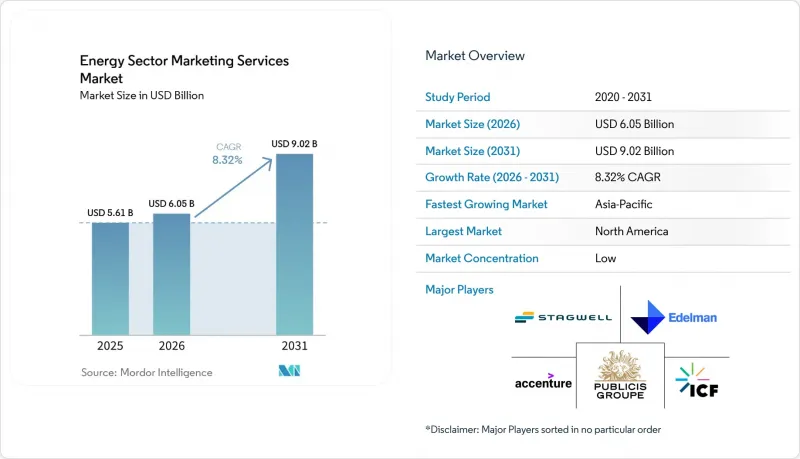
Mordor Intelligence에 의하면, 에너지 부문 마케팅 서비스 시장 규모는 2025년에 56억 1,000만 달러로 평가되었습니다. 2026년 60억 5,000만 달러에서 확대해, 2031년까지 90억 2,000만 달러에 이를 것으로 예측됩니다.
2026년부터 2031년까지 동안 연평균 성장률(CAGR)은 8.32%가 될 것으로 전망됩니다.
본 보고서는 서비스 유형(브랜드 전략·포지셔닝, 크리에이티브·콘텐츠 제작, 이메일·라이프사이클 마케팅, 이벤트·체험형 마케팅, 홍보·커뮤니케이션, 소셜 미디어 마케팅, 이해관계자·커뮤니티 참여) 및 지역별(북미, 남미, 기타)로 분류되어 있습니다. 시장 전망은 금액(달러) 기준으로 제시되어 있습니다.
세계의 에너지 부문 마케팅 서비스 시장 동향 및 인사이트
송전망 현대화 및 에너지 전환에 대한 지출 확대가 전문적인 스토리텔링에 대한 수요를 높이고 있습니다.
송전망 및 에너지 전환에 대한 투자로 인해, 유틸리티체와 개발 사업자에게 있어 커뮤니케이션은 사업 운영에서 더욱 핵심적인 요건이 되고 있습니다. ‘Net Zero Alliance’의 회원사인 각 유틸리티체들은 향후 몇 년간 대규모 전환 투자를 추진할 계획을 발표했습니다. 계획된 지출에서는 재생에너지 발전보다 송전망 및 에너지 저장에 중점을 두고 있습니다. 이러한 변화로 인해 비용, 일정, 신뢰성, 지역적 영향 및 고객에게 기대되는 혜택에 대한 설명이 필요한 프로젝트의 수가 증가하고 있습니다. 또한, 에너지 관련 커뮤니케이션의 대상도 일반 소비자에 그치지 않고 규제 당국, 정책 입안자, 토지 소유자, 투자자, 지역 사회로 확대되고 있습니다. 허가 취득, 요금 책정 근거 제시, 송전 회랑에 관한 소통이 개별 프로젝트에서 수년에 걸친 프로그램으로 전환됨에 따라, 에너지 부문의 마케팅 서비스 시장은 혜택을 보게 될 것입니다.
유틸리티자의 고객 경험 혁신에 따라, 고객 경험 중심의 참여 프로그램에 대한 수요가 높아지고 있습니다.
유틸리티자들이 디지털 참여를 단순한 부수적인 고객 서비스 기능이 아닌 규제 및 서비스 성과 과제로 인식하기 시작함에 따라, 에너지 부문의 마케팅 서비스 시장이 힘을 얻고 있습니다. 가정용 에너지 비용의 상승에 따라, 고객들은 인프라 계획, 서비스 신뢰성, 지불 지원, 그리고 프로그램에 자금이 지원되는 이유에 대한 유틸리티자의 설명에 대해 더욱 엄격한 시선을 보내고 있습니다. 조직은 투자 프로그램을 쉬운 말로 설명하고, 고객이 취해야 할 행동을 명확히 하며, 각 가정이 이미 이용할 수 있는 서비스를 이해할 수 있도록 돕는 커뮤니케이션이 요구됩니다. 또한 디지털 채널을 활용함으로써 정전 정보, 지불 지원, 에너지 효율화, 전기화 프로그램 및 계정 관련 안내를 일관된 고객 여정 속에서 연결할 수 있게 됩니다. 이를 통해 각 유틸리티팀의 별도 팀에서 관련 없는 메시지가 전달되는 것을 방지할 수 있습니다. 이러한 요구가 에너지 부문의 마케팅 서비스 시장을 뒷받침하고 있습니다. 이는 유틸리티자가 승인된 메시지를 유지하면서 고객 데이터, 콘텐츠, 미디어, 콜센터 정보 및 여러 채널에 걸친 아웃리치 활동을 조정하기 위한 지원을 종종 필요로 하기 때문입니다. 유틸리티자의 승인 절차를 이해하고 있는 제공업체는 프로그램 관련 커뮤니케이션을 규제 절차에서 중요한 참여율 및 만족도 지표와 연계할 수 있습니다. 이를 통해 해당 노력은 단순한 일회성 프로모션 캠페인보다 지속 가능한 것이 됩니다.
그린워싱 방지 규제가 강화됨에 따라 심사 비용과 주장의 승인에 소요되는 시간이 증가하고 있습니다.
에너지 부문의 마케팅 서비스 시장은 환경 관련 주장을 포함하는 캠페인이 공개 전에 추가적인 법적 검토와 증거 제시를 필요로 하기 때문에 더 큰 장벽에 직면해 있습니다. 지침 2024/825는 EU 회원국들에게 2026년 3월까지 해당 규정을 국내법에 반영할 것을 요구하고 있으며, 요건은 2026년 9월부터 완전히 적용됩니다. 이 지침은 인정되고 검증 가능한 실적으로 뒷받침되지 않는 일반적인 환경 주장을 제한하고 있으므로, 대행사는 문구, 뒷받침하는 기록, 그리고 대상 독자의 맥락이 모두 타당할 수 있는지 검토해야 합니다. 유럽 집행위원회는 2026년 5월에 지침을 업데이트하여 기업 간(B2B) 커뮤니케이션과 관련된 설명을 추가했습니다. 이러한 규정으로 인해 승인 주기가 길어지거나, 문서 작성 업무가 증가하거나, 증거가 불완전하거나, 심사 책임이 불분명하거나, 프로세스 후반부에 주장을 수정해야 할 필요가 발생하는 경우 캠페인 시작이 지연될 가능성이 있습니다. 클라이언트가 캠페인을 연기하거나 축소하는 경우, 이는 에너지 부문의 마케팅 서비스 시장을 억제하는 요인이 되지만, 한편으로는 공식적인 검증 절차와 확립된 승인 관리 기법을 갖춘 공급자의 가치를 높이는 결과로 이어지기도 합니다.
부문별 분석
2025년, 브랜드 전략 및 포지셔닝은 에너지 부문 마케팅 서비스 시장에서 27.61%의 점유율을 차지했습니다. 이러한 위치는 각 이해관계자들이 동일한 투자 계획의 서로 다른 요소에 주목하고 있는 경우에도, 에너지 기업이 규제 당국, 기관 투자자, 지역 사회, 고객에게 일관된 메시지를 전달할 필요성을 반영하고 있습니다. 인프라 계획에는 요금 산정 기준의 확대, 해상 풍력 발전소 입지 선정, 송전 프로젝트, 또는 원자력 발전소의 운전 허가 연장 등이 포함될 수 있으며, 각 상황에 따라 비용, 시기, 신뢰성, 지역사회에 미치는 영향 및 기대되는 혜택에 대해 서로 다른 우려를 가진 이해관계자들이 존재합니다. 서비스 제공업체는 프로젝트에 관한 대외적 설명을 규제 당국에 제출하는 기록, 투자자용 자료, 고객과의 소통, 지역사회와의 관계에 관한 계획, 그리고 주장을 뒷받침하는 기술 정보와 일관성을 유지해야 합니다. 따라서 브랜드 전략은 투자 계획의 신뢰성, 그리고 각 채널 간에 모순을 일으키지 않으면서 관련된 현실적인 상충 관계를 설명할 수 있는 기업의 능력과 밀접하게 연결되어 있습니다. 에너지 부문의 마케팅 서비스 산업에서 브랜드 전략은 단순한 시각적 연출이나 광고 활동에 그치지 않고, 캠페인, 콘텐츠, 홍보, 이해관계자 참여 활동의 기반이 됩니다.
소셜 미디어 마케팅은 2026년부터 2031년까지 연평균 성장률(CAGR) 9.22%로 확대될 것으로 예상되며, 이는 상장 서비스 중 가장 높은 성장률입니다. 이 서비스의 에너지 부문 마케팅 서비스 시장 규모는 여론의 논의에 신속하게 대응하고, 특정 고객층에게 시의적절하고 이해하기 쉬우며 관련성이 높은 플랫폼 고유의 콘텐츠를 통해 고객에게 다가갈 필요성에 의해 뒷받침되고 있습니다. 유틸리티자는 소셜 채널을 활용하여 전기차 소유자, 수요 반응(Demand Response) 대상 고객, 지원 정보를 요청하는 가구와 소통하는 동시에, 프로젝트나 서비스 행사, 혹은 대중의 관심이 집중되는 기간 동안 발생하는 질문에도 대응할 수 있습니다. 기술에 특화된 콘텐츠는 에너지 기업이 복잡한 프로젝트를 알기 쉬운 언어로 설명하는 수단이 되지만, 플랫폼상의 콘텐츠는 다른 캠페인 자료와 마찬가지로 환경에 관한 주장에 대한 면밀한 검토를 받을 가능성이 있으므로 증거로 뒷받침되어야 합니다. 크리에이티브 및 콘텐츠 제작 부서는 규제 당국을 위한 상세한 자료나 디지털 사용자를 위한 숏폼 콘텐츠를 통해 이러한 노력을 지원하며, 한편 홍보·커뮤니케이션 부서, 이해관계자·커뮤니티 참여 부서, 이메일·라이프사이클 마케팅 부서, 이벤트·체험형 마케팅 부서는 인허가 취득, 고객 여정,투자자 설명회, 업계 행사 등을 지원합니다. 에너지 부문의 마케팅 서비스 업계에서는 고객이나 이해관계자가 기업이나 프로젝트에 대한 견해를 형성하기 전에 여러 정보원에서 정보를 얻는 경우가 많기 때문에 단일 캠페인 채널이 아닌 상호 연계된 서비스를 중심으로 조직화되는 경향이 강해지고 있습니다.
지역별 분석
2025년, 북미는 전 세계 에너지 부문 마케팅 서비스 시장 점유율의 46.80%를 차지했습니다. 미국은 지속적인 송전망 현대화, 수요 측 관리 프로그램, 그리고 여러 이해관계자 그룹에 대한 명확한 설명이 필요한 고객 경험 이니셔티브를 통해 이러한 위상을 유지하고 있습니다. 예측 기간 동안 민간 전력 회사들은 송전망 현대화에 막대한 투자를할 것으로 예측됩니다. 퍼스트에너지(FirstEnergy)는 송전망에 대한 대규모 투자를 포함하는 주요 자본 계획을 발표했습니다. 이러한 자본 계획으로 인해 고객용 자료, 송전망 관련 홍보, 프로그램 참여 촉진 활동, 그리고 규제 당국, 토지 소유자, 투자자와의 협력에 대한 지속적인 수요가 발생하고 있습니다. 캐나다에서는 해상 풍력 발전에 대한 홍보 수요가 추가되었으며, 멕시코에서는 분산형 태양광 발전 및 전기화 프로그램의 마케팅이 기여하고 있습니다.
유럽은 에너지 부문 마케팅 서비스 시장에서 두 번째로 큰 지역이며, 가장 엄격한 환경 주장 요건 하에서 운영되고 있습니다. 2026년 9월에 시행될 ‘Empowering Consumers’ 규정에 따라, 지속가능성과 관련된 캠페인 계획에서 증거 검토가 매우 중요해졌습니다. 유럽연합 집행위원회는 2026년 7월, 회원국이 재생에너지 프로젝트에 대한 시민 참여를 촉진하기 위한 도구 모음을 발표하며, 프로젝트 계획 및 인허가 과정에서 지역 사회의 참여를 더욱 중요하게 다뤘습니다. 독일의 송전망 확장 및 영국의 해상 풍력 발전 프로젝트 파이프라인은 지역 사회 및 투자자와의 소통 필요성을 뒷받침하고 있는 반면, 브라질과 칠레에서는 남미 개발사를 대상으로 한 관련 1세대 브랜드 구축 업무가 창출되고 있습니다.
아시아태평양은 2031년까지 연평균 성장률(CAGR) 9.31%로 확대될 것으로 예측되며, 에너지 부문 마케팅 서비스 시장에서 가장 빠르게 성장하는 지역이 될 전망입니다. 인도가 2030년까지 500GW의 비화석 연료 발전 용량을 달성하겠다는 목표를 세운 만큼, 각 주와 언어 집단을 아우르는 소통의 필요성이 대두되고 있습니다. 한편, 이 지역의 디지털 사용자층은 프로젝트 홍보, 인식 제고 활동, 브랜드 구축을 뒷받침하고 있습니다. 2026년 동아시아 및 아시아태평양 10개국·지역을 대상으로 실시한 조사에 따르면, 소셜 미디어에서의 참여도가 가정의 에너지 이용 행동에 영향을 미치고 있는 것으로 밝혀졌습니다. 일본과 한국에서는 종합 에너지 기업들이 기존의 화석 연료 포트폴리오 재편을 추진하는 가운데, 투자자 대상 커뮤니케이션이 요구되고 있습니다. 한편, 중동 및 아프리카는 에너지 다각화 및 독립 발전 프로젝트 참여 측면에서 여전히 초기 단계에 있는 지역입니다.
기타 혜택 :
- 엑셀 형식 시장 예측(ME) 시트
- 3개월간의 애널리스트 지원
자주 묻는 질문
목차
제1장 서론
제2장 조사 방법
제3장 개요
제4장 시장 구도
제5장 시장 규모 및 성장 예측
제6장 경쟁 구도
제7장 시장 기회 및 향후 전망
KTH 26.09.02According to Mordor Intelligence, the energy sector marketing services market size was valued at USD 5.61 billion in 2025 and estimated to expand from USD 6.05 billion in 2026 to reach USD 9.02 billion by 2031, at a CAGR of 8.32% during the forecast period 2026-2031.
This report is Segmented by Service Type (Brand Strategy and Positioning, Creative and Content Production, Email and Lifecycle Marketing, Events and Experiential Marketing, Public Relations and Communications, Social Media Marketing, and Stakeholder and Community Engagement) and Geography (North America, South America, and More). The Market Forecasts are Provided in Terms of Value (USD).
Global Energy Sector Marketing Services Market Trends and Insights
Grid Modernization and Energy Transition Spending Expands Need for Specialized Narratives
Grid and energy transition spending is making communications a more central operating requirement for utilities and developers. Utilities for the Net Zero Alliance members announced plans to mobilize substantial transition investment over the coming years. Their planned spending places greater emphasis on grids and storage than on renewable generation. The change increases the number of projects that require an explanation of costs, timing, reliability, local effects, and expected customer benefits. It also broadens the audience for energy communications beyond retail customers to include regulators, policymakers, landowners, investors, and local communities. The Energy Sector Marketing Services Market benefits when permitting, rate-case support, and transmission-corridor communication shift from isolated projects to multi-year programs.
Utilities' Customer Experience Overhaul Raises Demand for Journey-Led Engagement Programs
The Energy Sector Marketing Services Market is supported as utilities are treating digital engagement as a regulatory and service-performance issue rather than a secondary customer service feature. Rising household energy costs have increased customer scrutiny of infrastructure plans, service reliability, payment support, and utility explanations of why a program is being funded. Organizations need communication that explains investment programs in plain language, identifies the customer action that may be required, and helps households understand the services already available to them. Digital channels also provide a way to connect outage information, payment support, energy efficiency, electrification programs, and account guidance within a consistent customer journey instead of delivering unrelated messages from separate utility teams. This need supports the Energy Sector Marketing Services Market because utilities often require help coordinating customer data, content, media, call-center information, and outreach across several channels while maintaining an approved message. Providers that understand utility approval processes can link program communications to participation and satisfaction measures that matter in regulatory proceedings, which makes the work more durable than a single promotional campaign.
Tightening Anti-Greenwashing Rules Raise Review Costs and Claim Approval Times
The Energy Sector Marketing Services Market faces added friction because campaigns that include environmental claims require more legal review and evidence before publication. Directive 2024/825 requires EU member states to transpose the rules by March 2026, and the requirements apply fully from September 2026. The directive restricts generic environmental claims when they are not supported by recognized, verifiable performance, so agencies must consider whether the wording, supporting record, and audience context are all defensible. The European Commission updated its guidance in May 2026, including clarification relevant to business-to-business communications. These rules can extend approval cycles, create more documentation work, and delay campaign launches when evidence is incomplete, review responsibilities are unclear, or claims need to be revised late in the process. They restrain the Energy Sector Marketing Services Market when clients defer or reduce campaigns, although they also increase the value of providers with formal verification processes and an established way to manage approvals.
Other drivers and restraints analyzed in the detailed report include:
- Rising Demand Response and Electrification Program Enrollment Requires Performance Marketing and Education
- Sustainability and Transition Storytelling Becomes Core to Investor and Community Trust
- Long Sales Cycles and Multi-Stakeholder Buying Committees Slow Revenue Realization for Agencies
For complete list of drivers and restraints, kindly check the Table Of Contents.
Segment Analysis
Brand Strategy and Positioning held 27.61% of the Energy Sector Marketing Services Market share in 2025. Its position reflects the need for energy companies to present consistent messages to regulators, institutional investors, communities, and customers, even when those groups focus on different elements of the same investment plan. Infrastructure plans can involve rate-base expansion, offshore wind siting, transmission projects, or nuclear license extensions, and each setting brings audiences with different concerns about costs, timing, reliability, community effects, and expected benefits. Providers must align the public explanation of a project with its regulatory record, investor materials, customer communications, community engagement plans, and the technical information that supports the claims being made. Brand work is therefore tied to the credibility of an investment plan and the company's ability to explain the practical tradeoffs involved without creating inconsistencies across channels. In the Energy Sector Marketing Services industry, it provides a foundation for campaign, content, public relations, and stakeholder engagement work, rather than acting only as a visual or advertising exercise.
Social Media Marketing is projected to expand at a 9.22% CAGR from 2026 to 2031, the fastest rate among the listed services. The Energy Sector Marketing Services Market size for this service is supported by the need to respond quickly to public discussion and reach customers through platform-native content that is timely, understandable, and relevant to a specific customer group. Utilities can use social channels to communicate with electric vehicle owners, customers eligible for demand response, and households seeking assistance information, while also addressing questions that emerge during a project, a service event, or a period of public attention. Technology-specific content gives energy companies a way to explain complex projects in accessible terms, but it must be supported by evidence because platform content can face the same environmental-claim scrutiny as other campaign materials. Creative and Content Production supports this work through detailed material for regulatory audiences and short-form content for digital audiences, while Public Relations and Communications, Stakeholder and Community Engagement, Email and Lifecycle Marketing, and Events and Experiential Marketing support permitting, customer journeys, investor meetings, and industry events. The Energy Sector Marketing Services industry is increasingly organized around connected services rather than a single campaign channel, because customers and stakeholders often receive information from several sources before they form a view of a company or project.
Complete Report Scope:
- By Service Type
- Brand Strategy and Positioning
- Creative and Content Production
- Email and Lifecycle Marketing
- Events and Experiential Marketing
- Public Relations and Communications
- Social Media Marketing
- Stakeholder and Community Engagement
- By Geography
- North America
- United States
- Canada
- Mexico
- South America
- Brazil
- Argentina
- Chile
- Colombia
- Rest of South America
- Europe
- United Kingdom
- Germany
- France
- Italy
- Spain
- Nordics
- Russia
- Rest of Europe
- Asia-Pacific
- China
- Japan
- India
- Australia
- South Korea
- Southeast Asia
- Rest of Asia-Pacific
- Middle East
- Saudi Arabia
- United Arab Emirates
- Qatar
- Israel
- Turkey
- Rest of Middle East
- Africa
- South Africa
- Nigeria
- Egypt
- Rest of Africa
- North America
Geography Analysis
North America held 46.80% of the global Energy Sector Marketing Services Market share in 2025. The United States supports this position through continued grid modernization, demand-side management programs, and customer experience initiatives that require clear explanation to several stakeholder groups. Investor-owned utilities were projected to make substantial investments in grid modernization during the forecast period. FirstEnergy announced a major capital plan, including significant transmission investment. Such capital programs create ongoing needs for customer materials, grid communications, program enrollment work, and engagement with regulators, landowners, and investors. Canada adds offshore wind communication needs, while Mexico contributes to distributed solar and electrification program marketing.
Europe was the second-largest geography and operated under the most demanding environmental claim requirements in the Energy Sector Marketing Services Market. The September 2026 application of the Empowering Consumers rules has made evidence review central to sustainability-related campaign planning. The European Commission published a July 2026 toolbox to help member states increase public participation in renewable energy projects, making community involvement more central to project planning and permitting. Germany's grid expansion and the United Kingdom's offshore wind pipeline sustain community and investor communications needs, while Brazil and Chile are creating related first-generation brand-building work for developers in South America.
Asia-Pacific is projected to expand at a 9.31% CAGR through 2031, making it the fastest-growing regional part of the Energy Sector Marketing Services Market. India's target of 500 GW of non-fossil capacity by 2030 creates communications needs across states and language groups, while the region's digital audiences support project communication, education, and brand building. A 2026 study of 10 East Asia and Pacific economies found that social media engagement influenced residential energy behavior. Japan and South Korea need investor communication as integrated energy companies reposition legacy fossil portfolios, while the Middle East and Africa remain earlier-stage areas for diversification and independent power project engagement.
- Accenture plc
- ICF International, Inc.
- Publicis Groupe S.A.
- Stagwell Inc.
- Edelman, Inc.
- APCO Worldwide LLC
- FTI Consulting, Inc.
- Brunswick Group LLP
- Borshoff, LLC
- Communications Strategy Group, Inc.
- Lee Andrews Group, Inc.
- Copper Consultancy Ltd
- Freshfield Communications Ltd
- Motion Marketing Ltd
- Tamarindo Group
- KEEWest Associates
- Silverline Communications
- 97th Floor LLC
Additional Benefits:
- The market estimate (ME) sheet in Excel format
- 3 months of analyst support
TABLE OF CONTENTS
1 INTRODUCTION
- 1.1 Study Assumptions and Market Definition
- 1.2 Scope of the Study
2 RESEARCH METHODOLOGY
3 EXECUTIVE SUMMARY
4 MARKET LANDSCAPE
- 4.1 Market Overview
- 4.2 Market Drivers
- 4.2.1 Grid Modernization and Energy Transition Spending Expands Need for Specialized Narratives
- 4.2.2 Utilities' Customer Experience Overhaul Raises Demand for Journey-Led Engagement Programs
- 4.2.3 Rising Demand Response and Electrification Program Enrollment Requires Performance Marketing and Education
- 4.2.4 Sustainability and Transition Storytelling Becomes Core to Investor and Community Trust
- 4.2.5 Generative Search Visibility Becomes a New Procurement Gatekeeper for Energy Brands
- 4.2.6 Permitting Timelines Depend Increasingly on Community Trust Architecture and Benefits Communication
- 4.3 Market Restraints
- 4.3.1 Tightening Anti-Greenwashing Rules Raise Review Costs and Claim Approval Times
- 4.3.2 Long Sales Cycles and Multi-Stakeholder Buying Committees Slow Revenue Realization for Agencies
- 4.3.3 Weak Utility Data and Digital Foundations Reduce Personalization Return on Investment
- 4.3.4 Local Opposition and Litigation Risk Can Freeze Campaigns Around Contested Projects
- 4.4 Industry Value Chain Analysis
- 4.5 Regulatory Landscape
- 4.6 Impact of Macroeconomic Factors on the Market
- 4.7 Technological Outlook
- 4.8 Porter's Five Forces Analysis
- 4.8.1 Threat of New Entrants
- 4.8.2 Bargaining Power of Buyers
- 4.8.3 Bargaining Power of Suppliers
- 4.8.4 Threat of Substitutes
- 4.8.5 Industry Rivalry
5 MARKET SIZE AND GROWTH FORECASTS (VALUE)
- 5.1 By Service Type
- 5.1.1 Brand Strategy and Positioning
- 5.1.2 Creative and Content Production
- 5.1.3 Email and Lifecycle Marketing
- 5.1.4 Events and Experiential Marketing
- 5.1.5 Public Relations and Communications
- 5.1.6 Social Media Marketing
- 5.1.7 Stakeholder and Community Engagement
- 5.2 By Geography
- 5.2.1 North America
- 5.2.1.1 United States
- 5.2.1.2 Canada
- 5.2.1.3 Mexico
- 5.2.2 South America
- 5.2.2.1 Brazil
- 5.2.2.2 Argentina
- 5.2.2.3 Chile
- 5.2.2.4 Colombia
- 5.2.2.5 Rest of South America
- 5.2.3 Europe
- 5.2.3.1 United Kingdom
- 5.2.3.2 Germany
- 5.2.3.3 France
- 5.2.3.4 Italy
- 5.2.3.5 Spain
- 5.2.3.6 Nordics
- 5.2.3.7 Russia
- 5.2.3.8 Rest of Europe
- 5.2.4 Asia-Pacific
- 5.2.4.1 China
- 5.2.4.2 Japan
- 5.2.4.3 India
- 5.2.4.4 Australia
- 5.2.4.5 South Korea
- 5.2.4.6 Southeast Asia
- 5.2.4.7 Rest of Asia-Pacific
- 5.2.5 Middle East
- 5.2.5.1 Saudi Arabia
- 5.2.5.2 United Arab Emirates
- 5.2.5.3 Qatar
- 5.2.5.4 Israel
- 5.2.5.5 Turkey
- 5.2.5.6 Rest of Middle East
- 5.2.6 Africa
- 5.2.6.1 South Africa
- 5.2.6.2 Nigeria
- 5.2.6.3 Egypt
- 5.2.6.4 Rest of Africa
- 5.2.1 North America
6 COMPETITIVE LANDSCAPE
- 6.1 Market Concentration
- 6.2 Strategic Moves
- 6.3 Market Share Analysis
- 6.4 Company Profiles (includes Global Level Overview, Market Level Overview, Core Segments, Financials as available, Strategic Information, Market Rank/Share, Products and Services, Recent Developments)
- 6.4.1 Accenture plc
- 6.4.2 ICF International, Inc.
- 6.4.3 Publicis Groupe S.A.
- 6.4.4 Stagwell Inc.
- 6.4.5 Edelman, Inc.
- 6.4.6 APCO Worldwide LLC
- 6.4.7 FTI Consulting, Inc.
- 6.4.8 Brunswick Group LLP
- 6.4.9 Borshoff, LLC
- 6.4.10 Communications Strategy Group, Inc.
- 6.4.11 Lee Andrews Group, Inc.
- 6.4.12 Copper Consultancy Ltd
- 6.4.13 Freshfield Communications Ltd
- 6.4.14 Motion Marketing Ltd
- 6.4.15 Tamarindo Group
- 6.4.16 KEEWest Associates
- 6.4.17 Silverline Communications
- 6.4.18 97th Floor LLC
7 MARKET OPPORTUNITIES AND FUTURE OUTLOOK
- 7.1 White-space and Unmet-Need Assessment


