

|
시장보고서
상품코드
2119347
당뇨병용 채혈 기기 : 시장 점유율 분석, 업계 동향 및 통계, 성장 예측(2026-2031년)Diabetic Lancing Device - Market Share Analysis, Industry Trends & Statistics, Growth Forecasts (2026 - 2031) |
||||||
 Mordor Intelligence
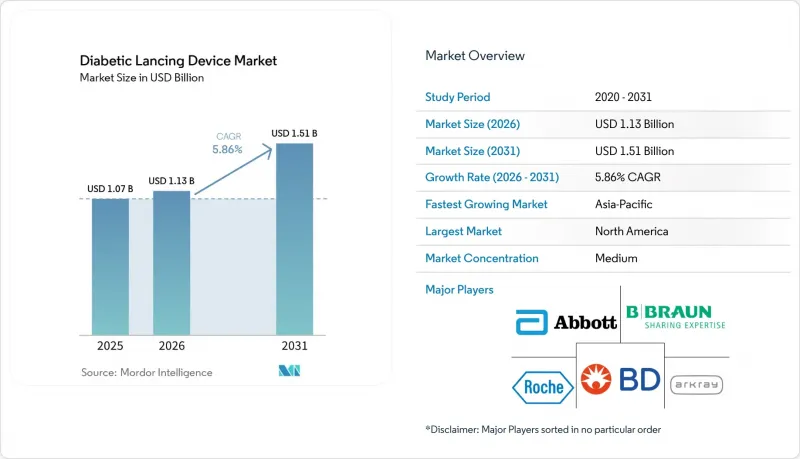
Mordor Intelligence에 의하면, 당뇨병용 채혈 기기 시장 규모는 2025년 10억 7,000만 달러로 평가되었습니다. 2026년 11억 3,000만 달러에서 2031년까지 15억 1,000만 달러로 확대되며 2026년부터 2031년에 걸쳐 CAGR 5.86%를 나타낼 전망입니다.
본 보고서는 제품 유형(재사용형 채열 기기, 일회용 안전 랜셋 등), 랜셋 유형(28G-30G 랜셋, 31G-33G 랜셋 등), 용도(재택 간호/자가 측정, 임상 용도),최종 사용자(병원 및 진료소, 진단 검사 기관 등), 지역(북미, 유럽, 아시아태평양 등)별로 분류되어 있습니다. 시장 전망은 금액(달러) 기준으로 제시되어 있습니다.
세계의 당뇨병용 채열 기기 시장 동향 및 인사이트
전 세계 당뇨병 유병률 증가가 SMBG 기기 수요를 끌어올리고 있습니다.
국제당뇨병연맹(IDF)의 보고에 따르면, 2024년에는 5억 8,900만 명의 성인이 당뇨병을 앓았으며, 이 수치는 장기적으로 크게 증가할 것으로 예측됩니다. 이에 따라 당뇨병용 채혈 기기 시장은 꾸준히 확대되는 관리 대상 인구와 밀접하게 연결되어 있습니다. 동 데이터에 따르면, 신규 환자의 80% 이상이 저·중소득 국가에서 발생하고 있으며, 이들 국가에서는 연속 혈당 모니터링의 보급률이 여전히 낮아 많은 환자에게 자가 혈당 측정(SMBG)이 실용적인 모니터링 표준으로 자리 잡고 있습니다. 이러한 지리적 경향이 중요한 이유는 남아시아, 사하라 사막 이남의 아프리카, 라틴아메리카에서 치료 초기 단계에 모세혈관 채혈 도구가 필요한 신규 사용자가 계속해서 증가하고 있기 때문입니다. 이러한 사용자는 일반적으로 고소득 시장의 소비자보다 환자 1인당 수익은 낮지만, 더 비싼 연속 혈당 모니터링으로의 급속한 전환 위험도 낮다고 할 수 있습니다. 따라서 당뇨병용 채혈 기기 시장은 표면적인 기술 전환에 관한 논조가 때때로 시사하는 것보다 판매량 측면에서 더 강한 내성을 보이고 있습니다. 또한, 다른 지역에서 고급 혈당 모니터링의 도입이 가속화되더라도 공급업체 입장에서는 랜싯에 대한 지속적인 수요라는 견고한 기반이 유지될 것입니다.
가정용 당뇨병 모니터링의 확산
재택 관리 및 자가 측정 동향은 당뇨병용 채혈 기기 시장이 여전히 병원이나 진료소 이외의 일상적인 검사 행위에 얼마나 크게 의존하고 있는지를 보여줍니다. 2025년 『BMC Public Health』지에 게재된 연구에 따르면, 혈당 측정 스트립에 대한 보험 환급 지원은 인슐린 치료를 받고 있는 2형 당뇨병 환자의 혈당 조절 개선과 관련이 있는 것으로 밝혀졌습니다. 이는 랜싯이나 채혈 기기를 포함한 SMBG(자가 혈당 측정)용 소모품을 보험 적용 대상으로 삼아야 한다는 보험사 측의 논리가 앞으로도 지속될 것임을 뒷받침합니다. 재택 환경에서 수요는 고령 환자층에 의해서도 뒷받침되고 있습니다. 60세 이상의 환자는 하루에 여러 번 측정이 필요한 관리 계획을 따르는 경우가 많기 때문입니다. 혈당 측정기, 측정 스트립, 채혈 장치, 랜셋을 조합한 SMBG 키트는 소비자에게는 구매 주기를 간소화하고, 공급업체에게는 수요 예측 가능성을 높여줍니다. 온라인 약국 및 소비자 직접 판매 채널이 확대되는 가운데, 이러한 세트 상품은 만성 질환 관리 루틴에서 재구매를 정착시키는 데 일조하고 있습니다. 커넥티드 키트는 채혈이라는 행위가 단순한 부수적이고 저가치의 부속품이 아니라, 보다 광범위한 모니터링 루틴의 일부가 됨으로써 고객 유지를 위한 또 다른 기반을 형성합니다.
연속 혈당 모니터링 시스템의 보급 확대
연속 혈당 모니터링(CGM)은 빈번한 검사를 받는 환자의 반복적인 손가락 채혈 필요성을 줄여주기 때문에 당뇨병용 채혈 기기 시장에 있어 여전히 가장 큰 구조적 제약 요인으로 남아 있습니다. 애보트(Abbott)는 2026년 5월, ‘Libre Duo’ 및 ‘Libre Duo 10 Day’에 대한 CE 마크를 획득했습니다. 이를 통해 혈당과 케톤체의 동시 측정 기능이 이 카테고리에 도입되어, CGM의 기능적 우위가 단순한 혈당 추적의 범위를 넘어 확대되었습니다. 또한, 미국당뇨병학회(ADA)도 2025년 치료 지침에서 인슐린이 필요한 당뇨병 관리의 경우, 초기 단계부터 CGM 도입을 검토해야 한다고 명시함으로써 센서 기반 모니터링에 대한 제도적 지원이 강화되고 있습니다. 하지만 비용이나 보험 급여의 미비, 행동 패턴 등의 요인으로 인해 전문 의료기관이나 고소득층 이외의 사용자 그룹에서 CGM의 보급은 여전히 더딘 상태이며, 즉각적인 대체 단계까지는 이르지 못하고 있습니다. 그 결과, 모든 환자층에서 손가락 채혈 검사가 단기간 내에 완전히 대체되기보다는 중기적인 전환의 계기가 될 것으로 전망됩니다. 이는 SMBG와 CGM이 공존하는 혼합형 의료 시스템에서 당뇨병용 채혈 기기 시장이 여전히 중요한 위치를 차지할 것임을 의미합니다.
부문별 분석
2025년, 재사용 가능한 채혈 장치는 당뇨병용 채혈 장치 시장 점유율의 42.57%를 차지했으며, 이는 집에서 빈번하게 검사를 실시하는 사람들을 위한 다회용 시스템으로서 오랫동안 확립되어 온 그 역할을 반영한 것입니다. 천자 깊이를 조절할 수 있는 기능 덕분에 일상적인 채혈 시의 편안함과 채혈량을 사용자가 더 세밀하게 제어할 수 있어, 그 입지는 여전히 견고하게 유지되었습니다. 또한, 다양한 게이지의 랜싯을 지원하므로 환자는 기기 본체를 교체하지 않고도 검사 경험을 자신에게 맞게 조정할 수 있습니다. 이러한 유연성은 사용자가 장기간에 걸쳐 통증 내성, 피부 상태, 검사 빈도를 균형 있게 조절해야 하는 재택 관리에서 중요합니다. 또한, 더 안전한 일회용 제품의 부상에도 불구하고 재사용 가능한 형태가 여전히 당뇨병용 채혈 기기 시장의 대부분을 차지하고 있는 이유도 바로 이 점에 기인합니다.
일회용 안전 랜셋은 2031년까지 연평균 성장률(CAGR) 6.12%로 확대될 것으로 예측되며, 전문 의료 현장에서 감염 관리 요건이 지속적으로 확대됨에 따라 가장 빠르게 성장하는 제품 카테고리가 되고 있습니다. 미국에서는 21 CFR §878.4850에 근거한 다중 환자용 채혈 랜싯에 대한 규제 조치로 인해, 임상 현장에서의 조달은 계속해서 일회용 안전 설계 제품으로 이동하고 있습니다. 가격에 민감한 약국 채널에서는 표준 랜셋이 여전히 판매량을 유지하고 있지만, 중국과 인도에서의 자체 브랜드 제품 생산으로 인해 이 카테고리의 이익률은 계속해서 압박을 받고 있습니다. 자동 채혈 기기는 소아 사용자나, 보다 통제되고 눈에 띄지 않는 천자를 원하는 성인들에게 지지를 받고 있어, 규모는 작지만 프리미엄 틈새 시장을 차지하고 있습니다. 당뇨병용 채혈 기기 업계 전체적으로는 제품 구성이 한편으로는 일회용에 의한 위생성을 중시하는 방향으로, 다른 한편으로는 편의성을 중시한 자동화 방향으로 전환되고 있습니다.
2025년 당뇨병용 채혈 기기 시장 규모 중 31G-33G 부문이 48.26%를 차지했으며, 통증 경감 및 조직 손상을 최소화하는 것을 중시하는 사용자에게는 여전히 더 얇은 게이지 제품이 선호되는 선택지임을 보여줍니다. 채혈 부위의 불편감은 권장되는 검사 절차 준수율에 영향을 미칠 수 있으므로, 이러한 선호도는 중요한 의미를 지닙니다. 2026년 『Scientific Reports』지에 게재된 관찰 연구에 따르면, 당뇨병 환자의 81.6%가 손가락 채혈 검사 중에 랜셋을 교체하지 않은 것으로 밝혀졌으며, 이는 사용자의 행동이나 불편감이 여전히 적절한 SMBG(자가 혈당 측정) 실천을 방해할 수 있음을 여실히 보여줍니다. 세부 랜셋에 대한 수요는 게이지 수 자체뿐만 아니라 코팅이나 천자의 부드러움과 같은 제품 설계에 의해서도 뒷받침되고 있습니다. 이는 사용자가 느끼는 편안함을 크게 변화시킬 가능성이 있기 때문입니다. 아센시아(Ascencia)사의 ‘MICROLET’ 랜셋은 피부 천자 성능을 향상시키는 것을 목적으로 한 실리콘 코팅 설계를 채택하고 있어, 이 점을 여실히 보여주고 있습니다.
28G-30G 부문은 2031년까지 연평균 성장률(CAGR) 6.89%를 나타낼 것으로 예측됩니다. 그 주된 이유는 임상 현장에서 더 큰 혈액 방울과, 작동력(액추에이션 포스)이 낮더라도 신뢰성이 높은 검체가 요구되는 경우가 많기 때문입니다. 병원이나 검사실에서는 많은 검사를 신속하고 일관되게 수행해야 하는 경우, 최대한의 편안함보다는 검사의 적절성과 처리 능력을 우선시하는 경향이 있습니다. 이 때문에 재택 간호에서는 더 얇은 게이지의 랜셋이 주류를 이루는 반면, 중간 게이지의 랜셋은 상업적으로 중요한 위치를 차지하고 있습니다. 34G 이상의 범주는 여전히 규모가 작고 보다 전문적인 분야에 국한되어 있으며, 수요는 피부 취약성이 더 큰 우려 사항인 소아 및 노인 간호에 집중되어 있습니다. 따라서 당뇨병용 채혈 기기 시장 전체에서 게이지 선택은 편의성을 중시하는 소매용과 업무 흐름을 중시하는 전문용 간의 양극화를 반영하고 있습니다. ISO 23908 : 2024는 일회용 랜셋의 모든 형태에 대해 날카로운 물체 보호, 재료 요건 및 선단 형상 기준에 영향을 미침으로써 이 부문을 더욱 형성하고 있습니다.
지역별 분석
북미는 2025년 당뇨병용 채혈 기기 시장 점유율의 37.46%를 차지했습니다. 이는 SMBG(자가 혈당 측정)의 높은 보급률, 체계적인 보험 환급 제도, 그리고 BD, 로슈, 애보트와 같은 주요 공급업체들의 확고한 입지에 힘입은 결과입니다. 미국은 임상 및 소매 수요 모두 확립된 혈당 모니터링 경로의 혜택을 받은 덕분에 계속해서 최대의 국내 시장으로 자리매김했습니다. 또한, 21 CFR §878.4850에 따른 채혈 랜싯의 규제적 처리는 전문 의료 현장에서 안전성을 중시하는 형태의 조달 선호를 뒷받침했습니다. 캐나다와 멕시코에서는 가격에 민감한 구매자를 대상으로 하는 약국 및 자체 브랜드 채널을 통해 판매량이 증가했습니다. 가정용 진단이 여전히 당뇨병용 채혈 기기 시장의 지속적인 수요를 뒷받침하고 있었으나, 인슐린 의존성 환자들 사이에서 CGM으로의 전환이 더욱 두드러졌기 때문에 이 지역의 성장은 신흥 지역에 비해 완만했습니다.
유럽은 당뇨병용 채혈 기기 시장에서 계속해서 2위 지역 시장을 차지했으며, 독일, 영국, 프랑스가 가정용 및 임상용 채혈 바늘 소비의 주요 수요 거점 역할을 했습니다. ISO 23908 : 2024 및 유럽 내 의료기기 규정 준수에 대한 광범위한 기대에 따라, 조달 활동은 일회용 안전 제품에 중점을 두었으며, 시판 후 관리 체제가 잘 갖춰진 공급업체가 우대를 받았습니다. 이러한 상황으로 인해 기존 기업들은 자사의 입지를 지킬 수 있었으며, 규정 준수 체계가 제대로 갖춰지지 않은 저비용 신규 진출기업들의 급속한 확장은 억제되었습니다. 중동 및 아프리카는 매출 규모 면에서는 여전히 소규모였으나, AMPATH 케냐가 2024년 7월부터 2025년 12월까지 23개 시설에서 당뇨병 및 고혈압 선별검사를 확대하여 8만 1,000명 이상을 검사하는 등,공공 선별 검사 정책이 미래를 향해 의미 있는 수요를 지속적으로 창출하고 있었습니다.
아시아태평양은 연평균 성장률(CAGR) 9.37%를 나타낼 것으로 예측되며, 2031년까지 당뇨병용 채혈기 시장 규모에서 가장 급속한 성장을 보일 전망입니다. 이 지역은 매우 큰 당뇨병 부담과 자가 혈당 측정(SMBG) 접근성 향상을 위한 투자 증가가 맞물려 있으며, 이는 기본적인 판매량 증가와 기기 품질 향상을 향한 점진적인 전환을 모두 뒷받침하고 있습니다. 중국은 저가 국산 제품의 거대한 공급 기반이 되고 있는 반면, 국제 브랜드들은 정확도, 연결성, 기기 품질 면에서 더욱 치열한 경쟁을 펼치고 있습니다. 남미 역시 브라질과 아르헨티나를 필두로 성장 추세를 보이고 있습니다. 이들 국가에서는 도시 지역의 당뇨병 관리 프로그램과 약국을 통한 유통이 제품 접근성 확대를 지속적으로 뒷받침하고 있습니다. 다만, 의료비 지출 주기와 환율 변동으로 인해 해당 지역 일부에서는 프리미엄 제품 형태가 어느 정도의 속도로 보급될지는 여전히 제한을 받고 있습니다.
기타 혜택 :
- 엑셀 형식 시장 예측(ME) 시트
- 3개월간의 애널리스트 지원
자주 묻는 질문
목차
제1장 서론
제2장 조사 방법
제3장 개요
제4장 시장 구도
제5장 시장 규모 및 성장 예측
제6장 경쟁 구도
제7장 시장 기회 및 향후 전망
KTH 26.09.02According to Mordor Intelligence, the diabetic lancing device market size is projected to expand from USD 1.07 billion in 2025 and USD 1.13 billion in 2026 to USD 1.51 billion by 2031, registering a CAGR of 5.86% between 2026 to 2031.
This report is Segmented by Product Type (Reusable Lancing Devices, Disposable Safety Lancets, and More), Lancet Type (28G-30G Lancets, 31G-33G Lancets, and More), Usage (Home Care / Self-Monitoring, and Clinical Use), End User (Hospitals & Clinics, Diagnostic Laboratories, and More), and Geography (North America, Europe, Asia-Pacific, and More). The Market Forecasts are Provided in Terms of Value (USD).
Global Diabetic Lancing Device Market Trends and Insights
Rising Global Diabetes Prevalence Increasing Demand for SMBG Devices
The International Diabetes Federation reported that 589 million adults were living with diabetes in 2024, and that figure is expected to rise materially over the longer term, which keeps the diabetic lancing device market tied to a steadily expanding care population. The same data showed that more than 80% of new cases were occurring in low and middle-income countries, where continuous glucose monitoring penetration remained low, and SMBG stayed the practical monitoring standard for many patients. This geographic pattern matters because South Asia, Sub-Saharan Africa, and Latin America continue to add first-time users who need capillary blood testing tools early in their care pathway. Those users usually generate lower revenue per patient than consumers in high-income markets, but they also face less risk of shifting quickly to more expensive continuous monitoring alternatives. That makes the diabetic lancing device market more volume resilient than headline technology transition narratives sometimes suggest. It also gives suppliers a durable base of repeat lancet demand that stays relevant even when premium glucose monitoring adoption accelerates elsewhere.
Increasing Adoption of Home-Based Diabetes Monitoring
Home care and self-monitoring show how strongly the diabetic lancing device market still depends on everyday testing behavior outside hospitals and clinics. A 2025 study in BMC Public Health found that reimbursement support for blood glucose test strips was associated with improved glycemic control among insulin-treated type 2 diabetes patients, which supports continued payer logic for covering SMBG consumables that include lancets and lancing devices. Demand in home settings is also reinforced by older patient groups, since people aged 60 years and above often follow care plans that require multiple checks each day. Bundled SMBG kits that combine a meter, strips, a lancing device, and lancets have also made the purchase cycle simpler for consumers and more predictable for suppliers. As online pharmacy and direct-to-consumer channels grow, these bundles help normalize repeat purchasing across chronic care routines. Connected kits add another retention layer because the lancing act becomes part of a broader monitoring routine rather than a separate low-value accessory.
Growing Adoption of Continuous Glucose Monitoring Systems
Continuous glucose monitoring remains the strongest structural restraint on the diabetic lancing device market because it reduces the need for repeated fingerstick sampling among high-frequency testers. Abbott secured CE Mark in May 2026 for Libre Duo and Libre Duo 10 Day, which brought dual glucose and ketone sensing into the category and extended the functional advantage of CGM beyond glucose tracking alone. The American Diabetes Association also stated in its 2025 standards of care that CGM should be considered from the outset for insulin-requiring diabetes management, which strengthens institutional support for sensor-based monitoring. Even so, replacement is not immediate because cost, reimbursement gaps, and behavior patterns still slow CGM uptake outside specialist care and higher-income user groups. The result is a medium-term pressure point rather than a complete near-term displacement of fingerstick testing across all patient segments. This means the diabetic lancing device market still retains substantial relevance in mixed-care systems where SMBG and CGM continue to coexist.
Other drivers and restraints analyzed in the detailed report include:
- Technological Advancements Toward Painless and Automated Lancing Devices
- Growing Preference for Single-Use Safety Lancets in Clinical Settings
- Limited Awareness and Affordability Challenges in Low-Income Regions
For complete list of drivers and restraints, kindly check the Table Of Contents.
Segment Analysis
Reusable lancing devices held 42.57% of the diabetic lancing device market share in 2025, which reflected their long-established role as multi-use systems for people who test frequently at home. Their position remained strong because adjustable penetration depth settings give users better control over comfort and blood volume during routine sampling. Compatibility with a wide range of lancet gauges also lets patients tailor the testing experience without replacing the full device body. This flexibility matters in home care, where users often balance pain tolerance, skin condition, and testing frequency over long periods. It also helps explain why reusable formats still anchor a large part of the diabetic lancing device market despite the rise of safer single-use alternatives.
Disposable safety lancets are projected to expand at a 6.12% CAGR through 2031, making them the fastest-growing product category as infection control requirements keep widening across professional care settings. In the United States, the regulatory treatment of multi-patient blood lancets under 21 CFR §878.4850 continues to channel clinical procurement toward single-use safety-engineered designs. Standard lancets still preserve unit volume in price-sensitive pharmacy channels, but private-label production in China and India continues to tighten margins for that category. Automatic lancing devices occupy a smaller premium niche because they appeal to pediatric users and to adults who want more controlled and less visible penetration. Across the diabetic lancing device industry, the product mix is shifting toward single-use hygiene on one side and comfort-focused automation on the other.
The 31G to 33G segment represented 48.26% of the diabetic lancing device market size in 2025, showing that finer gauges remain the preferred choice for users who value lower pain and less tissue trauma. That preference matters because discomfort at the sampling point can affect how consistently people follow recommended testing routines. A 2026 observational study in Scientific Reports found that 81.6% of diabetic patients did not replace lancets between fingerstick tests, which highlighted how user behavior and discomfort can still interfere with correct SMBG practice. Fine-gauge demand is also supported by product engineering beyond gauge alone, since coating and entry smoothness can materially change perceived comfort. Ascensia's MICROLET lancets illustrate this point through a silicone-coated design that aims to improve skin entry performance.
The 28G to 30G segment is expected to grow at a 6.89% CAGR through 2031, mainly because clinical settings often need a larger blood drop and a more dependable sample with lower actuation force. Hospitals and laboratories tend to prioritize adequacy and throughput over maximum comfort when many tests must be performed quickly and consistently. This makes mid-gauge lancets commercially important even as finer gauges lead in home care. The 34G and above category remains smaller and more specialized, with demand concentrated in pediatric and geriatric care where skin fragility is a stronger concern. Across the diabetic lancing device market, gauge choice therefore reflects a split between comfort-led retail use and workflow-led professional use. ISO 23908:2024 further shapes this segment by influencing sharps protection, material requirements, and tip geometry standards across single-use lancet formats.
Complete Report Scope:
- By Product Type
- Reusable Lancing Devices
- Disposable Safety Lancets
- Standard Lancets
- Automatic Lancing Device
- By Lancet Type
- 28G-30G Lancets
- 31G-33G Lancets
- 34G and Above Lancets
- By Usage
- Home Care / Self-Monitoring
- Clinical Use
- By End User
- Hospitals & Clinics
- Diagnostic Laboratories
- Home Healthcare
- Others
- By Geography
- North America
- United States
- Canada
- Mexico
- Europe
- Germany
- United Kingdom
- France
- Italy
- Spain
- Rest of Europe
- Asia-Pacific
- China
- India
- Japan
- Australia
- South Korea
- Rest of Asia-Pacific
- Middle East and Africa
- GCC
- South Africa
- Rest of Middle East and Africa
- South America
- Brazil
- Argentina
- Rest of South America
- North America
Geography Analysis
North America held 37.46% of the diabetic lancing device market share in 2025, supported by high SMBG adoption, structured reimbursement, and the entrenched presence of large suppliers such as BD, Roche, and Abbott. The United States remained the largest national market because clinical and retail demand both benefited from established blood glucose monitoring pathways. Regulatory treatment of blood lancets under 21 CFR §878.4850 also reinforced procurement preference for safety-oriented formats in professional care settings. Canada and Mexico added volume through pharmacy and private-label channels that served more price-sensitive buyers. Regional growth was slower than in emerging areas because CGM substitution was stronger among insulin-dependent patients, even though home diagnostics still supported ongoing demand in the diabetic lancing device market.
Europe remained the second-largest regional base for the diabetic lancing device market, with Germany, the United Kingdom, and France acting as the main demand centers for home healthcare and clinical lancet consumption. ISO 23908:2024 and broader European device compliance expectations kept procurement focused on single-use safety products and favored suppliers with stronger post-market systems. These conditions helped established players defend their position and limited faster expansion by low-cost entrants without developed compliance infrastructure. The Middle East and Africa remained smaller in revenue terms, but public screening initiatives were still creating meaningful future demand, as AMPATH Kenya expanded diabetes and hypertension screening across 23 facilities and screened more than 81,000 individuals between July 2024 and December 2025.
Asia-Pacific is projected to grow at 9.37% CAGR, which makes it the fastest-rising diabetic lancing device market size through 2031. The region combines a very large diabetes burden with increasing investment in SMBG access, which supports both basic volume growth and a gradual move toward better device quality. China provides a large base for lower-priced domestic supply, while international brands compete more on accuracy, connectivity, and device quality. South America is also moving upward, led by Brazil and Argentina, where urban diabetes management programs and pharmacy distribution continue to support broader product access. Even so, healthcare spending cycles and currency volatility still limit how quickly premium formats can scale across parts of the region.
- Abbott Laboratories
- AgaMatrix, Inc.
- Arkray
- Ascensia Diabetes Care Holdings AG
- AUVON Technology Co., Ltd.
- B. Braun
- Beckton Dickinson
- Cardinal Health
- Roche
- Genteel LLC
- HTL-Strefa S.A.
- Medline Industries
- Nipro
- Owen Mumford Limited
- Sanofi
- Sarstedt
- Terumo
- Trividia Health, Inc.
- Vitrex Medical A/S
- Ypsomed
Additional Benefits:
- The market estimate (ME) sheet in Excel format
- 3 months of analyst support
TABLE OF CONTENTS
1 Introduction
- 1.1 Study Assumptions and Market Definition
- 1.2 Scope of the Study
2 Research Methodology
3 Executive Summary
4 Market Landscape
- 4.1 Market Overview
- 4.2 Market Drivers
- 4.2.1 Rising Global Diabetes Prevalence Increasing Demand for SMBG Devices
- 4.2.2 Increasing Adoption of Home-Based Diabetes Monitoring
- 4.2.3 Technological Advancements toward Painless and Automated Lancing Devices
- 4.2.4 Increasing Diabetes Screening Programs in Emerging Markets
- 4.2.5 Growing Preference for Single-Use Safety Lancets in Clinical Settings
- 4.2.6 Integration of Lancing Devices with Connected Diabetes Management Kits
- 4.3 Market Restraints
- 4.3.1 Growing Adoption of Continuous Glucose Monitoring Systems
- 4.3.2 Limited Awareness and Affordability Challenges in Low-Income Regions
- 4.3.3 Price Pressure from Commodity Lancets and Private Label Alternatives
- 4.3.4 Reuse Behavior and Low Testing Compliance in Certain Patient Groups
- 4.4 Value And Supply-Chain Analysis
- 4.5 Regulatory Landscape
- 4.6 Technological Outlook
- 4.7 Porter's Five Forces Analysis
- 4.7.1 Threat of New Entrants
- 4.7.2 Bargaining Power of Buyers
- 4.7.3 Bargaining Power of Suppliers
- 4.7.4 Threat of Substitutes
- 4.7.5 Competitive Rivalry
5 Market Size and Growth Forecasts
- 5.1 By Product Type
- 5.1.1 Reusable Lancing Devices
- 5.1.2 Disposable Safety Lancets
- 5.1.3 Standard Lancets
- 5.1.4 Automatic Lancing Device
- 5.2 By Lancet Type
- 5.2.1 28G-30G Lancets
- 5.2.2 31G-33G Lancets
- 5.2.3 34G and Above Lancets
- 5.3 By Usage
- 5.3.1 Home Care / Self-Monitoring
- 5.3.2 Clinical Use
- 5.4 By End User
- 5.4.1 Hospitals & Clinics
- 5.4.2 Diagnostic Laboratories
- 5.4.3 Home Healthcare
- 5.4.4 Others
- 5.5 By Geography
- 5.5.1 North America
- 5.5.1.1 United States
- 5.5.1.2 Canada
- 5.5.1.3 Mexico
- 5.5.2 Europe
- 5.5.2.1 Germany
- 5.5.2.2 United Kingdom
- 5.5.2.3 France
- 5.5.2.4 Italy
- 5.5.2.5 Spain
- 5.5.2.6 Rest of Europe
- 5.5.3 Asia-Pacific
- 5.5.3.1 China
- 5.5.3.2 India
- 5.5.3.3 Japan
- 5.5.3.4 Australia
- 5.5.3.5 South Korea
- 5.5.3.6 Rest of Asia-Pacific
- 5.5.4 Middle East and Africa
- 5.5.4.1 GCC
- 5.5.4.2 South Africa
- 5.5.4.3 Rest of Middle East and Africa
- 5.5.5 South America
- 5.5.5.1 Brazil
- 5.5.5.2 Argentina
- 5.5.5.3 Rest of South America
- 5.5.1 North America
6 Competitive Landscape
- 6.1 Market Concentration
- 6.2 Market Share Analysis
- 6.3 Company Profiles (includes Global Level Overview, Market Level Overview, Core Segments, Financials as Available, Strategic Information, Market Rank/Share, Products and Services, Recent Developments)
- 6.3.1 Abbott Laboratories
- 6.3.2 AgaMatrix, Inc.
- 6.3.3 ARKRAY, Inc.
- 6.3.4 Ascensia Diabetes Care Holdings AG
- 6.3.5 AUVON Technology Co., Ltd.
- 6.3.6 B. Braun Melsungen AG
- 6.3.7 Becton Dickinson and Company
- 6.3.8 Cardinal Health, Inc.
- 6.3.9 F. Hoffmann-La Roche Ltd
- 6.3.10 Genteel LLC
- 6.3.11 HTL-Strefa S.A.
- 6.3.12 Medline Industries, LP
- 6.3.13 Nipro Corporation
- 6.3.14 Owen Mumford Limited
- 6.3.15 Sanofi S.A.
- 6.3.16 SARSTEDT AG & Co. KG
- 6.3.17 Terumo Corporation
- 6.3.18 Trividia Health, Inc.
- 6.3.19 Vitrex Medical A/S
- 6.3.20 Ypsomed Holding AG
7 Market Opportunities and Future Outlook
- 7.1 White-Space And Unmet-Need Assessment


