

|
시장보고서
상품코드
2119350
커넥티드 모빌리티 : 시장 점유율 분석, 업계 동향 및 통계, 성장 예측(2026-2031년)Connected Mobility - Market Share Analysis, Industry Trends & Statistics, Growth Forecasts (2026 - 2031) |
||||||
 Mordor Intelligence
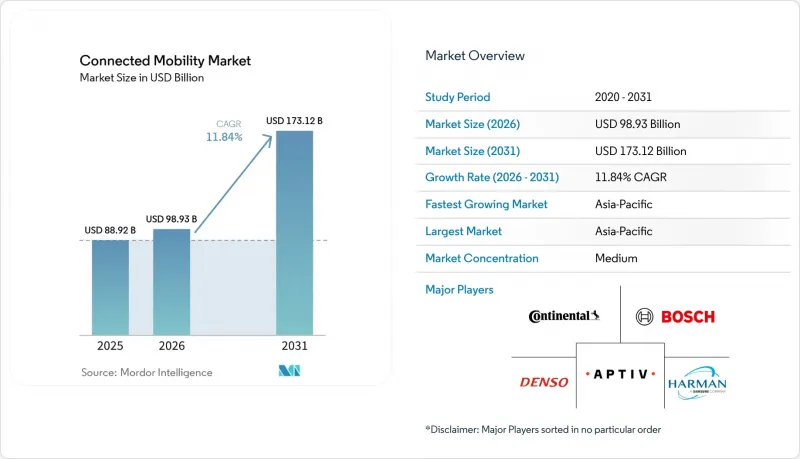
Mordor Intelligence에 의하면, 커넥티드 모빌리티 시장 규모는 2025년 889억 2,000만 달러로 평가되었습니다. 2026년에는 989억 3,000만 달러로 확대되어 2031년까지 1,731억 2,000만 달러에 이를 것으로 예상되고 2026년부터 2031년에 걸쳐 CAGR 11.84%를 나타낼 전망입니다.
본 보고서는 솔루션별(하드웨어, 소프트웨어, 서비스), 차종별(승용차, 소형 상용차, 버스 등),용도별(차량 관리, 인포테인먼트 및 내비게이션, 원격 진단 등), 최종 사용자 산업별(자동차 OEM, 차량 관리 사업자, 모빌리티 서비스 제공업체 등), 그리고 지역별로 분류되어 있습니다. 시장 전망은 금액(달러) 기준으로 제시되어 있습니다.
세계의 커넥티드 모빌리티 시장 동향 및 인사이트
안전 기준, eCall 및 ADAS의 필수 요건
유럽연합(EU) 당국은 유럽위원회 위임규정(EU) 2025/1871에 따라, 업데이트된 차세대 eCall 사양을 충족하지 않는 차량의 형식 승인을 거부해야 합니다. 이 기한에 따라 각 OEM 업체는 텔레매틱스 제어 장치의 사양 및 인터넷 프로토콜 멀티미디어 서브시스템(IP-MMS)의 호환성을 업데이트해야 합니다. 영국에서는 2025년 9월 이후 모든 신규 차량 등록 시 차세대 eCall 탑재가 의무화됩니다. 통신 시스템 업그레이드는 2027년 3월까지 완료되어야 하며, 기존의 2G 기반 서비스는 2029년부터 2030년에 걸쳐 단계적으로 폐지될 예정입니다. 또한, 유럽연합(EU)의 일반 안전 규정(GSR)에 따르면 2026년 7월 이후 모든 신차에 첨단 운전자 주의 산만 경고 시스템의 탑재가 의무화되어, 차량용 센서 및 처리 능력에 대한 추가적인 수요가 발생하고 있습니다. 중국의 SAE 레벨 3 및 레벨 4 자율주행 시스템에 관한 요건안은 2027년 7월까지 시행될 예정이며, 기존의 지침이 법적 구속력을 갖는 하드웨어 및 소프트웨어 요건으로 전환됩니다.
5G 구축 및 저지연 V2X 서비스
전용 단거리 통신(DSRC)에서 셀룰러 V2X 기술로의 전환은 현재 규제 일정에 따라 진행되고 있습니다. 연방통신위원회(FCC)는 2026년 12월 14일까지 5.9GHz 대역의 상부 주파수 대역에서 전용 단거리 통신(DSRC)을 사용한 운영을 중단할 것을 의무화했습니다. 이러한 변경에 따라 도로 관리 기관, 자동차 제조업체(OEM), 차량 소유 기업은 셀룰러 V2X 서비스로의 전환을 완료해야 합니다. 카푸시 트래픽콤과 노스캐롤라이나 턴파이크국은 2026년 2월, 트라이앵글 익스프레스웨이에서 상용 단계의 셀룰러 V2X 요금 징수 시스템을 가동했습니다. 버라이즌 비즈니스는 2025년 6월 ‘Edge Transportation Exchange’ 플랫폼을 출시했으며, 초기 사용자로는 애리조나주 상무부, 델라웨어주 교통국, 폭스바겐 그룹 오브 아메리카 등이 이름을 올렸습니다. 중국에서는 2025년 10월에 실시된 5G-Advanced 용도 실증 실험에서 통신 사업자 간에 센서 데이터가 실시간으로 공유되는 것이 입증되었으며, 이는 중국에서 생산되는 차량의 향후 플랫폼 설계에 영향을 미쳤습니다. 실제 운영이 파일럿 프로젝트와 상용 인프라 간의 격차를 좁힘에 따라 커넥티드 모빌리티 시장은 혜택을 보고 있습니다. 또한, 이러한 전환으로 인해 자동차 제조업체들이 제한적인 실증 실험용 연결 하드웨어를 확보하는 대신 양산 대응 모듈을 지정할 수 있게 됨에 따라 조달 결정도 변화하고 있습니다. 도로 운영 사업자의 경우, 요금 징수, 경고, 교통 조정이 동일한 네트워크 프레임워크에서 가능해짐에 따라 투자를 진행할 운영상의 근거가 생깁니다. 이에 따라 반복적인 도입 계약을 목표로 하는 공급업체에게는 상호 운용성, 네트워크 커버리지 및 기기 인증이 중요한 고려 사항이 됩니다.
사이버 보안 취약성과 리콜 위험
사이버 보안 사고는 현재 자동차 제조업체에 직접적인 재정적 및 운영상의 위험을 초래하고 있습니다. 캘리포니아 대학교 샌디에이고 캠퍼스의 연구진은 2026년 7월, 최소 220만 대의 차량에 탑재된 보안 시스템이 공통된 블루투스 인증 키를 사용하고 있었다는 사실을 밝혔습니다. 이 문제로 인해 5미터 이내의 제3자가 소유자의 키 포브가 없어도 도어 잠금을 해제하거나, 경적을 울리거나, 차량 시동을 방해할 수 있는 우려가 있습니다. 미국 사이버보안·인프라보안청(CISA)은 2026년 8월, 영향을 받는 Acrisure사 하드웨어에 관한 권고안 ICSA-26-216-01을 발표했습니다. 또한, Automotive Security Research Group은 2024년형 스즈키 스위프트의 롤링 코드 방식 키리스 엔트리 시스템에 영향을 미치는 캡처-리플레이(capture-replay) 취약점에 대해서도 보고했습니다. 유엔 규정 제155호 및 ISO/SAE 21434에서는 사이버 보안 관리가 공급업체의 자격 인증 요건으로 규정되어 있어, 이로 인해 중소 부품 공급업체의 규정 준수 부담이 커질 가능성이 있습니다.
부문별 분석
2025년, 커넥티드 모빌리티 시장 매출액 중 하드웨어가 39.10%를 차지했습니다. 이러한 위상은 텔레매틱스 제어 장치의 출하 대수가 많았다는 점과 북미 및 중국의 OEM 플랫폼 전반에 걸쳐 V2X(Vehicle-to-Everything) 통신 모듈의 통합이 진행되고 있음을 반영합니다. 2026년에는 유럽연합(EU) 내 신형 승용차 생산에 따라 연간 1,500만-1,800만 대의 텔레매틱스 제어 장치가 출하될 것으로 추정됩니다. 하드웨어에는 텔레매틱스 제어 장치, V2X(Vehicle-to-Everything) 모듈, 엣지 컴퓨팅 게이트웨이가 포함됩니다. 구역별 전기 및 전자 아키텍처에 따라 처리가 고성능 중앙 처리 장치로 이전됨에 따라 엣지 게이트웨이의 중요성은 더욱 커지고 있습니다. 따라서 커넥티드 모빌리티의 하드웨어 시장 규모는 필요한 차량용 연결 기기에 의해 지속적으로 뒷받침되고 있습니다. OEM의 생산 프로그램에서는 이러한 부품에 대해 안정적인 공급, 검증 및 긴 수명이 요구되며, 이는 표준화로 인해 그 가치가 저하되는 속도를 제한하고 있습니다. 또한 하드웨어 공급업체는 다양한 통신 네트워크, 전기 아키텍처 및 국가별 규제 요건을 충족해야 합니다. 이러한 조건으로 인해 향후 차별화 요인으로서 소프트웨어의 비중이 높아지더라도 엔지니어링 지원의 역할은 유지될 것입니다. 그러나 모듈의 표준화로 인해 하드웨어의 이익률에는 압박이 가해질 것으로 예측됩니다. 공급업체는 장치에 보안 소프트웨어, 라이프사이클 서비스 또는 독자적인 차량 데이터 기능을 결합해야 합니다.
소프트웨어 시장은 2031년까지 연평균 성장률(CAGR) 13.21%로 확대될 것으로 예측되며, 이는 솔루션 카테고리 중 가장 높은 성장률입니다. 커넥티드카 플랫폼과 무선 배포 시스템이 소프트웨어의 주요 하위 부문으로 자리 잡고 있습니다. 중앙 집중식 컴퓨팅은 차량 군 전체에 걸친 업데이트를 조정하는 데 필요한 네트워크 설계를 제공합니다. 볼보의 ‘HuginCore’ 접근 방식은 구조화된 배포 계층이 단일 코드베이스에서 여러 모델 연도에 걸친 220만 대의 차량을 업데이트할 수 있음을 입증하고 있습니다. 하만은 2025년 5월, Eclipse Foundation을 통해 자사의 ‘Connected Services Platform’을 오픈소스로 공개하며, 폐쇄적인 미들웨어 계층을 보호하기보다는 타사 애플리케이션 개발의 확대를 도모했습니다. SAE International은 2026년 2월, 프로토콜 통합을 촉진하는 네트워크형 V2X(Vehicle-to-Everything) 서비스에 관한 정보 보고서를 발표했습니다. 또한 서비스는 구독형으로 전환되고 있으며, 애플리케이션 프로그래밍 인터페이스(API)와 오픈 미들웨어가 보급됨에 따라 맞춤형 통합 작업은 감소하는 추세입니다. 솔루션의 구성 비율은 수익 측면에서 하드웨어가 주도권을 유지할 것으로 보이지만, 시간이 지남에 따라 소프트웨어 및 서비스가 우위를 차지할 것으로 예측됩니다. 하드웨어 공급업체는 여전히 차량의 신뢰성, 사이버 보안 및 인증에 관한 엄격한 요건을 충족해야 하므로, 이러한 변화는 단순히 장치를 코드로 대체하는 것에 그치지 않습니다. 오히려 소프트웨어를 통해 탑재된 각 장치가 차량의 수명 주기 전반에 걸쳐 더 많은 기능을 지원할 수 있게 됩니다. 이러한 관계로 인해 OEM 각사는 일관된 보안 통제 하에 업데이트, 진단, 구독 및 타사 용도를 관리할 수 있는 플랫폼을 우선시할 이유가 생깁니다.
2025년, 커넥티드 모빌리티 시장 매출 중 승용차가 55.31%를 차지했습니다. 유럽연합(EU)의 신형 승용차에 텔레매틱스가 거의 모든 차종에 탑재되고, 북미 프리미엄 차량에서 높은 보급률을 보였으며, 중국의 전기차(EV)에 텔레매틱스가 탑재된 것이 이러한 위상을 뒷받침했습니다. 승용차가 커넥티드 모빌리티 시장에서 차지하는 점유율은 임베디드 하드웨어를 지속적인 디지털 서비스로 전환하려는 각 OEM 업체들의 전략도 반영하고 있습니다. 제너럴 모터스(GM)는 2026년 2분기 온스타(OnStar) 사업의 매출이 8억 달러에 달했다고 보고했습니다. 슈퍼 크루즈(Super Cruise) 구독 건수는 연중 반이 지날 무렵 85만 건을 넘어섰으며, 연간 구독 매출은 전년 동기 대비 70% 증가했습니다. 수요 점유율에서 그 뒤를 이은 것은 대형 및 소형 상용차였습니다. 인도의 AIS-140 요건과 미국의 전자 로그 기록 장치(ELD) 규제로 인해 상용차 차량군에서 텔레매틱스는 규정 준수를 위한 필수 요건으로 자리 잡았습니다.
이륜차 및 삼륜차는 2031년까지 연평균 성장률(CAGR) 13.43%로 확대될 것으로 예측되며, 이는 차량 유형 중 가장 높은 성장률입니다. 라스트 마일 물류에서의 전기차 활용, 정부의 연결성 요건, 그리고 OEM의 투자가 이러한 확산을 뒷받침하고 있습니다. 인도에서 제안된 AIS-230 규격에 따르면, 2028년 10월 이후 생산되는 신형 이륜차, 승용차 및 상용차에 차량 간 통신(V2V)이 의무화될 예정입니다. 하만은 MWC 바르셀로나 2026에서 퀄컴 테크놀로지스와 공동으로 ‘Ready Ride’를 발표했습니다. 이는 확장성이 뛰어난 텔레매틱스 제어 장치, 셀룰러 모뎀 및 이륜차용 OEM 백엔드를 결합한 제품입니다. 키네틱 엔지니어링은 Jio Things와 제휴하여 자사의 전기 이륜차 라인업에 차세대 텔레매틱스 기능과 차량군 성능 모니터링 기능을 추가했습니다. 이러한 도입을 통해 커넥티비티의 적용 범위는 고급 전기 스쿠터에 그치지 않고, 보다 광범위한 차량군 활용으로 확대되고 있습니다. 버스 분야는 중국과 유럽의 스마트 시티 교통 인프라 투자 추세를 따르고 있지만, 그 속도는 이륜차나 삼륜차 부문에 비해 완만합니다. 대중교통 도입에 있어서도 운행 경로 시각화, 승객 정보, 유지보수 모니터링, 안전 통신에 대한 수요는 여전히 존재합니다. 버스의 구매 주기는 많은 경우 지자체 예산이나 인프라 조정에 좌우되기 때문에 도입이 지연될 가능성이 있습니다. 이륜차와의 이러한 대비는 공급업체가 단일 커넥티비티 패키지가 아닌, 각 차량 등급에 적합한 비용 구조와 데이터 서비스를 필요로 하는 이유를 보여줍니다.
지역별 분석
아시아태평양은 2025년 커넥티드 모빌리티 시장 매출의 32.45%를 차지했으며, 2031년까지 연평균 성장률(CAGR) 13.87%로 성장할 것으로 전망됩니다. 중국은 500개 이상의 가동 중인 셀룰러 V2X(Vehicle-to-Everything) 실증 구역,전기차(EV) 프로그램, 그리고 5G-Advanced 인프라에 힘입어 이 지역에서 가장 큰 시장 점유율을 차지하고 있습니다. 한국과 일본은 운전 지원 규제 및 자율주행 모빌리티 실증 실험과 관련된 고부가가치 프로젝트에 기여하고 있습니다. 인도는 AIS-140이 상용 차량 추적을 지원함에 따라 아시아태평양 내에서 가장 강력한 성장 궤도에 올라 있습니다. 2028년 10월 발효 예정인 AIS-230 요건은 이미 각 OEM 업체의 제품 계획에 영향을 미치고 있습니다. 인도 및 동남아시아의 이륜·삼륜 전기자동차 차량군에는 배터리 상태 데이터, 충전 세션 데이터, 그리고 고밀도 도시 지역의 경로 최적화가 요구되고 있습니다. 이러한 수요에 부응하여 하만, 퀄컴 테크놀로지스, 지오탭 각사는 타겟을 명확히 한 플랫폼 개발을 추진하고 있습니다.
북미는 2025년 지역별 매출에서 2위의 기여도를 기록했습니다. 이 지역에서는 미국의 전자 기록 규정에 의해 창출된 상용 차량 텔레매틱스 수요와, 전용 단거리 통신(DSRC)에서 셀룰러 V2X 기술로의 규제상 전환이 맞물려 있으며,연방통신위원회(FCC)가 정한 2026년 12월 14일 기한까지 도로 인프라 사업자와 OEM 플랫폼이 공동으로 전환을 완료해야 합니다. 스텔란티스는 2026년 8월 미국 교통부가 실시한 실시간 안전 알림을 목적으로 한 5G 커넥티드카 시험에 참여했습니다. 캐나다에서는 기업용 차량 텔레매틱스를 통해 안정적인 수요가 뒷받침되고 있습니다. 멕시코에서는 국내 및 미국 고객에게 공급되는 차량에 C-V2X 모듈이 탑재되어 있습니다. 따라서 이 지역의 커넥티드 모빌리티 시장은 규제에 따른 교체 수요와 이미 정착된 상용 차량 함대에서의 활용이라는 두 가지 혜택을 누리고 있습니다.
유럽에서는 도입이 성숙 단계에 이르렀으며, 2025년에는 유럽연합(EU)에서 생산되는 신형 승용차의 거의 모든 차량에 텔레매틱스 기능이 탑재될 예정입니다. ‘커넥팅 유럽 시설 디지털(CEF Digital)’은 총 길이 2만 6,000km에 달하는 고속도로를 따라 5G 회랑 구축에 30억 유로(33억 9,000만 달러) 이상을 배정했습니다. 2025년 시점에서 덴마크의 5G 이용 가능률은 83.4%를 기록했고, 노르웨이는 100%에 육박했습니다. BMW, 보쉬, RISE는 2026년 4월에 개최된 ‘5GAA Nordic’ 행사에서 국경을 초월한 도로 공사 경보 데이터 공유 실증 실험을 진행했습니다. 남미, 중동 및 아프리카는 총 매출 비중은 작지만, 정부의 차량 디지털화 및 애프터마켓 텔레매틱스에 의해 뒷받침되고 있습니다. Powerfleet은 2026년 2월, 남아프리카공화국 정부의 차량 수천 대를 추적하는 계약을 수주했으며, 이는 공공 조달이 아프리카 수요 기반이 될 수 있음을 보여주었습니다. 이 지역들의 커넥티드 모빌리티 시장 점유율은 여전히 작지만, 공공 기관의 차량 수요는 현지 서비스 기반을 강화할 가능성이 있습니다. 정부 차량 계약은 민간 차량이 유사한 도구를 도입하기 전에 현지 설치 업체, 연결성 제공업체 및 소프트웨어 파트너가 운영 경험을 쌓는 데 도움이 됩니다. 차량 구매자들은 여전히 하드웨어 비용과 지속적인 데이터 통신 요금에 매우 민감하기 때문에 이러한 추세는 중요합니다. 또한, 이러한 지역 시장의 초기 발전 단계에서 차량 디지털화 프로그램이 일반 소비자를 대상으로 한 커넥티비티보다 더 중요해질 수 있는 이유도 이 점에서 설명할 수 있습니다.
기타 혜택 :
- 엑셀 형식 시장 예측(ME) 시트
- 3개월간의 애널리스트 지원
자주 묻는 질문
목차
제1장 서론
제2장 조사 방법
제3장 개요
제4장 시장 구도
제5장 시장 규모 및 성장 예측
제6장 경쟁 구도
제7장 시장 기회 및 향후 전망
KTH 26.09.02According to Mordor Intelligence, the connected mobility market size is expected to increase from USD 88.92 billion in 2025 to USD 98.93 billion in 2026 and reach USD 173.12 billion by 2031, expanding at a CAGR of 11.84% over 2026-2031.
This report is Segmented by Solution (Hardware, Software, and Services), Vehicle Type (Passenger Vehicles, Light Commercial Vehicles, Buses, and More), Application (Fleet Management, Infotainment and Navigation, Remote Diagnostics, and More), End-User Industry (Automotive OEMs, Fleet Operators, Mobility Service Providers, and More), and Geography. The Market Forecasts are Provided in Terms of Value (USD).
Global Connected Mobility Market Trends and Insights
Mandatory Safety, eCall, and ADAS Requirements
European Union authorities must refuse type approval for vehicles that do not meet updated next-generation eCall specifications under Commission Delegated Regulation (EU) 2025/1871. This deadline requires OEMs to update telematics control unit specifications and Internet Protocol multimedia subsystem compatibility. The United Kingdom requires next-generation eCall in all new vehicle registrations from September 2025. Its telecommunications upgrades are required by March 2027, while the earlier 2G-based service is scheduled for retirement during 2029-2030. The European Union General Safety Regulation also requires advanced driver-distraction warning systems for all new vehicles from July 2026, creating additional demand for onboard sensors and processing capabilities. China's draft requirements for SAE Level 3 and Level 4 automated driving systems are scheduled to take effect by July 2027, turning earlier guidance into enforceable hardware and software requirements.
5G Rollout and Low-Latency V2X Services
The shift from dedicated short-range communications to cellular vehicle-to-everything technology now follows a regulatory timetable. The Federal Communications Commission required operations using dedicated short-range communications in the upper 5.9 GHz band to cease by December 14, 2026. This change requires road agencies, OEMs, and fleets to complete their transition to cellular vehicle-to-everything services. Kapsch TrafficCom and the North Carolina Turnpike Authority launched a production cellular vehicle-to-everything tolling system on the Triangle Expressway in February 2026. Verizon Business launched its Edge Transportation Exchange platform in June 2025, with early users including the Arizona Commerce Authority, the Delaware Department of Transportation, and Volkswagen Group of America. In China, demonstrations of 5G-Advanced applications in October 2025 showed real-time sensor sharing across operators, influencing future platform design for vehicles produced in the country. The connected mobility market benefits as live deployments reduce the gap between pilot projects and commercial infrastructure. The transition also changes procurement decisions because vehicle manufacturers can specify production-ready modules, rather than reserving connectivity hardware for limited demonstrations. Road operators gain an operational reason to invest when tolling, warnings, and traffic coordination can use the same network framework. This makes interoperability, network coverage, and device certification central considerations for suppliers seeking repeatable deployment contracts.
Cybersecurity Vulnerabilities and Recall Exposure
Cybersecurity incidents now create direct financial and operational risks for vehicle manufacturers. Researchers at the University of California, San Diego disclosed in July 2026 that security systems installed in at least 2.2 million vehicles used a shared Bluetooth authentication key. The issue could allow someone within 5 m to unlock doors, activate horns, or prevent a vehicle from starting without the owner's key fob. The US Cybersecurity and Infrastructure Security Agency issued advisory ICSA-26-216-01 for the affected Acrisure hardware in August 2026. The Automotive Security Research Group also documented a capture-replay weakness affecting rolling-code keyless entry in the 2024 Suzuki Swift. UN Regulation No. 155 and ISO/SAE 21434 make cybersecurity management a supplier qualification issue, which can increase compliance barriers for smaller component suppliers.
Other drivers and restraints analyzed in the detailed report include:
- Software-Defined Vehicles and EV Data Architectures
- Fleet Optimization and Usage-Based Insurance
- High Multi-Band V2X and Connectivity Costs
For complete list of drivers and restraints, kindly check the Table Of Contents.
Segment Analysis
Hardware held 39.10% of the connected mobility market revenue in 2025. Its position reflected high shipments of telematics control units and rising integration of vehicle-to-everything communication modules across North American and Chinese OEM platforms. New European Union passenger-car production is estimated to generate 15-18 million telematics control unit shipments annually in 2026. Hardware includes telematics control units, vehicle-to-everything modules, and edge computing gateways. Edge gateways are gaining relevance as zonal electrical and electronic architectures move processing into high-performance central units. The connected mobility hardware market size, therefore, remains supported by necessary onboard connectivity equipment. OEM production programs require a stable supply, validation, and long operating life for these components, which limits how quickly standardization can erode their value. Hardware suppliers also need to accommodate different communication networks, electrical architectures, and country-specific regulatory requirements. Those conditions preserve a role for engineering support even as software accounts for a larger portion of future differentiation. Yet module standardization is expected to place pressure on hardware margins. Suppliers need to pair devices with secure software, lifecycle services, or proprietary vehicle data capabilities.
Software is projected to expand at a 13.21% CAGR through 2031, the fastest rate among solution categories. Connected vehicle platforms and over-the-air delivery systems are the central software subsegments. Centralized computing provides the network design needed to coordinate updates across an entire fleet. Volvo's HuginCore approach demonstrates how a structured delivery layer can update 2.2 million vehicles across multiple model years from a single codebase. HARMAN open-sourced its Connected Services Platform through the Eclipse Foundation in May 2025, seeking to expand third-party application development rather than protect a closed middleware layer. SAE International published an information report on network vehicle-to-everything services in February 2026, supporting protocol convergence. Services are also moving toward subscriptions, while tailored integration work is declining as application programming interfaces and open middleware become more common. The solution mix is expected to favor software and services over time, although hardware retains revenue leadership. Hardware suppliers must still meet strict vehicle reliability, cybersecurity, and certification requirements, so the change is not simply a replacement of devices with code. Instead, software enables each installed device to support more functions throughout the vehicle's life cycle. This relationship gives OEMs a reason to favor platforms that can manage updates, diagnostics, subscriptions, and third-party applications with consistent security controls.
Passenger vehicles accounted for 55.31% of connected mobility market revenue in 2025. Near-universal embedded telematics in new European Union passenger cars, strong attachment in North American premium vehicles, and telematics in Chinese electric vehicles supported this position. The connected mobility market share of passenger vehicles also reflects OEM strategies that turn embedded hardware into recurring digital services. General Motors reported USD 800 million of OnStar business revenue in the second quarter of 2026. Super Cruise subscriptions exceeded 850,000 by midyear, while annual subscription revenue increased by 70% year over year. Heavy and light commercial vehicles held the next-largest shares of demand. India's AIS-140 requirements and US electronic logging device rules establish telematics as a compliance need for commercial fleets.
Two and three-wheelers are projected to expand at a 13.43% CAGR through 2031, the highest rate among vehicle types. Electric vehicle use in last-mile logistics, government connectivity requirements, and OEM investment are supporting adoption. India's proposed AIS-230 standard would require vehicle-to-vehicle communication in new two-wheelers, passenger vehicles, and commercial vehicles produced from October 2028. HARMAN presented Ready Ride with Qualcomm Technologies at MWC Barcelona 2026, combining a scalable telematics control unit, a cellular modem, and an OEM backend for two-wheelers. Kinetic Engineering partnered with Jio Things to add next-generation telematics and fleet-performance monitoring to its electric two-wheeler range. These deployments extend connectivity beyond premium electric scooters to broader fleet use. Buses follow smart-city transit investment in China and Europe, but at a slower pace than the two- and three-wheeler categories. Public transit deployments still create demand for route visibility, passenger information, maintenance monitoring, and safety communications. Their purchasing cycles often depend on municipal budgets and infrastructure coordination, which can delay deployment. The contrast with two-wheelers shows why suppliers need cost structures and data services suited to each vehicle class, rather than a single connectivity package.
Complete Report Scope:
- By Solution
- Hardware
- Telematics Control Units (TCUs)
- Connectivity Modules (Cellular, GNSS, Wi-Fi and Bluetooth)
- V2X Communication Modules
- Edge Computing Gateways
- Smart Antennas and Communication Devices
- Other Connectivity Hardware
- Software
- Connected Vehicle Platform Software
- Fleet Management Software
- Telematics Platform Software
- Over-the-Air (OTA) Software Platforms
- Vehicle Data Management and Analytics Software
- Connected Mobility Management Platforms
- Services
- Connectivity Services
- Managed Telematics Services
- System Integration and Deployment
- Consulting and Support Services
- Maintenance and Lifecycle Services
- Hardware
- By Vehicle Type
- Passenger Vehicles
- Light Commercial Vehicles
- Heavy Commercial Vehicles
- Buses
- Two and Three Wheelers
- By Application
- Fleet Management
- Infotainment and Navigation
- Remote Diagnostics
- Predictive Maintenance
- Usage-Based Insurance (UBI)
- Vehicle Safety and Security
- Over-the-Air (OTA) Updates
- Mobility-as-a-Service (MaaS)
- By End-User Industry
- Automotive OEMs
- Fleet Operators
- Mobility Service Providers
- Logistics and Transportation Companies
- Government and Smart City Authorities
- By Geography
- North America
- United States
- Canada
- Mexico
- South America
- Brazil
- Argentina
- Rest of South America
- Europe
- Germany
- United Kingdom
- France
- Italy
- Spain
- Rest of Europe
- Asia-Pacific
- China
- Japan
- India
- South Korea
- Rest of Asia-Pacific
- Middle East and Africa
- Middle East
- Saudi Arabia
- United Arab Emirates
- Turkey
- Rest of the Middle East
- Africa
- South Africa
- Nigeria
- Rest of Africa
- Middle East
- North America
Geography Analysis
Asia-Pacific accounted for 32.45% of connected mobility market revenue in 2025 and is projected to grow at a 13.87% CAGR through 2031. China held the largest country position in the region, supported by more than 500 active cellular vehicle-to-everything pilot zones, electric vehicle programs, and 5G-Advanced infrastructure. South Korea and Japan contribute high-value projects linked to driver-assistance rules and autonomous mobility trials. India has the strongest country growth path within Asia-Pacific because AIS-140 supports commercial fleet tracking. The proposed AIS-230 requirement, effective October 2028, is already influencing OEM product plans. Two- and three-wheeler electric fleets in India and Southeast Asia require battery health data, charging-session data, and dense-urban route optimization. This need is prompting targeted platform work from HARMAN, Qualcomm Technologies, and Geotab.
North America was the second-largest regional revenue contributor in 2025. The region combines commercial fleet telematics demand created by US electronic logging rules with the regulatory migration from dedicated short-range communications to cellular vehicle-to-everything technology. The Federal Communications Commission deadline of December 14, 2026, requires road infrastructure operators and OEM platforms to complete the conversion together. Stellantis participated in a US Department of Transportation 5G connected-vehicle test for real-time safety notifications in August 2026. Canada supports steady demand through enterprise fleet telematics. Mexico embeds cellular vehicle-to-everything modules in vehicles supplied to domestic and US customers. The regional connected mobility market, therefore, benefits from regulatory replacement demand and established commercial fleet use.
Europe has mature adoption, with near-universal embedded telematics in new European Union passenger-car production in 2025. The Connecting Europe Facility Digital allocated more than EUR 3 billion (USD 3.39 billion) for 5G corridor deployment along 26,000 km of highways. Denmark recorded 83.4% 5G availability in 2025, and Norway approached 100%. BMW, Bosch, and RISE demonstrated cross-border roadwork-warning data sharing at the 5GAA Nordic event in April 2026. South America, the Middle East, and Africa held smaller combined revenue positions but are supported by government fleet digitization and aftermarket telematics. Powerfleet secured a contract in February 2026 to track thousands of South African government vehicles, showing that public procurement can provide a volume base in Africa. The share of the connected mobility market in these regions remains small, although institutional fleet demand can strengthen the local service base. Government fleet contracts can help local installers, connectivity providers, and software partners build operational experience before private fleets adopt comparable tools. This pattern matters, as vehicle buyers remain highly sensitive to hardware costs and ongoing data charges. It also explains why fleet digitization programs can be more important than consumer connectivity in the early development of these regional markets.
- Continental AG
- Robert Bosch GmbH
- Denso Corporation
- Aptiv PLC
- Harman International
- ZF Friedrichshafen AG
- Visteon Corporation
- Valeo
- Geotab Inc.
- Samsara Inc.
- Verizon Connect
- Trimble Inc.
- Powerfleet, Inc.
- Webfleet Solutions
- Targa Telematics
- OCTO Telematics
- Sibros Technologies
- ECARX
- ACTIA Group
- Telit Cinterion
- Solera Holdings LLC
Additional Benefits:
- The market estimate (ME) sheet in Excel format
- 3 months of analyst support
TABLE OF CONTENTS
1 INTRODUCTION
- 1.1 Study Assumptions and Market Definition
- 1.2 Scope of the Study
2 RESEARCH METHODOLOGY
3 EXECUTIVE SUMMARY
4 MARKET LANDSCAPE
- 4.1 Market Overview
- 4.2 Market Drivers
- 4.2.1 Mandatory Safety, eCall, and ADAS Requirements
- 4.2.2 5G Rollout and Low-Latency V2X Services
- 4.2.3 Software-Defined Vehicles and EV Data Architectures
- 4.2.4 Fleet Optimization and Usage-Based Insurance
- 4.2.5 OEM Subscription and In-Vehicle App Ecosystems
- 4.2.6 Edge AI for Real-Time Vehicle Inference
- 4.3 Market Restraints
- 4.3.1 Cybersecurity Vulnerabilities and Recall Exposure
- 4.3.2 High Multi-Band V2X and Connectivity Costs
- 4.3.3 Cross-Border Data Localization and Privacy Compliance
- 4.3.4 Fragmented V2X Standards and Spectrum Governance
- 4.4 Industry Value-Chain Analysis
- 4.5 Regulatory Landscape
- 4.6 Technological Outlook
- 4.7 Impact of Macroeconomic Factors on the Market
- 4.8 Porter's Five Forces Analysis
- 4.8.1 Threat of New Entrants
- 4.8.2 Bargaining Power of Suppliers
- 4.8.3 Bargaining Power of Buyers
- 4.8.4 Threat of Substitutes
- 4.8.5 Competitive Rivalry
5 MARKET SIZE AND GROWTH FORECASTS (VALUE)
- 5.1 By Solution
- 5.1.1 Hardware
- 5.1.1.1 Telematics Control Units (TCUs)
- 5.1.1.2 Connectivity Modules (Cellular, GNSS, Wi-Fi and Bluetooth)
- 5.1.1.3 V2X Communication Modules
- 5.1.1.4 Edge Computing Gateways
- 5.1.1.5 Smart Antennas and Communication Devices
- 5.1.1.6 Other Connectivity Hardware
- 5.1.2 Software
- 5.1.2.1 Connected Vehicle Platform Software
- 5.1.2.2 Fleet Management Software
- 5.1.2.3 Telematics Platform Software
- 5.1.2.4 Over-the-Air (OTA) Software Platforms
- 5.1.2.5 Vehicle Data Management and Analytics Software
- 5.1.2.6 Connected Mobility Management Platforms
- 5.1.3 Services
- 5.1.3.1 Connectivity Services
- 5.1.3.2 Managed Telematics Services
- 5.1.3.3 System Integration and Deployment
- 5.1.3.4 Consulting and Support Services
- 5.1.3.5 Maintenance and Lifecycle Services
- 5.1.1 Hardware
- 5.2 By Vehicle Type
- 5.2.1 Passenger Vehicles
- 5.2.2 Light Commercial Vehicles
- 5.2.3 Heavy Commercial Vehicles
- 5.2.4 Buses
- 5.2.5 Two and Three Wheelers
- 5.3 By Application
- 5.3.1 Fleet Management
- 5.3.2 Infotainment and Navigation
- 5.3.3 Remote Diagnostics
- 5.3.4 Predictive Maintenance
- 5.3.5 Usage-Based Insurance (UBI)
- 5.3.6 Vehicle Safety and Security
- 5.3.7 Over-the-Air (OTA) Updates
- 5.3.8 Mobility-as-a-Service (MaaS)
- 5.4 By End-User Industry
- 5.4.1 Automotive OEMs
- 5.4.2 Fleet Operators
- 5.4.3 Mobility Service Providers
- 5.4.4 Logistics and Transportation Companies
- 5.4.5 Government and Smart City Authorities
- 5.5 By Geography
- 5.5.1 North America
- 5.5.1.1 United States
- 5.5.1.2 Canada
- 5.5.1.3 Mexico
- 5.5.2 South America
- 5.5.2.1 Brazil
- 5.5.2.2 Argentina
- 5.5.2.3 Rest of South America
- 5.5.3 Europe
- 5.5.3.1 Germany
- 5.5.3.2 United Kingdom
- 5.5.3.3 France
- 5.5.3.4 Italy
- 5.5.3.5 Spain
- 5.5.3.6 Rest of Europe
- 5.5.4 Asia-Pacific
- 5.5.4.1 China
- 5.5.4.2 Japan
- 5.5.4.3 India
- 5.5.4.4 South Korea
- 5.5.4.5 Rest of Asia-Pacific
- 5.5.5 Middle East and Africa
- 5.5.5.1 Middle East
- 5.5.5.1.1 Saudi Arabia
- 5.5.5.1.2 United Arab Emirates
- 5.5.5.1.3 Turkey
- 5.5.5.1.4 Rest of the Middle East
- 5.5.5.2 Africa
- 5.5.5.2.1 South Africa
- 5.5.5.2.2 Nigeria
- 5.5.5.2.3 Rest of Africa
- 5.5.5.1 Middle East
- 5.5.1 North America
6 COMPETITIVE LANDSCAPE
- 6.1 Market Concentration
- 6.2 Strategic Moves
- 6.3 Market Share Analysis
- 6.4 Company Profiles (includes Global Level Overview, Market Level Overview, Core Segments, Financials as available, Strategic Information, Market Rank/Share, Products and Services, Recent Developments)
- 6.4.1 Continental AG
- 6.4.2 Robert Bosch GmbH
- 6.4.3 Denso Corporation
- 6.4.4 Aptiv PLC
- 6.4.5 Harman International
- 6.4.6 ZF Friedrichshafen AG
- 6.4.7 Visteon Corporation
- 6.4.8 Valeo
- 6.4.9 Geotab Inc.
- 6.4.10 Samsara Inc.
- 6.4.11 Verizon Connect
- 6.4.12 Trimble Inc.
- 6.4.13 Powerfleet, Inc.
- 6.4.14 Webfleet Solutions
- 6.4.15 Targa Telematics
- 6.4.16 OCTO Telematics
- 6.4.17 Sibros Technologies
- 6.4.18 ECARX
- 6.4.19 ACTIA Group
- 6.4.20 Telit Cinterion
- 6.4.21 Solera Holdings LLC
7 MARKET OPPORTUNITIES AND FUTURE OUTLOOK
- 7.1 White-Space and Unmet-Need Assessment


