

|
시장보고서
상품코드
2119358
계류 로프 : 시장 점유율 분석, 업계 동향 및 통계, 성장 예측(2026-2031년)Mooring Ropes - Market Share Analysis, Industry Trends & Statistics, Growth Forecasts (2026 - 2031) |
||||||
 Mordor Intelligence
Mordor Intelligence에 의하면, 계류 로프 시장 규모는 2025년에 14억 8,000만 달러로 추정되고 예측 기간(2026-2031년) CAGR 4.87%로 확대되어 2026년 15억 5,000만 달러에서 2031년에는 19억 6,000만 달러에 이를 전망입니다.
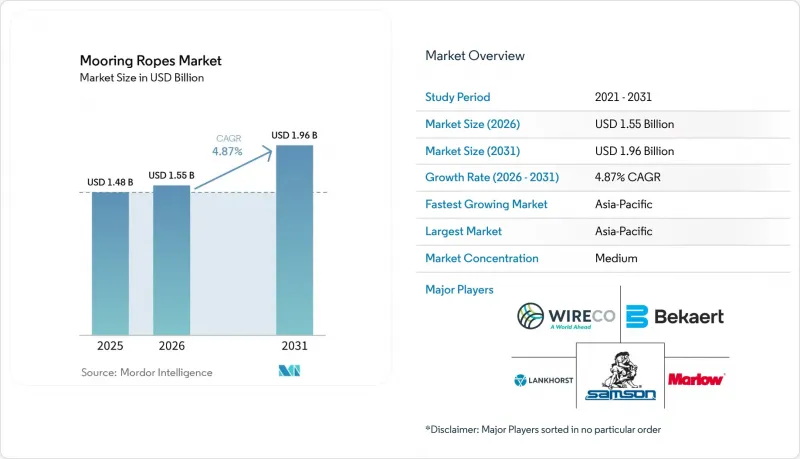
본 보고서는 소재 유형(나일론, 폴리에스터 등), 꼬임 수(4꼬임 이하, 4-10꼬임, 기타),용도(선박 계류, 해상 계류 등), 지역(아시아태평양, 북미, 유럽, 남미, 중동 및 아프리카)별로 분류되어 있습니다. 시장 전망은 금액(미 달러) 기준으로 제시되어 있습니다.
세계의 계류 로프 시장 동향 및 인사이트
해운 무역의 확대와 항만 현대화
항만의 확장으로 인해 새로운 부두, 터미널 개보수, 선단 갱신 및 이와 관련된 계류 로프 세트에 대한 안정적인 수요가 발생하고 있습니다. 터미널 운영 사업자가 더 대형 컨테이너선이나 초대형 원유 운반선(VLCC)의 취급에 대비할 때, 계류 로프 시장은 혜택을 받게 됩니다. 이는 볼라드 하중 증가에 따라 더 높은 파단 강도를 가진 로프가 필요하기 때문입니다. 이에 따라 고사양 합성 섬유 제품이나 4-10가닥, 혹은 10가닥 이상의 구조를 가진 제품에 대한 수요가 뒷받침되고 있습니다. PSA 싱가포르의 투아스 항은 개항 이래 처리량이 2,500만 TEU(20피트 컨테이너 환산 단위)를 돌파했으며, 2027년까지 부두를 18개로 확장하기로 결정되어, 이는 계류 설비의 교체 주기를 촉진하고 있습니다. 산토스 항은 2025년에 사상 최대인 590만 TEU를 처리했으며, 2026년에는 600만 TEU 이상을 목표로 하고 있어, 이로 인해 신규 및 교체용 선박 장비에 대한 수요가 뒷받침되고 있습니다. 멕시코 만사니요와 라살로 칼데나스의 확장 프로젝트 역시 수요를 증가시키고 있으며, 합성 로프의 활용에는 더 큰 성장 여지가 있습니다.
심해 및 초심해 해양 석유 및 가스 탐사
심해 탐사는 부유식 생산·저장·하역선(FPSO) 및 반잠수식 플랫폼에서 사용되는 고성능 로프 수요를 뒷받침하고 있습니다. 인도 석유천연가스공사(ONGC)가 2026년에 실시한 안다만 초심해 광구 및 인도 동부 연안을 대상으로 한 180억-200억 달러 규모의 심해 시추선 입찰은 프론티어 분지에서 국영 석유 회사의 활동이 지속되고 있음을 반영합니다. 계류 로프 시장은 프로젝트 일정에 따라 변동하기 쉬운 경향이 있습니다. 이는 해양 분야의 설비 투자나 최종 투자 결정이 연도별로 변동할 가능성이 있기 때문이며, 심해 인프라에 대한 근본적인 수요가 지속되고 있더라도 개별 수주가 지연될 수 있습니다. 확립된 해양 생산 능력을 갖춘 제조업체는 조기 프로젝트 수주 및 수주 잔고 확대를 통해 혜택을 볼 수 있습니다. 브라질의 프레솔트 분지, 서아프리카의 프론티어 광구, 그리고 동남아시아의 개발 지역은 해양 계류 수요의 중요한 거점으로 계속 남아 있습니다.
원자재 가격 변동
원자재 가격 변동은 계류 로프 시장의 이익률에 있어 가장 시급한 제약 요인입니다. 호르무즈 해협을 통과하는 석유화학제품의 흐름이 차질을 빚으면서, 다롄 상품 거래소의 폴리프로필렌 및 폴리에틸렌 가격은 2월 하순부터 2026년 4월까지 각각 38% 및 37% 상승했습니다. 같은 기간 동안 주요 아시아 시장에서는 벤젠 및 카프로락탐과 같은 나일론 중간체와 폴리에스터 섬유 가격도 상승했습니다. 표준 등급 로프 공급업체는 장기 공급 계약 하에서는 이러한 비용을 구매자에게 전가하기 어려운 경우가 적지 않습니다. 원자재 가격 상승이 지속될 경우, 헤지 능력이 뛰어난 대형 생산업체에 공급이 집중되어 있는 프리미엄 HMPE 제품의 상대적 수익성이 향상될 가능성이 있습니다. 수직 통합을 추진 중이거나 확립된 헤지 프로그램을 보유한 섬유 제조업체는 이러한 가격 변동을 흡수하는 데 있어 더 유리한 입장에 있습니다.
부문별 분석
2025년, 나일론은 계류 로프 시장 점유율의 41.23%를 차지했으며, 이는 상선 계류 시설에서 나일론이 확고히 자리 잡은 역할을 반영합니다. 나일론은 파단 전 성장률이 일반적으로 15-40%이므로 선박 취급 시 발생하는 충격 하중을 흡수할 수 있어, 성능과 비용을 모두 고려하는 표준 선박 계류 용도로 계속해서 널리 사용되고 있습니다. 상업용 선박의 계류에는 일반적으로 4-10가닥 구조의 나일론이 채택되고 있습니다. 폴리에스테르는 습윤 상태에서도 강도를 유지하고 나일론보다 크리프 현상이 적기 때문에 중요한 2위 자리를 차지하고 있습니다. 이러한 특성으로 인해 폴리에스테르는 해상 석유 터미널의 단일 지점 계류(SPM)용 계류 로프나, 장기간에 걸쳐 안정적인 하중이 요구되는 기타 용도에 적합합니다.
HMPE 계류 로프 시장 규모는 심해 에너지 및 부유식 풍력 발전 사업의 확대를 배경으로 2031년까지 연평균 성장률(CAGR) 5.34%로 확대될 것으로 예측됩니다. EN ISO 10325 : 2026은 HMPE 로프의 구조 및 성능 요건을 정의함으로써 사양의 불확실성을 줄이고 있습니다. 조사 결과, 부유식 풍력 발전의 계류에 있어 폴리에틸렌 테레프탈레이트(PET) 및 HMPE의 높은 내마모성이 확인되었으나, 최소 파단 하중의 15%를 초과하는 하중 하에서 HMPE의 크리프는 여전히 설계상 고려 사항으로 남아 있습니다. 그 밖의 범주에는 특수한 고하중 요구 사항 및 내화 요구 사항을 충족하기 위한 아라미드 섬유, 하이브리드 복합재료 및 강선이 포함됩니다. Garware Technical Fibers사는 26년도에 HMPE 가공 및 컴파운딩 역량에 대한 투자를 보고했으며, 이는 인도 공급업체들이 고부가가치 용도로의 전환을 목표로 하는 노력을 반영한 것입니다.
지역별 분석
아시아태평양은 2025년 계류 로프 시장 점유율의 43.07%를 차지했으며, 2031년까지 연평균 성장률(CAGR) 5.28%를 나타낼 것으로 예측됩니다. 이 지역에는 컨테이너 항구, 조선소 및 해상 에너지 자산이 집중되어 있습니다. 중국은 2026년 5월, 폴리에스테르 재질의 계류 로프를 사용하여 16MW 규모의 ‘삼협 링항(Sanxia Linghang)’ 부유식 풍력 발전 플랫폼을 설치했습니다. 가와사키 중공업은 선박 계류용 로프 장력 모니터링 시스템 ‘MOMOSEA’를 상용화하여, 센서를 통합한 계류 안전 대책에 주력하는 일본의 노력을 지원하고 있습니다. 인도 석유천연가스공사(ONGC)의 심해 시추 입찰은 인도의 미래 해상 수요를 시사하고 있습니다. 가웨어 테크니컬 파이버스는 2025년 7월 노르웨이 기업 2곳을 인수하여 해상 엔지니어링 및 프로젝트 관리 역량을 확대했습니다.
유럽과 북미는 계류 로프 시장에서 두 번째로 큰 수익원입니다. 유럽의 입지는 해상 풍력 발전의 활성화와 확립된 단일 지점 계류(SPM) 탱커 터미널 인프라에 의해 뒷받침되고 있습니다. 프랑스에서 실시된 EolMed 시범 프로젝트는 2026년 4월에 가동을 시작했으며, 지중해의 부유식 풍력 발전 계류 사양에 대한 기준이 되고 있습니다. 북미 수요는 미국 멕시코만에서의 심해 생산 및 브리티시컬럼비아주의 액화천연가스(LNG) 터미널 사업이 주를 이루고 있습니다. 베카트-벡스코(Beckart-Becksco)사는 멕시코만에서 쉘(Shell)사의 ‘스파르타(Sparta)’ 개발 프로젝트를 위해 합성 계류로프 ‘딥로프(DeepRope)’를 공급했습니다. 북유럽 국가들에서는 해상 석유 및 가스 자산, 양식 사업, 그리고 초기 단계의 부유식 해상 풍력 발전 프로젝트가 결합되어 있어, 이 지역은 고품질 로프 등급 및 수명 주기 서비스 역량을 갖춘 기업들에게 중요한 시장이 되고 있습니다.
남미, 중동 및 아프리카는 계류 로프 시장에서 규모는 작지만 지속적으로 성장하고 있는 지역입니다. 브라질의 산토스 항은 2026년에 600만 TEU(20피트 컨테이너 환산 단위) 이상을 목표로 하고 있으며, 브라질의 프리솔트층용 부유식 생산·저장·하역 설비(FPSO)의 파이프라인이 선박 및 해양 용도 전반에 걸친 수요를 뒷받침하고 있습니다. 아르헨티나의 해양 광구 권리 부여와 페트로브라스의 ‘모르포-1’ 심해 탐사 프로젝트는 해양 활동에 대한 장기적인 전망을 강화하고 있습니다. 사우디아라비아의 해양 유전 확장 및 남아프리카공화국의 오렌지 분지 탐사는 향후 계류 사양의 고도화에 대한 수요가 증가할 것임을 시사합니다. 알렉산드리아 항은 2025/26 회계연도에 사상 최대인 8,200만 톤의 화물을 처리했습니다. 모로코, 나이지리아, 케냐에 대한 투자 또한 기존 설비의 현대화 및 신규 설비 도입을 통한 수요 증가를 뒷받침하고 있습니다.
기타 혜택 :
- 엑셀 형식 시장 예측(ME) 시트
- 3개월간의 애널리스트 지원
자주 묻는 질문
목차
제1장 서론
제2장 조사 방법
제3장 개요
제4장 시장 구도
제5장 시장 규모 및 성장 예측
제6장 경쟁 구도
제7장 시장 기회 및 향후 전망
KTH 26.09.02According to Mordor Intelligence, the mooring ropes market size is estimated at USD 1.48 billion in 2025 and is estimated to grow from USD 1.55 billion in 2026 to USD 1.96 billion by 2031, at a CAGR of 4.87% during the forecast period (2026-2031).
This report is Segmented by Material Type (Nylon, Polyester, and More), Number of Strands (Up To 4 Strands, 4 To 10 Strands, and More), Application (Ship Mooring, Offshore Mooring, and More), and Geography (Asia-Pacific, North America, Europe, South America, and Middle-East and Africa). The Market Forecasts are Provided in Terms of Value (USD).
Global Mooring Ropes Market Trends and Insights
Growing Maritime Trade and Port Modernization
Port expansion is creating steady demand for new berths, terminal upgrades, fleet replacements, and associated mooring rope sets. The mooring ropes market benefits when terminal operators prepare to handle larger container ships and very large crude carriers, as higher bollard loads require ropes with greater breaking strength. This supports demand for higher-specification synthetic products and for 4- to 10-strand or above-10-strand constructions. PSA Singapore's Tuas Port has surpassed 25 million Twenty-foot Equivalent Units (TEUs) handled since commissioning and has confirmed an expansion to 18 berths by 2027, driving replacement cycles for mooring equipment. The Port of Santos targeted more than 6 million TEUs in 2026 after handling a record 5.9 million TEUs in 2025, supporting demand for new and replacement marine equipment. Expansion projects at Manzanillo and Lazaro Cardenas in Mexico are also increasing demand, with synthetic rope use having room to grow.
Offshore Oil and Gas Exploration in Deep and Ultra-Deep Waters
Deepwater exploration supports demand for high-performance ropes used by floating production, storage, and offloading vessels and semi-submersible platforms. Oil and Natural Gas Corporation's (ONGC's) 2026 tender for USD 18-20 billion of deepwater drilling rigs for the Andaman ultra-deepwater block and eastern offshore India reflects continued national oil company activity in frontier basins. The mooring ropes market is exposed to project timing because offshore capital spending and final investment decisions can shift between years, delaying individual orders even when the underlying need for deepwater infrastructure persists. Manufacturers with established offshore production capacity can benefit from earlier project awards and larger order books. Brazil's pre-salt basins, West African frontier acreage, and Southeast Asian developments remain relevant locations for offshore mooring demand.
Raw Material Price Volatility
Feedstock exposure is the most immediate constraint on margins in the mooring ropes market. Polypropylene and polyethylene prices on the Dalian Commodity Exchange rose 38% and 37%, respectively, between late February and April 2026, following disruptions to petrochemical flows through the Strait of Hormuz. Nylon intermediates, including benzene and caprolactam, as well as polyester fiber prices, also rose in key Asian markets during the same period. Standard-grade rope suppliers often find it difficult to pass these costs on to buyers under long-term supply agreements. Sustained feedstock inflation can improve the relative economics of premium HMPE products, whose supply is concentrated among larger producers with greater hedging capacity. Fiber producers with backward integration or established hedging programs are better positioned to absorb such volatility.
Other drivers and restraints analyzed in the detailed report include:
- Floating Offshore Wind and Marine Renewable Energy Deployment
- Adoption of Lightweight, High-Strength Synthetic Ropes
- High Installation and Certification Costs for Advanced Mooring Systems
For complete list of drivers and restraints, kindly check the Table Of Contents.
Segment Analysis
Nylon held 41.23% of the mooring ropes market share in 2025, reflecting its established role in commercial ship berths. Its typical 15-40% elongation before breaking supports shock-load absorption during vessel handling, and it remains widely used in standard ship mooring applications where both performance and cost are considerations. The 4-to-10-strand construction is commonly used with nylon in commercial ship mooring. Polyester holds an important secondary position due to its retained strength in wet conditions and lower creep than nylon. These properties make polyester suitable for Single Point Mooring (SPM) hawsers at offshore oil terminals and other applications requiring stable long-term loading.
The mooring ropes market size for HMPE is projected to expand at a 5.34% CAGR through 2031, driven by growth in deepwater energy and floating wind activity. EN ISO 10325:2026 reduces specification uncertainty by defining HMPE rope constructions and performance requirements. Research has identified strong wear resistance in Polyethylene Terephthalate (PET) and HMPE for floating wind mooring, although HMPE creep at loads above 15% of the minimum breaking load remains a design consideration. The other category includes aramid fiber, hybrid composites, and steel wire for specialized high-load or fire-resistant requirements. Garware Technical Fibers reported investment in HMPE processing and compounding capabilities in FY26, reflecting efforts by Indian suppliers to move toward higher-value applications.
Complete Report Scope:
- By Material Type
- Nylon
- Polyester
- Polypropylene (PP)
- High Modulus Polyethylene (HMPE)
- Others (Aramid Fibers, Hybrid and Composite Ropes, Steel Wire Ropes)
- By Number of Strands
- Up to 4 Strands
- 4 to 10 Strands
- Above 10 Strands
- By Application
- Ship Mooring
- Offshore Mooring
- Port and Terminal Operations
- Others (Floating Renewable Energy Systems, Aquaculture, Other Marine Applications)
- By Geography
- Asia-Pacific
- China
- India
- Japan
- South Korea
- ASEAN Countries
- Rest of Asia-Pacific
- North America
- United States
- Canada
- Mexico
- Europe
- Germany
- United Kingdom
- France
- Italy
- NORDIC Countries
- Rest of Europe
- South America
- Brazil
- Argentina
- Rest of South America
- Middle-East and Africa
- Saudi Arabia
- South Africa
- Rest of Middle-East and Africa
- Asia-Pacific
Geography Analysis
Asia-Pacific accounted for 43.07% of the Mooring Ropes Market share in 2025 and is forecast to grow at a 5.28% CAGR through 2031. The region has a high concentration of container ports, shipyards, and offshore energy assets. China installed the 16 MW Sanxia Linghang floating wind platform in May 2026, using polyester mooring lines. Kawasaki Heavy Industries commercialized its MOMOSEA rope tension monitoring system for ship berthing, supporting Japan's focus on sensor-integrated mooring safety. Oil and Natural Gas Corporation (ONGC)'s deepwater drilling tender points to India's future offshore requirements. Garware Technical Fibers expanded its offshore engineering and project management capabilities through its July 2025 acquisitions of two Norwegian businesses.
Europe and North America form the second-largest revenue pool in the Mooring Ropes Market. Europe's position is supported by offshore wind activity and established Single Point Mooring (SPM) tanker terminal infrastructure. The EolMed pilot in France was energized in April 2026 and serves as a reference point for mooring specifications in Mediterranean floating wind. North American demand is centered on deepwater production in the U.S. Gulf of Mexico and Liquefied Natural Gas (LNG) terminal activity in British Columbia. Bekaert-BEXCO supplied DeepRope synthetic mooring lines for Shell's Sparta development in the Gulf of Mexico. Nordic countries combine offshore oil and gas assets, fish farming operations, and early floating wind projects, making the region important for premium rope grades and lifecycle service capabilities.
South America, the Middle-East, and Africa represent smaller but expanding parts of the Mooring Ropes Market. Brazil's Port of Santos targeted more than 6 million Twenty-foot Equivalent Units (TEUs) in 2026, while its pre-salt Floating Production Storage and Offloading (FPSO) pipeline supported demand across ship and offshore applications. Argentina's offshore block awards and Petrobras's Morpho-1 deepwater prospect add longer-term visibility for offshore activity. Saudi offshore field expansions and exploration in South Africa's Orange Basin point to future demand for upgraded mooring specifications. Alexandria Port handled a record 82 million tons of cargo in FY2025/26. Investments in Morocco, Nigeria, and Kenya also support incremental replacement and new-equipment demand.
- Bekaert
- Bexco nv-sa
- Cortland Company
- Dynamica Ropes
- FOLCH ROPES S.A.
- Garware Technical Fibres Ltd.
- Jimmy Green Marine
- Katradis Marine Ropes Ind. S.A.
- Lankhorst Ropes
- Marlow Ropes
- Samson Rope Technologies
- Southern Ropes
- Teufelberger
- Usha Martin
- van Beelen Group BV
- WireCo
- Yale Cordage
Additional Benefits:
- The market estimate (ME) sheet in Excel format
- 3 months of analyst support
TABLE OF CONTENTS
1 Introduction
- 1.1 Study Assumptions and Market Definition
- 1.2 Scope of the Study
2 Research Methodology
3 Executive Summary
4 Market Landscape
- 4.1 Market Overview
- 4.2 Market Drivers
- 4.2.1 Growing Maritime Trade and Port Modernization
- 4.2.2 Offshore Oil and Gas Exploration in Deep and Ultra-Deep Waters
- 4.2.3 Floating Offshore Wind and Marine Renewable Energy Deployment
- 4.2.4 Adoption of Lightweight, High-Strength Synthetic Ropes
- 4.2.5 Sensor-Enabled Mooring Condition Monitoring
- 4.2.6 Bio-Based and Recyclable Rope Procurement Requirements
- 4.3 Market Restraints
- 4.3.1 Raw Material Price Volatility
- 4.3.2 High Installation and Certification Costs for Advanced Mooring Systems
- 4.3.3 Inconsistent Mooring Inspection and Replacement Practices
- 4.3.4 Limited Performance Data for Long-Life Fiber Ropes in Floating Wind
- 4.4 Value and Supply-Chain Analysis
- 4.5 Porter's Five Forces Analysis
- 4.5.1 Bargaining Power of Suppliers
- 4.5.2 Bargaining Power of Buyers
- 4.5.3 Threat of New Entrants
- 4.5.4 Threat of Substitutes
- 4.5.5 Competitive Rivalry
5 Market Size and Growth Forecasts (Value)
- 5.1 By Material Type
- 5.1.1 Nylon
- 5.1.2 Polyester
- 5.1.3 Polypropylene (PP)
- 5.1.4 High Modulus Polyethylene (HMPE)
- 5.1.5 Others (Aramid Fibers, Hybrid and Composite Ropes, Steel Wire Ropes)
- 5.2 By Number of Strands
- 5.2.1 Up to 4 Strands
- 5.2.2 4 to 10 Strands
- 5.2.3 Above 10 Strands
- 5.3 By Application
- 5.3.1 Ship Mooring
- 5.3.2 Offshore Mooring
- 5.3.3 Port and Terminal Operations
- 5.3.4 Others (Floating Renewable Energy Systems, Aquaculture, Other Marine Applications)
- 5.4 By Geography
- 5.4.1 Asia-Pacific
- 5.4.1.1 China
- 5.4.1.2 India
- 5.4.1.3 Japan
- 5.4.1.4 South Korea
- 5.4.1.5 ASEAN Countries
- 5.4.1.6 Rest of Asia-Pacific
- 5.4.2 North America
- 5.4.2.1 United States
- 5.4.2.2 Canada
- 5.4.2.3 Mexico
- 5.4.3 Europe
- 5.4.3.1 Germany
- 5.4.3.2 United Kingdom
- 5.4.3.3 France
- 5.4.3.4 Italy
- 5.4.3.5 NORDIC Countries
- 5.4.3.6 Rest of Europe
- 5.4.4 South America
- 5.4.4.1 Brazil
- 5.4.4.2 Argentina
- 5.4.4.3 Rest of South America
- 5.4.5 Middle-East and Africa
- 5.4.5.1 Saudi Arabia
- 5.4.5.2 South Africa
- 5.4.5.3 Rest of Middle-East and Africa
- 5.4.1 Asia-Pacific
6 Competitive Landscape
- 6.1 Market Concentration
- 6.2 Strategic Moves
- 6.3 Market Share (%)/Ranking Analysis
- 6.4 Company Profiles (includes Global Overview, Market Overview, Core Segments, Financials as available, Strategic Information, Products and Services, and Recent Developments)
- 6.4.1 Bekaert
- 6.4.2 Bexco nv-sa
- 6.4.3 Cortland Company
- 6.4.4 Dynamica Ropes
- 6.4.5 FOLCH ROPES S.A.
- 6.4.6 Garware Technical Fibres Ltd.
- 6.4.7 Jimmy Green Marine
- 6.4.8 Katradis Marine Ropes Ind. S.A.
- 6.4.9 Lankhorst Ropes
- 6.4.10 Marlow Ropes
- 6.4.11 Samson Rope Technologies
- 6.4.12 Southern Ropes
- 6.4.13 Teufelberger
- 6.4.14 Usha Martin
- 6.4.15 van Beelen Group BV
- 6.4.16 WireCo
- 6.4.17 Yale Cordage
7 Market Opportunities and Future Outlook
- 7.1 White-Space and Unmet-Need Assessment


