
|
시장보고서
상품코드
2119359
광변색 염료 : 시장 점유율 분석, 업계 동향 및 통계, 성장 예측(2026-2031년)Photochromic Dyes - Market Share Analysis, Industry Trends & Statistics, Growth Forecasts (2026 - 2031) |
||||||
 Mordor Intelligence
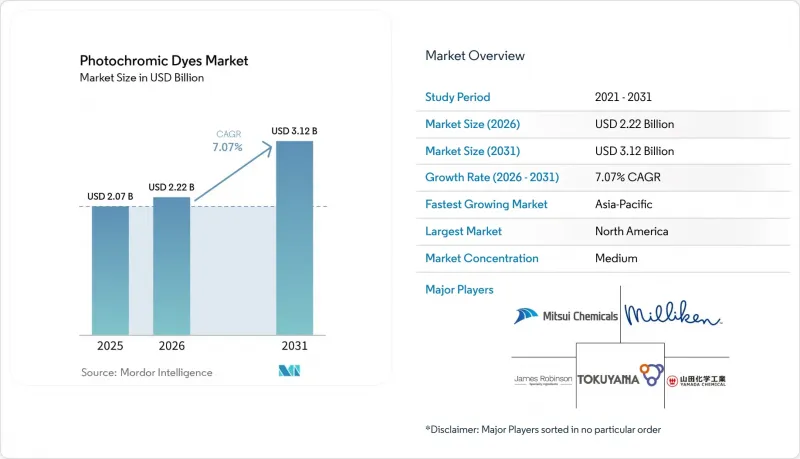
Mordor Intelligence에 의하면, 광변색 염료 시장은 2025년에 20억 7,000만 달러 규모로 평가되었습니다. 2026년 22억 2,000만 달러에서 2031년까지 31억 2,000만 달러에 이를 것으로 추정되고 예측 기간(2026-2031년) CAGR은 7.07%를 나타낼 전망입니다.
본 보고서는 화학 구조(나프토피란, 스피로옥사진, 스피로피란, 디아릴에텐 및 기타 화학 구조),형태(분말, 액체, 캡슐화 안료 및 기타 형태), 용도(안과용 렌즈, 플라스틱, 페인트 및 코팅 등), 지역(아시아태평양, 북미, 유럽, 남미, 중동 및 아프리카)별로 분류되어 있습니다. 시장 예측은 금액(달러) 기준으로 제시되어 있습니다.
세계의 광변색 염료 시장 동향 및 인사이트
적응형 광학 제품 및 자외선 차단 제품에 대한 수요 증가
고급 안경 렌즈의 등장으로 측정 가능한 성능상의 이점을 갖춘 광변색 시스템에 대한 수요가 발생했습니다. 2026년 4월, HOYA Vision Care는 광적응형 렌즈 시리즈의 3세대 제품인 ‘Sensity 3’를 출시했습니다. HOYA에 따르면, 사내 테스트 결과 주요 경쟁사 제품에 비해 피로 저항성이 최대 4배, 색상 안정성이 4배 향상된 것으로 나타났습니다. 또한, 이 회사는 이 렌즈의 색상 회복 속도가 이전 세대 Sensity 제품보다 25% 더 빠르다고 밝혔습니다. 2025년, 미국 검안사 협회(Association of Optometrists)는 ‘Transitions GEN S’가 시각 건강 개선에 관한 이중 맹검 무작위 임상시험의 증거를 뒷받침하는 최초의 광변색 제품이라고 보고했습니다. 이러한 주장으로 인해 광변색 염료 시장 전체에서 신뢰할 수 있는 활성화 임계값, 재현 가능한 피드백 거동 및 관리된 제조 품질을 갖춘 염료 화학 물질에 대한 수요가 높아졌습니다.
스마트 패키지, 라벨 및 보안 인쇄의 확대
브랜드 소유자들은 포장 및 인쇄 문서의 육안 진위 확인을 향상시키기 위해 포토크로믹 잉크를 채택했습니다. 포토크로믹 UV 잉크는 특정 자외선 파장에 반응하기 때문에 일반적인 사진 촬영 방법으로는 그 반응을 재현하기 어려웠습니다. 검사 담당자는 전용 판독 기기를 사용하지 않고도 색상 변화를 확인할 수 있었습니다. 2025년 연구에서는 문서 인증을 목적으로 종이 기판 위에 스크린 인쇄된 스피로피란 센서가 검증되었습니다. 그 반응은 세관 및 품질 관리 용도를 위해 미리 보정된 색상 척도에 대해 측정할 수 있었습니다. 이러한 실증 결과를 통해 라벨, 문서 및 브랜드 보호 용도에서의 광변색 염료 시장에 대한 관심이 더욱 높아졌습니다.
제조 과정의 복잡성과 특수 화학물질 비용
다단계 유기 합성 공정으로 인해 나프토피란 및 디아릴에텐 화합물의 비용은 높게 책정되었습니다. 이러한 비용은 신규 공급업체의 진입을 방해하고, 대량 생산되는 플라스틱 및 섬유 분야에서의 채택을 제한하고 있었습니다. 스피로옥사진 및 스피로피란은 더 낮은 단가 비용으로 제조할 수 있었습니다. 그러나 이들 물질의 적용 온도 범위가 좁았기 때문에 안과용 렌즈 분야에서는 여전히 더 고가인 나프토피란 계열이 중요한 역할을 수행하고 있었습니다. 이로 인해 광변색 염료 시장의 고가 부문에서는 높은 가격 수준이 유지되었습니다. 또한, 특수 방향족 중간체의 경우, 장기 공급 계약이 체결되지 않은 경우 생산자는 투입 비용의 변동에 노출될 수밖에 없었습니다.
부문별 분석
나프토피란 계열은 안과용 렌즈 배합에서 광범위하게 사용된 덕분에 2025년에는 매출 점유율의 38.12%를 차지했습니다. 그 특성은 대량 생산되는 렌즈 성형용 수지 시스템이나 확립된 광학 제품 제조 공정에 적합했습니다. 또한, 나프토피란 계열은 기존의 대체품에 비해 색상 회복이 빠르고 작동 온도 범위도 넓다는 특징이 있었습니다. 이러한 특성 덕분에 고급 안경에 채택되는 데 박차를 가했습니다. 스피로옥사딘 계열은 저비용 렌즈 등급 및 특정 인쇄 잉크 용도에서 여전히 중요한 역할을 수행했습니다. 스피로피란 계열은 포토닉 페이퍼, 위조 방지 라벨, 그리고 자외선에 의한 가역성이나 색상 대비가 중요한 섬유 기판에 사용되고 있습니다. 풀기드 유도체나 유기·무기 하이브리드를 포함한 기타 화학 계열은 상업적으로 여전히 소규모에 머물러 있었습니다. 이러한 응용 분야에서는 명확한 활성화 파장 및 스위칭 거동이 요구되었기 때문에 연구의 주목을 계속 받았습니다. 광변색 염료 업계에서는 각 최종 용도의 성능 요구 사항에 따라 형성된 화학 계열의 조합이 유지되었습니다.
디아릴에텐은 2031년까지 연평균 성장률(CAGR) 8.05%를 나타낼 것으로 예측됩니다. 그 열적 쌍안정성은 광로직, 데이터 저장, 형광 센싱 및 스위칭 상태 유지가 필요한 기타 용도를 뒷받침했습니다. 2025년 리뷰에서는 디아릴에텐, 스피로피란 및 기타 5가지 광 스위치 분류가 다뤄졌습니다. 이 리뷰에서는 특정 활성화 파장이나 스위칭 속도를 추구하는 배합 설계자들을 위해, 이용 가능한 광물리적 거동의 폭넓은 범위가 제시되었습니다. 2025년에 발표된 연구에서는 전체 파장 범위의 가시광선을 흡수하는 페로센을 함유한 푸시-풀형 나프토피란 구조가 소개되었습니다. 이 연구 결과는 자외선에 의존하는 이용 사례를 넘어 반응하는 미래의 적응형 렌즈 개발을 촉진할 가능성이 있습니다. ISO 8980-3에서는 안과용 인증 성능 요건의 정의가 지속적으로 진행되었습니다. 이러한 요건으로 인해 나프토피란의 채택이 촉진되는 한편, 대체 화학 물질에 대한 상업적 검증도 완료되었습니다. 광변색 염료 시장에서는 기존 렌즈용 화학 물질과 특수 기기용 신소재가 모두 주목받았습니다.
지역별 분석
2025년, 북미는 광변색 염료 시장 매출 점유율의 32.02%를 차지했습니다. 관리형 시력 관리 네트워크가 렌즈 처방 및 판매를 주도하고, 소매 수준에서 프리미엄 포토크로믹 렌즈로의 업그레이드를 촉진함으로써 광학 제품에 대한 비교적 안정적인 수요 기반이 형성되었습니다. 영국 검안사 협회(Association of Optometrists)의 보고서에 따르면, ‘트랜지션즈 GEN S’의 개발에는 5년 동안 165명의 과학자와 55명의 박사 학위 소지 화학자가 참여했으며, 이는 이 지역의 광변색 공급망의 깊이를 반영합니다. 또한, 대체품의 위협이 커지는 가운데, 의약품 및 고급 주류 분야의 보안 인쇄와 브랜드 보호도 2차 수요를 뒷받침했습니다.
유럽은 광학 제조, 유럽연합의 화학물질 등록·평가·허가 및 제한(REACH) 규정 준수, 그리고 항공우주 및 자동차 분야 사용자들의 관심이 결합되어 광변색 염료 시장에서 기술적으로 요구 수준이 높은 지역으로 남아 있었습니다. 독일, 프랑스, 영국이 유럽의 주요 거점이 되었으며, 프랑스에 본사를 둔 OliKrom사는 2025년 6월 파리 에어쇼에서 ‘VisioKrom’을 발표했습니다. 이 회사는 이 첨가제를 일반 소비자용 렌즈 제품이 아닌, 품질 관리를 위한 광변색 화학 기술을 활용하여 항공우주 및 자동차용 금속 부품의 부식 방지 처리를 시각화하는 데 활용하기로 했습니다. 북유럽 국가에서는 실외 사용 습관과 잘 갖춰진 광학 소매망 덕분에 1인당 렌즈 보급률이 높은 수준을 유지하고 있는 반면, 동유럽의 제조 거점은 국내 및 수출용 공급망에서 보안 인쇄 및 스마트 패키징 수요를 뒷받침하고 있었습니다.
아시아태평양은 동아시아의 근시 유병률 상승으로 인해 학령기층의 적응형 안경 수요가 증가하고 있어, 2031년까지 연평균 성장률(CAGR) 8.17%를 나타낼 것으로 예측되며, 이는 지역별로는 가장 높은 성장률입니다. 확대되는 중산층 고객층이 프리미엄 렌즈 수요를 뒷받침하는 한편, 동남아시아 국가연합(ASEAN) 시장 전체의 보안 인쇄 요구 사항이 추가적인 이용 사례를 창출했습니다. 일본은 광변색 화학 물질의 개발 및 제조에서 계속해서 중요한 역할을 하고 있는 반면, 한국과 일본의 아세안(ASEAN) 무역 파트너국들은 보안 인쇄 및 코팅을 통해 시장에 기여하고 있습니다. 남미, 중동 및 아프리카는 여전히 소규모 지역 부문에 머물러 있지만, 남미에서는 조직화된 안경 소매 체인이 광변색 렌즈 취급 프로그램을 확대함에 따라 브라질이 주요 수요 거점으로 부상하고 있습니다. 아시아태평양의 광변색 염료 시장 규모는 안경 수요와 기능성 소재의 용도 확대에 의해 뒷받침되고 있습니다.
기타 혜택 :
- 엑셀 형식 시장 예측(ME) 시트
- 3개월간의 애널리스트 지원
자주 묻는 질문
목차
제1장 서론
제2장 조사 방법
제3장 개요
제4장 시장 구도
제5장 시장 규모 및 성장 예측
제6장 경쟁 구도
제7장 시장 기회 및 향후 전망
KTH 26.09.02According to Mordor Intelligence, the photochromic dyes market was valued at USD 2.07 billion in 2025 and is estimated to grow from USD 2.22 billion in 2026 to reach USD 3.12 billion by 2031, at a CAGR of 7.07% during the forecast period (2026-2031).
This report is Segmented by Chemistry (Naphthopyrans, Spirooxazines, Spiropyrans, Diarylethenes, and Other Chemistries), Form (Powder, Liquid, Encapsulated Pigments, and Other Forms), Application (Ophthalmic Lenses, Plastics, Paints and Coatings, and More), and Geography (Asia-Pacific, North America, Europe, South America, and Middle-East and Africa). The Market Forecasts are Provided in Terms of Value (USD).
Global Photochromic Dyes Market Trends and Insights
Rising Demand for Adaptive Optical and UV-Protective Products
Premium ophthalmic lenses created demand for photochromic systems with measurable performance advantages. In April 2026, HOYA Vision Care launched Sensity 3, the third generation of its light-adaptive lens range. HOYA stated that internal tests showed up to 4X greater fatigue resistance and 4X improved color stability than a leading competitor. The company also stated that the lens had a 25% faster fade-back speed than the prior Sensity generation. The Association of Optometrists reported in 2025 that Transitions GEN S was the first photochromic product positioned with double-blind, randomized clinical trial evidence of improved visual health. These claims increased the need for dye chemistries with reliable activation thresholds, repeatable fade-back behavior, and controlled production quality across the photochromic dyes market.
Expansion of Smart Packaging, Labels, and Security Printing
Brand owners used photochromic inks to improve visible authentication in packaging and printed documents. Photochromic UV inks responded under specified ultraviolet wavelengths, which made their response harder to reproduce with ordinary photographic methods. Inspectors could observe the color response without using dedicated reading equipment. A 2025 study demonstrated screen-printed spiropyran sensors on paper substrates for document authentication. The response could be measured against a pre-calibrated color scale for customs and quality-control use. This evidence supported wider interest in the photochromic dyes market for labels, documents, and brand-protection applications.
High Manufacturing Complexity and Specialty-Chemical Costs
Multi-step organic synthesis created high costs for naphthopyran and diarylethene compounds. These costs limited new supplier entry and constrained adoption in high-volume plastic and textile uses. Spirooxazines and spiropyrans could be produced at a lower unit cost. However, their narrower temperature ranges meant that more expensive naphthopyran systems remained important for ophthalmic lenses. This maintained higher pricing across the premium part of the photochromic dyes market. Specialty aromatic intermediates also exposed producers to input-cost changes when they lacked longer-term supply arrangements.
Other drivers and restraints analyzed in the detailed report include:
- Growth of Smart Materials in Electronics and Optical Devices
- Advances in Photochromic Formulation and Microencapsulation
- Photochemical Fatigue and Environmental Stability Limitations
For complete list of drivers and restraints, kindly check the Table Of Contents.
Segment Analysis
Naphthopyrans held 38.12% revenue share in 2025, supported by their extensive use in ophthalmic lens formulations. Their behavior suited high-volume lens-casting resin systems and established optical production processes. Naphthopyrans also offered faster fade-back behavior and a broader operating temperature range than earlier alternatives. These characteristics supported their use in premium eyewear. Spirooxazines retained a role in lower-cost lens grades and selected printing-ink applications. Spiropyrans are used in photonic paper, anti-counterfeiting labels, and textile substrates where ultraviolet reversibility and color contrast are important. Other chemistries, including fulgide derivatives and organic-inorganic hybrids, remained commercially smaller. They continued to receive research attention because applications needed distinct activation wavelengths and switching behavior. The photochromic dyes industry retained a chemistry mix shaped by the performance requirements of each end-use.
Diarylethenes are projected to advance at an 8.05% CAGR through 2031. Their thermal bistability supported optical logic, data storage, fluorescence sensing, and other applications where a retained switched state was necessary. A 2025 review covered diarylethenes, spiropyrans, and 5 other photoswitch classes. It showed the range of photophysical behaviors available to formulators seeking tailored activation wavelengths and switching kinetics. Research published in 2025 introduced ferrocene-containing push-pull naphthopyran structures with panchromatic visible-light absorption. This work could support future adaptive lenses that respond beyond ultraviolet-dependent use cases. ISO 8980-3 continued to define performance requirements for ophthalmic qualification. These requirements reinforced naphthopyran adoption while alternative chemistries completed commercial validation. The photochromic dyes market supported both established lens chemistry and newer materials for specialized devices.
Complete Report Scope:
- By Chemistry
- Naphthopyrans
- Spirooxazines
- Spiropyrans
- Diarylethenes
- Other Chemistries
- By Form
- Powder
- Liquid
- Encapsulated Pigments
- Other Forms
- By Application
- Ophthalmic Lenses
- Plastics
- Printing Inks
- Paints and Coatings
- Textiles and Apparel
- Other Applications
- By Geography
- Asia-Pacific
- China
- India
- Japan
- South Korea
- ASEAN Countries
- Rest of Asia-Pacific
- North America
- United States
- Canada
- Mexico
- Europe
- Germany
- United Kingdom
- France
- Italy
- NORDIC Countries
- Rest of Europe
- South America
- Brazil
- Argentina
- Rest of South America
- Middle-East and Africa
- Saudi Arabia
- South Africa
- Rest of Middle-East and Africa
- Asia-Pacific
Geography Analysis
North America held 32.02% revenue share of the photochromic dyes market in 2025. Managed vision care networks shaped lens dispensing and supported premium photochromic upgrades at the retail level, providing a relatively stable demand base for optical products. The Association of Optometrists reported that the development of Transitions GEN S involved 165 scientists and 55 doctoral-level chemists over 5 years, reflecting the depth of the regional photochromic supply chain. Security printing and brand protection in pharmaceuticals and premium spirits also supported secondary demand as counterfeiting pressures increased.
Europe remained a technically demanding region for the photochromic dyes market because it combined optical manufacturing, European Union Registration, Evaluation, Authorisation and Restriction of Chemicals (REACH) compliance, and interest from aerospace and automotive users. Germany, France, and the United Kingdom represented the larger European centers, while France-based OliKrom presented VisioKrom at the Paris Air Show in June 2025. The company positioned the additive for visualizing anti-corrosion treatments on aerospace and automotive metal components, using photochromic chemistry for quality control rather than a consumer lens product. Nordic countries supported higher per-capita lens adoption through outdoor use patterns and strong optical retail access, while Eastern European manufacturing hubs supported security-printing and smart-packaging demand for domestic and export supply chains.
Asia-Pacific is projected to advance at an 8.17% CAGR through 2031, the highest regional rate, as rising myopia prevalence in East Asia has increased demand for adaptive eyewear among school-age populations. A growing middle-class customer base supported premium lens demand, while security-printing requirements across the Association of Southeast Asian Nations, or ASEAN, markets added another use case. Japan remained important for photochromic chemistry development and manufacturing, while South Korea and Japan's ASEAN trading partners contributed through security printing and coatings. South America and Middle-East and Africa remained smaller geographic segments, with Brazil representing South America's main demand center as organized optical retail chains expanded photochromic lens attachment programs. The photochromic dyes market size in Asia-Pacific is supported by both eyewear demand and expanding functional-material applications.
- Bloclo Technology Company
- Chromatic Technologies Inc.
- FX Pigments Pvt. Ltd.
- James Robinson Speciality Ingredients
- Kolortek Co., Ltd.
- LCR Hallcrest
- Matsui International
- Milliken
- Mitsui Chemicals, Inc.
- OliKrom
- QCR Solutions Corp
- Tokuyama Corporation
- Vivimed Labs
- Yamada Chemical Co., Ltd.
Additional Benefits:
- The market estimate (ME) sheet in Excel format
- 3 months of analyst support
TABLE OF CONTENTS
1 Introduction
- 1.1 Study Assumptions and Market Definition
- 1.2 Scope of the Study
2 Research Methodology
3 Executive Summary
4 Market Landscape
- 4.1 Market Overview
- 4.2 Market Drivers
- 4.2.1 Rising Demand for Adaptive Optical and UV-Protective Products
- 4.2.2 Expansion of Smart Packaging, Labels, and Security Printing
- 4.2.3 Growth of Smart Materials in Electronics and Optical Devices
- 4.2.4 Advances in Photochromic Formulation and Microencapsulation
- 4.2.5 Under-Reported: Demand for Application-Specific Color and Fade Profiles
- 4.2.6 Under-Reported: Integration of Photochromics Into Low-Order, Digital-Printing Workflows
- 4.3 Market Restraints
- 4.3.1 High Manufacturing Complexity and Specialty-Chemical Costs
- 4.3.2 Photochemical Fatigue and Environmental Stability Limitations
- 4.3.3 Under-Reported: Formulation Compatibility Risk Across Binders, Solvents, and Substrates
- 4.3.4 Under-Reported: Limited Standardization of Performance Testing Across Applications
- 4.4 Value Chain Analysis
- 4.5 Porter's Five Forces Analysis
- 4.5.1 Bargaining Power of Suppliers
- 4.5.2 Bargaining Power of Buyers
- 4.5.3 Threat of New Entrants
- 4.5.4 Threat of Substitutes
- 4.5.5 Competitive Rivalry
5 Market Size and Growth Forecasts (Value)
- 5.1 By Chemistry
- 5.1.1 Naphthopyrans
- 5.1.2 Spirooxazines
- 5.1.3 Spiropyrans
- 5.1.4 Diarylethenes
- 5.1.5 Other Chemistries
- 5.2 By Form
- 5.2.1 Powder
- 5.2.2 Liquid
- 5.2.3 Encapsulated Pigments
- 5.2.4 Other Forms
- 5.3 By Application
- 5.3.1 Ophthalmic Lenses
- 5.3.2 Plastics
- 5.3.3 Printing Inks
- 5.3.4 Paints and Coatings
- 5.3.5 Textiles and Apparel
- 5.3.6 Other Applications
- 5.4 By Geography
- 5.4.1 Asia-Pacific
- 5.4.1.1 China
- 5.4.1.2 India
- 5.4.1.3 Japan
- 5.4.1.4 South Korea
- 5.4.1.5 ASEAN Countries
- 5.4.1.6 Rest of Asia-Pacific
- 5.4.2 North America
- 5.4.2.1 United States
- 5.4.2.2 Canada
- 5.4.2.3 Mexico
- 5.4.3 Europe
- 5.4.3.1 Germany
- 5.4.3.2 United Kingdom
- 5.4.3.3 France
- 5.4.3.4 Italy
- 5.4.3.5 NORDIC Countries
- 5.4.3.6 Rest of Europe
- 5.4.4 South America
- 5.4.4.1 Brazil
- 5.4.4.2 Argentina
- 5.4.4.3 Rest of South America
- 5.4.5 Middle-East and Africa
- 5.4.5.1 Saudi Arabia
- 5.4.5.2 South Africa
- 5.4.5.3 Rest of Middle-East and Africa
- 5.4.1 Asia-Pacific
6 Competitive Landscape
- 6.1 Market Concentration
- 6.2 Strategic Moves
- 6.3 Market Share (%)/Ranking Analysis
- 6.4 Company Profiles (includes Global Overview, Market Overview, Core Segments, Financials as available, Strategic Information, Products and Services, and Recent Developments)
- 6.4.1 Bloclo Technology Company
- 6.4.2 Chromatic Technologies Inc.
- 6.4.3 FX Pigments Pvt. Ltd.
- 6.4.4 James Robinson Speciality Ingredients
- 6.4.5 Kolortek Co., Ltd.
- 6.4.6 LCR Hallcrest
- 6.4.7 Matsui International
- 6.4.8 Milliken
- 6.4.9 Mitsui Chemicals, Inc.
- 6.4.10 OliKrom
- 6.4.11 QCR Solutions Corp
- 6.4.12 Tokuyama Corporation
- 6.4.13 Vivimed Labs
- 6.4.14 Yamada Chemical Co., Ltd.
7 Market Opportunities and Future Outlook
- 7.1 White-Space and Unmet-Need Assessment

(주말 및 공휴일 제외)


