

|
시장보고서
상품코드
2119365
신흥 기술 레이더 플랫폼 : 시장 점유율 분석, 업계 동향 및 통계, 성장 예측(2026-2031년)Emerging Technology Radar Platforms - Market Share Analysis, Industry Trends & Statistics, Growth Forecasts (2026 - 2031) |
||||||
 Mordor Intelligence
Mordor Intelligence에 의하면, 신흥 기술 레이더 플랫폼 시장 규모는 2025년 11억 4,000만 달러로 평가되었습니다. 2026년에는 12억 7,000만 달러로 확대되어 2031년까지 25억 4,000만 달러에 이를 것으로 예측되며, 2026년부터 2031년까지 연평균 성장률(CAGR)은 10.96%를 나타낼 전망입니다.
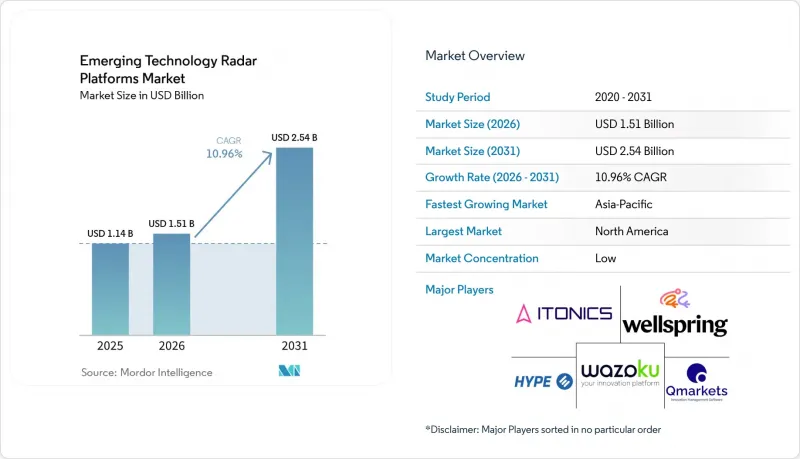
본 보고서는 플랫폼 기능(동향 및 예측 정보 등), 도입 형태(클라우드 기반, 하이브리드 등), 조직 규모(대기업, 중소기업), 용도(연구 개발 등), 최종 사용자(에너지·유틸리티 등) 및 지역별로 분류되어 있습니다. 시장 예측은 금액(달러) 기준으로 제시되어 있습니다.
세계의 신흥 기술 레이더 플랫폼 시장 동향 및 인사이트
지속적인 기술 포어사이트에 대한 기업 수요
조직들은 기술 포사이트를 일시적인 연례 활동이 아닌 지속적인 의무로 인식하고 있습니다. 이러한 변화로 인해 신흥 기술 레이더 플랫폼 시장의 구매 근거도 변화하고 있습니다. 예산, 제품 계획, 투자 대안을 재검토할 때 팀은 최신 근거를 필요로 하기 때문입니다. 플랫폼을 활용함으로써 전략 팀은 발전 중인 기술, 불확실한 기술, 혹은 중요성을 잃어가고 있는 기술에 대해 공통된 인식을 가질 수 있습니다. 또한 경영진이나 이사회에 기술 관련 의사결정 근거를 문서화하는 것도 용이해집니다. 제품 출시 시기나 기술 선택이 경쟁적 입지에 직접적인 영향을 미치는 경우, 지속적인 업데이트는 특히 유용합니다. 그 결과 발생하는 수요는 정적인 보고서가 아닌, 최신 정보를 명확하고 설득력 있는 의사결정으로 전환할 수 있는 공급업체를 우대하게 될 것입니다.
AI를 활용한 미약한 신호의 감지 및 통합
AI 기능을 통해 레이더 플랫폼의 기능은 기본적인 키워드 모니터링이나 수동 검토의 범위를 넘어 확장되고 있습니다. 핀란드 VTT 기술 연구센터가 발표한 조사에서는 언어 모델과 ‘강도’ 및 ‘확산’이라는 두 가지 지표를 활용하여 약 9만 건의 과학 논문 중에서 미약한 신호를 식별하는 대규모 접근 방식이 소개되었습니다. 이 접근 방식을 통해 포사이트 팀은 정보량 증가에 맞추어 분석가를 증원하지 않고도 더 광범위한 조사 자료를 면밀히 검토할 수 있게 됩니다. ITONICS에 따르면, Prism AI는 특허, 논문, 경쟁사의 동향 등 5,000만 건 이상의 신호를 처리하여 기술 레이더를 작성하고 있다고 합니다. 이 시스템의 실용적 가치는 시스템이 관련성이 높은 초기 증거와 단순히 새롭거나 주목을 받는 신호를 구별할 수 있는지 여부에 달려 있습니다. 따라서 각 공급업체는 자동화된 통합 기능에 정보 출처의 추적 가능성과 사용자 검토 기능을 결합하고 있습니다.
데이터 출처, 라이선싱 및 지적 재산권상의 제약
레이더 플랫폼은 간행물, 특허, 기업 정보 및 기타 외부 기록에 대한 접근에 의존합니다. 라이선스 조건이나 데이터 이용 규제로 인해, 특히 소규모 공급업체의 경우 광범위한 커버리지를 유지하기 위한 비용이 증가할 가능성이 있습니다. 또한, 유럽의 조달 팀은 다중 출처 플랫폼을 승인하기 전에 데이터 권리, 개인정보 보호 및 기밀 정보 취급에 대해서도 평가를 수행합니다. 이러한 확인 작업으로 인해 판매 주기가 장기화될 가능성이 있으며, 데이터 거버넌스는 제품 선정에 있어 결정적인 요건이 됩니다. 구매자가 플랫폼이 어떤 데이터를 활용할 수 있는지 확인해야 하는 경우, 확립된 데이터 계약과 명확한 출처 기록을 보유한 공급업체는 실질적인 우위를 점하게 됩니다. 따라서 신흥 기술 레이더 플랫폼 시장에서는 합법적이고 투명한 데이터 관리 관행을 입증하지 못하는 기업의 경우 진입 장벽이 높아질 가능성이 있습니다.
부문별 분석
2025년, ‘기술 스카우팅 및 호라이즌 스캐닝’은 플랫폼 매출의 38.42%를 차지했으며, 플랫폼 기능별로는 ‘신흥 기술 레이더 플랫폼 시장’에서 가장 큰 점유율을 기록했습니다. 대규모 연구개발(R&D) 팀과 전략 팀은 새로운 AI 기능이 이용 가능해지기 전부터 스카우팅 워크플로를 활용해 왔습니다. 이러한 배경 덕분에 벤더들은 스카우팅 업무를 CRM 도구, R&D 포트폴리오, 스테이지게이트 프로세스와 연계하기 위한 시간을 확보할 수 있었습니다. 조직은 자사의 제품, 업무, 투자 계획과 관련된 기술을 식별하기 위한 체계적인 방법을 필요로 하기 때문에 이 부문은 여전히 중요합니다. 이 부문의 큰 점유율은 외부 기술 정보를 흡수하기 위한 재현 가능한 프로세스를 유지하는 것의 실용적 가치도 반영하고 있습니다. 이를 통해 조직은 특정 주제가 공식적인 논의 대상이 되기 전에 해당 정보의 출처, 날짜, 관련성 및 담당자를 기록할 수 있는 장을 마련할 수 있습니다. ‘신흥 기술 레이더 플랫폼 시장’에서 이 기능은 사용자에게 외부 동향을 확립된 기술적 우선순위와 비교할 수 있는 실용적인 출발점을 제공합니다. 또한 팀이 왜 해당 주제가 검토되었는지, 누가 검토했는지, 그리고 내부 의사결정 과정을 어떻게 거쳐 진행되었는지를 기록하는 데에도 도움이 됩니다. 이러한 구조는 여러 부서가 동일한 주제를 모니터링하고 있거나, 입수 가능한 증거에 대한 공통된 견해가 필요한 경우에 유용합니다.
동향 및 포어사이트 인텔리전스 시장은 2026년부터 2031년까지 연평균 성장률(CAGR) 14.27%를 나타낼 것으로 예측됩니다. 이 기능은 단순히 신호 목록을 받는 데 그치지 않고, 기술 개발이 가져오는 광범위한 영향을 이해해야 하는 경영진을 지원합니다. 이를 통해 기술 동향과 사업 방향, 시기, 자원 배분에 관한 과제를 연결 지을 수 있게 됩니다. 특허 및 과학 문헌 인텔리전스는 스타트업, 기업, 파트너 발굴 기능과 더불어, 특정 정보 요구 사항에서 시작하는 구매자에게 여전히 유용합니다. 이러한 기능들은 조직이 보다 광범위한 플랫폼으로 전환하기 전의 진입점이 될 수 있습니다. 규제 및 지정학적 인텔리전스의 중첩 기능 또한, 이중용도 기술이나 승인 절차를 모니터링하는 에너지·방위 분야 사용자에게 부가가치를 제공합니다. ‘신흥 기술 레이더 플랫폼 시장’은 플랫폼이 신호를 사용자가 이미 해결해야 할 의사결정 과제와 연결함으로써 이러한 폭넓은 활용을 지원합니다. 이를 통해 눈에 보이는 모든 동향을 즉시 투자 기회로 취급하지 않으면서도, 경영진이 불확실성에 대해 논의할 수 있는 보다 명확한 근거를 제공할 수 있습니다.
2025년에는 플랫폼 구독의 81.23%가 클라우드 기반 도입을 차지했으며, 이는 분산된 혁신 팀 전체의 접근에 대한 수요를 반영합니다. 클라우드를 통한 제공은 로컬 인프라 작업의 상당 부분을 경감시켜, 사용자가 공유된 레이더 출력을 기반으로 협업할 수 있도록 합니다. 이 모델은 전략, 연구개발(R&D), 벤처, 제품 각 팀이 서로 다른 사무실이나 국가에서 활동하는 조직에 적합합니다. Planview사는 자사의 Anvi 제품군의 일부로 60개 이상의 커넥터를 갖춘 데이터 패브릭을 소개하며, 클라우드 플랫폼과 고객 시스템을 연동하는 것의 중요성을 강조했습니다. 클라우드 기능이 보편화됨에 따라 데이터의 깊이, 신호의 신선도, 그리고 유용한 통합이 도입 형태 그 자체보다 더 강력한 차별화 요소가 되고 있습니다. 또한 고객은 다수의 사용자가 코멘트를 추가하거나 평가를 업데이트하거나, 외부 신호에 내부 증거를 첨부하는 경우, 제공업체가 맥락을 유지할 수 있는지 여부도 평가했습니다. 클라우드 플랫폼은 동일한 기술 평가에 대해 일관성 없는 여러 버전을 생성하지 않으면서도, 그러한 변경 사항을 명확하게 반영할 수 있어야 합니다. ‘신흥 기술 레이더 플랫폼 시장’에서는 공통된 접근 환경을 통해 서로 다른 부서가 개별 파일을 회람하는 대신, 동일한 데이터 세트를 기반으로 작업할 수 있게 됩니다. 그 가치는 여전히 접근 권한 관리와 어떤 데이터를 공유할 수 있는지에 대한 명확한 이해에 달려 있습니다.
하이브리드 배포는 2026년부터 2031년에 걸쳐 연평균 성장률(CAGR) 14.36%를 나타낼 것으로 예측됩니다. 금융 서비스, 국방, 의료 기관에서는 다른 업무에 클라우드 기반 AI 기능을 활용하면서도 기밀 데이터를 지정된 관할 구역 내에 보관해야 할 필요가 있을 수 있습니다. 웹 기반 및 On-Premise형 도입은 구독 시장 점유율 측면에서는 미미하지만, 국방 및 국가 주도의 AI 프로그램에서는 On-Premise 구성이 여전히 중요한 역할을 하고 있습니다. 유럽의 구매자들은 하이브리드 모델을 활용하여 기밀성이 높은 내부 데이터와 기밀성이 낮은 외부 신호 처리를 분리할 수 있습니다. Planview사는 2026년 6월, 포트폴리오의 의사 결정, 자원 및 성과를 연결하는 ‘Outcome Intelligence Graph’를 발표했습니다. 이 아키텍처는 거버넌스 관리를 저해하지 않으면서 접근성을 보장합니다. ‘신흥 기술 레이더 플랫폼 시장’에서 하이브리드 설계는 광범위한 외부 인텔리전스와 제한된 내부 정보 사이에서 발생하는 현실적인 딜레마를 해결하고 있습니다. 이를 통해 고객은 어떤 콘텐츠를 클라우드 계층으로 이전하고, 어떤 콘텐츠를 관리된 환경 내에 남겨둘지 결정할 수 있습니다.
지역별 분석
2025년, 북미는 전 세계 매출의 37.28%를 차지하며 신흥 기술 레이더 플랫폼 시장에서 가장 큰 점유율을 확보했습니다. 이는 공식적인 혁신, 벤처, 기술 인텔리전스를 담당하는 구매 담당자들 수요에 힘입은 결과입니다. 포춘 500대 기업의 혁신 연구소, 기업 벤처 부문 및 대학의 기술 이전 사무소가 플랫폼 기능 전반에 걸친 수요를 뒷받침하고 있습니다. 미국은 많은 조직에서 기술 스카우팅 및 경쟁 정보 수집 도구가 이미 정착되어 있었기 때문에 해당 지역 내에서 가장 큰 시장 규모를 자랑했습니다. 이러한 도입 실적이 있기 때문에 동종 업계의 다른 기업이 이미 유사한 시스템을 이용하고 있는 경우, 벤더가 고객의 워크플로우에 진입하기가 더 쉬워집니다. 캐나다의 공공 자금 지원 혁신 프로그램과 멕시코의 항공우주 및 자동차 공급망 관련 이니셔티브도 추가적인 수요원이 되고 있습니다.
아시아태평양은 2026년부터 2031년까지 연평균 성장률(CAGR) 14.81%를 나타낼 것으로 예측됩니다. 이러한 성장은 단일 구매 패턴에 기인한 것이 아니라, 공공 기술 프로그램과 민간 부문 수요 모두에 기인합니다. 인도의 IT 서비스 기업과 제약 기업들은 생명공학 및 첨단 제조 분야에서 협력 파트너를 발굴하기 위해 포사이트 도구를 활용하고 있습니다. 일본과 한국에서는 전자 및 반도체 관련 기업들이 경쟁사의 동향을 지속적으로 모니터링해야 하므로, 특허 중심의 인텔리전스에 대한 수요가 있습니다. NEXEA와 MyInnovationX는 2026년 4월, 동남아시아 전역의 8,000개 이상의 기술 솔루션 제공업체 데이터베이스를 연동한 AI 기반 오픈 이노베이션 플랫폼을 발표했습니다. 이러한 전개는 해당 지역의 생태계가 기존의 혁신 거점을 넘어 확장되고 있음을 보여줍니다.
2025년에는 유럽이 매출의 상당 부분을 차지하며, 독일, 영국, 프랑스가 주요 시장으로 부상했습니다. 이는 산업 분야의 연구개발(R&D) 지출과 확고한 입지를 갖춘 기업의 혁신 역량에 힘입은 결과입니다. GDPR(EU 개인정보보호규정) 및 EU AI법으로 인해 규정 준수 관련 고려 사항이 추가되면서, 강력한 데이터 관리 체계와 승인된 데이터 접근 체계를 갖춘 공급업체가 유리한 입지를 점하고 있습니다. Bpifrance는 2025년 4월, Dealroom과 공동으로 ‘Radar de l’Innovation’을 출범시켜 그린테크, 산업계 스타트업, 기업용 기술, 딥테크를 아우르고 있습니다. 남미는 규모는 작지만 활발한 움직임을 보이고 있으며, 브라질은 상파울루의 연구개발(R&D) 조정 센터를 통해 기업의 혁신 활동을 지원하고 있습니다. 한편, 중동 및 아프리카에서는 사우디아라비아와 UAE가 기술 전망 도구에 대한 제도적 수요를 조성하고 있어 새로운 기회가 생겨나고 있습니다.
기타 혜택 :
- 엑셀 형식 시장 예측(ME) 시트
- 3개월간의 애널리스트 지원
자주 묻는 질문
목차
제1장 서론
제2장 조사 방법
제3장 개요
제4장 시장 구도
제5장 시장 규모 및 성장 예측
제6장 경쟁 구도
제7장 시장 기회 및 향후 전망
KTH 26.09.02According to Mordor Intelligence, the emerging technology radar platforms market size is projected to expand from USD 1.14 billion in 2025 to USD 1.27 billion in 2026, and to USD 2.54 billion by 2031, registering a CAGR of 10.96% between 2026 and 2031.
This report is Segmented by Platform Function (Trend and Foresight Intelligence, and More), Deployment Mode (Cloud-Based, Hybrid and More), Organization Size (Large Enterprises, and Small and Medium-Size Enterprises), Application (Research and Development, and More), End User (Energy and Utilities, and More), and Geography. The Market Forecasts are Provided in Terms of Value (USD).
Global Emerging Technology Radar Platforms Market Trends and Insights
Enterprise Demand for Continuous Technology Foresight
Organizations are making technology foresight an ongoing responsibility instead of an annual exercise. This shift changes the buying case for the Emerging Technology Radar Platforms Market because teams need updated evidence when budgets, product plans, and investment choices are reviewed. A platform can give strategy teams a common view of technologies that are advancing, uncertain, or losing relevance. It can also make it easier to document a technology decision for senior management and boards. Continuous updates are most useful where product timing and technology choices directly affect competitive position. The resulting demand favors providers that translate current information into clear, defensible decisions rather than static reports.
AI-Assisted Weak-Signal Detection and Synthesis
AI functions are extending radar platforms beyond basic keyword monitoring and manual review. Research published by VTT Technical Research Center of Finland described a large-scale approach that used language models and 2 indicators, intensity and diffusion, to identify weak signals in a body of nearly 90,000 scientific publications. This approach can help foresight teams examine a wider set of research materials without matching the increase in information volume with an equivalent increase in analyst hiring. ITONICS stated that Prism AI processes more than 50 million signals, including patents, publications, and competitor developments, to create technology radars. The practical value depends on whether the system separates relevant early evidence from signals that are merely new or highly visible. Providers are therefore pairing automated synthesis with source traceability and user review.
Data Provenance, Licensing, and Intellectual Property Constraints
Radar platforms depend on access to publications, patents, company information, and other external records. Licensing terms and data-use controls can increase the cost of maintaining broad coverage, particularly for smaller providers. European procurement teams also assess data rights, privacy, and the handling of proprietary information before approving a multi-source platform. These checks can lengthen sales cycles and make data governance a decisive product requirement. Providers with established data agreements and clear provenance records have a practical advantage when buyers need to validate what a platform can use. The Emerging Technology Radar Platforms Market may therefore see a higher barrier to entry for firms that cannot demonstrate lawful and transparent data practices.
Other drivers and restraints analyzed in the detailed report include:
- Pressure to Reduce Technology Obsolescence and Innovation Cycle Time
- Integration of Patent, Publication, Funding, and Deployment Signals
- High False-Positive Risk in AI-Generated Technology Signals
For complete list of drivers and restraints, kindly check the Table Of Contents.
Segment Analysis
Technology Scouting and Horizon Scanning commanded 38.42% of platform revenue in 2025, giving it the largest Emerging Technology Radar Platforms Market share by platform function. Large R&D and strategy teams had used scouting workflows before newer AI functions became available. This history gave vendors time to connect scouting work with CRM tools, R&D portfolios, and stage-gate processes. The segment remains important because organizations need a disciplined way to identify technologies relevant to their products, operations, and investment plans. Its large share also reflects the practical value of maintaining a repeatable intake process for external technology evidence. It gives organizations a place to capture the source, date, relevance, and owner of a topic before it is elevated into a formal discussion. In the Emerging Technology Radar Platforms Market, this function gives users a practical starting point for comparing external developments against established technical priorities. It also helps teams record why a topic was reviewed, who considered it, and how it moved through an internal decision process. That structure is useful when several units monitor the same subject but require a common view of the available evidence.
Trend and Foresight Intelligence is forecast to grow at a 14.27% CAGR from 2026 to 2031. The function serves executives who need to understand the broader implications of technological developments rather than receive an inventory of signals. It can connect technology movement with questions about business direction, timing, and resource allocation. Patent and Scientific-Literature Intelligence, together with Startup, Company, and Partner Discovery, remains useful for buyers who begin with a specific information need. These functions can become entry points before an organization moves to a broader platform. Regulatory and geopolitical intelligence overlays also add value for energy and defense users monitoring dual-use technologies and approval paths. The Emerging Technology Radar Platforms Market supports this broader use when the platform links a signal to a decision question that users already need to resolve. It can give executives a clearer basis for discussing uncertainty without treating every visible development as an immediate investment case.
Cloud-based deployment held 81.23% of platform subscriptions in 2025, reflecting demand for access across distributed innovation teams. Cloud delivery reduces much of the local infrastructure work and enables users to collaborate on shared radar outputs. This model fits organizations where strategy, R&D, venture, and product teams work in different offices or countries. Planview described a data fabric with more than 60 connectors as part of its Anvi offering, showing the importance of linking a cloud platform with customer systems. As cloud capabilities become common, data depth, signal freshness, and useful synthesis become stronger differentiators than deployment alone. Customers also assess whether a provider can preserve context when many users add comments, update a rating, or attach internal evidence to an external signal. A cloud platform must make those changes understandable without creating several inconsistent versions of the same technology assessment. For the Emerging Technology Radar Platforms Market, common access also allows different functions to work from the same source set rather than circulate separate files. The value remains dependent on permission controls and a clear understanding of which data can be shared.
Hybrid deployment is forecast to grow at a 14.36% CAGR from 2026 to 2031. Financial services, defense, and healthcare organizations may need to keep sensitive data within defined jurisdictions while using cloud-based AI functions for other work. Web-based and on-premises deployments accounted for smaller shares of subscriptions, although on-premises configurations remain relevant for national defense and sovereign AI programs. European buyers can use hybrid models to separate sensitive internal data from less-sensitive external signal processing. Planview introduced its Outcome Intelligence Graph in June 2026 to connect portfolio decisions, resources, and outcomes. The architecture supports accessibility without removing governance controls. In the Emerging Technology Radar Platforms Market, hybrid designs address the practical tension between broad external intelligence and restricted internal information. They allow a customer to decide which content can move to a cloud layer and which content must remain in a controlled setting.
Complete Report Scope:
- By Platform Function
- Technology Scouting and Horizon Scanning
- Trend and Foresight Intelligence
- Patent and Scientific-Literature Intelligence
- Startup, Company, and Partner Discovery
- Other Platform Functions
- By Deployment Mode
- Cloud-Based
- Web-Based
- On-Premises
- Hybrid
- By Organization Size
- Large Enterprises
- Small and Medium-Size Enterprises
- By Application
- Corporate Strategy and Strategic Foresight
- Research and Development
- Corporate Venture Capital and M&A
- Open Innovation and Technology Scouting
- Competitive Intelligence
- Regulatory and Risk Intelligence
- By End User
- Technology and Software
- Manufacturing and Industrial
- Healthcare and Life Sciences
- Financial Services and Insurance
- Energy and Utilities
- Automotive and Mobility
- Aerospace and Defense
- Other End Users
- By Geography
- North America
- United States
- Canada
- Mexico
- South America
- Brazil
- Argentina
- Chile
- Rest of South America
- Europe
- Germany
- United Kingdom
- France
- Italy
- Spain
- Rest of Europe
- Asia-Pacific
- China
- Japan
- India
- South Korea
- Australia
- Rest of Asia-Pacific
- Middle East
- United Arab Emirates
- Saudi Arabia
- Qatar
- Rest of Middle East
- Africa
- South Africa
- Egypt
- Nigeria
- Rest of Africa
- North America
Geography Analysis
North America retained 37.28% of global revenue in 2025, giving the region the largest share of the Emerging Technology Radar Platforms Market and benefiting from buyers with formal innovation, venture, and technology-intelligence responsibilities. Fortune 500 innovation laboratories, corporate venture units, and university technology transfer offices support demand across platform functions. The United States was the largest country within the region because technology scouting and competitive intelligence tools were already established in many organizations. This installed base can make it easier for a vendor to enter a customer's workflow when peers already use similar systems. Canada's publicly funded innovation programs and Mexico's aerospace and automotive supply chain work provide additional sources of demand.
Asia-Pacific is forecast to grow at a 14.81% CAGR from 2026 to 2031. Growth comes from both public technology programs and private-sector demand rather than one single buying pattern, with India's IT services and pharmaceutical companies using foresight tools to identify partnerships in biotechnology and advanced manufacturing. Japan and South Korea have a demand for patent-centered intelligence because electronics and semiconductor organizations need ongoing monitoring of competitors. NEXEA and MyInnovationX unveiled an AI-driven open innovation platform in April 2026 that connected a database of more than 8,000 technology solution providers across Southeast Asia. The development showed that the regional ecosystem was broadening beyond established innovation centers.
Europe accounted for a meaningful share of revenue in 2025, with Germany, the United Kingdom, and France as major markets, supported by industrial R&D spending and established corporate innovation functions. GDPR and the EU AI Act add compliance considerations that favor suppliers with strong data-handling controls and approved data-access arrangements. Bpifrance launched Radar de l'Innovation with Dealroom in April 2025, covering Greentech, industrial startups, Tech for Business, and Deeptech. South America remained smaller but active, with Brazil supporting corporate innovation work through R&D coordination centers in Sao Paulo, while Middle East and Africa presented an emerging opportunity as Saudi Arabia and the UAE developed institutional demand for technology foresight tools.
- Tera
- Trendtracker
- Avantion
- Tolaga Research, Inc.
- Traction Technology, Inc.
- Ezassi, Inc.
- ITONICS Innovation GmbH
- Wazoku Limited
- HYPE Innovation GmbH
- Qmarkets Ltd.
- Brightidea, Inc.
- Wellspring International, Inc.
- IdeaScale, Inc.
- InnovationCast, Inc.
- Planview, Inc.
- Tracxn Technologies Private Limited
- CB Insights, LLC
- StartUs Insights GmbH
- Bloomflow SAS
- Viima Solutions Oy
Additional Benefits:
- The market estimate (ME) sheet in Excel format
- 3 months of analyst support
TABLE OF CONTENTS
1 INTRODUCTION
- 1.1 Study Assumptions and Market Definition
- 1.2 Scope of the Study
2 RESEARCH METHODOLOGY
3 EXECUTIVE SUMMARY
4 MARKET LANDSCAPE
- 4.1 Market Overview
- 4.2 Market Drivers
- 4.2.1 Enterprise Demand for Continuous Technology Foresight
- 4.2.2 AI-Assisted Weak-Signal Detection and Synthesis
- 4.2.3 Pressure to Reduce Technology Obsolescence and Innovation Cycle Time
- 4.2.4 Integration of Patent, Publication, Funding, and Deployment Signals
- 4.2.5 Expansion of Cloud-Based Innovation Workflows Across Distributed Teams
- 4.2.6 Adoption of Explainable Technology Maturity and Momentum Scoring
- 4.3 Market Restraints
- 4.3.1 Data Provenance, Licensing, and Intellectual-Property Constraints
- 4.3.2 High False-Positive Risk in AI-Generated Technology Signals
- 4.3.3 Fragmented Enterprise Data and Difficult Workflow Integration
- 4.3.4 Limited Internal Capacity to Convert Radar Signals into Funded Pilots
- 4.4 Impact of Macroeconomic Factors on the Market
- 4.5 Industry Value-Chain Analysis
- 4.6 Technology Outlook
- 4.7 Regulatory Landscape
- 4.8 Porter's Five Forces Analysis
- 4.8.1 Threat of New Entrants
- 4.8.2 Bargaining Power of Suppliers
- 4.8.3 Bargaining Power of Buyers
- 4.8.4 Threat of Substitutes
- 4.8.5 Intensity of Competitive Rivalry
5 MARKET SIZE AND GROWTH FORECASTS (VALUE)
- 5.1 By Platform Function
- 5.1.1 Technology Scouting and Horizon Scanning
- 5.1.2 Trend and Foresight Intelligence
- 5.1.3 Patent and Scientific-Literature Intelligence
- 5.1.4 Startup, Company, and Partner Discovery
- 5.1.5 Other Platform Functions
- 5.2 By Deployment Mode
- 5.2.1 Cloud-Based
- 5.2.2 Web-Based
- 5.2.3 On-Premises
- 5.2.4 Hybrid
- 5.3 By Organization Size
- 5.3.1 Large Enterprises
- 5.3.2 Small and Medium-Size Enterprises
- 5.4 By Application
- 5.4.1 Corporate Strategy and Strategic Foresight
- 5.4.2 Research and Development
- 5.4.3 Corporate Venture Capital and M&A
- 5.4.4 Open Innovation and Technology Scouting
- 5.4.5 Competitive Intelligence
- 5.4.6 Regulatory and Risk Intelligence
- 5.5 By End User
- 5.5.1 Technology and Software
- 5.5.2 Manufacturing and Industrial
- 5.5.3 Healthcare and Life Sciences
- 5.5.4 Financial Services and Insurance
- 5.5.5 Energy and Utilities
- 5.5.6 Automotive and Mobility
- 5.5.7 Aerospace and Defense
- 5.5.8 Other End Users
- 5.6 By Geography
- 5.6.1 North America
- 5.6.1.1 United States
- 5.6.1.2 Canada
- 5.6.1.3 Mexico
- 5.6.2 South America
- 5.6.2.1 Brazil
- 5.6.2.2 Argentina
- 5.6.2.3 Chile
- 5.6.2.4 Rest of South America
- 5.6.3 Europe
- 5.6.3.1 Germany
- 5.6.3.2 United Kingdom
- 5.6.3.3 France
- 5.6.3.4 Italy
- 5.6.3.5 Spain
- 5.6.3.6 Rest of Europe
- 5.6.4 Asia-Pacific
- 5.6.4.1 China
- 5.6.4.2 Japan
- 5.6.4.3 India
- 5.6.4.4 South Korea
- 5.6.4.5 Australia
- 5.6.4.6 Rest of Asia-Pacific
- 5.6.5 Middle East
- 5.6.5.1 United Arab Emirates
- 5.6.5.2 Saudi Arabia
- 5.6.5.3 Qatar
- 5.6.5.4 Rest of Middle East
- 5.6.6 Africa
- 5.6.6.1 South Africa
- 5.6.6.2 Egypt
- 5.6.6.3 Nigeria
- 5.6.6.4 Rest of Africa
- 5.6.1 North America
6 COMPETITIVE LANDSCAPE
- 6.1 Market Concentration
- 6.2 Strategic Moves
- 6.3 Market Share Analysis
- 6.4 Company Profiles (includes Global Level Overview, Market Level Overview, Core Segments, Financials as available, Strategic Information, Market Rank/Share, Products and Services, Recent Developments)
- 6.4.1 Tera
- 6.4.2 Trendtracker
- 6.4.3 Avantion
- 6.4.4 Tolaga Research, Inc.
- 6.4.5 Traction Technology, Inc.
- 6.4.6 Ezassi, Inc.
- 6.4.7 ITONICS Innovation GmbH
- 6.4.8 Wazoku Limited
- 6.4.9 HYPE Innovation GmbH
- 6.4.10 Qmarkets Ltd.
- 6.4.11 Brightidea, Inc.
- 6.4.12 Wellspring International, Inc.
- 6.4.13 IdeaScale, Inc.
- 6.4.14 InnovationCast, Inc.
- 6.4.15 Planview, Inc.
- 6.4.16 Tracxn Technologies Private Limited
- 6.4.17 CB Insights, LLC
- 6.4.18 StartUs Insights GmbH
- 6.4.19 Bloomflow SAS
- 6.4.20 Viima Solutions Oy
7 MARKET OPPORTUNITIES AND FUTURE OUTLOOK
- 7.1 White-Space and Unmet-Need Assessment


