

|
시장보고서
상품코드
2119369
바베시오증 치료 : 시장 점유율 분석, 업계 동향 및 통계, 성장 예측(2026-2031년)Babesiosis Treatment - Market Share Analysis, Industry Trends & Statistics, Growth Forecasts (2026 - 2031) |
||||||
 Mordor Intelligence
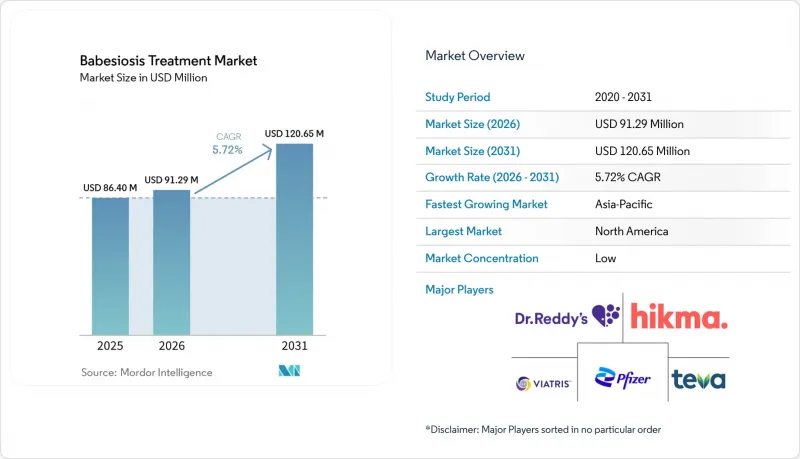
Mordor Intelligence에 의하면, 바베시오증 치료 시장 규모는 2025년 8,640만 달러로 평가되었습니다. 2026년에는 9,129만 달러로 확대되어 2031년까지 1억 2,065만 달러에 이를 것으로 예상되고 2026년부터 2031년에 걸쳐 CAGR 5.72%로 성장할 전망입니다.
본 보고서는 약물 분류별(항원충제, 마크로라이드계 항생제 등), 투여 경로별(경구, 비경구), 환자층별(소아, 성인, 고령자), 유통 채널별(병원 약국, 소매 약국 등), 지역별(북미, 유럽, 아시아태평양 등)로 분류되어 있습니다. 시장 전망은 금액(달러) 기준으로 제시되어 있습니다.
세계의 바베시오증 치료 시장 동향 및 인사이트
진드기에 의한 감염 위험 및 지리적 범위 확대
진드기의 서식 범위와 활동 기간이 확대됨에 따라 바베시오증 치료 시장의 환자 기반이 확대되고 있습니다. 1993년부터 2024년까지 1,130명의 환자를 추적 조사한 2025년 연구에 따르면, 연간 환자 수가 14.2% 증가한 것으로 보고되었으며, 뉴잉글랜드 지역의 평균 감염 시즌은 2000년 이전의 2.2개월에서 2023년에는 11개월로 길어진 것으로 밝혀졌습니다. 이러한 감염 위험 기간의 장기화에 따라 유행 지역에서는 연중 내내 진단 체계 구축과 의약품 확보가 점점 더 중요해지고 있습니다. CDC의 감시 데이터에 따르면, 2011년 감시가 시작된 이래 미국 내 유행 주 수는 7개 주에서 13개 주로 두 배로 증가했습니다. 중부 대서양 연안 지역에서는 현지에서 감염된 사례와 감염된 익소데스 스카풀라리스(Ixodes scapularis) 진드기가 확인되어, 위험이 기존의 북동부 중심 지역을 넘어 확대되고 있음이 밝혀졌습니다. 따라서 바베시오증 치료 시장은 단기적인 계절적 조달 주기에 대한 의존도가 낮아지고, 지속적인 임상 및 약국 대비 태세에 대한 의존도가 높아지고 있습니다.
분자 검사를 통한 사례 발견 건수 증가
분자 검사를 통해 중증 병세가 진행되기 전에 감염을 확인하고 치료할 수 있는 사례가 증가하고 있습니다. 2024년 직접 PCR에 관한 연구에서는 실험실 PCR과의 일치율이 98%인 것으로 보고되었으며, 추출 과정을 거치지 않은 전혈에서 60분 이내에 결과를 얻을 수 있었습니다. 이러한 워크플로우를 통해 응급실은 외부 검사 기관의 인프라에 의존하지 않고도 아나플라즈마 및 에를리키아와 함께 바베시아를 평가할 수 있게 됩니다. 2026년의 형광 RPA 연구에서는 1마이크로리터당 0.046마리의 기생충으로 B. microti를 검출하는 데 성공했으며, 발열 환자 코호트에서 21건의 양성 사례를 확인했습니다. B. divergens는 비장을 적출한 환자에게 중증 질환을 유발할 가능성이 있으며, 집중적인 정맥 내 치료가 필요한 경우도 있으므로 보다 정확한 종 동정도 중요합니다. 진단이 불확실한 임상적 의심 단계에서 실험실 확인 결과를 바탕으로 한 적시 처방 경로로 전환됨에 따라 바베시오증 치료 시장은 혜택을 볼 것입니다.
FDA 승인을 받은 인간 바베시오증 치료제가 존재하지 않는다는 점
인간 바베시오증에 특화된 FDA 승인 적응증을 가진 의약품은 존재하지 않으므로, 현재의 처방 실태는 임상 지침이나 적응증 외 사용에 의존하고 있습니다. IDSA는 대부분의 증상이 있는 환자에 대해 아토바퀸과 아지스로마이신의 병용을 권장 요법으로 제시하고 있으며, 클린다마이신과 키니네의 병용을 대체 요법으로 제시하고 있습니다. 이러한 견해로 인해 제품의 직접적인 판촉 활동, 보험 급여의 확실성, 그리고 차별화된 치료법 개발에 대한 인센티브가 제한되고 있습니다. 타페녹신은 확대 접근 임상시험을 통해 평가가 진행되고 있으며, 60 Degrees Pharmaceuticals사는 2025년 10월, 임상시험을 완료한 첫 번째 환자에서 바베시아가 검출되지 않았다고 보고했습니다. FDA의 완전한 승인을 신청하기 위해서는 추가적인 결정적인 증거가 필요합니다. 그 결과, 바베시오증 치료 시장은 브랜드 치료제의 출시가 아닌 제네릭 의약품의 처방 관행에 의해 계속해서 형성되고 있습니다.
부문 분석
2025년, 바베시오증 치료 부문 시장 점유율의 41.76%를 항기생충제가 차지했으며, 이는 권장 치료 요법에서 아토바콴이 차지하는 역할에 힘입은 것입니다. IDSA는 증상이 있는 환자에 대한 주요 치료 옵션으로 아토바퀸과 아지스로마이신의 병용을 제시하고 있으며, 이로 인해 아토바퀸은 일상적인 외래 진료와 많은 구제 요법 모두에서 중심적인 역할을 하고 있습니다. 마크로라이드계 항균제, 주로 아지스로마이신은 이 권장 병용 요법에서 표준 병용 약물이므로 그 다음으로 중요한 위치를 차지하고 있습니다. 링코사미드계 및 퀴놀린 유도체는 주요 치료 요법을 사용할 수 없는 환자나 대체 요법이 필요한 환자에게 계속해서 사용되고 있습니다. 클린다마이신은 경구제 및 주사제 형태가 있으므로 외래 및 입원 환경 모두에서 사용할 수 있다는 추가적인 이점이 있습니다. 기타 범주에는 비 B. microti 감염증, 특히 유럽의 일부 B. divergens 사례에 사용되는 정맥 내 퀴닌 및 독시사이클린 기반 치료법이 포함됩니다. 이러한 치료법의 조합으로 인해 환자나 종에 따라 임상적 중증도가 다르더라도 바베시오증 치료 시장은 확립된 제네릭 의약품에 계속 의존하고 있습니다.
복합 제제는 2031년까지 연평균 성장률(CAGR) 6.89%를 나타낼 것으로 예측되며, 이는 약물 분류별 가장 높은 성장률입니다. 이 성장률은 재발성, 난치성 또는 중증 감염증에 대해 다제 병용 요법이 더 빈번하게 사용되고 있음을 반영합니다. 2025년 매사추세츠주 다기관 공동 코호트 연구에 따르면, 입원 환자의 8%가 아토바콴, 아지스로마이신, 클린다마이신 3제 병용 요법을 받고 있었습니다. 또한, 면역결핍 환자에게는 아토바콴·프로구아니르가 구제 요법으로 사용되고 있습니다. 타페노킨을 주성분으로 하는 치료법은 현재 임상시험 중이며, 2025년 10월에 보고된 최초의 확대 접근 환자 승인은 초기 임상적 징후를 보여주고 있습니다. 병용 요법은 1회 치료당 의약품 소비량을 증가시킬 가능성이 있지만, 공식적인 적응증이 없기 때문에 이러한 치료법은 의사의 판단에 맡겨져 있습니다. 따라서 지속적인 재발성 질환은 새로운 치료법에 대한 수요를 창출하고 있지만, 개발 인센티브가 제한적이어서 이 질환에 특화된 선택지의 수는 제한적입니다.
2026년에는 경구 투여가 투여 경로 점유율의 76.16%를 차지했습니다. 이는 면역 기능이 정상인 많은 외래 환자가 7-10일 동안 아토바콘 현탁액과 아지스로마이신의 경구 병용 요법을 받고 있기 때문입니다. CDC의 임상 진료 지침에서는 대부분의 증상이 있는 사례에서 아토바콘과 아지스로마이신의 병용 요법이 권장되는 치료 옵션으로 제시되고 있습니다. 경구 투여의 편의성은 루핀, 시플라, 아우로빈드, 테바, 비아트리스, 글렌마크 등 여러 제약사의 제네릭 의약품 공급으로 더욱 강화되었습니다. 이러한 공급 기반을 통해 경쟁이 촉진되어, 검사 진단을 받은 후 널리 치료를 받을 수 있게 되었습니다. 또한 환자는 퇴원 후에도 치료를 지속할 수 있게 됩니다. 많은 경증에서 중등도 사례는 장기 입원 없이 관리할 수 있으므로 경구 투여는 여전히 중요합니다. 바베시오증 치료 시장에서 경구 투여가 차지하는 위치는 새로운 약물 군으로의 전환이라기보다는 실용적인 외래 치료를 반영한 것입니다.
비경구 투여는 중증 사례나 면역결핍 환자의 임상적 필요를 배경으로 2031년까지 연평균 성장률(CAGR) 6.91%로 확대될 것으로 예측됩니다. 정맥 내 투여용 아지스로마이신은 환자의 상태가 안정되어 경구 요법으로 전환할 수 있을 때까지의 초기 입원 치료 기간 동안 사용될 수 있습니다. 프레제니우스 카비 USA는 정맥 내 투여용 아지스로마이신 제제를 공급하고 있는 반면, 히쿠마 파마슈티컬스 USA는 2024년 6월에 판매를 시작한 5% 포도당 주사액에 함유된 클린다마이신을 판매하고 있습니다. 뉴잉글랜드 지역에서는 감염 시즌이 장기화되고 있어, 단순히 계절적인 재고 확보 차원을 넘어 상시 비축되는 주사제 수요가 증가하고 있습니다. 즉시 사용 가능한 정맥 주사용 백은 병원 약제부의 자동화 프로그램에도 적합하며, 조제 속도를 높이는 데 기여할 수 있습니다. 따라서 주사제의 생산 능력은 중증도에 따른 의료 서비스를 제공하는 공급업체에게 실질적인 경쟁 우위가 됩니다. 바베시오증 치료 시장 내 이 분야는 경구 치료에 비해 규모는 작지만, 치료 기간이 가장 길고 가장 많은 의료 자원을 필요로 하는 환자들과 밀접하게 연관되어 있습니다.
지역별 분석
2025년, 북미는 바베시오증 치료 부문 점유율의 53.17%를 차지했습니다. 이는 잘 구축된 감시 체계, 혈액 안전 요건, 그리고 치료 접근성이 뒷받침된 결과입니다. 미국에서는 2023년에 3,586건의 사례가 보고되었으며, 발생률은 인구 10만 명당 1.06이었습니다. 뉴욕주에서는 1,169건, 매사추세츠주에서는 841건이 보고되었으며, 이 두 주를 합치면 미국 전체 연간 총 건수의 절반 이상을 차지합니다. 메릴랜드주, 버지니아주, 웨스트버지니아주에서도 현지 감염이 확인되었으며, 버지니아주의 일부 지역에서는 감염된 진드기가 확인되었습니다. 캐나다에서는 바베시오증에 대한 헌혈자 NAT 검사 의무화가 도입되지 않았습니다. 그러나 생태계의 변화로 인해 온타리오주와 퀘벡주를 지나는 국경 부근에 감염 경로가 형성되고 있습니다. 멕시코에서의 감염은 여전히 소수에 그치고 있으며, 산발적인 사례는 대체로 국경을 넘는 이동과 관련이 있습니다.
유럽에서는 북미에 비해 감염자 수가 적지만, 그 임상 경과로 인해 병원에서 집중적인 관리가 필요합니다. 유럽에서는 Ixodes ricinus에 의해 매개되는 B. divergens가 중요한 존재이며, 중증 사례는 비장을 적출한 환자에게 집중되어 있습니다. 이 그룹에서 치료받지 않은 감염증의 치사율은 최대 40%에 달할 수 있어, 신속한 진단과 집중 치료의 필요성을 높이고 있습니다. 유럽에서 기록된 사례의 대부분은 프랑스, 독일, 영국에서 보고되었습니다. 프랑스의 2026년 다기관 공동 등록부는 프랑스 본토에서 인간 바베시오증의 역학적, 임상적, 치료적 특징을 기록하는 것을 목적으로 합니다. 북유럽에서는 1979년부터 2020년 사이에 Ixodes ricinus의 분포 영역이 북부 생물지리구를 가로질러 약 400km 이동했습니다. 중동 및 아프리카, 남미는 감시 및 검사 체계가 미비하여 확인된 사례 수가 제한적이며, 여전히 초기 단계에 머물러 있습니다.
아시아태평양은 2031년까지 연평균 성장률(CAGR) 6.68%를 나타낼 것으로 예측되며, 바베시오증 치료 시장에서 가장 두드러진 성장을 보일 것으로 전망됩니다. 중국이 주요 기여국이며, 2025년까지 17개 성에서 300건 이상의 증상을 보인 인간 사례가 기록되었습니다. 남부 지역에서는 B. microti가, 북동부에서는 B. venatorum이 보고되었습니다. 2024년 파일럿 연구에서는 3개 성급 행정 구역에 걸쳐 9만 2,700명의 헌혈자를 선별 검사한 결과, 중국 헌혈자 중 최초로 바베시아 관련 동반 감염이 확인되었습니다. 일본, 한국, 인도, 호주에서도 학술적 조사 대상이 되고 있는 산발적인 인간 사례가 보고되고 있습니다. 중국 규제 당국은 공식적인 치료 지침을 마련하지 않았기 때문에 처방 및 조제 방식에는 여전히 편차가 있습니다. 이로 인해 단기적인 시장 규모는 제한적이지만, 감시 체계와 표준화된 임상 프로토콜이 정비되면 조기에 진출한 공급업체에게는 비즈니스 기회가 생길 것입니다.
기타 혜택 :
- 엑셀 형식 시장 예측(ME) 시트
- 3개월간의 애널리스트 지원
자주 묻는 질문
목차
제1장 서론
제2장 조사 방법
제3장 주요 요약
제4장 시장 구도
제5장 시장 규모 및 성장 예측
제6장 경쟁 구도
제7장 시장 기회 및 향후 전망
KTH 26.09.10According to Mordor Intelligence, the babesiosis treatment market size is expected to increase from USD 86.40 million in 2025 to USD 91.29 million in 2026 and reach USD 120.65 million by 2031, growing at a CAGR of 5.72% over 2026-2031.
This report is Segmented by Drug Class (Antiprotozoal Agents, Macrolide Antibiotics, and More), by Route of Administration (Oral, Parenteral), by Patient Population (Pediatric, Adults, Geriatric), by Distribution Channel (Hospital Pharmacies, Retail Pharmacies, and More), Geography (North America, Europe, Asia-Pacific, and More). The Market Forecasts are Provided in Terms of Value (USD).
Global Babesiosis Treatment Market Trends and Insights
Expanding Tick-Borne Exposure and Geographic Range
The Babesiosis Treatment Market is gaining a broader patient base as the range and active season of ticks expand. A 2025 study that followed 1,130 patients between 1993 and 2024 reported annual case growth of 14.2% and found that the mean transmission season in New England lengthened from 2.2 months before 2000 to 11 months in 2023. This longer exposure window increases the need for year-round diagnostic readiness and medicine availability in endemic states. CDC surveillance also shows that endemic U.S. states doubled from 7 to 13 after surveillance began in 2011. In the mid-Atlantic, locally acquired infections and infected Ixodes scapularis ticks confirm that the risk is extending beyond established northeastern centers. The Babesiosis Treatment Market, therefore, depends less on a short seasonal procurement cycle and more on standing clinical and pharmacy preparedness.
Rising Case Detection Through Molecular Testing
Molecular testing is increasing the number of infections that can be confirmed and treated before serious illness develops. A 2024 direct PCR study reported 98% concordance with laboratory PCR and produced results from unextracted whole blood in less than 60 minutes. This type of workflow can help emergency departments assess Babesia alongside Anaplasma and Ehrlichia without depending on reference laboratory infrastructure. A 2026 fluorescent RPA study detected B. microti at 0.046 parasites per microliter and confirmed 21 positive cases in a febrile patient cohort. Better species identification also matters because B. divergens can produce severe disease in asplenic patients and may require intensive intravenous treatment. The Babesiosis Treatment Market benefits when diagnosis moves from uncertain clinical suspicion to a timely laboratory-confirmed prescription pathway.
Absence of an FDA-Approved Human Babesiosis Treatment
No medicine has an FDA-approved label specifically for human babesiosis, so current prescribing depends on clinical guidance and off-label use. IDSA recommends atovaquone plus azithromycin as the preferred regimen for most symptomatic patients, with clindamycin plus quinine as an alternative. This position limits direct product promotion, reimbursement certainty, and incentives to develop differentiated therapies. Tafenoquine is being evaluated through an expanded-access study, and 60 Degrees Pharmaceuticals reported in October 2025 that the first completed patient had no detectable Babesia. Further pivotal evidence would still be needed before a full FDA approval could be sought. The Babesiosis Treatment Market consequently remains shaped by generic prescribing practices rather than by a branded treatment launch.
Other drivers and restraints analyzed in the detailed report include:
- Mandatory Blood Donor Screening in U.S. Endemic States
- Growing Immunocompromised and Older Patient Pool
- Low Disease Awareness and Frequent Misdiagnosis
For complete list of drivers and restraints, kindly check the Table Of Contents.
Segment Analysis
Antiprotozoal agents accounted for 41.76% of the Babesiosis treatment segment share in 2025, supported by atovaquone's role in the preferred treatment regimen. IDSA identifies atovaquone plus azithromycin as the main option for symptomatic patients, which makes atovaquone central to both routine outpatient care and many salvage approaches. Macrolides, primarily azithromycin, hold the next major position because they are the standard companion medicine in this preferred combination. Lincosamides and quinoline derivatives continue to serve patients who cannot use the primary regimen or need an alternative approach. Clindamycin has an additional advantage because oral and injectable forms allow it to be used across outpatient and hospital settings. The other category includes intravenous quinine and doxycycline-based approaches used for non-B. microti infections, particularly some European B. divergens cases. This treatment mix keeps the Babesiosis Treatment Market tied to established generic molecules, even when clinical severity differs by patient or species.
Combination products are forecast to grow at a 6.89% CAGR through 2031, the highest rate among drug classes. The pace reflects more frequent use of multi-drug protocols for relapsing, refractory, or severe infection. In the 2025 Massachusetts multicenter cohort, 8% of hospitalized patients received triple therapy with atovaquone, azithromycin, and clindamycin. Atovaquone-proguanil has also been used as a salvage combination in immunocompromised patients. Tafenoquine-based treatment is under clinical investigation, and the first expanded-access patient clearance reported in October 2025 provides an early clinical signal. Combination use can increase medicine consumption per episode, but the lack of a formal label keeps these regimens dependent on physician judgment. Persistent relapsing disease therefore creates demand for new regimens, while limited development incentives constrain the number of purpose-built options.
Oral delivery held 76.16% of the route-of-administration share in 2026 because many immunocompetent outpatients receive an oral atovaquone suspension and azithromycin regimen for 7 to 10 days. CDC clinical care guidance lists atovaquone plus azithromycin as the preferred option for most symptomatic cases. Oral access is reinforced by multi-manufacturer generic supply from Lupin, Cipla, Aurobindo, Teva, Viatris, and Glenmark. This supplier base supports price competition and broad access after a laboratory diagnosis. It also allows patients to continue therapy after discharge from the hospital. The oral route remains important because many mild-to-moderate cases can be managed without an extended inpatient stay. Its position in the Babesiosis Treatment Market reflects practical outpatient treatment rather than a shift toward a new drug class.
Parenteral delivery is forecast to expand at a 6.91% CAGR through 2031, driven by severe disease and the clinical needs of immunocompromised patients. Intravenous azithromycin may be used during initial hospital treatment until a patient is stable enough to transition to oral therapy. Fresenius Kabi USA supplies an intravenous azithromycin formulation, while Hikma Pharmaceuticals USA markets clindamycin in 5% dextrose injection, which started marketing in June 2024. The longer transmission season in New England has increased the need for standing injectable inventories rather than purely seasonal stocking. Ready-to-use intravenous bags also fit hospital pharmacy automation programs and can support faster preparation. Injectable manufacturing capacity is, therefore, a practical competitive advantage for suppliers serving severity-driven care. This part of the Babesiosis Treatment Market is smaller than oral care, but it is linked to patients with the longest and most resource-intensive treatment courses.
Complete Report Scope:
- By Drug Class
- Antiprotozoal Agents
- Macrolide Antibiotics
- Lincosamide Antibiotics
- Quinoline Derivatives
- Combination Products
- Others
- By Route of Administration
- Oral
- Parenteral
- By Patient Population
- Pediatric
- Adults
- Geriatric
- By Distribution Channel
- Hospital Pharmacies
- Retail Pharmacies
- Online Pharmacies
- Specialty Pharmacies
- By Geography
- North America
- United States
- Canada
- Mexico
- Europe
- Germany
- United Kingdom
- France
- Italy
- Spain
- Rest of Europe
- Asia-Pacific
- China
- Japan
- India
- Australia
- South Korea
- Rest of Asia-Pacific
- Middle East and Africa
- GCC
- South Africa
- Rest of Middle East and Africa
- South America
- Brazil
- Argentina
- Rest of South America
- North America
Geography Analysis
North America accounted for 53.17% of the Babesiosis treatment segment share in 2025, supported by developed surveillance, blood safety requirements, and treatment access. The United States reported 3,586 cases in 2023, with an incidence of 1.06 per 100,000 people. New York reported 1,169 cases, and Massachusetts reported 841, together representing more than half of the national annual total. Locally acquired infection is also documented in Maryland, Virginia, and West Virginia, where infected ticks have been identified at some Virginia sites. Canada has not established mandatory donor NAT requirements for Babesia. However, ecological change is creating a near-border exposure corridor through Ontario and Quebec. Mexico remains a small contributor, with sporadic cases generally linked to cross-border travel.
Europe has a smaller population than North America, but its clinical pattern creates a need for intensive hospital management. B. divergens transmitted by Ixodes ricinus is important in Europe, and severe infection is concentrated among asplenic patients. Untreated infection in this group can have a case-fatality rate of up to 40%, which raises the need for rapid diagnosis and intensive treatment. France, Germany, and the United Kingdom account for many recorded European cases. France's 2026 multicenter registry aims to document the epidemiological, clinical, and therapeutic features of human babesiosis in metropolitan France. In northern Europe, Ixodes ricinus shifted its range by nearly 400 km across the Boreal biogeographical region between 1979 and 2020. The Middle East, Africa, and South America remain early-stage areas because surveillance and laboratory infrastructure limit recognized case volumes.
Asia-Pacific is forecast to grow at a 6.68% CAGR through 2031, making it the fastest-growing regional part of the Babesiosis Treatment Market. China is the primary contributor, with more than 300 symptomatic human cases documented through 2025 across 17 provinces. B. microti has been reported in southern regions, while B. venatorum has been reported in the northeast. A 2024 pilot study screened 92,700 donors across 3 provincial-level administrative divisions and identified the first Babesia-related co-infection in Chinese blood donors. Japan, South Korea, India, and Australia have also reported isolated human cases under academic investigation. China's regulatory system has not issued formal treatment guidelines, so prescribing and procurement remain fragmented. This limits near-term scale but gives early suppliers an opening if surveillance and standardized clinical pathways develop.
- Alkem Laboratories
- Amneal Pharmaceuticals
- Apotex
- Aurobindo Pharma
- Bionpharma, Inc.
- Cipla
- Dr. Reddy's Laboratories
- Endo International
- Fresenius
- Glenmark Pharmaceuticals
- GlaxoSmithKline
- Hetero Drugs Limited
- Hikma Pharmaceuticals
- Lupin
- Pfizer
- Sandoz Group AG
- Sun Pharmaceuticals Industries
- Teva Pharmaceutical Industries
- Viatris
- Zydus Lifesciences
Additional Benefits:
- The market estimate (ME) sheet in Excel format
- 3 months of analyst support
TABLE OF CONTENTS
1 INTRODUCTION
- 1.1 Study Assumptions and Market Definition
- 1.2 Scope of the Study
2 RESEARCH METHODOLOGY
3 EXECUTIVE SUMMARY
4 MARKET LANDSCAPE
- 4.1 Market Overview
- 4.2 Market Drivers
- 4.2.1 Expanding Tick-Borne Exposure and Geographic Range
- 4.2.2 Rising Case Detection Through Molecular Testing
- 4.2.3 Mandatory Blood Donor Screening in U.S. Endemic States
- 4.2.4 Growing Immunocompromised and Older Patient Pool
- 4.2.5 Persistent Relapsing Disease Creating Demand for New Regimens
- 4.2.6 Cross-Species One Health Surveillance and Veterinary Treatment Demand
- 4.3 Market Restraints
- 4.3.1 Absence of an FDA-Approved Human Babesiosis Treatment
- 4.3.2 Low Disease Awareness and Frequent Misdiagnosis
- 4.3.3 Atovaquone Resistance and Relapse in Immunocompromised Hosts
- 4.3.4 Low Commercial Incentive for Rare-Disease Drug Development
- 4.4 Supply Chain Analysis
- 4.5 Regulatory Landscape
- 4.6 Technological Outlook
- 4.7 Porter's Five Forces Analysis
- 4.7.1 Bargaining Power of Suppliers
- 4.7.2 Bargaining Power of Buyers
- 4.7.3 Threat of New Entrants
- 4.7.4 Threat of Substitutes
- 4.7.5 Competitive Rivalry
5 MARKET SIZE AND GROWTH FORECASTS (VALUE, USD)
- 5.1 By Drug Class
- 5.1.1 Antiprotozoal Agents
- 5.1.2 Macrolide Antibiotics
- 5.1.3 Lincosamide Antibiotics
- 5.1.4 Quinoline Derivatives
- 5.1.5 Combination Products
- 5.1.6 Others
- 5.2 By Route of Administration
- 5.2.1 Oral
- 5.2.2 Parenteral
- 5.3 By Patient Population
- 5.3.1 Pediatric
- 5.3.2 Adults
- 5.3.3 Geriatric
- 5.4 By Distribution Channel
- 5.4.1 Hospital Pharmacies
- 5.4.2 Retail Pharmacies
- 5.4.3 Online Pharmacies
- 5.4.4 Specialty Pharmacies
- 5.5 By Geography
- 5.5.1 North America
- 5.5.1.1 United States
- 5.5.1.2 Canada
- 5.5.1.3 Mexico
- 5.5.2 Europe
- 5.5.2.1 Germany
- 5.5.2.2 United Kingdom
- 5.5.2.3 France
- 5.5.2.4 Italy
- 5.5.2.5 Spain
- 5.5.2.6 Rest of Europe
- 5.5.3 Asia-Pacific
- 5.5.3.1 China
- 5.5.3.2 Japan
- 5.5.3.3 India
- 5.5.3.4 Australia
- 5.5.3.5 South Korea
- 5.5.3.6 Rest of Asia-Pacific
- 5.5.4 Middle East and Africa
- 5.5.4.1 GCC
- 5.5.4.2 South Africa
- 5.5.4.3 Rest of Middle East and Africa
- 5.5.5 South America
- 5.5.5.1 Brazil
- 5.5.5.2 Argentina
- 5.5.5.3 Rest of South America
- 5.5.1 North America
6 COMPETITIVE LANDSCAPE
- 6.1 Market Concentration
- 6.2 Market Share Analysis
- 6.3 Company Profiles (includes Global Level Overview, Market Level Overview, Core Segments, Financials as available, Strategic Information, Market Rank/Share, Products and Services, Recent Developments)
- 6.3.1 Alkem Laboratories
- 6.3.2 Amneal Pharmaceuticals, Inc.
- 6.3.3 Apotex Inc.
- 6.3.4 Aurobindo Pharma Limited
- 6.3.5 Bionpharma, Inc.
- 6.3.6 Cipla Limited
- 6.3.7 Dr. Reddy's Laboratories
- 6.3.8 Endo International
- 6.3.9 Fresenius Kabi AG
- 6.3.10 Glenmark Pharmaceuticals Ltd.
- 6.3.11 GSK plc
- 6.3.12 Hetero Drugs Limited
- 6.3.13 Hikma Pharmaceuticals PLC
- 6.3.14 Lupin Limited
- 6.3.15 Pfizer Inc.
- 6.3.16 Sandoz Group AG
- 6.3.17 Sun Pharmaceutical Industries Limited
- 6.3.18 Teva Pharmaceutical Industries Ltd.
- 6.3.19 Viatris Inc.
- 6.3.20 Zydus Lifesciences
7 MARKET OPPORTUNITIES AND FUTURE OUTLOOK
- 7.1 White-Space and Unmet-Need Assessment

(주말 및 공휴일 제외)


