

|
시장보고서
상품코드
2119379
녹내장 진단 : 시장 점유율 분석, 업계 동향 및 통계, 성장 예측(2026-2031년)Glaucoma Diagnostics - Market Share Analysis, Industry Trends & Statistics, Growth Forecasts (2026 - 2031) |
||||||
 Mordor Intelligence
Mordor Intelligence에 의하면, 녹내장 진단 시장 규모는 2025년 24억 9,000만 달러로 평가되었습니다. 2026년에는 26억 3,000만 달러로 확대되어 2026년부터 2031년에 걸쳐 CAGR 5.62%로 성장을 지속하여, 2031년까지 34억 6,000만 달러에 이를 것으로 예측됩니다.
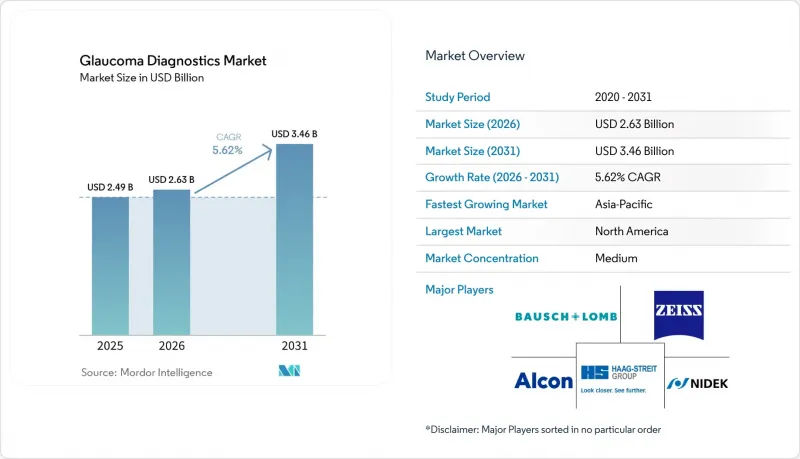
본 보고서는 제품 유형(진단 기기, 영상 진단 장치, 소모품), 기술(안압 측정, 검안경 검사 등), 환자층(성인, 고령자, 소아), 검사 범주(스크리닝 검사 등), 최종 사용자(병원 등), 지역(북미, 유럽 등)별로 분류되어 있습니다. 시장 전망은 금액(달러) 기준으로 제시되어 있습니다.
세계의 녹내장 진단 시장 동향 및 인사이트
녹내장 유병률 증가와 조기 발견
세계 녹내장 환자 수는 1990년 410만 명에서 2021년 760만 명으로 증가했으며, 2021년 연령 조정 장애 조정 생명년(DALY) 비율은 인구 10만 명당 33.1에 달했습니다. 2020년에는 최소 4,300만 건의 원발성 개방각 녹내장이 진단되지 않은 채 남아 있었으며, 아프리카와 아시아에서는 유럽에 비해 진단되지 않은 사례의 부담이 더 큽니다. 이 진단되지 않은 환자층은 환자를 확정 진단으로 이끄는 선별 검사 경로에 대한 지속적인 수요를 창출하고 있습니다. 2020년에는 녹내장으로 인해 360만 명이 양안 실명에 이르렀고, 410만 명이 중등도에서 중증의 시각 장애를 앓았으며, 이는 전 세계 실명의 8.4%를 차지했습니다. 따라서 녹내장 진단 시장에서는 아직 전문의의 진료를 받지 않은 환자를 식별하기 위해 병원에 설치된 첨단 장비와 접근성이 높은 1차 진단 도구가 모두 필수적입니다. 근시가 미래의 질병 부담에 미칠 것으로 예상되는 영향으로 미루어 볼 때, 수요가 고령화가 진행된 국가들에만 국한되지 않을 것임을 시사합니다.
고령화, 영상 진단 및 연계형 모니터링 워크플로우
녹내장의 유병률은 40세에서는 200명 중 1명이지만, 80세에서는 8명 중 1명으로 증가하여 많은 환자가 경과 관찰이나 검사를 받아야 하는 기간이 길어집니다. 중장년에 진단받은 환자는 장기간에 걸쳐 OCT나 시야 검사를 받게 되며, 이로 인해 기존 기기의 반복 사용이 촉진됩니다. 독일의 임상 지침에서는 40세부터 녹내장 위험 평가를 권장하고 있지만, 법정 보험에 의한 급여는 여전히 특정 위험 요인을 가진 환자로 제한되어 있습니다.
OCT 플랫폼은 구조 영상, 혈관 정보 및 소프트웨어를 통한 소견 확인을 한 번의 세션에 통합함으로써 그 역할을 확대되고 있습니다. 임상의가 영상 진단과 시야 검사 결과를 함께 확인할 수 있게 됨으로써, 단편적인 기록에 대한 의존도를 줄이면서 경과에 따른 변화를 평가할 수 있게 되어, 녹내장 진단 시장에 이점을 가져다줍니다. 또한, 자동 위치 조정, 휴대형 영상 진단, 원격 소견 확인을 통해 전문의 수가 제한적인 1차 진료 및 원격 안과 진료 현장에서도 진단 활동이 더욱 실용적으로 이루어질 수 있습니다.
설비 투자 비용과 진단 능력의 불균형
고급 OCT 및 다중 모드 영상 진단 시스템의 가격은 서비스료, 소프트웨어 비용, 교정 비용을 제외하고 3만 달러에서 10만 달러 이상입니다. 이러한 비용은 특히 미진단 질환의 부담이 큰 지역에서 소규모 지역 의료 센터의 도입을 제한하는 요인이 되고 있습니다. 제한된 설비 투자 예산으로 장비 구입비 외에도 유지보수, 라이선스, 교정, 직원 교육 등의 지속적인 비용도 충당해야 합니다. 많은 고성능 시스템은 달러 또는 유로로 가격이 책정되어 있어, 환율 위험이 구매의 경제성을 더욱 제약할 가능성이 있습니다. 휴대용 안압계나 안저 카메라는 접근성을 개선해 주지만, 확실한 병기 분류나 경과 관찰에 필요한 구조적 영상 진단이나 기능 검사를 대체할 수는 없습니다. 따라서 녹내장 진단 시장은 예산, 인력 체계, 서비스 역량이 각기 다른 시설들의 요구에 부응해야 합니다. 내구성이 뛰어난 장비, 투명성이 높은 유지보수 계약, 그리고 규모에 맞춘 교육 프로그램을 제공하는 공급업체는 임상 기준을 유지하면서 도입 시 주요 장벽을 낮출 수 있습니다.
부문별 분석
2025년, 녹내장 진단 시장에서 진단 기기는 56.23%의 점유율을 차지했습니다. 안압계, 슬릿 램프 및 전방각 검사 장치는 전문의 및 1차 진료의 진료 워크플로우에서 여전히 필수적인 일선 도구입니다. 이러한 기기는 수명이 길고 유지보수 요건도 비교적 간단하기 때문에 특히 대량의 정기 검사에 신뢰할 수 있는 기기가 필요하고, 확립된 검사 방법을 더 복잡한 영상 진단 기술로 즉시 대체할 수 없는 의료 기관에서 일관되게 사용할 수 있습니다.
많은 진료소에서는 초기 안압, 각막각, 시신경 유두 평가에 이 기기들을 의존하고 있습니다. 이러한 측정값은 환자가 경과 관찰, 영상 검사 의뢰, 또는 녹내장 전문의의 추가 평가가 필요한지 여부를 판단하는 데 필요한 실용적인 정보를 제공합니다. 설비가 잘 갖춰진 시장에서는 수요가 성숙 단계에 이르렀지만, 임상의가 영상 소견을 해석하기 전 단계로서 이 기기들은 여전히 필수적입니다. 또한, 완전한 다중 모드 진단 플랫폼을 도입할 수 없는 진료소에게도 실용적인 대안이 되고 있습니다.
프로브 커버, 시야 검사 용품, 유지보수 용품 등의 소모품은 규모는 작지만 지속적인 수익원이 될 것으로 기대됩니다. 이러한 지속적인 수요로 인해 녹내장 진단 시장에서 서비스 계약의 중요성이 높아질 것으로 예상되며, 공급업체는 클리닉이 핵심 검사 장비를 장기간 보유하는 동안 정기적인 교정, 교체용 액세서리 제공 및 실질적인 사용자 지원을 통해 장비의 가동률을 유지할 수 있도록 지원할 수 있게 됩니다. 전반적으로 이 제품군은 일상적인 안과 진료의 광범위한 기반을 제공할 것으로 예상되며, 의료 서비스 제공업체는 익숙한 일선 검사 방법을 유지하면서, 임상 경로나 의뢰 패턴에 따라 더 상세한 평가가 필요한 경우에는 영상 진단 기술을 도입할 수 있게 됩니다.
진단용 영상 장치는 2031년까지 연평균 성장률(CAGR) 6.27%를 나타낼 것으로 예측됩니다. 이 범주에는 광간섭 단층 촬영(OCT) 시스템, 스캐닝형 레이저 검안경 및 안저 카메라가 포함됩니다. 이러한 시스템은 구조 측정, 망막 시각화, 그리고 점점 더 중요해지고 있는 혈관 평가를 연계된 워크플로우 내에 통합하고 있습니다. 2025년 9월, 토프콘은 유럽 시장에 ‘Triton2’ 및 ‘IMAGEnet7’을 출시하며 광시야 OCT 혈관조영술, 트루 컬러 이미징, 전안부 분석 및 ‘Smart Denoise’ 기술을 추가했습니다. 이러한 시스템을 통해 의료진은 여러 임상 업무를 소수의 장비로 통합할 수 있게 되었습니다. 또한, 재검사 시 보다 상세한 경과 관찰도 지원합니다. 임상의는 현재 이미지와 과거의 구조적 소견을 비교하고, 동일한 플랫폼을 사용하여 의심되는 변화가 추가 평가가 필요한지 여부를 기록할 수 있기 때문입니다. 2026년, 녹내장 진단 업계는 초기 평가와 지속적인 모니터링을 모두 지원하는 플랫폼으로 전환되고 있습니다. 그러나 영상 진단 장비 공급업체는 저비용의 단독 기기와 비교하여 신뢰할 수 있는 임상적 가치를 입증해야 합니다. 이러한 강점은 의료 제공업체가 각 진료에서 보다 종합적인 정보를 필요로 하는 상황에서 가장 잘 발휘됩니다. 단일 영상 진단 플랫폼을 통해 임상 의사는 기준선 평가, 질환 의심 확인, 경과 관찰 시 구조적 소견 비교, 그리고 지속적인 모니터링의 필요성을 환자에게 설명할 때 보다 명확한 설명을 할 수 있게 됩니다.
2025년 시점에서 광간섭 단층촬영(OCT)은 녹내장 진단 시장의 38.73%를 차지했습니다. OCT는 망막 신경섬유층 및 신경절세포 복합체를 측정하여 구조적 평가를 지원하며, OCT 혈관조영술은 동일한 영상 진단 워크플로우 내에서 혈관 정보를 추가합니다. 확립된 기준 데이터베이스는 일상적인 임상 판단에서 OCT의 역할을 강화하고 있으며, 연속적인 스캔을 통해 임상의는 시간 경과에 따른 미세한 구조적 변화를 쉽게 식별할 수 있습니다. 그 결과, OCT는 진단과 장기 경과 관찰 모두에서 중요한 역할을 수행하고 있으며, 특히 초기 위험 평가나 질병의 확정 진단부터 치료 재검토, 나아가 진행 가능성 평가에 이르기까지 환자를 지속적으로 모니터링하는 진료 현장에서 그 중요성이 두드러집니다. OCT 기술은 치료의 여러 단계를 지원하기 때문에 녹내장 진단 시장에서 OCT는 견고한 기반을 유지하고 있습니다. 그러나 유용한 결과를 얻기 위해서는 영상 품질, 촬영의 일관성, 그리고 임상의의 해석이 여전히 매우 중요합니다. 공급업체는 데이터 검토를 환자 기록과 통합함으로써 바쁜 진료 현장에서의 사용 편의성을 향상시킬 수 있습니다. 또한, 내원할 때마다 일관된 측정 프로토콜에 따라 직원을 안내하는 시스템은 비교 가능한 후속 스캔을 가능하게 하여 그 실용적 가치를 높입니다.
시야 검사 시장은 2031년까지 연평균 성장률(CAGR) 6.85%로 확대될 것으로 예측됩니다. 구조적 측정만으로는 환자의 시각 장애를 완전히 파악할 수 없기 때문에 기능적 검사는 여전히 필수적입니다. 독일 지침에서는 40세 이상 성인을 대상으로 한 녹내장 위험 평가의 핵심 요소로 안압 측정과 시신경 유두 평가를 꼽고 있습니다. 칼 자이스 메디텍은 2026년 6월, 엔비전 헬스 테크놀로지스(Envision Health Technologies)와의 제휴를 발표하고, 게임 요소를 도입한 VR 기반 시야 검사의 개발에 착수했습니다. 이 제휴는 다양한 의료 현장에서의 검사 접근성을 높이고 환자의 순응도를 향상시키는 것을 목표로 합니다. VR 기반 접근 방식은 더 많은 장소에서 검사가 가능하게 하고, 환자가 이동이나 일정 조정에 번거로움을 느끼지 않고 반복적으로 검사를 받을 수 있도록 함으로써, 기존 진료소에서의 시야 검사에 수반되는 실용적인 문제를 완화할 가능성이 있습니다. 안압 측정은 여전히 안압 초기 선별 검사의 표준적인 방법이며, 한편 전방각경 검사 및 안저경 검사는 전문적인 역할을 계속 수행하고 있습니다. 이러한 기술을 결합함으로써 녹내장 진단 시장에서 접근성이 높은 선별 검사와 상세한 진단 확인 간의 균형이 유지되고 있습니다. 안압 측정, 구조적 영상 진단, 기능 검사는 각각 녹내장 평가에서 서로 다른 임상적 과제를 다루기 때문에 이러한 균형은 여전히 중요합니다.
지역별 분석
북미는 2025년, OCT의 보험 적용, 적극적인 선별 검사 프로그램, 그리고 학술적인 안과 센터의 밀집된 네트워크에 힘입어 녹내장 진단 시장에서 38.62%의 점유율을 차지했습니다. 미시간주의 SIGHT 프로그램은 원격 의료와 케어 내비게이션이 의료 서비스가 미치지 않는 지역의 후속 관리를 개선할 수 있음을 입증했으며, MI-SIGHT 2는 2025년 12월에 피험자 등록을 시작했습니다. 연방 공인 의료 센터(FQHC)에서 진행 중인 도입 연구에서는 AI를 활용한 선별 검사에서 OCT 단독 검사 프로토콜과 복합 영상 검사 프로토콜을 비교하고 있습니다. 이러한 노력은 1차 진료, 원격 진단, 전문의의 확인을 통합한 플랫폼을 뒷받침하고 있습니다. 캐나다의 주립 의료 제도에서는 OCT 자금 조달 모델이 검토되고 있는 반면, 멕시코의 민관 혼합 의료 제도에서는 초급 수준의 안압 측정 및 안저 사진 촬영에 대한 수요가 계속해서 증가하고 있습니다.
아시아태평양은 2031년까지 연평균 성장률(CAGR) 10.44%를 나타낼 것으로 예측되며, 녹내장 진단 시장에서 가장 높은 지역별 성장률을 보이고 있습니다. 동아시아에서는 2024년부터 2060년에 걸쳐 개방각녹내장의 유병률이 50.5% 증가할 것으로 전망됩니다. 중국에서는 주요 공립 병원이 다중 모드 영상 진단을 도입하여 안과 부문의 현대화를 추진하고 있으며, 인도에서는 원격의료를 활용한 선별 검사 네트워크가 확대되고 있습니다. 또한 일본에서는 고령화가 진행됨에 따라 임상 장비에 대한 투자가 지속적으로 뒷받침되고 있습니다. 한국과 호주는 AI를 통합한 워크플로우를 가장 먼저 도입하고 있습니다. 이 지역은 대규모 도입뿐만 아니라 전문 병원 이외의 시설에서도 운영되는 서비스 모델이라는 점에서도 중요합니다.
유럽은 2025년, 확립된 안과 네트워크, 보험 급여에 따른 영상 진단, 그리고 지역 제조업체의 지원을 바탕으로 큰 시장 점유율을 차지했습니다. 독일의 지침에서는 40세부터의 위험 평가를 권장하고 있지만, 법정 보험의 적용 대상은 여전히 특정 위험 요인을 가진 개인으로 한정되어 있습니다. EU의 의료기기 요건은 문서화된 프로세스와 확립된 임상적 근거를 갖춘 공급업체를 우대할 가능성이 있습니다. 중동 및 아프리카, 남미에서는 미충족 수요가 높지만, 자본 및 인력의 제약으로 인해 도입이 제한되고 있습니다. 사하라 이남 아프리카에서는 2040년까지 미진단된 원발성 개방각 녹내장이 86.3% 증가할 것으로 예측됩니다.
기타 혜택 :
- 엑셀 형식 시장 예측(ME) 시트
- 3개월간의 애널리스트 지원
자주 묻는 질문
목차
제1장 서론
제2장 조사 방법
제3장 개요
제4장 시장 구도
제5장 시장 규모 및 성장 예측
제6장 경쟁 구도
제7장 시장 기회 및 향후 전망
KTH 26.09.02According to Mordor Intelligence, the glaucoma diagnostics market size is expected to grow from USD 2.49 billion in 2025 to USD 2.63 billion in 2026 and is forecast to reach USD 3.46 billion by 2031 at 5.62% CAGR over 2026-2031.
This report is Segmented Into Product Type (Diagnostic Instruments, Diagnostic Imaging Devices, and Consumables), Technology (Tonometry, Ophthalmoscopy, and More), Patient Demographics (Adults, Geriatric, and Pediatric), Test Category (Screening Tests, and More), End User (Hospitals, and More), and Geography (North America, Europe, and More). The Market Forecasts are Provided in Terms of Value (USD).
Global Glaucoma Diagnostics Market Trends and Insights
Rising Glaucoma Prevalence and Earlier Case Finding
Global glaucoma cases increased from 4.1 million in 1990 to 7.6 million in 2021, while the age-standardized disability-adjusted life-year rate reached 33.1 per 100,000 population in 2021. In 2020, at least 43 million cases of primary open-angle glaucoma remained undetected, with Africa and Asia bearing a greater burden of missed cases than Europe. This undiagnosed population creates sustained demand for screening pathways that guide patients toward a confirmed diagnosis. Glaucoma caused bilateral blindness in 3.6 million people and moderate-to-severe visual impairment in 4.1 million people in 2020, accounting for 8.4% of global blindness. Therefore, the glaucoma diagnostics market relies on both advanced hospital-based equipment and accessible first-line tools to identify individuals who have not yet entered specialist care. The expected contribution of myopia to the future disease burden also indicates that demand is not limited to countries with the oldest populations.
Aging, Imaging, and Connected Monitoring Workflows
Glaucoma prevalence increases from 1 in 200 people at age 40 to 1 in 8 people at age 80, extending the period during which many patients require observation and testing. Individuals diagnosed in later middle age can undergo OCT and visual field testing for many years, supporting the recurring use of existing equipment. Germany's clinical guideline recommends glaucoma risk assessments from age 40, although statutory insurance coverage remains limited to individuals with specific risk factors.
OCT platforms are expanding their role by integrating structural imaging, vascular information, and software-based review into a single session. The glaucoma diagnostics market benefits when clinicians can review imaging and visual field results together, enabling them to assess changes over time while reducing reliance on disconnected records. Automated alignment, portable imaging, and remote review also make diagnostic activities more practical in primary care and tele-ophthalmology settings, where specialist capacity remains limited.
Capital Costs and Uneven Diagnostic Capacity
Premium OCT and multimodal imaging systems cost between USD 30,000 and more than USD 100,000, excluding service, software, and calibration expenses. These costs limit procurement by smaller community centers, particularly in areas with a high burden of undiagnosed disease. Limited capital budgets must cover both the equipment purchase and ongoing expenses for servicing, licensing, calibration, and staff training. Foreign currency exposure can further constrain affordability, as many high-specification systems are priced in USD or EUR. Portable tonometers and fundus cameras improve access; however, they cannot replace the structural imaging and functional testing required for confident staging and follow-up. Therefore, the glaucoma diagnostics market must address the needs of facilities with varying budgets, staffing levels, and service capabilities. Suppliers that provide durable equipment, transparent maintenance arrangements, and scalable training programs can reduce a key adoption barrier while maintaining clinical standards.
Other drivers and restraints analyzed in the detailed report include:
- Community Programs and Primary-Care Access
- AI-Enabled Interpretation and Screening Quality
- Workforce Limits, Variable Testing, and AI Governance
For complete list of drivers and restraints, kindly check the Table Of Contents.
Segment Analysis
Diagnostic instruments accounted for 56.23% of the glaucoma diagnostics market share in 2025. Tonometers, slit lamps, and gonioscopy equipment remain essential first-line tools in specialist and primary care workflows. Their long service life and relatively straightforward maintenance requirements support consistent use, particularly among providers that require reliable equipment for high volumes of routine examinations and cannot immediately replace established examination methods with more complex imaging technologies.
Many practices rely on these instruments for initial intraocular pressure, angle, and optic disc assessments. These measurements provide the practical information needed to determine whether a patient requires observation, imaging referral, or further evaluation by a glaucoma specialist. Although demand is mature in well-equipped markets, these instruments remain necessary before clinicians interpret imaging findings. They also provide a practical option for clinics that cannot support a full multimodal diagnostic platform.
Consumables, including probe covers, visual field materials, and maintenance items, are expected to generate smaller but recurring revenue streams. This recurring demand is expected to increase the relevance of service contracts in the glaucoma diagnostics market, enabling suppliers to support equipment uptime through scheduled calibration, replacement accessories, and practical user assistance throughout the extended period during which clinics retain their core examination tools. Overall, this product group is expected to provide a broad foundation for routine ophthalmic care, allowing providers to maintain familiar first-line examination methods while adopting imaging technologies when clinical pathways or referral patterns require more detailed assessments.
Diagnostic imaging devices are projected to grow at a CAGR of 6.27% through 2031. This category includes optical coherence tomography (OCT) systems, scanning laser ophthalmoscopes, and fundus cameras. These systems integrate structural measurements, retinal visualization, and increasingly, vascular assessment within a connected workflow. In September 2025, Topcon introduced Triton2 and IMAGEnet7 to the European market, adding wide-field OCT angiography, true-color imaging, anterior-segment analysis, and Smart Denoise technology. These systems enable providers to consolidate multiple clinical tasks into fewer instruments. They also support more detailed follow-up during repeat testing, as clinicians can compare current images with earlier structural findings and use the same platform to document whether suspected changes warrant further assessment. As of 2026, the glaucoma diagnostics industry is shifting toward platforms that support both initial evaluation and ongoing monitoring. However, imaging suppliers must demonstrate reliable clinical value compared with lower-cost standalone instruments. Their advantage is strongest in settings where providers require more comprehensive information from each visit. A single imaging platform can support baseline assessments, confirmation of suspected disease, comparison of structural findings during follow-up appointments, and clearer patient discussions when clinicians need to explain the need for continued monitoring.
Optical coherence tomography (OCT) accounted for 38.73% of the glaucoma diagnostics market in 2025. OCT supports structural assessment by measuring the retinal nerve fiber layer and ganglion cell complex, while OCT angiography adds vascular information within the same imaging workflow. Established normative databases reinforce OCT's role in routine clinical decision-making, and serial scans help clinicians identify subtle structural changes over time. As a result, OCT plays an important role in both diagnosis and long-term surveillance, particularly when practices monitor patients from initial risk assessment and disease confirmation through treatment review and potential progression assessment. The glaucoma diagnostics market maintains a strong OCT foundation because the technology supports multiple stages of care. However, image quality, acquisition consistency, and clinician interpretation remain critical to generating useful results. Suppliers can improve usability in busy practices by integrating data review with patient records. Systems that guide staff through consistent measurement protocols at each visit also support comparable follow-up scans and enhance their practical value.
Visual field testing is forecast to expand at a CAGR of 6.85% through 2031. Functional testing remains essential because structural measurements alone cannot fully characterize a patient's visual impairment. The German guideline identifies tonometry and optic disc assessment as core elements of glaucoma risk evaluation for individuals aged 40 years and older. Carl Zeiss Meditec announced a collaboration with Envision Health Technologies in June 2026 to develop gamified, VR-based visual field testing. The collaboration aims to improve access and patient adherence across different care settings. VR-based approaches may reduce the practical barriers associated with conventional clinic-based perimetry by enabling testing in more locations and helping patients complete repeat assessments with fewer travel and scheduling challenges. Tonometry remains the standard initial screening method for intraocular pressure, while gonioscopy and ophthalmoscopy retain specialist roles. Together, these technologies provide the glaucoma diagnostics market with a balance between accessible screening and detailed diagnostic confirmation. This balance remains important because pressure measurement, structural imaging, and functional testing each address distinct clinical questions during glaucoma assessment.
Complete Report Scope:
- By Product Type
- Diagnostic Instruments
- Diagnostic Imaging Devices
- Consumables
- By Technology
- Tonometry
- Ophthalmoscopy
- Visual Field Testing
- Optical Coherence Tomography
- Others
- By Patient Demographics
- Adults
- Geriatrics
- Pediatrics
- By Test Category
- Screening Tests
- Diagnostic Tests
- Progression-Monitoring Tests
- By End User
- Hospitals
- Ophthalmology Clinics
- Diagnostic Centers
- Others
- By Geography
- North America
- United States
- Canada
- Mexico
- Europe
- Germany
- United Kingdom
- France
- Italy
- Spain
- Rest of Europe
- Asia-Pacific
- China
- India
- Japan
- Australia
- South Korea
- Rest of Asia-Pacific
- Middle East and Africa
- GCC
- South Africa
- Rest of Middle East and Africa
- South America
- Brazil
- Argentina
- Rest of South America
- North America
Geography Analysis
North America held a 38.62% share of the glaucoma diagnostics market in 2025, supported by reimbursed OCT use, active screening programs, and a dense network of academic ophthalmology centers. The Michigan SIGHT program demonstrated that telemedicine and care navigation can improve follow-up in underserved communities, while MI-SIGHT 2 began enrollment in December 2025. An implementation study at Federally Qualified Health Centers is comparing OCT-only and combined imaging protocols for AI-based screening. These initiatives support platforms that integrate primary care, remote review, and specialist confirmation. Canada's provincial health systems are evaluating OCT funding models, while Mexico's mixed public-private healthcare system continues to drive demand for entry-level tonometry and fundus photography.
Asia-Pacific is forecast to grow at a CAGR of 10.44% through 2031, representing the fastest regional growth rate in the glaucoma diagnostics market. East Asia is expected to record a 50.5% increase in open-angle glaucoma prevalence between 2024 and 2060. Major public hospitals in China are modernizing ophthalmology departments with multimodal imaging, India is expanding telemedicine-based screening networks, and Japan's aging population continues to support investment in clinical equipment. South Korea and Australia are early adopters of AI-integrated workflows. The region is important both for high-volume adoption and for service models that operate beyond specialist hospitals.
Europe held a significant market share in 2025, supported by established ophthalmology networks, reimbursement-backed imaging, and regional manufacturers. Germany's guideline framework supports risk assessment from age 40, although statutory coverage remains limited to individuals with defined risk factors. EU medical device requirements may favor suppliers with documented processes and established clinical evidence. The Middle East, Africa, and South America face high unmet needs; however, capital and workforce constraints limit deployment. Sub-Saharan Africa is projected to experience an 86.3% increase in undetected primary open-angle glaucoma by 2040.
- Alcon
- AMETEK, Inc.
- Bausch Health
- Canon
- Carl Zeiss
- EssilorLuxottica
- HAAG-Streit
- Halma
- Heidelberg Engineering
- Keeler
- Danaher
- LKC Technologies, Inc.
- Nidek
- Optopol Technology Sp. z o.o.
- Optovue Incorporated
- Reichert
- Revenio Group Plc
- Topcon
- Visionix
- Ziemer Group
Additional Benefits:
- The market estimate (ME) sheet in Excel format
- 3 months of analyst support
TABLE OF CONTENTS
1 Introduction
- 1.1 Study Assumptions & Market Definition
- 1.2 Scope of the Study
2 Research Methodology
3 Executive Summary
4 Market Landscape
- 4.1 Market Overview
- 4.2 Market Drivers
- 4.2.1 Rising Glaucoma Prevalence and Undiagnosed Disease Burden
- 4.2.2 Aging Population and Longer Diagnostic Follow-Up
- 4.2.3 OCT, Multimodal Imaging and AI-Assisted Interpretation
- 4.2.4 Government Screening and Community Eye-Care Programs
- 4.2.5 Primary-Care and Tele-Ophthalmology Channel Expansion
- 4.2.6 Interoperable Longitudinal Structure-Function Workflows
- 4.3 Market Restraints
- 4.3.1 High Capital, Service and Calibration Costs
- 4.3.2 Shortage of Ophthalmologists and Ophthalmic Technicians
- 4.3.3 Corneal Biomechanics and Test-Protocol Variability
- 4.3.4 Data Governance and Clinician Liability for AI Triage
- 4.4 Value / Supply-Chain Analysis
- 4.5 Regulatory Landscape
- 4.6 Technological Outlook
- 4.7 Porter's Five Forces Analysis
- 4.7.1 Threat of New Entrants
- 4.7.2 Bargaining Power of Buyers
- 4.7.3 Bargaining Power of Suppliers
- 4.7.4 Threat of Substitutes
- 4.7.5 Competitive Rivalry
5 Market Size & Growth Forecasts (Value, USD)
- 5.1 By Product Type
- 5.1.1 Diagnostic Instruments
- 5.1.2 Diagnostic Imaging Devices
- 5.1.3 Consumables
- 5.2 By Technology
- 5.2.1 Tonometry
- 5.2.2 Ophthalmoscopy
- 5.2.3 Visual Field Testing
- 5.2.4 Optical Coherence Tomography
- 5.2.5 Others
- 5.3 By Patient Demographics
- 5.3.1 Adults
- 5.3.2 Geriatrics
- 5.3.3 Pediatrics
- 5.4 By Test Category
- 5.4.1 Screening Tests
- 5.4.2 Diagnostic Tests
- 5.4.3 Progression-Monitoring Tests
- 5.5 By End User
- 5.5.1 Hospitals
- 5.5.2 Ophthalmology Clinics
- 5.5.3 Diagnostic Centers
- 5.5.4 Others
- 5.6 By Geography
- 5.6.1 North America
- 5.6.1.1 United States
- 5.6.1.2 Canada
- 5.6.1.3 Mexico
- 5.6.2 Europe
- 5.6.2.1 Germany
- 5.6.2.2 United Kingdom
- 5.6.2.3 France
- 5.6.2.4 Italy
- 5.6.2.5 Spain
- 5.6.2.6 Rest of Europe
- 5.6.3 Asia-Pacific
- 5.6.3.1 China
- 5.6.3.2 India
- 5.6.3.3 Japan
- 5.6.3.4 Australia
- 5.6.3.5 South Korea
- 5.6.3.6 Rest of Asia-Pacific
- 5.6.4 Middle East and Africa
- 5.6.4.1 GCC
- 5.6.4.2 South Africa
- 5.6.4.3 Rest of Middle East and Africa
- 5.6.5 South America
- 5.6.5.1 Brazil
- 5.6.5.2 Argentina
- 5.6.5.3 Rest of South America
- 5.6.1 North America
6 Competitive Landscape
- 6.1 Market Concentration
- 6.2 Market Share Analysis
- 6.3 Company Profiles (includes Global Level Overview, Market Level Overview, Core Segments, Financials as Available, Strategic Information, Market Rank/Share for Key Companies, Products & Services, and Recent Developments)
- 6.3.1 Alcon Inc.
- 6.3.2 AMETEK, Inc.
- 6.3.3 Bausch & Lomb Incorporated
- 6.3.4 Canon Inc.
- 6.3.5 Carl Zeiss Meditec AG
- 6.3.6 EssilorLuxottica SA
- 6.3.7 Haag-Streit Group
- 6.3.8 Halma Plc
- 6.3.9 Heidelberg Engineering GmbH
- 6.3.10 Keeler
- 6.3.11 Leica Microsystems
- 6.3.12 LKC Technologies, Inc.
- 6.3.13 NIDEK CO., LTD.
- 6.3.14 Optopol Technology Sp. z o.o.
- 6.3.15 Optovue Incorporated
- 6.3.16 Reichert, Inc.
- 6.3.17 Revenio Group Plc
- 6.3.18 Topcon Corporation
- 6.3.19 Visionix
- 6.3.20 Ziemer Ophthalmic Systems AG
7 Market Opportunities & Future Outlook
- 7.1 White-space & Unmet-need Assessment


