

|
시장보고서
상품코드
2119382
칸디다증 : 시장 점유율 분석, 업계 동향 및 통계, 성장 예측(2026-2031년)Candidiasis - Market Share Analysis, Industry Trends & Statistics, Growth Forecasts (2026 - 2031) |
||||||
 Mordor Intelligence
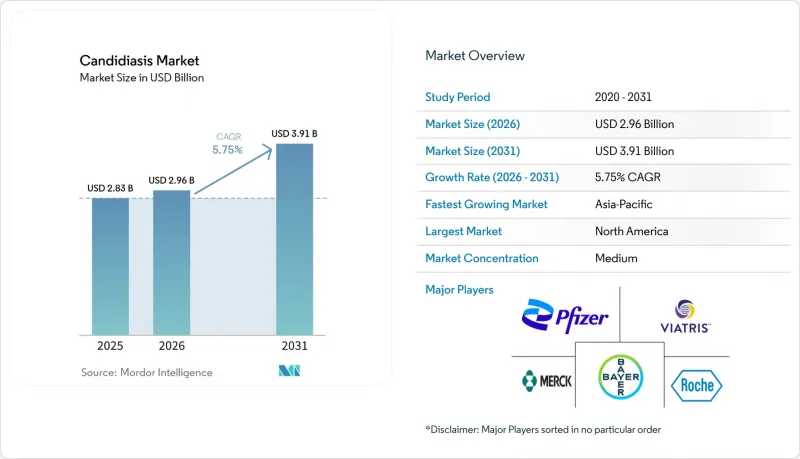
Mordor Intelligence에 의하면, 칸디다증 시장 규모는 2025년에 28억 3,000만 달러로 평가되었습니다. 2026년 29억 6,000만 달러에서 2031년까지 39억 1,000만 달러에 이를 것으로 예상되며, 예측 기간(2026-2031년) CAGR은 5.75%를 나타낼 전망입니다.
본 보고서는 치료법별(항진균제, 지지요법), 약물 분류별(아졸계, 에키노칸진계, 폴리엔계, 글루칸 합성 효소 억제제, 기타), 임상 적응증, 투여 경로(경구, 주사, 외용, 질 내 투여),환자층, 최종 사용자, 유통 채널 및 지역(북미, 유럽, 아시아태평양, 중동, 남미)
세계의 칸디다증 시장 동향 및 인사이트
면역결핍 및 중증 환자 수 증가
항암 치료, 생물학적 제제 및 이식 전 처치의 보급으로 인해 칸디다증에 걸리기 쉬운 환자층이 증가하고 있습니다. 2026년 리뷰에 따르면, 중환자실(ICU) 입원 1,000건당 7건의 침습성 칸디다증 합병증이 발생하는 것으로 추정되지만, 진단상의 문제로 인해 실제 수치가 과소평가되었을 가능성도 있다고 지적되고 있습니다. 미국 질병통제예방센터(CDC)는 미국 내 지역사회 유래 칸디다혈증의 독립적인 감염 경로로 주사 약물 사용을 꼽고 있습니다. 이러한 감염 경로로 인해 위험은 기존의 종양 환자나 이식 환자의 범위를 넘어, 지역사회 유래 질환을 가진 젊은 성인들이 일반적인 병원 처방약 관리만으로는 불충분하여 전문적인 외래 정맥 내 투여가 필요한 치료 경로에 포함되게 됩니다. 이러한 광범위한 환자층은 단일한 입원 치료나 조제 패턴에 해당되지 않기 때문에 칸디다증 시장에도 영향을 미치고 있습니다. 따라서 칸디다증 시장에는 입원 치료, 외래 정맥 내 치료, 경구 단계적 감량 요법 등 각 분야에 걸쳐 수요가 존재합니다. 이러한 환자군은 치료가 병원 밖으로 이전될 때, 조정된 약국의 지원, 확실한 사후 관리, 그리고 감염 기간 및 중증도에 적합한 치료 선택지 등 항진균제에 대한 전문적인 접근이 필요할 수 있습니다.
증가하는 의료 관련 칸디다혈증 및 침습성 칸디다증
의료 관련 칸디다혈증은 중환자실(ICU)에서 여전히 심각한 감염증입니다. 2020년부터 2024년까지 17만 9,590명의 ICU 입원 환자를 대상으로 한 2026년 이탈리아 연구에 따르면, ICU에서 발병한 칸디다혈증의 병원 내 사망률은 50.3%였던 반면, 동등한 세균성 혈류 감염의 경우 34.1%였습니다. 이 연구에서는 ICU 내 칸디다혈증의 33%를 차지하는 칸디다 파라프실로시스(Candida parapsilosis) 분리주 중 53.7%가 플루코나졸 내성을 보인 것으로 보고되었습니다. 또한 칸디다혈증의 평균 중환자실 입원 일수는 44일, 세균성 혈류감염에서는 36일이었다는 사실도 보고되었습니다. CDC는 칸디다혈증 1건당 입원 비용이 6,000-2만 9,000달러 증가한다고 밝혔습니다. 이러한 임상적 및 비용적 부담으로 인해 내성이나 치료 실패가 우려되는 경우, 병원에서는 광범위 스펙트럼의 에키노칸딘계 항진균제나 새로운 치료법이 채택되는 경향이 있습니다. 이는 집중 치료의 장기화로 인한 경제적·임상적 영향이, 아졸계 약물을 1차 선택으로 하는 프로토콜에 따른 비용 절감 효과를 상회할 가능성이 있기 때문입니다.
사용량이 많은 아졸계 약물의 제네릭 의약품에 의한 가격 하락
플루코나졸은 미국에서 63건의 NDC(National Drug Code) 등록을 통해 1단위당 0.83-1.95달러에 구입할 수 있습니다. 이러한 저가 공급으로 인해, 일반적인 질환 형태에서 처방 건수나 근본적인 치료 수요가 여전히 높은 경우에도 칸디다증 시장의 외래 부문 평균 판매 가격이 압박받고 있습니다. 감수성 검사 결과 더 비싼 대체 약물이 권장되는 경우에도, 병원 처방집에서는 제네릭 아졸계 약물을 초기 치료제로 유지할 수 있습니다. 상환 제도는 내성 증거가 확인되지 않는 한, 반드시 고가 의약품을 우대하는 것은 아닙니다. BARDA가 포스마노게픽스에 대해 최대 2억 6,800만 미달러의 지원을 표명한 것은 새로운 항진균 작용기전 개발에서 공공 지원이 수행하는 역할을 보여줍니다. 또한, 스튜어드십 정책이나 지급 기관의 규정에 따라, 약제·치료 위원회가 고가의 항진균제를 승인하기 전에 공식적인 내성 증거의 제시를 요구받는 경우도 있으며, 그 결과 병원 측은 신제품의 가격과 임상적 위험, 그리고 지역의 약물 감수성 데이터를 저울질해야 할 필요에 직면하게 됩니다.
부문별 분석
2025년, 항진균제는 칸디다증 시장 점유율의 85.23%를 차지하며, 외래 환자, 입원 치료 및 중증 침습성 감염증의 모든 영역에서 치료 수익의 주요 원천이 되었습니다. 지지 요법은 2026년부터 2031년까지 연평균 성장률(CAGR) 6.5%로 확대될 것으로 예측됩니다. 2026년 총설에 따르면, 비카테터 관련 칸디다혈증의 병원 내 사망률은 57%, 카테터 관련 질환의 경우 42.9%로 보고되었습니다. 이러한 차이로 인해 중증 환자 치료에서 카테터 관리, 영양 지원, 면역 기능 회복 및 감염원 통제에 대한 관심이 높아지고 있습니다. 이러한 상황에서 임상 팀은 환자를 감염에 취약하게 만드는 기저 질환에 대응하는 것과 병행하여 감염 관리에도 힘써야 합니다. 병원이 지지 요법을 통합적인 감염 관리 접근법의 일환으로 인식하게 되면 칸디다증 시장은 그 혜택을 누리게 될 것입니다.
이로 인해 항진균제 처방과 더불어 감염 관리 제품 및 병원 공급 서비스에 대한 수요가 발생할 것입니다. 이브렉사팡거는 1,3-β-D-글루칸 합성 효소를 억제하는 경구용 트리테르페노이드이므로, 치료 범주가 어떻게 변화하고 있는지를 보여줍니다. 이 약의 경구 제형은 병원에서 치료에 사용되는 리포펩타이드계 에키노칸진과는 다릅니다. 외과적 및 시술적 치료는 주로 심부 복막 칸디다증이나 심장 칸디다증에서 감염원의 통제가 필요한 경우로 제한되며, 전체 치료의 극히 일부에 불과합니다. 치료법의 선택은 감염의 중증도, 발병 부위, 진단 확정 및 환자가 병원 밖에서 약물을 투여받을 수 있는 능력에 따라 결정됩니다.
2025년, 아졸계 약물은 칸디다증 시장 점유율의 42.35%를 차지했으며, 이는 플루코나졸 및 이트라코나졸의 광범위한 처방에 힘입은 것이었습니다. 제네릭 의약품은 판매량이 많으며 상품 가격으로 거래되는 반면, 새로운 아졸계 약물은 특정 침습성 진균 감염증 적응증에서 더 높은 가격 책정이 가능합니다. 바질레아(Basilea)사는 2026년, 크레센바(Cresemba)가 침습성 진균 감염증 분야에서 전 세계 매출 1위를 기록했다고 발표했습니다. 또한, 오테세코나졸은 재발성 외음부·질 칸디다증에 대해 2027년까지 FDA의 독점권을 보유하고 있었습니다. EUCAST 및 CLSI의 감수성 기준은 내성 임계치에 도달한 경우 아졸계 약물에서 점진적으로 전환할 것을 지침으로 하고 있습니다.
칸디다증 시장에서 글루칸 합성 효소 억제제는 2031년까지 연평균 성장률(CAGR) 6%를 나타낼 것으로 예측됩니다. 이브렉사푼거는 외음부-질 칸디다증 및 재발성 외음부-질 칸디다증에 대한 적응증을 통해 이 부문을 뒷받침하고 있습니다. SCYNEXIS사는 SCY-247이 ‘감염병 치료제 적격 지정(Qualified Infectious Disease Product)’ 및 ‘패스트 트랙 지정(Fast Track designation)’을 획득했으며, 2026년 2월에 정맥 내 투여를 통한 1상 임상시험의 투여 단계에 진입했다고 보고했습니다. 에키노칸진계 항진균제에는 카스포팽긴, 미카팽긴, 아니둘라팽긴이 포함되어 있으며, 이들은 침습성 칸디다증에 대한 지침에서 권장되는 치료법입니다. 레자팡진은 주 1회 투여가 가능하지만, 폴리엔계 항진균제는 신독성으로 인해 일상적인 사용이 제한되므로 중증의 난치성 또는 광범위 내성 감염증에 한정하여 사용되고 있습니다.
외음부·질 칸디다증은 2025년 칸디다증 시장에서 임상 적응증별 매출의 35.56%를 차지했습니다. 이러한 위상은 높은 유병률, 처방률, 일반의약품을 통한 치료 선택지, 그리고 재발성 질환에 특화된 제품의 존재를 반영합니다. 2025년 11월에 발표된 2년간의 VIOLET 3상 연장 임상시험에서는 재발성 질환에서 오테세코나졸의 지속적인 유효성이 보고되었습니다. 이러한 임상적 근거는 향후 적응증 확대 및 전문의의 처방 판단을 뒷받침할 가능성이 있습니다. 구강 및 중인두 질환은 HIV 감염자나 면역억제 요법을 받고 있는 암 환자들 사이에서 여전히 흔하지만, 구강 질환이 더 중증인 경우 식도 질환에는 전신 요법이 필요할 수 있습니다.
침습성 칸디다증은 2026년부터 2031년까지 연평균 성장률(CAGR) 6.25%를 나타낼 것으로 예측됩니다. WHO는 C. auris가 침습성 질환을 유발할 가능성이 있고 항진균제에 대한 내성을 보이기 때문에 이를 최우선 진균 병원체로 지정하고 있습니다. 이 분류는 감수성 검사에 기반한 치료에 대한 의료기관의 관심을 높이는 데 기여합니다. 피부 칸디다증 및 요로 칸디다증은 일반적으로 외용 요법이나 단기간의 아졸계 경구약으로 관리됩니다. 전신성 및 파종성 사례의 경우, 중환자실(ICU) 환경에서 정맥 내 항진균제 투여가 필요하며, 적응증 범위 내에서 1회 발병당 치료비가 가장 높습니다.
지역별 분석
2025년, 북미는 칸디다증 관련 매출의 42.11%를 차지하며, 임상 및 상업적 중심지인 미국의 뒷받침을 받아 계속해서 최대 지역 시장으로 자리매김했습니다. CDC의 추정에 따르면, 미국에서는 매년 2만 5,000건의 칸디다혈증 사례가 발생하며, 사례당 6,000-2만 9,000달러의 추가 입원 비용이 발생합니다. 이는 중증도가 높은 환경에서의 치료에 대한 경제적 타당성을 뒷받침하는 것입니다. 2019년부터 C. auris에 대한 보고 의무화 및 2023년부터의 선별 검사 사례 보고를 통해 전국적인 사례 데이터가 확보되어, 다른 많은 지역에 비해 의료 시스템이 노출 상황을 보다 명확하게 파악하고 있습니다. 이러한 감시는 특히 내성 감염증이 확인된 지역에서 신속 진단, 감수성 검사 및 새로운 항진균제에 대한 투자를 촉진하고 있습니다. FDA는 2025년 12월에 REZZAYO의 처방 라벨을 갱신할 예정이며, 한편 문디파마(MundiPharma)는 2026년 하반기에 HSCT(조혈모세포이식) 예방 투여와 관련하여 FDA에 보충 신청을 할 계획입니다.
유럽에서는 C. auris의 감염 상황이 국가마다 다르며, 각국의 의료 시스템 내 조달 우선순위가 변화하고 있을 뿐만 아니라, 감시, 감염 대책, 항진균제 접근성과 관련하여 서로 다른 요구 사항이 발생하고 있습니다. ECDC의 2024년 조사에 따르면, 키프로스, 프랑스, 독일에서 집단 감염이 확인된 반면, 그리스, 이탈리아, 루마니아, 스페인에서는 병원 네트워크를 통해 풍토병적인 감염이 확인되었습니다. EU 회원국인 그리스, 이탈리아, 스페인에서는 첫 사례가 보고된 지 5-7년 만에 풍토병화 단계에 이르렀으며, 이들 국가의 경험은 현재 최근 발생한 집단 감염에 대처하고 있는 국가들에게 참고가 됩니다. 독일은 2024년, SGB V의 희귀질환 의약품 규정에 따라 레자팽진의 공식적인 유효성 평가를 완료했습니다. 또한, 2025년에 제정된 국제 칸디다 지침은 영국, 프랑스, 스페인, 이탈리아의 중환자실(ICU) 및 혈액내과에서 처방 지침이 될 것입니다.
아시아태평양에서는 중환자 치료 능력의 확대와 약물 내성으로 인해 기존의 아졸계 약물 사용이 어려워지는 가운데, 2026년부터 2031년까지 연평균 성장률(CAGR) 8.2%를 나타낼 것으로 예측되며, 이는 칸디다증 시장에서 지역별 가장 높은 성장률입니다. 2026년 중국 3차 의료기관에서 실시된 연구에 따르면, 칸디다혈증 발생률은 2015년 0.98%에서 2024년 1.69%로 증가했으며, C. tropicalis의 아졸계 약물에 대한 내성은 여전히 높은 수준을 유지하고 있습니다. 2026년 인도 북부에서 실시된 연구에서는 플루코나졸에 대한 높은 내성을 보이며, 암포테리신 B에 대한 감수성이 저하된 다제내성 C. auris가 보고되었으며, 이로 인해 병원에서는 에키노칸딘계 약제로의 전환이 진행될 가능성이 있습니다. 2025년 4월 오테세코나졸이 중국의 보험 적용 약품 목록에 추가됨에 따라 재발성 외음부·질 칸디다증에 대한 접근성이 확대되었으나, 일본, 한국, 호주에서는 고급 항진균제에 대한 체계화된 처방집에 따른 접근성이 유지되고 있습니다. 중동 및 남미는 중환자실(ICU)의 확대, HIV 합병증의 부담, 그리고 남미 병원 네트워크에서 보고된 C. auris의 에키노칸딘 내성 등을 배경으로, 비교적 소규모이긴 하지만 성장이 예상되는 지역입니다.
기타 혜택 :
- 엑셀 형식 시장 예측(ME) 시트
- 3개월간의 애널리스트 지원
자주 묻는 질문
목차
제1장 서론
제2장 조사 방법
제3장 개요
제4장 시장 구도
제5장 시장 규모 및 성장 예측, 금액 및 수량
제6장 경쟁 구도
제7장 시장 기회 및 향후 전망
KTH 26.09.02According to Mordor Intelligence, the candidiasis market size was valued at USD 2.83 billion in 2025 and is estimated to grow from USD 2.96 billion in 2026 to reach USD 3.91 billion by 2031, at a CAGR of 5.75% during the forecast period (2026-2031).
This report is Segmented by Treatment Type (Antifungal Medications, Supportive Therapy), Drug Class (Azoles, Echinocandins, Polyenes, Glucan Synthase Inhibitors, Others), Clinical Indication, Route of Administration (Oral, Injectable, Topical, Vaginal), Patient Population, End User, Distribution Channel, and Geography (North America, Europe, Asia-Pacific, Middle East, South America)
Global Candidiasis Market Trends and Insights
Growing Immunocompromised and Critically Ill Patient Pool
The wider use of chemotherapy, biologic medicines, and transplant conditioning has increased the population vulnerable to candidiasis. A 2026 review estimated that invasive candidiasis complicated 7 episodes per 1,000 ICU admissions, while noting that diagnostic problems can lead to undercounting. The CDC identifies injection-drug use as a separate pathway for community-onset candidemia in the United States. This pathway extends risk beyond the conventional oncology and transplant populations, bringing younger adults with community-onset disease into a care pathway that can require specialized outpatient intravenous access rather than routine hospital formulary management alone, and the candidiasis market is affected because this broader population does not fit a single inpatient treatment or dispensing pattern. The candidiasis market, therefore, has demand across inpatient care, outpatient intravenous treatment, and oral step-down therapy. These patient groups can require specialized access to antifungals when care shifts outside hospitals, including coordinated pharmacy support, reliable follow-up, and treatment choices that fit the duration and intensity of the infection.
Rising Healthcare-Associated Candidemia and Invasive Candidiasis
Healthcare-associated candidemia remains a serious infection in intensive care settings. A 2026 Italian study of 179,590 ICU admissions from 2020 through 2024 found 50.3% in-hospital mortality for ICU-acquired candidemia, compared with 34.1% for comparable bacterial bloodstream infections. The study reported fluconazole resistance in 53.7% of Candida parapsilosis isolates, a species responsible for 33% of ICU candidemia episodes. It also reported average ICU stays of 44 days for candidemia and 36 days for bacterial bloodstream infections. The CDC stated that a candidemia episode added USD 6,000 to USD 29,000 in hospitalization costs. These clinical and cost pressures support hospital use of broad-spectrum echinocandins and newer treatments when resistance or treatment failure is a concern, because the financial and clinical effects of prolonged critical care can outweigh savings from an azole-first protocol.
Generic Price Erosion in High-Volume Azole Therapies
Fluconazole is available through 63 National Drug Code entries in the United States at USD 0.83 to USD 1.95 per unit. This low-price availability compresses average selling prices in the outpatient portion of the candidiasis market, even when the number of prescriptions and the underlying need for treatment remain significant across common forms of disease. Hospital formularies can retain generic azoles as initial treatments even when susceptibility testing supports a higher-cost alternative. Reimbursement systems do not always reward premium medicines without documented resistance. BARDA's potential commitment of up to USD 268 million for fosmanogepix shows the role of public support in developing novel antifungal mechanisms. Stewardship policies and payer rules can also require formal resistance evidence before a pharmacy and therapeutics committee supports a premium antifungal, leaving hospitals to balance the price of a newer product against clinical risk and local susceptibility data.
Other drivers and restraints analyzed in the detailed report include:
- Expansion of Rapid Species Identification and Susceptibility Testing
- Mainstream Adoption of Outpatient Oral and Maintenance Therapies
- Limited Antifungal Development Incentives and Lengthy Clinical Trials
For complete list of drivers and restraints, kindly check the Table Of Contents.
Segment Analysis
Antifungal medications accounted for 85.23% of the candidiasis market share in 2025, making them the main source of treatment revenue across outpatient cases, hospital care, and severe invasive infections. Supportive therapy is expected to expand at a 6.5% CAGR from 2026 through 2031. A 2026 review reported 57% in-hospital mortality for non-catheter-related candidemia and 42.9% for catheter-related disease. This difference has strengthened attention to catheter management, nutritional support, immune restoration, and source control in high-acuity care, where the clinical team must address infection management alongside the underlying conditions that make the patient vulnerable. The candidiasis market benefits when hospitals view supportive care as part of an integrated infection-management approach.
This creates demand for infection-control products and hospital supply services that sit beside antifungal prescribing. Ibrexafungerp shows how treatment categories are changing because it is an oral triterpenoid that inhibits 1,3-beta-D-glucan synthase. Its oral form differs from lipopeptide echinocandins used in hospital treatment. Surgical and procedural treatment remains a small part of care, mainly when deep peritoneal or cardiac candidiasis requires source control. Treatment selection depends on infection severity, the affected site, diagnostic confirmation, and a patient's ability to receive medication outside the hospital.
Azoles held 42.35% of the candidiasis market share in 2025, supported by extensive prescribing of fluconazole and itraconazole. Generic products generate high volume but operate at commodity prices, while newer azoles can have higher pricing in selected invasive-fungal indications. Basilea stated in 2026 that Cresemba was the global revenue leader for invasive fungal infections. Oteseconazole also had FDA exclusivity through 2027 for recurrent vulvovaginal candidiasis. Susceptibility standards from EUCAST and CLSI guide escalation from azoles when resistance breakpoints are reached.
Glucan synthase inhibitors are forecast to grow at a 6% CAGR through 2031 in the candidiasis market. Ibrexafungerp supports this category through its use for vulvovaginal and recurrent vulvovaginal candidiasis. SCYNEXIS reported that SCY-247 received Qualified Infectious Disease Product and Fast Track designations and entered intravenous Phase 1 dosing in February 2026. Echinocandins include caspofungin, micafungin, and anidulafungin, which are guideline-endorsed treatments for invasive candidiasis. Rezafungin adds once-weekly dosing, while polyenes are reserved for severe refractory or pan-resistant infections because nephrotoxicity limits routine use.
Vulvovaginal candidiasis represented 35.56% of 2025 clinical-indication revenue in the candidiasis market. Its position reflects high prevalence, prescription, and over-the-counter treatment options, and dedicated recurrent-disease products. A 2-year VIOLET Phase 3 extension study published in November 2025 reported sustained efficacy for oteseconazole in recurrent disease. This clinical evidence may support future label updates or specialist prescribing. Oral and oropharyngeal disease remains common among people with HIV and patients receiving immunosuppressive cancer care, while esophageal disease can require systemic treatment when oral disease is more severe.
Invasive candidiasis is forecast to record a 6.25% CAGR from 2026 through 2031. The WHO identifies C. auris as a high-priority fungal pathogen because it can cause invasive disease and show resistance to antifungal medicines. This classification supports institutional attention to susceptibility-guided treatment. Cutaneous and urinary candidiasis are usually managed with topical treatment or short oral azole courses. Systemic and disseminated forms require intravenous antifungals in ICU settings and have the highest per-episode treatment value within the indication range.
Complete Report Scope:
- By Treatment Type
- Antifungal Medications
- Supportive Therapy
- Surgical & Procedural Interventions
- By Drug Class
- Azoles
- Echinocandins
- Polyenes
- Glucan Synthase Inhibitors
- Other Antifungals
- By Clinical Indication
- Oral & Oropharyngeal Candidiasis
- Esophageal Candidiasis
- Vulvovaginal Candidiasis
- Cutaneous Candidiasis
- Urinary Candidiasis
- Invasive Candidiasis
- Systemic & Disseminated Candidiasis
- By Route of Administration
- Oral
- Injectable
- Topical
- Vaginal/Intravaginal
- By Patient Population
- Adults
- Pediatrics
- Pregnant & Reproductive-Age Women
- Older Adults
- Immunocompromised Patients
- By End User
- Hospitals
- Specialty Clinics
- Diagnostic Laboratories
- Long-Term Care Facilities
- Homecare Settings
- Research Institutes & CROs
- By Distribution Channel
- Hospital Pharmacies
- Retail Pharmacies
- Online Pharmacies
- Direct Institutional Procurement
- By Geography
- North America
- United States
- Canada
- Mexico
- Rest of North America
- Europe
- Germany
- United Kingdom
- France
- Italy
- Spain
- Rest of Europe
- Asia-Pacific
- China
- Japan
- India
- South Korea
- Australia
- Rest of Asia-Pacific
- Middle East
- GCC
- South Africa
- Rest of Middle East and Africa
- South America
- Brazil
- Argentina
- Rest of South America
- North America
Geography Analysis
North America held 42.11% of candidiasis revenue in 2025 and remained the largest regional market, supported by the United States as the central clinical and commercial reference point. The CDC estimates 25,000 candidemia cases each year in the United States, with an additional USD 6,000 to USD 29,000 in hospital costs per case, which supports the economic case for treatment in high-acuity settings. Mandatory C. auris reporting since 2019 and screening-case reporting since 2023 provide national case data, giving health systems a clearer view of exposure than many other regions. This surveillance supports investment in rapid diagnostics, susceptibility testing, and newer antifungals, particularly where resistant infections are documented. The FDA updated the REZZAYO prescribing label in December 2025, while Mundipharma plans an FDA supplemental application for HSCT prophylaxis in H2 2026.
Europe has varied C. auris conditions that are changing procurement priorities across national health systems and creating different needs for surveillance, infection control, and antifungal access. The ECDC's 2024 survey found outbreaks in Cyprus, France, and Germany, while Greece, Italy, Romania, and Spain had endemic transmission through hospital networks. EU Greece, Italy, and Spain moved from the first documented case to endemicity over 5 to 7 years, which makes the experience in those countries relevant for states now managing more recent outbreaks. Germany completed a formal benefit assessment for rezafungin in 2024 under the SGB V orphan drug provision, and the 2025 international Candida guideline can guide ICU and hematology prescribing in the United Kingdom, France, Spain, and Italy.
Asia-Pacific is forecast to grow at an 8.2% CAGR from 2026 through 2031, the fastest regional rate in the candidiasis market, as critical care capacity expands and resistance complicates conventional azole use. A 2026 Chinese tertiary-hospital study found that candidemia incidence increased from 0.98% in 2015 to 1.69% in 2024, with persistently high azole resistance in C. tropicalis. A 2026 Northern India studyreported multidrug-resistant C. auris with high fluconazole resistance and reduced amphotericin B susceptibility, which can shift hospitals toward echinocandins. Oteseconazole's April 2025 listing on China's reimbursement drug list expanded access for recurrent vulvovaginal candidiasis, while Japan, South Korea, and Australia retain structured formulary access for premium antifungals. The Middle East and South America are smaller growth areas, supported by ICU expansion, HIV coinfection burden, and reported C. auris echinocandin resistance in South American hospital networks.
- Pfizer
- Merck
- Astellas Pharma
- Viatris
- Bayer
- SCYNEXIS
- Mycovia Pharmaceuticals
- Cidara Therapeutics, Inc.
- Melinta Therapeutics, LLC
- Basilea Pharmaceutica Ltd.
- Roche
- GlaxoSmithKline
- Novartis
- Teva Pharmaceutical Industries
- Cipla
- Lupin
- Biocon
- Torrent Pharmaceuticals
- NovaDigm Therapeutics, Inc.
- T2 Biosystems, Inc.
- bioM-rieux SA
- Associates of Cape Cod, Inc.
Additional Benefits:
- The market estimate (ME) sheet in Excel format
- 3 months of analyst support
TABLE OF CONTENTS
1 INTRODUCTION
- 1.1 Study Assumptions and Market Definition
- 1.2 Scope of the Study
2 RESEARCH METHODOLOGY
3 EXECUTIVE SUMMARY
4 MARKET LANDSCAPE
- 4.1 Market Overview
- 4.2 Market Drivers
- 4.2.1 Growing immunocompromised and critically ill patient pool
- 4.2.2 Rising healthcare-associated candidemia and invasive candidiasis
- 4.2.3 Expansion of rapid species identification and susceptibility testing
- 4.2.4 Mainstream adoption of outpatient oral and maintenance therapies
- 4.2.5 Increasing surveillance of multidrug-resistant Candida auris
- 4.2.6 Hospital network transmission creates recurring screening and infection-control demand
- 4.3 Market Restraints
- 4.3.1 Generic price erosion in high-volume azole therapies
- 4.3.2 Limited antifungal development incentives and lengthy clinical trials
- 4.3.3 Diagnostic uncertainty delays targeted therapy and reimbursement
- 4.3.4 Emerging resistance reduces the useful life of established drug classes
- 4.4 Value / Supply-Chain Analysis
- 4.5 Regulatory Landscape
- 4.6 Technological Outlook
- 4.7 Porters Five Forces Analysis
- 4.7.1 Threat of New Entrants
- 4.7.2 Bargaining Power of Suppliers
- 4.7.3 Bargaining Power of Buyers
- 4.7.4 Threat of Substitutes
- 4.7.5 Competitive Rivalry
5 MARKET SIZE AND GROWTH FORECASTS, VALUE AND VOLUME
- 5.1 By Treatment Type
- 5.1.1 Antifungal Medications
- 5.1.2 Supportive Therapy
- 5.1.3 Surgical & Procedural Interventions
- 5.2 By Drug Class
- 5.2.1 Azoles
- 5.2.2 Echinocandins
- 5.2.3 Polyenes
- 5.2.4 Glucan Synthase Inhibitors
- 5.2.5 Other Antifungals
- 5.3 By Clinical Indication
- 5.3.1 Oral & Oropharyngeal Candidiasis
- 5.3.2 Esophageal Candidiasis
- 5.3.3 Vulvovaginal Candidiasis
- 5.3.4 Cutaneous Candidiasis
- 5.3.5 Urinary Candidiasis
- 5.3.6 Invasive Candidiasis
- 5.3.7 Systemic & Disseminated Candidiasis
- 5.4 By Route of Administration
- 5.4.1 Oral
- 5.4.2 Injectable
- 5.4.3 Topical
- 5.4.4 Vaginal/Intravaginal
- 5.5 By Patient Population
- 5.5.1 Adults
- 5.5.2 Pediatrics
- 5.5.3 Pregnant & Reproductive-Age Women
- 5.5.4 Older Adults
- 5.5.5 Immunocompromised Patients
- 5.6 By End User
- 5.6.1 Hospitals
- 5.6.2 Specialty Clinics
- 5.6.3 Diagnostic Laboratories
- 5.6.4 Long-Term Care Facilities
- 5.6.5 Homecare Settings
- 5.6.6 Research Institutes & CROs
- 5.7 By Distribution Channel
- 5.7.1 Hospital Pharmacies
- 5.7.2 Retail Pharmacies
- 5.7.3 Online Pharmacies
- 5.7.4 Direct Institutional Procurement
- 5.8 By Geography
- 5.8.1 North America
- 5.8.1.1 United States
- 5.8.1.2 Canada
- 5.8.1.3 Mexico
- 5.8.1.4 Rest of North America
- 5.8.2 Europe
- 5.8.2.1 Germany
- 5.8.2.2 United Kingdom
- 5.8.2.3 France
- 5.8.2.4 Italy
- 5.8.2.5 Spain
- 5.8.2.6 Rest of Europe
- 5.8.3 Asia-Pacific
- 5.8.3.1 China
- 5.8.3.2 Japan
- 5.8.3.3 India
- 5.8.3.4 South Korea
- 5.8.3.5 Australia
- 5.8.3.6 Rest of Asia-Pacific
- 5.8.4 Middle East
- 5.8.4.1 GCC
- 5.8.4.2 South Africa
- 5.8.4.3 Rest of Middle East and Africa
- 5.8.5 South America
- 5.8.5.1 Brazil
- 5.8.5.2 Argentina
- 5.8.5.3 Rest of South America
- 5.8.1 North America
6 COMPETITIVE LANDSCAPE
- 6.1 Market Concentration
- 6.2 Market Share Analysis
- 6.3 Company Profiles (includes Global Level Overview, Market Level Overview, Core Segments, Financials as available, Strategic Information, Market Rank/Share, Products and Services, Recent Developments)
- 6.3.1 Pfizer Inc.
- 6.3.2 Merck & Co., Inc.
- 6.3.3 Astellas Pharma Inc.
- 6.3.4 Viatris Inc.
- 6.3.5 Bayer AG
- 6.3.6 SCYNEXIS, Inc.
- 6.3.7 Mycovia Pharmaceuticals, Inc.
- 6.3.8 Cidara Therapeutics, Inc.
- 6.3.9 Melinta Therapeutics, LLC
- 6.3.10 Basilea Pharmaceutica Ltd.
- 6.3.11 F. Hoffmann-La Roche Ltd
- 6.3.12 GSK plc
- 6.3.13 Novartis AG
- 6.3.14 Teva Pharmaceutical Industries Ltd.
- 6.3.15 Cipla Limited
- 6.3.16 Lupin Limited
- 6.3.17 Biocon Limited
- 6.3.18 Torrent Pharmaceuticals Ltd.
- 6.3.19 NovaDigm Therapeutics, Inc.
- 6.3.20 T2 Biosystems, Inc.
- 6.3.21 bioM-rieux SA
- 6.3.22 Associates of Cape Cod, Inc.
7 MARKET OPPORTUNITIES AND FUTURE OUTLOOK
- 7.1 White-Space and Unmet-Need Assessment
- 7.2 Future Outlook


