

|
시장보고서
상품코드
2119558
텅스텐 : 시장 점유율 분석, 업계 동향 및 통계, 성장 예측(2026-2031년)Tungsten - Market Share Analysis, Industry Trends & Statistics, Growth Forecasts (2026 - 2031) |
||||||
 Mordor Intelligence
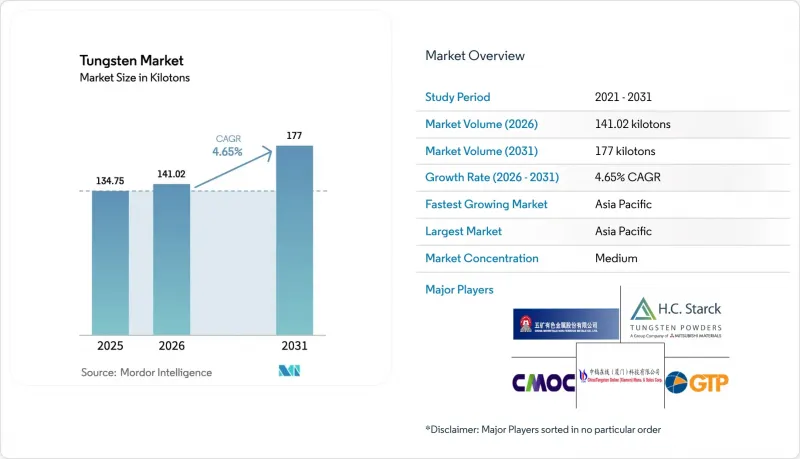
Mordor Intelligence에 의하면, 텅스텐 시장 규모는 2025년에 134.75 킬로톤으로 평가되었습니다. 2026년 141.02 킬로톤에서 2031년까지 177 킬로톤에 이를 것으로 예상되며, 예측 기간(2026-2031년) CAGR은 4.65%를 나타낼 전망입니다.
본 보고서는 제품 유형(박, 리본, 선재, 튜브), 제품 형태(텅스텐 카바이드, 텅스텐 합금, 텅스텐 압연 제품, 텅스텐 화학제품), 최종 이용 산업(자동차, 전기 및 전자,공작기계·설비 등) 및 지역(아시아태평양, 북미, 유럽, 기타 지역)별로 분류되어 있습니다. 시장 예측은 수량(톤) 단위로 제시되어 있습니다.
세계의 텅스텐 시장 동향 및 인사이트
자동차 및 항공우주 분야의 초경합금 절삭 공구 수요 급증
초경합금 인서트는 파워트레인 및 기체 부품의 담금질 강, 티타늄, 알루미늄 복합재 가공에 있어 여전히 필수적인 요소입니다. 전기차로의 전환에 따라 배터리 하우징에 대한 공차 요건이 엄격해지고 있으며, 각 OEM 업체들은 셀 주변의 자기 간섭을 최소화하기 위해 코발트 결합제 함유율이 6 wt% 미만인 초미세 입자 초경합금 등급을 지정하고 있습니다. 항공우주 업계의 주요 제조업체들은 DLC 코팅이 적용된 초경 엔드밀을 채택하고 있으며, 이를 통해 탄소섬유 패널의 절삭 속도가 25% 향상됨과 동시에, 1개의 절삭날당 가공 가능한 부품 수가 1만 개 이상으로 늘어났습니다. ISO 513 : 2024에 따라 등급 명명 규칙이 재분류되면서 공구 교체 주기가 촉발되었고, 교체 수요가 견조한 추세를 보이고 있습니다. 독일과 일본의 1차 공급업체들은 형상 및 코팅을 공동 개발하는 통합형 제조업체와 조달을 통합하고 있으며, 이러한 동향이 프리미엄 가격 책정을 뒷받침하고 있습니다.
전자 기기의 소형화가 고밀도 상호 연결을 촉진
반도체 제조업체들은 3나노미터 미만의 노드에서 비아 충전 및 접점 메탈라이제이션에 있어 알루미늄에서 텅스텐으로의 전환을 추진하고 있습니다. 2025년 하반기 양산이 시작된 인텔의 18A 공정에서는 300mm 웨이퍼 1장당 약 15g의 육불화텅스텐을 소비합니다. TSMC는 2nm 공정의 양산 확대를 뒷받침하기 위해 2024년에 텅스텐 CVD 생산 능력을 40% 확대했습니다. 삼성은 원자층 증착법(ALD)을 이용한 WS2 배리어 층에 관한 12건의 특허를 출원했으며, 이는 2차원 텅스텐 화합물의 채택이 더욱 확대될 것임을 시사합니다. 칩렛 및 3D 적층과 같은 첨단 패키징 수요로 인해 장치 1대당 텅스텐 사용량은 증가하고 있으며, 전자 분야는 텅스텐 시장의 견실한 성장 축이 되고 있습니다.
중국을 중심으로 한 공급 변동과 수출 할당
베이징이 2024년에 도입한 텅스텐 분말, 탄화물 및 합금에 대한 수출 허가 규제는 유럽과 미국의 구매자들에게 불확실성을 가중시켰습니다. 암모늄 파라텅스텐산염의 현물 가격은 유럽 소비자들이 재고를 소진하고 베트남 제련소가 2차 생산을 확대함에 따라 2개월 동안 22% 상승한 후 안정세를 보였습니다. 미국 지질조사국(USGS)은 2015년에 국내 채굴이 종료됨에 따라 텅스텐을 ‘고위험’으로 분류했으며, 국방 비축량은 승인 수준의 고작 15%에 그치고 있습니다. 르완다와 한국에서의 대체 공급은 2028년까지 유럽 수요의 8% 미만을 충당할 수 있을 뿐이며, 공급 리스크는 여전히 높은 수준을 유지하고 있습니다.
부문별 분석
2025년, 와이어는 텅스텐 시장 점유율의 39.75%를 차지했으며, EDM 가공업체와 용광로 제조업체들이 그 특유의 고온 강도를 신뢰하고 있기 때문에 2031년까지 이 선두 자리를 유지할 전망입니다. 범용 필라멘트 와이어는 LED의 보급에 따라 감소 추세를 보이고 있지만, EDM용 및 가이드와이어용 정밀 인발 등급은 연평균 6%의 성장률을 보이고 있습니다. 플란제(Plansee)사가 2025년에 개발한 산화 란탄 첨가 와이어는 재결정 온도를 1,800°C까지 높여 금형 제조업체의 스크랩을 12% 절감합니다. 튜브는 가장 빠르게 성장하는 제품으로, 초음속 항공기 프로그램 및 MRI 제조업체들이 박벽 텅스텐·레늄 열전대를 필요로 함에 따라 연평균 성장률(CAGR)은 5.10%로 성장을 지속하고, 있습니다. 벽 두께 0.5 mm 미만의 로터리 스웨징 기술을 보유한 기업은 단 4곳에 불과하며, 이것이 기술적 경쟁 우위(기술적 해자)를 창출하고 있습니다.
박막 및 리본 시장 점유율은 비교적 낮습니다. 두께 0.025mm 이하의 박막은 X선 소스 및 우주용 전자 기기의 차폐재로 사용되며, 리본은 박막 증착 시 증발 보트 역할을 합니다. 텅스텐의 녹는점인 3,422°C에 필적하는 대체재는 거의 없기 때문에 수요는 틈새 시장이지만 안정적입니다. 전반적으로 이러한 동향은 기존 조명 용도가 축소되는 상황 속에서도 특수 제조업체에게 지속적인 성장의 여지를 제공하며, 텅스텐 시장이 균형 잡힌 성장 궤도를 유지하는 데 기여하고 있습니다.
지역별 분석
아시아태평양은 2025년 생산량의 58.28%를 차지했으며, 2031년까지 연평균 성장률(CAGR) 5.02%를 기록할 전망입니다. 중국은 텅스텐 카바이드 정제량의 75%, 파라텅스텐산 암모늄 정제량의 90%를 국내에서 충당하고 있으며, 관세가 부과되더라도 수출 가격은 유럽 및 미국 수준보다 25-35% 낮게 책정되어 있습니다. 인도는 2024년에 텅스텐을 중요 광물로 지정하고, 데가나 광산의 개발을 우선적으로 추진하여 2028년까지 연간 1,800톤의 생산을 목표로 하고 있습니다. 일본에서는 2024년 공작기계 수주액이 1조 8,000억 엔에 달함에 따라 초미세 입자 카바이드 수요가 견조한 추세를 보이고 있습니다. 한국의 메모리 공장에서는 SK하이닉스와 삼성이 3D-NAND의 층 수를 확대하고 있어 텅스텐 CVD 소비가 증가하고 있습니다.
북미에서는 국내 광산 생산량이 부족하여 의존도가 여전히 높은 상태이지만, 2024년에 ‘국방생산법’에 따라 2억 달러가 배정되어 제련 및 재활용 역량 구축을 목표로 하고 있습니다. 캐나다의 알몬티(Almonty)사는 2027년에 샌던(Sandown) 광산이 가동을 시작하면 북미 공작기계 제조업체에 공급할 예정입니다. 멕시코에서는 2024년에 52억 달러 규모의 자동차 분야에 대한 외국인 직접 투자(FDI)가 급증하고 있으며, 니어쇼어화된 기계 가공 라인에서 초경공구에 대한 수요가 높아지고 있습니다.
유럽에서는 독일 생산자들이 6.5%의 반덤핑 관세가 부과된 후에도 가격이 30% 저렴한 중국산 초경합금 수입품과 경쟁하고 있습니다. 2024년 ‘중요 원자재법’은 2030년까지 텅스텐의 15%를 재활용할 것을 의무화하고 있으며, 이에 따라 우미코어(Umicore)사는 연간 3,000톤의 스크랩을 처리하기 위해 호보켄 공장의 개보수에 4,500만 유로를 투자했습니다. 러시아산 정광은 제재의 영향으로 주로 국내에서 소비되고 있지만, 르완다에서 새로 가동을 시작한 선광소는 유럽의 제련소에 공급하고 있습니다. 3대 지역 이외에는 라틴아메리카, 아프리카, 중동이 합쳐서 세계 생산량의 약 8%를 공급하고 있으며, 특히 볼리비아와 르완다가 크게 기여하고 있습니다.
기타 혜택 :
- 엑셀 형식 시장 예측(ME) 시트
- 3개월간의 애널리스트 지원
자주 묻는 질문
목차
제1장 서론
제2장 조사 방법
제3장 개요
제4장 시장 구도
제5장 시장 규모 및 성장 예측
제6장 경쟁 구도
제7장 시장 기회 및 향후 전망
KTH 26.09.02According to Mordor Intelligence, the tungsten market size was valued at 134.75 kilotons in 2025 and is estimated to grow from 141.02 kilotons in 2026 to reach 177 kilotons by 2031, at a CAGR of 4.65% during the forecast period (2026-2031).
This report is Segmented by Product Type (Foils, Ribbons, Wires, and Tubes), Product Form (Tungsten Carbides, Tungsten Alloys, Tungsten Mill Products, and Tungsten Chemicals), End-Use Industry (Automotive, Electrical and Electronics, Machine Tools and Equipment, and More), and Geography (Asia-Pacific, North America, Europe, and Rest of the World). The Market Forecasts are Provided in Terms of Volume (Tons).
Global Tungsten Market Trends and Insights
Demand Surge From Cemented-Carbide Cutting Tools in Automotive and Aerospace
Cemented-carbide inserts remain indispensable for machining hardened steels, titanium, and aluminum composites in powertrain and airframe components. The shift to electric vehicles raises tolerance demands on battery housings, prompting OEMs to specify ultra-fine-grain carbide grades with cobalt binders below 6 wt% to minimize magnetic interference near cells. Aerospace primes are adopting diamond-like-carbon-coated carbide end mills that cut carbon-fiber panels 25% faster while extending life beyond 10,000 parts per edge. ISO 513:2024 reclassified grade nomenclature, triggering a tooling refresh cycle that keeps replacement demand buoyant. Tier-1 suppliers in Germany and Japan are consolidating purchases with integrated producers that co-engineer geometry and coatings, a dynamic that supports premium pricing.
Electronics Miniaturization Boosting High-Density Interconnects
Semiconductor manufacturers are shifting from aluminum to tungsten for via-fill and contact metallization at sub-3-nanometer nodes. Intel's 18A process, entering high-volume production in late 2025, consumes roughly 15 g of tungsten hexafluoride per 300 mm wafer. TSMC expanded tungsten-CVD capacity by 40% in 2024 to backstop its 2 nm ramp. Samsung filed a dozen patents on atomic-layer-deposited WS2 barriers, pointing to broader adoption of two-dimensional tungsten compounds. Advanced packaging needs-chiplets and 3D stacking-are multiplying tungsten usage per device, making electronics a resilient growth pillar for the tungsten market.
China-Centric Supply Volatility and Export Quotas
Beijing's 2024 export-licensing rule for tungsten powder, carbide, and alloys amplified uncertainty for Western buyers. Spot prices for ammonium paratungstate rose 22% in two months before easing as European consumers drew down stocks and Vietnamese smelters boosted secondary output. The US Geological Survey highlighted tungsten as high risk since domestic mining ended in 2015, and the National Defense Stockpile holds only 15% of the authorized level. Alternative supply from Rwanda and South Korea will cover less than 8% of European demand by 2028, leaving exposure elevated.
Other drivers and restraints analyzed in the detailed report include:
- Defense Adoption of Kinetic-Energy Penetrators
- Li-Ion and Solid-State Batteries Using Tungsten-Disulfide Anodes
- Health Risks of Tungsten-Carbide Dust Exposure
For complete list of drivers and restraints, kindly check the Table Of Contents.
Segment Analysis
Wire captured 39.75% of the Tungsten market share in 2025, a lead it retains through 2031 because EDM shops and furnace builders rely on its unique high-temperature strength. Commodity filament wire is tapering with LED adoption, but precision-drawn grades for EDM and guidewires are rising 6% annually. Plansee's 2025 lanthanum-oxide-doped wire raises recrystallization temperature to 1,800 °C, cutting scrap 12% for tool-and-die makers. Tubes are the fastest-growing product, clocking a 5.10% CAGR as hypersonic vehicle programs and MRI makers need thin-wall tungsten-rhenium thermocouples. Only four firms command rotary-swaging capabilities for sub-0.5 mm walls, creating a technological moat.
A smaller share belongs to foils and ribbons. Foils down to 0.025 mm shield X-ray sources and space electronics, while ribbons serve as evaporation boats in thin-film deposition. Demand is niche yet stable because few substitutes match tungsten's 3,422 °C melting point. Collectively, these trends embed durable upsides for specialty manufacturers even as legacy lighting uses recede, helping the tungsten market maintain a balanced growth profile.
Complete Report Scope:
- By Product Type
- Foils
- Ribbons
- Wires
- Tubes
- By Product Form
- Tungsten Carbides
- Tungsten Alloys
- Tungsten Mill Products
- Tungsten Chemicals
- By End-use Industry
- Automotive
- Aerospace
- Electrical and Electronics
- Machine Tools and Equipment
- Other End-users (Energy Storage and Batteries, Medical Imaging and Oncology)
- By Geography
- Asia-Pacific
- China
- Japan
- India
- South Korea
- Rest of Asia-Pacific
- North America
- United States
- Canada
- Mexico
- Europe
- Germany
- United Kingdom
- France
- Italy
- Russia
- Rest of Europe
- Rest of the World
- South America
- Middle East and Africa
- Asia-Pacific
Geography Analysis
Asia-Pacific controlled 58.28% of 2025 volume and is on a 5.02% CAGR path to 2031. China integrates 75% of carbide and 90% of ammonium-paratungstate refining, pricing exports 25-35% below Western levels even after tariffs. India labeled tungsten a critical mineral in 2024 and fast-tracked Degana, targeting 1,800 t yr-1 by 2028. Japan's JPY 1.8 trillion machine-tool orders in 2024 keep ultra-fine-grain carbide demand buoyant. South Korean memory fabs push tungsten-CVD consumption as SK Hynix and Samsung expand 3D-NAND layers.
North America's lack of domestic mine output keeps exposure high, but a USD 200 million Defense Production Act allocation in 2024 aims to seed refining and recycling capacity. Canada's Almonty will feed North American toolmakers when Sangdong starts in 2027. Mexico's USD 5.2 billion auto FDI boom in 2024 raises carbide-tool needs for nearshored machining lines.
In Europe, German producers face Chinese carbide imports priced 30% lower even after a 6.5% anti-dumping duty. The 2024 Critical Raw Material Act mandates 15% recycled tungsten by 2030, prompting Umicore's EUR 45 million Hoboken upgrade to process 3,000 t yr-1 of scrap. Russian concentrate stays mostly domestic due to sanctions, while Rwanda's newly commissioned concentrator feeds European smelters. Outside the big three regions, Latin America, Africa, and the Middle East jointly supplied around 8% of global volume, with Bolivia and Rwanda as notable contributors.
- A.L.M.T. Corp.
- Allegheny Technologies Inc.
- Avis Metal Industries Limited
- Betek GmbH and Co. KG
- Buffalo Tungsten Inc.
- China Minmetals Non-Ferrous Metals Co.
- China Molybdenum Co., Ltd.
- Chongyi Zhangyuan Tungsten Co.
- Elmet Technologies
- Global Tungsten and Powders
- Guangdong XiangLu Tungsten Co.
- H.C. Starck Tungsten GmbH
- International Metalworking Companies
- Jiangxi Tungsten Holding Group
- Jiangxi Yaosheng Tungsten
- Kennametal Inc.
- Nippon Tungsten Co., Ltd.
- Ormonde Mining plc
- Plansee SE
- QuesTek Innovations LLC
- Sandvik AB
- Treibacher Industrie AG
- Umicore N.V.
- Wolf Minerals Ltd.
- WOLFRAM Company JSC
- Xiamen Tungsten Co., Ltd.
Additional Benefits:
- The market estimate (ME) sheet in Excel format
- 3 months of analyst support
TABLE OF CONTENTS
1 Introduction
- 1.1 Study Assumptions and Market Definition
- 1.2 Scope of the Study
2 Research Methodology
3 Executive Summary
4 Market Landscape
- 4.1 Market Overview
- 4.2 Market Drivers
- 4.2.1 Demand surge from cemented-carbide cutting tools in auto and aero
- 4.2.2 Electronics miniaturisation boosting high-density interconnects
- 4.2.3 Defence adoption of kinetic-energy penetrators
- 4.2.4 Li-ion and solid-state batteries using tungsten disulfide anodes
- 4.2.5 Additive-manufacturing of radiation-shielding parts
- 4.3 Market Restraints
- 4.3.1 China-centric supply volatility and export quotas
- 4.3.2 Health risks of tungsten-carbide dust exposure
- 4.3.3 Substitution by advanced ceramics and cermets
- 4.4 Value Chain Analysis
- 4.5 Porter's Five Forces
- 4.5.1 Bargaining Power of Suppliers
- 4.5.2 Bargaining Power of Buyers
- 4.5.3 Threat of New Entrants
- 4.5.4 Threat of Substitutes
- 4.5.5 Degree of Competition
5 Market Size and Growth Forecasts (Volume)
- 5.1 By Product Type
- 5.1.1 Foils
- 5.1.2 Ribbons
- 5.1.3 Wires
- 5.1.4 Tubes
- 5.2 By Product Form
- 5.2.1 Tungsten Carbides
- 5.2.2 Tungsten Alloys
- 5.2.3 Tungsten Mill Products
- 5.2.4 Tungsten Chemicals
- 5.3 By End-use Industry
- 5.3.1 Automotive
- 5.3.2 Aerospace
- 5.3.3 Electrical and Electronics
- 5.3.4 Machine Tools and Equipment
- 5.3.5 Other End-users (Energy Storage and Batteries, Medical Imaging and Oncology)
- 5.4 By Geography
- 5.4.1 Asia-Pacific
- 5.4.1.1 China
- 5.4.1.2 Japan
- 5.4.1.3 India
- 5.4.1.4 South Korea
- 5.4.1.5 Rest of Asia-Pacific
- 5.4.2 North America
- 5.4.2.1 United States
- 5.4.2.2 Canada
- 5.4.2.3 Mexico
- 5.4.3 Europe
- 5.4.3.1 Germany
- 5.4.3.2 United Kingdom
- 5.4.3.3 France
- 5.4.3.4 Italy
- 5.4.3.5 Russia
- 5.4.3.6 Rest of Europe
- 5.4.4 Rest of the World
- 5.4.4.1 South America
- 5.4.4.2 Middle East and Africa
- 5.4.1 Asia-Pacific
6 Competitive Landscape
- 6.1 Market Concentration
- 6.2 Strategic Moves
- 6.3 Market Share(%)/Ranking Analysis
- 6.4 Company Profiles (includes Global level Overview, Market level overview, Core Segments, Financials as available, Strategic Information, Market Rank/Share for key companies, Products and Services, and Recent Developments)
- 6.4.1 A.L.M.T. Corp.
- 6.4.2 Allegheny Technologies Inc.
- 6.4.3 Avis Metal Industries Limited
- 6.4.4 Betek GmbH and Co. KG
- 6.4.5 Buffalo Tungsten Inc.
- 6.4.6 China Minmetals Non-Ferrous Metals Co.
- 6.4.7 China Molybdenum Co., Ltd.
- 6.4.8 Chongyi Zhangyuan Tungsten Co.
- 6.4.9 Elmet Technologies
- 6.4.10 Global Tungsten and Powders
- 6.4.11 Guangdong XiangLu Tungsten Co.
- 6.4.12 H.C. Starck Tungsten GmbH
- 6.4.13 International Metalworking Companies
- 6.4.14 Jiangxi Tungsten Holding Group
- 6.4.15 Jiangxi Yaosheng Tungsten
- 6.4.16 Kennametal Inc.
- 6.4.17 Nippon Tungsten Co., Ltd.
- 6.4.18 Ormonde Mining plc
- 6.4.19 Plansee SE
- 6.4.20 QuesTek Innovations LLC
- 6.4.21 Sandvik AB
- 6.4.22 Treibacher Industrie AG
- 6.4.23 Umicore N.V.
- 6.4.24 Wolf Minerals Ltd.
- 6.4.25 WOLFRAM Company JSC
- 6.4.26 Xiamen Tungsten Co., Ltd.
7 Market Opportunities and Future Outlook
- 7.1 White-space and Unmet-need Assessment
- 7.2 EU Critical Raw-Material Act driven recycling incentives


