|
시장보고서
상품코드
2119562
마그네슘 화합물 : 시장 점유율 분석, 업계 동향 및 통계, 성장 예측(2026-2031년)Magnesium Compounds - Market Share Analysis, Industry Trends & Statistics, Growth Forecasts (2026 - 2031) |
||||||
 Mordor Intelligence
Mordor Intelligence에 의하면, 마그네슘 화합물 시장 규모는 2025년 138억 7,000만 달러로 평가되었습니다. 2026년 145억 8,000만 달러에서 2031년까지 187억 2,000만 달러로 확대되며 2026년부터 2031년까지 연평균 성장률(CAGR)은 5.13%를 나타낼 전망입니다.
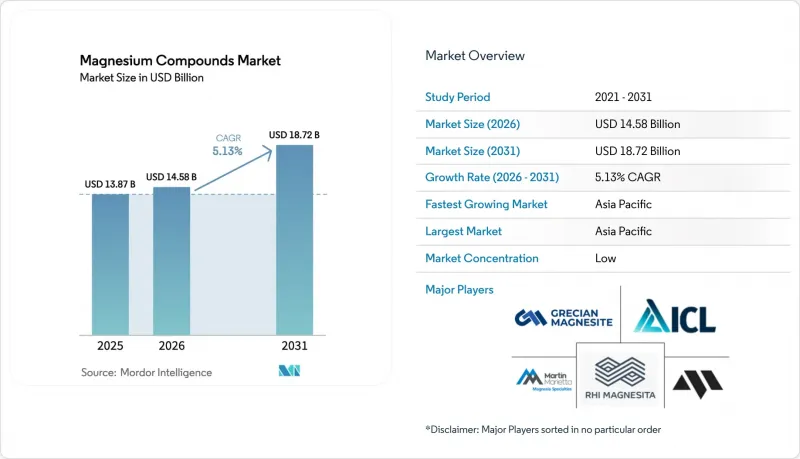
본 보고서는 원료별(해수, 천연 염수, 기타 원료), 제품 유형별(무기 화학제품 및 유기 화학제품), 최종 사용자 산업별(농업, 전기 및 전자, 자동차, 항공우주, 건설, 내화물, 기타 최종 사용자 산업), 그리고 지역별(아시아태평양, 북미, 유럽 등)로 분류되어 있습니다. 시장 전망은 금액(달러) 기준으로 제시되어 있습니다.
세계의 마그네슘 화합물 시장 동향 및 인사이트
세계 철강 생산 회복에 따른 내화물 수요 급증
2025년 초, 조강 생산량은 전년 대비 증가했습니다. 그러나 2024년에는 랴오닝성의 재고가 높은 수준을 유지한 것이 요인이 되어 내화물용 마그네시아 가격이 하락했습니다. 인도의 생산 능력 증설은 2024년에 승인되었으나, 통상 18-24개월의 시차를 거쳐 내화물 수주에 반영되기 시작할 것으로 예측됩니다. 세계 철강 생산의 대부분을 차지하는 전기 아크로(EAF)는 라이닝의 수명을 단축시키는 것으로 알려져 있으며, 그 결과 내화 벽돌의 교체 빈도가 높아집니다. RHI 마그네시아사는 유럽의 소비량이 정체된 반면, 아시아의 내화물 소비량은 증가 추세를 보이고 있다고 보고하고 있습니다. 마그네시아 벽돌은 EAF 가동 시 발생하는 격렬한 열충격을 견디기 위해 필수적이기 때문에 마그네슘 화합물 시장은 그 혜택을 볼 것으로 전망됩니다.
엄격한 폐수·배기가스 규제가 Mg계 환경용 시약 수요를 견인
2024년 4월, 미국 환경보호청(EPA)은 1차 마그네슘 제련업체에 이산화황 회수 규정을 의무화하고, 각 공장에 제품 회수 시스템으로도 기능하는 산화마그네슘 스크러버 도입을 의무화했습니다. 2025년에는 유럽이 도시 하수에 대한 인 배출 제한을 강화함에 따라, 슬러지 양을 줄일 수 있다는 장점 때문에 석회보다 수산화마그네슘의 사용이 권장되기 시작했습니다. 2025년, 이스라엘 케미컬스는 EU의 유틸리티체를 대상으로 한 수산화마그네슘 슬러리 판매 증가를 발표하며, 그 성공 요인으로 ISO 14001 인증을 획득한 제품을 꼽았습니다. 아시아에서도 유사한 정책이 도입되고 있는 만큼, 친환경 등급의 마그네슘 화합물이 프리미엄 가격을 확보하고 시장 점유율을 더욱 확대할 것이라는 기대가 높아지고 있습니다.
일부 최종 용도에서 가격에 민감한 Ca 또는 Al 화합물의 대체재
탄산칼슘은 경소성 마그네시아의 약 절반 수준의 비용으로, 난연성이 우선시되지 않는 경우 대표적인 충전제로 사용되고 있습니다. 2025년에는 오랜 기간에 걸친 인증 실적을 바탕으로 수산화알루미늄이 세계 난연제 시장에서 압도적인 점유율을 차지했습니다. 한편, 인도와 동남아시아의 건설 예산에서는 수처리용으로 수입된 수산화마그네슘보다 현지산 석회가 우선적으로 채택되는 경향이 있으나, 이에 대해서는 성능 측면에서의 상충 관계가 지적되고 있습니다. 이러한 경제적 선택으로 인해 기준선 연평균 성장률(CAGR)은 하향 조정될 것입니다.
부문별 분석
천연 염수는 2025년 생산량의 44.38%를 차지했으며, 사해에서의 운영을 기반으로 범용 마그네시아의 저비용 공급원으로 계속 자리 잡고 있습니다. 해수 유래 생산량은 현재 10%대 중반의 점유율에 그치고 있지만, 전해 비용의 하락과 ESG 감사에서 저탄소 발자국이 높이 평가됨에 따라 연평균 6.18%의 성장이 예상됩니다.
마그네슘 화합물 시장은 이러한 이중 구조의 혜택을 받고 있습니다. 대규모 염수 증발 설비를 교체하지 않고도 해수에서 고순도 제품을 조달할 수 있기 때문입니다. Magrathea Metals사의 파일럿 시험에서는 해수 운영 비용이 이미 그레이트 솔트 호수의 염수보다 낮은 것으로 나타났습니다. 연안 지역의 프로젝트가 규모를 확대하여 재현된다면, 범용 공급업체들은 잉여 염수 생산 능력을 내화물 등급으로 전환하는 한편, 해수 플랜트는 전자 및 제약 업계의 구매자들에게 공급하게 될 것입니다.
지역별 분석
아시아태평양은 2025년 시장 규모의 53.28%를 차지했으며, 랴오닝성의 생산 능력 동결에도 불구하고 2031년까지 5.94%의 성장이 예상됩니다. 인도의 신규 철강 프로젝트와 일본의 특수 등급 제품 수출이 중국의 건설 수요 둔화를 상쇄하고 있습니다.
그레이트 솔트 호수에서의 가동 중단 이후 북미에서는 공급이 부족해졌지만, 여전히 큰 시장 점유율을 유지하고 있습니다. 수입 관세가 부과되고 있음에도 불구하고, 구매자들은 중국산 이외공급에 대해 더 높은 가격을 지불하는 것을 마다하지 않습니다. 이러한 상황은 태평양 연안의 해수 마그네슘 사업의 번영으로 가는 길을 열어주고 있습니다.
유럽 시장 점유율은 주로 네덜란드의 네드마그(NedMag)사의 사업과 향후 가동 예정인 베르데 마그네슘(Verde Magnesium)사의 공장에 좌우될 것입니다. 향후 몇년내에 가동을 시작할 예정인 이 공장은 유럽의 수입 의존도를 낮출 것으로 전망됩니다. 한편, 브라질의 비료 수요와 걸프협력회의(GCC) 국가들의 염수 프로젝트에 힘입은 남미와 중동은 합쳐서 시장의 상당 부분을 차지하고 있습니다.
기타 혜택 :
- 엑셀 형식 시장 예측(ME) 시트
- 3개월간의 애널리스트 지원
자주 묻는 질문
목차
제1장 서론
제2장 조사 방법
제3장 개요
제4장 시장 구도
제5장 시장 규모 및 성장 예측
제6장 경쟁 구도
제7장 시장 기회 및 향후 전망
KTH 26.09.02According to Mordor Intelligence, the magnesium compounds market size is projected to expand from USD 13.87 billion in 2025 and USD 14.58 billion in 2026 to USD 18.72 billion by 2031, registering a CAGR of 5.13% between 2026 to 2031.
This report is Segmented by Source (Seawater, Natural Brines, and Other Sources), Product Type (Inorganic Chemicals and Organic Chemicals), End-User Industry (Agriculture, Electrical and Electronics, Automotive, Aerospace, Construction, Refractory, and Other End-User Industries), and Geography (Asia-Pacific, North America, Europe, and More). The Market Forecasts are Provided in Terms of Value (USD).
Global Magnesium Compounds Market Trends and Insights
Booming Refractory Demand from Reviving Global Steel Output
In early 2025, crude steel production saw a year-on-year increase. However, in 2024, prices for refractory-grade magnesia dipped, a decline attributed to persistently high inventories in Liaoning. While Indian capacity additions received approval in 2024, they are expected to start influencing refractory orders after the typical 18-to-24-month delay. Electric-arc furnaces, accounting for a significant portion of global steel output, are known to shorten lining life, consequently increasing the frequency of brick replacements. RHI Magnesita reported an uptick in Asian refractory consumption, contrasting with stagnant volumes in Europe. The magnesium compounds market stands to gain, as magnesia bricks are crucial for withstanding the heightened thermal shocks associated with EAF operations.
Stringent Wastewater and Flue-Gas Norms Spurring Mg-Based Environmental Reagents
In April 2024, the U.S. EPA mandated a sulfur-dioxide capture rule for primary magnesium refiners, compelling plants to adopt magnesium-oxide scrubbers that also function as product-recovery systems. In 2025, Europe imposed stricter phosphorus discharge limits on municipal wastewater, favoring magnesium hydroxide over lime due to its ability to reduce sludge volumes. In 2025, Israel Chemicals announced increased sales of magnesium hydroxide slurry to EU utilities, attributing the success to their ISO 14001-certified output. With similar policies emerging in Asia, there's a growing expectation that environmental-grade magnesium compounds will command premium prices and capture additional market volumes.
Price-Sensitive Substitution by Ca or Al Compounds in Several End-Uses
Calcium carbonate is about half the cost of light-burned magnesia and is the go-to filler when flame retardancy isn't a priority. In 2025, aluminum hydroxide commanded a dominant share of the global flame-retardant market, bolstered by longstanding certifications. While construction budgets in India and Southeast Asia lean towards locally sourced lime for water treatment, opting for it over imported magnesium hydroxide, there are noted performance trade-offs. These economic choices result in a deduction from the baseline CAGR.
Other drivers and restraints analyzed in the detailed report include:
- Soil-Magnesium Depletion Accelerating Fertilizer-Grade Mg Salts Usage
- Desalination-Brine Valorization Unlocking Ultra-Low-Cost Mg Feedstocks
- Supply-Chain Volatility Driven by China-Centric Production and Energy Costs
For complete list of drivers and restraints, kindly check the Table Of Contents.
Segment Analysis
Natural brines held 44.38% of the 2025 volume and remain the low-cost base for commodity magnesia, anchored by Dead Sea operations. Seawater-derived output, while a mid-teen share today, is set for 6.18% annual growth as electrolysis costs fall and ESG audits favor its lower carbon footprint.
The magnesium compounds market benefits from this dual structure because high-purity products can be sourced from seawater without displacing large-scale brine evaporation assets. Magrathea Metals showed that seawater operating costs already undercut Great Salt Lake brine in pilot runs. If coastal projects replicate at scale, commodity suppliers may pivot excess brine capacity toward refractory grades while seawater plants serve electronics and pharma buyers.
Complete Report Scope:
- By Source
- Seawater
- Natural Brines
- Other Sources
- By Product Type
- Inorganic Chemicals
- Organic Chemicals
- By End-User Industry
- Agriculture
- Electrical and Electronics
- Automotive
- Aerospace
- Construction
- Refractory
- Other End-User Industries
- By Geography
- Asia-Pacific
- China
- India
- Japan
- South Korea
- ASEAN
- Oceania
- Rest of Asia-Pacific
- North America
- United States
- Canada
- Mexico
- Europe
- Germany
- United Kingdom
- France
- Italy
- Russia
- Rest of Europe
- South America
- Brazil
- Argentina
- Rest of South America
- Middle-East and Africa
- Saudi Arabia
- South Africa
- Rest of Middle-East and Africa
- Asia-Pacific
Geography Analysis
Asia-Pacific supplied 53.28% of the 2025 value and should grow 5.94% to 2031 despite Liaoning's capacity freeze. India's new steel projects and Japan's specialty-grade exports offset slower Chinese construction.
After the shutdown at the Great Salt Lake, North America faced tighter supply but maintained a significant market share. Despite facing tariffs on imports, buyers are still willing to pay a premium for non-Chinese supplies. This scenario is paving the way for seawater ventures to flourish along the Pacific coast.
Europe's market share largely hinges on Nedmag's operations in the Netherlands and the upcoming Verde Magnesium plant. Set to launch in the coming years, this plant is poised to reduce Europe's import dependency. Meanwhile, South America and the Middle East, driven by Brazilian fertilizer needs and brine projects in the Gulf Cooperation Council (GCC), together account for a notable portion of the market.
- Alliance Chemical
- Baymag Inc.
- Dashiqiao Huamei Group Co., Ltd.
- Grecian Magnesite
- Haicheng Huayu Group
- Imerys
- Israel Chemicals Ltd. (ICL)
- KUMAS Manyezit
- Liaoning Jinding Magnesite Group (JDMG)
- Magnezit Group
- Martin Marietta Magnesia Specialties
- Nedmag B.V.
- Premier Magnesia, LLC
- RHI Magnesita
- Tateho Chemical Industries Co.,Ltd
- TIMAB Magnesium (Roullier Group)
- Ube Material Industries
- US Magnesium LLC
Additional Benefits:
- The market estimate (ME) sheet in Excel format
- 3 months of analyst support
TABLE OF CONTENTS
1 Introduction
- 1.1 Study Assumptions and Market Definition
- 1.2 Scope of the Study
2 Research Methodology
3 Executive Summary
4 Market Landscape
- 4.1 Market Overview
- 4.2 Market Drivers
- 4.2.1 Booming refractory demand from reviving global steel output
- 4.2.2 Stringent wastewater and flue-gas norms spurring Mg-based environmental reagents
- 4.2.3 Soil-magnesium depletion accelerating fertilizer-grade Mg salts usage
- 4.2.4 Desalination-brine valorisation unlocking ultra-low-cost Mg feedstocks
- 4.2.5 Rapid adoption of low-carbon magnesium-phosphate cements in construction
- 4.3 Market Restraints
- 4.3.1 Price-sensitive substitution by Ca/Al compounds in several end-uses
- 4.3.2 Supply-chain volatility driven by China-centric production and energy costs
- 4.3.3 ESG scrutiny of Pidgeon-route carbon footprint curbing new capacity
- 4.4 Value Chain Analysis
- 4.5 Porter's Five Forces
- 4.5.1 Bargaining Power of Suppliers
- 4.5.2 Bargaining Power of Consumers
- 4.5.3 Threat of New Entrants
- 4.5.4 Threat of Substitute Products and Services
- 4.5.5 Degree of Competition
5 Market Size and Growth Forecasts(Value)
- 5.1 By Source
- 5.1.1 Seawater
- 5.1.2 Natural Brines
- 5.1.3 Other Sources
- 5.2 By Product Type
- 5.2.1 Inorganic Chemicals
- 5.2.2 Organic Chemicals
- 5.3 By End-User Industry
- 5.3.1 Agriculture
- 5.3.2 Electrical and Electronics
- 5.3.3 Automotive
- 5.3.4 Aerospace
- 5.3.5 Construction
- 5.3.6 Refractory
- 5.3.7 Other End-User Industries
- 5.4 By Geography
- 5.4.1 Asia-Pacific
- 5.4.1.1 China
- 5.4.1.2 India
- 5.4.1.3 Japan
- 5.4.1.4 South Korea
- 5.4.1.5 ASEAN
- 5.4.1.6 Oceania
- 5.4.1.7 Rest of Asia-Pacific
- 5.4.2 North America
- 5.4.2.1 United States
- 5.4.2.2 Canada
- 5.4.2.3 Mexico
- 5.4.3 Europe
- 5.4.3.1 Germany
- 5.4.3.2 United Kingdom
- 5.4.3.3 France
- 5.4.3.4 Italy
- 5.4.3.5 Russia
- 5.4.3.6 Rest of Europe
- 5.4.4 South America
- 5.4.4.1 Brazil
- 5.4.4.2 Argentina
- 5.4.4.3 Rest of South America
- 5.4.5 Middle-East and Africa
- 5.4.5.1 Saudi Arabia
- 5.4.5.2 South Africa
- 5.4.5.3 Rest of Middle-East and Africa
- 5.4.1 Asia-Pacific
6 Competitive Landscape
- 6.1 Market Concentration
- 6.2 Strategic Moves
- 6.3 Market Share/Ranking Analysis
- 6.4 Company Profiles {(includes Global-level Overview, Market-level overview, Core Segments, Financials, Strategic Information, Products and Services, Recent Developments)}
- 6.4.1 Alliance Chemical
- 6.4.2 Baymag Inc.
- 6.4.3 Dashiqiao Huamei Group Co., Ltd.
- 6.4.4 Grecian Magnesite
- 6.4.5 Haicheng Huayu Group
- 6.4.6 Imerys
- 6.4.7 Israel Chemicals Ltd. (ICL)
- 6.4.8 KUMAS Manyezit
- 6.4.9 Liaoning Jinding Magnesite Group (JDMG)
- 6.4.10 Magnezit Group
- 6.4.11 Martin Marietta Magnesia Specialties
- 6.4.12 Nedmag B.V.
- 6.4.13 Premier Magnesia, LLC
- 6.4.14 RHI Magnesita
- 6.4.15 Tateho Chemical Industries Co.,Ltd
- 6.4.16 TIMAB Magnesium (Roullier Group)
- 6.4.17 Ube Material Industries
- 6.4.18 US Magnesium LLC
7 Market Opportunities and Future Outlook
- 7.1 White-space and Unmet-Need Assessment