

|
시장보고서
상품코드
2119603
바이오닉 아이 시장 : 점유율 분석, 업계 동향과 통계, 성장 예측(2026-2031년)Bionic Eyes - Market Share Analysis, Industry Trends & Statistics, Growth Forecasts (2026 - 2031) |
||||||
 Mordor Intelligence
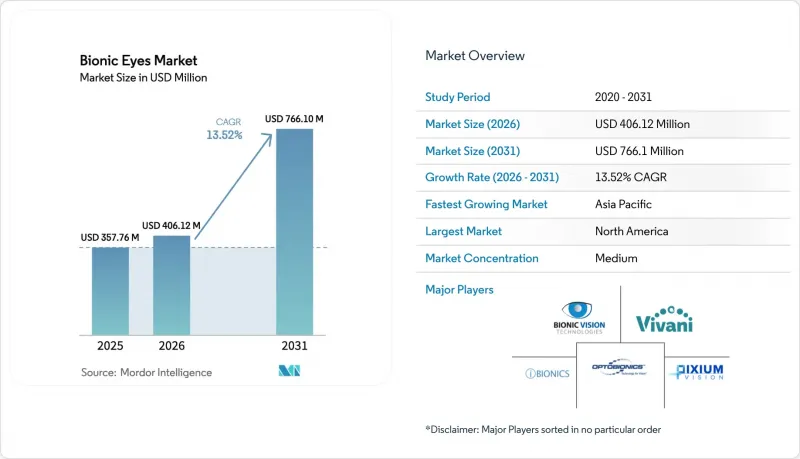
Mordor Intelligence에 의하면, 2026년 바이오닉 아이 시장 규모는 4억 612만 달러로 추정되고 있어 2025년 3억 5,776만 달러에서 확대해, 2031년에는 7억 6,610만 달러에 이를 것으로 예측됩니다.
2026년부터 2031년까지 연평균 성장률(CAGR) 13.52%로 성장할 것으로 전망됩니다.
본 보고서는 기술별(망막 보철물, 시신경 보철물 등), 기기 삽입 방식별(체외 착용형 시스템, 완전 이식형 시스템), 최종 사용자(병원·안과 의료 체인, 안과 클리닉 등),구성 부품(마이크로전자 어레이·센서 등), 지역(북미, 유럽 등)별로 분류되어 있습니다. 시장 예측은 금액(미 달러) 기준으로 제시되어 있습니다.
전 세계 바이오닉 아이 시장 동향 및 인사이트
고령화와 망막 퇴행성 질환의 유병률
세계 평균 수명의 연장에 따라 망막 질환 발생률이 정점에 달하는 연령대에 진입하는 인구가 증가하고 있습니다. 노인성 황반변성은 이미 2억 명 이상에게 영향을 미치고 있으며, 50세 이후에는 10년마다 유병률이 2배로 증가합니다. 또한, 전 세계적으로 약 4,000명 중 1명의 비율로 발병하는 색소성 망막염도 수요를 더욱 끌어올리고 있습니다. 호주의 2세대 바이오닉 아이에 대한 장기 추적 조사에서는 2.5년 동안 전극의 기능성이 97%를 유지한 것으로 나타나, 고령 이식 환자의 내구성이 확인되었습니다. 선진국의 의료 시스템은 수술 인프라와 만성 질환 관리 체계를 갖추고 있어 조기 도입을 흡수하고 있지만, 고령화는 전 세계적인 현상이며, 신흥 시장에서도 의료 체계가 정비됨에 따라 지속적인 수요가 예상됩니다. 따라서 인구 동향의 추세가 2030년을 훨씬 넘어 두 자릿수 성장을 뒷받침하게 될 것입니다.
마이크로전자공학 및 생체 재료의 발전
반도체의 미세화와 유연하며 내식성이 뛰어난 기판의 등장으로, 조직에 가해지는 부담을 최소화하면서 채널 수를 늘릴 수 있는 뉴런 규모의 임플란트가 가능해졌습니다. 텔루르 나노와이어를 이용한 망막 어레이는 외부 전원이 필요 없이 가시광선 및 근적외선을 직접 전류로 변환하여, 이 분야를 자가 발전형 시각 칩의 실현에 한 걸음 더 가까이 다가서게 하고 있습니다. 스웨덴 연구진은 안구 조직 내의 굴곡을 견딜 수 있는 탄성 고분자 위에 40µm 크기의 전극을 형성하여 만성 염증의 위험을 줄였습니다. 이와 병행하여 진행되고 있는 PDMS를 이용한 기밀 코팅 연구에서는 생리액 속에서 10년에 걸친 임플란트의 수명이 예상되고 있습니다. 이러한 발전들이 합쳐져 실현 가능한 해상도가 향상되고, 신뢰성이 높아지며, 재수술 횟수가 감소함에 따라 보험사의 수용이 가속화될 것입니다.
고액의 수술비 및 장비비, 제한된 보험 보상
환자 1인당 총 비용은 하드웨어, 뇌신경외과 수술, 재활을 포함해 11만 5,000달러에서 50만 달러에 달하며, 고액 의료 보험에 가입하지 않은 환자에게는 경제적 부담이 큰 과제가 되고 있습니다. 유럽의 비용 대비 효과 평가에 따르면, QALY(질 조정 생존년)당 5만 3,165유로를 초과하는 비율이 나타났으며, 이는 많은 보험사의 기준치를 상회하고 있습니다. 생산량이 적어 규모의 경제를 달성하기 어려운 반면, 기밀 포장 및 고품질 생체 재료의 사용으로 인해 기존 임플란트에 비해 부품 원가가 높습니다. 보험 환급은 여전히 불균일하며, 메디케어(미국 공적 의료보험)의 적용 범위는 제한적이고, 많은 민간 보험 플랜에서 이 기기를 ‘실험적’으로 간주하고 있어, 환자들은 본인 부담금을 지불하거나 임상시험에 참여할 수밖에 없는 상황입니다. 이러한 경제적 장벽으로 인해 신흥국 시장에서의 보급이 지연되고 있으며, 제조업체의 손익분기점 달성도 늦어지고 있습니다.
부문 분석
망막 보철과 관련된 바이오닉 아이 시장 규모는 2025년에 1억 8,115만 달러에 달하여 시장 점유율의 50.62%를 차지했습니다. 이는 수십 년에 걸친 반복적인 개선과 보다 명확한 보험 환급 경로가 반영된 결과입니다. 피질 시각 보철은 아직 발전 단계에 있지만, 2031년까지 연평균 성장률(CAGR)은 14.33%를 나타낼 것으로 예측됩니다. 이는 신경 칩이 손상된 망막이나 시신경의 구조를 우회함으로써, 시신경 외상을 포함한 중증 실명 환자에 대한 적용 범위를 넓히고 있기 때문입니다. 초기 대뇌 피질 시각 보철물의 임상시험에서는 저해상도 시력에 근접할 정도의 이동 능력 향상과 문자 인식 정확도 향상이 보고되어, 이 기술의 보다 광범위한 도입이 뒷받침되고 있습니다. 이에 따라 투자 동향도 변화하고 있으며, Neuralink와 학술 컨소시엄이 수백만 달러 규모의 보조금 및 사모 자금을 확보하고 있습니다.
경쟁 구도는 갈라지고 있습니다. 망막 분야의 기존 기업들은 화소 밀도 향상이나 더 얇은 망막하 필름 개발을 추구하는 반면, 대뇌 피질 분야의 선구자들은 안전한 경막 관통형 전극 매트와 머신러닝 디코더에 주력하고 있습니다. 대뇌 피질 시스템은 수술의 복잡성이 높고, 더 높은 해상도와 더 광범위한 환자층을 기대할 수 있기 때문에 개발 기간이 길음에도 불구하고 투자자들을 끌어모으고 있습니다. 채널 수의 확대와 장기적인 안전성 확보에 성공할 수 있는지 여부가 2035년까지 바이오닉 아이 시장에서 피질형 플랫폼이 망막형 솔루션을 추월할지 여부를 결정지을 것입니다.
2025년에는 카메라가 장착된 안경과 이식형 자극 장치를 결합한 외부 착용형 시스템이 바이오닉 아이 시장의 64.60%를 차지했으나, 사회적 수용성의 제약과 유지보수의 필요성으로 인해 성장이 정체되고 있습니다. 반면, 완전 이식형 시스템은 무선 원격 측정, 광에너지 회수 기술 및 소형 배터리 기술이 성숙해짐에 따라 연평균 성장률(CAGR) 14.28%로 성장을 지속하고, 있습니다. 레이저 구동 다이아몬드 임플란트는 현재 55%의 광전 변환 효율을 달성하여, 안구 내에서 자체 발전으로 작동이 가능해짐에 따라 외부 전원 팩이 더 이상 필요하지 않게 되었습니다.
사용자 피드백에 따르면, 자율성과 심미적인 자연스러움이 도입의 주요 기준으로 중요시되고 있습니다. 마찬가지로, 수술팀도 경피 리드를 배제함으로써 감염 위험을 줄여주는 밀폐형 유닛을 선호하고 있습니다. 상업적 로드맵에서는 유도 충전 코일, 초박형 아연-공기 전지, 생체 적합성 캡슐화 소재가 우선순위로 꼽히고 있으며, 이를 통해 바이오닉 아이 시장에서 금세기 말까지 완전 이식형 모델의 매출 점유율이 확대될 것으로 전망됩니다.
지역별 분석
북미는 FDA의 브레이크스루 패스웨이(Breakthrough Pathway), 메디케어 코딩, 그리고 안과 센터의 밀집된 네트워크에 힘입어 2025년 매출의 41.72%를 차지했습니다. 1억 달러가 넘는 ARPA-H의 자금 지원이 전안구 이식 컨소시엄을 뒷받침하며, 이 지역의 리더십을 강화하고 있습니다. 공적 보험은 특정 망막 기기를 보장하여 환자의 본인 부담금을 경감하고 있습니다. 공급업체, 외과 레지던트, 벤처 투자자로 구성된 생태계는 바이오닉 아이 시장에서 임상시험 피험자 모집 및 제품 출시를 가속화하는 자기 강화형 혁신 허브를 형성하고 있습니다.
아시아태평양은 인구 고령화의 가속화와 정부 주도의 의료기기 개혁에 힘입어 2031년까지 연평균 성장률(CAGR) 14.67%로 가장 빠르게 성장하는 지역입니다. 일본과 한국은 선진적인 임상 프로그램을 제공하는 반면, 중국과 인도는 방대한 환자층과 확대되는 보험 적용 시범 사업을 가져오고 있습니다. 호주에서 진행된 2세대 임플란트 임상시험에서는 2.5년 동안 전극 활성도가 97%를 유지하여 이 지역의 연구 깊이를 보여주고 있습니다. 안과 의사의 불균형한 분포는 여전히 장벽으로 남아 있지만, 원격 연수 및 의료 관광을 통한 노력으로 접근성은 점차 확대되고 있습니다.
유럽에서는 HTA(의료기술평가) 기관이 엄격한 비용 대비 효과를 요구하고 있기 때문에 시장은 성숙해 있지만 선별적인 점유율에 그치고 있습니다. Pixium사의 PRIMAvera와 같이 CE 마크를 획득한 플랫폼은 건성 황반변성(AMD)을 대상으로 하며, 통합된 데이터 레지스트리를 활용하여 시간 경과에 따른 치료 성과를 추적하고 있습니다. 높은 안전 기준으로 인해 승인 주기는 길어지고 있지만, 기준을 충족한 의료기기는 승인 후 강력한 보험 환급 지원을 받을 수 있습니다. 라틴아메리카, 중동 및 아프리카에서는 시장이 아직 발전 단계에 있지만, 지역 기술 단지와 국경을 초월한 백내장 수술 네트워크가 향후 10년 후반에는 바이오닉 아이 센터로 전환될 가능성이 있습니다.
기타 혜택:
- 엑셀 형식 시장 예측(ME) 시트
- 3개월간의 애널리스트 지원
자주 묻는 질문
목차
제1장 서론
제2장 조사 방법
제3장 개요
제4장 시장 구도
제5장 시장 규모와 성장 예측
제6장 경쟁 구도
제7장 시장 기회와 향후 전망
JHS 26.09.03According to Mordor Intelligence, the bionic eyes market size in 2026 is estimated at USD 406.12 million, growing from 2025 value of USD 357.76 million with 2031 projections showing USD 766.1 million, growing at 13.52% CAGR over 2026-2031.
This report is Segmented by Technology (Retinal Prosthesis, Optic-Nerve Prosthesis, and More), Device Placement (External Wearable Systems, Fully Implantable Systems), End-User (Hospitals & Eye-Care Chains, Ophthalmology Clinics, and More), Component (Micro-Electronic Array & Sensors, and More), and Geography (North America, Europe, and More). The Market Forecasts are Provided in Terms of Value (USD).
Global Bionic Eyes Market Trends and Insights
Aging Population & Retinal-Degeneration Prevalence
Global life expectancy gains mean more individuals enter age cohorts where retinal pathologies peak. Age-related macular degeneration already affects over 200 million people, and prevalence doubles each decade after 50 years. Retinitis pigmentosa adds further demand at roughly 1 in 4,000 incidence worldwide. Long-term follow-up from Australia's second-generation bionic eye showed 97% electrode functionality over 2.5 years, confirming durability for older recipients. Developed health systems possess surgical infrastructure and chronic-care pathways, so they absorb early adoption, yet aging is universal, ensuring sustained demand even in emerging markets as capacity builds. Demographic momentum thus anchors double-digit expansion well beyond 2030.
Advances in Micro-Electronics & Bio-Materials
Miniaturized semiconductors and flexible, corrosion-resistant substrates now allow neuron-scale implants that minimize tissue trauma while boosting channel count. Tellurium nanowire retinal arrays convert visible and near-infrared light directly into current without external packs, moving the field closer to self-powered vision chips. Swedish researchers fabricated 40-µm electrodes on elastic polymers that withstand bending inside ocular tissue, cutting chronic inflammation risk. Parallel work on PDMS hermetic coating projects decade-long implant survival in physiological fluid. Combined, these advances raise achievable resolution, boost reliability, and lower revision surgeries, accelerating payer acceptance.
High Surgical & Device Cost; Limited Reimbursement
Total outlays run from USD 115,000 to USD 500,000 per patient, covering hardware, neurosurgery, and rehabilitation, challenging affordability outside premium insurance pools. European cost-utility reviews show ratios beyond EUR 53,165 per QALY, exceeding many payer thresholds. Low production volumes limit scale efficiencies, while hermetic packaging and high-grade biomaterials raise bill-of-materials versus conventional implants. Reimbursement remains patchy; Medicare covers a limited set, and many private plans tag devices experimental, forcing patients to self-fund or enroll in trials. These financial frictions slow uptake in emerging economies and delay break-even for manufacturers.
Other drivers and restraints analyzed in the detailed report include:
- Increasing Neuro-Prosthetic R&D Funding
- Favorable Regulatory Fast-Track Designations
- Post-Surgical Risks & Explantation Rates
For complete list of drivers and restraints, kindly check the Table Of Contents.
Segment Analysis
The bionic eyes market size linked to retinal prostheses totaled USD 181.15 million in 2025, equal to 50.62% share, reflecting decades of iterative refinement and clearer reimbursement pathways. Cortical visual prostheses, while nascent, post a 14.33% CAGR through 2031 as neural chips bypass damaged retinal and optic-nerve structures, widening eligibility to profound blindness including optic-nerve trauma. Early cortical trials report navigation improvements and letter recognition accuracy that approach low-resolution vision, validating the technology for broader deployment. Investment is shifting accordingly, with Neuralink and academic consortia capturing multi-million-dollar grants and private placements.
The competitive profile diverges: retinal incumbents pursue pixel-density upgrades and slimmer sub-retinal films, whereas cortical pioneers focus on safe trans-dural electrode mats and machine-learning decoders. Cortical systems carry higher surgical complexity but promise higher ceiling resolution and larger addressable populations, enticing investors despite longer timelines. Success in scaling channel counts and securing chronic safety will determine if cortical platforms overtake retinal solutions before 2035 in the bionic eyes market.
External wearable systems contributed 64.60% of the bionic eyes market share in 2025 thanks to camera-mounted glasses paired with implanted stimulators, but growth plateaus under social-acceptance constraints and maintenance demands. Fully implantable configurations are registering 14.28% CAGR as wireless telemetry, photonic power scavenging, and miniature batteries mature. Laser-driven diamond implants now achieve 55% photovoltaic conversion, demonstrating self-powered operation inside the eye and removing external packs.
User feedback underscores autonomy and cosmetic neutrality as key adoption criteria. Surgical teams likewise prefer sealed units that reduce infection risk by eliminating percutaneous leads. Commercial roadmaps prioritize inductive charging coils, ultrathin zinc-air batteries, and biocompatible encapsulants, indicating that fully implantable models will command rising revenue share by the end of the decade in the bionic eyes market.
Complete Report Scope:
- By Technology
- Retinal Prosthesis
- Optic-Nerve Prosthesis
- Cortical Visual Prosthesis
- Others (Photovoltaic, Magnetoelectric)
- By Device Placement
- External Wearable Systems
- Fully Implantable Systems
- By End-User
- Hospitals & Eye-Care Chains
- Ophthalmology Clinics
- Academic & Research Institutes
- By Component
- Micro-electronic Array & Sensors
- Power & Telemetry Modules
- Software & Firmware
- By Geography
- North America
- United States
- Canada
- Mexico
- Europe
- Germany
- United Kingdom
- France
- Italy
- Spain
- Rest of Europe
- Asia-Pacific
- China
- India
- Japan
- South Korea
- Australia
- Rest of Asia-Pacific
- South America
- Brazil
- Argentina
- Rest of South America
- Middle East and Africa
- GCC
- South Africa
- Rest of Middle East and Africa
- North America
Geography Analysis
North America held 41.72% of 2025 revenue, supported by FDA breakthrough pathways, Medicare coding, and dense clusters of ophthalmic centers. ARPA-H funding exceeding USD 100 million underwrites whole-eye transplant consortia, reinforcing regional leadership. Public insurers cover select retinal devices, lowering out-of-pocket burdens. The ecosystem of suppliers, surgical fellows, and venture investors forms a self-reinforcing innovation hub that accelerates trial enrollment and product launch within the bionic eyes market.
Asia-Pacific is the fastest-growing area at 14.67% CAGR through 2031, driven by accelerating demographic aging and government-backed medical-device reforms. Japan and South Korea contribute advanced clinical programs, whereas China and India supply vast patient pools and expanding reimbursement pilots. Australia's second-generation implant trial, maintaining 97% electrode activity over 2.5 years, signals regional research depth. Unequal ophthalmologist distribution remains a barrier, yet tele-training and surgical-tourism initiatives are widening access.
Europe captures a mature but selective share as HTA agencies demand strict cost efficacy. CE-marked platforms such as Pixium's PRIMAvera target dry AMD and leverage centralized data registries to track longitudinal outcomes. While high safety standards prolong approval cycles, successful devices gain strong reimbursement backing once thresholds are met. Latin America, Middle East, and Africa remain nascent; however, regional technology parks and cross-border cataract surgery networks may transition into bionic eye centers later in the decade.
- Vivani Medical Inc.
- Pixium Vision SA
- Bionic Vision Technologies Pty Ltd
- Nano Retina Ltd
- iBionics Inc.
- Samsara Vision Inc.
- Mojo Vision Inc.
- Ocumetics Technology Corp.
- Innovega
- Blackrock Neurotech LLC
- Cortigent Inc.
- IntelliMicro Medical Co., Ltd.
- Boston Retinal Implant Project
- Monash Vision Group
- Sigenics Inc.
- Second Sight Medical Products
- Optobionics Corporation
Additional Benefits:
- The market estimate (ME) sheet in Excel format
- 3 months of analyst support
TABLE OF CONTENTS
1 Introduction
- 1.1 Study Assumptions & Market Definition
- 1.2 Scope of the Study
2 Research Methodology
3 Executive Summary
4 Market Landscape
- 4.1 Market Overview
- 4.2 Market Drivers
- 4.2.1 Aging population & retinal-degeneration prevalence
- 4.2.2 Advances in micro-electronics & bio-materials
- 4.2.3 Increasing neuro-prosthetic R&D funding
- 4.2.4 Favorable regulatory fast-track designations
- 4.2.5 Closed-loop adaptive-stimulation algorithms
- 4.2.6 AR/VR optic know-how leveraged in implants
- 4.3 Market Restraints
- 4.3.1 High surgical & device cost; limited reimbursement
- 4.3.2 Post-surgical risks & explantation rates
- 4.3.3 Algorithmic latency-induced cyber-sickness
- 4.3.4 Scarcity of ultra-miniature hermetic-package supply
- 4.4 Value / Supply-Chain Analysis
- 4.5 Regulatory Landscape
- 4.6 Technological Outlook
- 4.7 Porter's Five Forces
- 4.7.1 Threat of New Entrants
- 4.7.2 Threat of Substitutes
- 4.7.3 Bargaining Power of Suppliers
- 4.7.4 Bargaining Power of Buyers
- 4.7.5 Competitive Rivalry
5 Market Size & Growth Forecasts (Value, USD)
- 5.1 By Technology
- 5.1.1 Retinal Prosthesis
- 5.1.2 Optic-Nerve Prosthesis
- 5.1.3 Cortical Visual Prosthesis
- 5.1.4 Others (Photovoltaic, Magnetoelectric)
- 5.2 By Device Placement
- 5.2.1 External Wearable Systems
- 5.2.2 Fully Implantable Systems
- 5.3 By End-User
- 5.3.1 Hospitals & Eye-Care Chains
- 5.3.2 Ophthalmology Clinics
- 5.3.3 Academic & Research Institutes
- 5.4 By Component
- 5.4.1 Micro-electronic Array & Sensors
- 5.4.2 Power & Telemetry Modules
- 5.4.3 Software & Firmware
- 5.5 By Geography
- 5.5.1 North America
- 5.5.1.1 United States
- 5.5.1.2 Canada
- 5.5.1.3 Mexico
- 5.5.2 Europe
- 5.5.2.1 Germany
- 5.5.2.2 United Kingdom
- 5.5.2.3 France
- 5.5.2.4 Italy
- 5.5.2.5 Spain
- 5.5.2.6 Rest of Europe
- 5.5.3 Asia-Pacific
- 5.5.3.1 China
- 5.5.3.2 India
- 5.5.3.3 Japan
- 5.5.3.4 South Korea
- 5.5.3.5 Australia
- 5.5.3.6 Rest of Asia-Pacific
- 5.5.4 South America
- 5.5.4.1 Brazil
- 5.5.4.2 Argentina
- 5.5.4.3 Rest of South America
- 5.5.5 Middle East and Africa
- 5.5.5.1 GCC
- 5.5.5.2 South Africa
- 5.5.5.3 Rest of Middle East and Africa
- 5.5.1 North America
6 Competitive Landscape
- 6.1 Market Concentration
- 6.2 Market Share Analysis
- 6.3 Company Profiles (includes Global level Overview, Market level overview, Core Segments, Financials as available, Strategic Information, Market Rank/Share for key companies, Products & Services, and Recent Developments)
- 6.3.1 Vivani Medical Inc.
- 6.3.2 Pixium Vision SA
- 6.3.3 Bionic Vision Technologies Pty Ltd
- 6.3.4 Nano Retina Ltd
- 6.3.5 iBionics Inc.
- 6.3.6 Samsara Vision Inc.
- 6.3.7 Mojo Vision Inc.
- 6.3.8 Ocumetics Technology Corp.
- 6.3.9 Innovega Inc.
- 6.3.10 Blackrock Neurotech LLC
- 6.3.11 Cortigent Inc.
- 6.3.12 IntelliMicro Medical Co., Ltd.
- 6.3.13 Boston Retinal Implant Project
- 6.3.14 Monash Vision Group
- 6.3.15 Sigenics Inc.
- 6.3.16 Second Sight Medical Products Inc.
- 6.3.17 Optobionics Corporation
7 Market Opportunities & Future Outlook
- 7.1 White-space & Unmet-Need Assessment


